© 2016, IRJET | Impact Factor value: 4.45 | ISO 9001:2008 Certified Journal | Page 1155
Survey of Communication System for DG’s and Microgrid in
Electrical Power Grid
Mr. Prakash D. Chavan
1, Prof. Rajan J. Devi
21
Department of Electronics Engineering, K.B.P. College of Engineering, Satara, Maharashtra, India
2
Professor, Department of Electronics Engineering, K.B.P. College of Engineering, Satara, Maharashtra, India
Abstract— Different distributed generation (DG) units form a Microgrid in electrical power grid. Microgrid contains two or more distributed generation unit such as wind power, photovoltaic cell, solar panel, fuel cell etc. Each DG unit converts physical quantity (wind, solar, fuel cell etc.) into electrical power. The role of inverter, in DG, is to convert DC Power into 3 phase power and supplied to power grid to cater load demand. For this purpose DG’s are need to work in synchronization. Each DG has to communicate the status of frequency, phase and voltage with other DG’s working in Microgrid to maintain synchronization with the power grid. A communication between DG’s may be wired or wireless. A communications system is the key component of the Microgrid infrastructure. Different communications technologies are supported by wired and wireless communications media. The DG acquires information about synchronization parameters using a wireless or wired network (such as a WiFi, ZigBee, and/or cellular communication network, PLC, Ethernet etc.). The information contains phase voltage, phase current, frequency and phase angle between DG’s output voltage and grid voltage. This paper presents different communication technologies suitable for inverter based DG’s and Microgrid to access and control data from/to each DG as a node. The main objective of this paper is to survey the communication channels and protocols suitable for Microgrid in electrical power grid.
Index Terms
-
Microgrid, DG node, wireless network, communication channelI.
INTRODUCTION
Renewable energy sources such as wind, solar, fuel cell etc. are forming distributed generation sources in a Microgrid. Microgrid interconnects a group of DG units and loads at a distribution voltage level in a local area such as homes or a residential community. An important task of Microgrid is to share the load demand using multiple Distributed Generation (DG) units.
Microgrid needs resynchronization for smooth reconnection to utility, which means that a Microgrid not only can disconnect from the utility when grid fault is detected, but also reconnect to the utility when the fault is cleared. This transition should not cause negative effects on the utility and critical loads. So the control strategy is used for the parallel operation of inverters in a Microgrid. The power sharing according to the capacity of individual
DG can be achieved through communication network, so the communication is the key part of the Microgrid [1-2].
Communication network will help us to measure and monitor different parameters such as current, voltage, phase, frequency, power etc. at DG node. Basically power is the product of voltage and current. When voltage and current are not in phase, there are two components, real or active power and reactive power. DGs in Microgrid share the power to connected load as active power and reactive power. Normally DGs connected in Microgrid are sufficient to cater the load in Microgrid. Temporary excess loads or any short fall can be supplied by main grid. When more than two DGs are in Microgrid sharing of active and reactive power is an important issue. The communication network can play important role to control power flow from Microgrid to main grid and vice versa [3].
To control and monitor various parameters like voltage, current, frequency etc. of multiple DGs in Microgrid needs a communication channel. Communication channels are either wired or wireless. Out of that wireless network uses IEEE 802.15.4 standard for communication purpose. Hence implementation of network for communication between DGs and Microgrid in grid system will help us to measure and control power flow in a grid system [4]. In this paper, survey of communication channels and protocols suitable for Microgrid is presented.
This paper is organized as follows; section II describes the Microgrid architecture. Section III descries role of communication in Microgrid. Methods and technology available for Microgrid system is presented in section IV. The communication standards are studied in section V. Finally this paper is concluded in section VI.
II.
MICROGRID ARCHITECTURE
VOLUME: 03 ISSUE: 07 | JULY-2016 WWW.IRJET.NET P-ISSN: 2395-0072
© 2016, IRJET | Impact Factor value: 4.45 | ISO 9001:2008 Certified Journal | Page 1156 generated is stepped up to a higher voltage at which it
connects to the transmission network. The term grid usually refers to a network. Grid may also be used to refer to an entire continent's electrical network, a regional transmission network or may be used to describe a sub network such as a local utility's transmission grid or distribution grid [4] [5]. The electricity generation, transmission, distribution and control networks make up the electrical grid. Smaller grids have a radial structure with supply lines branching out from a large centralised electricity supplier.
A Microgrid is defined as an aggregator of several micro generation units, storage devices and loads operating as a single system that provides electricity. Microgrid is a concept that combines distributed generation sources, including distributed energy resources (DER) and distribution storage. Microgrid operates in an islanded mode or grid connected mode. The term synchronization means a connection of Microgrid with main grid. The synchronization of generator with grid by traditional synchronizer is easy. The synchronization of Microgrid with main grid is very difficult because Microgrid operates with multiple DG’s that produced electrical power together and critical loads that’s cannot be controllable by traditional synchronizer. To overcome this problem it is needed to control multiple generators and energy storage system in coordinated way for the Microgid synchronization. Generator generates electrical power having some parameters such as voltage, current, frequency etc. and the importance of these parameters is to produce active and reactive power depends on phase between voltage and current. To manage DG’s parameters (Voltage, current, frequency etc.) a network of communication system need to be implemented in Microgrid with necessary communication protocols [6].
Figure1 Microgrid Architecture
The architecture of communication network can be centralized or hierarchical. Figure 1 shows the basic architecture of Microgrid. Microgrid may range in size from a tiny residential load to small city. The Microgrid is small scale flexible reliable source of electricity and can operate in grid-connected or stand-alone mode. Two methods are used in Microgrid to manage the power of a Microgrid: the centralized operation that concentrates information in node and decentralized operation which uses local information and provides more autonomy to the DER units [7]. While smart grid is a modernized electrical grid that uses information and communications technology together and act on information, such as information about the behaviours of suppliers and consumers, in an automated fashion to improve the efficiency, reliability, economics, and sustainability of the production and distribution of electricity [8] . A system containing different DG’s & loads in Microgrid is presented in Figure 1. Each DG will generate its own electrical energy; and supplies active and reactive power for sharing the power at specified voltage and phase. It is necessary to get status of other DG’s working in grid through communication channel [9][10]. Next section describes the role of communication in Microgrid to improve the reliability in power grid.
III.
ROLE OF COMMUNICATION IN
MICROGRID
As mentioned in section I, there are two communication technics available in Microgrid, one is wired and second one is wireless. In Microgrid system, DG’s are connected to different load (homes, residential area etc.) and main power grid through distribution network. It is necessary to know the information about current, voltage, phase, power etc. at each DG unit to main control unit through proper communication channel. So it is very easy to monitor and control all the parameters on main central control unit; hence the role of communication in Microgrid is more important. [11].
VOLUME: 03 ISSUE: 07 | JULY-2016 WWW.IRJET.NET P-ISSN: 2395-0072
© 2016, IRJET | Impact Factor value: 4.45 | ISO 9001:2008 Certified Journal | Page 1157 Therefore, for safe operation in Microgrid and to
maintain power system stability, we need advanced control techniques combined with effective communication techniques. The information such as voltage, current, phase etc. and communication technology (wired or wireless) infrastructure in a Microgrid needs to be reliable, highly available, secure and easy to manage.
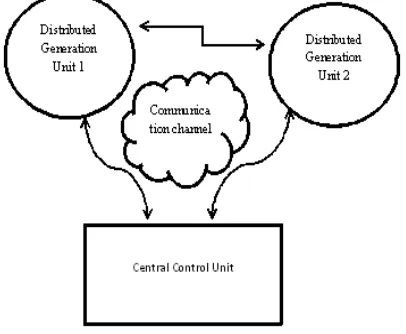
Figure 2 shows communication in Microgrid, the communication infrastructure of the Microgrid should provide continuous connection with all units in the Microgrid. In central control scheme a central controller must interact with all units to manage the Microgrid [12]. A local data concentrator is commonly used to collect data from several groups of node and send the data to the central controller through communication channel. The selection of a communication technology and network topology is not limited in Microgrid. Numerous technologies or channels for communication can be considered in Microgrid [13]. To achieve a safe and stable operation in Microgrid needs a good communication technology. Next section describes details about communication methods and technologies available for Microgrid. This is helpful to understand different communication channels suitable for communication in Microgrid, according to spectrum, data rate, coverage range etc.
Figure 2 Centralized communications network in Microgrid
IV.
COMMUNICATION METHODS AND
TECHNOLOGIES AVAILABLE FOR
MICROGRID SYSTEM
For protection and power control in Microgrid communication systems are very important. The basic communication methods used in the existing Microgrid are: power-line carrier, broadband over power line, leased telephone line, global system for mobile (GSM) communication, LAN / WAN / Internet (TCP/IP), wireless
radio communication, optic fiber, WiFi 802.11b, WiMAX 802.16 and ZigBee / IEEE 802.15.4. These are the method used for communication in Microgrid [14][15].
The communication system in Microgrid may use of multiple technologies such as wireless, Ethernet, fiber and power line communications. There are two basic communication channels are used in Microgrid such as Wired and Wireless. The details of wired technologies suitable for Microgrid are as follows:
A. Power line Communication
[image:3.595.59.262.420.587.2]Power line communication (PLC) is a technique that uses the existing power lines to transmit high-speed (2–3 Mb/s) data signals from one device to the other. PLC has been the first choice for communication with the electricity meter due to the direct connection with the meter [16][17]. In a typical PLC network, Microgrids are connected to the data concentrator through power lines and data is transferred to the data centre via cellular network technologies. PLC technology is chosen for data communication between DG's and the data concentrator, while GPRS technology is used for transferring the data from the data concentrator to the utility’s data canter [18].
Table I
Classification of PLC by frequency band
Classification Frequency
band Data Rate Application Ultra
Narrowband PLC (UNB
PLC)
~ 3 KHz 100
bps Control, AMR
Narrowband
PLC (NB PLC) ~ 500 KHz Kbps 500 Control, smart metering
Broadband
PLC 1.8 ~ 250 MHz Over 1 Mbps multimedia Data and communication
© 2016, IRJET | Impact Factor value: 4.45 | ISO 9001:2008 Certified Journal | Page 1158 classified in three types through the use of frequency band.
Table I shows summary of these three types of PLC [18].
1) Advantages: PLC can be considered as a promising technology for Microgrid applications due to the fact that the existing infrastructure decreases the installation cost of the communications infrastructure. The standardization efforts on PLC networks, the cost-effective, ubiquitous nature, and widely available infrastructure of PLC, can be the reasons for its strength and popularity. Data transmissions are broadcast in nature for PLC; hence, the security aspects are critical. Confidentiality, authentication, integrity, and user intervention are some of the critical issues in Microgrid communications. Moreover, PLC technology can be well suited to urban areas for micro grid applications, such as, monitoring and control applications.
2) Disadvantages: There are some technical challenges due to the nature of the powerline networks. The powerline transmission medium is a harsh and noisy environment that makes the channel difficult to be modelled. Furthermore, the network topology, the number and type of the devices connected to the power lines, wiring distance between transmitter and receiver, adversely affect the quality of signal that is transmitted over the power lines. The sensitivity of PLC to disturbances and dependency on the quality of signal are the disadvantages that make PLC technology not suited for data transmission. However, there have been some hybrid solutions in which PLC technology is combined with other technologies, i.e., GPRS or GSM, to provide full-connectivity not possible by PLC technology.
Table II shows some communication technologies suitable for Microgrid and their classification according to spectrum, data rate, coverage range, application and limitations. Out of these communication technologies, wireless communications have some advantages over wired technologies, such as low-cost infrastructure and ease of connection to unreachable areas. On the other hand, wired communications do not have interference problems and their functions are not dependent on batteries, as wireless communications often do. Basically, two types of information infrastructure are needed for information flow in a Microgrid system. The first flow is from sensor to slave controller; the second is between slave controller and the utility’s data canters i.e. at master controller. The communication system between the Microgrid components is mostly based on the structure of Microgrid and its control system. Generally, there are two approaches for communication system in a micro-grid. It can be centralized, i.e. there is a main controller in the Microgrid that collects the required data from DG nodes and performs necessary actions, or it can be decentralized, where every DG node has its own microcontroller that will take actions according to their policies [19][20].
Table II
Microgrid Communication Technologies
Technol
ogy Spectrum Data Rate Coverage Range
Applicat
ion Limitations
PLC 1-30
MHz 2-3 Mbp s
1-3
Km AMI, Fraud Detecti on
Harsh, Noisy Channel environ ment ZigBee 2.4 GHz,
868-915 MHz
250
Kbps 30-50 m AMI, HAN Low data rate, short range
GSM
900-1800 MHz
Up to 14.4 Kbps
1-10
Km AMI, HAN Low data rate
WiMAX 2.4 GHz, 3.5 GHz, 5.8 GHz
Up to 75 Mbp s
10-50
Km AMI, Deman d Respon se
Not Widespr ead
The details of wireless technologies suitable for Microgrid are as follows:
A. ZigBee
ZigBee is a Wireless communications technology that is relatively low in power usage, data rate, complexity, and cost of deployment. It is an ideal technology for smart lightning, energy monitoring, home automation, and automatic meter reading, Microgrid etc. The communication between DG’s, as well as among intelligent Microgrids is very important. ZigBee is one of the newest technologies developed by ZigBee Alliance; enabling Wireless Personal Area works (WPAN). ZigBee is the name of a specification for a suite of high level communication protocols using small, low-power digital radios based on the IEEE 802.15.4 standard. Networking plays a very important role in ZigBee core technologies. There are basically two type routing algorithms used in the ZigBee network AODV and the Tree Based Routing Algorithm [21]
1) Advantages: ZigBee has 16 channels in the 2.4 GHz band, each with 5 MHz of bandwidth. 0 dBm (1 mW) is the maximum output power of the radios with a transmission range between 1 and 100 m with a 250 Kb/s data rate and OQPSK modulation [19]. ZigBee is a Wireless communications technology based on the IEEE 802.15.4 standard.
© 2016, IRJET | Impact Factor value: 4.45 | ISO 9001:2008 Certified Journal | Page 1159 appliances, which share the same transmission medium,
license-free industrial, scientific and medical (ISM) frequency band ranging from IEEE 802.11 wireless local area networks (WLANs), WiFi, Bluetooth and Microwave. Hence, due to that there is possibility of corrupting the entire communications channel due to the interference of 802.11/b/g in the vicinity of ZigBee. This is the disadvantages of ZigBee protocol.
From the above discussion on ZigBee now concluded as, ZigBee is considered as a good option for communication between DG's in Microgrid along with its simplicity, mobility, robustness, low bandwidth requirements, low cost of deployment, its operation within an unlicensed spectrum, easy network implementation, being a standardized protocol based on the IEEE 802.15.4 standard as compared to wired technology.
B. Wireless Mesh
A mesh network is a flexible network consisting of a group of nodes, where new nodes can join the group and each node can act as an independent router. The self-healing characteristic of the network enables the communication signals to find another route via the active nodes, if any node should drop out of the network. Especially, in North America, RF mesh-based systems are very popular. A private company, SkyPilot Networks uses mesh networking for smart grid applications due to the redundancy and high availability features of mesh technology [22] [23].
In the traditional power grid, energy generation facilities are generally developed with wired sensors which are located only at a few critical places. This is due to the high cost of installation and maintenance of those sensors. Wireless Networks having low cost sensors that can communicate via wireless links hence have flexible deployment opportunities. In fact, the utilization of Wireless Networks becomes even more essential with the increasing number of renewable energy sites in the energy generation cycle. These renewable energy generation facilities can be in remote areas, and operate in harsh environments where fault-tolerance of Wireless Networks makes them an ideal candidate for such applications.
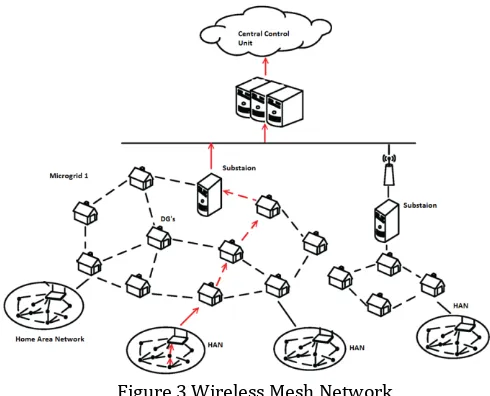
[image:5.595.320.565.93.291.2]These varying ambient conditions cause intermittent power generation which makes renewable resources hard to integrate to the power grid. For those reasons, WSNs can offer solutions for renewable energy generation sites, such as solar (PV) farms or wind farms. Figure 3 shows wireless mesh network in power grid.
Figure 3 Wireless Mesh Network
1) Advantages: Mesh networking is a cost effective solution with dynamic organization, healing, self-configuration, high scalability services, which provide many advantages, such as improving the network performance, balancing the load on the network, extending the network coverage range. Good coverage can be provided in urban and suburban areas with the ability of multi hop routing.
2) Disadvantages: Network capacity, fading and interference can be counted as the major challenges of wireless mesh networking systems. In addition, while data packets travel around many neighbours, there can be loop problems causing additional overheads in the communications channel that would result in a reduction of the available bandwidth.
C. Cellular Network Communication
Existing cellular networks can be a good option for communicating between DG's and the utility and between far nodes. The existing communications infrastructure avoids utilities from spending operational costs and additional time for building a dedicated communications infrastructure. Cellular network solutions also enable DG's deployments spreading to a wide area environment. 2G, 2.5G, 3G, WiMAX, are the cellular communication technologies available to utilities for DG's deployments. Cellular communication infrastructure are the another communication technology used for the communication between DG's and Microgrid. [24]
VOLUME: 03 ISSUE: 07 | JULY-2016 WWW.IRJET.NET P-ISSN: 2395-0072
© 2016, IRJET | Impact Factor value: 4.45 | ISO 9001:2008 Certified Journal | Page 1160 System (UMTS) wireless technologies are also used in
Microgrid projects [24].
1) Advantages: Cellular networks already exist. Therefore, a utility does not need to spend extra cost for building the communications infrastructure required for a Microgrid. Widespread and cost-effective benefits make cellular communication one of the leading communications technologies in the market. When security comes into discussion, cellular networks are ready to secure the data transmissions with strong security controls. In addition, GSM technology performs up to 14.4 Kb/s, GPRS performs up to 170 Kb/s and they both support AMI, Demand Response, Home Area Network (HAN) applications. Anonymity, authentication, signalling protection and user data protection security services are the security strengths of GSM technology. Lower cost, better coverage, lower maintenance costs, and fast installation features highlight why cellular networks can be the best candidate as a Microgrid communications technology for the applications, such as demand response management, advanced metering infrastructures, Home Area Network, outage management, etc.
2) Disadvantages: Some power grid applications needs continuous availability of communications. However, the services of cellular networks are shared by customer market and this may result in network congestion or decrease in network performance in emergency situations. Hence, these cases utilities need to build their own private communications network. In abnormal situations, such as a wind storm, cellular network providers may not provide guarantee service. Compared to public networks, private networks may handle these kinds of situations better due to the usage of a variety of technologies and spectrum bands.
As we discussed above, different communication channels are available in Microgrid for communication between DG’s and Microgrid. Communication plays important role in Microgrid system. Out of these wired and wireless communication technologies, wireless communication is more effective over wired communication, such as easy to deploy in urban and rural area, low cost, low complex, easy to troubleshoot etc. Next section we will discussed on communication standards or protocol suitable for Microgrid system. There are different communication protocols such as IEC 61850 protocols, IEEE1547 etc. are available in Microgrid to monitor, control, and measure power utilities.
V.
COMMUNICATION STANDARDS
A Microgrid system based on the IEC 61850 protocol, it consists of a Microgrid monitoring system, a protocol converter that transforms serial data to IEC 61850 data and distributed energy Resource controllers for varied
distributed energy resources nodes. The IEC 61850 has been adopted as an international communication protocol to monitor, control, and measure power utilities. The IEC 61850-7-420 has been chosen to interact with the Microgrid [25] [26].
Distributed energy resources (DER) vendors need communication capability because they interconnect to the micro grid. DER vendors have used their own proprietary communication protocols due to the short of standards. The distributed energy resources logical nodes data model for DER are standardized under the basic communication structure fixed in the communication networks and systems for power helpfulness automation introduced in the IEC 61850-7- 420 [27].
A. Micro Grid System Based IEC 61850
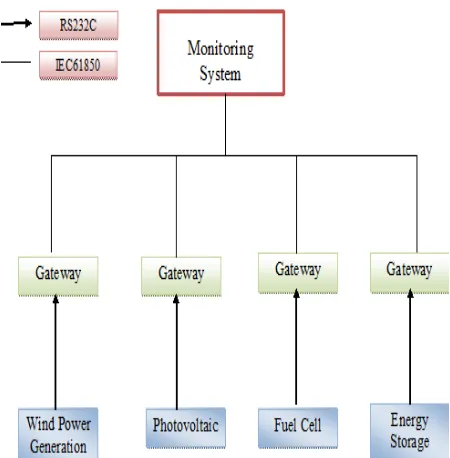
DER nodes, i.e., wind power generator, photovoltaic system, fuel cells, and energy storage are shown in figure 4 that have dedicated controllers for each DER unit. Each controller sends measured and status data that are encoded with their own proprietary protocol to the dedicated gateway using a serial communication link. The gateways convert received measured values and status information to those prescribed by the IEC 61850 data model and sends them to the micro grid monitoring system through a 100 Mbps. Ethernet interface using services defined in IEC 61850. The micro grid monitoring system works as a small Energy Management System (EMS), which sends control command to the DER controller via the gateway as required. Each component of the deployed micro system is described in a top-down manner [28].
1) Gateway
VOLUME: 03 ISSUE: 07 | JULY-2016 WWW.IRJET.NET P-ISSN: 2395-0072
[image:7.595.50.275.104.333.2]© 2016, IRJET | Impact Factor value: 4.45 | ISO 9001:2008 Certified Journal | Page 1161 Figure 4 Microgrid communications Architecture
B. IEEE 1547
EEE 1547TM 2003 Standard for Interconnecting Distributed Resources with Electric Power Systems is the primary interconnection standard and auxiliary standards for testing, applications, and communications are under improvement by IEEE work groups. The 1547 standard is the only systems-level technical standard of consistent necessities and specifications universally needed to interconnect DR with the grid.
Distributed generation (DG) not only provides local benefits to its owner, but it also offers new options for utilities. These options range from a physical hedge alongside purchased power to alternatives to transmission and distribution system upgrades or construction. Understanding how DG systems are designed, interconnected, and operated is key to understanding the effect of DG on electric power systems and on utilities, goals of maintaining system and supply source reliability. Interconnecting DG to electric power systems can involve system engineering, safety, and reliability considerations [28] [29].
C. IEC 61400-25
Wind power plants have through the years steadily gained a bigger and more dominant Position in the power generation industry. Each vendor has their proprietary solutions on controlling and monitoring of the products supplied. In today’s ever changing and rapidly growing energy market, monitoring and easy communication is essential. Through this communication the current state of the individual power plant can be controlled and monitored when required, and counter measurements can be enforced if needed in order to supply the demand for energy and
keep the stability of the distribution system. It is vital that the overall dispatching systems are able to control the energy generation from a wind farm on demand in order to meet the fluctuations in the energy consumption [30].
A common way to achieve this is a vendor independent approach. IEC 61400-25, Wind Plant Communications, and Expected Output: based on IEC 61850. The IEC 61400-25 series defines communication for monitoring and control of wind power plants. The modelling approach of the IEC 61400-25 series has been selected to provide definitions of classes and services such that the specifications are independent of specific protocol stacks, implementations, and operating systems [30] [31]. IEC 61400-25 defines protocols for communication, control, and monitoring of wind power plants (WPP). This standard includes a wide range of mandatory and optional elements, ranging from security, communications interface, and system speed. This enables control and monitoring to be handle communication in a standardized and secure way. An analysis \focusing on isolating the necessary requirements of IEC61400-25 has been carried out to create a generic prototype which can be used by WPP vendors where main communications interface of the prototype utilizes web services.
The prototype is comprised of several independent modules to allow the possibility of choosing a fully customizable setup by the end user. Configuration of the system need to be done in an easy way, ensuring a flexible and reusable system, where different choices for the system can be added or left out depending on user specifications. From the requirements a prototype with the purpose of examining the key aspects of these definitions has been elaborated The mapping of these classes and services to a specific communication profile is not within the scope of this 27part of the IEC 61400-25 series but within the scope of future IEC 61400-25-41 [31]. To reach interoperability, all data in the information model need a strong definition with observe to syntax and semantics. The semantics of the data is mostly provided by names assigned to logical nodes and data they contain, as defined in this part of the IEC 61400-25 series.
VOLUME:03ISSUE:07|JULY-2016 WWW.IRJET.NET P-ISSN:2395-0072
© 2016, IRJET | Impact Factor value: 4.45 | ISO 9001:2008 Certified Journal | Page 1162 IEC 61400-25 series implementations are application
specific. The IEC 61400-25 series does not guarantee a certain level of performance. This is beyond the scope of the IEC 61400-25 series. However, there is no underlying limitation in the communications technology to prevent high speed application (millisecond level responses) [32].
D. Powerline Networking
1) Home Plug: Home Plug is a powerline technology and the existing home electricity is used to connect the smart appliances to HAN (Home Area Network); Home Plug Command and Control (HPCC) version is designed for low-cost applications. Home Plug is a promising technology to create a reliable HAN between electric appliances and a smart meter. 2) PRIME: PRIME is an open, global powerline
standard that provides multivendor interoperability and welcomes several entities to its body. Advanced Digital Design, CURRENT Group, Landis+Gyr, STMicroelectronics, uSyscom and ZIV Medida are some of the current companies that have extensive experience in PLC technology.
3) G3-PLC: G3-PLC is a powerline communications specification launched by ERDF and Maxim that aims to provide interoperability, cyber security and robustness and reduce infrastructure costs in smart grid implementations worldwide.
E. Home Area Network Device Communication
Measurement and Control
U-SNAP: There have been a variety of incompatible standards for Home Area Network (HAN). This lack of standardization in HAN Utility has driven major AMI suppliers and product manufacturers to develop a solution,
namely Utility Smart Network Access Port (U-SNAP). The main requirement is the existence of an interface to connect any type of product to a HAN. U-SNAP basically enables the standardization of a connector and serial interface and identifies the hardware interface, physical dimensions, data transfer, message contents and protocol specifics for HAN devices to provide many communication protocols to connect HAN devices to smart meters.
1) IEEE P1901: The IEEE P1901 Working Group (WG) under the sponsorship of the IEEE Communications Society developed the IEEE P1901 standard for high-speed powerline communications to meet in-home multimedia, utility and smart grid application requirements [32].
Access control and physical layer specifications for broadband over powerline networks are analyzed in detail and the access system with cell structure is defined by the IEEE P1901 Working Group [32]. The IEEE P1901 standard has an important effect on communications technology by integrating powerline communications into wireless networks with extensive features, such as high-speed, walls-penetration, etc.
2) IEEE 802.15.4: The term ZigBee is used to describe a standardized wireless protocol for personal area networking, or “WPAN.” ZigBee is different from other wireless standards in that it has been designed to serve a diverse market of applications that require low cost, low power wireless connectivity with more sophistication than previously available at the target price. The standard focuses on low data rate, low duty cycle connectivity, a market segment not serviced well by existing standards. ZigBee is hardware and software standard built on the recently ratified IEEE 802.15.4 standard. This important standard defines the hardware and software, which is described in networking terms as the physical (PHY), and Medium Access Control (MAC) layers.
ZigBee is implemented in either the globally assigned 2.4 GHz unlicensed band or one of the 900 MHz regional bands. Unlicensed radio spectrum is designated by international agreement and puts the burden of specification adherence on the equipment manufacturer.
Table III Comparison between ZigBee standard with other standard
There are many wireless options available to designers. Let’s compare ZigBee with some of the more popular standards which share the unlicensed 2.4 GHz band. The parameters listed in the chart include the governing MAC standard, maximum ZigBee (WPAN) Bluetooth
(WLAN/WPAN) Wi-Fi (WLAN)
802.15.4
standard 802.15.1 standard 802.11 standard 250 kbps 1 Mbps Up to 54 Mbps
TX: 35 mA TX: 40 mA TX: 400+ mA
Standby: 3 uA Standby: 200
uA Standby: 20 mA 32-60 KB
memory 100+ KB memory 100+KB memory Lighting,
sensors, RC peripherals
Telecom audio, cable replacement
Enterprise, home access points Mesh
VOLUME: 03 ISSUE: 07 | JULY-2016 WWW.IRJET.NET P-ISSN: 2395-0072
© 2016, IRJET | Impact Factor value: 4.45 | ISO 9001:2008 Certified Journal | Page 1163 over the air data rate, typical transmit and standby
currents, memory requirements for a typical device, target applications and networking options. Table III shows comparison between ZigBee standard with other standard.
3) Z-Wave: Z-Wave is an alternative solution to ZigBee that handles the interference with 802.11/b/g since it operates in the 800 MHz range. Z-Wave is not an open standard and developed by The Z-Wave Alliance, an international consortium of manufacturers. The simple, modular and low-cost features make Z-Wave one of the leading wireless technologies in home automation. Z-Wave can be easily embedded to consumer electronic appliances, such as lighting, remote control, security systems that require low-bandwidth data operations [32].
VI.
CONCLUSION
In this paper, we discussed the microgrid concept, microgrid architecture, communication technique, communication standards in grid system. Microgrid system consists of different DG’s. Distributed generation (DG) systems are presented as a suitable form to offer high reliable electrical power supply. The concept is particularly interesting when different kinds of energy resources are available, such as photovoltaic panels, fuel cells, or speed wind turbines. The main objective is to study Microgrid architecture consists of different Distributed Generation (DG) units and each DG will consider as a node. DG's are needed to communicate with each other through proper communication media or channel. So the survey of different communication channels for Microgrid system is more important in power grid. This paper is presenting overall communication technologies suitable for Microgrid. Out of that wireless have some advantages over wired technology because of low cost infrastructure, less complex, good data rate, configure in different topologies etc.
REFERENCES
[1] Hao Liang,, IEEE, Bong Jun Choi, Weihua Zhuang, and Xuemin
Shen,, “Stability Enhancement of Decentralized Inverter Control Through Wireless Communications in Microgrids,” IEEE transactions on smart grid, vol. 4, no. 1, March 2013
[2] Hao Liang, Bong Jun Choi, Weihua Zhuang, and Xuemin
(Sherman) Shen Department of Electrical and Computer Engineering, University of Waterloo, Waterloo, Ontario, Canada, N2L 3G1 “Decentralized Inverter Control in Microgrids Based on Power Sharing Information through Wireless Communications” globecom 2012- wireless networking symposium
[3] Alessandro Giusti, Matteo Salani, Gianni A. Di Caro, Andrea E.
Rizzoli, and Luca M. Gambardella “Restricted Neighborhood Communication Improves Decentralized Demand-Side Load
Management” IEEE transactions on smart grid, vol. 5, no. 1, January 2014
[4] Wei Liu, , Wei Gu, , Wanxing Sheng, , Xiaoli Meng, Zaijun Wu, ,
and Wu Chen, “Decentralized Multi-Agent System-Based Cooperative Frequency Control for Autonomous Microgrids With Communication Constraints” IEEE transactions on sustainable energy, vol. 5, no. 2, April 2014
[5] Alireza Kahrobaeian, , and Yasser Abdel-Rady Ibrahim
Mohamed,“Networked-Based Hybrid Distributed Power Sharing and Control for Islanded Microgrid Systems” IEEE transactions on power electronics, vol. 30, no. 2, February 2014
[6] Vahidreza Nasirian, Seyedali Moayedi, Ali Davoudi, and
Frank L. Lewis, Fellow, IEEE “Distributed Cooperative Control of DC Microgrids” IEEE transactions on power electronics, vol. 30, no. 4, April 2015
[7] K. T. Tan, P. L. So, Senior Member, IEEE, Y. C.Chu, andM. Z. Q.
Chen, ”Coordinated Control and Energy Management of Distributed Generation Inverters in a Micro grid,” IEEE transactions on power delivery, vol. 28, no. 2, April 2013
[8] Ritwik Majumder, “Reactive Power Compensation in
Single-PhaseOperation of Microgrid,” IEEE Transactions on industrial electronics, vol. 60, no. 4, April 2013
[9] Alba Colet-Subirachs, Albert Ruiz-A´ lvarez, Oriol
Gomis-Bellmunt, Felipe Alvarez-Cuevas-Figuerola, and Antoni Sudri`a-Andreu, “Centralized and Distributed Active and Reactive Power Control of a Utility Connected Micro grid Using IEC61850,” IEEE systems journal, vol. 6, no. 1, March 2012
[10]Nagaraju Pogaku, Milan Prodanovic´, and Timothy C. Green,
“Modeling, Analysis and Testing of Autonomous Operation of an Inverter-Based Microgrid” IEEE transactions on power electronics, vol. 22, no. 2, March 2007
[11]Josep M. Guerrero, Luis García de Vicuña, José Matas, Miguel
Castilla, and Jaume Miret, “A Wireless Controller to Enhance Dynamic Performance of Parallel Inverters in Distributed Generation Systems,” IEEE Transactions on power electronics, vol. 19, no. 5, September 2004
[12]Amirnaser Yazdani, and Prajna Paramita Dash, Student “A
Control Methodology and Characterization of Dynamics for a Photovoltaic (PV) System Interfaced With a Distribution Network” IEEE transactions on power delivery, vol. 24, no. 3, July 2009
[13]Wenpeng, D. Sharp, and S. Lancashire, “Smart grid
communication network capacity planning for power utilities,” in Proc. IEEE PES,Transmission Distrib. Conf. Expo., Apr. 19–22, 2010, pp. 1–4.
[14]Yen Kheng Tan, and Sanjib Kumar Panda, “Self-Autonomous
Wireless Sensor Nodes With Wind Energy Harvesting for Remote Sensing of Wind-Driven Wildfire Spread” IEEE transactions on instrumentation and measurement, vol. 60, no. 4, April 2011
[15]Amir-Hamed Mohsenian-Rad, Vincent W. S. Wong, Juri
Jatskevich, Robert Schober, Fellow, IEEE, and Alberto
Leon-Garcia, Fellow, IEEE “Autonomous Demand-Side
Management Based on Game-Theoretic Energy Consumption Scheduling for the Future Smart Grid” IEEE transactions on smart grid, vol. 1, no. 3, December 2010
[16]Mohammad E. Khodayar, Masoud Barati, and Mohammad
VOLUME:03ISSUE:07|JULY-2016 WWW.IRJET.NET P-ISSN:2395-0072
© 2016, IRJET | Impact Factor value: 4.45 | ISO 9001:2008 Certified Journal | Page 1164 Distribution System in Microgrid Operation” IEEE
transactions on smart grid, vol. 3, no. 4, december 2012
[17]Seon-Ju Ahn, Soon-Ryul Nam, Joon-Ho Choi, and Seung-Il
Moon,“Power Scheduling of Distributed Generators for Economic and Stable Operation of a Microgrid” IEEE transactions on smart grid, vol. 4, no. 1, march 2013’
[18]Juan Van Roy, Niels Leemput, Student, Frederik Geth, Jeroen
Büscher, Robbe Salenbien, and Johan Driesen, “Electric Vehicle Charging in an Office Building Microgrid With Distributed Energy Resources” IEEE transactions on sustainable energy, vol. 5, no. 4, october 2014
[19]kay römer and friedemann mattern, eth zurich “The design
space of wireless sensor networks” IEEE Wireless Communications, December 2004
[20]Mihai T. Lazarescu “Design of a WSN Platform for Long-Term
Environmental Monitoring for IoT Applications” IEEE journal on emerging and selected topics in circuits and systems, vol. 3, no. 1, march 2013
[21]M. Manigandan*, Dr. B.Basavaraja *Assistant Professor, K L
University Guntur, #Professor, GITAM University Hyderabad, India., “Active and Reactive Power Control of MICROGRID using Wireless Technology (ZigBee 2.4GHz),” Chennai and Dr.MGR University Second International Conference on Sustainable Energy and Intelligent System (SEISCON 2011).Dr. M.G.R. University, Maduravoyal, Chennai, Tamil Nadu, India. July. 20-22, 2011
[22]Hao liang, bong jun choi, weihua zhuang, xuemin (sherman)
shen, and a. s. a.awad, university of waterlooatef abdrabou, united arab emirates university, “Multiagent coordination in microgrids via wireless networks,” IEEE Wireless Communications • June 2012
[23]Hao Liang, , Bong Jun Choi, Atef Abdrabou,Weihua Zhuang,
Fellow, IEEE, and Xuemin (Sherman) Shen, Fellow, IEEE, “Decentralized Economic Dispatch in Microgrids via Heterogeneous Wireless Networks,” IEEE journal on selected areas in communications, vol. 30, no. 6, july 2012
[24]Yun Wei Li, D. Mahinda Vilathgamuwa, and Poh Chiang Loh,
“A Grid-Interfacing Power Quality Compensator for Three-Phase Three-Wire Microgrid Applications” IEEE transactions on power electronics, vol. 21, no. 4, july 2006
[25]Hristiyan Kanchev, Di Lu, Frederic Colas, Vladimir Lazarov,
and Bruno Francois, “Energy Management and Operational Planning of a Microgrid With a PV-Based Active Generator for Smart Grid Applications” IEEE transactions on industrial electronics, vol. 58, no. 10, october 2011
[26]Esteban Padilla, Kodjo Agbossou, SeniorMember, IEEE, and
Alben Cardenas,Member, IEEE “Towards Smart Integration of Distributed Energy Resources Using Distributed Network Protocol Over Ethernet” IEEE transactions on smart grid, vol. 5, no. 4, July 2014
[27]Vehbi C. Güngör, Dilan Sahin, Taskin Kocak, Salih Ergüt,
Concettina Buccella, Carlo Cecati, Fellow, IEEE, and Gerhard P. Hancke,“Smart Grid Technologies: Communication Technologies and Standards” IEEE transactions on industrial informatics, vol. 7, no. 4, november 2011
[28]Y. Peizhong, A. Iwayemi, and C. Zhou, “Developing ZigBee
deployment guideline under WiFi interference for smart grid applications,” IEEE Trans. Smart Grid, vol. 2, no. 1, pp. 110– 120, Mar. 2011
[29]V. C. Gungor, D. Sahin, T. Kocak, and S. Ergüt, “Smart grid
communications and networking,” Türk Telekom, Tech. Rep. 11316-01, Apr.2011.
[30]B.K. Yoo, S.H. Yang, H.S. Yang†, W. Kim, Y.S. Jeong, B.M. Han
and K.S. Jang, “Communication Architecture of the IEC 61850-based Micro Grid System”, IEEE, Journal of Electrical Engineering & Technology, Vol. 6, No. 5, pp. 605~612, 2011.
[31]INTERNATIONAL STANDARD IEC 61400-25-2, First edition
2006-12 .
[32]V. C. Gungor, D. Sahin, T. Kocak, and S. Ergüt, “Smart grid
![Table I shows summary of these three types of PLC [18].](https://thumb-us.123doks.com/thumbv2/123dok_us/8189263.812877/4.595.301.565.130.392/table-i-shows-summary-types-plc.webp)