
International Journal of Emerging Technology and Advanced Engineering
Website: www.ijetae.com (ISSN 2250-2459,ISO 9001:2008 Certified Journal, Volume 5, Issue 10, October 2015)
379
3D Face databases: A review
Divya Chauhan
1, Krupali Umaria
2, Krupa Dave
31PG Student, 2,3Assistant Professor, E & C Dept., C.G. Patel Institute of Technology, Uka Tarsadia University, Bardoli,
Gujarat
Abstract— In recent year 3D Face Recognition Database available to researchers in three dimensional (3D) face
recognition and other related areas in biometric
applications.3D face recognition achieve better precision as compare to two dimensional (2D) face recognition.3D face database that a rich set of various parameters like illumination problems, different facial expressions, occlusions, rotations of head (pose variation) and other parameters like aging of the person. But the main problem of 3D face recognition methods is the acquisition of 3D face images which generally needs a range of different camera. It is where the research community is facing difficulty. 3D face recognition also depends on available 3D face databases. In this paper, we have to present a qualitative review of all the available 3D face databases. A comparative table of all the databases is also given with all the necessary parameters. Hence, this new database can be a very valuable resource for development and evaluation of algorithms on 3D face recognition under adverse conditions and facial expression analysis as well as for facial
expression synthesis.
Keywords—face recognition; face databases; facial images
Texture information, depth information
I. INTRODUCTION
Face recognition using two-dimensional (2D) images has a prove that recognition rate more than 90 percent, but it is under semi controlled environment and fully controlled only. It is difficult to recognize a face in an – impossible to control; because of variation of various parameters like different lighting conditions (also known as illumination problem), different expression variation, rotations in subject’s head (also known as pose variation) and aging of the person and occlusion effects etc. All these parameters together deteriorating the recognition rate vastly. Since the shape of the face is highly discriminative and is In effective to changes in lighting conditions, pose variations and facial expressions, the 3D face recognition as an alternative or unique method for face recognition. From past few years, research has been done on 3D face recognition growth to be a further evolution of 2D face recognition problems and achieved more accurate results using various algorithms on different databases.
Due to the fact that 3D face recognition generally depends greatly on the available 3D face databases and these databases in-turn depends on multiple range of different cameras which is little costlier and needs more time, being the main limitation of the 3D face recognition research. the main reason of study on 3D face recognition reveals the scarcity of valuable 3D databases. In this paper, a thorough review of all 3D face databases is given.
The rest of the paper is organized as follow. Since the number of subjects in the database will have a good impact on recognition results In section II define all database details, section III define summary of all the databases given in Table and section IV define Conclude the paper.
II. DATABASES
[image:1.612.338.553.436.590.2]Face recognition algorithms which combine 2D and 3D data have been recently proposed. Texture information is more efficient than depth information for face recognition.
Fig. 1 Depth images of different person [2].
International Journal of Emerging Technology and Advanced Engineering
Website: www.ijetae.com (ISSN 2250-2459,ISO 9001:2008 Certified Journal, Volume 5, Issue 10, October 2015)
380
A. GavabDB database [1]The GavabDB database was created by the GAVAB research group of computer science department at the University of King Juan Carlos inMadrid, Spain. This face database contain 61 Caucasian individuals ( 16female and 45 male ) aged between 18 years to 40 years, with 9 meshes numbered from 1 to 9 for each person, captured under different settings. For incomplete meshes, the occluded patches typically can be reconstructed relying on the symmetric nature of human faces. Each image was given by a mesh of connected 3D points of the facial surface without any texture. Total 9 meshes: 2 X-rotated views with neutral expression, 2 Y-rotated views with neutral expression and 2- frontal views with neutral expression, and 3 frontal gesture images (laugh, smile and random gesture chosen by the user respectively). It also includes many variation of pose and facial expressions were provided in the database.
B. The FRAV- 3D database [2]
The Face Recognition and Artificial Vision (FRAV) was created by the Rey Juan Carlos University (URJC) has composed 3D database which can be used for research in 2D, 2.5D rang images or 3D face recognition .The image were captured by scanner Minolta VIVID-700 red laser light-stripe triangulation range finder was used under controlled indoor conditions and which provides texture information (2D image) and a VRML file (3D image).this face database contain 3D mesh with up to 4000 points and 7500 triangles and a classical 2D color image were produced which can give texture information as well as a VRML file from which the range data (2.5D) can be calculated. [2]. These subjects were asked to sit opposite to the scanner, with a dark plain background behind them. No hats, scarves or glasses were allowed. In all the participants kept their eyes closed during the acquisition process and all scans were acquired using a strict protocol for standardizing reasons. Each shot differed from the previous one in only one acquisition parameter, which included
turns, available or not available of gestures and changes in illumination. This database contain 106 person (one woman
for every three men) involved in the acquisition process. this database was built under fully controlled environment condition and has no person was allowed to use any kind of occlusion. In every case only one parameter was modified between two captures is being a unique feature of this database.so in this databasetotal of16 captures per person were taken in every session, with different poses and lighting conditions.
C. Texas 3D database [3]
Texas 3D face database was created by the company Advanced Digital Imaging Research (ADIR), LLC (Friendswood, TX)[3] and it was collected at a high spatial resolution of 0.32mm using a stereo imaging System of two 2D and 3D facial models was, formerly a subsidiary of Iris International, Inc. (Chatsworth, CA), with assistance from research students and faculty from the Laboratory for Image and Video Engineering at The University of Texas at Austin. In recent, this database is the largest publicly available database of 3D facial images acquired using MU-2 stereo imaging system. This Database was a collection of 1149 3D Model of 118 adult human subjects high resolution, pose normalized, preprocessed, and perfectly aligned color.[4]. The number of images per subject varies from 1 per subject to 89 per subject. The subjects’ ages range from 22 to 75 years. this database includes images of both males and females from the major ethnic groups of Caucasians, Africans, Asians, East Indians, and Hispanics. The 3D models in the Texas 3D Face Recognition Database were acquired using an MU-2 stereo imaging system manufactured by 3Q Technologies Ltd. (Atlanta, GA).
Fig. 2 (a) color, and (b) range images of the Texas 3D Face Recognition Database[3]
D. CASIA-3D database [5]
[image:2.612.344.536.396.551.2]International Journal of Emerging Technology and Advanced Engineering
Website: www.ijetae.com (ISSN 2250-2459,ISO 9001:2008 Certified Journal, Volume 5, Issue 10, October 2015)
381
Fig.3To the subjects with glasses, one additional scans with glasses also present in the database. Thus, each person contains 37 or 38 scans. And from each scan, one 2D color image and one 3D facial triangulated surface were also generated. During building the database, we consider not only the single variations of poses, expressions and illuminations, but also the combined variations of expressions under illumination and poses under expressions, as shown in Fig.4. To the subjects with glasses, we will collect one additional scans with glasses. Thus, each person contains 37 scans. And from each scan, one 3D facial triangulated surface and 2D color image are also generated.
Fig.4 Pose variations [5]
E. FRGC 3D database [6]
The FRGC database was created by the University of Notre Dame. The face recognition grand challenge (FRGC) is designed to achieve high performance goal by presenting to researchers a six-experiment challenge problem along with data corpus of 50,000 images[6]. The FRGC data corpus consists of 50,000 recordings divided into training and validation partitions. The data corpus contains high resolution still images taken under controlled unstructured illumination and with lighting conditions, 3d scans collected still images. The data consists of 3D scans and high resolution still imagery taken under controlled and uncontrolled conditions.
The FRGC database whole part of their progressive multi-model biometric data collection, Database were captured using vivid 900/910 sensor under controlled illumination and consists of both range and texture channels. The data for the FRGC experiments were divided into training and validation partitions. The data for the FRGC experiments was divided into training and validation partitions. The 3D training set that contains 3d scans, and controlled and uncontrolled still images from 943 subject sessions. Still face recognition algorithms can be training from the 3D training set when experiments that compare 3D and still algorithms need to control for training set. The 3D training set consists of 3D scans and controlled and uncontrolled still collected in 4007 subject sessions, the validation set contains images from 466 subjects. The analytical graph of the validation partition broken out by sex, age, and race as shown in Fig. 5 the validation partition contains from 1 to 22 subject sessions per subject.
Fig.5 Demographics of FRGC ver2.0 validation partition by (a) race, (b) age, and (c) sex [6]
F. The Bosphorus database [7]
International Journal of Emerging Technology and Advanced Engineering
Website: www.ijetae.com (ISSN 2250-2459,ISO 9001:2008 Certified Journal, Volume 5, Issue 10, October 2015)
382
i) The facial expressions are composed of judiciously selected subject of Auction Units (AU) [9]. Upto 35 expressions per subject and one third of the subjects are professional actors/actresses. as well as the six basic emotions. ii) a systematic rich set of head pose variations were available and iii) different types of face occlusions were included. Bosphorus database consist 4666 face images of 105 subjects in various pose, expressions, and occlusion. 18 subjects have beard/moustache and short facial hair is available for 15 subjects. The majority of the subjects are aged between 25 and 35 old. There are 60 men and 45 women in total, and most of the subjects are Caucasian. Also, 27 professional actors/actresses are joined in the database. Up to 54 face scans are available per subject, but 34 of these subjects have 31 scans. Thus, the number of total face scans is 4652. Each scan has been manually labeled for 24 facial landmark points such as nose tip, inner eye corners, etc., provided that they are visible in the given scan.
G. The RMA-3D database[10]
The use of the "3D_RMA" database was created by the SIC restricted to research purposes. 3D RMA is a database of 3D human faces. The RMA 3D database collected in two sessions (in November 1997 and January 1998) from a total of 120 subjects aged between 20 and 60. 120 persons were asked to pose twice in front of the image capturing system in each session.[10] for each session, three shots per person were recorded with different (but limited) location of head : straight forward, left or right, upward or downward for each and every session. Using structured light system all data are obtained with a stereo vision assisted structured light system. on the average, faces contain 4000 3D points and they cover different portions of the faces. the 3D faces with high noise level or problematic acquisitions have been discarded. Finally, the reference subset consists of 106 subjects, (19 subjects have only five shots whereas 87 subjects have 6 shots).
H. Photoface database
The Photoface database was collected four-source photometric stereo to rapidly capture facial geometry. Capture a new 3D face database for testing the project and for benefit of the existing state-of-the-art face recognition algorithms to the dataset Capture skin reflectance data in order to generate poses of any face captured by the device. This unique 3D face database is the largest currently available [12], containing 3187 sessions of 453 subjects, captured in two recording periods of time approximately six months each.
The Photoface device was located in an unsupervised corridor allowing real-world and unconstrained capture [13]. Each session comprises differently lit color photographs four of the subject, from which albedo estimations and surface normal can be calculated (photometric stereo MATLAB code). This allows for many data fusion modalities and testing scenarios. Eleven facial landmarks have been manually located on each session for alignment purposes.
I. The BU3DFE database
The BU3DFE was created by the Binghamton University 3D Facial Expression Database (BU3DFE), and it is a static database of color images of hundred human faces. About 2500 facial expressions of 56 percent female and 44 percent male subjects age ranging from 18 years to 70 years [14]. Database was built with seven expressions per subject: neutral, happiness, fear, angry, surprise and sadness. Each expression shape model, corresponding facial texture image was captured at two views about plus 45° and minus 45. As a result, the database consists of 2500 geometric shape models and 2500 two-view’s texture images.
J. The MPI database[15]
[image:4.612.379.509.559.688.2]The MPIBC 3D face database was created by the Max- Planck Institute for Biological Cybernetics in Tubingen, Germany. This database contains images of 200 laser-scanned heads of young models (100 male and 100 female) without hair, makeup, and accessories of different 7 views [14]. All the head models are of Caucasian people aged 20 to 40 years [15]. The shape and texture information of each face and with same resolution was present.in this database head models were synthesized by morphing real scans of Cyber ware which resulted in the final face representation with similar number of color values and around 70000 vertices.
International Journal of Emerging Technology and Advanced Engineering
Website: www.ijetae.com (ISSN 2250-2459,ISO 9001:2008 Certified Journal, Volume 5, Issue 10, October 2015)
383
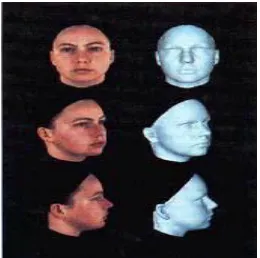
K. The BFM database[16] [image:5.612.327.563.132.463.2]The Basel Face Modal 3D database is a 3D Morphable Model database(3DMM), which provides training dataset also. This database contains images of face scans of 200 subjects (100 male and 100 female), most of them were Europeans. The age of the persons was between 8 and 62 years (Fig.7,8). This 3D face Morphable model covering the face surface from ear to ear. This 3D morphable model is a high quality texture model. This database can also be used directly in an analysis by entirely , to fit the model to images, or it can be used indirectly to generate training or test images at any imaging condition. Hence in addition to being a useful model for use in face analysis , it can also be viewed as a meta type of database which allows the creation of infinity of accurately labelled entirely test and training images[16].
Fig. 7 The BFM was trained on200 individuals (100F/100M).Age (average 25y) [16].
Fig 8 Weight (average 66kg) are distributed over a large range [16].
III. SUMMARY OF ALL DATABASES
TABLE I[1,3,5,7,9,13,14,17]
Database Year Subject Number of images
par subject
Condition Texture image
Gavabdb 2004 61 9 P ,e No
FRAV 2006 106 16 P, e ,i Yes
TEXAX 2010 105 One-19 e No
CASIA 2004 123 9 P ,i Yes
FRGC 2002 66 0ne-2 i No
Bosphorus 2008 106 31-53 P ,i ,e No
3D-RMA 2001 120 3 P No
PHOTOFACE 2008 453 One-2 e ,i Yes
BU3PE 2006 100 25 P ,e Yes
MPI 1999 200 7 P ,e Yes
BFM 2009 200 1-4 e, i Yes
As shown in Table above comparison of different databases for conditions like p, e, i (position, expression, illumination) are given.
IV. CONCLUSION
[image:5.612.53.265.332.463.2] [image:5.612.54.268.516.638.2]International Journal of Emerging Technology and Advanced Engineering
Website: www.ijetae.com (ISSN 2250-2459,ISO 9001:2008 Certified Journal, Volume 5, Issue 10, October 2015)
384
REFERENCES [1] GavabDB:facedatabase,URL:
http://www.gavab.es/recursos_en.html#GavabDB
[2] Cristina Conde, Ángel Serrano and Enrique Cabello,―Multimodal 2D, 2.5D & 3D Face Verification,‖ IEEE signal processing society international conference on image processing. ICIP 2006, pp 2061- 2064
[3] Texas 3D Face Recognition Database (Texas 3DF ), http://live.ece.utexas.edu/research/texasdfr/
[4] S. Gupta, K. R. Castleman, M. K. Markey, A. C. Bovik, "Texas 3D Face Recognition Database", IEEE Southwest Symposium on Image Analysis and Interpretation, May 2010, p 97-100,Austin, TX [5] CASIA-3D FaceV1, http://biometrics.idealtest.org/
[6] Phillips et al.(2005) P.J. Phillips, P.J. Flynn, T. Scruggs, K.W. Bowyer, J. Chang, K. Hoffman, J. Marques, J. Min, and W. Worek. ―Overview of the face recognition grand challenge‖. In IEEE Computer Society Conference on Computer Vision and Pattern Recognition, CVPR 2005, pp. 947–954.
[7] The Bosphorus Database, http://bosphorus.ee.boun.edu.tr/
[8] P. Ekman and W. Friesen. ―Facial Action Coding System,‖ New York: Consulting Psychologists Press, 1977
[9] 3D_RMA: 3D database,
http://www.sic.rma.ac.be/~beumier/DB/3d_rma.html
[10] Beumier and Acheroy(2001) C. Beumier and M. Acheroy ―Face verification from 3D and grey level clues,‖ Pattern Recognition Letters, 22(12):1321–1329
[11] S Zafeiriouy, M Hansen, G Atkinson, V Argyriou, M Petrouz, Melvyn S and L Smith, ―The Photoface Database‖, Proc. of BMVC Workshop, 2011, pp. 132-139
[12] S.N.Kautkar, G.A.Atinkson, M. L.Smith, ―Face recognition in 2D and 2.5D using ridgelets and photometri stereo‖, Pattern Recognition, 2012, pp. 3317-3327
[13] Lijun Yin; Xiaozhou Wei; Yi Sun; Jun Wang; Matthew J., ―A 3D Facial Expression Database For Facial Behavior Research‖, 7th International Conference on Automatic Face and Gesture Recognition (FGR06), 10-12 April 2006 P:211 – 216
[14] Blanz, V. and T. Vetter, ―A Morphable Model for the Synthesis of 3D Faces,‖ SIGGRAPH'99 Conference Proceedings, 187-194 (1999 [15] Troje, N. and H. H. Bülthoff, ―Face recognition under varying poses:
The role of texture and shape,‖ Vision Research 36, 1996, pp. 1761-1771.
[16] Blanz, V. and T. Vetter, ―A Morphable Model for theSynthesis of 3D Faces,‖ SIGGRAPH'99 Conference Proceedings, 187-194 (1999).
![Fig. 1 Depth images of different person [2].](https://thumb-us.123doks.com/thumbv2/123dok_us/8696668.878455/1.612.338.553.436.590/fig-depth-images-different-person.webp)
![Fig. 2 (a) color, and (b) range images of the Texas 3D Face Recognition Database[3]](https://thumb-us.123doks.com/thumbv2/123dok_us/8696668.878455/2.612.344.536.396.551/fig-color-range-images-texas-face-recognition-database.webp)
![Fig 8 Weight (average 66kg) are distributed over a large range [16].](https://thumb-us.123doks.com/thumbv2/123dok_us/8696668.878455/5.612.327.563.132.463/fig-weight-average-kg-distributed-large-range.webp)
