en
t
re
v
ie
w
s
re
ports
de
p
o
si
te
d r
e
se
a
rch
refer
e
e
d
re
sear
ch
interacti
o
ns
inf
o
rmation
Emma Laing
*†
, Vassilis Mersinias
‡
, Colin P Smith
‡
and Simon J Hubbard
*
Addresses: *Faculty of Life Sciences, The University of Manchester, Manchester M13 9PT, UK. †Current Address: School of Biomedical and Molecular Sciences, University of Surrey, Guildford GU2 7XH, UK. ‡Functional Genomics Laboratory, School of Biomedical and Molecular Sciences, University of Surrey, Guildford GU2 7XH, UK.
Correspondence: Simon J Hubbard. Email: [email protected]
© 2006 Laing et al.; licensee BioMed Central Ltd.
This is an open acess article distributed under the terms of the Creative Commons Attribution License (http://creativecommons.org/licenses/by/2.0), which permits unrestricted use, distribution, and reproduction in any medium, provided the original work is properly cited.
Gene expression in operons
<p>Analysis of the relative transcript levels of intra-operonic genes in <it>Streptomyces coelicolor </it>suggests significant levels of inter-nal regulation.</p>
Abstract
Background: Recent studies have shown that microarray-derived gene-expression data are useful for operon prediction. However, it is apparent that genes within an operon do not conform to the simple notion that they have equal levels of expression.
Results: To investigate the relative transcript levels of intra-operonic genes, we have used a Z-score approach to normalize the expression levels of all genes within an operon to expression of the first gene of that operon. Here we demonstrate that there is a general downward trend in expression from the first to the last gene in Streptomyces coelicolor operons, in contrast to what we observe in Escherichia coli. Combining transcription-factor binding-site prediction with the identification of operonic genes that exhibited higher transcript levels than the first gene of the same operon enabled the discovery of putative internal promoters. The presence of transcription terminators and abundance of putative transcriptional control sequences in S. coelicolor operons are also described.
Conclusion: Here we have demonstrated a polarity of expression in operons of S. coelicolor not seen in E. coli, bringing caution to those that apply operon prediction strategies based on E. coli 'equal-expression' to divergent species. We speculate that this general difference in transcription behavior could reflect the contrasting lifestyles of the two organisms and, in the case of Streptomyces, might also be influenced by its high G+C content genome. Identification of putative internal promoters, previously thought to cause problems in operon prediction strategies, has also been enabled.
Background
The analysis of gene expression patterns observed over a range of conditions and time points has become widely used in modern biology to discover relationships between different genes in a genome. This can involve clustering genes into co-expressed sets to try and predict common functions and reg-ulatory relationships, or to determine differential expression
in different conditions to provide insight into the function of specific genes. Additionally, in prokaryotic organisms, the relationships inferred from gene co-expression should also provide clues to the organization of genes into operons and regulons. Since operons are, by definition, a transcriptional unit containing genes that are co-regulated as a single poly-cistronic message, they are, therefore, deemed to be
Published: 2 June 2006
Genome Biology 2006, 7:R46 (doi:10.1186/gb-2006-7-6-r46)
Received: 22 December 2005 Revised: 3 March 2006 Accepted: 9 May 2006 The electronic version of this article is the complete one and can be
functionally similar. Hence, an understanding of operon structure and regulation forms a basis on which to build reg-ulatory networks.
[image:2.612.56.299.565.692.2]Given the importance of operons to prokaryotic gene function and regulation, several approaches have been developed to try and predict them, exploiting genome sequences and other related features. As operon structure has been observed to be relatively poorly conserved [1-4] non-homology based predic-tion of operons has predominated. These methods use the basic principles that genes within the same operon are con-trolled by a single promoter, tend to be close together [5], ter-minate at a single transcription terminator, and are transcribed at similar levels. Several groups have developed computational methods to predict operons that adopt these principles, either through the use of sequence information alone [6] or by combining it with microarray data [7,8] and/ or by including functional annotation [5,9-11] in Escherichia coli or Bacillus subtilis. The use of microarray data and/or functional data improves the quality of operon prediction above that achieved from sequence alone and in addition offers some experimental validation of the predictions [7,8,11].
Through the presence of a promoter(s) and other regulatory features such as cis-acting transcription factor-binding sites upstream of the first gene of an operon, it is generally assumed that genes within an operon are expressed at equal levels. Typically, this equal expression is measured through distance metrics such as Pearson correlation or Euclidean distance where a score of 1 or 0 (respectively) is considered to be more likely with operonic pairs than non-operonic pairs. Indeed, recent studies in E. coli [8] and B. subtilis [7] have shown that this is the case, with operonic pairs of genes show-ing high correlation in gene expression usshow-ing either metric. However, although microarray data are useful in predicting operons, the ideal condition of perfectly correlated gene expression, even within well characterized operons, is not observed experimentally, and the distinction between oper-onic and non-operoper-onic pairs is not straightforward.
In the light of these findings we were motivated to analyze the patterns of expression across documented operons in Strep-tomyces coelicolor, an actinomycete with a high G+C content genome that is responsible for the production of about two-thirds of all natural antibiotics currently available, and to compare them with our knowledge of known E. coli operons. This was driven from an interest in S. coelicolor itself, which is a complex bacterium equipped with an unusually large number of transcription factors, including 65 sigma factors [12], and also to provide a third, phylogenetically diverse, bacterial species in which to examine operon-expression rela-tionships. Furthermore, we use the determined pattern of expression across operons to identify potential internal cis -acting control sites by combining microarray-derived expres-sion profiles with transcription factor binding site (TFBSs) and terminator prediction algorithms. This study reveals that the control of gene expression in operons in Streptomyces
differs from, and is more complex than that observed in E. coli and B. subtilis, and is likely to demonstrate more internal control.
Results and discussion
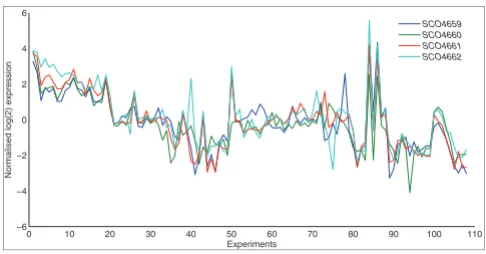
In order to compare expression levels of genes within oper-ons, we considered several metrics, concluding that the Pear-son correlation coefficient provides a superior measure of the direction or change in gene expression over a set of experi-ments. This has also been observed by other workers [7] and suggests that the gene expression profiles of operonic mem-bers are co-ordinated (that is, go up and down in a correlated fashion) but not necessarily in terms of absolute expression level. This idea is illustrated in Figure 1, which depicts the normalized expression profile of 107 experiments for each of the four genes found within the known S. coelicolor rspL-tuf1
operon [13]. Figure 1 illustrates cases where genes in the same operon have similar trajectory patterns over a variety of experiments, but varying expression levels for individual experiments.
When the normalized expression levels of genes within oper-ons are compared in S. coelicolor and E. coli (Figure 2a,c), the intra-operonic pairs show a higher degree of correlation than those not in operons, using either of our definitions for non-operonic (either through direction, or crossing a true operon boundary). For example, the mean correlation values in S. coelicolor are 0.34, 0.26, 0.14 for known operons, non-oper-ons (via direction), and non-opernon-oper-ons (via boundaries), respectively. The equivalent values in E. coli are 0.74, 0.53, 0,54. However, the trend is more marked between known operonic gene pairs and randomly selected gene pairs (p < 0.01 after t test; Figure 2b,d). Interestingly, the most signifi-cant trend is noted between random gene pairs in E. coli and
S. coelicolor, where randomly selected gene pairs are signifi-cantly (p < 0.01 after t test) more highly correlated than with mean correlation coefficients of 0.4 and 0.06, respectively (Figure 2b,d). This is also backed up by Figure 2e, which Example operon expression profile
Figure 1
Example operon expression profile. Expression profile across all 107 experiments for all genes within the rspL-tuf1 operon in S. coelicolor.
0 10 20 30 40 50 60 70 80 90 100 110
−6 −4 −2 0 2 4 6
Experiments
Normalised log(2) expression
comm
en
t
re
v
ie
w
s
re
ports
refer
e
e
d
re
sear
ch
de
p
o
si
te
d r
e
se
a
rch
interacti
o
ns
inf
o
rmation
[image:3.612.51.554.86.329.2]Correlations in intra-operonic and non-operonic gene expression Figure 2
Correlations in intra-operonic and non-operonic gene expression. Correlations in intra-operonic and non-operonic gene expression in (a) S. coelicolor and (c) E. coli. Random gene pair correlation distribution (after 10,000 simulations) in (b) S. coelicolor and (d) E. coli. (e) Shows upstream intergenic distance versus Pearson correlation distributions for S. coelicolor and E. coli.
Variation in generalised operon gene expression Figure 3
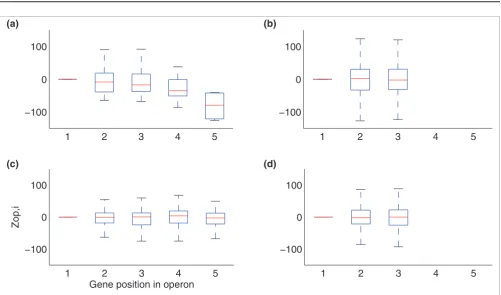
Variation in generalised operon gene expression. Box plot diagrams for all Zop,i values calculated for genes at position k in (a) all known S. coelicolor
operons, (b) adjacent genes known not to be in an operon in S. coelicolor, (c) all known E. coli operons, and (d) adjacent genes known not be in an operon in E. coli.
−50 50 150 250
0 0.2 0.4 0.6 0.8
Intergenic distance (50nt bins)
Pearson correlation
(e)
−1 −0.5 0 0.5 1
0 0.1 0.2 0.3 0.4 0.5
(d)
−1 −0.5 0 0.5 1
0 0.1 0.2 0.3 0.4 0.5
Pearson correlation
Frequency
(c)
−10 −0.5 0 0.5 1
0.1 0.2 0.3 0.4 0.5
(b)
−10 −0.5 0 0.5 1
0.1 0.2 0.3 0.4 0.5
(a) Operonic pairs
Non−operonic (boundaries) Non−operonic (direction)
S. coelicolor E. coli
1 2 3 4 5
−100 0 100 (a)
1 2 3 4 5
−100 0 100
Zop,i
Gene position in operon (c)
1 2 3 4 5
−100 0 100 (b)
1 2 3 4 5
[image:3.612.55.556.378.673.2]shows that the closer gene pairs are together (using adjacent gene pairs on the same strand in the genome), the stronger the correlation in their expression profiles, independent of their operonic status. Again, the similarity in gene expression between adjacent genes transcribed in the same direction is much larger in E. coli compared to S. coelicolor (Figure 3e). This has important implications for operon prediction meth-ods that use microarray data directly or to validate predic-tions [7,8,11,14] because, particularly in E. coli, gene proximity is highly correlated with co-expression regardless of whether the genes are members of the same operon.
Taken together, these results suggest that control of genes within characterized operons in S. coelicolor is more com-plex, and that the regulation of expression at adjacent loci is more diverse than in E. coli. Indeed, the large differences in gene expression patterns observed between the two species were unexpected and we tested for bias in the data sets that might cause this. However, we found no systematic differ-ences in the number and type of experiments (time-course derived data and/or single perturbations) or absence of vari-ation of individual gene expression (measured by an entropy value, (E Laing and S Hubbard, unpublished data)) that would lead to higher correlations. Indeed, the latter entropy calculations suggested there is more variation in the E. coli
data sets. The apparent increased complexity of genetic con-trol in S. coelicolor might explain this, given the larger, more complex genome and increased number of transcription factors.
There is, nevertheless, increased correlation in gene expres-sion for operonic members (Figure 2a,c) and for this reason we analyzed expression patterns of documented operons in S. coelicolor and E. coli. Using a Z-score normalization proce-dure (see Materials and methods), gene expression across an operon is normalized to the first gene of the same operon, which allows individual gene expression patterns both within and across operons to be compared. For every position i
within an operon the distribution of Zop,i for operonic genes at position i can then be plotted, such that a box in the plots illustrated in Figure 3a-d represents a gene position in a 'vir-tual' operon. Figure 3a shows a box plot of Zop,i values for each gene position in operons in S. coelicolor, restricted to five due to lack of experimental data for larger operons. Figure 3a sug-gests that operons in S. coelicolor exhibit 'polar' expression, whereby gene expression generally decreases throughout the operon, with successive genes having lower expression levels than the preceding gene. This does not correspond to the common notion that operonic genes are expressed equally. This apparent downward trend was tested by randomly shuf-fling gene order in the same operon set using 1,000 simula-tions, which showed that when the order of the genes in an operon are changed no polarity of expression is observed (data not shown). Using the random (shuffled) Zop,i distribu-tions for each position, p values were obtained. Although no significance less than p < 0.05 was observed for individual
positions compared to random, the deviations from expecta-tion for individual genes in given operons is significant, with Z-values exceeding 20 in many instances. We suggest that the downward trend of expression is a characteristic of S. coeli-color operons.
It is evident that some genes do not follow the trend of down-ward expression observed in Streptomyces operons in Figure 3a. One possible explanation for this increased expression is the presence of internal promoters, a feature that is thought to cause problems in operon prediction methods [6-8,11,14]. Although the prediction of promoter sequences is difficult, TFBSs in prokaryotes tend to be proximal to a promoter [15] and potential internal promoters were assayed by the identi-fication of a putative TFBS. Intra-operonic genes (excluding the initial gene of an operon) were classed as either over-rep-resented intra-operonic genes (OIGs) with a Zop,i greater than the µop,1 + σop,1 or non-over-represented intra-operonic genes
(NOIGs) with a Zop,i less than the µop,1 - σop,1. The abundance of TFBSs within their upstream intergenic regions was stud-ied (Figure 4). Figure 4 shows that there is a consistent over-representation of TFBSs in the OIGS set for Streptomyces, not present in randomly selected genes from the same operon set, with a p < 0.05 from a chi-square test using TFBS predic-tion thresholds mb + nσb (n = 4, 4.5, and 5).
The TFBS prediction algorithm uses position specific weight matrices (PSWMs) to predict likely sites in the upstream regions of candidate genes. Some genes do not possess sub-stantial upstream non-coding sequence, and hence these genes were filtered out in the TFBS tests shown in Figure 4 in order to remove any potential bias. However, the gene hisB
(SCO2052) is known to have an internal promoter upstream in E. coli but has no upstream intergenic sequence in S. coelicolor, overlapping the upstream neighboring gene by four bases. This gene was originally assigned to the upregu-lated set prior to filtering and is, therefore, predicted to be internally promoted, although our approach would not attempt to find a putative TFBS. A substantial proportion of the gene sets fall into this category; 48% of the upregulated data set and 27% of the normal data set had no upstream intergenic sequence. The upregulated genes that fall into this category may well be similar cases in which internal tran-scription initiation occurs but the internal promoter lies in an intragenic upstream sequence. The significant difference between TFBS abundance for upregulated and normal genes using this method would suggest that TFBS prediction algo-rithms capable of analyzing overlapping upstream regions should be developed.
comm
en
t
re
v
ie
w
s
re
ports
refer
e
e
d
re
sear
ch
de
p
o
si
te
d r
e
se
a
rch
interacti
o
ns
inf
o
rmation
[16]; third, a binding site is present and used in termination, a phenomenon found in Spiroplasma citri [17]; fourth, exper-imental error, where expression measurements in the profile are less than the true biological amount; or fifth, due to false positives within our TFBS set, although few false positives are expected at the prediction threshold of mb + 5σb [18].
Only 4 of 55 NOIGs were predicted to have a binding site with a threshold of mb + 5σb; SCO3358 (cseB), SCO2610 (mreC),
SCO5319 (whiE protein II), and SCO5625 (tsf). No additional information about the transcriptional status of SCO2610 or SCO5319 could be found and, consequently, information for the two remaining genes is briefly discussed here. SCO3358 is the third gene of the sigE operon, an operon that has been found to be entirely transcribed only 10% of the time due to termination downstream of the first gene sigE [19]. In agree-ment with this, SCO3358 has reduced expression compared to the first gene of the operon. The binding site we predicted upstream of SCO3358 (cseB) may offer an additional route to activate this gene in the operon, as the product of SCO3358 regulates the upstream promoter of the operon [19]. SCO5625 (tsf), is the second gene of a bicistronic operon and is expressed less than the first gene (rpsB) by a ratio of 2:1 in
S. coelicolor [13], consistent with the array data presented here. However, the authors of this work [13] could not deduce the likely mechanism and speculated that attenuation, if occurring, may be brought about by a 16 base-pair inverted
repeat just upstream of tsf in S. coelicolor, similar to that found in E. coli. Alternatively, a similar attenuation mecha-nism in S. coelicolor to that proposed for the rpsB-tsf operon of Spiroplasma citri may be responsible, where a DNA bind-ing protein interacts with the region immediately down-stream of rpsB [20]. The binding site found to be bound by a protein just upstream of tsf (although how it would influence transcription is not known) by Le Dantec et al. [20] was an AT-rich inverted repeat that did not resemble a typical termi-nator sequence. Interestingly, the inverted repeat predicted by our method to be in the upstream region of tsf is also AT-rich. From the 23 OIGs, 5 genes were predicted to have a TFBS (using the threshold of mb + 5σb); SCO2389 (acpP),
SCO0712 (lipR), SCO2390 (fabF), SCO4662 (tuf1), and SCO5356 (thrB). Table 1 details known information about the regulation of these genes, where all but one of the OIGs with predicted binding sites are known to have a promoter in their upstream regions. Although formally classified as a monocis-tronic operon in Streptomyces, thrB is included as it is tran-scriptionally linked to a bicistronic operon involved in the same pathway immediately upstream in E. coli, and often part of an operon in other organisms (for example, B. subtilis) [21].
[image:5.612.56.555.87.347.2]The fact that thrB was identified as an OIG and a TFBS was also predicted is promising for operon prediction algorithm improvement, since thrB is expressed independently in Predicted TFBS abundance in operons
Figure 4
Predicted TFBS abundance in operons. Transcription factor binding site (TFBS) abundance in the upstream intergenic regions of intra-operonic genes with a Zop,i greater than µop,1 + σop,1 (OIG) and genes with a Zop,i less than µop,1 - σop,1 (NOIG) when using (a) the documented S. coelicolor operon data set
reduced to genes that have an upstream intergenic distance greater than 0, (b) a random selection from documented S. coelicolor operons, (c) Li et al.'s [17] TFBS prediction on documented E. coli operons, and (d) our TFBS prediction on documented E. coli operons. NOIG, non-over-represented intra-operonic genes; OIG, over-represented intra-intra-operonic genes.
4 4.5 5 5.5 6
0 20 40 60 80 (a)
4 4.5 5 5.5 6
0 20 40 60 80 (b)
4 4.5 5 5.5 6
0 20 40 60 80 (c)
Transcription factor binding site prediction threshold
Abundance %
4 4.5 5 5.5 6
0 20 40 60 80 (d)
Streptomyces. Additionally, tuf1 in Streptomyces ramocis-simus was found to have a TFBS characterized by an inverted repeat upstream of the internal promoter [22], which is spec-ulated to play a role in promoter activation; the promoter sequence, although 'weak' [22], is highly conserved across dif-ferent strains of streptomycetes, suggesting it plays an impor-tant role. Interestingly, the TFBS inverted repeat predicted here in S. coelicolor is very similar to the one found in S. ram-ocissimus, suggesting that the mechanism for internal upreg-ulation of tuf1 is conserved.
In contrast to the situation observed in S. coelicolor, no bias towards increased abundance of TFBSs in OIGs is seen in E. coli (Figure 4c,d), again suggesting that there is a general dif-ference in transcriptional regulation between the two species. Of the 65 experimentally validated internal promoter sites (as annotated in RegulonDB [23,24]) within our constructed operon set for E. coli (Additional data file 1) 37% of proximal downstream genes (to the promoter) were classed as OIGs by our method using a restricted set of experiments. Of these, 12 genes had upstream intergenic regions that could be tested for TFBSs. Using the TFBS prediction threshold of mb + 5σb,
we compared the two sets of PSWMs (see Materials and methods) at finding these known sites. Only 1 site (8%) of the possible 12 was correctly predicted by the matrices built by Li and co-workers [18], whilst our matrices identified 5 (42%). In addition to known sites, our matrices predicted 22 other putative internal control sites in E. coli operons (compared to 17 by Li and co-workers matrices [18]), 4 of which are docu-mented in RegulonDB [23,24] as being predicted by compu-tational methods. A complete list of the predicted internal promoters in E. coli is given in Additional data file 2.
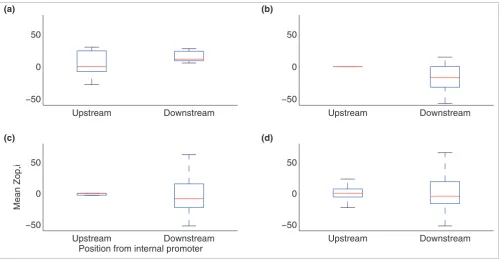
To further test the internal promoter predictions, box plots were made of the mean expression of all the operonic genes upstream and downstream of the putative internal promoter in this restricted set of S. coelicolor operons, after normaliz-ing to the first gene of the operon (Figure 5a). In total, 80% of the mean values for genes downstream of the predicted inter-nal promoter have a higher expression compared to the mean values for genes upstream, indicating enhancement of expression due to presence of the promoter (as expected). As a control, when selecting the same number of genes randomly
from all of the documented S. coelicolor operons and ran-domly splitting them into upstream and downstream genes (following 1,000 simulations) only 32% were upregulated (Figure 5b). The same trend in E. coli is not observed, with higher expression observed downstream of the internal pro-moter in 57% of cases compared to 49% in equivalent random tests (Figure 5c,d).
Internal termination could also play an important role in the control of individual gene expression within operons. Hence, one might expect NOIGs to have a greater abundance of ter-minators in their upstream regions than OIGs. The prediction of rho-dependent terminators is a difficult task due to the diversity of structures bound by the rho-factor and, therefore, only rho-independent terminators were considered here. Although rho-independent terminator prediction algorithms have been developed by several groups (for example, [25-27]) the %G+C richness of the S. coelicolor genome (approxi-mately 72%) and the phylogenetic similarity of S. coelicolor
and M. tuberculosis [12] suggested the use of GeSTer [28]. This algorithm is not dependent on the presence of a U-rich tail following a stem-loop, which might be expected to be absent in S. coelicolor. Permitting stem-loops to be sited up to 300 bases downstream of a gene's stop codon, along with GeSTer's default settings [28], resulted in 3,365 predicted terminators. Only about 8% had a U-rich tail, agreeing with expectations. We used the distance between the end of a gene and the start of the stem-loop (GDSL) as a potential metric to reduce false positives, and counted intra-operonic genes from the OIG and NOIG sets with predicted terminators in the upstream intergenic regions. Figure 6 shows the fraction of intra-operonic genes with predicted terminators within the OIG and NOIG sets, excluding the first gene in each operon, which would be expected to have a terminator upstream considering that only 27% of upstream intergenic regions in
S. coelicolor are divergent.
[image:6.612.56.562.120.207.2]Regardless of expression status, very few intra-operonic genes are predicted to have an upstream terminator (maxi-mum of about 32% when considering the entire intergenic region). The propensity of genes with predicted terminators for NOIG to OIG are shown in Figure 6, and varies between 0.5 and 2.3. The only clear signal differing from random is
Table 1
Over-represented intra-operonic genes with predicted TFBS*
Gene name Known internal promoter? Organism (reference if known)
SCO2389 (acpP) Yes Escherichia coli [61]
SCO0712 (lipR) ?
-SCO2390 (fabF) Yes Escherichia coli [61]
SCO4662 (tuf1) Yes Streptomyces ramocissimus [22]
SCO5356 (thrB) Monocistronic Streptomyces [21]
comm
en
t
re
v
ie
w
s
re
ports
refer
e
e
d
re
sear
ch
de
p
o
si
te
d r
e
se
a
rch
interacti
o
ns
inf
o
rmation
observed within 10 bases of the stop codon of the preceding gene, where OIGs have a higher propensity for predicted terminators compared to random, and the opposite effect is seen for NOIGs. Although this appears to be somewhat
coun-terintuitive, we believe this reflects the need to regulate cer-tain genes within an operon independently, which may require the presence of an internal upstream terminator and promoter, as well as a terminator downstream of the gene. This would in effect 'isolate' the gene, allowing its expression independently of the whole operon (where physiological con-ditions might dictate this). Indeed, we see a similar enrich-ment for OIGs with a higher propensity for downstream terminators too (1.7 compared to 0.7 for NOIGs). This sug-gests a more complex mechanism for the regulation and expression of some genes within operons, involving both internal transcriptional initiation and termination.
[image:7.612.56.556.85.346.2]Finally, to gain some insight into the complexity of intra-operonic gene regulation, intra-intra-operonic genes were split using a TFBS prediction threshold of mb + 5σb and a basic GDSL threshold of 0, to yield four different classes as defined in Table 2: type 1 and type 2 are likely to represent OIGs due to the presence of an upstream TFBS, given what is observed in Figure 4; type 3 are expected to be NOIGs due to the pres-ence of an upstream terminator but the abspres-ence of a putative TFBS; and type 4 should represent the majority of genes if there is to be any agreement with the basic operon model as proposed by Jacob and Monod [29]. The proportion of genes falling into each class split into OIGs and NOIGs is also shown in Table 2. Encouragingly, approximately 80% do not have a predicted TFBS or terminator site. Although this is expected Variation up and down stream of putative internal promoters
Figure 5
Variation up and down stream of putative internal promoters. Box plots of the mean expression of genes upstream and downstream of the putative internal promoter in (a) documented S. coelicolor operons using our predictions, (b) random simulations of S. coelicolor operons, (c) documented E. coli operons using experimentally known internal promoters, and (d) random simulations of E. coli operons.
Upstream Downstream
−50 0 50 (a)
Upstream Downstream
−50 0 50 (b)
Upstream Downstream
−50 0 50
Mean Zop,i
Position from internal promoter (c)
Upstream Downstream
−50 0 50 (d)
Predicted terminator propensities in operons Figure 6
Predicted terminator propensities in operons. Propensity of over-represented operonic genes (OIGs) and non-over-over-represented intra-operonic genes (NOIGs) predicted to have a terminator in their upstream intergenic region for all GDSL threshold bins compared to random. Propensities were calculated by dividing the fraction of OIGs or NOIGs with a predicted terminator by the fraction of all genes that were OIGs or NOIGs in this restricted 78 gene subset. This was done for non-inclusive 10 base-pair regions moving out from the stop codon of the previous gene. Random values were estimated by random picking from the 78 gene intra-operonic set to represent the OIG and NOIG expressed data sets, repeating 1,000 times.
10 20 30 40 50 60 70
0.4 0.6 0.8 1 1.2 1.4 1.6 1.8 2 2.2 2.4
Distance between end of gene and start of stem−loop (GDSL)
Propensity
[image:7.612.55.296.421.556.2]to be an overestimate, it is not likely to be a large one given the low false negative rate expected from use of the TFBS matri-ces (approximately 2%). Furthermore, the majority of type 4 genes are NOIGs and, therefore, have reduced expression compared to the first gene in the operon. This suggests that although internal regulation (promotion and termination) plays an important role in the control of gene expression of genes within some operons, this is by no means a universal mechanism. However, we do expect that some internal TFBSs are missed by current algorithms (about 20% of the genes classed as type 4 are upregulated, although no internal sites could be detected). It is estimated, therefore, that 'internal' gene regulation is likely to operate on 20% to 40% of operonic genes, based on the data currently available.
Interestingly, those genes that have both a TFBS and termina-tor predicted in their upstream regions (type 1) make up 9% of operonic genes and seem to be mostly upregulated, with a OIG:NOIG ratio of 1.3. This is consistent with the 'isolated' gene expression hypothesis, where both an internal promoter and terminator are required to express this gene independ-ently from the rest of the operon. In addition, there appear to be very few genes in this dataset (3%) that have a TFBS and no terminator (type 2), suggesting that genes that have an upstream TFBS site also have a terminator present, allowing for a tighter control of expression.
Conclusion
Although the co-regulation of genes in prokaryotes has been shown to be highly conserved in some cases when comparing operonic gene pairs from one organism to the regulon map of another [30], inter-species operon structure is generally not stable [1-4,31]. Instability of operons and, therefore, operonic regulation through the addition, removal, and reorganization of genes during long-term evolution as well as different phys-iological and developmental states [31] can produce a variety of control mechanisms. Furthermore, it has previously been suggested that patterns of gene co-regulation could be spe-cific to the organism or a set of closely related organisms [32]. Here we provide evidence that demonstrates large differences in the general regulatory mechanisms that S. coelicolor and E. coli use to control gene expression within operons. This is apparent through the different relative expression patterns across operons and differences in abundance of predicted
TFBSs within operons, pointing to different levels of intra-operonic gene regulation between the two species. This raises a note of caution for those attempting to predict operons through the use of expression similarity in other species. Given the dynamistic nature of orthologous genes' operonic organization and differences in their regulation, we cannot expect expression across operons to be similar either.
Operons in S. coelicolor exhibit a polarity in expression that is not observed in E. coli. When considering the minimum and maximum values obtained for each gene position within an operon (Figure 3), it could also be seen that E. coli genes have a tighter distribution of Zop,i values than S. coelicolor. However, this corresponds to a mixture of functionally equiv-alent and non-equivequiv-alent operon examples. It could be argued that equivalent operons between species that function in a similar response/pathway may have similar regulatory elements and/or expression patterns. An examination of existing comparable data sets suggests otherwise. When com-paring documented operons in E. coli and the orthologous operons in S. coelicolor (defined as containing at least one equivalent gene, yielding a total of 15 pairs matched by gene name), general expression across the operons is different (Figure 7). Using expression data from all available experimental sets, the downward 5' to 3' directionality in expression is retained in S. coelicolor operons, but is not shared by orthologous operons in E. coli. This has been observed previously when differences in the regulation of orthologous operons across many organisms were character-ized [1,30], although not from levels of expression across operons.
[image:8.612.56.557.116.199.2]The co-transcription of genes in operons allows concerted expression of gene products involved in the same response/ pathway [33,34]. However, our data demonstrates a marked polarity of expression in S. coelicolor operons. The concept of polarity is not new; as early as 1979, Ullman and colleagues [35] discussed operon polarity as a "salient feature of prokaryotic gene expression, where promoter-distal genes have reduced expression compared to promoter-proximal genes most likely caused by premature termination". This may be caused by a variety of mechanisms, including environ-mental factors, absence of termination suppressors, and the possible presence of the rho-factor [35]. A further factor is differential mRNA degradation, where genes closer to the 3'
Table 2
Classification of genes by predicted regulatory sites and fraction of OIGs and NOIGs that fall into each gene type
Type number Predicted TFBS? Predicted terminator? OIG (%) NOIG (%)
1 Y Y 5.1 3.9
2 Y N 1.3 1.3
3 N Y 2.6 7.8
comm
en
t
re
v
ie
w
s
re
ports
refer
e
e
d
re
sear
ch
de
p
o
si
te
d r
e
se
a
rch
interacti
o
ns
inf
o
rmation
end of the polycistronic transcript can be degraded more slowly than genes closer to the 5' end [36].
Although it is not clear from the data presented here which, if any, of these mechanisms is responsible for the differential patterns observed in S. coelicolor operons, it is interesting to compare gene expression differences already characterized between S. coelicolor and E. coli. S. coelicolor has an esti-mated 12.3% of 7,825 genes involved in regulation [12] whilst
E. coli has 7.2% of 4,829 genes [37], agreeing with the obser-vation that the proportion of genes involved in regulation increases with bacterial genome size [38]. Furthermore, S. coelicolor has a large number of sigma factors (65) compared to E. coli's 6. Based on these figures alone we would expect a greater diversity of regulation in S. coelicolor than in E. coli. A good example of this greater diversity in S. coelicolor is the specialization of stress regulons, where each is thought to be controlled by a specific sigma factor or multiple regulatory genes with very few induced proteins being shared between stress responses [12,39]. In contrast, in E. coli, sigma 38 (RpoS) brings on a general response to starvation, osmotic, oxidative, and heat stresses [39]. Streptomycetes inhabit highly diverse and dynamic soil and aquatic environments and, as sessile saprophytic organisms, need to constantly modulate gene expression levels to adapt to these changes and modify their metabolism appropriately. This could have led to the development of a more 'punctuated' and flexible transcriptional organization. In this context we also speculate on the potential influence of the high G+C content of Strepto-myces on the evolution of operons and intra-operon control. The topological consequences of a high G+C (72%) genome might have favored the evolution of 'operons' that can be transcribed segmentally to perhaps modulate torsional stress.
An advantage of operon structure is that, in the majority of cases, all the genes within an operon encode proteins that are needed within the same pathway/response. For S. coelicolor, where specialized responses are elicited under certain condi-tions, specialized promoters within operons would also be an
advantage. Indeed, where an increase in expression greater than the expression of the first gene in the operon is needed, we found evidence for a significant abundance of internal promoters in S. coelicolor, something not seen in E. coli.
Finally, we have shown that 60% to 80% of S. coelicolor intra-operonic genes defined in this study did not have any putative internal control sites upstream. Although this represents the majority of the operonic genes, it has serious implications for operon prediction methods. These methods often use the presence of promoters and/or terminators at the start and/or end of an operon as signals to delineate operon boundaries, and clearly in the cases of S. coelicolor this is likely to cause mis-prediction of operon membership. The consideration of internal control sites within operons has not yet been imple-mented in these approaches, and could lead to improvements for some species. Here, we have shown that the use of across-operon expression levels combined with TFBSs and termina-tor prediction is a strategy capable of allowing for such sites. Work to produce an operon prediction tool that integrates these different sources of information is on-going in our laboratory.
Materials and methods
Microarray data
Data from two-color DNA microarrays for S. coelicolor were collected from two sources: time-dependent gene expression patterns during development and antibiotic production on solid growth medium, averaged over three replicates stored in ArrayExpress [40,41] (Accession numbers: Experiment, E-MAXD-14; Arrays: A-MAXD-6, UMIST_S COELICOLOR_SC8_7337; A-MAXD-7, UMIST_S COELICOLOR_SC3_6077; A-MAXD-8, UMIST_S COELICOLOR_SC4_6884), resulting in 19 time points with expression ratios extracted from a Genespring® version 5
(Silicon Genetics) output file [42]; and 88 other experiments publicly available in the Stanford Microarray Database (SMD; Additional data file 3) [43,44] with expression ratios calcu-lated from the background-subtracted median values in each channel. In total, 145 publicly available experiments were col-lected for E. coli, using 56 from SMD (Additional data file 4) with expression ratios calculated in the same way as S. coelicolor SMD data except for mean intensities being used as medians were unavailable, and taking 89 from the E. coli gene expression database of the University of Oklahoma [45-53] (Additional data file 4) with expression ratios calculated from the available control and test values.
Positive and negative examples of operons
[image:9.612.55.296.86.215.2]Operon definitions were based on the annotated genome of E. coli K12 strain MG1655 from GenBank [54,55] [Gen-Bank:NC_000913] and the S. coelicolor chromosome (not cosmid) in EMBL [56,57] [EMBL:AL645882 version 2]. Pos-itive examples of operons were collected through searching the literature for operons in S. coelicolor (Additional data file Comparative gene expression for orthologous operons
Figure 7
Comparative gene expression for orthologous operons. Boxplot of Zop,i
scores are shown for orthologous operons, where at least one gene is the same in a documented S. coelicolor compared to E. coli. Data are shown in E. coli (EC) and S. coelicolor (SC) using all available experiments.
EC1 EC2 EC3 EC4 EC5 SC1 SC2 SC3 SC4 SC5 −120
−100 −80 −60 −40 −20 0 20 40 60
Z,opi
5) and from the transcriptional unit annotation in EcoCyc for
E. coli [58,59] (Additional data file 6). Negative examples of operons were collected from knowledge of basic operon struc-ture applicable to both organisms (Figure 8). Assuming that the entire polycistronic transcript is documented, non-oper-ons of length 2 were formed by using the initial gene of the operon and its upstream neighboring gene if that neighbor is transcribed in the same direction (for example, gene pair d-e), and the last gene in the documented operon and its down-stream neighboring gene, again if it is transcribed in the same direction (for example, gene pair g-h). To increase the size of the non-operonic data set a non-operon of length 3 was also formed by collecting triplets of genes that are transcribed in the opposite direction (for example, genes b-c-d). In total, 35 operons and 1,282 non-operons were collected for S. coeli-color, and 325 operons and 821 non-operons were collected for E. coli.
TFBS prediction
Lists of putative TFBSs for both S. coelicolor and E. coli were collected by searching upstream intergenic regions for over-represented dimers using the method of Li et al. [18], search-ing against the same E. coli K12 strain MG1655 from GenBank [54,55] and S. coelicolor chromosome from EMBL [56,57]. This method defines putative TFBSs as PSWMs for each puta-tive site, based on the statistical over-representation of dimeric words (dyads) in defined sequence sets. Our imple-mentation of this method yielded slightly different results from the published ones; however, we used both sets of TFBSs for E. coli - the published TFBSs of Li et al. [18], giving 849 putative sites, and the TFBSs collected with our imple-mentation of Li et al.'s method [18], resulting in 1,506 puta-tive sites. Comparisons between the two data sets were performed and we were able to find all of those published by Li et al. [18] plus additional sites and we therefore use this as an alternative set. For S. coelicolor, a TFBS list was built by searching upstream of all genes on the chromosome and applying the same method [60], resulting in 3,628 putative sites defined by PSWMs. Here we define 'upstream' as the maximum of 300 nucleotides or the intergenic distance to the stop codon of the previous gene. Previous work applying a similar approach on S. coelicolor [60] reported 2,497 putative TFBSs. However, using dyad word lengths of 3 to 5 nucle-otides instead of 4 nuclenucle-otides results in additional matrices, as well as all of the matrices found previously [60].
Hence, for each putative TFBS the defining sequences can be matched back against the PSWM, resulting in a mean score
md with standard deviation σd. Similarly, a mean score mb
with standard deviation σb is obtained matching the PSWM
against background sequences (all upstream sequences) as described in Li et al. [18]. For a sequence to be predicted to contain a given TFBS, the score of the sequence against the PSWM must be higher than md - 2σd and mb + xσb, where x is used to represent trials of different thresholds as discussed later in this report; since this is the only part of the threshold that changes, the TFBS prediction threshold used will be rep-resented by mb + xσb.
Normalization of microarray data
A per-chip normalization strategy was used throughout. This was found to be the best normalization strategy with regards to operon prediction, since the general trajectory of expres-sion is retained. Hence, all log2 expression ratios for each experiment in the microarray data sets collected for S. coeli-color and E. coli were calculated as follows:
We define the expression level of each gene in a given operon of m genes as gi for i = 1, m. As the first gene of an operon (g1) is the first to be transcribed it is expected that the transcrip-tion level of the downstream genes should be equal to the expression of g1 (given the expectation that they are co-tran-scribed in a single polycistronic unit) and, therefore, the expression level of g1 is taken as a representative of the operon's expression level (µop,1). Using all available
experi-ments (j) µop,1 is calculated by:
Where n = total number of experiments (107 for S. coelicolor
and 145 for E. coli). µop,1 has a standard deviation associated
with it (σop,1):
Each gene in an operon (gi) can then be expressed as a Z-score, normalizing its value of expression compared to the
µop,1, Zop,i can then be calculated:
[image:10.612.58.299.89.166.2]The Z-score provides a simple metric that measures the expression level of genes in an operon with respect to the first, Examples of positive and control sets of operons/non-operons
Figure 8
Examples of positive and control sets of operons/non-operons.
b
a c d e f g h i
Non-operon Non-operon
Known operon Known operon Non-operon Non-operon
Non-operon
b
a b c d e f g h i
a b c d e f g h i
a c d e f g h i
Non-operon Non-operon
Known operon Known operon Non-operon Non-operon
Non-operon
gi j, =log (2 expression ratio of_ _ _gene i in experiment_j_ _ _ Median __of all expression ratios in experiment_j_ _ _ _ _ )
µop
j j
n g
n ,
,
1 1 0 =
∑
=σop i j µop
j
n g
n
, , ,
( )
1 1
2
0 1
= −
− =
∑
Z
g n
op i op i op op
i j j
n
op
op
, , ,
,
, ,
, /
= − =
− =
∑
µ µ σ
µ
σ
1
1
0 1
comm en t re v ie w s re ports refer e e d re sear ch de p o si te d r e se a rch interacti o ns inf o rmation
with an expectation that genes should have small Z-scores close to 0 if the measured expression of every gene in an operon is truly uniform. In addition, this procedure facilitates cross-operon comparison by normalizing the expression of the first gene in every operon to 0.
Additional data files
The following additional data are available with the online version of this paper. Additional data file 1 lists 65 E. coli
genes found in our constructed data set of operons that have an experimentally validated upstream internal promoter. Additional data file 2 comprises two tables: the top table describes OIGs in E. coli found to have a putative TFBS site using our own PSWMs, their Zop,i score (in comparison to the first gene of the respective operon) and whether they are experimentally known (or computationally predicted); the bottom table describes E. coli OIGs predicted to have an upstream internal promoter using Li et al. [18] matrices. Additional data file 3 lists the SMD Experiment IDs used for
S. coelicolor. Additional data file 4 lists the Oklahoma data-base experiment IDs and SMD Experiment IDs used for E. coli. Additional data file 5 documents experimentally vali-dated operons used in this analysis for S. coelicolor. Addi-tional data file 6 documents experimentally validated operons used in this analysis for E. coli.
Additional File 1
Sixty-five E. coli genes found in our constructed data set of operons that have an experimentally validated upstream internal promoter Sixty-five E. coli genes found in our constructed data set of operons that have an experimentally validated upstream internal promoter. Click here for file
Additional File 2
OIGs in E. coli found to have a putative TFBS site and predicted to have an upstream internal promoter
The top table describes OIGs in E. coli found to have a putative TFBS site using our own PSWMs, their Zop,i score (in comparison to the first gene of the respective operon) and whether they are exper-imentally known (or computationally predicted); the bottom table describes E. coli OIGs predicted to have an upstream internal pro-moter using Li et al. [18] matrices.
Click here for file Additional File 3
SMD Experiment IDs used for S. coelicolor SMD Experiment IDs used for S. coelicolor. Click here for file
Additional File 4
Oklahoma database experiment IDs and SMD Experiment IDs used for E. coli
Oklahoma database experiment IDs and SMD Experiment IDs used for E. coli.
Click here for file Additional File 5
Experimentally validated operons used in this analysis for S. coelicolor
Experimentally validated operons used in this analysis for S. coelicolor.
Click here for file Additional File 6
Experimentally validated operons used in this analysis for E. coli Experimentally validated operons used in this analysis for E. coli. Click here for file
Acknowledgements
E.L. was the recipient of a MRC Priority PhD Studentship in Bioinformatics. This work was partly supported by grants from the BBSRC (to CPS).
References
1. Dandekar T, Snel B, Huynen M, Bork P: Conservation of gene order: a fingerprint of proteins that physically interact. Trends Biochem Sci 1998, 23:324-328.
2. Itoh T, Takemoto K, Mori H, Gojobori T: Evolutionary instability of operon structures disclosed by sequence comparisons of complete microbial genomes. Mol Biol Evol 1999, 16:332-346. 3. Mushegian AR, Koonin EV: Gene order is not conserved in
bac-terial evolution. Trends Genet 1996, 12:289-290.
4. Snel B, Bork P, Huynen MA: Conservation of gene co-regulation in prokaryotes and eukaryotes. Trends Biotechnol 2002, 20:410. 5. Salgado H, Moreno-Hagelsieb G, Smith TF, Collado-Vides J: Operons
in Escherichia coli: Genome analyses and predictions. Proc Natl Acad Sci 2000, 97:6652-6657.
6. Yada T, Nakao M, Totoki Y, Nakai K: Modelling and predicting transcriptional units of Escherichia coli genes using hidden markov models. Bioinformatics 1999, 15:987-993.
7. de Hoon MJL, Imoto S, Kobayashi K, Ogasawara N, Miyano S: Pre-dicting the operon structure of Bacillus subtilis using operon length, intergene distance, and gene expression information. In Proceedings of the Ninth Pacific Symposium on Biocomputing: January 6-10 2004; Hawaii Edited by: Altman RB, Dunker AK, Hunter L, Jung TA. Klein TE: World Scientific; 2004:276-287.
8. Sabatti C, Rohlin L, Oh M, Liao JC: Co-expression pattern from DNA microarray experiments as a tool for operon prediction. Nucleic Acids Res 2002, 30:2886-2893.
9. Bockhorst J, Craven M, Page D, Shavlik J, Glasner J: A Bayesian net-work approach to operon prediction. Bioinformatics 2003, 19:1227-1235.
10. Bockhorst J, Qiu Y, Glasner J, Liu M, Blattner F, Craven M: Predict-ing bacterial transcriptional units usPredict-ing sequence and expression data. Bioinformatics 2003:i34-i43.
11. Craven M, Page D, Shavlik J, Bockhorst J, Glasner J: A probabilistic learning approach to whole-genome operon prediction. In Proceedings of the 8th International Conference on Intelligent Systems for Molecular Biology (ISMB): August 19-23 2000; San Diego Edited by: Bourne P, Gribskov M, Altman R, Jensen N, Hope D, Lengauer T, Mitchell J, Scheeff E, Smith C, Strande S, et al. American Association for Artificial Intelligence Press; 2000:116-127.
12. Bentley SD, Chater KF, Cerdeño-Tárraga AM, Challis GL, Thomson NR, James KD, Harris DE, Quail MA, Kieser H, Harper D, et al.: Complete genome sequence of the model actinomycete Streptomyces coelicolor A3(2). Nature 2002, 417:141-147. 13. Hoogvliet G, van Wezel GP, Krall B: Evidence that a single EF-Ts
suffices for the recycling of multiple and divergent EF-TU species in Streptomyces coelicolor A3(2) and Streptomyces ramocissimus. Microbiology 1999, 145:2293-2301.
14. Price MN, Huang KH, Alm E, Arkin AP: A novel method for accu-rate operon predictions in all sequenced prokaryotes. Nucleic Acids Res 2005, 33:880-892.
15. Thieffry D, Salgado H, Huerta AM, Collado-Vides J: Prediction of transcriptional regulatory sites in the complete genome sequence of Escherichia coli K-12. Bioinformatics 1998, 14:391-400.
16. Wek RC, Hatfield GW: Examination of the internal promoter, PE, in the ilv GMEDA operon of E. coli K-12. Nucleic Acids Res 1986, 14:2763-2777.
17. Le Dantec L, Bové JM, Saillard C: Gene organisation and tran-scriptional analysis of the Spiroplasma citri rsp B/tsf/x operon. Curr Microbiol 1998, 37:269-273.
18. Li H, Rhodius V, Gross C, Siggia ED: Identification of the binding sites of regulatory proteins in bacterial genomes. Proc Natl Acad Sci 2002, 99:11772-11777.
19. Paget MSB, Leibovitz E, Buttner MJ: A putative two-component signal transduction system sE, a sigma factor required for normal cell wall integrity in Streptomyces coelicolor A3(2). Mol Microbiol 1999, 33:97-107.
20. Le Dantec L, Castroviejo M, Bové JM, Saillard C: Purification, clon-ing, and preliminary characterisation of a Spiroplasma citri ribosomal protein with DNA binding capacity. J Biol Chem 1998, 273:24379-24386.
21. Fernández M, Cuadrado Y, Reico E, Aparicio JF, Martin JF: Charac-terisation of the hom-thrC-thrB cluster in aminoethoxyvi-nylglycine-producing Streptomyces sp. NRRL 5331. Microbiology 2002, 148:1413-1420.
22. Tieleman LN, van Wezel GP, Bibb MJ, Kraal B: Growth phase-dependent transcription of the Streptomyces ramocissimus tuf 1 gene occurs from two promoters. J Bacteriol 1997, 179:3619-3624.
23. RegulonDB [http://regulondb.ccg.unam.mx/]
24. Salgado H, Gama-Castro S, Peralta-Gil M, Diaz-Peredo E, Sanchez-Solano F, Santos-Zavaleta A, Martinez-Flores I, Jimenez-Jacinto V, Bonavides-Martinez C, Segura-Salazar J, et al.: RegulonDB (version 5.0): Escherichia coli K-12 transcriptional regulatory network, operon organization, and growth conditions. Nucleic Acids Res 2006, 34:D394-D397.
25. d'Aubenton Carafa Y, Brody E, Thermes C: Prediction of rho-inde-pendent Escherichia coli transcription terminators. A statistical analysis of their RNA stem-loop structures. J Mol Biol 1990, 216:835-858.
26. Ermolaeva MD, Khalak HG, White O, Smith HO, Salzberg SL: Pre-diction of transcription terminators in bacterial genomes. J Mol Biol 2000, 301:27-33.
27. Macke T, Ecker DJ, Gutell R, Gautheret D, Case D, Sampath R: RNAMotif, an RNA secondary structure definition and search algorithm. Nucleic Acids Res 2001, 29:4724-4735. 28. Unniraman S, Prakash R, Nagaraja V: Conserved economics of
transcription termination in eubacteria. Nucleic Acids Res 2002, 30:675-684.
29. Jacob F, Monod J: Genetic regulatory mechanisms in the syn-thesis of proteins. J Mol Biol 1961, 3:318-356.
30. Snel B, van Noort V, Huynen MA: Gene co-regulation is highly conserved in the evolution of eukaryotes and prokaryotes. Nucleic Acids Res 2004, 32:4725-4731.
31. Xie G, Keyhani NO, Bonner CA, Jensen RA: Ancient origin of the tryptophan operon and the dynamics of evolutionary change. Microbiol Mol Biol Rev 2003, 67:303-342.
drive the evolution of gene clusters. Genetics 1996, 143:1843-1860.
34. Price MN, Huang KH, Arkin AP, Alm E: Operon formation is driven by co-regulation and not by horizontal gene transfer. Genome Res 2005, 15:809-819.
35. Ullmann A, Joseph E, Danchin A: Cyclic AMP as a modulator of polarity in polycistronic transcriptional units. Proc Natl Acad Sci USA 1979, 76:3194-3197.
36. Selinger DW, Saxena RM, Cheung KJ, Church GM, Rosenow C: Glo-bal RNA Half-life analysis in Escherichia coli reveals positional patterns of transcript degradation. Genome Res 2003, 13:216-233.
37. Pérez-Rueda E, Collado-Vides J: The repertoire of DNA-binding transcriptional regulators in Escherichia coli K-12. Nucleic Acids Res 2000, 28:1838-1847.
38. Stover CK, Pham XQ, Erwin AL, Mizoguchi SD, Warrener P, Hickey MJ, Brinkman FSL, Hufnagle WO, Kowalik DJ, Lagrou M, et al.: Com-plete genome sequence of Pseudomonas aeruginosa PA01, an opportunistic pathogen. Nature 2000, 406:959-964.
39. Vohradsky J, Li XM, Dale G, Folcher M, Nguyen L, Viollier PH, Thompson CJ: Developmental control of stress stimulons in Streptomyces coelicolor revealed by statistical analyses of glo-bal gene expression patterns. J Bacteriol 2000, 182:4979-4986. 40. ArrayExpress [http://www.ebi.ac.uk/arrayexpress/]
41. Parkinson H, Sarkans U, Shojatalab M, Abeygunawardena N, Contrino S, Coulson R, Farne A, Garcia Lara G, Holloway E, Kapushesky M, et al.: ArrayExpress-a public repository for microarray gene expression data at the EBI. Nucleic Acids Res 2005, 33:D553-D555.
42. Mersinias V: DNA microarray-based analysis of gene expres-sion in Streptomyces coelicolor A3(2) and Streptomyces livi-dans. In PhD thesis University of Manchester Institute of Science and Technology, Department of Biomolecular Sciences; 2004.
43. Stanford Microarray Database [http://genome-www5.stan ford.edu]
44. Gollub J, Ball CA, Binkley G, Demeter J, Finklestein DB, Hebert JM, Hernandez-Boussard T, Jin H, Kaloper M, Matese JC, et al.: The Stanford Microarray Database: data access and quality assessment tools. Nucleic Acids Res 2003, 31:94-96.
45. University of Oklahoma E. coli Gene Expression Database [http://chase.ou.edu/macro]
46. Chang DE, Smalley DJ, Conway T: Gene expression profiling of Escherichia coli growth transitions: an expanded stringent response model. Mol Microbiol 2002, 45:289-306.
47. Chang DE, Smalley DJ, Tucker DL, Leatham MP, Norris WE, Steven-son SJ, AnderSteven-son AB, Grissom JE, Laux DC, Cohen PS, Conway T: Carbon Nutrition of E. coli in the Mouse Intestine. Proc Natl Acad Sci USA 2004, 101:7427-7432.
48. Ma Z, Richard H, Tucker DL, Conway T, Foster JW: Collaborative regulation of Escherichia coli Glutamate-dependent acid resistance by two Arac-like regulators, GadX and GadW (YHiW). J Bacteriol 2002, 184:7001-7012.
49. Ma Z, Gong S, Richard H, Tucker DL, Conway T, Foster JW: GadE (YhiE) activates glutamate decarboxylase-dependent acid resistance in Escherichia coli K-12. Mol Microbiol 2003, 49:1309-1320.
50. Tao H, Bausch C, Richmond C, Blattner FR, Conway T: Functional genomics: Expression analysis of Escherichia coli growing on minimal and rich media. J Bacteriol 1999, 181:6425-6440. 51. Tucker DL, Tucker N, Conway T: Gene expression profiling of
the pH response in Escherichia coli. J Bacteriol 2002, 184:6551-6558.
52. Tucker DL, Tucker N, Ma Z, Foster JW, Miranda RL, Cohen PS, Con-way T: Genes of the GadX-GadW regulon in Escherichia coli. J Bacteriol 2003, 185:3190-3201.
53. Wolfe AJ, Chang D, Walker JD, Seitz-Partridge JE, Vidaurri MD, Lange CF, Prüß BM, Henk MC, Larkin JC, Conway T: Evidence that acetyl phosphate functions as a global signal during biofilm development. Mol Microbiol 2003, 48:977-988.
54. GenBank [http://www.ncbi.nlm.nih.gov/Genbank]
55. Benson DA, Karsch-Mizrachi I, Lipman DJ, Ostell J, Wheeler DL: GenBank: update. Nucleic Acids Res 2004, 32:D23-D26. 56. EMBL [http://www.ebi.ac.uk/embl]
57. Kanz C, Aldebert P, Althorpe N, Baker W, Baldwin A, Bates K, Browne P, van der Broek A, Castro M, Cochrane G, et al.: The EMBL Nucleotide Sequence Database. Nucleic Acids Res 2005, 33:D29-D33.
58. EcoCyc [http://ecocyc.org]
59. Keseler IM, Collado-Vides J, Gama-Castro S, Ingraham J, Paley S, Paulsen IT, Peralata-Gil M, Karp PD: EcoCyc: A comprehensive database resource for Escherichia coli. Nucleic Acids Res 2005, 33:D334-D337.
60. Studholme DJ, Bentley SD, Kormanec J: Bioinformatic identifica-tion of novel regulatory DNA sequence motifs in Streptomy-ces coelicolor. BMC Microbiol 2004, 4:14.
![Figure 4Predicted TFBS abundance in operons[17] TFBS prediction on documented Predicted TFBS abundance in operons](https://thumb-us.123doks.com/thumbv2/123dok_us/8669556.872246/5.612.56.555.87.347/figure-predicted-abundance-operons-prediction-documented-predicted-abundance.webp)