International Journal of Emerging Technology and Advanced Engineering
Website: www.ijetae.com (ISSN 2250-2459,ISO 9001:2008 Certified Journal, Volume 4, Issue 3, March 2014)
750
Performance of Turbo Product Code Decoding in Wireless
Communication
Amruta P. Pokhare
1, Trushita Chaware
2, Rajesh Bansode
31Lecturer, Department of Information and Technology, Atharva College of Engineering,
Mumbai University, Malad (W), Mumbai - 400101, India
2
Assistant Professor, Department of Electronics and Telecommunication, MIT College of Engineering, Kothrud, Pune - 411038, India
3Assistant Professor, Department of Information and Technology, Thakur College of Engineering &Technology,
Mumbai University, Kandivali (E), Mumbai - 400101, India
Abstract—In this paper, the effect of TPC decoding using Chase-II algorithm with reduced number of test patterns (TPs) is evaluated using the AWGN channel in orthogonal frequency division multiplexing (OFDM) mode. The TPC is constructed with multi-error-correcting extended Bose-Chaudhuri-Hocquengem (eBCH) codes. TPs are classified into different conditions based on the relationship between syndromes and the number of errors so that TPs with the same codeword are not decoded except the one with the least number of errors. The parameters considered are bit error rate (BER), Eb/N0, data rate and code rate.
The research contribution shows that the percent of TPs need to be decoded for eBCH(128, 113, 2) when p = 2 for 1st iteration it is between 22% - 16% and from 5th iteration onwards it is between 14% - 12% for SNR = 1.5dB, 1.8dB, 2.0dB, 2.2dB, 2.4dB and 2.5dB in 802.16 system, respectively. This research contribution helps to make the 802.16 systems simpler, reduces the decoding time, complexity and improves the performance.
Keywords— 802.16 system, Chase II algorithm, extended BCH codes, test patterns, turbo product codes.
I. INTRODUCTION
802.16 is commonly called as Worldwide
Interoperability for Microwave access (Wi-MAX). It provides specifications for both fixed line of sight (LOS) communication in the range of 10 - 66GHz (802.16c) and fixed portable nonLOS communication in the range of 2 -11GHz (802.16a, 802.16d). Also it defines wireless communication for mobiles, moving at speed of 125 kmph, in the range of 2 - 6 GHz (802.16e). Earlier single carrier multiplexing was used, which faced a major limiting factor of inter symbol interference (ISI). The 802.16e is well
implemented with Orthogonal Frequency Division
Multiplexing (OFDM) as its physical layer scheme as an alternative for the single carrier multiplexing [1]. Hence, the implementation of 802.16e OFDM systems is done.
Efficient communication systems permit a high rate of information to be communicated with the lowest possible power. Commonly used error correcting codes for a wireless medium are Convolutional Turbo Codes (CTC). TPC is used instead of CTC. TPC with eBCH as a constituent code provides further benefits because eBCH codes are decoded easily using the syndrome method and it is used for multiple random error correction. A general comparison for parameters of CTC and TPC is as follows.
In terms of code rate, CTCs perform best for low code rate applications whereas TPCs perform best for high code rate applications [2]. In terms of data rate, CTCs will have difficulty achieving high data rates whereas TPCs operate at high data rates [2]. In terms of error floor, CTCs exhibit error floor at BERs below 10-5 whereas TPCs error floor is less pronounced and at lower BER values [2].
TPC provides a performance/complexity trade off and is effectivelyused in the latest wireless applications to its best capacity. TPC’s have been used with hamming code as constituent coding for various wireless communication applications. TPC using hamming code is been proposed as an optional coding scheme in the 802.16 standard. TPC with BCH code in 802.16 systems is area where work is in progress. Promising features of TPC and BCH codes has led to the motivation to explore its implications in 802.16 systems.
International Journal of Emerging Technology and Advanced Engineering
Website: www.ijetae.com (ISSN 2250-2459,ISO 9001:2008 Certified Journal, Volume 4, Issue 3, March 2014)
751 In Chase Pyndiah Algorithm [3], the number of Test Pattern (TP) increases with the number of least reliable bits and where all the TP’s are to be decoded. Due to the need of high code rate and less decoding complexity, TP reduction technique is needed in the implication of 802.16 systems.
This paper proposes the use of TPC for the purpose of error correction in 802.16 systems. To achieve high code rate with less decoding complexity, a method to reduce the number of test patterns (TPs) [4] decoded in the Chase-II algorithm constructed with multi-error-correcting extended Bose-Chaudhuri-Hocquengem (eBCH) codes is been used during the implementation of 802.16 systems.
The rest of this letter is organized as follows. In Section II, the proposed method is briefly described. Then in Section III the implementation of the Chase-II algorithm for TPC decoding is briefly described. Then, the TP reduction technique is explained in detail. In Section IV, the complexity reduction in TPs is studied through simulations. Finally, conclusions are drawn in Section V, followed by the acknowledgment and references.
II. PROPOSED METHOD
Error correction technique plays a very important role in
wireless communication. Various channel coding
techniques are used to detect and correct the errors at the receiver side. Turbo product code is one of the powerful error correcting technique which is used in Wireless Communication. This paper proposes the use of TPCs for encoding and decoding. As stated in the introduction TPC performs best for high code rate and high data rate applications without any error floor. It also is a low cost method with simplified decoding and has low power consumption.
The implementation of 802.16 systems with a method to reduce the number of TPs decoded in the Chase-II algorithm for TPCs constructed with
multi-error-correcting extended Bose-Chaudhuri-Hocquengem
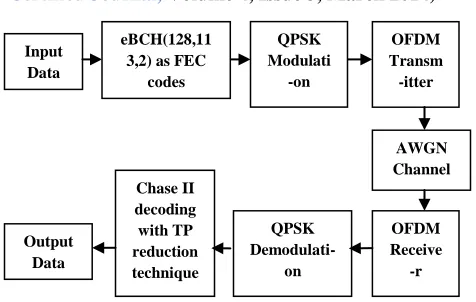
(eBCH) codes is studied. The block diagram of proposed system is as shown in Fig 1. The input data is generated randomly of block size 113 X 113. The eBCH(128,113,2) where p = 2 is used as a forward error correcting (FEC) codes at the time of encoding.
[image:2.612.321.559.128.279.2]The encoded data of block size 128 X 128 is modulated using QPSK modulation technique. The modulated data is then transmitted over AWGN channel in OFDM mode. The TPC decoding is done using Chase II algorithm with TP reduction technique to obtain the output data as shown in Fig 1, respectively.
Figure 1 Block diagram of proposed system
III. CHASE DECODING WITH TPREDUCTION FOR TPC Assume C = (cep, c0, · · · , cn−1) is a column or a row
of a 2-D TPC built with eBCH(n+1, k, t), where ci Є
{0,1}, i = 0,···,n − 1,cep = c0⊕ c1⊕ · · · ⊕ cn−1, and ⊕ is the exclusive OR operation. When C is transmitted over an additive white Gaussian noise (AWGN) channel with the BPSK assumption {0 → +1, 1 → −1}, the corrupted version, R = (rep, r0,···,rn−1), is obtained at
the receiver. Then, from R, the hard-decision Y = (yep,
y0, · · ·, yn−1) and p LRB positions, j0, j1, ··· ,jp−1, are
obtained.
Here, assume that rep is not one of the LRBs. In the
Chase-II algorithm, 2p test patterns are formed by setting 0 or 1 in the LRB positions and 0 in other positions.
Through the operation of exclusive OR between Y and each TP, 2p test sequences (TSs) are then obtained. Because one TP forms one TS, “TP” and “TS” are used interchangeably hereafter. The aim of the Chase-II algorithm is to find the maximum likelihood codeword among all the codewords decoded from these TSs and the extrinsic information for each decoded bit.
In the following subsection A, a brief description of Chase-II algorithm for TPC decoding [4], where the calculation of syndromes, even parity and metrics follows the method in [5], but with extension to t = 2. And then a TP reduced decoding method [4].
A. Chase-II algorithm for TPC decoding
Since one TP is different from some other TPs in only one bit position, syndromes, even parity and metrics are calculated recursively. Therefore, it is necessary to initialize the syndromes, even parity and metric of the first TP (TP0) which is mentioned in equation 1, 2, 3, 4 and 5
respectively.
OFDM Transm -itter Input
Data
QPSK Modulati
-on eBCH(128,11
3,2) as FEC codes
AWGN Channel Chase II
decoding with TP reduction technique
QPSK
Demodulati-on
OFDM Receive
-r Output
International Journal of Emerging Technology and Advanced Engineering
Website: www.ijetae.com (ISSN 2250-2459,ISO 9001:2008 Certified Journal, Volume 4, Issue 3, March 2014)
752
S01 = y0 ⊕y1x ⊕···⊕yn−1xn−1|x=α, (1)
S03 = y0⊕y1x ⊕···⊕yn−1xn−1|x=α3, for eBCH2, (2)
S05 = y0⊕ y1x ⊕···⊕yn−1xn−1|x=α5, for eBCH3. (3)
Even parity: P0 = yep⊕ y0⊕ y1⊕ · · · ⊕ yn−1. (4)
Metric: l0 = 0 (5)
S 12b +j = Sj1⊕ αjb , (6)
S3 2b +j = Sj3⊕ α3jb , for eBCH2, (7)
S5 2 b
+j = Sj
5⊕
α5jb , for eBCH3, (8)
P2b +j = Pj⊕ 1, (9)
l2b +j = lj − (2yjb − 1) rjb (10)
Where j = 0, · · · , 2b, and b = 0, · · · , p − 1; α is the primitive element of GF (2m) that generates the coding polynomial; jb is the only bit position that TP2
b
+j differs
from TPj . Only relative metrics lj are calculated in the
above, because they are enough to find the maximum likelihood codeword and to evaluate extrinsic information [3], [6]. Sj
2
, Sj 4
and Sj 6
need not to be calculated due to the fact that Sj2 = (Sj1)2, Sj4 = (Sj1)4, and Sj6 = (Sj3)2.
The above recursive calculation is the key point in [7], [5], the TP decoding complexity is not considered because the codewords determined from syndromes for the single-EC eBCH component codes. However, when multi-EC eBCH codes are considered, the process to find the error locator polynomial and error positions according to the syndromes requires many more operations [8].
For a TP (≠TP0) who’s syndromes and even parity
updating needs only one addition operation each, this decoding process dominates the complexity. Furthermore, once a codeword is obtained, the metric of corresponding TPs also need to be updated at the corrected error positions. As a result, reducing the number of TPs for the processes of codeword decoding and metric updating is important for TPCs with multi-EC components codes and is the focus of reference [4]. With the decoded codewords and their metrics, then the extrinsic information is evaluated from any one method from [3], [6]. In this paper, the method of [3] is adopted for extrinsic information calculation.
B. TPC Decoding with TP Reduction
Suppose there are bit errors located at some LRB positions for particular TS. Then, there must be different TS which has no errors at the LRB positions because all possible variations in LRBs are enumerated by TPs.
These two TSs may produce the same codeword after decoding, while the decoding complexity of the latter TS is smaller. Some other TSs may also be decoded to the same codeword as long as the EC capability t is larger than the number of errors in those TSs.
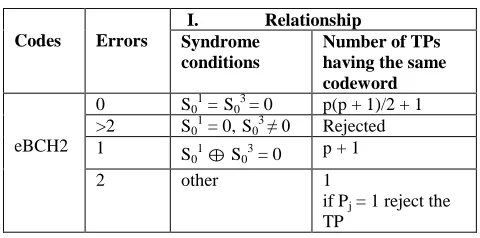
In order to reduce the decoding complexity, first find one TP with the least number of errors and then reject other TPs that have the same codeword upon decoding. The representation of syndromes reveals the possible number of errors in TPs as shown in Table 1.
Later obtain and list this relationship and the number of TPs with the same codeword. For example, with eBCH2, when a TP has syndromes satisfying the first condition without errors, then all TPs that have one bit or two bits different from the found TP will have the same codeword. TPs having errors greater than the EC capacity are not decoded and rejected directly. Some TPs are also rejected by checking the even parity.
When the last condition as mentioned in Table 1 [4], is encountered in eBCH2 codes but the even parity value is 1 that means there are actually more than two errors existing. It is beyond the EC capacity of the eBCH2 codes. Therefore, such TP is also rejected directly.
In existing methods syndromes and even parity are immediately used for error correction after they have been calculated. While in [4], the representation of syndromes and the values of even parity are exploited to classify TPs before the start of error correction process.
TABLE I
SYNDROMES, THE NUMBER OF ERRORS AND THE NUMBER OF TPS WITH THE SAME CODEWORDS FOR EXTENDED BCH2
Codes Errors
I. Relationship Syndrome
conditions
Number of TPs having the same codeword
eBCH2
0 S01 =S03 = 0 p(p + 1)/2 + 1
>2 S01 = 0,S03 ≠ 0 Rejected
1 S
0
1⊕
S0 3
= 0 p + 1
2 other 1
if Pj = 1 reject the
TP
[image:3.612.324.564.493.612.2]International Journal of Emerging Technology and Advanced Engineering
Website: www.ijetae.com (ISSN 2250-2459,ISO 9001:2008 Certified Journal, Volume 4, Issue 3, March 2014)
753 Then, directly reject all other TPs whose number of bit difference in LRBs compared with the found TP is within the EC capability t. All these TPs shall generate the same codeword when decoded.
After the first condition has been checked and processed, the remaining TPs are checked according to the next condition and certain TPs are rejected from decoding algorithm. It needs to be pointed out that this checking process, though actually binary comparisons, does not cause any additional cost. This is because in the conventional eBCH decoding of each TS, these conditions also need to be considered.
In [4], since checking one condition is conducted only for the remaining TPs after processing previous conditions, this process in fact reduces the comparison cost and is beneficial with large complexity reduction in TP decoding.
Example:
For number of coded bits n = 7, number of information bits k = 4, error correction capacity t = 1, m = 3 and n = 2m – 1. Assume, message bits = 1 1 1 1.Transmitted code for this message is received code = 1 1 1 1 1 1 1. Assume error is at last bit, hence the received code is received code1 =1 1 1 1 1 1 0.
Let’s assume the number of least reliable bits (LRB) positions be p = 2. Assuming 1st and 2nd bits as LRB positions, then following are the test patterns (TPs) generated:
TP0 = 0 0 0 0 0 0 0
TP1 = 0 1 0 0 0 0 0
TP2 = 1 0 0 0 0 0 0
TP3 = 1 1 0 0 0 0 0
Now, generating the test sequences (TSs). TSs is nothing but the EX - OR of TPs with the received codewords, as shown below.
TSs = receivedcode1 ⊕TPs
Therefore,
TS0 = 1 1 1 1 1 1 0
TS1 = 1 0 1 1 1 1 0
TS2 = 0 1 1 1 1 1 0
TS3 = 0 0 1 1 1 1 0
Considering GF (2m) = GF (23) = GF (8) where generator polynomial is α3
+ α + 1 = 0. According to equation 1 and equation 2 syndromes for TS0 are calculated
as follows:
S01 = α + α2 + α3 + α4 + α5 + α6
S01 = α + α2 + α +1 + α2 + α + α2 + α + 1+ α2 + 1
S0 1
= 1
S03 = α3 + α6 + α9 + α12 + α15 + α18
S03 = α + 1 + α2 + 1 + α2 + α2 + α + 1 + α + α2 + α
S03 = 1
According to Table 1 conditions the 1st condition (number of errors is equal to 0) S01 = S03 = 0 is not
satisfied. The 2nd condition (number of errors are greater than 2) S01 = 0, S03 ≠ 0 is not satisfied. 3rd condition
(number of errors is equal to 1) S01⊕ S03 = 0 (1 ⊕ 1 = 0)
is satisfied. Since 3rd condition is satisfied no need to check 4th condition. Therefore, TS0 is decoded to get the correct
bits = 1 1 1 1 1 1 1 respectively.
IV. SIMULATION RESULTS
The simulated results shows the implications of using TPC with constituent code of eBCH(128,113,2) as a FEC in an 802.16e systems. To achieve high code rate with less decoding complexity, a method to reduce the number of test patterns (TPs) decoded in the Chase-II algorithm constructed with multi-error-correcting extended Bose-Chaudhuri-Hocquengem (eBCH) codes [4] is been used during the implementation of 802.16 systems. The parameters set for the systems where k = 113 and n = 128 as mentioned in Table 2.
TABLEII
TPC IN 802.16SYSTEMS PARAMETERS
Modulation Data Block Size (k x k)
Coded Block Size (n x n)
Code Rate
QPSK 12769 bits 16384 bits 0.779
In this paper, there are total two simulation results drawn, out off which one result represents the percent of TPs decoded for eBCH (128, 113, 2) when p = 2 for SNR 1.5dB, 1.8dB, 2.0dB, 2.2dB, 2.4dB and 2.5dB in 802.16 systems as shown in Figure 2.
International Journal of Emerging Technology and Advanced Engineering
Website: www.ijetae.com (ISSN 2250-2459,ISO 9001:2008 Certified Journal, Volume 4, Issue 3, March 2014)
[image:5.612.71.268.150.402.2]754
Figure 2. Percent of TPs decoded when p= 2 for TPCs constructed with eBCH(128,113,2) in 802.16 systems. Curves from top to bottom are for SNR = 1.5dB, 1.8dB, 2.0dB, 2.2dB and 2.5dB, respectively.
In comparison with the simulation results of reference [4], this papers simulated results indicate that for one block size of 128 X 128, 22% of TPs are actually decoded at the 1st iteration for SNR 1.5dB. The percentage of TPs being decoded decreases dramatically with the increase of iteration number as well as the increase of SNR. At 1st iteration the percent of TPs decoded are 20%, 19%, 18%, 16% for SNR 1.8dB, 2dB, 2.2dB, 2.5dB respectively as shown in Figure 2. And from 5th iteration onwards the percent of TPs decoded are between 14% - 12% for SNR 1.5dB, 1.8dB, 2.0dB, 2.2dB, 2.4dB and 2.5dB, respectively.
The need of using complex interleaver as in case of CTC and doing its optimization using different techniques as explained in [9], for obtaining better BER is avoided. Chase II algorithm is applied for 8 iterations for decoding the TPC at the receiver. TPC is implemented in a 128 point FFT OFDM systems. Modulation method used is QPSK. The result is plotted using Monte Carlo simulation method for iteration 2, iteration 4, iteration 6 and iteration 8 as shown in Figure 3.
The calculation of extrinsic information in this letter follows the method in [3] whereas reference [4] follows the method of [9]. The QPSK modulation technique is been used in this letter where as reference [4] uses BPSK modulation. The decoding performance is as shown in Figure 3 respectively. The simulated result gives BER of 6.57 X 10⁻⁵ at SNR 1dB for eBCH(128,113,2)where p = 2 as shown in Figure 3.
Figure 3. BER versus Eb/N0 for TPC with eBCH(128,113,2) where p = 2 in 802.16 systems
V. CONCLUSION
The effect of TPC (eBCH) channel coding method is evaluated using the AWGN channel in OFDM mode. The TPCs are constructed with multi-error-correcting extended eBCH codes in 802.16 systems. The TP reduction technique [4] is been used to reduce the number of TPs decoded in the Chase-II algorithm. The analysis of TPC (eBCH) is done considering parameters like BER, Eb/N0
ratio, characteristics of channel under consideration, noise variance of channel etc.
[image:5.612.338.544.240.481.2]International Journal of Emerging Technology and Advanced Engineering
Website: www.ijetae.com (ISSN 2250-2459,ISO 9001:2008 Certified Journal, Volume 4, Issue 3, March 2014)
755 The decoding with TP reduction technique in 802.16 systems can also be tested using various modulation techniques.
Acknowledgment
I thank, first and foremost, Thakur Collage of Engineering and Technology for their support. Finally, I thank my teachers to review and provide their invaluable suggestions that helped me to improve the quality of my paper.
REFERENCES
[1] M. S. Baig, “Signal Processing Requirements for WiMAX (802.16e) Base Station,” M. Eng. thesis, Chalmers University of Technology, Goteborg, Sweden, 2005.
[2] B. Thomson. (n.d.). Improving Bandwidth Utilization with Turbo Product Codes [Online]. Available: http://www.ewh.ieee.org/ r6/scv/comsoc/0009.pdf
[3] R. Pyndiah, “Near-optimum decoding of product codes: block turbo codes,” IEEE Trans. Commun., vol. 46, no. 8, pp. 1003-1010, 1998. [4] G. T. Chen, L. Cao, L. Yu, and C. W. Chen, “Test-Pattern-Reduced
Decoding for Turbo Product Codes with Multi-Error-Correcting eBCH Codes,” IEEE Trans. Commun., vol. 57, no. 2, pp. 307-310, 2009.
[5] C. Argon and S. W. McLaughlin, “An efficient Chase decoder for Turbo product codes,” IEEE Trans. Commun., vol. 52, no. 6, pp. 896-898, 2004.
[6] N. Le, M. R. Soleymani, and Y. R. Shayan, “Distance-based decoding of block Turbo codes,” IEEE Commun. Lett., vol. 9, No. 11, pp. 1006-1008, 2005.
[7] S. A. Hirst, B. Honary, and G. Markarian, “Fast Chase algorithm with an application in turbo decoding,” IEEE Trans. Commun., vol. 49, no. 10, pp. 1693-1699, 2001.
[8] T. K. Moon, Error Correcting Codes-Mathematical Methods and Algorithms, Hoboken, NJ: John Wiley and Sons, Inc., 2005. [9] S.J.Park, and J.H.Jeon, “Interleaver Optimization of Convolutional