International Journal of Emerging Technology and Advanced Engineering
Website: www.ijetae.com (ISSN 2250-2459, ISO 9001:2008 Certified Journal, Volume 9, Issue 10, October 2019)
167
A Dragonfly Optimization Algorithm (DOA) for Node
Capture Attack to Improve the Security of Wireless Sensor
Network
Ankur Khare
1, Rajendra Gupta
2, Piyush Kumar Shukla
31Research scholar, pursuing Ph.D. in Computer Science & Engineering in Rabindranath Tagore Technical University, Bhopal,
India.
2Associate Professor in Computer Science Department in Rabindranath Tagore Technical University, Bhopal, India. 3Assistant Professor in Computer Science & Engineering Department, in University Institute of Technology, RGPV, Bhopal,
India.
Abstract— Wireless sensor network (WSN) is highly susceptible to several network attacks because of restricted resource utilization in the large network area of communication. The node capture attack is a specific network attack in which attacker steals the information by capturing the nodes and their components to compromise complete networks. We implement a Dragonfly Optimization Algorithm (DOA) to find out the nodes which have the highest probability of capturing by attacking. DOA performs multi objective optimization on the basis of cost of energy expenditure, number of keys and velocity of nodes and output of experiment represents that the DOA shows higher compromised traffic fraction, minimum cost of energy consumption and minimum attacking rounds as compared to the PSO and other node capture algorithms.
Index Terms— Attacking Rounds , Capturing Cost, Compromised Network, Dragonfly , Energy Expenditure, Optimization, Traffic Fraction.
I. INTRODUCTION
In recent years there is a lot of research work done in several application areas of wireless sensor network (WSN) like military, medical and industrial areas [6]. This rapid development in WSN also increases the vulnerabilities in networks which permits the attacker to destroy the network by controlling the whole network [9]. The node capture attack is performed by an attacker to control complete network by capturing a few nodes and their components [4]. Several mechanisms are applied with highest efficiency for stealing the private information of nodes. UML approach, hypothetical methodology system, susceptibility approach and probabilistic methods are usually performed for node capture attack and random key reconstruction in WSN [5, 10].
Nodes are selected randomly and keys and private information are stolen in RA (Random Attack) [1]. The attacker also captured the nodes having maximum keys for encryption to destroy the network in MKA (Maximum Key Attack) [1, 7].
In this situation the maximum key nodes are selected if they found in any path or not. The maximum number of links is also utilized for node capture in MLA (Maximum Link Attack), but nodes which are not staying in any path and having maximum links are captured to increase the vulnerability [1]. The nodes having maximum traffic are captured in MTA (Maximum Traffic Attack), but this technique is not used the node and path relationship to control whole network [1].
The minimum capturing cost of nodes with higher vulnerabilities is considered for node capture in GNAVE (Greedy Node capture Approximation using Vulnerability Evaluation), but execution time is not taken as consideration and few nodes are ignored which are not present in any path [1]. This problem is solved in MA (Matrix-based node capture attack Algorithm) in which a relation between node and path is developed with minimum energy [1]. The cost of energy consumption and efficiency of attack is not provided by MA. PCA (Path Covering Attack) is implemented to improve the performance of node capture attack by reducing the capturing nodes, but it has still a drawback of energy consumption [2]. Energy consumption is considered in MREA (Minimum Resource Expenditure node capture Attack) with key predistribution scheme [3, 9].
International Journal of Emerging Technology and Advanced Engineering
Website: www.ijetae.com (ISSN 2250-2459, ISO 9001:2008 Certified Journal, Volume 9, Issue 10, October 2019)
168
y x
K , II. FUNDAMENTAL MODELS
2.1 Network and Link Model
A graph
S L
N N
G , illustrates the network of
S
N
number of sensor nodes andN
L number of links in WSN where sensor nodes are utilized for message transmission through packets with the help of some routing methodology like single and multipath routing approach. All possible paths and routes are established innetwork which controlled a large number of links between nodes [9, 10]. A reliable link is secured by encryption based on large size key to enhance the security and encrypted message can be transferred between link nodes S
x
N and S
y
N without troubling other nodes. The group
of complete links is represented by (1).
S NS
y N S N S x N y x L L
N , | , (1)
2.2 Key Redeployment Model
Every sensor node S S
x N
N is selected a subgroup of
cryptographic keys Kxfrom a set of entire keys K i.e.
K
K
x
in WSN [7, 9]. If a packet is transmitted between two nodes Sx
N andNSythen it is compulsory that a group of
keys Kx,yKxKyis shared by these nodes situated in
each other transmission range
R
g.If Kx
K2,K3,K5,K6
and KyK1,K2,K4,K5.Then,
2, 3, 5, 6
1, 2, 4, 5 2, 5,y Kx Ky K K K K K K K K K K x
K .
2.3 Attacker Model
The attacker model describes a mechanism to capture a node and extracting the cryptographic keys for retrieving all the information transmitting over WSN [6]. It is to be believed that attacker has known the key redeployment model and routing methodology used in WSN and destination nodes have the maximum security against attack [9, 10]. So the attacker can capture the nodes having minimum energy expenditure with maximum participation, maximum number of keys and minimum velocity other than destination nodes. We have developed a Dragonfly Optimization Approach (DOA) to obtain optimal nodes whose attacker can be captured to create maximum vulnerability in WSN.
If at least one key C K y x
K , is compromised, then link
L N y x
L, is compromised.
If at least one link of path PxPis compromised,
then that path Pxis compromised.
If at least one path of a route Rs,d Ris compromised, then that route Rs,dis compromised.
III. PROPOSED DRAGONFLY OPTIMIZATION APPROACH
(DOA) FOR NODE CAPTURE ATTACK HELPFUL HINTS
3.1 Energy Expenditure of Nodes
A Node is possessed to capture if it has consumed minimum energy and communicated with maximum number of neighbours in WSN. Each node sends a HELLO packet for collecting the information about the neighbours within its transmission range (tx_rng) in WSN. So node participation (NP) is calculated after transmitting all the
packets as the number of neighbours (
N
(
d
)
) by (2).(2)
The energy expenditure (EE) of each node is obtained by using (3). D W D NP D EE (3)
HereWD= Capturing cost of Node D.
3.2 Velocity of Nodes
A Node is possessed to capture if it has minimum velocity rather than its neighbours and similar magnitude and direction of velocity as neighbours in WSN. Node`s velocity is calculated by (4). (D = 1 to N and t = 1 to time taken)
) 1 ) 6 . 0 ( * ( * )) 1 , ( _ * ( ) 1 , ( _ ) , (
_VelocityDt Nodes velocityDt Nodes velocityDt rand
Nodes
(4)
3.3 Key Utilization
A node is possessed to capture if it has maximum number of keys for packet transmission. A single key is used for a single packet transmission between nodes. Key utilization (KU) is obtained by calculating the number of keys of a node (NK) using (5) and (6).
Otherwise N keys If NK KU D K k k D D 0 1 , (5) y x L,
d d Dd dis cedd tx rng
d N D NP
, tan ( , ) _ )
(
_ ,
1International Journal of Emerging Technology and Advanced Engineering
Website: www.ijetae.com (ISSN 2250-2459, ISO 9001:2008 Certified Journal, Volume 9, Issue 10, October 2019)
169 Where, Otherwise N K If
NKDk k D
0 1
,
(6)
3.4 Contribution of Nodes
Node`s Contribution (NC) is evaluated for each node by using all three factors (EED, Node`s Velocity andKUD) by (7).
(7)
Where 1
wt ,wt2and
3
wtare factor`s weights, and
1
3 2 1wt wt
wt .
3.5 Dragonfly Optimization Approach (DOA)
After establishing multi objective function NC, DOA is implemented to find optimal nodes from the current nodes, which maximize the objective function. DOA is a metaheuristic technique which is enthused by dragonfly `s static and dynamic nature based on exploration and exploitation. DOA provides three primary principle separations, alignment and cohesion and two other important concepts of swarming food sources attraction and enemy avoidance shown in (8 to 12).
(8) (9) (10) (11) (12)
Where
X
=position of dragonfly entity,X
b=positionof
b
thentity,N
d=number of neighbouring entities, X
=food source position ,X
=enemy source position, andV
b=velocity ofb
thentity.The step vector (speed vector) is obtained by using (13) and after that position of dragonfly is modified by using (14).
(13)
(14)
Where s, c, a, f, w and e are constant parameters.
DOA algorithm Start
Calculate Energy Expenditure EEDby using (3)
Evaluate Velocity of Nodes (Nodes_Velocity) by using (4) Evaluate Key Utilization (KU) by using (5 and 6)
Obtain Contribution of node (NC) by combining
D
EE ,Nodes_Velocity and KU using (7) Initializing DOA using following steps
Set initial population values (equal to number of nodes) of dragonfly Xa (a =1, 2, 3,………Nd)
Set initial values of step vector
X
a(a=1,2,3,………..Nd)
While end situation is not fulfilled
Evaluate the complete dragonfly’s objective values Modify the food and enemy source
Modify s, a, f, w, e and c
Evaluate S, A, F, E and C by utilizing (8 to 12) Modify radius of neighbours
If there is at least one neighbour is present to the dragonfly
Modify speed vector by (13) Modify position vector by (14) Else
Modify position vector by (14) End If
Verify and correct dragonfly`s new positions on the basis of variable`s limits
End While Stop
IV. RESULT AND ANALYSIS
The efficiency of DOA is analyzed against PSO, MREA, and PCA with the help of some parameters represented in table 1.
D
D D
D wt KU
Velocity Nodes wt EE wt NC Maximize * _ 1 * 1
* 2 3
1
t a a a a a
t sS aA cC fF eE w X
X
1 ( )
) ( 1 b N b a X X S d
d N b b a N V A d
1 X N X C d N b b a d
1X X Fa
X
X
E
a
1
1
t t
t X X
International Journal of Emerging Technology and Advanced Engineering
Website: www.ijetae.com (ISSN 2250-2459, ISO 9001:2008 Certified Journal, Volume 9, Issue 10, October 2019)
170
Table1: Simulation Parameters
Parameters Values
Number of sensor nodes (
N
S) 300Size of network 100 m * 100 m
Source nodes (S) 20
Transmission Range (tx_rng) 30
Destination nodes (D) 5
Number of Keys (K) 300
Population Size of Dragonfly
(
N
d)300
Iterations 300
4.1 Compromised Traffic Fraction
[image:4.612.326.565.218.335.2]It is the proportion of compromised traffic (paths) to complete traffic, obtaining in single and multipath routing in WSN. Figure 1 and 2 shows the higher attacking efficiency of DOA which has been captured only 11 and 15 nodes for single and multipath routing, respectively as compared to the PSO (13 and 17 nodes), MREA (14 and 18 nodes) and PCA (14 and 18 nodes) out of 300 nodes to compromise whole network.
[image:4.612.324.563.222.480.2]Figure 1: Compromised Traffic Fraction (Single Path Routing)
Figure 2: Compromised Traffic Fraction (Multipath Routing)
4.2 Cost of Energy Consumption
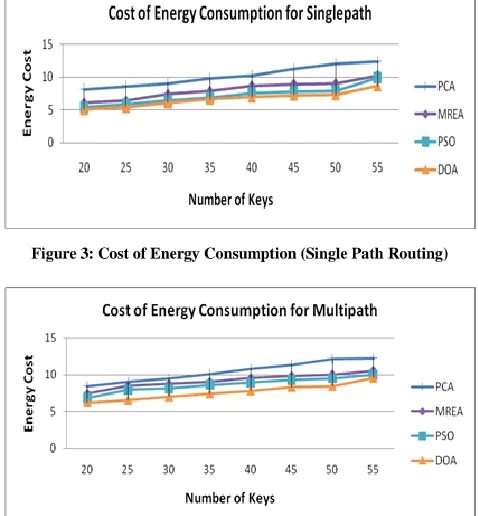
It is the cost of consuming energy to capture the nodes for controlling whole network. It is increased with increasing the number of capturing nodes, so DOA has minimum cost of energy consumption as compared to the PSO, MREA, and PCA (fig. 3 and 4).
[image:4.612.51.288.427.555.2]Figure 3: Cost of Energy Consumption (Single Path Routing)
Figure 4: Cost of Energy Consumption (Multipath Routing)
4.3 Attacking Rounds
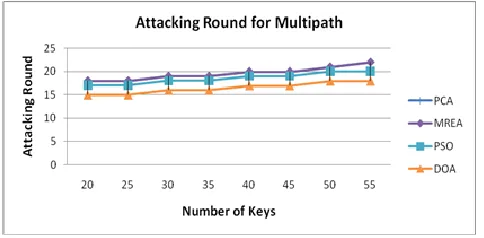
It is defined as the number of rounds to capture the desired nodes for controlling the whole network. DOA has captured minimum number of nodes and attacking rounds are also directly related to the compromised traffic fraction, so DOA has minimum attacking rounds as compared to the PSO, MREA and PCA (fig 5 and 6).
[image:4.612.51.289.589.702.2] [image:4.612.321.565.599.706.2]International Journal of Emerging Technology and Advanced Engineering
Website: www.ijetae.com (ISSN 2250-2459, ISO 9001:2008 Certified Journal, Volume 9, Issue 10, October 2019)
[image:5.612.49.291.138.257.2]171
Figure 6: Attacking Round (Multi Path Routing)
V. CONCLUSION
Several network attacks are performed in large communication area of wireless sensor network due to restricted resources utilization which makes the WSN highly susceptible. The attacker controls complete network by capturing the nodes and stealing the secure information. We develop a Dragonfly Optimization Algorithm (DOA) to locate the nodes having maximum probability for capturing by an attacker. DOA implements on multi objective optimization in terms of cost of energy expenditure, number of keys and velocity of nodes and experimental results shows that the DOA obtains higher compromised traffic fraction, minimum cost of energy consumption and minimum attacking rounds as compared to the PSO and other node capture algorithms.
REFERENCES
[1] C. Lin and G. Wu, “Enhancing the attacking efficiency of the node capture attack in WSN: a matrix approach”, J Supercomput, Springer Science &Business Media, pp-1-19, 2013. (DOI 10.1007/s11227-013-0965-0)
[2] C. Lin, G. Wu, C. W. Yu, and L. Yao, “Maximizing destructiveness of node capture attack in wireless sensor networks”, J Supercomput, Springer Science & Business Media, Vol. 71, pp-3181–3212, 2015.(DOI 10.1007/s11227-015-1435-7)
[3] C. Lin, T. Qiu, M. S. Obaidat, C. W. Yu, L. Yao and G. Wu, “MREA: a minimum resource expenditure node capture attack in wireless sensor networks”, Security And Communication Networks, Wiley Online Library, Vol. 9, pp-5502–5517, 2016. (DOI: 10.1002/sec.1713)
[4] H. Kaur, “Node Replication attack detection using Dydog in Clustered sensor network”, Computer Science and Engineering Department, Thapar University Patiala, pp-1-71, 2017.
[5] I. Q. Kolagar, H. H. S. Javadi, and M. Anzani, “Hypercube Bivariate-Based Key Management for Wireless Sensor Networks”, Journal of Sciences, Islamic Republic of Iran, University of Tehran, Vol. 28, No. 3, pp-273 – 285, 2017.
[6] K. Chowdary, and K.V.V. Satyanarayana, “Malicious Node Detection and Reconstruction of Network In Sensor Actor Network”, Journal of Theoretical and Applied Information Technology, Vol.95, No.3, pp-582-591, 2017.
[7] M. Ehdaie, N. Alexiou, M. Ahmadian, M. R. Aref and P. Papadimitratos, “Mitigating Node Capture Attack in Random Key Distribution Schemes through Key Deletion”, Journal of Communication Engineering, Vol. 6, No. 2, pp-1-10, 2017. [8] P. K. Shukla, S. Goyal, R. Wadhvani, M. A. Rizvi, P. Sharma, and
N. Tantubay, “Finding Robust Assailant Using Optimization Functions (FiRAO-PG) in Wireless Sensor Network”, Hindawi Publishing Corporation, Mathematical Problems in Engineering, pp-1-8, 2015. (http://dx.doi.org/10.1155/2015/594345)
[9] P. Ahlawat and M. Dave, “An attack resistant key predistribution scheme for wireless sensor Networks”, Journal of King Saud University – Computer and Information Sciences, Elsevier, pp-1-13, 2018.
[10] P. Ahlawat and M. Dave, “An attack model based highly secure key management scheme for wireless sensor Networks”, 6th International