International Journal of Emerging Technology and Advanced Engineering
Website: www.ijetae.com (ISSN 2250-2459,ISO 9001:2008 Certified Journal, Volume 4, Issue 6, June 2014)
522
Performance Evaluation of AODV and DSR Routing Protocols
for Vehicular Ad-hoc Networks (VANETs)
Narendra Mohan Mittal
1, Dr. Prem Chand Vashist
21
M-Tech. Student, 2Head of CSE Department & MVN University, Palwal, Haryana, India;
Abstract—Vehicular Ad Hoc Network (VANET) is a sub
class of Mobile Ad Hoc Networks (MANET). Vehicular Ad Hoc Network (VANET) provides wireless communication among vehicles and road side equipment. The communication between vehicles is used for safety and non safety purpose. The performance of communication depends on how better the routing takes place in the network. Routing of data depends on the routing protocols being used in network. In this paper we evaluate and compare the performance of two reactive routing protocols, Ad hoc On Demand Distance Vector (AODV) and Dynamic Source Routing (DSR) by taken three performance metrics like network load, throughput and end-to-end delay with varying number of mobile nodes (40, 60, 80, 100 and 120) with constant speed 10m/s. For the performance evaluation of two reactive routing protocols (AODV, DSR) we employed OPNET Modeller v14.5. OPNET modeller v14.5 is a commercial network simulator environment used for simulations of both wired and wireless networks. On the basis of results derived from simulation a conclusion is drawn on the comparison between these two different routing protocols with performance parameters like network load, throughput and end-to-end delay.
Keywords-- Ad-hoc network, AODV, DSR, MANET,
OPNET Simulation, VANET.
I. INTRODUCTION
The increasing demand of wireless communication and wireless devices have tends to research on self organizing, self healing networks without the interference of any centralized or pre-established infrastructure/authority. The networks with the absence of any centralized or pre-established infrastructure are known as Ad hoc networks. Ad hoc Networks are the category of wireless networks that uses multi hop radio relaying. Vehicular Ad hoc Networks (VANET) is an application of Mobile Ad Hoc Networks (MANETs). It is the most advanced technology that provides Intelligent Transportation System (ITS) in wireless communication among vehicles to vehicles and road side equipment (RSUs) to vehicles according to IEEE 802.11p standard. VANET provides broad range of safety and non safety applications. Safety application provides safety to the passengers such as lane change warning, collision detection etc.
It also provides comfort and commercial applications to the road users such as electronic toll collection, audio/video exchanging, electronic payments, route guidance, weather information, mobile E-commerce, internet access etc.
This paper is organized as follows. Literature review are described in section II, VANET routing protocols and simulation setup are described in section III and IV, then performance metrics used in this study are described in section V. In section VI we present the simulation result and analysis of our observation. Finally conclusion and future works are given in section VII.
II. LITERATURE REVIEW
In recent years, several researchers have analyzed and compare various ad-hoc Routing Protocols taking into consideration different performance metrics as basis for performance evaluation. They have used different simulators and simulation models for the same.
Samir R. Das et al. [1]: In this paper authors compared and analyzed the performance of AODV and DSR routing protocols using default random way point mobility model. For performance evaluation of considered protocols they used ns-2 simulator with variable pause time. After getting simulation results they conclude that DSR outperformed AODV in delay and throughput on small number of nodes with lower load and mobility while AODV performed better than DSR on large number of nodes with higher load and mobility. They also found that DSR has low throughput and delay because of aggressive use of caching and stale routes.
International Journal of Emerging Technology and Advanced Engineering
Website: www.ijetae.com (ISSN 2250-2459,ISO 9001:2008 Certified Journal, Volume 4, Issue 6, June 2014)
523
Amit N. Thakare et al. [3]: In this paper authors analyzed the performance of AODV and DSR routing protocols using ns-2 simulator with Random Waypoint mobility model. After getting simulation results they conclude that packet loss of DSR is higher as compared to AODV and ratio of packet received was higher for AODV as compared to the DSR routing protocol.
Davesh et al. [4]: In this paper authors analyzed the performance of AODV and DSR routing protocols using ns2 simulator with varying number of nodes. After getting simulation results they conclude that AODV shows very high packet delivery ratio in 40 mobile nodes, but substantially decreases if the simulation node increases. DSR shows less end to end delay as compared to the AODV. Finally they concluded that AODV performs best because it provides almost identical result in all scenarios and DSR suits for lower scalability networks in which mobile nodes move at moderate speed.
III. VANETROUTING PROTOCOLS
Routing is a mechanism to establish and to select a specific path in order to send data from source to destination. There are various routing algorithm designed for ad-hoc networks. The protocols for VANET routing can be classified as:
A. Proactive Routing Protocols: These types of routing protocols are also known as table driven routing protocols because they maintain table of connected nodes to transmit data from one node to another node and each node share its table with another node. Different types of proactive routing protocols are Destination Sequence Distance Vector Routing (DSDV), Optimized link state routing (OLSR), Fisheye State Routing (FSR).
B. Reactive Routing Protocols: These type of routing protocols are also known as On Demand routing protocols because it establish a route from source to destination whenever a node has something to send thus reducing burden on network. Reactive routing have route discovery phase where network is flooded in search of destination. There are different types of Reactive routing protocols like AODV, DSR and TORA. Here we are discussing two on demand routing protocols for VANET.
1) Ad Hoc on Demand Distance Vector (AODV): Ad hoc On Demand Distance Vector (AODV) is a pure reactive routing protocol which is capable of both unicasting and multicasting. It works on demand basis when it is required by the nodes within the network. When source node has to send some data to destination node then initially it propagates Route Request (RREQ) message which is forwarded by intermediate nodes until destination is reached. A route reply message is unicasted back to the source node if the receiver is either the node using the requested address, or it has a valid route to the requested address
2) Dynamic Source Routing (DSR): The Dynamic Source routing (DSR) protocol is a very efficient and simple routing protocol specifically designed for the multi-hop mobile wireless ad-hoc networks. It allows the network to be completely self organizing and configuring, without the need for any pre established network infrastructure .It using source routing to send packets from source to destination nodes. Source routing means that the source node must know the complete hop sequence to the destination node .In DSR each node maintains a route cache, where all route and route information are stored.
IV. SIMULATION SETUP
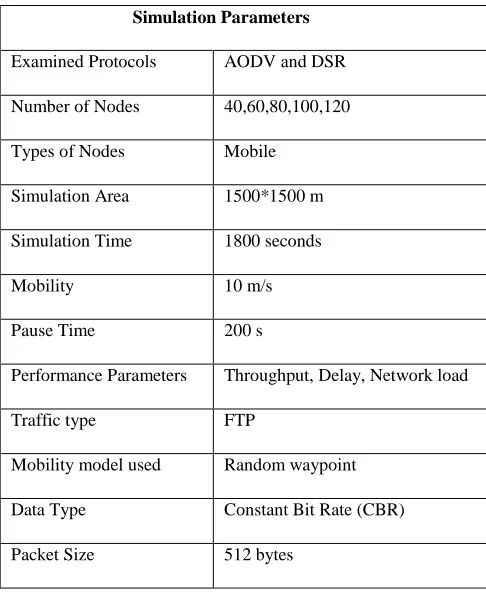
In this work we employed OPNET Modeler v14.5 for simulation. A campus network was modelled within an area of 1500 m x 1500 m. The all mobile nodes were spread within the area. In Table I describe the simulation parameters that are used in this simulation in order to evaluate and compare the performance of two selected routing protocols (AODV, DSR) over a MANET network.
Each and every scenario there is different numbers of mobile nodes. In first scenario we have 40 mobile nodes at constant speed 10m/s for simulating AODV routing protocol. In second scenario we have 40 mobile nodes at constant speed 10m/s for simulating DSR routing protocol and so on according to the Table II.
International Journal of Emerging Technology and Advanced Engineering
Website: www.ijetae.com (ISSN 2250-2459,ISO 9001:2008 Certified Journal, Volume 4, Issue 6, June 2014)
[image:3.612.46.289.157.453.2]524
Table I Simulation Parameters
Simulation Parameters Examined Protocols AODV and DSR
Number of Nodes 40,60,80,100,120
Types of Nodes Mobile
Simulation Area 1500*1500 m
Simulation Time 1800 seconds
Mobility 10 m/s
Pause Time 200 s
Performance Parameters Throughput, Delay, Network load
Traffic type FTP
Mobility model used Random waypoint
Data Type Constant Bit Rate (CBR)
Packet Size 512 bytes
Each scenario was run for 1800 seconds (simulation time). Under each simulation we check the behaviour of AODV and DSR routing protocol with constant mobility (10 m/s) and constant pause time. For examining average statistics of the network load, delay and throughput for the AODV and DSR routing protocol of VANET we collected DES (global discrete event statistics) on each protocol and Wireless LAN. We take the FTP traffic in the application configuration object this sets the application to model the high load FTP traffic for analyse the effects on routing protocols. In profile configuration object we configured the profile with high load FTP application. The nodes were wireless LAN mobile nodes with data rate of 11Mbps. After defining profile configuration we configure Mobility Configuration object for defining the mobility pattern and model that the nodes will follow during the simulation. The default random waypoint mobility model was used in this simulation. Mobile nodes in all scenarios moving with the constant speed of 10 m/s and pause time is 200 seconds.
[image:3.612.316.569.157.406.2]
Table II Scenario used
Scenarios Nodes Protocol
Scenario 1 40 AODV
Scenario 2 40 DSR
Scenario 3 60 AODV
Scenario 4 60 DSR
Scenario 5 80 AODV
Scenario 6 80 DSR
Scenario 7 100 AODV
Scenario 8 100 DSR
Scenario 9 120 AODV
Scenario 10 120 DSR
V. PERFORMANCE METRICS
We have primarily selected the following three performance metrics in order to study the performance comparison of AODV and DSR.
A. End to End Delay
The packet end to end delay is the average time that packets take to traverse in the network. Delay is the total time taken by the packets to reach from the source to destination. It is expressed in seconds. Hence all the delays in the network are called packet end-to-end delay. It includes all the delays in the network such as propagation delay (PD), processing delay (PD), transmission delay (TD), queuing delay (QD).
B. Network Load
International Journal of Emerging Technology and Advanced Engineering
Website: www.ijetae.com (ISSN 2250-2459,ISO 9001:2008 Certified Journal, Volume 4, Issue 6, June 2014)
525
When there is more traffic coming on the network, and it is difficult for the network to handle all this traffic so it is called the network load. High network load affects the VANET routing packets that reduce the delivery of packets for reaching to the channel.
C. Throughput
Throughput can be defined as the ratio of the total amount of data reaches a destination from the source. The time it takes by the destination to receive the last message is called as throughput. It is expressed as bytes or bits per seconds (byte/sec or bit/sec). It can expressed as
VI. RESULT AND ANALYSIS
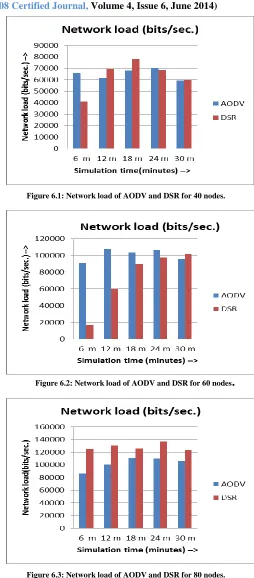
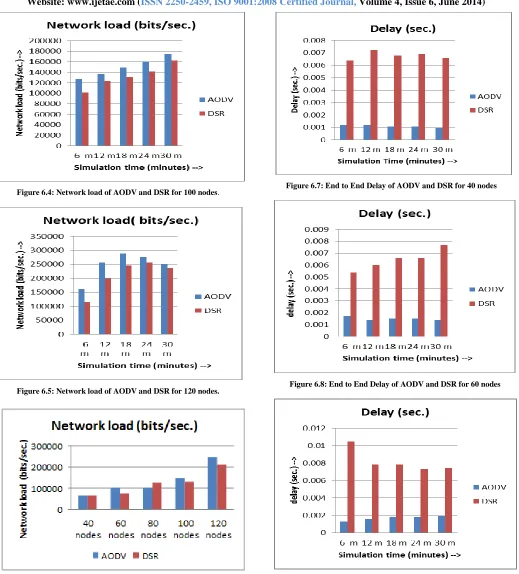
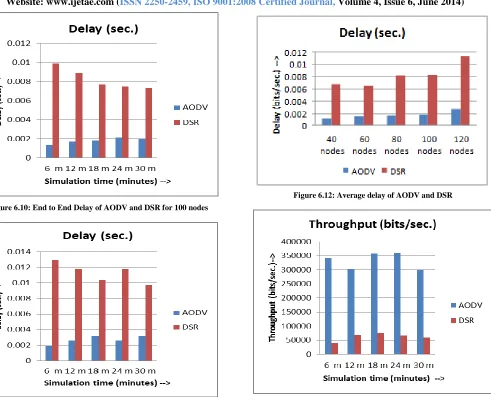
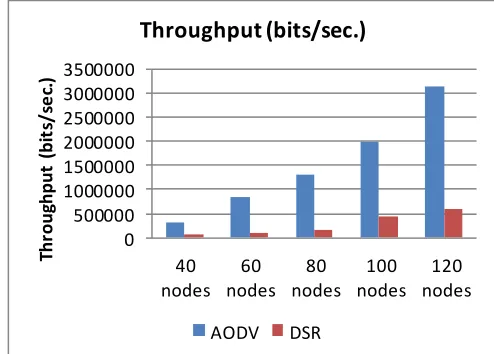
The simulation result shows the performance behavior of the considered protocols in terms of network load, end to end delay and throughput. Figure 6.1–6.6 depicts the performance on the basis of network load with varying number of nodes. From graph results it is observed that DSR has less average network load as compared to the AODV except the 80 mobile nodes scenario that shown in figure 6.6. DSR has less average network load because of its on demand routing characteristics so there is no need to update the routing table. Figure 6.7–6.12 depicts the performance on the basis of end to end delay with varying number of nodes. From graph results it is observed that DSR shows higher end to end delay as compared to AODV due to the reason that when a RREQ is sent, the destination replies to all RREQ it received, which make it slower to determine the least congested route. In AODV, every destination replies to only first RREQ. In figure 6.12 observed that as the number of node increases AODV performs better than DSR, due to the route discovery process is very fast. Figure 6.13–6.18 depicts the performance on the basis of throughput with varying number of nodes. Here we see that AODV shows very high average throughput as compared to DSR that shown in figure 6.18. Because AODV is highly reliable in terms of large-scale environment and high-speed.
Figure 6.1: Network load of AODV and DSR for 40 nodes.
[image:4.612.318.572.119.697.2]Figure 6.2: Network load of AODV and DSR for 60 nodes
.
International Journal of Emerging Technology and Advanced Engineering
Website: www.ijetae.com (ISSN 2250-2459,ISO 9001:2008 Certified Journal, Volume 4, Issue 6, June 2014)
526
Figure 6.4: Network load of AODV and DSR for 100 nodes.
Figure 6.5: Network load of AODV and DSR for 120 nodes.
[image:5.612.50.569.123.697.2]Figure 6.6: Average Network load of AODV and DSR
Figure 6.7: End to End Delay of AODV and DSR for 40 nodes
Figure 6.8: End to End Delay of AODV and DSR for 60 nodes
International Journal of Emerging Technology and Advanced Engineering
Website: www.ijetae.com (ISSN 2250-2459,ISO 9001:2008 Certified Journal, Volume 4, Issue 6, June 2014)
527
[image:6.612.71.562.123.520.2]Figure 6.10: End to End Delay of AODV and DSR for 100 nodes
Figure 6.11: End to End Delay of AODV and DSR for 120 nodes
[image:6.612.319.562.125.512.2]Figure 6.12: Average delay of AODV and DSR
[image:6.612.48.293.129.517.2]International Journal of Emerging Technology and Advanced Engineering
Website: www.ijetae.com (ISSN 2250-2459,ISO 9001:2008 Certified Journal, Volume 4, Issue 6, June 2014)
[image:7.612.50.297.131.308.2]528
[image:7.612.324.571.139.316.2]Figure 6.14: Throughput of AODV and DSR for 60 nodes.
Figure 6.16: Throughput of AODV and DSR for 100 nodes.
Figure 6.17: Throughput of AODV and DSR for 120 nodes.
0 500000 1000000 1500000 2000000 2500000 3000000 3500000
40 nodes
60 nodes
80 nodes
100 nodes
120 nodes
Thr
ou
ghp
ut
(
bi
ts
/s
e
c.
)
Throughput (bits/sec.)
AODV DSR
Figure 6.18: Average Throughput of AODV and DSR
VII. CONCLUSION
This paper described a performance evaluation and comparison between two reactive routing protocols (AODV, DSR) for vehicular ad hoc network. Both protocols were simulated using OPNET 14.5 and were compared in terms of end to end delay , throughput and network load with varying number of nodes (40, 60, 80, 100, 120). From the simulation result in section we can conclude that average throughput of AODV in all scenarios is much better than DSR and average end to end delay of DSR is much higher than AODV and in terms of network load DSR shows less average network load as compared to AODV routing protocol.
REFERENCES
[1] Samir R. Das, Charles E. Perkins, Elizabeth M. Royer, Mahesh K. Marina, “Performance Comparison of TWO On-demand Routing Protocols for Ad Hoc Networks”. Nineteenth Annual Joint Conference of the IEEE Computer and Communications Societies. Proceedings, INFOCOM 2000.
[2] Monika, Sanjay Batish and Amardeep Dhiman, “Comparative Study of AODV, DSDV and DSR Routing Protocols in vehicular Network Using EstiNet Simulator”, International Journal of Scientific & Engineering Research ISSN: 2229-5518, Volume 3- Issue 6, June 2012.
[3] Amit N. Thakare, Mrs. M. Y. Joshi, “Performance Analysis of AODV & DSR Routing Protocols in Mobile Ad hoc Networks”, Indian Journal of Computer Application (IJCA) Special Issues, 2010. [4] Davesh Singh Som, Dhananjaya Singh. “Performance Analysis and
[image:7.612.46.300.353.700.2]International Journal of Emerging Technology and Advanced Engineering
Website: www.ijetae.com (ISSN 2250-2459,ISO 9001:2008 Certified Journal, Volume 4, Issue 6, June 2014)
529 [5] Sapna S. Kaushik& P.R. Desmukh. “Comparison of effectiveness of
AODV, DSDV and DSR Routing Protocols in Mobile AD-hoc Networks” International Journal of Information Technology and Knowledge Management ISSN: 499-502, Volume 2, 2009. [6] Rajesh Deshmuklh, AshaAmbhaikarV.K.Taksande& Dr. K. D. Kulat
“Performance Evaluation of AODV and DSR with Reference to Network Size” International Journal of Computer Applications (0975 – 8887) Volume 11– No.8, December 2010.
[7] Joshi H. P., M. Sichitiu, and M. Kihl, “Distributed robust geocast multicast routing for inter-vehicle communication,” in Proceedings of WEIRD Workshop on WiMax, Wireless and Mobility, 2007, pp. 9-21.
[8] Bachir A.and A. Benslimane, “A multicast protocol in ad hoc networks inter-vehicle geocast,” in Proceedings of IEEE Vehicular Technology Conference, Vol. 4, 2003, pp. 2456-2460.
[9] Chen Y. S., Y. W. Lin, and S. L. Lee, “A mobicast routing protocol for vehicular ad hoc networks,” in Proceedings of ACM/Springer Mobile Networks and Applications, Vol. 15, 2010, pp. 20-35. [10] Skordylis A. and Trigoni N., “Delay-bounded routing in vehicular
ad-hoc networks (VANET),” in Proceedings of ACM International Symposium on Mobile Ad hoc Networking and Computing, 2008, pp. 3020-3026.
[11] Tonguz , J. S. Parikh, F. Bai, P. Mudalige, and V. K. Sadekar, “On the broadcast storm problem in ad hoc wireless networks,” in Proceedings of International Conference on Broadband Communications, Networks and Systems, 2006, pp. 1-11.
[12] Tonguz, F. Bai, P. Mudalige, “Broadcasting in VANET,” in Proceedings of IEEE Mobile Networking for Vehicular Environments, 2007, pp. 7-12.
[13] Amit Kumar Saha, David B. Johnson. “Modeling mobility for vehicular ad-hoc networks”. In Proceedings of the first ACM workshop on Vehicular ad hoc networks. Philadelphia, PA, USA, Oct. 2004, pp. 22-34.
[14] K. Saito, K. Sugiyama, T. Nishida, and K. Eguchi, “Broadcast methods for inter-vehicle communications system,” in Proceedings of IEEE Wireless Communications and Networking Conference, Vol. 4, 2005, pp. 2252-2257.
[15] Yamaguchi H., K. Yukimasa, and S. Kusumoto, “QoS routing Protocol for vehicular ad hoc networks,” in Proceedings of IEEE International Workshop on Quality of Service, 2006, pp. 132-139. [16] Balon N., and J. Guo, “Increasing Broadcast Reliability in Vehicular
Ad Hoc Networks(VANET),” In Proceeding of the 3rd ACM International Workshop on Vehicular Ad Hoc Networks VANET, NY, USA, 2006, pp. 104-105.
[17] Jorjeta G. Jetcheva, Yih-Chun Hu, Amit Kumar Saha, and David B. Johnson. “Design and Evaluation of a Metropolitan Area Multitier Wireless Ad Hoc Network Architecture in VANET”. In Proceedings of the Fifth IEEE Workshop on Mobile Computing Systems & Applications, Monterey, CA, Oct. 2003, pp.32-37.
[18] Tseng Y.C., Y.S. Chen, and J.P. Sheu, "The broadcast storm problem in a mobile ad hoc network(MANET)," In Proceeding of the 5th ACM/IEEE International Conference on Mobile Computing and Networking, NY, USA, 1999, pp. 51-162.
[19] H. Safa, H. Artail, and R. Shibli, “An interoperability model for supporting reliability and power-efficient routing in mobile ad hoc network,” International Journal of Ad Hoc and Ubiquitous Computing, Vol. 4, 2009, pp. 74-83.
[20] H.P. Glathe, L. Karlsson, G.P. Brusaglino, L. Calandrino, “The PROMETHEUS Programme– Objectives, Concepts and Technology for Future Road Traffic”, in Proceedings of 12th conference of
networking, May 1990, pp. 477-484.
[21] Heissenbüttel M., T. Braun, M. Wälchli, and T. Bernoulli, “Optimized stateless broadcasting in wireless multi-hop networks,” in proceeding of 4th IEEE international conference on Infocom
Barcelona ,2006, pp.234-240.
[22] Sommer, C.; Dietrich, I.; Dressler, F. “Realistic Simulation of Network Protocols in VANET Scenarios” in Proceedings of International Journal of Ad Hoc and Ubiquitous Computing, Vol. 3, 2008, pp. 217-223.
[23] Tseng Y.C., Y.S. Chen, and J.P. Sheu, "The broadcast storm problem in a mobile ad hoc network(MANET)," In Proceeding of the 5th ACM/IEEE International Conference on Mobile Computing and Networking, NY, USA, 1999, pp. 51-162.
[24] Jerome Haerri “Performance Comparison of AODV and OLSR in VANETs Urban Environments under Realistic Mobility Patterns” Department of Mobile Communications, june 2005, pp. 123-134. [25] Korkmaz G., E. Ekici, F. Ozgüner, and U. Ozgüner, "Urban
multi-hop broadcast protocol for inter-vehicle communication systemsin VANET," In Proceeding of the 1st ACM International Workshop on Vehicular Ad Hoc Networks, NY, USA, 2004,pp. 76-85.
[26] Rajive Bagrodia, Richard Meyer, Mineo Takai, Yu an Chen, Xiang Zeng, Jay Martin, and Ha Yoon Song. “A parallel simulation environment for complex systems” in Proceedings of the 1st ACM international workshop on Vehicular ad hoc networks; 2004; Pages: 66 – 75.
[27] Dirk Reichardt, Maurizio Miglietta, and Wolfgang Schulz “CARTALK 2000 Safe and Comfortable Driving Based Inter-Vehicle- Communication in VANET”, in proceedings of IEEE Intelligent Vehicle Symposium, June 2002, pp.145-147.
[28] T. Sawamura, K. Tanaka, M. Atajanov, N. Matsumoto, and N. Yoshida, “Adaptive router promotion and group forming in ad-hoc networks,” in Proceedings of International Journal of Ad Hoc and Ubiquitous Computing, Vol. 3, 2008, pp. 217-223.
[29] Ding Y, Borcea C., Xiao L “A static-node assisted adaptive routing protocol in vehicular networks” In Proceedings of the ACM international Workshop on Vehicular Ad Hoc Networks VANET, 2007, pp.59–68.
[30] Manvi S., Kakkasageri M.S., Mahapurush , “Performance Analysis of AODV, DSR, Routing Protocols In Vehicular Ad hoc Network Environment” In Proceedings of International conference on future Computer and Communication., April. 2009. pp. 21-26.
[31] Bernsen, J. Manivannan, “Routing Protocols for Vehicular Ad Hoc Networks That Ensure Quality of Service” In Proceedings of the fourth international conference on Wireless and Mobile Communications., Aug. 2008, pp.1-6.
[32] Zhao J. C. and Josh Broch, “Vehicle-Assisted Data Delivery in Vehicular Ad Hoc Networks” in Proceedings of 25th IEEE International Conference on Computer Communications. Proceedings, April 2006, pp. 6-12.
International Journal of Emerging Technology and Advanced Engineering
Website: www.ijetae.com (ISSN 2250-2459,ISO 9001:2008 Certified Journal, Volume 4, Issue 6, June 2014)
530 [34] Goel A., Ramakrishnan K. G., D. Kataria, and D. Logothetis,
“Efficient computation of delay-sensitive routes from one source to all destinations,” in Proceedings of IEEE Conference on Computer Communications, 2001, pp. 854-858.
[35] Nzouonta J. R., Guiling N. and Wang Borcea C., “VANET Routing on City Roads Using Real-Time Vehicular Traffic Information,” in Proceedings of Vehicular Technology, IEEE Transactions on vol. 58, no. 7, Sept. 2009, pp. 33-37.
[36] David B. Johnson, David A. Maltz, and Josh Broch, “The Dynamic Source Routing Protocol for Multi-Hop Wireless Ad Hoc Networks”, in Ad Hoc Networking, Editor: Charles E.Perkins, Addison-Wesley, Chapter 5, 2001 , pp. 139-172.
[37] Blum J., Eskandarian A., and Hoffman L. "Performance Characteristics of Inter- Vehicle Ad Hoc Networks". in Proceedings of IEEE 6th International Conference on Intelligent Transportation Systems, Shanghai, China,2004, Pp. 115-119.
[38] Manoharan R., S. L. P. Thambidurai, “Energy efficient robust on-demand multicast routing protocol for mobile ad hoc network,” in Proceedings of International Journal of Ad Hoc and Ubiquitous Computing, Vol. 3, 2008, pp. 90-98.
[39] H. Wu, Fujimoto, R., Guensler, R., and Hunter, M, “MDDV: a mobility-centric data dissemination algorithm for vehicular network,” in Proceedings of the 1st ACM international Workshop on Vehicular Ad Hoc Networks, October, 2004, pp. 47-56.