
Towards the Realisation of a fully integrated Interactive
Computer
Music
System
(ICMS),
adopting
Transformative Expressive Dimensions
George Meikle
Doctor of Philosophy in Music
University of Salford
School of Arts & Media
Contents
List of Figures 5
Acknowledgements 8
Declaration 9
List of Abbreviations 10
Abstract 11
1. Introduction 12
2. Literature Review 15
2.1 Philosophical/Aesthetic Context for Open Interpretation and Interactivity in
Contemporary Arts 15
2.2 The beginnings of ComputerAided Algorithmic Composition (CAAC) and
Generative Music 19
2.3 Early and Experimental Interactive Works and Systems 25
2.4 Web and Touchscreenbased Interactive Music Applications and Games 29
2.5 HCI in Popular Electronic Music Records/Releases and MusicCreation
Applications/Virtual Instruments 31
2.6 Categorisation and Approach to Design of ICMSs 37
2.7 Timbre and Spectromorphology 41
2.8 Topic Theory 44
2.9 Breaking of Routine in Collaborative, Improvisatory Performance and Aiding
Composition through the Development of New Musical Ideas 48
3. Methodology and Implementation 50
3.1 The 11 Criteria for Collaborative Musical Interface Design 53
3.2 Affordances 62
3.3 High Level Design Strategies and Gesturetypes in the ScreenPlay GUI 65
3.4 ScreenPlayGEN 67
3.5 ScreenPlayTRNS4M/ScreenPlayFX 70
3.5.1 JoyLament 72
3.5.2 LightDark 82
3.5.3 OpenClose 87
3.5.4 StabilityDestruction 90
4.1 Salford Sonic Fusion Festival 2014 93
4.2 8th MMU Postgraduate Research Conference "Innovation" 101
4.3 April 2016 Showcase of ScreenPlay 104
5. Conclusion 106
6. Reference List 110
7. Appendix 1: ScreenPlay Setup/Configuration Instructions 137
7.1 Software/Technical Requirements 137
7.2 Directions for Setup and Configuration 138
7.2.1 Single Mode 138
7.2.2 Multi Mode 140
8. Appendix 2: ScreenPlay GUI Instructions 142
9. Appendix 3: Patch Documentation 148
9.1 Notes on Max 148
9.2 ScreenPlayCTRL 148
9.2.1 Main patcher/ScreenPlayCTRL 1.0 149
9.2.2 [p transposition] 153
9.2.3 [p recctrl] 155
9.2.4 [p clipmanager] 159
9.2.5 [p cliptrig] 159
9.2.6 [p getclipids] 159
9.2.7 [p clipcheck] 161
9.2.8 [p clipswitch] 164
9.2.9 [p newclip] 165
9.2.10 [p clipfire] 167
9.2.11 [p looplength] 168
9.2.12 [p clipclear] 170
9.2.13 [p quantizesettings] 171
9.2.14 [p metroctrl] 174
9.2.15 [p tempoctrl] 174
9.3 ScreenPlayGEN 175
9.3.1 Main patcher/ScreenPlayGEN 1.0 175
9.3.2 [p clipindex] 178
9.3.4 [p markovanalysis] 183
9.3.5 [p pitchanalysis2nd] 185
9.3.6 [p velanalysis1st] 185
9.3.7 [p pair] (pitchanalysis2nd) 186
9.3.8 [p pair] (velanalysis1st) 187
9.3.9 [p notegen] 188
9.3.10 [p pitchgen2nd] 190
9.3.11 [p velgen1st] 193
9.3.12 [p deltagen1st] 193
9.3.13 [p pitchsfgd] 195
9.3.14 [p genplay] 196
9.3.15 [p cliptrigpsicheck] 198
9.4 ScreenPlayTRNS4M 199
9.4.1 Main patcher/ScreenPlayTRNS4M 1.0 199
9.4.2 [p stabdes]/[p clospar]/[p ltedk] 200
9.4.3 [p getnotes] 201
9.4.4 [p velocity.store] 203
9.4.5 [p velocity] 207
9.4.6 [p gatectrl] 208
9.4.7 [p duration.store] 209
9.4.8 [p duration] 211
9.4.9 [p trans.dur] 213
9.4.10 [p longshort] 214
9.4.11 [p */factor] 216
9.4.12 [p nextnote.calc] 216
9.4.13 [p mutenote.calc] 221
9.4.14 [p passnote.calc] 222
9.4.15 [p notecount] 222
9.4.16 [p passnote.dur] 223
9.4.17 [p passnote.on] 225
9.4.18 [p pitch.store] 227
9.4.19 [p pitch] 230
9.4.21 [p updown] 236
9.4.22 [p range.sfgd] 238
9.4.23 [p scaleswitch] 240
9.4.24 [p transdiatonic]/[p transchromatic] 241
9.4.25 [p +/8ve.calc] 242
9.4.26 [p joylam.compile] 243
9.4.27 [p replacenotes] 247
10. Appendix 4: Example UserFeedback Questionnaire 249
11. Appendix 5: Accompanying Data CD 250
11.1 ScreenPlay Video Demonstration 250
11.2 ScreenPlay Max for Live MIDI Devices/Ableton Audio Effect Rack 250
11.3 ScreenPlay GUI TouchOSC Layout Files 251
11.4 Skeleton Ableton Live Set Files 251
List of Figures
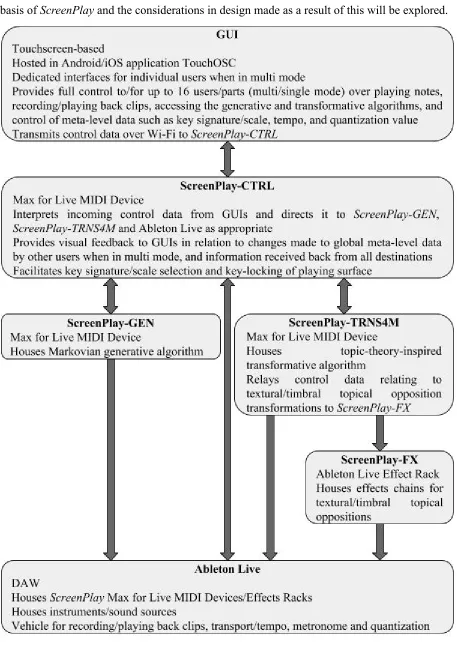
Figure 1. System overview diagram 52
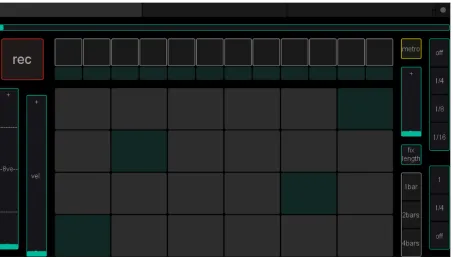
Figure 2. ScreenPlay GUI main control page 56 Figure 3. Diagram of ScreenPlay 's gridbased playing surface 56
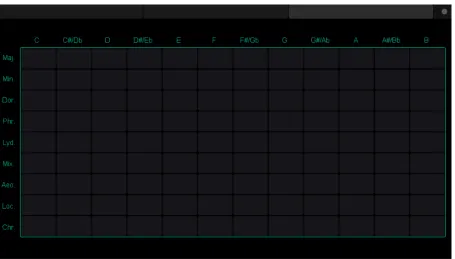
Figure 4. ScreenPlay GUI key selection matrix 57
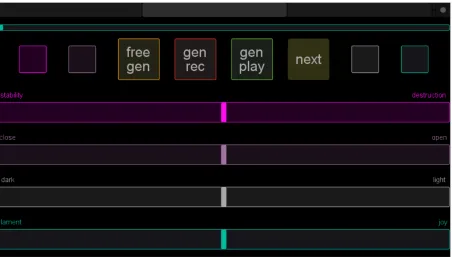
Figure 5. ScreenPlay GUI generative/transformative algorithm control page 67
Figure 6. Markovian first order transition table for note duration 68
Figure 7. Markovian second order transition table for pitch 68
Figure 8. Original melodic line from which first/second order transition tables are derived 69
Figure 9. "Light" transformation effects chain 85
Figure 10. "Dark" transformation effects chain 87
Figure 11. "Open" transformation effects chain 90
Figure 12. "Close" transformation effects chain 90
Figure 13. "Destruction" transformation effects chain 91
Figure 14. ScreenPlay GUI main control page 142
Figure 15. ScreenPlay GUI key selection matrix 145
Figure 16. ScreenPlay GUI generative/transformative algorithm control page 145
Figure 17. ScreenPlayCTRL Max for Live MIDI Device 148
Figure 18. [plugsync~] object in ScreenPlayCTRL main patcher window 149
Figure 19. Core highlevel programming in ScreenPlayCTRL main patcher window 150
Figure 20. ScreenPlayCTRL setup controls 151
Figure 21. ScreenPlayCTRL setup controls 152
Figure 22. [p transposition] in ScreenPlayCTRL 153
Figure 23. [p recctrl] in ScreenPlayCTRL 156
Figure 24. [p getclipids] in ScreenPlayCTRL 160
Figure 25. [p clipcheck] in ScreenPlayCTRL 161
Figure 26. [p clipswitch] in ScreenPlayCTRL 164
Figure 27. [p newclip] in ScreenPlayCTRL 166
Figure 28. [p clipfire] in ScreenPlayCTRL 167
Figure 29. [p looplength] in ScreenPlayCTRL 168
Figure 30. [p clipclear] in ScreenPlayCTRL 170
Figure 32. [p metroctrl] in ScreenPlayCTRL 174
Figure 33. [p tempoctrl] in ScreenPlayCTRL 175
Figure 34. ScreenPlayGEN Max for Live MIDI Device 175
Figure 35. ScreenPlayGEN main patcher window 176
Figure 36. [p clipindex] in ScreenPlayGEN 178
Figure 37. [p loopobserver] in ScreenPlayGEN 179
Figure 38. [p markovanalysis] in ScreenPlayGEN 183
Figure 39. [p pitchanalysis2nd] in ScreenPlayGEN 185
Figure 40. [p pair] inside [p pitchanalysis2nd] in ScreenPlayGEN 186
Figure 41. [p pair] inside [p velanalysis1st] in ScreenPlayGEN 187
Figure 42. [p notegen] in ScreenPlayGEN 188
Figure 43. [p pitchgen2nd] in ScreenPlayGEN 190
Figure 44. [p deltagen1st] in ScreenPlayGEN 194
Figure 45. [p pitchsfgd] in ScreenPlayGEN 195
Figure 46. [p genplay] in ScreenPlayGEN 196
Figure 47. ScreenPlayTRNS4M Max for Live MIDI Device 199
Figure 48. Core highlevel programming in ScreenPlayTRNS4M main patcher window 199
Figure 49. [p stabdes] in ScreenPlayTRNS4M 200
Figure 50. [p getnotes] in ScreenPlayTRNS4M 202
Figure 51. [p velocity.store] in ScreenPlayTRNS4M 203
Figure 52. [p velocity] in ScreenPlayTRNS4M 207
Figure 53. [p gatectrl] in ScreenPlayTRNS4M 208
Figure 54. [p duration.store] in ScreenPlayTRNS4M 209
Figure 55. [p duration] in ScreenPlayTRNS4M 211
Figure 56. [p trans.dur] in ScreenPlayTRNS4M 213
Figure 57. [p longshort] in ScreenPlayTRNS4M 214
Figure 58. [p nextnote.calc] in ScreenPlayTRNS4M 217
Figure 59. [p notecount] in ScreenPlayTRNS4M 222
Figure 60. [p passnote.dur] in ScreenPlayTRNS4M 224
Figure 61. [p passnote.on] in ScreenPlayTRNS4M 225
Figure 62. [p pitch.store] in ScreenPlayTRNS4M 228
Figure 63. [p pitch] in ScreenPlayTRNS4M 230
Figure 65. [p updown] in ScreenPlayTRNS4M 236
Figure 66. [p range.sfgd] and [p setrange] in ScreenPlayTRNS4M 238
Figure 67. [p scaleswitch] in ScreenPlayTRNS4M 240
Figure 68. [p +/8ve.calc] in ScreenPlayTRNS4M 242
Figure 69. [p joylam.compile] in ScreenPlayTRNS4M 243
Figure 70. [p replacenotes] in ScreenPlayTRNS4M 247
Acknowledgements
I would like to thank the University of Salford and Arts and Humanities Research Council for
providing me with the opportunity, resources and funding to carry out my research. Special thanks go to Prof. Stephen Davismoon for the impeccable level of support and guidance with
which he has provided me throughout the duration of the research project, as well as the multitude of opportunities beyond the scope of my research that he has opened up and made
available to me. I would also like to thank Prof. Alan Williams and Mr. Brendan Williams for
their vital input in helping to inform and shape my research at various stages in its development.
Declaration
Large parts of the verbatim used in sections 2.3 Early and Experimental Interactive Works and
Systems, 2.4 Web and Touchscreenbased Interactive Music Applications and Games, and 2.5 HCI in Popular Electronic Music Records/Releases and MusicCreation Applications/Virtual
Instruments of the Literature Review have been published in Contemporary Music Review, 35 (2) in the article "Examining the Effects of Experimental/Academic Electroacoustic and
Popular Electronic Musics on the Evolution and Development of Human–Computer
Interaction in Music" (Meikle, 2016). Other areas also include paraphrasing of the published text. The inclusion of this text is done so in accordance with the Taylor & Francis Publishing
Agreement, which states that the author retains the right to include the article in a thesis or dissertation that is not to be published commercially. Intext citations have been used to
indicate the appropriate sections of the text.
List of Abbreviations
HCI Humancomputer interaction
ICMS Interactive computer music system
UI User interface
GUI Graphical user interface
CAAC Computeraided algorithmic composition
MIDI Musical Instrument Digital Interface
CC Control change
OSC Open Sound Control
IP Internet Protocol
DAW Digital audio workstation
VST Virtual Studio Technology
BCI Braincomputer interfacing
CD Compact disc
WAV Waveform Audio File Format
EEG Electroencephalography
Abstract
The principal aim of conducting this research project is to advance the field of
humancomputer interaction (HCI) in music through the inception of new and exciting ideas relating to the conceptual and aesthetic values and characteristics associated with interactive
computer music system (ICMS) design, development and implementation. This exploratory investigation has been carried out through the continued development of a unique
screenbased ICMS, ScreenPlay , which brings together aspects of many prominent, preexisting system design models along with other novel inclusions, such as the capability of operating as both a multiuserandcomputer collaborative, improvisatory interactive
performance system and a singleuserandcomputer studio compositional tool for Ableton Live, and the implementation of Markovian generative and topictheoryinspired
transformative algorithms to provide new ways of breaking routine in collaborative
improvisation and generating new musical ideas in composition, as well as providing new dimensions of expressivity. The intention being that the culmination of these efforts should be
the establishment of a system design model that offers the user(s)/performer(s) a significantly more engaging, intuitive and complete interactive musical experience than that afforded by
any currently available system.
This is not an objective that should be perceived as being born of arrogance or ignorance; many established and commercially successful ICMSs provide users with amazing
and unique experiences, and the value of their contribution to the field of HCI in music is not to be underestimated or taken for granted. However, for all the relative strengths and
possibilities of interacting with these systems, there is potential for improvement and
evolution in equal measure. This is largely due to the tendency of ICMS developers to focus (sometimes almost exclusively) on providing the best possible experience when engaging
with a system only with regard to a single parameter/characteristic of the musical output at the expense of providing depthincontrol at any level over some or any of the many other
parameters/characteristics available. It is necessary for all forms of technology and art to
continually improve and evolve beyond what has already been achieved in order to avoid extinction, and nowhere is this more apparent than within an innovative and niche field of
research such as HCI in music.
1. Introduction
join[ing] the mechanical power of the machine to the nuances and
"subjectivizing" control of the human performer … is itself an aesthetic value for our new age. This ultimately will be the way music will need to move until
the next big issues arise. (Garnett, 2001, p. 32)
HCI in music is a field of research that has been extensively documented over the course of
the last few decades; dating back at least as far as the 1980s, as evidenced by Michel Waisvisz's sensorybased ICMS, The Hands (1984; 2006), and the work of "Computer Network Music" ensemble The Hub (Bischoff, Perkins, Brown, GreshamLancaster, Trayle & Stone, 1987present; Early Computer Network Ensembles, n.d.; Brown, n.d.). It is, however,
only in the relatively recent history of HCI in music that its relevance and impact within
widespread popular culture has been recognisable; largely due to the massive surge in popularity of electronic dance music as well as the advent of powerful, portable, affordable
and readily available touchscreen devices throughout the world. Through remixes, DJ sets and, more recently, live remixing popular electronic/dance music has brought about a new
attitude and acceptance on the part of the audience/listener with regard to the open
interpretation of musical works and improvisation in live performance. This ideology opposes that of composers during the structuralist era which, supported by the likes of Stravinsky
(1947), proclaimed that deviation in recital from the score was unacceptable throughout a period that ranged from the 1890s up until the 1950s. First challenged in popular music by
rock bands that discarded the score in favour of the recording as the primary musical artefact,
the necessity for a primary musical artefact at all was then brought into question by the developments in electronic dance music described above. It is this prevailing attitude within
popular electronic music/club culture, along with the predominantly loopbased structure and relatively rigid form of most dance music, which means it is perfectly suited both
ideologically and stylistically to the design of ICMSs intended for use by nonexpert users
and novice musicians. In recent years this has led many artists to release songs, EPs and albums not as traditional recordings either via CD, vinyl or through digital download stores
music in this format has the advantage of going some way to replacing the tangibility of CDs
and vinyls in a music business becoming ever more reliant on digital downloads and subscription streaming services by offering the consumer a unique and exciting experience
that also has the potential to provide a more attractive alternative to illegal peertopeer
filesharing and torrenting of music. Interestingly, it also draws parallels with Roland Barthes' theory of two musics (1977, p. 149) and the music publishers of Tin Pan Alley who, in the
late 19th and early 20th century, sold songs not as recordings but as lead sheets to be played back on a piano in the homes of the consumers as a collaborative/social pastime for families
and friends.
My own personal interest in HCI in music stemmed, initially, from studying composition as a computer musician at undergraduate level with a focus on popular electronic
music production. At postgraduate level my compositional studies branched out to include a research project into the open interpretation of electronic dance music as outlined above, as
well as more experimental electroacoustic works during a project for which I, along with three
other students, was commissioned to compose the accompanying music to an audiovisual installation inside Queen Street Mill in Burnley between 2011 and 2012, Ways of Seeing: Interwoven Lives (Kershaw, Kelledy, Meikle, O'neill & Reiser). The project explored the impact the mill had on the surrounding community through the memories of individuals who
had either worked there themselves or were friends/relations of those who had. Both of these
studies, along with undertaking a module relating to visual programming within modular programming environment software such as Max/MSP and Patchwork Graphic Lisp (PGWL),
influenced my desire to conduct research into the field of HCI in music. The two projects entailed composing and mixing for playback via multichannel installations (5.1 the former,
8channel the latter); the first focussing on differing approaches to the open interpretation of
musical works through improvisatory performance techniques, including loopbased live remixing with a buttonmatrix MIDI controller and the use of generative algorithms to
transform and evolve the source material of original works; the second involving the composition of multiple accompanying soundscapes to specific sequences of images and
interview recordings to be isolated from each other at various locations within the installation
space.
The idea to expand upon the conceptual ideas and designaesthetics of many
has developed an extensive code of hand signals that he uses to direct performers in
improvisatory performance in order to craft variation in melody, harmony, and form and structure: the key aim of the inclusion in ScreenPlay of the Markovian generative and topictheoryinspired transformative algorithms. The decision to utilise elements of topic
theory in order to facilitate this functionality is due to the textural/timbral potentialities associated with electronic music through synthesis and audio effects processing, as well as the
suitability of using metaphorical language to express each of the topical opposition transformations to both novice and expert users alike: "stabilitydestruction"; "openclose";
"lightdark"; "joylament".
In order to properly frame and contextualise the research project I asked the following question: is it possible to conceive of an ICMS that achieves in its design and implementation
that which has not yet been accomplished by current and preexisting systems; catering to both novice and experienced users and musicians, and using only existing technology so as to
maximise its impact in the fields of HCI in music and music technology? Reactable (Jordà, Kaltenbrunner, Geiger, & Alonso, 2003present), NodeBeat (Sandler, Windle & Muller, 2011present) and Incredibox (So Far So Good, 2011present) are just a few examples of ICMSs that each exhibit the characteristics of only one of the three overarching approaches to ICMS design: sequenced , transformative and generative (Rowe, 1994; Drummond, 2009). A common hindrance to the vast majority of ICMSs, ScreenPlay seeks to combat this exclusivity of focus through the encapsulation and evolution of the fundamental principles behind the three system design models in what is a novel approach to ICMS design, along
with the introduction of new and unique concepts to HCI in music in the form of the aforementioned topictheoryinspired transformative algorithm and its application alongside
the Markovian generative algorithm in breaking routine in collaborative improvisatory
performance and generating new musical ideas in composition, as well as providing new and additional dimensions of expressivity in composition and performance. While the
multifunctionality of the system, which allows it to exist as both a multiuserandcomputer interactive performance system and singleuserandcomputer studio compositional tool
including the affordance of dedicated GUIs to each individual involved in collaborative,
improvisatory performance when in multi mode and the technicality of hosting up to sixteen separate users through a single instance of Ableton Live in order to achieve this is another of
2. Literature Review
2.1 Philosophical/Aesthetic Context for Open Interpretation and Interactivity in Contemporary Arts
The concepts underpinning contemporary examples of interactivity in music are, predominantly, those essential to poststructuralist theory, including its approach to the open
interpretation of works within the arts. This idea is summarised by John Storey (1997, p. 89),
who states that 'Poststructuralists reject the idea of an underlying structure upon which meaning can rest secure and satisfied. Meaning is always a process … [it] is a momentary
stop in a continuing flow of interpretations of interpretations.' Furthermore, Storey cites in support of this the contention between Ferdinand de Saussure's structuralist theory that
language be divided into signifier the written or verbal word and signified the associated mental image/"sound image" or physical object/action/characteristic etc. with said word (Saussure, 1916/1959 [3rd ed., English translation], pp. 6667; Bredin, 1984, p. 67; Storey,
1997, p. 73) and that of poststructuralism whereby 'Signifiers do not produce signifieds, they produce more signifiers' (p. 89). The 'polysemic nature of signs' (p. 83) was first
recognised by Roland Barthes in Mythologies (1957/1972 [English translation]/1991 [25th ed.]) when he initially coined the concept of secondary signification, or "myth" (1991, p. 113). In Elements of Semiology Barthes explains the link between primary/secondary signification and denotation/connotation, declaring that 'The signifiers of connotation … are made up of
signs (signifiers and signifieds united) of the denoted system' (1983, p. 91); further elaborating with the idea that the signifieds of connotation are formed by ideology, and the
signifiers by rhetoric (p. 92) indicating that myth is the agent through which an author of a work is able to impose a particular slant or bias on the message it conveys (1991, p. 115). A
point best summarised by Boer, who states that 'myth is not determined by the content of its message, but the way the message is told.' (2011, p. 215)
Umberto Eco (1989) expands on these ideas by outlining the distinction between an open work and work in movement : an open work being one which, despite being complete in its structural entirety, is open to an infinite number of possible interpretations by the audience
usually subject to the influence of internal and external factors such as the mood, tastes and intuition of the addressee as well as the environment and timeframe within which a work is
observer a level of collaboration with the creator in piecing together the intentionally
disjointed fundamental components of the work. Eco also makes clear the disparity that exists between the openness in perception of any realworld interaction with a work or object that,
by design, has no intentionally subjective openness and that of the premeditated, infinitely
variable open form characteristic to open works and works in movement. The work of Luigi Pareyson (1960, cited in Eco, 1989, pp. 2122) is referenced in support of this, who states that
any of the infinite permutations existent within the finite structure of an open work or work in movement is tantamount to a complete embodiment of the work so long as there is a
recognition by the addressee that numerous other permutations exist and must be actively
sought out in order to deepen the understanding of the work.
Deleuze & Guattari's book A Thousand Plateaus (1980) could be considered a literary example that is simultaneously representative of the qualities attributed to both an open work and a work in movement. The chapters in the book are 'present[ed] … as a network of
"plateaus" that are precisely dated, but can be read in any order' (Massumi, 2005, ix, in
Deleuze & Guattari, 2005). In effect, the reader is free to reconfigure these "plateaus" in a multitude of different formations to result in various embodiments of the complete work.
However, the book has also been realised in its totality by the authors, meaning that it can only be considered complete once all of the chapters or "plateaus" have been explored by the
reader. A Thousand Plateaus , in many ways, epitomises the poststructuralist ideology that coherency in form and structure is secondary to content and openness in a work. This is achieved via an overarching, networkbased construction founded on the concept of nomad thought a school of thinking in direct opposition to that of state philosophy whereby the field of perception and scrutiny can be described as '"smooth," or openended' as opposed to
'"striated" or gridded.' (p. xiii)
It is this ideology, so evident in A Thousand Plateaus , that calls into question the integrity and esteem of the author. According to Barthes (1977), the structuralist view on the
relationship between an author and his or her work is that a work's significance can be attributed to the character, background or circumstances etc. of the individual responsible for
creating it and, additionally, that such a standpoint works in aid of simplifying the critical
process. In support of this he cites the regularity with which the inspiration and motivation behind Van Gogh's work is associated with his mental state. In contrast Barthes argues that it
during the moment in which he or she examines the work. This is a point echoed by Storey,
who states that 'A text is a work seen as inseparable from the active process of the intertextuality of its many readings.' (1997, p. 90)
Storey also notes that Barthes, in relation to literature, points out how the context of
publication of a work and its target demographic can influence the interpretation of that work in the eyes of the reader depending on their personal beliefs and prejudices, social/cultural
heritage and political inclination (Barthes, 1991, pp. 125126; 1977, p. 29; p. 46; Storey, 1997, pp. 8486) (much in the same way as Eco's concept of an open work); as has already
been alluded to when discussing Barthes' notion of the role played by ideology in secondary
signification/connotation/myth. In terms of HCI in music, and ScreenPlay in particular, this is an important point in relation to graphical user interface (GUI) design: a gamer will likely
have differing expectations as to what may be an appropriate manner in which to visually represent the control surface of an ICMS and its affordances to the user to be discussed in
more depth in section six of the Literature Review (Categorisation and Approach to Design of
ICMSs) than would an electronic musician, classical musician, or nonmusician etc.. Likewise and in spite of being conceived without any intention of being applied to the open
interpretation of works within the arts or giving any consideration to musical relevance structuralism's binary opposition model can also be applied to ICMS design and the
relationship between anticipated and intended functionality of GUI control
surfaces/screenbased interfaces. This is due to the fact that not only is the binary opposition model exemplified by Saussure's signifier/signified theory but is inclusive also of the
syntagmatic (combination) and paradigmatic (substitution) series (Saussure, 1959, pp. 122125) syntagmatic being 'the linear relationships between linguistic elements in a
sentence'; paradigmatic being 'the relationship between elements within a sentence and other
elements which are syntactically interchangeable' also referred to by Saussure as associative relations (Appignanesi & Garratt, 2013, p. 60; Saussure, 1959, p. 123) which, in turn, are directly linked to the opposing ideas of metonymy and metaphor respectively (Jakobson & Halle, 1956, pp. 7682). In addition, the learned cultural codes and conventions upon which
Saussure's signifier/signified binary opposition model is reliant (Saussure, 1959, pp. 6570)
The manifestation of Structuralism's own view on the interpretation of works within
music, however, is highlighted by the ideology, championed by many composers and philosophers during the first half of the 20th century, that the written score should be
considered the primary musical artefact of a musical work and the performer of a piece has an
ethical obligation to faithfully recite it without the addition of any improvisatory flair or embellishment in other words, to '"let the music speak for itself"' (Taruskin, 1982, p. 339).
Igor Stravinsky (1947) states that 'The sin against the spirit of the work always begins with a sin against its letter' (p. 124) and also distinguishes between two types of performer: the executant and the interpreter . An executant is described as the kind of performer who strictly obeys the letter of the score, whereas the interpreter is a performer who adds supplementary and (in the eyes of Stravinsky) unnecessary ornamentation against the direction of the score:
'the conflict[ions] of these two principles … impose themselves between the musical work and the listener and prevent a faithful transmission of its message.' (p. 122)
Over time, the widespread increase in availability of audio technology and the rise of
poststructuralism has seen such ideas disappear, in large part, from music as a whole. Although written scores are still commonplace today within orchestral/big band concert
situations etc., the movement away from a structuralist approach to music recital and consumption began with the recognition of the recording taking precedent over the score as
the primary musical artefact; first through the compositions of Pierre Schaeffer and Pierre
Henry, which contributed to the conception of Musique Concrѐte (Schaeffer, 1952/2012 [English translation]; Moorefield, 2005), and later in popular music; while the free
improvisation of jazz also played a significant role in the shifting of this balance. Modernday popular electronic music, through its approach to performing and listening to live music, is
exemplary of the ideologies posited by poststructuralism with regard to openness in a work.
Rather than playing the original recorded version of a piece during a performance 'DJs often favour remixes because they keep their playlists fresh … but still deliver a level of familiarity
that they can be confident crowds will respond to' (This is the Remix, 2010, p. 25). In fact, prior to the emergence of "live" electronic music performance (as opposed to playing
records/CDs/WAVs as part of a DJ set) made possible by technological advancements in both
hardware and software, many producers would create oneoff "VIP mixes" of their compositions and distribute the recording to a select few of their counterparts in order to
In recent years, the integration between Ableton Live software (2001present) and buttonmatrix MIDI controllers such as the Akai APC40 (2009), Novation Launchpad (2009) and DJ TechTools Midi Fighter series (2009present) has paved the way for spontaneous, improvisatory live performances of recorded works to be fluidly and efficiently crafted
through a process of breaking down a composition into its constituent parts and further dividing these up into individual loops/clips to be played back in any order and number of
combinations resulting in the ideal solution for artists looking to construct imaginative and bespoke live performances. The idea of the "VIP mix" has also evolved so that producers/DJs
will now distribute the stems of their compositions to allow others to individualise and
recontextualise a work in a manner unique to their particular performancestyle. As has the process of composition whereby similar techniques to those implemented in performance are
utilised to capture an essence of "liveness" in the recording. The acceptance of the live remix in popular electronic music culture has rewarded DJs with 'the status of artist, and this has
necessitated a redefinition of such familiar concepts as musical instrument, performer and the
role of audience in performance' (Fikentscher, 2000, p. 52). As such, the recent progression towards widespread interest and exploration on the part of the audience and
composers/programmers respectively into interactive music systems (particularly games and album/single releases) within popular electronic music is both obvious and logical. (Meikle,
2016)
2.2 The beginnings of ComputerAided Algorithmic Composition (CAAC) and Generative Music
Generative music, pioneered by the likes of Iannis Xenakis (1963/1971 [English
translation]/1992 [revised ed.]), Lejaren Hiller and Leonard Isaacson (1958; 1959), David Caplin and Dietrich Prinz (Caplin, 2008, 2009a, 2009b, 2009c, 2009d, 2011, cited in Ariza,
2011; Prinz, n.d.) and Harriet Padberg (1964), has formed the foundation upon which the entirety of HCI in music has been built, and can be separated into two main categories. The
first is 'aleatoric or "stochastic" music, in which events are generated according to the
statistical characterization of a random process.' The second is 'music where the computer is employed to calculate permutations of a set of predetermined compositional elements' (Dodge
observations' from every calculation, or so that 'previous results influence the current
outcome'. The latter encapsulates both motivic (based around the concept of applying independent variations to musical motifs/motives 'the smallest melodic/rhythmic fragment of
a musical theme often only two or three notes') (p. 382) and serial (the application of transformative operations to a set of twelve tonerows each of which cannot contain any duplicate notes) (pp. 391392) compositional techniques. Variation of the fundamental motifs
and tonerows of motivic and serial composition can be achieved in a number of ways. It is common in motivic works to make use of repetition, transposition, alteration, inversion,
retrogression and "registral displacement" (displacement of pitchvalues to another octave)
with regard to melodic contouring, as well as augmentation and diminution of rhythmic features (pp. 383388). "Classical" serial technique commonly involves the application of
transposition, inversion, retrogression and retrograde inversion operations to the pitchclasses of the tonerows (Babbitt, 1955; 2011, pp. 3848), whereas more contemporary composers
often implement the M5 and M7 operations, which '[reorder] the pitchclasses by multiplying
each member of the row by 5, [or 7], modulo 12' (Dodge & Jerse, 1997, p. 395). Composers such as Olivier Messiaen, Pierre Boulez and Luigi Nono all experimented with rhythmic
serialization through the use of 'durational rows … analogous to a series of pitchclasses', which 'can [then] be subjected to the same permutations as the pitch row' (p. 395;
SmithBrindle, 1966, pp. 163167). On the other hand, Milton Babbitt and Charles Wuorinen
used the timepoint system (Babbitt, 1962; 2011, pp. 109140; Wuorinen, 1979) ('the assignment of the pitchclass numbers to the corresponding rhythmic division of the measure'
(Dodge & Jerse, 1997, p. 396)), and John Melby developed his own method for serializing rhythm (pp. 397398).
Throughout his extensive catalogue of works Xenakis experimented with a number of
different approaches to algorithmic composition. However, he maintained a disdain for the deterministic values of serialism and 'judged that the serial system had two weaknesses, the
series and the polyphonic structure … he saw no reason to limit [the] number of tones to 12 or 13. "Why not a continuous spectrum of frequencies? … of timbres, intensities, durations?"'
(Matossian, 1986, p. 85; Xenakis, 1955, cited in Xenakis, 1966, p. 11). Despite this, Xenakis'
first major composition (excluding his socalled "early works" (Solomos, 2002)), Metastaseis (195354), does hold tenuous links to serialist practice through its use of twelve tonerows;
the basis of which was founded on the Golden Section and its inherent relationship with the
Fibonacci series (Wheatley, 2007, p. 15) Xenakis instead applied the Fibonacci series (a simple numerical series where the next number is equal to the sum of the two that preceded it)
in articulating both pitch and rhythm (Matossian, 1986, p. 60). Harriet Padberg's work was
also founded in serial technique, along with the use of texttopitch mapping procedures (1964, pp. 1920) similar to the voweltopitch mapping seen in Guido D'Arezzo's Micrologus (c.1026); although she fails to recognize this connection in her writing (Ariza, 2011, p. 48) . 1 Aside from Metastaseis and a few more possible exceptions with deterministic properties including Duel (1959) and Strategie (195662); both of which exploit games theory through the provision of 'a set of musical tactics or moves [to the conductors of two opposing orchestras] that are graded according to the suitability of their choice in response to, or
simultaneously with, the opponent's tactic' (Matossian, 1986, p. 139; Xenakis, 1992, pp. 110130), and Nomos Alpha (1966) through its use of sieve theory (1992, pp. 219236; see also pp. 194200/1970, pp. 219 for a general analysis of sieve theory) the vast majority of
Xenakis' works are rooted in aleatoric/stochastic random processes. His second work, Pithoprakta (195556), for instance, makes use of probability theory (Matossian, 1986, p. 89) and is also influenced by the MaxwellBoltzmann distribution (Xenakis, 1992, pp 1521; Matossian, 1986, p. 92).
The first example of CAAC was Hiller and Isaacson's Illiac Suite string quartet (1956; 1959; Dodge & Jerse, 1997, p. 374; Ariza, 2011, p. 40); Caplin and Prinz were the first to use a computer to formulate new musical structures as opposed to purely generating sound,
through their implementation of the Musikalisches Würfelspiel dice games attributed to Mozart in 1955 (Ariza, 2011, p. 40; p. 44); and Harriet Padberg was not only the first woman
to have research and software related to CAAC published in 1964 but her dissertation, entitled ComputerComposed Canon and Free Fugue (1964), was the very first of its kind conducted by anyone (Ariza, 2011, p. 40; p. 47). Xenakis' first algorithmic composition using a computer
(the IBM 7090) was entitled ST/481.240162 (195662), while he also wrote a thesis in which he dissected his earlier work, Achorripsis (195657), which was originally calculated by hand, with the aim of outlining the fundamental rules of the process of composition to be applied to
a computer program (Matossian, 1986, pp. 159160). Subsequent works composed by Xenakis using a computer included ST/10 , ST/4 , Morsima/Amorsima and Atrées (195662).
Compared to the disappointing clumsily contrived computer compositions at
the time and of later years, the value of Xenakis' contribution [to the field] should not be underestimated. With a simple 45minute programme on the
IBM 7090, he succeeded in producing not only eight compositions which stand
up as integral works but also in leading the development of computer aided composition. (Matossian, 1986, p. 161)
Xenakis' thesis on Achorripsis , however, was not his first attempt to formalize an aspect of musicmaking, having previously done so in his book Formalized Music: Thought and Mathematics in Composition (1963/1971 [English translation]/1992 [revised ed.]). Here he used set theory as the basis to outline a skeletonapproach to algorithmic composition
dependent on logic and group theory; of which Herma (196061) is the musical embodiment (pp. 170177; Matossian, 1986, pp. 148151). He was also responsible for conducting
pioneering work within other areas of composition/performance that have come to directly
influence the evolution of HCI in music, such as experimentation with spatialisation in Eonta (196364) (which also makes use of the Olympic system a compositional technique,
comparable in ways to complexity theory, where intricate musical phrases are "relayed" between multiple performers to make possible what is not in unison) (Boulez, 1964, cited in
Matossian, 1986, p. 178), Terretektorh (196566) and Nomos Gamma (196768), as well as his application of "cinematographic painting" in creating a number of audiovisual works, or "polytopes"; examples of which include Polytope of Montreal (1967), HibikiHanaMa (196970), Persepolis (1971), Polytope of Cluny (1972) and The Legend of Er (1977) composed specifically to be performed in the Diatope (a temporary, moveable
pavilion/performance space designed by Xenakis as part of his architectural work and erected
in Paris (Matossian, 1986, pp. 214218; 224227; Harley, 1998; Sterken, 2001; Oswalt, 2002). In relation to the transformative/generative operations implemented into the system
programming of ScreenPlay the various approaches to algorithmic composition used by Xenakis in the examples discussed above are of little direct influence; as is also true of other
approaches not touched upon by Xenakis in the works mentioned, such as simulated
annealing (Iazzetta & Kon, 1995), evolutionary computation and modelling/emulation of biological processes (Alsop, 1999; Brooks & Ross, 1996; Edwards, 2011; Miranda, 2003).
1986, pp. 230233) as well as Gmeeorh (1974), Noomena (1974), N'Shima (1975), Khoaï (1976) and Erikthon (1974) (Matossian, 1986, pp. 230236) is, however, of a great deal more immediate relevance. Random walks and fractional noises are both Markovian processes
(resulting in the formation of Markov chains), meaning that the value of the current outcome
is dependent on those which have preceded it. Firstorder Markov chains of which Caplin and Prinz's experimentation with transitional probabilities is reminiscent (Hiller, 1970, cited
in Ariza, 2011, p. 46) are not ordinarily overly suited for use within transformative/generative ICMSs, due to the fact that the outcome of each calculation is only
subject to the influence of the result immediately prior to it i.e. they have "short memories".
Second and thirdorder Markov chains are much more appropriate, due to their longer "memories" and dependence on the previous two or three results respectively when generating
new values. The fractional noises including white noise, brown (or brownian)/1/ f 2 noise and 1/ f noise are all examples of random walks/Markovian processes. White noise has no "memory", brown noise has an extremely short "memory", while '1/ f noise has the best memory of any noise … and produces patterns said to be "selfsimilar"' (Dodge & Jerse, 1997, p. 369). As such, 'Oneoverf (1/ f ) noise is generally agreed to produce the most aesthetically pleasing quality [when applied to music] of the three types of noise' (p. 370). 1/ f 0.5 and 1/ f 1.5 also have a reasonably long memory and so too are worthy of consideration in this context (p. 369). ScreenPlay makes use of both secondorder and firstorder Markov chains despite their short "memory" applied to pitch values and other musical parameters respectively (velocity, duration etc.) in order to strike a pleasing balance between
recognisability and variation and unpredictability.
As well as Xenakis' use of random walks in his compositional process for a number of
works, his stochastic approach to sound design is also apt in relation to ScreenPlay ; with its use of a topictheoryinspired transformative algorithm to alter not only pitchvalues and rhythmic durations but also textural/timbral sonic properties (Xenakis, 1992, p. 246; Serra,
1993; Harley 2002). As is his general outlook on the use of mathematics in music influential to HCI in popular electronic music as a whole, being that he always showed a willingness to
alter the results of his calculations in the case he felt doing so would improve the artistic
quality/integrity of a piece (Matossian, 1986, p. 156). In fact, Xenakis was so ahead of his time that, in many ways, he epitomises the computermusician of today: his multifaceted
musician (also inclusive of composition/arrangement and computer programming albeit of a
slightly different kind as well as sounddesign and production skills, such as mixing and mastering).
It should be remembered that of equal importance to the work of, among others, the
individuals mentioned above in the progression of algorithmic/generative music are the technological advancements in computer hardware that facilitated it; such as the integrated
loudspeakers of the Ferranti Mark I (1951), Mark I* (195157), Mercury (1957) and CSIRAC (194964; CSIRAC, n.d.) used by Caplin and Prinz (Prinz, n.d.; Ariza, 2011, p. 46), the IBM
1620 (195970; 1620 Data Processing System, n.d.; da Cruz, 2009) and 7072 (1960) used by
Padberg (Padberg, 1964, cited in Ariza, 2011, p. 48), and the 7090 (1959; 7090 Data Processing System, n.d.) used by Xenakis (Xenakis, 1992; Matossian, 1986, pp. 157162). It
is by using these computers that they along with many others between 1955 and '65, such as Hiller and Robert Baker with their MusicSimulatorInterpreter for Compositional Procedures
(MUSICOMP) (Baker, 1963, cited in Ariza, 2011, p. 41; Hiller, 1967; 1969) and Gottfried
Michael Koenig's Project 1 (1970) were able to '[implement] and extend wellknown approaches to procedural algorithmic composition that had formerly been carried out without
computers' (Ariza, 2011, p. 41). The same pattern of development can be seen reflected in the evolution of HCI in music nowadays, with the rapid developments in ICMS design being
driven not only by the individuals programming the systems but also by increasing
technological advancements in terms of improved hardware and its affordances, as well as the mass availability and affordability of sensory/touchscreen technology and other technologies
associated with the field.
Xenakis himself even developed in the 1970's an early ICMS of sorts in the form of
UPIC ( Unité Polyagogique Informatique CEMAMu) (Xenakis & SaintJean, 1977; Xenakis,
1992, pp. 329334; Matossian, 1986, pp. 240242; Marino, Serra & Raczinski, 1993; Di Nunzio, 2014), which was a unique compositional tool/instrument in the form of a large
interactive table/tabletlike surface onto which waveforms and compositions could be drawn using an electromagnetic pen. The piece Mycenae Alpha (1978; Matossian, 1986, p. 242) was Xenakis' first using the system. Development of UPIC continued long after its initial
introduction in 1977, with significant iterative releases coming in 1983 with updated hardware, the first real time version in 1988, and the first version for PC in 1991. The
show how UPIC demonstrated at an incredibly early stage the potentialities of the use of this
technology in HCI in music.
2.3 Early and Experimental Interactive Works and Systems
Long before the emergence of ICMSs in popular electronic music culture the potentialities of
HCI in music were also being explored by pioneering individuals like Michel Waisvisz. The Hands (1984; 2006) was a sensorybased interactive system responsive to nonmusical gestures transmitted via wearable controllers attached to the fingers and hands of the user, and
thus showcased a loose basis for the design of ICMSs to be used by nonexpert musicians a key notion in the design and functionality of ScreenPlay . Laetitia Sonami's Lady's Glove (19912001; n.d.), which was developed and manufactured in conjunction with Bert Bongers in its fourth and fifth generations, is conceptually similar to The Hands utilising hand/wristmounted controllers to capture gestural, nonmusical input data used to influence
the musical output of the system yet in some ways is more refined in terms of operational simplicity and efficiency; especially the later incarnations with the added influence upon
design of Bongers. Despite the dependence of these systems on nonmusical controlgestures, which have been inherent in the evolution of ICMSs aimed at nonexpert users, it can be
assumed that their fluid and efficient operation would be subject to somewhat of a learning
curve due to the fact they were both designed to be used in performance only by their respective creators. The work and performances of electronic ensemble HyperSense Complex (Riddell, Langley & Burton, 20022005; Riddell, 2005; n.d.; Langley, n.d.; Burton, 2003) also exemplify sensory/gestural musical interaction for trained/professional performers and
musicians utilising wearable motionsensitive controllers.
Another electronic ensemble, The Hub (Bischoff, Perkins, Brown, GreshamLancaster, Trayle & Stone, 1987present; Early Computer Network Ensembles, n.d.; Brown, n.d.), is
responsible for advancing the field of "Computer Network Music" a genre of electronic/electroacoustic music that explores the potentialities of enabling multiple
performers to collaborate and interact with each other in improvisational composition and
representative of Computer Network Music. In contrast to The HUB , however, the system was designed not only for use by a specific ensemble of musicians involved in its development but also as a gallery installation for public use. In developing Global String Tanaka and Toeplitz expanded upon the ideas established by The Hub by using the internet as the central juncture through which a number of remote users at multiple sites around the world could interact with the users in the other installation performancespaces. The installation consisted of a physical
string connected to a virtual string network, which would transfer analogue pulses of the real string measured by vibration sensors and converted to digital data over the virtual string
network to the other installation locations. The responses performed by these users would be
transferred back over the virtual string network and provide audible and visual feedback directly to the other performance spaces. The concept of Computer Network Music is key to ScreenPlay , but its implementation falls somewhere in between that of The HUB and Global String to produce an experience when interacting and "playing" with the system that is accessible to and enjoyable for both novice musicians/users and those with a high level of
experience, proficiency and expertise.
Further examples of interactive soundart installations designed for public gallery
spaces include Gestation by Garth Paine (19992001; 2013) and Bystander by Ross Gibson and Kate Richards (20042006; n.d.) part of the larger project Life After Wartime . Both Gestation and Bystander interpret and respond accordingly to the number and movements of individuals within the multichannel installation environment. Bystander , however, incorporates the use of an additional parameter by responding dynamically to the collective
attentiveness of the audience. By collecting this data and applying it as an influential factor in the generation and evolution of the audiovisual output from the system the audience can
systematically learn during the process of experiencing and interacting with the system how to
impart a certain level of control over the resulting output.
The central premise of Bystander is that the more quiet and attentive the audience, the more aesthetically coherent and semantically divulgent the
"world". Ideally visitors can gain the "trust" of the space and perform a dance
of intimacy with the "world" and its complex narrative matrix. (Gibson & Richards, n.d., p. 1)
Although both systems allow for the generation of musical output without assuming or
requiring any prior knowledge of the operational protocols on behalf of the participants, they offer little or no direct and precise control over the subsequent soundscape to any one
individual within the collective group whose movement through the various sections of the
installation space over time is expressed in the composition generated by the algorithms encoded into the system architecture. When coupling this with the lack of feedback provided
to the audience defining to some extent how the musical output of the system is influenced by the input data especially in Gestation it could be construed that both systems are more randomly reactive than interactive . This is also true of La Maison Sensible , or The Sensitive House (Lasserre, met den Ancxt, Ajima & Nagemi, 2015; Lasserre & met den Ancxt, 2015; Emory, 2015), which is another audiovisual gallery installation; although it is instead
designed to respond to the physical interactions between the audience/users and the walls/objects within the performance environment. Because of the lack of genuine,
communicative twoway interaction between the users and these systems their design has
little bearing on that of ScreenPlay , which aims to supply a deeply engaging experience to each of the users interacting with it at any one time.
This is not, however, the case with the works of schnellebuntebilder and Universal
Everything in particular STEPSEQUENCER (Timpernagel et al., 201314;
STEPSEQUENCER, n.d.; synthhead, 2014a) and 1000 Hands (Pyke et al., 2013; Kaganskiy, 2013). STEPSEQUENCER is an audiovisual installation designed to be controlled simultaneously by a small number of participants via both physical and digitallyprojected
controlobjects located on the floor of the performance space in a manner reminiscent to that of the classic arcade game Dance Dance Revolution , or Dancing Stage (Konami, 1998present; DDR, n.d.). It is the precise control afforded to the users over specific aspects
of the musical output by the various control objects and the focus of the system on generating popular electronic/dance music in response to the actions of the user that is influential in the
approach to designing ScreenPlay . The majority of the installations produced by Universal Everything focus primarily on generating visual responses to the interactions of the audience
as opposed to audible ones. Despite this, the reliance of 1000 Hands on the use of the audience's own touchscreen devices to interface with the system by drawing images and shapes that are then transmitted to and shown on the display of the installation is paramount to
![Figure 29. [p looplength].](https://thumb-us.123doks.com/thumbv2/123dok_us/8688271.876511/169.595.160.463.91.421/figure-p-looplength.webp)
![Figure 30. [p clipclear].](https://thumb-us.123doks.com/thumbv2/123dok_us/8688271.876511/171.595.126.496.97.410/figure-p-clipclear.webp)
![Figure 31. [p quantizesettings] (Funk, B. & Stearns, L., 2012).](https://thumb-us.123doks.com/thumbv2/123dok_us/8688271.876511/174.595.153.474.53.668/figure-p-quantizesettings-funk-b-stearns-l.webp)
![Figure 32. [p metroctrl].](https://thumb-us.123doks.com/thumbv2/123dok_us/8688271.876511/175.595.250.371.98.231/figure-p-metro-ctrl.webp)
