International Journal of Emerging Technology and Advanced Engineering
Website: www.ijetae.com (ISSN 2250-2459, ISO 9001:2008 Certified Journal, Volume 7, Issue 12, December 2017)
67
Comparison of Mechanical Properties of Micro and Nano
Al6351-SiC Metal Matrix Composites Fabricated by Stir
Casting
K Hima Sagar
1, K Dharma Reddy
2, P Venkataramaiah
3, G Vijay Kumar
41M.Tech (Student), 2Assistant Professor, 3Professor & Head, 4Post Doctoral Researcher, Department of Mechanical
Engineering, S.V. University, Tirupati-517502, India
Abstract— Metal matrix composites (MMCs) have a prospective for improved over the unreinforced alloy and are the most capable in achieving enhanced mechanical properties. In this research, composites of Al 6351- Micro(53µm) SiC and Nano(50nm) SiC (0.2,0.4,0.6,0.8 and 1.0 wt.%) were produced by stir casting technique. Hardness, Impact strength, Tensile strength and wear tests were performed on the micro and Nano composite specimens. The fabricated Nano composites showed improvement in Hardness, Impact strength and Tensile strength over the micro composites. There was no much improvement in the wear property because of less wt.% of reinforcement.
Keywords—Metal matrix composites, Silicon carbide, Stir casting, Hardness, Tensile test, Impact test and Wear test.
I. INTRODUCTION
Metal Matrix Composites (MMCs) possess higher stiffness and specific strength than that of conventional structural materials that are used in aerospace and automotive industries. MMCs generally consist of a light weight metal as matrix element, and the fibers, whiskers or particles as reinforcing element. Reinforcement helps in improving the material properties which otherwise the metal alone doesn’t have. The mechanical characteristics of the material can be altered by selecting the right matrix material, right reinforcement material as well as the quantity to be embedded into the matrix. Metal matrix composites show considerable improvement in stiffness, hardness, and fatigue strength, etc. when compared to the matrix material. Apart from this, they also possess high creep strength even at elevated temperatures and adequate thermal fatigue resistance.
Brabazon et al. [1], investigated the effects of controlled stirring during solidification on the microstructure and
mechanical properties of aluminium alloys. Lakhvir Singh
et al. [2], has been done the study on the effect of different input process parameters i.e. particle sizes of alumina, wt. % of reinforcement, stirring time on the hardness, impact strength and tensile strength in fabrication of MMC by
using stir casting technique.
Balasivanandha Prabhuet et al. [3] analysed the influence of stirring speed and stirring time on distribution
of particles in SiC AMC. The analysis revealed that at
lower stirring speed and time, the particle clustering was more at some places, by increasing them the distribution resulted better and also it had its effect on hardness of the
composite. Ali Mazahery et.al. [4] have done
characterization of cast A356 alloy reinforced with nano SiC composites. They reported that the yield strength, ultimate tensile strength and the elastic modulus are improved with the addition of nano particles although some
reduction in ductility was observed. Sedat Ozdenet al. [5]
investigated the impact behaviour of Al and SiC particle reinforced with AMC under different temperature conditions. The impact behaviour of composites was affected by clustering of particles, particle cracking and
weak matrix-reinforcement bonding. Nano sized
reinforcements can significantly improve mechanical strength, creep resistance at elevated temperature, better machinability and higher fatigue life without affecting ductility. Improvement in the properties of MMCs is attributed to the hardening mechanism, fine particle size, uniform distribution, inter particle spacing and thermal
stability at high temperature [6–7]. H.C. How and T.N.
Baker [8], in their investigation of wear behaviour of Al6061-saffil fiber, concluded that saffil are significant in
improving wear resistance of the composite.
The contributions of several researchers regarding the effect of reinforcement on hardness of the composites are summarized as follows; The particulate reinforcements
such as SiC, Al2O3 and aluminide [9-10] are generally
preferred to impart higher hardness. Umanath k. [11] have fabricated Al 6061alloy based hybrid composites
reinforced with mixtures of SiC and Al2O3 particles with 25
International Journal of Emerging Technology and Advanced Engineering
Website: www.ijetae.com (ISSN 2250-2459, ISO 9001:2008 Certified Journal, Volume 7, Issue 12, December 2017)
68 Dontham setty .et. al. [12] investigated the effect of selected nanomaterials (SiC, B4C, CNTs, 0.5 Wt %) on the microstructure and mechanical properties of A356 Nanocomposites.
From the literature survey it is revealed that a few studies has been carried out for the investigation of mechanical properties of aluminium alloy composites. Some of the information is really appreciating. However there is no information regarding micro and nano SiC composites at same percentage of reinforcement, towards its investigation of mechanical properties. Hence to fill the gap in this issue the present work has been carried out.
II. EXPERIMENTAL PROCEDURE
The stir casting method was used to prepare micro and nano composites. The Al6351 alloy pieces were heated in a graphite crucible. The reinforcement particulates of micro and nano SiC and magnesium (1%wt) are preheated incoherently for 30 minutes. Magnesium is added to promote wettability. The heated slurry was stirred at 700rpm for 5 minutes using a two blade stainless steel impeller to ensure uniform incorporation of the reinforcement particles into the Aluminium matrix. The two blade stainless steel impeller was coated with alumina powder to avoid iron contamination of the molten Al metal. The impeller was placed just 20 mm above from the bottom of the graphite crucible, and the blades of the impeller (tilted at an angle of 55°), when rotated, covered a relatively large area of the crucible base and this design barred the SiC from settling down when the melted slurry was stirred for 5 minutes. Furthermore, stirring at an optimized speed of 700 rpm created a vortex in the melt, and this effectively enhanced the distribution of the particles. This stirring process was used to ensure the homogeneity of the melted slurry. The melt, with the micro SiC incorporated Al6351 MMC and nano SiC particles incorporated Al6351 MMC, are poured in to a mould of dimensions 400×60×20mm as a rectangular plate. The stir casting setup is shown in fig.1.
Fig.1: Stir casting setup Fig.2: Mould
Casted workpieces were machined to the required shape. From every workpiece the specimens were cut in required dimensions to perform different mechanical properties.
III. RESULTS AND DISCUSSION
A. Hardness Test
The hardness values are taken at four different places and average hardness values of the Al6351-micro SiC and Al6351- nano SiC composites are calculated. The BHN values are tabulated.
TABLE I
BRINEL HARDNESS TEST RESULTS
Wt.% of
reinforcement
Brinel Hardness Number(BHN)
Micro
SiC-Al6351
Nano
SiC-Al6351
0.0 85.00 85.00
0.2 86.54 96.51
0.4 88.44 100.89
0.6 90.31 103.169
0.8 92.37 107.92
1.0 94.41 112.95
The Brinel hardness number (BHN) values are plotted in graph for various weight percentages of Al6351-micro SiC and Al6351- nano SiC reinforcement composites and are indicated in Fig.5. and it indicates that the addition of micro and nano SiC increases the hardness of the composite material. The improved hardness by increasing the weight percentage of micro and nano SiC particles mainly results from the presence of extremely harder micro and nano SiC particles in Al6351 matrix material.
International Journal of Emerging Technology and Advanced Engineering
Website: www.ijetae.com (ISSN 2250-2459, ISO 9001:2008 Certified Journal, Volume 7, Issue 12, December 2017)
69 It is observed from the Fig.3 that the amounts of reinforcement in Al6351 alloy have influence on the hardness of both micro and nano SiC composites. Hardness has increased with increase in wt.%. But it is clearly observed that increasing rate of hardness is more for nano composites compared to micro composites.
B. Wear Test
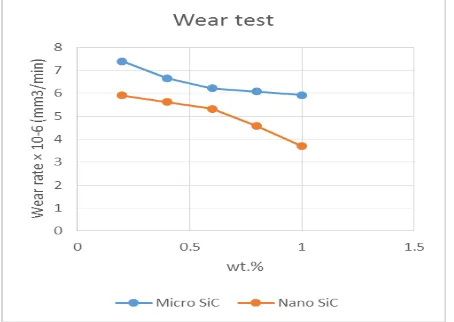
The Pin on Disc setup is used for a quick and easy method of sliding wear measurement. The pin on disc setup measures sliding wear properties of dry or lubricated surfaces of a variety of bulk materials and coatings. The pin surface can be worn and friction tested. The normal load, rotational speed, and the wear track diameter are all set by the user prior to the pin on disc test. Dry sliding wear tests were conducted using a pin-on-disc tester as per the ASTM G-99 standard. Pin specimens of dimensions 75×12×10mm were machined from the casted plates. A pin holder loaded the stationary pins vertically onto a rotating En-31 steel disc. A normal load of 1 kg and 2 kg were applied using dead weights at 1200 and 1450 rpm for the corresponding wear track of 132mm diameter over the steel disc. For each sliding condition, 5 minutes of run were carried out. At the end of it, the pins were carefully cleaned and weighed using a sensitive electronic balance with an accuracy of ±0.001 mg to determine the weight loss. The following table 1 shows the mass loss and wear rate for the applied load of 1 kg and 2kg for micro SiC and Al6351-nano SiC Composites and interprets that increasing the weight percentage of reinforcement particles, reduces the wear rate up to 1.0wt% micro SiC and of nano SiC. The wear rate corresponding to different weight percentages are tabulated below.
TABLE II
WEAR TEST RESULTS
Wt.% of
reinforcement
Wear rate × 10-6 (mm3/min)
Micro
SiC-Al6351
Nano
SiC-Al6351
0.0 8.31 8.31
0.2 7.39 5.91
0.4 6.66 5.62
0.6 6.22 5.33
0.8 6.07 4.58
1.0 5.92 3.70
[image:3.612.332.559.141.302.2]The variation of wear rate of Al6351- micro SiC and Al6351- nano SiC composites are depicted in fig.4.
Fig.4: Wear rate of Micro and Nano composites.
It is observed from the fig.4 that the amounts of reinforcement in Al6351 alloy have influence on the wear behaviour of Al6351-micro SiC and Al6351- nano SiC composite materials. The figure clearly indicate that the wear rate is reduced by increasing the weight percentage of micro SiC up to 1.0wt% & nano SiC up to 1.0wt%.
C. Izod Impact Test
Izod impact strength testing is an method of determining impact strength. A notched sample is generally used to
determine impact strength. Impact is a very important
phenomenon in governing the life of a structure. An arm held at a specific height (constant potential energy) is released. The arm hits the sample and breaks it. From the energy absorbed by the sample, its impact strength is determined. The values of Impact Strength corresponding to different weight percentages are tabulated below.
TABLE III
IZOD IMPACT TEST RESULTS
Wt.% of
reinforcement
Impact Strength(MPa)
Micro
SiC-Al6351
Nano
SiC-Al6351
0.0 12.50 12.50
0.2 13.73 20.36
0.4 12.72 23.53
0.6 15.63 27.32
0.8 18.96 29.21
1.0 21.78 31.39
[image:3.612.42.296.536.673.2] [image:3.612.316.570.543.673.2]International Journal of Emerging Technology and Advanced Engineering
Website: www.ijetae.com (ISSN 2250-2459, ISO 9001:2008 Certified Journal, Volume 7, Issue 12, December 2017)
70
Fig.5: Variation of Impact Strength of Micro and Nano Composites.
It is observed from the Fig.5 that both the micro and nano composites has increasing trend with increase in wt.% as seen in hardness. The increasing rate of nano composite is almost double compared to micro composites.
D. Tensile Test
Tensile Tests are performed for several reasons, the results of tensile tests are used in selecting materials for engineering applications. Tensile properties frequently are included in material specifications to ensure quality. Tensile properties often are measured during development of new materials and processes, so that different materials and processes can be compared. Finally, tensile properties often are used to predict the behaviour of a material under forms of loading other than un-axial tension. The strength of a material often is the primary concern. The strength of interest may be measured in terms of either the stress necessary to cause appreciable plastic deformation or the
maximum stress that the material can withstand. The
samples were machined to get dog-bone specimen for tensile test. As shown in Fig.6
Fig.6: Standard Sample for Tensile Strength Test
The UTM (universal testing machine) was used for the tensile test is shown in Fig.7
Fig.7: Universal Testing Machine
The specimens were loaded hydraulically. The loads at which the specimen has reached the yield point and broken
were noted down. The ultimate tensile strength of Micro
and Nano SiC Aluminium Metal Matrix Composites fabricated at different weight percentages is evaluated by using Universal Testing Machine (UTM). The ultimate tensile strength is calculated by using the formula
𝜎
𝑈𝑇𝑆=𝑃
𝑚𝑎𝑥/𝐴
0Where Pmax is the maximum breaking load and A0 is the
original cross section area. Whereas other outputs such as elongation, yield strength and fracture toughness were not considered in this work.
The values of ultimate tensile strength corresponding to different weight percentages are tabulated.
TABLE IV
TENSILE TEST RESULTS
Wt.% of
reinforcement
Tensile Strength(MPa)
Micro
SiC-Al6351
Nano
SiC-Al6351
0.0 250 250
0.2 251 257
0.4 252 262
0.6 254 265
0.8 256 269
International Journal of Emerging Technology and Advanced Engineering
Website: www.ijetae.com (ISSN 2250-2459, ISO 9001:2008 Certified Journal, Volume 7, Issue 12, December 2017)
71 The evaluated ultimate tensile strength is depicted in Fig.8.
Fig.8:Variation of Tesile Strength of Micro and Nano Composites.
It is observed from the Fig.8 that there is no much improvement in tensile strength of micro composites with increase in wt.%. But in nano composites there is better improvement compared to micro composites.
IV. CONCLUSIONS
In the present work, wear test, hardness, Izod impact test and tensile test were conducted on the micro SiC reinforced and nano SiC reinforced Al6351 metal matrix composites (MMCs) with various weight percentages. Based on the present experimental work the following conclusions can be drawn:
1.The stir casting method is found to be suitable for
fabricating Al6351-micro SiC and Al6351- nano SiC metal matrix composites.
2.Al6351- nano SiC exhibit less wear rate as compared
with Al6351-micro SiC metal matrix composites. Al6351-1.0% - nano SiC composites have low wear rate compared with other reinforcement weight percentages.
3.Increasing rate of Tensile strength is more for nano
SiC composite compared to micro SiC.
4.Impact strength is increasing with respect to increase
in wt.% of reinforcement. But Increasing rate of Impact strength of nano SiC is almost double the increasing rate of micro SiC composite.
5. Hardness is also increasing with increase in wt.% of
reinforcement. But the Hardness of nano SiC composites is increasing rapidly compared to micro SiC composites.
From this investigation it should be suggested that the Al6351 - nano SiC composite is the most suitable choice considering the parameters like wear resistance, tensile strength, hardness and impact strength among the investigated cases.
REFERENCES
[1] Brabazon D, Browne D.J, Carr A.J (2002) ―Mechanical stir casting of aluminium alloys from the mushy state: process, microstructure and mechanical properties‖, Materials Science and Engineering A326, pp. 370–381.
[2] Lakhvir Singh, Baljinder Ram, Amandeep Singh (2013) ―Optimization of process parameter for stir casted Aluminium metal matrix composite using taguchi Method‖, International Journal of Research in Engineering and Technology, Vol. 02, Issue. 08, pp. 375-383.
[3] S. Balasivanandha prabhu, L. Karunamoorthy, S. Kathiresan and B. Mohan // Material Processing Technology 171 (2006) 268. [4] F.M. Husking, F. Folgar Portillo, R. Wunderlin and R. Mehrabian,
―Composites of aluminium alloys: fabrication and wear behaviour‖, Journal of Material Science, 17, 1982, p 477-498.
[5] Sedat Ozden, Recep Ekici and Fehmi Nair // Composites: Part A 38 (2007) 484.
[6] G. Cao, J. Kobliska, H. Konishi, X. Li, Tensile properties and microstructure of SiC nanoparticle reinforced Mg-4Zn Alloy fabricated by ultrasonic cavitations based solidification processing, Metallurgical and Materials Transactions A 39A (2008) 880– 886.Spector, A. Z. 1989. Achieving application requirements. In Distributed Systems, S. Mullende.
[7] G. Cao, H. Konishi, X. Li, Recent developments on ultrasonic cavitation based solidification processing of bulk magnesium nanocomposites, International Journal of Metalcasting, American Foundry Society 2 (2008) 57–68.
[8] H.C. How, T.N. Baker, ―Dry sliding wear behaviour of Saffil-reinforced AA6061 composites‖, Wear 210 (1997) 263-272. [9] M. Hutching, ―Wear by particulates‖, Chemical Engineering
Science, 42, 1987, p 869-878.
[10] Debdas Roy, Bikramjit Basu and Amitava Basu Mallick, ―Tribological properties of Ti aluminide reinforced Al-based in situ metal matrix composite‖, Intermetallics, 13, 2005, p 733–740. [11] Umanath K., ―Friction and wear behaviour of Al6061Alloy (SiCP
+Al2O3P) hybrid composites‖, International Journal of Engineering Science and Technology, 3, 2011 p 5441-5451.