
IMPROVING INITIATION, DECISION AND
EXECUTION PHASES FOR VERTICAL
HANDOVER IN HETEROGENEOUS
WIRELESS MOBILE NETWORKS
Omar Abd Alraheem Omar Khattab
School of Computing, Science and Engineering
College of Science and Technology
the University of Salford, Salford, UK
I
ACKNOWLEDGMENTS
First and foremost, I am eternally grateful to the Almighty Allah for all the blessings He gave me and for enabling me to complete this thesis. I would like to seize this opportunity to thank a number of people whose role has been reason in this success.
I would like to express my deepest sense of gratitude to my great supervisor Dr. Omar
Alani for his guidance, encouragement and trust throughout my PhD research studies.
After three years of patience and hard work, my dream has really come true with his
support. Therefore, I would love the congratulation compliments which I may receive to
be extended to him.
I would like also to thank the members of my assessment committee, Dr. Martin Hope, Dr. Steven Hill, Prof. Nigel Linge and Dr. Bernardi Pranggono for their constructive remarks and recommendations.
I owe a big thank to all my true friends and to the university‘s staff who stood by my side during my journey of PhD.
I am so grateful to my fabulous family, especially my parents, brothers, sisters, nephews and nieces who have pushed themselves to the extreme ends to ensure that I continue my education to the highest level. Truly, without their love, sacrifices and support, I would not have reached this point in my life and this PhD research work would not have been possible.
II
ABSTRACT
One of the challenging issues in Next Generation Wireless Systems (NGWS) is seamless Vertical Handover (VHO) during the mobility between different types of technologies (3GPP and non-3GPP) such as Global System for Mobile Communication (GSM), Wireless Fidelity (Wi-Fi), Worldwide Interoperability for Microwave Access (WiMAX), Universal Mobile Telecommunications System (UMTS) and Long Term Evolution (LTE). Therefore, the telecommunication operators are required to develop an interoperability strategy for these different types of existing networks to get the best connection anywhere, anytime without interruption of the ongoing sessions. In order to identify this problem accurately, the research study presented in this thesis provides four surveys about VHO approaches found in the literature. In these surveys, we classify the existing VHO approaches into categories based on the available VHO techniques for which we present their objectives and performances issues. After that, we propose an optimised VHO approach based on the VHO approaches that have been studied in the literature and take into consideration the research problems and conclusions which are arisen in our surveys. The proposed approach demonstrates better performance (packet loss, latency and signaling cost), less VHO connection failure (probability of minimising VHO reject sessions), less complexity and an enhanced VHO compared with that found in the literature. It consists of a procedure which is implemented by an algorithm.
The proposed procedure of loose coupling and Mobile Internet Protocol version 4 (MIPv4) provides early buffering for new data packets to minimise VHO packet loss and latency. Analysis and simulation of the proposed procedure show that the VHO packet loss and latency are significantly reduced compared with previous MIPv6 procedures found in the literature.
III
IV
KEYWORDS
V
TABLE of CONTENTS
ACKNOWLEDGMENTS………..……….…… I
ABSTRACT………..…… II
KEYWORDS……… IV
TABLE of CONTENTS………...…… V
LIST of FIGURES……… IX
LIST of TABLES……….. XII
LIST of ABBREVIATIONS……….... XIV
LIST of SYMBOLS………..… XXII
Chapter 1: Thesis Introduction and Methodology
1.1 Introduction ………... 1
1.1.1 Problem Statement and Motivation ……… 2
1.1.2 Thesis Contributions………..………….. 3
1.1.3 Research Methodology………... 4
1.2 Summary of Publications, Awards and Training Sessions ………. 7
1.2.1 Summary of Included Publications and Awards ….………..…... 7
1.2.2 Summary of Included Training Sessions………... 10
1.3 Thesis Organisation ……….… 12
Chapter 2: Background and Overview 2.1 Introduction……….………... 14
2.2 How Have Wireless Access Networks Evolved……..……….……… 14
2.2.1 Global System for Mobile Communication (GSM)……….… 15
2.2.2 Universal Mobile Telecommunications System (UMTS)………...… 17
2.2.3 Wireless Fidelity (Wi-Fi)……….……… 23
VI
2.2.4.1 Worldwide Interoperability for Microwave Access
(WiMAX)………...… 27
2.2.4.2 Long Term Evolution (LTE)………...……… 31
2.2.4.3 A Comparison between WiMAX and LTE as the Next Generation Mobile Networks …………...………. 35
2.2.4.3.1 WiMAX and LTE Technical Specifications……… 35
2.2.4.3.2 Coupling of WiMAX and LTE………...…. 39
2.3 What are Heterogeneous Wireless Networks ………... 42
2.4 Who Needs Heterogeneous Wireless Networks………...…… 43
2.5 Why are Heterogeneous Wireless Networks Necessary ……..……….….. 43
2.6 What is the Handover Management within Heterogeneous Wireless Networks……….……….… 45
2.6.1 Handover Classifications………...…………... 46
2.6.2 Handover Multimode Mobile Terminal………...………...… 51
2.6.3 Handover Techniques………. 52
2.6.4 Handover Criteria………..……….. 54
2.6.5 Handover Access Network Selection Methods………... 56
2.7 Chapter Summary………. 58
Chapter 3: Available Techniques of Vertical Handover (VHO) in Heterogeneous Wireless Networks 3.1 Introduction……….……….. 60
3.2 Background of VHO Techniques……….………...…….. 61
3.2.1 Interworking Architectures………..… 61
3.2.1.1 Loose Coupling……….... 62
3.2.1.2 Tight Coupling………. 63
3.2.1.3 Loose vs. Tight Coupling Comparison……...………. 65
3.2.2 Access Network Discovery and Selection Function (ANDSF) Mechanism ………... 66
3.2.3 Interworking Frameworks…... 67
VII
3.2.3.2 IP Multimedia Subsystem (IMS) Framework…………... 71 3.2.3.3 VHO Approaches Classifications Based on Frameworks….. 73 3.2.3.3.1 MIH Category……….……. 73 3.2.3.3.2 IMS Category………... 77 3.2.3.3.3 MIP under IMS Category……….… 78 3.2.3.3.4 MIH and IMS Combination Category ………….... 79 3.2.3.4 Comparison of VHO Approaches……..……….……… 80 3.2.3.4.1 Comparison between the Frameworks…...……..… 80 3.2.3.4.2 Comparison between the Categories……….... 82 3.2.4 Mobility Management Protocols………...………... 86 3.2.4.1 Comparison of VHO Approaches Classifications Based on
MIPv4 and MIPv6……….. 87
3.3 Chapter Summary………….……….... 89
Chapter 4: Connection Failure and Signaling Cost Drawbacks in Heterogeneous Wireless Networks
4.1 Introduction………..……….… 91 4.2 VHO Approaches Classifications Based on MIH and ANDSF……...……. 92 4.2.1 ANDSF Category……… 93 4.2.2 MIH Category………. 96 4.2.3 MIH and ANDSF Combination Category……….. 97 4.3 Comparison of VHO Approaches Based on MIH and ANDSF ………..… 99
4.4 Chapter Summary………...……….. 101
Chapter 5: New Procedure for Enhancing the VHO in Heterogeneous Wireless Networks
VIII
5.2.1.1.1 Analytical Results and Discussions of the Proposed
Procedure………...………….……….. 116
5.2.1.2 Simulation Scenarios, Results and Discussions of the Proposed Procedure……...………. 118
5.3 Chapter Summary………...…….. 120
Chapter 6: New Algorithm for Enhancing the VHO in Heterogeneous Wireless Networks 6.1 Introduction ……….………. 121
6.2 Imperative Alternative MIH for VHO (I AM 4 VHO) Algorithm... 122
6.2.1 Analytical Modelling of the Proposed Algorithm …..…..….……… 124
6.2.1.1 Analytical Results and Discussions of the Proposed Algorithm………...………….……… 131
6.2.2 Simulation Scenarios, Results and Discussions of the Proposed Algorithm……...……….… 140
6.3 Chapter Summary……….…...…. 143
Chapter 7: Conclusions and Future Work 7.1 Introduction ……….. 144
7.2 Outcomes of the Research Study (Conclusions)………... 144
7.3 Future Work………..… 148
References………...…… 151
IX
LIST of FIGURES
1.1 Research Methodology………...…... 5
2.1 Global System for Mobile Communication (GSM) Structure……… 16
2.2 Universal Mobile Telecommunications System (UMTS) Architecture………..20
2.3 Extended Service Set (ESS) and Distribution System……… 25
2.4 The WiMAX and LTE Standards’ Development………... 26
2.5 Mapping between UMTS and 802.16 QoS Classes……… 29
2.6 Mobile WiMAX Network………... 31
2.7 LTE – System Architecture Evolution (SAE)………. 32
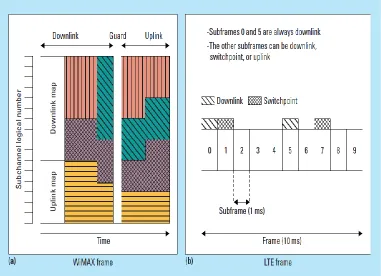
2.8 Both WiMAX and LTE Employ Reservation Based Access Using the Concept Frames……….…..……… 37
2.9 Open Coupling Integration between 4G Networks………. 40
2.10 Loose Coupling Integration between 4G Networks ………... 41
2.11 Tight Coupling Integration between 4G Networks ……… 41
2.12 Very Tight Coupling Integration between 4G Networks ………...… 42
2.13 Operators’ Vision of Using Heterogeneous Wireless Networks …………... 43
2.14 Vertical Handover Classification……… 46
2.15 Parameters Used for Making Vertical Handover Decisions………...………… 54
3.1 Loose Coupling Integration...………..……...….... 62
3.2 Tight Coupling Integration at GGSN Level……….……..…...…….. 63
3.3 Tight Coupling Integration at RNC Level……….……... 64
3.4 Access Network Discovery and Selection Function (ANDSF) Passing Information about Radio Access Technologies (RATs) to Mobile Users (MUs)……….. 66
3.5 Media Independent Handover (MIH)………...……….. 68
3.6 Media Independent Information Service (MIIS) Passing Information about Radio Access Technologies (RATs) to Mobile Users (MUs)…………... 70
X
3.8 Comparison between the Categories (RATs)……….… 83
3.9 Comparison between the Categories (Performances)………. 84
3.10 Comparison between the Categories (Evaluation Methods)………...… 84
4.1 Seamless Single-Radio Handover from Mobile WiMAX to 3GPP Access…… 94
4.2 Signaling Flow of the Improved Vertical Handover from Mobile WiMAX to 3GPP UTRAN………. 95
4.3 Handover Process with Media Independent Handover (MIH) and Access Network Discovery and Selection Function (ANDSF) Development………… 98
5.1 Various Radio Access Technologies (RATs) Integration Supported by
MIH/ANDSF………..…. 104
5.2 Imperative Alternative Media Independent Handover for Vertical Handover (I AM 4 VHO) Procedure ……….. 107
5.3 Diagram of Proposed Imperative Alternative Media Independent Handover for Vertical Handover (I AM 4 VHO) Procedure... 109
5.4 Time Signaling for Imperative Alternative Media Independent Handover for Vertical Handover (I AM 4 VHO) Procedure ……….... 111
5.5 Comparison of Vertical Handover Procedures Performance Using Analytical Modelling Results (Latency)….……...………... 117
5.6 Comparison of Vertical Handover Procedures Performance Using Analytical Modelling Results (Packet Loss)………...……….…… 117
5.7 SimulationDiagram of Proposed Procedure from Wi-Fi to WiMAX………… 119
5.8 Comparison of the Proposed Vertical Handover Procedure Performance Using Simulation Result vs. Analytical Modelling Result (Latency)…...……… 120
5.9 Comparison of the Proposed Vertical Handover Procedure Performance Using Simulation Result vs. Analytical Modelling Result (Packet Loss)……...… 120
6.1 Imperative Alternative Media Independent Handover for Vertical Handover (I AM 4 VHO) Algorithm………... 123
6.2 Handover Initiation and Optimum RATs Phases Using Mamdani Fuzzy Logic Inference System (FIS)...………...…. 124
6.3 Input Variable “RSS” ………..………. 126
XI
6.5 Input Variable “Converge Area”………..………...… 127
6.6 Input Variable “Latency”……… 127
6.7 Output Variable “Handover Factor”………...……… 128
6.8 Radio Access Technologies (RATs) Coverage Area………..…… 132
6.9 Wireless Network Selection Function (WNSF) Values…..………….…...… 135
6.10 Comparison of Probability of Minimising VHO Connection Failure Algorithms ( )……….………. 135
6.11 Comparison of Probability of Minimising VHO Connection Failure Algorithms ( )……….……….… 136
6.12 Comparison of Probability of Minimising VHO Connection Failure Algorithms ( )……….………. 136
6.13 Comparison of Probability of Minimising VHO Connection Failure Algorithms ( )……….………. 137
6.14 Comparison of Probability of Minimising VHO Connection Failure Algorithms ( )……….………. 137
6.15 Comparison of Probability of Minimising VHO Connection Failure Algorithms ( )……….…. 138
6.16 Comparison of Probability of Minimising VHO Connection Failure Algorithms ( )……….…. 138
6.17 Comparison of Probability of Minimising VHO Connection Failure Algorithms ( )……….. 139
6.18 Comparison of Probability of Minimising VHO Connection Failure Algorithms ( )………..… 139
6.19 Scenario1: Probability of Minimising VHO Connection Failure……...……… 142
6.20 Scenario2: Probability of Minimising VHO Connection Failure…………...… 142
XII
LIST of TABLES
2.1 UMTS Traffic Type and QoS Requirements for Different Traffic Type…... 22
2.2 Most Important Features and System Requirements of Mobile WiMAX Standards……….…. 28
2.3 Service Flow for WiMAX……… 29
2.4 WiMAX and LTE Technical Specifications……….……… 36
2.5 Advantages and Disadvantages for UMTS, Wi-Fi, WiMAX and LTE ….….. 44
2.6 Comparison of Handover Control……… 50
3.1 Comparing Loose vs. Tight Coupling………..……… 65
3.2 Link Layer Events……….……… 69
3.3 Handover Information Elements………...……… 69
3.4 Handover Commands for Network Initiated Handovers……….………. 70
3.5 Control Layer of an IP Multimedia Subsystem (IMS) ……….……... 72
3.6 Comparative Summary of the Two Frameworks (MIH and IMS)…..…... 81
3.7 Comparative Summary of the Eighteen VHO Approaches Based on MIH and IMS Frameworks……….……..… 85
3.8 Comparative Summary of the Two Categories Based on MIPv4 and MIPv6………...……… 88
4.1 Similarities and Contrasts of Media Independent Handover (MIH) and Access Network Discovery and Selection Function (ANDSF)……….... 97
4.2 Comparative Summary of the Three Categories Based on MIH and ANDSF……….… 99
5.1 Notations for Imperative Alternative Vertical Handover (I AM 4 VHO) Procedure Time Signaling………..……….. 112
5.2 Input Parameters for Performance Evaluation of Analytical Modelling... 116
5.3 Parameters for Performance Evaluation of Simulation Modelling…...…….... 119
6.1 Performance Evaluation for Optimum RATs List of Priority...………..……. 134
XIII
XIV
LIST of ABBREVIATIONS
2G Second Generation.
3G Third Generation.
3GPP 3rd Generation Partnership Project.
4G Fourth Generation.
AAA Authentication, Authorisation and Accounting.
AAVHO Automatically Alternative Vertical Handover.
ABC Always Best Connected.
AC Admission Control.
AGW Access Gateway.
AHP Analytic Hierarchy Process.
AIVHO Automatically Imperative Vertical Handover.
ANDSF Access Network Discovery and Selection Function.
ANS Access Network Selection.
AP Access Point.
AS Application Server.
ASNGW Access Service Network Gateway.
ATIS Alliance for Telecommunications Industry Solutions.
AUC Authentication Unit Centre.
BBERF Bearer Binding and Event Reporting Function.
BCE Binding Cache Entry.
BE Best Effort.
BER Bit Error Rate.
BGCF Breakout Gateway Control Function.
BS Base Station.
BSC Basic System Controller.
BSS (GSM) Basic Service Set.
XV
BTS Basic Transceiver System.
BU Binding Update.
CBR Constant Bit Rate.
CDMA Code Division Multiple Access.
CE Consumer Electronic.
CMR Call to Mobility Ratio.
CN Correspondent Node.
CoA Care of Address.
CS Circuit Switched.
CSCF Call Session Control Function.
CSN Connectivity Services Network.
DFF Data Forwarding Function.
DHCP Dynamic Host Configuration Protocol.
DL Down Link.
DRX Discontinued Reception.
DSL Digital Subscriber Line.
DTX Discontinued Transmission.
EDGE Enhanced Data Rates for Global System for Mobile Communication
Evolution.
EIR Equipment Identity Register.
ENUM Electronic Numbering.
EPC Evolved Packet Core.
ertPS extended non-real-time Polling Service.
ESS Extended Service Set.
ETSI European Telecommunication Standards Institute.
E-UTRAN Evolved Universal Mobile Telecommunications System Terrestrial Radio Access Network.
EVDO Evolution Data Optimised.
FA Foreign Agent.
FAF Forward Authentication Function.
XVI
FIS Fuzzy logic Inference System.
FL Fuzzy Logic.
FTP File Transfer Protocol.
GGSN Gateway General Packet Radio Service Support Node.
GMSC Gateway Mobile Station Switching Centre.
GPRS General Packet Radio Service.
GRA Grey Relational Analysis.
GSM Global System for Mobile Communication.
HA Home Agent.
HAWAII Handover Aware Wireless Access Internet Infrastructure.
HC Hybrid Coupling.
HEL Handover Execution Latency.
HF Handover Factor.
HHO Horizontal Handover.
HIP Host Identity Protocol.
HL Handover Latency.
HLR Home Location Register.
HPL Handover Preparation Latency.
HSDPA High Speed Downlink Packet Access.
HSPA High Speed Packet Access.
HSS Home Subscriber Service.
HTTP Hypertext Transfer Protocol.
IBSS Independent Basic Service Set.
ICSCF Interrogating Call Session Control Function.
IEEE Institute of Electrical and Electronics Engineers.
IETF Internet Engineering Task Force.
IMS Internet Protocol Multimedia Subsystem.
IMT-Advanced International Mobile Telecommunication-Advanced.
IPTV Internet Protocol Television.
ISDN Integrated Services Digital Network.
XVII
ITU-R International Telecommunication Radio Communication Sector.
IWU Interworking Unit.
LAN Local Area Network.
LC Loose Coupling.
LCWC Loosely Coupled WiMAX Cellular.
LMA Local Mobility Anchor.
LTE Long Term Evolution.
MAC Medium Access Control.
MADM Multiple Attribute Decision Making.
MAG Mobile Access Gateway.
MAN Metropolitan Area Network.
MAVHO Manually Alternative Vertical Handover.
MCC Mobile Country Code.
MCHO Mobile Controlled Handover.
MCNA Mobile Controlled Network Assisted.
ME Mobile Equipment.
MF Membership Function.
MGC Media Gateway Controller.
MGCF Media Gateway Control Function.
MGW Media Gateway.
MICS Media Independent Command Service.
MIES Media Independent Event Service.
MIH Media Independent Handover.
MIHF Media Independent Handover Function.
MIIS Media Independent Information Service.
MIMO Multiple Input Multiple Output.
MIPv4 Mobile Internet Protocol version 4.
MIPv6 Mobile Internet Protocol version 6.
MME Mobility Management Entity.
MN Mobile Node.
XVIII
MNC Mobile Network Code.
MPEG Moving Pictures Expert Group.
MPLS Multiprotocol Label Switching.
MRFC Media Resource Function Controller.
MRFP Multimedia Resource Function Processor.
MS Mobile Station.
MSC Mobile Station Switching Centre.
MU Mobile User.
MUAR Mobile User and Advertisement Router.
MUHA Mobile User and Home Agent.
NAI Network Access Identifier.
NAP Network Access Provider.
NCHO Network Controlled Handover.
NCMA Network Controlled Mobile Assisted.
NE Network Element.
NET_MM Network Mobility Manager.
NGWS Next Generation Wireless Systems.
NN Neural Network.
nrtPS non-real-time Polling Service.
NSP Network Service Provider.
NSS Network and Switching Subsystem.
OFDMA Orthogonal Frequency Division Multiple Access.
OMC Operation Maintenance Centre.
OSS Operation Support Subsystem.
PBA Proxy Binding Acknowledge.
PBU Proxy Binding Update.
PCEF Policy and Charging Enforcement Function.
PCRF Policy and Charging Rules Function.
PCSCF Proxy Call Session Control Function.
PDP Packet Data Protocol.
XIX
PGW Packet Data Network Gateway.
PKM Privacy Key Management.
PLMN Public Land Mobile Network.
PMIPv6 Proxy Mobile Internet Protocol version 6.
PoA Point of Attachment.
PoC Push to-talk-over Cellular.
PoS Point of Service.
PS Packet Switched.
PSNR Peak Signal to Noise Ratio.
PSTN Public Switched Telephone Network.
QoS Quality of Service.
RAN Radio Access Network.
RAS Radio Access Station.
RAT Radio Access Technology.
RLC Radio Link Control.
RNC Radio Network Control.
RNS Radio Network Subsystem.
RRM Radio Resource Management.
RSS Received Signal Strength.
rtPS real-time Polling Service.
SAE System Architecture Evolution.
SAW Simple Additive Weighting.
SC Single Carrier.
SCFDMA Single Carrier Frequency Division Multiple Access.
SDU Service Data Unit.
SGSN Serving General Packet Radio Service Support Node
SGW Serving Gateway.
SIM Subscriber Identity Module.
SIP Session Initiation Protocol.
S-MAG Source-Mobile Access Gateway.
XX
SN Source Node.
SNR Signal to Noise Ratio.
SoRs Sufficient of Resources.
SS Subscriber Station.
SS7 Signaling System Number 7 Protocol.
TC Tight Coupling.
TCWC Tightly Coupled WiMAX Cellular.
TDD Time Division Duplex.
TDM Time Division Multiplexing.
TDMA Time Division Multiple Access.
THIG Topology Hiding Interworking Gateway.
TMAG Target Mobile Access Gateway.
TOPSIS Technique for Order Preference by Similarity to Ideal Solution.
UE User Equipment.
UGS Unsolicited Grant Service.
UL Up Link.
UMTS Universal Mobile Telecommunications System.
USIM Universal Mobile Telecommunications System Subscriber Identity Module.
VGSN Virtual General Packet Radio Service Support Node.
VHL Vertical Handover Latency.
VHO Vertical Handover.
VIP Virtual Internet Protocol.
VLR Visitor Location Register.
VoD Video on Demand.
VoIP Voice over Internet Protocol.
VPN Virtual Private Network.
WAG Wireless Local Area Network Access Gateway.
WAN Wide Area Network.
WCDMA Wideband Code Division Multiple Access.
WEP Wireless Equivalent Privacy.
XXI
WiMAX Worldwide Interoperability for Microwave Access.
WLAN Wireless Local Area Network.
XXII
LIST of SYMBOLS
1/Ci Low Service Cost.
1/Li Low Network Latency.
1/Pi Low Battery Power Requirement.
A Set of Alternatives.
B Matrix.
Bwl Bandwidth of the Wireless Link.
C
Set of Handover Decision Criteria (Attributes) that can be Expressed as Fuzzy Sets in the Space of Alternatives.
CAi High Network Coverage Area.
Di High Data Rate.
Ei Good Security.
fi(u) Objective Function Evaluated for a Network.
K Number of Available Radio Access Technologies (RATs).
LAUTRD Latency of Authentication Respond.
LAUTRT Latency of Authentication Request.
LRATMU
Latency of Target Radio Access Technology (RAT) Passed to Mobile User (MU).
LTB Latency of Binding Update.
LTBA Latency of Binding Acknowledgment with Home Agent.
Lwl Latency of the Wireless Link.
Nf(X) Normalized Function of a Parameter.
Pkt_loss Percentage of Packet Loss.
PPx
Router or Agent Route Lookup Latency and Packet Processing Latency.
Probability of Successful Checking Resources on Available Radio Access Technologies (RATs).
XXIII
R
Number of Available Successful Radio Access Technologies (RATs).
Ri High Reliability.
Sctrl Average Size of a Control Message.
Si Good Signal Strength.
TAA Time Latency for Automatically Alternative Vertical
Handover (VHO) Trigger.
Tagt_adv Period at Which Access Point (AP)/Base Station (BS) Sends
Agent Advertisement over the Wireless Link.
TAI Time Latency for Automatically Imperative Vertical
Handover (VHO) Trigger.
TAN-MAG Latency between Access Point (AP)/Base Station (BS) and Mobile
Access Gateway (MAG).
TBS Time of the Buffering Signaling.
tcell Value of Cell Residence Time.
TDOMAIN-AAA Latency between Entities in Proxy Mobile Internet Protocol
version 6 (PMIPv6)-Domain and Authentication, Authorisation and Accounting (AAA)/Media Independent Information Service (MIIS) Server.
TMA Time Latency for Manually Alternative Vertical Handover
(VHO) Trigger.
TMAG-LMA
Latency between Mobile Access Gateway (MAG) and Local Mobility Anchor (LMA).
TMU-AN
Latency between Mobile User (MU) and Access Point (AP)/Base Station (BS).
U Vector of Input Parameters.
V Unit Eigenvector.
VHL Vertical Handover (VHO) Latency
VHLCombination Vertical Handover (VHO) Latency of Combination Procedure
XXIV
VHLI AM 4 VHO Vertical Handover (VHO) Latency for Imperative Alternative
Media Independent Handover (MIH) for Vertical Handover Procedure.
VHL802.21
Vertical Handover (VHO) Latency for IEEE 802.21-Enabled PMIPv6 Procedure.
VHLPFMIPv6
Vertical Handover (VHO) Latency for Proxy First Mobile Internet Protocol version 6.
VHLPMIPv6
Vertical Handover (VHO) Latency for Proxy Mobile Internet Protocol version 6.
VLi Good Mobile Terminal Velocity.
W Weighting Matrix.
wX Weight Which Indicates the Importance of a Parameter.
Y Base Station (BS) in a Cellular Coverage Area.
yt Only One Target Base Station (BS) Selected.
Z Access Point (AP) in a Cellular Coverage Area.
zt Only One Target Access Point (AP) Selected.
λmax Maximum Eigenvalue.
μCi(Aj) Degree of Membership of Alternative Aj in the Criterion Ci.
Probability of Successful Checking Resources on any Individual Radio Access Technology (RAT).
1
Chapter 1
Thesis Introduction and Methodology
1.1
Introduction
2
Chapter 1 Thesis Introduction and Methodology
rate and low cost to MUs. Therefore, multiple networks (3rd Generation Partnership Project (3GPP) e.g., UMTS and non-3GPP e.g., WiMAX), multiple services (e.g., web browsing, file downloading and streaming application) and multiple radio interfaces (multimode mobile terminal) are three main things which should be taken into account when considering heterogeneous wireless networks.
The main focus of this thesis is to develop a VHO approach to optimise the performance of VHO in heterogeneous wireless network environment. This chapter begins with section 1.1.1 introducing the problem statement and motivation of the research in this thesis, followed by 1.1.2 which presents thesis contributions. Then, section 1.1.3 presents the research methodology. In section 1.2.1, a summary of publications and awards is presented. In section 1.2.2, a summary of training sessions is presented and finally, the thesis organisation is presented in section 1.3.
1.1.1 Problem Statement and Motivation
3
Chapter 1 Thesis Introduction and Methodology
The research project presented in this thesis provides an optimised VHO approach. It demonstrates better performance (packet loss, latency and signaling cost), less VHO connection failure (probability of minimising VHO reject sessions), less complexity and an enhanced VHO compared with that found in the literature.
1.1.2
Thesis Contributions
We present a new approach based on the VHO approaches that have been studied in the literature for enhancing the VHO heterogeneous wireless network environment. It can be implemented with the Media Independent Handover (MIH) framework which is more flexible and has better performance compared with the available VHO techniques found in the literature. The proposed approach considers and tackles four main VHO mobility elements which are responsible to provide seamless VHO in heterogeneous wireless network environment and which have yet to be addressed thoroughly in the literature. These four elements are: packet loss, latency, signaling cost and probability of VHO connection failure (probability of minimising VHO reject sessions). The proposed approach consists of a procedure with three phases which is implemented by an algorithm to provide significant improvements on the VHO phases compared with that found in the literature. These three phases, as described below, are: Handover Initiation, Handover Decision and Handover Execution. These three phases are described below.
1. Handover Initiation
4
Chapter 1 Thesis Introduction and Methodology
2. Handover Decision
A handover decision phase is presented using a VHO algorithm based on our approach which achieves less VHO connection failure (probability of minimising VHO reject sessions) as a result of using the optimum RATs list of priority.
3. Handover Execution
A handover execution phase is presented which helps to provide better VHO performance with minimal packet loss (softer) and minimal latency (faster) due to buffering new data packets earlier.
1.1.3
Research Methodology
The research methodology that has been used is an iterative process where new ideas have been added to existing solutions found in the literature and published previously. Feedback from supervisor, examiners, senior scientists and reviewers at meetings, assessments, conferences and journals, has been taken into account. The following research methodology has been developed and adopted for this research program. The main phases of the methodology are shown in Figure.1.1.
1. Reviewing previous literature
First of all, we have reviewed the evolution of wireless access networks and the handover management within heterogeneous wireless networks. Then, we have surveyed previous relevant works about a variety of VHO approaches which have been proposed to provide seamless VHO. We have acquired good knowledge for developing a VHO approach to optimise the performance of VHO in heterogeneous wireless network environment by performing a comprehensive study from previous literature.
2. Identification, studying and analysing the research problems
5
Chapter 1 Thesis Introduction and Methodology
[image:30.612.107.509.192.702.2]and (chapter 4, [137]). In these surveys, we have classified the existing VHO approaches into categories based on the available VHO techniques for which we have presented their objectives and performances issues.
Figure 1.1: Research Methodology 1. Reviewing previous literatures.
2. Identification, studying and analysing the research problems.
5. Analysing and validating collected results and comparing them before the solution.
7. Publish the contribution results of the proposed approach and write up the PhD thesis.
6. Modification to improve performance. 3. Design a new approach based on confidence
approaches to address the research problems.
6
Chapter 1 Thesis Introduction and Methodology
3. Design a new approach based on confidence approaches to address the research problems
It should take into consideration the research problems which have arisen in previous phase (chapter 3, [88, 109 and 115]) and (chapter 4, [137]). Therefore, we have presented and published our approach in (chapter 5 (5.2, 5.2.1) and chapter 6 (6.2), [92]) based on the VHO approaches that have been studied in the literature for enhancing the VHO heterogeneous wireless network environment. The proposed approach consists of a procedure which is implemented by an algorithm.
4. Analytical modelling and simulation of the proposed approach
In this phase, we have provided analytical and simulation results of our approach.
5. Analysing and validating collected results and comparing them before the solution
In this phase, we have focused on the validation of the proposed approach in order to test and analyse its performance and reliability. The effectiveness of the new approach has been tested and validated.
6. Modification to improve performance
In this phase, we have used our validation of the test results to modify and improve the performance of the proposed approach; the thing which allowed us to produce an improved version.
7. Publish the contribution results and write up the PhD thesis
7
Chapter 1 Thesis Introduction and Methodology
1.2
Summary of Publications, Awards and Training Sessions
1.2.1 Summary of Included Publications and Awards
Refereed Journal Articles
1. Khattab, O.; Alani, O.;, “Simulation of Performance Execution Procedure to Improve Seamless Vertical Handover in Heterogeneous Networks,” International Journal of Advanced Computer Science and Applications (IJACSA), vol. 5, no. 6, Jun 2014, pp. 109-113.
2. Khattab, O.; Alani, O.;, “A Survey on MIH vs. ANDSF: Who Will Lead the Seamless Vertical Handover Through Heterogeneous Networks?,” International Journal of Future Generation Communication and Networking (IJFGCN), vol. 6, no. 4, Aug 2013, pp. 1-11.
3. Khattab, O.; Alani, O.;, “A Survey on Media Independent Handover (MIH) and IP Multimedia Subsystem (IMS) in Heterogeneous Wireless Networks,”
International Journal of Wireless Information Networks (IJWIN), Springer, vol. 20, no. 2, Jun 2013, pp. 215-228.
4. Khattab, O.; Alani, O.;, “I AM 4 VHO: New Approach to Improve Seamless Vertical Handover in Heterogeneous Wireless Networks,” International Journal
of Computer Networks & Communications (IJCNC), vol. 5, no. 3, May 2013, pp. 53-63.
5. Khattab, O.; Alani, O.;, “Mobile IPv4 Based Procedure for Loose Coupling Architecture to Optimise Performance in Heterogeneous Wireless Networks,”
International Journal of Computer Networks and Wireless Communications
8
Chapter 1 Thesis Introduction and Methodology
Papers in Refereed External Published Conferences Proceedings
1. Khattab, O.; Alani, O.;, “Algorithm for Seamless Vertical Handover in Heterogeneous Mobile Networks,” IEEE Technically Co-Sponsored Science and Information Conference, 27-29 Aug 2014, pp. 1-8.
2. Khattab, O.; Alani, O.;, “The Design and Calculation of Algorithm for Optimising Vertical Handover Performance,” 9th IEEE/IET International Symposium on Communication Systems, Networks and Digital Signal Processing 2014 (CSNDSP
2014), 23-25 Jul 2014, pp. 421-426.
3. Khattab, O.; Alani, O.;, “An Overview of Interworking Architectures in Heterogeneous Wireless Networks: Objectives, Features and Challenges,” 10th International Network Conference 2014 (INC 2014), 8-10 Jul 2014, pp. 71-79.
4. Khattab, O.; Alani, O.;, “Survey on Media Independent Handover (MIH) Approaches in Heterogeneous Wireless Networks,” IEEE19th European Wireless 2013 (EW 2013), 16-18 Apr 2013, pp. 1-5.
5. Khattab, O.; Alani, O.;, “Improvements to Seamless Vertical Handover between Mobile WiMAX, Wi-Fi and 3GPP through MIH,” 13th Annual Post Graduate Symposium on the Convergence of Telecommunications, Networking and
9
Chapter 1 Thesis Introduction and Methodology
Abstracts in Internal Published Conferences Proceedings
1. Khattab, O.; Alani, O.;, “New Algorithm for Minimising Connection Failure in Heterogeneous Mobile Networks,” 4th Computing Science and Engineering Post Graduate Conference, 13 Nov 2013, Salford University, Salford, UK.
2. Khattab, O.; Alani, O.;, “New Procedure for Improving Vertical Handover Performance in Heterogeneous Mobile Networks,” Salford Postgraduate Annual Research Conference 2013 (SPARC 2013), 5-6 Jun 2013, Salford University, Salford, UK.
3. Khattab, O.; Alani, O.;, “Improving Vertical Handover (VHO) Performance in Heterogeneous Mobile Networks,” 3rd Computing Science and Engineering Post Graduate Conference, 14 Nov 2012, Salford University, Salford, UK.
Posters in External Published Conferences and Events Proceedings
1. I have been selected among hundreds of applicants to present the poster, entitled “New Procedure for Improving Vertical Handover Performance in Heterogeneous Mobile Networks,” SET for Britain Exhibition in the Engineering Section, House
of Commons, 18 Mar 2013, London, UK.
10
Chapter 1 Thesis Introduction and Methodology
Posters in Internal Published Conferences and Events Proceedings
1. Prize winner for best poster, entitled “New Algorithm for Minimising Connection Failure in Heterogeneous Mobile Networks,” Dean’s Annual Research Showcase,
Digital, Media and Information Technology Section, 19 Jun 2013, Salford University, Salford, UK.
2. A poster entitled “MIH vs. ANDSF: Who Will Lead the Radio Access Technologies through the Vertical Handover?,” Dean’s Annual Research Showcase, Digital, Media and Information Technology Section , 20 Jun 2012, Salford University, Salford, UK.
3. A poster entitled “Technical Challenges with Ubiquitous Networks,” Salford Postgraduate Annual Research Conference 2012 (SPARC 2012), 30-31 May 2012, Salford University, Salford, UK.
The Dean’s Prize for Postgraduate Research Student
1. I have been awarded the Dean’s Prize for postgraduate student in recognition of my outstanding research work and achievements as a postgraduate research student, Dean’s Annual Research Showcase, 18 Jun 2014, Salford University, Salford, UK.
1.2.2
Summary of Included Training Sessions
Internal Training Sessions (Salford University, Salford, UK)
11
Chapter 1 Thesis Introduction and Methodology
3. 21-Jan-2013 Abstract Writing. 4. 4-Dec-2012 PhD Progression Points.
5. 29-Nov-2012 Applying a Project Management Approach to Progress your Work. 6. 1-Nov-2012 Critical Thinking at Postgraduate Level.
7. 31-Oct-2012 Supporting and Motivating your Research. 8. 28-Mar-2012 Publishing Papers in Refereed Journal. 9. 28-Mar-2012 Maximizing Impact at Conferences. 10. 22-Mar-2012 Online Copyright.
11. 14-Mar-2012 Information Management for the Web.
External Summer School
1. Communications, Networking and Photonics, 18-22 Jun 2012, Edinburgh University, Edinburgh, UK.
Internal Workshops (Salford University, Salford, UK)
1. 12 Jun 2012 Approaching Publishers: Guidance for Academic Authors.
Internal Seminars (Salford University, Salford, UK)
1. How Can ICT Support Collaborative Work? Drivers and Challenges, 21 Mar 2012.
12
Chapter 1 Thesis Introduction and Methodology
1.3 Thesis Organisation
The structure of the thesis comprises of six chapters, set out as follows:
Chapter 1: in this chapter, we have given a brief introduction to the subject matter provided, introducing the reader to the problem statement and motivation. We also have listed contributions and research methodology. Finally, summary of publications, awards and training sessions have been presented.
Chapter 2: in this chapter,we give a critical overview of the evolution of wireless access networks and the handover management within heterogeneous wireless networks. Five basic questions define this chapter to clearly understand the purpose of this research study: how have wireless access networks evolved? What are heterogeneous wireless networks? Who needs heterogeneous wireless networks? Why are heterogeneous wireless networks necessary? and finally, what is the handover management within heterogeneous wireless networks?.
13
Chapter 1 Thesis Introduction and Methodology
Chapter 4: in this chapter, we present a comprehensive survey of VHO approaches designed to provide seamless VHO based on MIH and Access Network Discovery and Selection Function (ANDSF) mechanism for which we present their objectives and performances issues. To offer a systematic comparison in this survey, the VHO approaches are categorised into three groups based on MIH and ANDSF: ANDSF based VHO approaches, MIH based VHO approaches and MIH and ANDSFcombination based VHO approaches.
Chapter 5: in this chapter, we present our Imperative Alternative Media Independent Handover for Vertical Handover (I AM 4 VHO) approach which based on the VHO approaches that have been studied in the literature. It consists of a procedure which is implemented by an algorithm. We present the proposed I AM 4 VHO procedure as the first part of our approach for providing seamless VHO with minimal packet loss and latency.
Chapter 6: in this chapter, we present the proposed I AM 4 VHO algorithm as the second part of our approach for providing seamless VHO with a lower probability of VHO connection failure, signaling cost and inevitable degradation in QoS.
14
Chapter 2
Background and Overview
2.1
Introduction
The rapid evolutions in broadband wireless networks and the growing MU’s demand for communication services anywhere, anytime are driving an evolution toward the seamless integration between different RATs in heterogeneous wireless networks to provide the best connected services to the MU constantly [3]. The benefits of heterogeneous wireless networks are many and varied. These include: flexibility, reducing cost, simplifying the operation and maintenance, rapid deployment of services and applications, new services, high data transmission, customisation, support multimedia services at lower cost of transmission, the mobility of the sessions and the possibility to transfer the context [3].
In order to make this chapter more clear and understandable for general readership, we divide its sections into questions as follows: in sections 2.2, 2.3, 2.4, 2.5 and 2.6, background information on heterogeneous wireless networks are presented to answer the following questions respectively: how have wireless access networks evolved? What are heterogeneous wireless networks? Who needs heterogeneous wireless networks? Why are heterogeneous wireless networks necessary? and finally, what is the handover management within heterogeneous wireless networks. In the last section 2.7, some conclusions are presented.
2.2. How Have Wireless Access Networks Evolved?
15
Chapter 2 Background and Overview
This section presents a background of those main access networks technologies; namely, GSM, UMTS, Wi-Fi, WiMAX and LTE.
2.2.1 Global System for Mobile Communication (GSM)
Global System for Mobile Communication (GSM) is a Second Generation (2G) wireless access technology. The GSM is the first cellular system to specify digital modulation and network level architectures and services, the first important set of Radio Frequency (RF) for GSM standard started at 1900 MHz [7]. The GSM was first introduced in Europe in 1991 and today is one of the most popular digital cellular telecommunications systems widely used over the world [7]. Due to the increase of the number and the requirement of GSM subscriber the GSM wireless access technology is still an attractive area for research in the field of mobile telecommunication [7, 8 and 9].
A variety of services are offered by GSM wireless access technology. The GSM services are a subset of Integrated Services Digital Network (ISDN) services and the most basic and important service offered by the system is telephony [10, 11 and 12]. In addition, GSM can send and receive several types of data services at bit rates up to 9600 bps [10, 11 and 12].
16
Chapter 2 Background and Overview
communicating with other networks such as ISDN and Public Switched Telephone Network (PSTN) [7]. The NSS includes the following units: Mobile-Station Switching Centre (MSC), Home Location Register (HLR), Visitor Location Register (VLR), Authentication Unit Centre (AUC) and Equipment Identity Register (EIR) [7], this is shown in Figure.2.1. The HLR is a centralised database that contains subscriber information and location information of all the users residing in the area of MSC [7]. The VLR is a database of all roaming mobiles in the area of MSC but not residing there [7]. The AUC is a database that provides HLR and VLR with authentication parameters and encryption keys required for security purposes [7]. The EIR is a database that includes numbers of all registered mobile units [7]. The BSS is built up of Basic System Controller (BSC), Basic Transceiver System (BTS) and Mobile Station (MS), also the BSS consists of many of BSCs each of which controls many BTSs and it is associated with the channel management, transmission functions and radio link control [7]. The BSS provides and manages radio transmission paths between MSs and MSC which is the heart of NSS and it provides call setup, routing, switching, handover and other functions [7]. The BSS also manages the radio interface between MSs and all other subsystems of GSM while OOS is built up of Operation Maintenance Centre (OMC) and system software which manages and monitors whole GSM system [7].
MS
BTS
BTS
BTS
BTS
MS
BTS
BTS
BTS
BTS
OMC
MSC
PSTN
ISDN
[image:41.612.93.521.505.707.2]Data Network HLR VLR AUC EIR
17
Chapter 2 Background and Overview
The disadvantage in the GSM technology occurs when a radiation noise is generated from an antenna propagation signal of a Smartphone [9]. This leads the voice quality of the Smartphone to be degraded [9].
2.2.2 Universal Mobile Telecommunications System (UMTS)
2G systems like GSM were originally designed for efficient delivery of voice services. 3G systems like UMTS were designed from the beginning for mobile voice and data users [5]. Therefore, UMTS is the evolution of GSM system and General Radio Packet Service (GPRS) developed by Third Generation Partnership Project (3GPP) to increase the support for some features such as data rate in radio interface and the compatibility for the two services domains: Packet Switched (PS) and Circuit Switched (CS) data transmission [13]. Some of the most common keys drive of this type of UMTS access technology [14]:
Growth in the market for fixed networked multimedia services.
Increasing demand for rapid and remote access to information.
E-Commerce and transaction based applications. The key enablers of UMTS [14]:
Appropriate regulatory framework.
Advances in spectrum efficient radio technologies and data compression techniques.
Development of open UMTS standards.
Improvements in user interface design and display technologies.
Reduced size, power and cost of mobile devices.
Early exploitation of GPRS and GSM2 and services. The UMTS provides different types of services [14, 15 and 16]:
18
Chapter 2 Background and Overview
Mobile multimedia services
- Medium: asymmetric, bursty typically less than 1 Mbyte (e.g., Local Area Network (LAN)/internet access and on-line shopping).
- High: asymmetric, bursty, high data rate (e.g., fast LAN/internet access for large reports with graphics and video clips).
- High interactive: asymmetric and continuous, real time applications requiring minimum delay (e.g., videoconferencing and collaborative working).
Physical layer: the radio access using Wideband Code Division Multiple Access (WCDMA) as underlying air radio interface. The WCDMA supports both FDD and Time Division Duplex (TDD) modes of operation.
Data rate: the UMTS supports different data rates depending on propagation channel condition and the moving speed of mobile. For example, user moving over than 120 Km/h with maximum 500 Km/h in rural areas can expect speeds of 144 Kbps, user moving less than 120 Km/h and urban outdoor environment can expect rates of 384 Kbps, users indoor or moving at less 10 Km/h can reaches speed 2Mbs [3].
Radio Link Control (RLC): the RLC part of the data link layer takes care of issues such as acknowledged and unacknowledged data transfer, transparency, QoS settings, error notification and the establishment of RLC connections.
Low delays with packet round trip times below 200 ms.
Seamless mobility also for packet data applications.
QoS differentiation for high efficiency of service delivery.
Simultaneous voice and data capability.
Interworking with existing GSM/GPRS networks.
Security:theUMTS improved security features come from five security keys:
- Network access security is designed to provide secure access to users for 3G services and to protect any potential attacks on the radio access link.
19
Chapter 2 Background and Overview
- User domain security features provide secure access to MUs.
- Application domain security features support the secure exchange of messages between the user and provider domains.
- Visibility and configurability security allow for the configuration of security features by the user on the device.
In the Figure.2.2, the architecture of UMTS network consists of three different blocks. the first one, User Equipment (UE) which is composed of Mobile Equipment (ME) and UMTS Subscriber Identity Module (USIM) card [16]. The ME is the radio terminal used for radio communication over Uu interface while USIM is a smartcard that includes the subscriber identity, performs authentication algorithms and stores authentication and encryption keys and some subscription information that are needed at the terminal [16]. The second one, UMTS Terrestrial Radio Access Network (UTRAN) comprises sets of NodeB and Radio Network Controller (RNC) [16]. The NodeB converts the data flow between Iub and Uu interfaces, it also participates in radio resource management [16]. The RNC owns and controls the radio resources in its domain as it is the service access point for all services UTRAN which provides the core network; for example, management of connections to UE [16]. The third one, GSM/UMTS core network. A brief description of the elements of GSM/UMTS core network is provided as follows [16]:
20
Chapter 2 Background and Overview
MSC/VLR: the MSC/VLR is the switch (MSC) and database (VLR) that serves the UE in its current location for CS services. The MSC function is used to switch the CS transactions while VLR function includes a copy of the visiting user’s service profile and more precise information on UE’s location within the serving system. The part of the network that is accessed via MSC/VLR is often referred to as CS domain. The MSC also has a role in the early UE handling.
Gateway Mobile-Station Switching Centre (GMSC): the GMSC is the switch at the point where UMTS Public Land Mobile Network (PLMN) is connected to the external CS networks. All incoming and outgoing CS connections go through GMSC.
Serving General Packet Radio Service Support Node (SGSN) functionality: the SGSN is similar to that of MSC/VLR but it is usually used for PS services. The support is also required for early UE handling operation like SGSN and MSC.
Gateway General Packet Radio Service Support Node (GGSN) functionality: the GGSN is close to that of GMSC but is in relation to PS services.
Figure 2.2: Universal Mobile Telecommunications System (UMTS) Architecture [16] USIM ME Cu Uu PLMN, PSTN, ISDN, etc… Internet MSC/ VLR SGSN GMSC HLR GGSN NodeB NodeB NodeB NodeB RNC RNC
lub lur lu
UTRAN
21
Chapter 2 Background and Overview
The external networks consist of CS and PS networks. The CS support connections like the existing telephony service (e.g., ISDN and PSTN). The PS supports connections for packet data services (e.g., internet) [16].
In UMTS system there are number of interfaces between the logical networks elements which have been defined as follows [16]:
Cu interface: this is the communication interface between USIM smartcard and ME. It matches a standard format for smartcards.
Uu interface: this is the WCDMA radio interface. The Uu is the interface through which UE accesses the fixed part of the system and is therefore probably the most important open interface in UMTS.
Iu interface: this is the communication interface between UTRAN and the core network. Similarly to the corresponding interfaces in GSM. It supports different protocol stacks for interfacing with CS or PS. The open Iu interface gives UMTS operators the possibility of acquiring UTRAN and core network from different manufacturers.
Iur interface: the open Iur interface allows the communication interface between adjacent RNCs from different manufacturers and therefore complements the open Iu interface.
Iub interface: the Iub is the physical communication interface between NodeB and RNC.
22
Chapter 2 Background and Overview
Conversational class: the conversational class services are mainly for conversational real time applications such as voice, video telephony and video gaming. This class services can be supported by fixed resource allocation in the network. This class is the most sensitive to delay.
Streaming class: the streaming class services are meant for streaming media applications such as multimedia, Video on Demand (VoD) and webcast. In this class a certain amount of delay variation is tolerable due to application level buffering. Besides, this class service is a variant of the constant bit rate and real time variable bit rate services.
Interactive class: the interactive class is applicable for services requiring assured throughput. To ensure better response times for this class a higher scheduling priority compared with the background class may be required such as web browsing, network gaming and database access. Traffic flow prioritization is taken into account within the service class.
Background class: the background class services are for traditional best effort services such as e-mail, SMS and downloading. This is traffic has the lowest priority among all the classes. This class is class insensitive to delay.
Table 2.1: UMTS Traffic Type and QoS Requirements for Different Traffic Type [25] Traffic Type Application Service Data Unit (SDU) Loss Rate End to End Delay
Conversation Voice. < 10-2 < 150 ms.
Streaming Streaming. < 10-1 < 250 ms.
Interactive Web. < 10-3 < 4 s.
23
Chapter 2 Background and Overview
However, UMTS provides low data rate and high cost additional capacity in spectrum [4, 5].
2.2.3 Wireless Fidelity (Wi-Fi)
The Wi-Fi (IEEE 802.11) is wireless telecommunication system designed to provide broadband for Wireless Local Area Network (WLAN) where the users use the mobile devices (e.g., mobiles and laptops) to access the internet in small geographic area such as university’s buildings, airports and railway stations. Over 97% of laptops today come with Wi-Fi as a standard feature and an increasing number of handhelds and Consumer Electronics (CEs) devices are adding Wi-Fi capabilities [27] as Wi-Fi technology in conformance with IEEE 802.11 are growing every year [28]. The initial standard IEEE 802.11, which came in 1997, had a data rate of 1 Mbps [29]. By year 1999 this was changed; 802.11a (54 Mbps at wider frequency band), 802.11b (11 Mbps, same frequency band but a different modulation technique) and 802.11g (using modulation technique of 802.11a but frequency band of 802.1lb) [29]. During the period between 1990-2000, the IEEE committee, which had already created wired LAN standards (802.3 Ethernet), started processing wireless LAN standard [29]. As Ethernet was dominant at that time, the committee decided to make wireless standard 802.11 compatible with Ethernet above data link layer; however, it was different from Ethernet in link layer and physical layer due to various issues faced the wireless communication [29]. 3GPP standard differentiates two types of Wi-Fi access technology [30]:
Untrusted: introduced in the early stages of Wi-Fi specification in 3GPP Release 6 (2005). Untrusted access includes any type of Wi-Fi access that either is not under control of the operator (e.g., public open hotspot, subscriber’s home (WLAN) or that does not provide sufficient security (e.g., authentication and encryption).
24
Chapter 2 Background and Overview
The Wi-Fi provides different types of services [30, 31 and 32]:
Low cost: the industrial wiring is highly expensive; therefore, the wire replacement will save cost.
Mobility: moving around (e.g., university’s buildings, airports and railway stations) without losing connectivity.
Availability of user devices that support the technology.
Dynamic chain configuration: tighter coupling between fabric and office enables to draw an improved production environment and dynamically re-configured.
Widespread existing deployments.
Network administrators can set up or increase networks without installing new wires.
Capability to address new users and devices without mobile subscription (i.e. Subscriber Identity Module (SIM)).
Integration of services: the Wi-Fi solution can also transport office traffic, stepping forward the evolution set by industrial Ethernet, optimising network maintenance and enabling the connection to the office.
Globally available spectrum capacity.
Standards availability for integration into mobile networks.
25
Chapter 2 Background and Overview
2.2.4 Fourth Generation Communication Systems (4G)
During the last few years, telecommunication authorities were busy while working out how to emerge to the next generation of wireless technology environment which was motivated by the growing demand for advanced telecommunication services which require wider spectrum and higher QoS [35]. Besides, the telecommunication industry experts are required to develop an interoperability strategy for new mobile wireless systems which can satisfy users’ demands of telecommunication systems [35]. Growing demand for new applications required to be supported by new mobile systems such as Voice over Internet Protocol (VoIP), video conference, Push to-talk-over Cellular (PoC), multimedia messaging, multiplayer games, Virtual Private Networks (VPNs), web browsing, email access, audio and video Streaming, content download of ring tones, video clips and File Transfer Protocol (FTP) [36]. These applications require higher throughput, wider bandwidth, smaller delay and innovative transmission methods which
26
Chapter 2 Background and Overview
will give higher spectral efficiency and good quality [35]. Therefore, WiMAX and LTE technologies are considered as candidates to achieve the 4G requirements announced by International Telecommunication Radio Communication Sector (ITU-R) which is known as International Mobile Telecommunication-Advanced (IMT-Advanced) [35]. Figure.2.4 shows the evolution of WiMAX and LTE standards. It also shows the Enhanced Data Rates for GSM Evolution (EDGE) which is the evolution of GSM to provide third generation services with bit rates up to 500 kbps within a GSM [16]. The 4G wireless networks must support the following criteria: (a) high data rate (1 Gbps peak rate for low mobility and 100 Mbps peak rate for high mobility) (b) high capacity (c) low cost per bit
(d) low latency (e) good QoS (f) good coverage and (g) mobility support at high speeds [38].
Enhanced Data rates for GSM Evolution (EDGE) Downlink (DL) = 474 Kbps.
Uplink (UL) = 474 Kbps.
Enhanced EDGE DL = 1.3 Mbps. UL = 653 Kbps.
High-Speed Downlink Packet Access
(HSDPA) DL = 14.4 Mbps. UL = 384 Kbps.
Evolution Data Optimised (EVDO) Rev 0
DL = 2.4 Mbps. UL = 153 Kbps.
HSDPA/High-Speed Uplink Packet Access (HSUPA) DL = 14.4 Mbps. UL = 5.76 Mbps.
2006 2007 2008 2009 2010
HSPA Evolution DL = 28 Mbps.
UL = 11.5 Mbps.
LTE DL = 100 Mbps. UL = 50 Mbps.
EVDO Rev A DL = 3.1 Mbps. UL = 1.8 Mbps.
EVDO Rev B DL = 14.7 Mbps. UL = 4.9 Mbps.
EVDO Rev C DL = 100 Mbps. UL = 50 Mbps.
IM T -A d v an ce d ( 4 G )
Fixed WiMAX. Mobile WiMAX DL = 23 Mbps. UL = 4 Mbps.
Mobile WiMAX DL = 46 Mbps. UL = 4 Mbps. 3GPP Global Systems for Mobile Communications (GSM) 3GPP Wideband Code Division Multiple Access (WCDMA) 3GPP Orthogonal Frequency-Division Multiple Access (OFDMA) 3GPP2 CDMA 2000 IEEE OFDMA
27
Chapter 2 Background and Overview

![Figure 2.1: Global System for Mobile (GSM) Structure [7]](https://thumb-us.123doks.com/thumbv2/123dok_us/8711012.881924/41.612.93.521.505.707/figure-global-system-for-mobile-gsm-structure.webp)
![Table 2.2: Most Important Features and System Requirements of Mobile WiMAX Standards [41]](https://thumb-us.123doks.com/thumbv2/123dok_us/8711012.881924/53.612.91.517.145.682/table-important-features-requirements-mobile-wimax-standards.webp)
![Table 2.3: Service Flow for WiMAX [44]](https://thumb-us.123doks.com/thumbv2/123dok_us/8711012.881924/54.612.156.477.458.696/table-service-flow-for-wimax.webp)
![Figure 2.6: Mobile WiMAX Network [38]](https://thumb-us.123doks.com/thumbv2/123dok_us/8711012.881924/56.612.70.549.180.537/figure-mobile-wimax-network.webp)
![Figure 3.1: Loose Coupling Integration [56]](https://thumb-us.123doks.com/thumbv2/123dok_us/8711012.881924/87.612.95.524.441.688/figure-loose-coupling-integration.webp)
![Figure 3.2: Tight Coupling Integration at GGSN Level [6]](https://thumb-us.123doks.com/thumbv2/123dok_us/8711012.881924/88.612.122.497.484.709/figure-tight-coupling-integration-ggsn-level.webp)
![Table 3.1: Comparing Loose vs. Tight Coupling [88]](https://thumb-us.123doks.com/thumbv2/123dok_us/8711012.881924/90.612.175.440.417.701/table-comparing-loose-vs-tight-coupling.webp)
![Figure 3.5: Media Independent Handover (MIH) [103]](https://thumb-us.123doks.com/thumbv2/123dok_us/8711012.881924/93.612.129.503.90.480/figure-media-independent-handover-mih.webp)
