International Journal of Emerging Technology and Advanced Engineering
Website: www.ijetae.com (ISSN 2250-2459,ISO 9001:2008 Certified Journal, Volume 4, Issue 10, October 2014)
574
Cellulose Phosphate as Additive in Mortar. I: Development and
Application
Gelsoneide da S. Gois
1, Misael P. O. da Silva
2, Amelia S. F. e Santos
3, Carlos A. Paskocimas
4,
Rubens M do Nascimento
51 PhD Student, Department of Chemical Engineering – DEQ, Federal University of Pernambuco, Av. Prof. Morais Rego, 1235 -
Cidade Universitária, 50670-901, Recife - PE, Brazil
2Graduate Student, Department of Materials Engineering – DEMat, Federal University of Rio Grande do Norte, Campus
Universitário Lagoa Nova, 59072-970, Natal/RN, Brazil; 3
Adjunct Professor, Department of Materials Engineering – DEMAT, Federal University of Paraiba, Cidade Universitária, 58051-900, João Pessoa/PB, Brazil
4-5 Associate Professor, Department of Materials Engineering – DEMat, Federal University of Rio Grande do Norte, Campus
Universitário Lagoa Nova, 59072-970, Natal/RN, Brazil;
Abstract — Mortar industries are seeking innovative alternatives to improve the performance of their products and reduce production costs. In this work, the influence of cellulose phosphate additive on physicochemical properties of mortars was assessed. Mortar formulations with different proportions of cellulose phosphate and commercial additive based on hydroxyethyl methyl cellulose (HEMC) were prepared, keeping the proportions of sand, cement and water constant. These mortars were characterized in the fresh and hardened state. The incorporated air content in the fresh state decreased significantly with the increasing concentration of cellulose phosphate, and promoted a substantial increase in the mortar apparent mass density in the hardened state. Regarding compressive and flexural strength, the presence of cellulose phosphate in partial substitution for commercial additive improved the mortar strength. The results showed that the increase of cellulose phosphate concentration in mortar acted substantially on its properties, mainly, when added in conjunction with the commercial additive.
Keywords — additive, cellulose phosphate, hydroxyethyl methyl cellulose, mortar, water-retaining.
I. INTRODUCTION
Chemical additives are present in a wide variety of mortars currently used in construction. They are classified according to their function as air-incorporation, water retention, retardation or acceleration of the cement hardening, among others [1].
Different types of polymers can be used in the polymerization of concrete or mortar mixtures for the formation of the co-matrix of the hydraulic cement paste with polymer simultaneously or alone, but interdependently, the matrix phase (which gathers aggregates in a single mass).
Polymers in the concrete or mortar mixture is intended to improve adhesion, chemical resistance, decrease permeability, reduce drying shrinkage, improve tensile strength and accelerate hardening. Different chemical families and physical forms of polymers have been tested with some success, but acrylic latex and epoxy additives are the most commonly used. The best properties of concrete or mortar depend on the formation of the polymer phase and the cement hydration, forming an interpenetrating network structure of polymer and the hydrated cement phases [2].
Additives are compounds added in small amount to the mixture in order to improve one or more properties of the mortar in the fresh state and in the hardened state, and their amount is expressed as percentage of binding agent. Usually, additives are used to reduce the drying shrinkage (to minimize cracking), increase the hardening time and maintain plasticity (workability), increase water retention and adhesion of the mortar to the substrate [3].
The easiness of working with a mortar is associated to a set of interrelated factors which provide good quality and productivity in its application. The basic rheological properties that characterize workability are consistence and plasticity [4].
Water retention is defined as the property which gives the mortar the ability to not change its rheological behavior and workability by the maximum period of time as possible when submitted to stresses that lead to water loss, either by evaporation, suction of the substrate or by the cement hydration reactions [5].
International Journal of Emerging Technology and Advanced Engineering
Website: www.ijetae.com (ISSN 2250-2459, ISO 9001:2008 Certified Journal, Volume 3, Issue 4, April 2013)
575 Cellulose derivatives such as methyl cellulose (MC), carboxymethyl cellulose (CMC), hydroxyethyl cellulose (HEC), hydroxyethyl methyl cellulose (HEMC) and hydroxypropyl methyl cellulose (HPMC) [6] are included in this category.
Cellulose ethers act in cement-based materials primarily in modifying the viscosity of the aqueous phase in the mixture, since due to their hydrophilic nature (presence of hydroxyl groups OH), the water molecules attach to the additive molecules. Thus, there is an increased water retention, viscosity [7, 8] and reduced consistency index [6].
Cellulose derivatives increase the plasticity and cohesion of the mortar avoiding slippage and incorporate air, leaving the mortar more workable and delay the hardening setting time, which extend the open time [9].
According to literature [10-12], cellulose phosphate derived from phosphoric acid is insoluble in water, whereas that obtained from phosphorous acid is soluble. The insolubility of cellulose phosphate in water comes from the formation of cross-links during the chemical modification reaction.
Since most processes of cellulose phosphate synthesis use phosphoric acid, the products obtained with cellulose phosphate are often insoluble in water. This type of cellulose has been primarily used as a flame retardant additive for textiles and plastics and as cation exchanger especially in biochemical separation processes [11].
Water-soluble cellulose phosphate derivatives have been applied in the food field as thickening agent of aqueous systems when the absence of toxicity is an important advantage. Another application is in the biomedical field because cellulose gels with high phosphorus content show good biocompatibility and ability to form calcium phosphates [10].
Since most of the additives are cellulose-based, water-soluble cellulose phosphate (Cp) was synthesized and its incorporation in mortar made with Portland cement was evaluated. In this study, five mortar formulations were used: three with varying cellulose phosphate concentrations for partially substituting the commercial additive based on hydroxyethyl methyl cellulose (HEMC), one with 100% the proposed additive and one without the proposed additive containing only the commercial additive based on hydroxyethyl methyl cellulose (HEMC). These mortars were evaluated in the fresh state (consistency index, water retention, density and incorporated air content) and in the hardened state (water absorption by capillarity, density, compressive and flexural strength). This evaluation was performed considering the same proportion of sand, cement and water.
II. MATERIALS AND METHODS
A. Materials
In the synthesis of cellulose phosphate, urea (CH2N2O)
from Synth and phosphorous acid (H3PO3) from Chemcruz TM were used as reagents, both of analytical grade and used
without further purification. Microcrystalline cellulose (MCC), Microcel 102, was supplied by Blanver Farmoquímica Ltda.
A product based on hydroxyethyl methyl cellulose (HEMC) was used as the commercial additive for mortars, which was donated by BQMIL. Medium sand was used as aggregate and cement CP II F 32 as binding agent.
B. Synthesis of Cellulose Phosphate
The reaction to modify cellulose with phosphorous acid was performed according to the general guidelines of the method described by Inagaki et al. [13]. In this procedure, MCC and phosphorous acid were added alternatively portionwise to the molten urea at 140oC in a ratio of 1:5:6 (MCC: H3PO3: CH2N2O) under mechanical stirring, in
order to reduce the foaming.
The reaction was allowed to proceed for 1 hour at 150ºC. Then, the mixture was dissolved in 1 M aqueous sodium hydroxide, precipitated and washed with methanol in order to remove residual reagents. The modified cellulose was dried over phosphorus pentoxide at room temperature.
C. Preparation of Mortar Formulations
Table 1 shows the proportions of HEMC and cellulose phosphate (Cp) used in this study. The proportion of medium sand and cement was set at 1:5 by volume (cement: sand). In all formulations, the water (w) / cement (c) factor was maintained at w / c = 1.31. The raw materials of each composition were weighed and homogenized. Then, water was added and homogenized in a Contenco mechanical cement mixer with variable mixing speed, model I-3010.
TABLEI
Mortar formulations with cement: sand ratio of 1:5 (v/v) and water: cement (w/c) factor of 1.31.
Mortar (1:5)
Additive (wt %) HEMC Cellulose
Phosphate
HEMC 0.300 -
HEMC:Cp25 0.225 0.075
HEMC:Cp50 0.150 0.150
HEMC:Cp75 0.075 0.225
International Journal of Emerging Technology and Advanced Engineering
Website: www.ijetae.com (ISSN 2250-2459, ISO 9001:2008 Certified Journal, Volume 3, Issue 4, April 2013)
576
D. Additive Characterization
Fourier Transform Infrared Spectroscopy (FTIR): The
infrared spectrum was obtained on a Shimadzu Fourier transform infrared spectrophotometer (FTIR), Prestige-21, using 32 scans, resolution of 4 cm-1 and range 2 cm-1. Microcrystalline cellulose (MCC) and cellulose phosphate (Cp) samples were pressed in the form of potassium bromide (KBr) pellet and analysed in the transmission mode.
X-Ray Diffraction (XRD): The X-ray diffraction analysis was performed for MCC and Cp samples using Shimadzu diffractometer XRD - 7000 operated at 30 kV and 30 mA, with source of Cu K ( = 0.154 nm) and Ni filter. Data acquisition was performed within interval of 2 ranging from 5 to 90° at a rate of 0.02 s-1.
Scanning Electron Microscopy (SEM) Coupled with
Energy Dispersive Spectroscopy (EDS): MCC and Cp
samples were analysed for surface appearance (topography) and also regarding the chemical elements through energy dispersive spectroscopy (EDS), using the set of peripherals and radiation detectors integrated to a Hitachi scanning electron bench microscope (SEM), model TM 3000, operated at 5-15 kV. Image acquisition was performed with the equipment operating in the mode for the detection of backscattered electrons (BSE) and with varied increases (magnitude), which are shown in the respective photomicrographs.
E. Characterization of Mortars in the Fresh State
1) Consistency Index – Workability: The consistency
index test was performed according to ABNT NBR 13276/2005 [14], which recommends the method for determining the water content in the preparation of mortars for laying walls and lining of walls and ceilings. The principle of the test is to measure the spreading of the mortar after being submitted to 30 strokes in the consistency table.
2) Water Retention: The instructions contained in the
ABNT NBR 13277/1995 were used [15]. Although authors such as Nakakura [16] and Tristão and Machado [17], among others, have found that the method of ABNT NBR 13277/1995 is not effective, it was considered that the results found with the test would be used only for comparative purposes between mortars.
3) Incorporated Air Content and Mass Density: Mass
density and incorporated air content were determined according to ABNT NBR 13278/2005 [18]. This standard establishes the method for determining the mass density and incorporated air content in fresh mortars intended for laying and lining of walls and ceilings. The test result is related to the aggregation state of the mixture of molecules.
F. Characterization of Mortars in the Hardened State
1) Apparent Mass Density: The apparent mass density
test in the hardened state was conducted after curing time of 28 days according to ABNT NBR 13280/2005 [19]. This standard recommends the method for determining the apparent mass density of mortar intended for laying and lining of walls and ceilings, in the hardened state. The specimens were shaped according to this standard.
2) Water Absorption by Capillarity: The test of water
absorption by capillary was performed according to ABNT NBR 15259/2005 [20] at 10 and 90 minutes of immersion obtained for all mortars. The specimens were moulded according to ABNT NBR 13279/2005 [21] and tested at 28 days of curing. This test measures the water absorption of mortars by capillary pores.
3) Flexural and Compressive Strength: Flexural and
compression strength tests were performed according to ABNT NBR 13279/2005 [21] obtained at 28 days of curing. Prior to flexural and compressive strength test, the axis of the specimen is demarcated to ensure the application of load at its middle.
III. RESULTS AND DISCUSSION
A. Additive Characterization
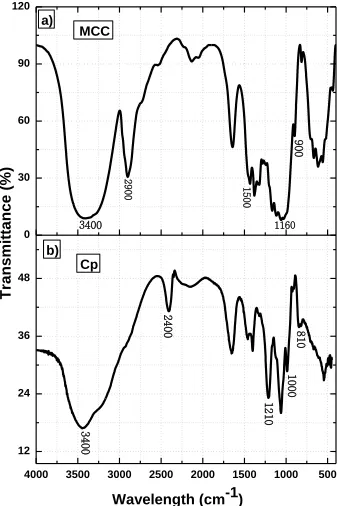
Fourier Transform Infrared Spectroscopy (FTIR): The FTIR spectra of commercial cellulose and synthesized cellulose phosphate are shown in Figure 1.
In the FTIR spectrum of MCC (Figure1(a)), the following characteristic bands are observed: one broad band at 3400-3500 cm-1, corresponding to the vibration of OH groups; one band at 2800-2900 cm-1 attributed to CH2 groups, and bands at 1160-1120 cm -1 for the C-O-C group of -glycosidic bonds.
International Journal of Emerging Technology and Advanced Engineering
Website: www.ijetae.com (ISSN 2250-2459, ISO 9001:2008 Certified Journal, Volume 3, Issue 4, April 2013)
577 It was observed the appearance of a band at ≈ 2400 cm-1
corresponding to the P-H bond; another at ≈ 1210 cm-1 corresponding to P = O bonds, a shoulder at 980-1000 cm-1 attributed to P-OH group, and a band at ≈ 810 cm-1 corresponding to the P-O-C bond [7]. The presence of these characteristic bands in the MCC spectrogram after the phosphorylation reaction confirms that the surface of microcrystalline cellulose was chemically modified and that the cellulose phosphate (Cp) has been obtained.
4000 3500 3000 2500 2000 1500 1000 500 12
24 36 48 0 30 60 90 120
3400
2400
1210
1000
810
Cp b)
Wavelength (cm-1)
T
ra
n
s
mit
ta
n
c
e
(
%) 2900
3400
a) MCC
1500
1160
[image:4.612.334.550.130.299.2]900
Figure 1 - Infrared spectra of MCC (b) and Cp (a).
X-Ray Diffraction (XRD): The X-ray diffraction patterns of MCC and Cp are shown in Figure 2. As can be seen, the diffractogram of cellulose phosphate is presented in the form of an amorphous halo, without the presence of peaks characteristic of the crystalline phase. This diffraction pattern shows that the cellulose phosphate has a random structure without crystalline order.
10 20 30
0 200 400 600 800 1000 1200 1400
b a
2(degree)
Intens
ity
(a
[image:4.612.81.250.250.503.2].u.)
Figure 2 - Diffractograms of MCC (a) and Cp (b).
The microcrystalline cellulose is presented as a semi-crystalline material, as can be seen in Figure 2. This diffractogram shows two peaks at 2 = 16° and 22.6°. These peaks are characteristic of the type I cellulose, since there is no doublet in the main peak at 22.6° [22,23]. Peaks at 2 = 16° and 22.6° correspond to crystallographic planes (101) and (002), respectively [24].
Scanning Electron Microscopy (SEM) Coupled with
Energy Dispersive Microanalysis (EDS): Figure 3 shows
the micrographs of MCC and Cp. According to these images, the particles of all samples exhibit an irregular and elongated shape, which is more prominent in MCC (Figure 3(a)). In the case of Cp (Figure 3(b)), a more agglomerated aspect can be observed. This result can be attributed to the fact that this additive was produced in aqueous medium, without the adoption of any additional procedure to enhance the deagglomeration of particles.
B. Tests with Mortars in the Fresh State
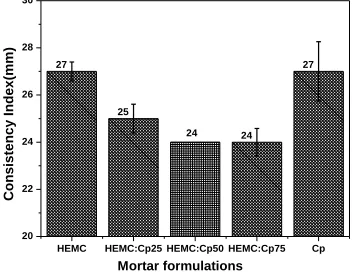
1)Consistency Index – Workability: Figure 4 shows the
International Journal of Emerging Technology and Advanced Engineering
Website: www.ijetae.com (ISSN 2250-2459, ISO 9001:2008 Certified Journal, Volume 3, Issue 4, April 2013)
[image:5.612.337.545.137.301.2]578 The same behavior was not detected in mortar only with the addition of Cp, which remained with consistency index equal to that of mortar additivated only with HEMC.
Figure 3 - Micrographs of MCC (a) and Cp (b).
It was further found that formulations with high cellulose phosphate concentration showed a remarkable reduction in the mortar plasticity. This effect can be attributed to the increased interaction between the phosphate groups of Cp and the surface of cement particles, causing an increased apparent viscosity. Moreover, it is believed that the addition of Cp contributes to a better interaction with the surface of inorganic substrates. This conclusion was based on the contact angle determination results for water / HEMC and water / Cp systems compared to pure water (Figure 5).
27
25
24 27
HEMC HEMC:Cp25 HEMC:Cp50 HEMC:Cp75 Cp
20 22 24 26 28 30
Mortar formulations
Con
s
is
te
nc
y
I
ndex
(mm)
24
Figure 4 - Results of the consistency index for mortars identified as
HEMC, HEMC:Cp25, HEMC:Cp50, HEMC:Cp75 and Cp.
10 20 30 40 50 60
30 40 50
Time (s)
C
o
n
tact
an
g
le
(
[image:5.612.98.239.172.392.2]HEMC Cp Water
Figure 5 - Contact angle values of water and aqueous solution of HEMC and Cp over a glass slide at room temperature.
The results showed that the addition of HEMC increases the water surface tension, while adding Cp decreases the water surface tension, which favors the wetting effect of mortars containing Cp on the surface of inorganic substrates. This effect can be observed in the work carried out byGóis et al.[25] These statements can be corroborated by the work of Do [5], in which the author states that "the smaller the contact angle between the surface of the solid material (substrate) and the surface of the liquid (binding paste), the greater the adherence between them".
2)Water Retention: Figure 6 shows the water retention
results obtained for all mortars studied.
93
90
87 88 88
HEMC HEMC:Cp25 HEMC:Cp50 HEMC:Cp75 Cp 70
80 90 100
W
a
te
r r
e
te
nt
ion (%)
Mortar formulations
[image:5.612.335.552.479.656.2] [image:5.612.80.256.554.691.2]International Journal of Emerging Technology and Advanced Engineering
Website: www.ijetae.com (ISSN 2250-2459, ISO 9001:2008 Certified Journal, Volume 3, Issue 4, April 2013)
579 These results show that there was no significant change in water retention for different formulations containing Cp, i.e., increase or decrease in water retention of mortars with increased cellulose phosphate or even with the use commercial additive. Therefore, it was found that the use of the additive in the mortar mixture in substitution to commercial additive (HEMC) does not affect this property significantly.
For mortars to have good performance and durability, they should exhibit adequate water retention. The results show that all the mortars studied showed water retention between 86 to 94%, which in accordance with ABNT NBR 13281/2005 [26] is classified as U4 class, corresponding to high-performance products. Thus, mortars added with both Cp and HEMC or only Cp are in the same classification.
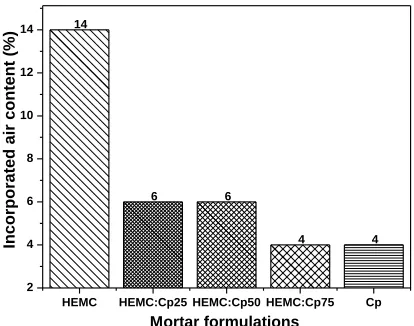
3)Incorporated Air Content: The results show that the
addition of cellulose phosphate promotes a marked reduction in the incorporated air content (Figure 7).
This result may be attributed to the increased interaction between cellulose phosphate aqueous solution and inorganic particles of the aggregate and cement, since wettability increases with the addition of Cp (Figure 5). Consequently, the system tends to incorporate less air and therefore it has reduced its characteristic of incorporating air compared to commercial cellulose (HEMC).
14
6 6
4 4
HEMC HEMC:Cp25 HEMC:Cp50 HEMC:Cp75 Cp 2
4 6 8 10 12 14
Inc
orpora
te
d a
ir
c
ont
e
nt
(%)
[image:6.612.328.559.178.354.2]Mortar formulations
Figure 7 - Incorporated air content values for mortars identified as
HEMC, HEMC:Cp25, HEMC:Cp50, HEMC:Cp75 and Cp.
According to literature [27], as the incorporated air content increases, there is a decrease in relative density, which can be seen by comparing the results shown in Fig. 6 and Figure7. The literature shows that a mortar with lower density and higher air content has better workability [27]. Nevertheless, cellulose phosphate promotes a reduction in the incorporated air content and an increase in density without affecting the consistency index
4)Mass Density: Figure 8 shows the mass density
results for all mortars studied. The mass density corresponds to the packing state of the mortar.
1831
2003 2007
2043 2051
HEMC HEMC:Cp25 HEMC:Cp50 HEMC:Cp75 Cp 1500
1600 1700 1800 1900 2000 2100
Mortar formulations
M
a
s
s
de
ns
ity
(
k
g/m
3 )
Figure 8 - Mass density results in the fresh state for mortars identified
as HEMC, HEMC:Cp25, HEMC:Cp50, HEMC:Cp75 and Cp.
These results show that the addition of Cp promotes an increase in density relatively to mortar containing 100% of HEMC. According to ABNT NBR 13281/2005 [26], the mortars studied are all within density range from 1000 to 2200 Kg / m³ and thus classified as class D5.
C. Tests with Mortars in the Hardened State
1)Apparent Mass Density: Figure 9 shows the results of
apparent mass density obtained for all mortars studied.
1608
1711
1855 1854
1923
HEMC HEMC:Cp25 HEMC:Cp50 HEMC:Cp75 Cp 1500
1600 1700 1800 1900 2000
Mortar formulations
App
a
re
nt
ma
s
s
de
ns
ity
(
k
g/m
3 )
Figure 9 - Apparent mass density in the hardened state results for mortars identified as HEMC, HEMC:Cp25, HEMC:Cp50, HEMC:Cp75
[image:6.612.64.271.430.593.2]International Journal of Emerging Technology and Advanced Engineering
Website: www.ijetae.com (ISSN 2250-2459, ISO 9001:2008 Certified Journal, Volume 3, Issue 4, April 2013)
580 The results show that the addition of cellulose phosphate promotes an increase in density of mortars in the hardened state with respect to formulation with only commercial additive based on HEMC.
According to Nakakura [16], apparent mass density is indicative of the compactness resulting from the aggregate / binding agent mixture and particle size distribution. It indirectly determines the volume of voids incorporated by additives and the amount of water lost by evaporation.
However, the results obtained may be related to the marked reduction in the incorporated air content in the fresh state, since there was no change in the proportion of aggregates and binding agent.
According to ABNT NBR 13281/2005 [26], the mortars studied are all in the density range from 1600 to 2000 Kg.m-³ and therefore classified as Class M5. Thus, mortars added with both Cp and HEMC are in the same classification.
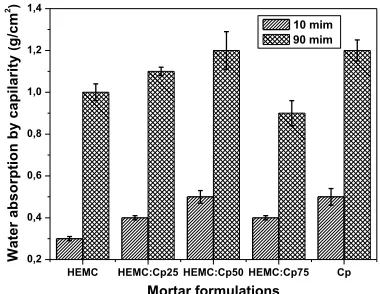
2)Water Absorption by Capillarity: Figure 10 shows the
water absorption by capillarity results at 10 and 90 minutes of immersion obtained for all mortars studied. The results show that for all formulations studied, the same absorption trend for both times tested was observed.
HEMC HEMC:Cp25 HEMC:Cp50 HEMC:Cp75 Cp
0,2 0,4 0,6 0,8 1,0 1,2 1,4
Mortar formulations
W
ater
ab
so
rp
ti
o
n
b
y
cap
il
ar
ity
(
g
/cm
2)
10 mim 90 mim
Figure 10 - Results of water absorption by capillarity for mortars identified as HEMC, HEMC:Cp25, HEMC:Cp50, HEMC:Cp75 and Cp.
According to Ohama [28], the presence of cellulosic polymers in mortars and concretes increases porosity due to the incorporation of air that occurs during its preparation and molding. Moreover, according to Hou and Chung [29], methyl cellulose tends to close the small pores of cement pastes more effectively than with large pores.
Cp-based formulations have higher apparent mass density and therefore lower porosity compared to mortar with HEMC. This result suggests that these mortars should have less capillary action compared with mortar additivated only with HEMC, which has not been verified.
Thus, it could be inferred that the effects of capillarity are more related to the microstructure and microporosity of the matrix phase, namely the cementitious matrix, having little relation to the porosity generated by the incorporated air. Moreover, HEMC seems to have a more effective waterproofing action. Thus, the results obtained should be related to pore volume and pore size distribution in the cementitious matrix, which are more in agreement with results obtained by Hou and Chung [29].
3)Flexural and Compressive Strength: Figure 11 and
[image:7.612.335.552.290.472.2]Figure 12 show the flexural and compressive strength results after 28 days of curing obtained for all mortars studied.
Figure 11 - Flexural strength results for mortars identified as HEMC, HEMC:Cp25, HEMC:Cp50, HEMC:Cp75 and Cp
Figure 12 - Compressive strength results for mortars identified as
[image:7.612.70.260.415.562.2] [image:7.612.332.554.499.668.2]International Journal of Emerging Technology and Advanced Engineering
Website: www.ijetae.com (ISSN 2250-2459, ISO 9001:2008 Certified Journal, Volume 3, Issue 4, April 2013)
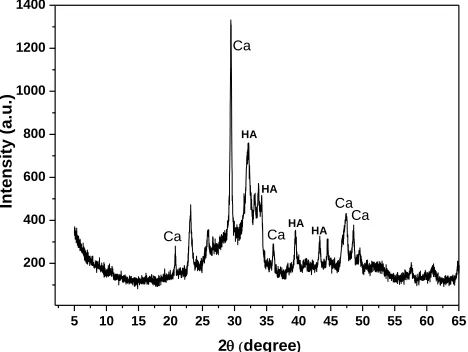
581 The results show that formulation with the addition of 100% Cp showed a marked reduction in the mechanical properties, both in the flexural mode as in the compression mode. This result may be associated with the interaction of this additive with calcium ions from the cementitious phase, interfering with the mechanisms of formation of hydrated phases, resulting in reduction in the properties of the cementitious matrix. This statement is confirmed by the X-ray diffraction data, which demonstrates the formation of the hydroxyapatite phase, as shown in Figure 13. The formation of the hydroxyapatite phase competes with the cement hydration reactions.
5 10 15 20 25 30 35 40 45 50 55 60 65
200 400 600 800 1000 1200 1400
2(degree)
Intens
ity
(a
.u.)
Ca Ca
Ca
Ca HA
HA
HA HA
[image:8.612.52.286.285.461.2]Ca
Figure 13 - X-ray diffractogram showing the presence of hydroxyapatite (HA) in the reaction of calcium hydroxide with the
amorphous cellulose in the ratio of 1:2.
Moreover, formulations based on Cp and HEMC show results equivalent to formulation with 100% HEMC, highlighting that the formulations HEMC:Cp50 and
HEMC:Cp75 surpassed the performance in flexural strength
and in compressive strength, respectively, of formulation with 100% HEMC, showing a possible synergistic effect of these additives when used together. Moreover, it was observed that for these formulations, the amounts of Cp did not negatively interfere in the formation mechanisms of cementitious phases.
It was observed that the obtained values of flexural strength in all mortars exceed 1.5 MPa. Therefore, according to ABNT 13279 [21], all mortars are within the same strength range, from 1.5 to 2.7 MPa, being classified as class R3. Thus, it was concluded that the additive was satisfactory for use in mortar settlement walls and ceilings.
The results presented in Figure 11 show that formulations HEMC:Cp50 and HEMC:Cp75 are above
5MPa and HEMC:Cp25 is close to this compressive
strength value, which allows their use as masonry mortar. Therefore, according to ABNT 13279 [21], the mortars studied can be divided into two types of classification. Formulations HEMC and HEMC:Cp75 are in the same
strength range, from 5.5 to 8.0 MPa, being classified as class P5, and mortars HEMC:Cp25 and HEMC:Cp50 are in
the strength range from 4.0 to 5.5 MPa, being classified as class P4. Thus, it was concluded that the additive was satisfactory for this application. However, formulation with 100% Cp does not belong to any of these classes, compromising its use.
IV. CONCLUSIONS
The chemical modification results proved the success of the cellulose phosphate reaction. The use of cellulose phosphate at different concentrations in mortars showed significant action when used to partially substitute commercial cellulose (HEMC), without compromising the mortar properties in the fresh and hardened state.
It was observed that the substitution of commercial cellulose by 50% (HEMC:Cp50) and 75% (HEMC:Cp75) of cellulose phosphate in mortar formulations have a better performance in flexural and compressive strength, respectively, than mortar with 100% of commercial cellulose. However, mortar with 100% of cellulose phosphate presented decreased compressive and flexural strength results, which impairs its use in that apllication.
Acknowledgments
The authors are gratefully to Laboratory of Construction Materials the DEC/UFRN, in particular, to Francisco Assis Braz (seu Chico) and Sandro Ricardo S. Andrade; PPGCEM/UFRN; CAPES; and LSQM/DEMat/UFRN.
REFERENCES
[1] Ramachandran, V. S. 1995. Concrete Admixtures Handbook. Noyes Publications.
[2] Whitney, D. P. 2008. Concrete Construction Engineering Handbook. Noyes Publications.
[3] Baumgart, O. 1999. Aditivos para concretos, argamassas e caldas de cimento. Industria e Comercio S.A. Vedacit Mag. 12nd ed. (in
portuguese).
[4] 3-MR COMMITTEE ON MORTARS AND RENDERINGS. 1980.
Matériaux and Construction. 13, 55-66.
International Journal of Emerging Technology and Advanced Engineering
Website: www.ijetae.com (ISSN 2250-2459, ISO 9001:2008 Certified Journal, Volume 3, Issue 4, April 2013)
582
[6] Silva, V. S. 2004. Adherence slurry mortar in structural concrete - improving the microstructure of the interface zone by the addition of silica from rice husk. PhD thesis. University of São Paulo (in portuguese).
[7] Khayat, K. H. 1998. Viscosity-Enhancing admixtures for cement-based materials – an overview. Cem. Concr. Comp. 20, 171–188. [8] Póvoas, Y. V. 2006. Evaluation of training "film" on adhesive
mortar and its influence on adhesion. PhD Thesis, Polytechnic School of USP (in portuguese).
[9] Póvoas, Y. V., and John, V. M. 1999. Weather Open MORTAR: Influence of Additives HEC and PVAc Technical Bulletin of Polytechnic School of USP, BT/PCC/241(in portuguese).
[10] Granja, P. L., Pouysegu, L., Petraud, M., Jeso, B., and Baquey, C. 2001. Barbosa M A. Cellulose Phosphates as Biomaterials. I. Synthesis and Characterization of Highly Phosphorylated Cellulose Gels. J. Appl. Polym. Sci. 82, 3341-3353.
[11] Reid, J. D., and Mazzeno, L. W. 1949. Preparation and Properties of Cellulose Phosphates. Ind. Eng. Chem. 41, 2828-2831.
[12] Suflet, D. M., Chitanu, G. C., and Popa, V. L. 2006. Phosphorylation of polysaccharides: New results on synthesis and characterization of phosphorylated cellulose. React. Funct. Polym. 66, 1240-1249. [13] Inagaki, N., Nakamura, S., Asai, H., and Katsuur, K. A. 1976.
Phosphorylation of Cellulose with Phosphorous Acid and Thermal Degradation of the product. J. Appl. Polym. Sci. 20, 2829.
[14] Brazilian Technical Standards Association. NBR 13276. 2005, Rio de Janeiro (in portuguese).
[15] Brazilian Technical Standards Association. NBR 13277. 2005, Rio de Janeiro (in portuguese).
[16] Nakakura, E. H., and Cincotto, M. A. Analysis of the requirements for the classification of cement mortar coat. BT/PCC/359:http://publicacoes.pcc.usp.br/PDF2003&2004_1/BT% 20-%20359.pdf (accessed Out, 2012).
[17] Tristão, F. A., and Machado, V. K. C. B. L. 2003. Analysis method for water retention consistency and mortars. In V Brazilian Symposium of Mortars Technology, São Paulo, Brazil, 2003.
[18] Brazilian Technical Standards Association. NBR 13278. 2005, Rio de Janeiro (in portuguese).
[19] Brazilian Technical Standards Association. NBR 13280. 2005, Rio de Janeiro (in portuguese).
[20] Brazilian Technical Standards Association. NBR 15259. 2005, Rio de Janeiro (in portuguese).
[21] Brazilian Technical Standards Association. NBR 13279. 2005, Rio de Janeiro (in portuguese).
[22] Li, R. J., Fei, J. M., Cai, Y. R., Li, Y. F., Feng, J. Q., and Yao, J. M. 2009. Cellulose whiskers extracted from mulberry: A novel biomass production. Carbohyd. Polym., 76, 94-99.
[23] Klemm, D., Heublein, B., Fink, H. P., and Bohn, A. 2005. Cellulose: Fascinating Biopolymer and Sustainable Raw Material Angew. Chem. Int., 44, 3358-3393.
[24] Sun, Y., Lin, L., Pang, C. S., Deng, H., Peng, B., Li, H., He, J. Z. B., and Hand, L. S. 2007. Hydrolysis of Cotton Fiber Cellulose in Formic Acid. Energy Fuels 21, 2386.
[25] Góis, G. S. 2013. Synthesis, application and evaluation of the effect of phosphorus content of phosphate cellulose masonry mortar with commercial additive-based hydroxyethyl methyl cellulose (HEMC). Master Dissertation, Federal University of Rio Grande do Norte, (in portuguese).
[26] Brazilian Technical Standards Association. NBR 13281. 2005, Rio de Janeiro (in portuguese).
[27] Maciel, L. L; Barros, M. M. S., Sabbatini, F. H. 2012. Recommendations for running mortar coatings for internal and
external walls and ceilings
seal..:http://pcc436.pcc.usp.br/Textost%C3%A9cnicos/Revestimento s%20verticais/Apostila%20Revesti
ento%20Maciel%20Barros%20Sabbatini.pdf. (accessed Jun, 2012). [28] Ohama, Y. 1995. Polymer modified mortars and concrete. In
Concrete Admixtures Handbook, Noyes Publications.