A TRANSFORMATIONAL ORGANISATIONAL
FRAMEWORK FOR IMPROVING IRAQI
QUASI-GOVERNMENTAL CONSTRUCTION COMPANIES’
PERFORMANCE
TAHA S. AMEEN AL-OBAIDI
A THESIS SUBMITTED IN PARTIAL FULFILMENT
OF THE REQUIREMENTS OF THE DEGREE OF
DOCTOR OF PHILOSOPHY
SCHOOL OF THE BUILT ENVIRONMENT
UNIVERSITY OF SALFORD, MANCHESTER, UK
Table of Contents
List of Tables... VII List of Figures ... VIII Acknowledgements ... XI Dedication ... XII Declaration ... XIII Abstract ... XIV
Chapter One - Introduction ... 1
1.1 Research Background ... 1
1.2 Research Problem... 4
1.3 Research Questions ... 5
1.4 Research Aims and Objectives ... 6
1.5 Research Scope and Assumptions ... 6
1.6 Research Process ... 7
1.7 Structure of the Thesis ... 9
Chapter Two - Iraqi Quasi-Governmental Construction Companies’ (IQGCCs) Performance and Need for Change ... 11
2.1 Introduction ... 11
2.2 Iraq an Overview ... 11
2.3 Iraqi Business Environment Pre and Post 2003 ... 13
2.3.1 Iraq Pre-2003 ... 14
2.3.2 Iraq Post-2003 ... 15
2.4 The Performance of Iraqi State-Owned Enterprises and the Need for Change ... 18
2.5 Organisational Change Management ... 21
2.5.1 First-Order Change ... 22
2.5.2 Second-Order Change ... 23
2.6 Reflection on the Change Management Needed for IQGCCs ... 25
2.7 Summary... 25
Chapter Three – The Role of Business Process and Organisational Management ... 26
3.1 Introduction ... 26
3.2 Background and Emergence of Business Process Thinking ... 26
3.3 Business Process (BP) ... 30
3.3.1 Business Process (BP) Definition and Elements ... 30
3.3.2 Why is Process Institutionalisation Important?... 34
3.3.3 Business Process Types ... 34
3.4.1 Total Quality Management TQM ... 41
3.4.2 Business Process Reengineering (BPR) ... 42
3.4.3 Lean ... 44
3.4.4 Benchmarking ... 47
3.4.5 Business Process Management (BPM) ... 49
3.5 Documentation and Mapping ‘As Is’ Processes ... 52
3.5.1 Activity Decomposition Models ... 54
3.5.2 Data Flow Diagram (DFD) ... 55
3.5.3 Integration DEFinition Function Modelling (IDEFØ) ... 57
3.5.4 Business Process Model and Notation (BPMN) ... 60
3.5.5 Selecting the Most Appropriate Process Mapping Technique ... 63
3.6 Designing and Modelling the Business Process ... 64
3.7 Business Process in Construction ... 65
3.7.1 The Need for Process Thinking in the Construction Industry ... 65
3.7.2 Research in Construction Process ... 66
3.7.3 Initiatives to Map and Improve the Construction Process ... 67
3.7.3.1 The RIBA Plan of Work ... 67
3.7.3.2 OGC Construction Procurement Framework ... 69
3.7.3.3 Structured Process Improvement for Construction Enterprises (SPICE) ... 72
3.7.3.4 The Generic Design and Construction Process Protocol (GDCPP) ... 74
3.7.4 Reflection on the Construction Process Research and Initiatives and the Need for Adopting Process thinking in IQGCCs. ... 77
3.8 Process and Organisational Structure ... 78
3.8.1 Functional or Programmatic Organisational Structure ... 80
3.8.2 Divisional Organisational Structures ... 81
3.8.3 Matrix Structure ... 82
3.8.4 Project-Based Structure ... 83
3.8.5 Hybrid Organisational Structure ... 85
3.9 Information Technology (IT) and Process... 87
3.10 Summary ... 87
Chapter Four – Current Industry Good Practices for Large Construction Companies under Traditional Procurement ... 89
4.1 Introduction ... 89
4.2 Process Modelling Levels Zero and One ... 90
4.2.1 Bidding A1 Process ... 94
4.2.1.1 Get Opportunity A1-1 Process ... 94
4.2.1.2 Work-up Bid A1-2 Process ... 99
4.2.1.3 Tender Review and Submission A1-3 Process ... 109
4.2.1.4 Post-Tender Negotiation A1-4 Process ... 113
4.2.2 Pre-Construction Planning A2 Process ... 114
4.2.2.1 Post Awarding Review A2-1 Process. ... 116
4.2.2.2 Mobilisation A2-2 Process ... 118
4.2.3 Construction A3 Process ... 126
4.2.3.1 Deliver to Site A3-1 Process ... 127
4.2.3.2 Commence Work on Site A3-2 process ... 128
4.3 The Proposed Theoretical Transformational Organisational Framework ... 137
4.3.1 The Aims and Concept of the Proposed Theoretical Transformational Organisational Framework 138 4.3.2 Assumptions Underpinning the Proposed Theoretical Framework ... 139
4.3.3 The Elements of the Proposed Theoretical Framework ... 139
4.3.4 An Organisational Structure to Support the Proposed Theoretical Framework ... 143
4.4 Summary... 145
Chapter Five - Research Methodology ... 146
5.1 Introduction ... 146
5.2 Research Methodology ... 146
5.2.1 Research Philosophy ... 147
5.2.2 Research Approaches ... 148
5.2.3 Methodology Choice... 150
5.2.4 Research Strategy ... 152
5.2.4.1 Case Study as a Research Strategy ... 155
5.2.4.2 Justification Research Strategies ... 155
5.2.4.3 Selection Criteria of Case Study ... 158
5.2.5 Data Collection ... 160
5.2.5.1 Interviews ... 162
5.2.5.2 Focus Group ... 164
5.2.5.3 Documents Review ... 165
5.2.5.4 Selection of Respondents ... 165
5.2.6 Data Analysis ... 167
5.2.6.1 Thematic Approach ... 168
5.2.6.2 Procedure Adopted in Analysing the First Stage of Data Collection ... 169
5.2.6.3 Procedure Adopted in Analysing the Second Stage of Data Collection ... 170
5.2.7 Validation of the Conceptual Framework ... 172
5.2.8 Validity and Reliability ... 172
5.3 Summary... 174
Chapter Six - Mapping and Examining the Operational Processes of IQGCCs ... 175
6.1 Introduction ... 175
6.2 Procedure of Data Collection ... 176
6.3 Case Study One ... 178
6.3.1 Company Background ... 178
6.3.2 ‘As is’ Operational Business Process Analysis - Company One ... 181
6.3.2.1 Bidding A1 Process – Company One ... 181
6.3.2.1.1 Get Opportunity A1-1 Process – Company One ... 182
6.3.2.1.2 ‘Work up Bid’ A1-2 Process – Company One ... 184
6.3.2.1.3 Tender Review and Submission A1-3 Process – Company One ... 185
6.3.2.2 Pre-construction Planning A2 Process – Company One ... 187
6.3.2.2.1 Post Award Review A2-1 Process – Company One ... 188
6.3.2.2.2 Mobilisation A2-2 Process – Company One ... 190
6.3.2.3 Construction A3 Process – Company One ... 191
6.3.2.3.1 Commence Work on Site A3-1 – Company One ... 191
6.3.2.4 Closeout and Termination A4 Process – Company One ... 197
6.4.1 Company Background ... 199
6.4.2 ‘As is’ Operational Business Process Analysis – Company Two ... 201
6.4.2.1 Bidding A1 Process – Company Two ... 201
6.4.2.1.1 Get Opportunity A1-1 Process – Company Two ... 202
6.4.2.1.2 Work up Bid A1-2 Process – Company Two ... 204
6.4.2.1.3 Tender Review and Submission: A1-3 Process – Company Two ... 205
6.4.2.2 Pre-construction Planning A2 process – Company Two ... 207
6.4.2.2.1 Post Award Review A2-1 Process – Company Two ... 207
6.4.2.2.2 Mobilisation A2-2 Process – Company Two ... 210
6.4.2.3 Construction A3 Process – Company Two ... 211
6.4.2.4 Closeout and Termination A4 Process – Company Two ... 215
6.5 Case Study Three... 217
6.5.1 Company Background ... 217
6.5.2 ‘As is’ Operational Business Process Analysis - Company three ... 219
6.5.2.1 Bidding A1 Process – Company Three ... 219
6.5.2.1.1 Get Opportunity A1-1 Process – Company Three ... 220
6.5.2.1.2 Work up Bid A1-2 Process – Company Three ... 220
6.5.2.1.3 Finalise the Bid Proposal and Submission A1-3 Process – Company Three ... 221
6.5.2.2 Pre-construction Planning A2 Process – Company Three ... 221
6.5.2.2.1 Post Award Review A2-1 Process – Company Three ... 222
6.5.2.2.2 Mobilisation A2-2 Process – Company Three ... 223
6.5.2.3 Construction: A3 Process –Company Three... 224
6.5.2.4 Closeout and Termination: A4 Process – Company Three ... 225
6.6 Integrated Framework of IQGCCs Current Practices ... 227
6.7 Challenges and Problematic Points in the Current Practices ... 231
6.7.1 Challenges and Problematic Points in the Current Bidding Process ... 231
6.7.2 Challenges and Problematic Points in the Current Pre-Construction Planning Process ... 237
6.7.3 Challenges and Problematic Points in the Current Construction Process ... 240
6.7.4 Challenges and Problematic Points in the Closeout and Termination Process ... 248
6.8 Bases of the Challenges and Problematic Points ... 249
6.8.1 Government Restrictions ... 249
6.8.2 Authority ... 250
6.8.3 Management ... 251
6.8.4 Communication ... 252
6.8.5 Summary of the Challenges in the IQGCCs Operational Processes the Need for Rectification ... 252
6.9 Summary... 254
Chapter Seven - The Proposed Theoretical Framework Applicability Test ... 256
7.1 Introduction ... 256
7.2 Developing Interviews Questions for the Second Stage of Data Collection ... 256
7.3 Conducting the Interviews ... 257
7.4 Data analysis ... 259
7.4.1 Element One: Government Restrictions ... 261
7.4.1.1 Government Regulations ... 261
7.4.1.2 Inspection Bodies Role ... 263
7.4.1.3 Political Interferences ... 264
7.4.2 Element Two: Authority ... 267
7.4.2.1 Authority Delegation ... 268
7.4.2.2 Responsibility and Accountability ... 271
7.4.2.3 Empowerment ... 273
7.4.2.4 Discussion of Element Two: Authority ... 273
7.4.3 Element Three: Management ... 276
7.4.3.1 Business Process Phases and Stages ... 277
7.4.3.1.1 Phase One: Bidding Process ... 278
7.4.3.1.2 Phase Two: Pre-construction Planning Process ... 282
7.4.3.1.3 Phase Three: Construction Process ... 285
7.4.3.1.4 Phase Four: Closeout and Termination Process ... 286
7.4.3.2 Process Execution ... 289
7.4.3.2.1 Multidisciplinary Team ... 289
7.4.3.2.2 Process Performers ... 291
7.4.3.3 Stage Gate and Phase Review ... 304
7.4.3.4 Gates Controllers and Evaluators ... 307
7.4.3.4.1 Bid/No Bid Review Meeting ... 307
7.4.3.4.2 Adjudication Review Meeting ... 309
7.4.3.4.3 Tender Performance Review Meeting ... 310
7.4.3.4.4 Clarification Review Meeting ... 311
7.4.3.4.5 Kick-off Review Meeting ... 312
7.4.3.4.6 Construction Starting Review Meeting ... 312
7.4.3.4.7 Package Completion Review Meeting ... 312
7.4.3.4.8 Project Performance Review Meeting ... 313
7.4.3.5 Process Owner ... 315
7.4.3.6 Stage Review Reports... 315
7.4.3.7 Organisational Structure ... 319
7.4.3.8 Discussion of Element Three: Management ... 322
7.4.3.8.1 Process View ... 322
7.4.3.8.2 Process Job and Multidisciplinary Team... 323
7.4.3.8.3 Process Owner... 324
7.4.3.8.4 Stage Gate and Review Report ... 325
7.4.3.8.5 Organisational Structure ... 327
7.4.4 Element Four: Communication ... 328
7.4.4.1 Discussion of Element Four: Communication ... 328
7.4.5 Summary of the Solutions to the Challenges Inherent in the IQGCCs’ Operational Processes... 329
7.5 Summary... 331
Chapter Eight - Validation of the IQGCCs’ Conceptual Transformational Organisational Framework ... 332
8.1 Introduction ... 332
8.2 Validation Process ... 332
8.3 Results from the Validation ... 333
8.4 Final Recommended Transformational Organisational Framework for IQGCCs ... 340
8.5 Summary... 350
Chapter Nine - Conclusion... 351
9.1 Introduction ... 351
9.3 Recommendation for the Implementation of the Proposed Framework ... 362
9.4 Research Contributions to Knowledge... 364
9.4.1 Contributions to Knowledge and Academic Community ... 364
9.4.2 Contributions to Practice ... 365
9.5 Research limitations ... 366
9.6 Recommendations for Further Research ... 367
References ... 368
Appendix A - Extended BPMN Modelling Elements ... 404
Appendix B - Factors Affect Bid/No Bid Decision ... 409
Appendix C - The Pro-Forma Interview Questions for the First Stage of Data Collection ... 412
Appendix D - The Pro-Forma Interview Questions for the Second Stage of Data Collection ... 414
List of Tables
Chapter Two
Table 2-1: Summary of SOEs and their affiliation with line Ministries………. 18
Table 2-2: Summary of IQGCCs and their affiliation with line Ministries……… 19
Chapter Three Table 3-1: Business process definitions……….. 30
Table 3-2: Advantages and disadvantage of the functional organisational structure……….. 81
Table 3-3: Advantages and disadvantage of the divisional organisational structures……… 82
Table 3-4: Advantages and disadvantage of matrix structures………... 83
Table 3-5: Advantages and disadvantage of project based structure……….. 84
Chapter Five Table 5-1: The differences between deductive and inductive approaches………...………... 149
Table 5-2: Main characteristics of quantitative and qualitative approaches………... 151
Table 5-3: Relevant situations for different research strategies……….. 156
Table 5-4: Focus group advantages and disadvantages……….. 164
Table 5-5: Minimum non-probability sample size……….. 167
Table 5-6: Actions taken to address the validity and reliability of case study.……….………….. 173
Table 5-7: Actions taken to address the validity and reliability issue in interviews………... 174
Chapter Six Table 6-1: Distribution of the research participants……… 176
Table 6-2: Details of participants……… 177
Table 6-3: Employees categories - Company one...……… 178
Table 6-4: Employees categories - Company two……….. 199
Table 6-5: Employees categories - Company three……… 217
Table 6-6: Results of the company’s business operations in 2012 & 2013- Company three……. 218
Table 6-7: Cross-case analysis of the current processes employed by the companies under study 229 Table 6-8: Purchasing powers and manner granted to Iraqi Ministers and Governors…………... 240
Table 6-9: Summary of challenges in IQGCCs’ current processes with their key sources……… 253
Chapter Seven Table 7-1: Details of participants – stage two of the data collection.……….………… 258
Table 7-2: The adjusted version of the key core business processes of IQGCCs………... 288
Table 7-3: Solutions to the challenges of the IQGCCs’ current processes………. 330
Chapter Eight Table 8-1: Information on the interviewees involved in the framework validation interviews….. 333
List of Figures
Chapter One
Figure 1-1: Research process ………... 8
Chapter Two Figure 2-1: Iraq map……….... 12
Figure 2-2: Iraq’s expected population growth………... 13
Figure 2-3: First-order / Incremental change………... 23
Figure 2-4: Second-order / Transformational change……….. 24
Chapter Three Figure 3-1: Functional organisation……….…………... 27
Figure 3-2: Business process elements……….…………... 32
Figure 3-3: Type of processes……….………. 35
Figure 3-4: The BPTrends process hierarchy……….………. 38
Figure 3-5: BPM lifecycle……….……….………. 51
Figure 3-6: Example of activity decomposition model……….…….. 55
Figure 3-7: Concept of Data Flow Diagramming (DFD)……… 56
Figure 3-8: IDEFØ model language……….……….. 58
Figure 3-9: Decomposition of IDEFØ structure……….…………. 59
Figure 3-10: The core element set of BPMN……….…….. 61
Figure 3-11: A typical Business Process Model and Notation (BPMN) diagram…….……….. 62
Figure 3-12: RIBA Plan of Work 2013……….……….. 68
Figure 3-13: OGC Gateway (TM) Process……….. 70
Figure 3-14: OGC framework for construction procurement……….. 71
Figure 3-15: SPICE maturity model……… 73
Figure 3-16: Process Protocol Map………. 76
Figure 3-17: Typical functional organisational structure………..……….. 80
Figure 3-18: Divisional organisational structures….……….…………. 81
Figure 3-19: Matrix structures……….……… 83
Figure 3-20: Project-based structure……….………... 84
Chapter Four Figure 4-1: Context diagram for a construction project……….………. 90
Figure 4-2: IDEFØ Level 1 the company operational process………..….……… 91
Figure 4-3: Typical sequence of phases in a project life cycle……… 92
Figure 4-4: Activity Decomposition Diagram expanding the different phases’ processes….… 93 Figure 4-5: IDEFØ level tow A1 Bidding process………...……….…….. 94
Figure 4-6: IDEFØ level three A1-1 Get opportunity process………...….……… 96
Figure 4-7: IDEFØ level three A1-2 Work up bid process……….. 100
Figure 4-8: Programme of tender activities……….…… 101
Figure 4-9: Roles of the main bidding team members………. 102
Figure 4-10: IDEFØ level three A1-3 Tender review and submission process……….………. 110
Figure 4-11: IDEFØ level three A1-4 Post-tender negotiation process………... 113
Figure 4-12: IDEFØ level tow A2 Pre-construction planning process……… 116
Figure 4-13: IDEFØ level three A2-1 Post awarding review process………. 116
Figure 4-14: IDEF0 level three A2-2 Mobilisation process…………...…….……… 119
Figure 4-15: Cost baseline, cash flow, and funding display……….…………... 123
Figure 4-16: Activity Decomposition Diagram expanding construction process………....…… 126
Figure 4-18: Construction phase main processes……… 128
Figure 4-19: Activity Decomposition Diagram expanding the closeout and termination processes………..……… 134
Figure 4-20: The process employed to develop the proposed theoretical transformational organisational framework……… 138
Figure 4-21: The proposed theoretical transformational organisational framework…………... 141
Figure 4-22: Proposed organisational structure……….….. 144
Chapter Five Figure 5-1: The Research Onion……….. 146
Figure 5-2: Deductive research sequential stages……….………... 148
Figure 5-3: Inductive research sequential stages………. 149
Figure 5-4: Example of data presentation using Nvivo 11……….. 171
Chapter Six Figure 6-1: Organisational structure – Company one………...………... 179
Figure 6-2: Regional office structure – Company one……… 180
Figure 6-3: IDEFØ Level 1 The company’s operational process - Company one………...…... 181
Figure 6-4: Activity Decomposition Diagram expanding the bidding process – Company one. 182 Figure 6-5: IDEFØ level three A1-1 Get opportunity process – Company one……...………... 184
Figure 6-6: IDEFØ level three A1-2 Work up bid process – Company one………...………… 185
Figure 6-7: IDEF0 level three A1-3 Tender review and submission – Company one………… 186
Figure 6-8: Activity Decomposition Diagram expanding the pre-construction planning – Company one………... 187
Figure 6-9: IDEFØ level three A2-1 Post award review – Company one……..……… 188
Figure 6-10: IDEFØ level three A2-2 Mobilisation – Company one………..……... 190
Figure 6-11: Activity Decomposition Diagram expanding the construction process – Company one………... 192
Figure 6-12: Mechanisms adopted to produce the desired deliverables – Company one……… 193
Figure 6-13 A: IDEFØ Subcontracting process – Company one………..………. 195
Figure 6-13 B: IDEF0 Subcontracting process – Company one………. 195
Figure 6-14: IDEFØ level three A4-1 Closeout and termination – Company one………..…... 198
Figure 6-15: Organisational structure – Company two………... 200
Figure 6-16: Activity Decomposition Diagram expanding the bidding processes – Company two………... 202
Figure 6-17: IDEFØ level three A1-1 Get opportunity process – Company two……..………. 204
Figure 6-18: IDEFØ level three A1-2 Work up bid process – Company two…………..…….. 205
Figure 6-19: IDEFØ level three A1-3 Tender review and submission – Company two...…….. 206
Figure 6-20: Activity Decomposition Diagram expanding the pre-construction planning – Company two………... 207
Figure 6-21: IDEFØ level three A2-1 Post award review – Company two………. 208
Figure 6-22: IDEFØ level three A2-2 Mobilisation – Company two……….. 210
Figure 6-23: IDEFØ level three A4-1 Closeout and termination – Company two…..………... 216
Figure 6-24: Organisational structure – Company three………. 218
Figure 6-25: IDEFØ level two A1 Bidding process – Company three…………..………. 219
Figure 6-26: IDEFØ level three A1-1 Get opportunity process – Company three………..…... 220
Figure 6-27: IDEFØ level three A1-2 Work up bid process – Company three………..……… 221
Figure 6-28: IDEFØ level three A1-3 Tender review and submission – Company three…..… 221
Figure 6-29: IDEFØ level tow A2 pre-construction planning process – Company three…...… 222
Figure 6-31: IDEFØ level three A2-2 Mobilisation – Company three…………..………. 223
Figure 6-32: IDEFØ level three A4-1 Closeout and termination – Company three………..…. 226
Figure 6-33: Integrated framework of IQGCCs current practice………. 230
Chapter Seven Figure 7-1: Cognitive mapping for the IQGCCs’ key performance impacting factors………... 260
Figure 7-2: Government restrictions sub-factors………. 261
Figure 7-3: Authority sub-factors……… 268
Figure 7-4: IQGCCs management layers………. 271
Figure 7-5: Management/the proposed framework key elements……….. 277
Figure 7-6: Business process phases and stage……… 278
Figure 7-7: Process execution……….. 289
Figure 7-8: "As to be" key roles and responsibilities of the IQGCCs' management layers……. 302
Figure 7-9: IQGCCs’ transformational organisational framework after adjusting the key internal stakeholders and their roles……… 303
Figure 7-10: IQGCCs’ transformational organisational framework after adjusting the stage gates types……… 306
Figure 7-11: Gates controllers and evaluators………. 307
Figure 7-12: IQGCCs’ transformational organisational framework after adjusting the gates controllers/ evaluators……….. 314
Figure 7-13: IQGCCs’ transformational organisational framework after adjusting the times of sharing stage review reports……… 318
Figure 7-15: The adjusted organisational structure of IQGCCs……….. 321
Acknowledgements
I would like to express my sincere thanks and appreciation to all people and organisations who, without their support and encouragement, I would never have completed this doctoral study. First and foremost, I would like to thank my supervisor Dr Anthony Higham for his continuous support, guidance, advice, and encouragement throughout the PhD journey. My gratitude also goes to my both previous supervisors, Professor Mustafa Al Shawi and David Eaton who unfortunately retired during the first year of my study. Special thanks from the depths of my heart to Mustafa, who has always believed in me and through him the foundation stone for this thesis was laid.
I wish to thank my sponsor, the Higher Committee for Educational Development in Iraq (HCED), for offering me this scholarship for PhD study. I would also like to thank all the soldiers and volunteers from various Iraqi security forces and allies, who, without their valuable sacrifices to defend our country and our families there, the completion of this PhD study would also not have been possible. I am indebted forever for the sacrifices of those heroes.
I would like to extend my thanks to all the interviewees who have agreed to be part of this study and who have participated through sharing their experience, knowledge and time, not forgetting also the academic and supporting staff at the University of Salford for their unlimited support.
Dedication
I would like to dedicate this research endeavour to
my dear mother,
my beloved wife,
Declaration
This thesis is submitted in partial fulfilment for the award of Doctor of Philosophy at the University of Salford, United Kingdom and has not been previously submitted to meet requirements for an award at any higher education under my name or that of any other individuals.
Any materials previously published or written by another person(s)/organisation(s) is made reference accordingly. Yet, during the progress of study, some of the research arguments and findings were published in conference papers and as conference presentation prior to the submission of the thesis, as listed in Appendix E.
Abstract
Rising globalisation, the liberalisation of international trade and rapid technological development over the last two decades have subjected the business environment to rapid, dynamic change. In the face of such change, seminal researchers and business leaders have reached a conclusion that Business Process (BP) is the core of an organisation. Thus, in order to survive, grow, and stay ahead of the competition in today’s turbulent environment, organisations need to mainly focus on improving their business processes.
Similarly, the Iraqi business environment, after the 2003 conflict, have been subject to profound change influenced by the radical changes to Iraq’s political and economic systems. These changes have directly impacted on Iraqi Quasi-Governmental Construction Companies (IQGCCs) where, after decades of domination over most publicly funded construction contracts, these companies face now fierce competition from in excess of 3,500 local and international private firms. As a result, IQGCCs have subsequently struggled to both win contracts and generate profit and the majority have incurred substantial financial losses, becoming unsustainable burdens on the national budget. Although the Iraqi government has attempted to reform the performance of these companies, most of these efforts have ended in their recapitalisation, rather than the identification and resolution of their problems. Accordingly, through employing Business Process Management (BPM) as a comprehensive and widely used approach to increase BP’s principles in an organisation, this research aims to synthesise a transformational organisational framework to address the challenges emanating from current practice within IQGCCs with the view to determining a step change improvement that could ultimately enhance their bottom line performances.
To achieve this aim, an exploratory study, which comprised three companies selected from IQGCCs as case studies, was conducted with the aim of mapping and examining the current operational processes employed by these companies and pinpointing the main challenges existing in these processes. Thereafter, a series of semi-structured interviews were carried out with ten experts selected from various management levels of three IQGCCs in order to test the applicability of the theoretical framework developed from the literature to address the challenges inherent in the IQGCCs’ processes. Based on the experts’ responses, the theoretical framework was refined and then further validated through four more semi-structured interviews to produce the final recommended transformational organisational framework for IQGCCs.
Chapter One - Introduction
1.1 Research Background
Governments worldwide have long sought to establish state-owned enterprises (SOEs) with the aim of achieving a variety of public policy objectives, such as: building basic physical infrastructure; providing essential services including finance, water and electricity; controlling natural resources; generating revenue for the treasury, and so forth (World Bank Group, 2014). These entities have formed a significant part of the global economy through the delivery of services. Analysis by the World Bank Group (2014) suggests that SOEs account for 20% of global investment, 5% of global employment, and as much as 40% of the total output for some countries.
Despite the apparent significance of SOEs, global studies conducted in different countries suggest that SOEs tend to be less efficient and perform poorer than their private sector counterparts (Issham et al., 2008; Bouri et al., 2010; Rocha, 2011; De Luna-Martinez & Vicente 2012; World Bank and Development Research Center, 2013). In trying to account for this lack of efficiency with SOEs, Arocena and Oliveros (2012) allude to three principal causes, which are directly related to the ownership of the organisation and, in turn, cause lags in performance. These root causes include: the separation of ownership and control; government protection of public organisations from bankruptcy; and finally, the intervention of politicians, bureaucrats, and government officials in managing the SOEs. Yet, these findings are contested by others, such as Broadman (1995), Aivazian et al. (2005), Koppell (2007), Curristine et al. (2008), and Alice and Esther (2011), who espouse that the traditional management model adopted by these organisations, which is typified by a highly bureaucratic and hierarchical structure, is the main cause of their inefficiency. The effects of this are then amplified by the incompetence of directors and employees. As a result of the toxic mix of incompetence and inefficiency, public organisations often fail to achieve their business objectives.
Arocena and Oliveros (2012) also identify that SOEs that typically show higher improvement levels in their efficiency after privatisation, are those that had higher efficiency before privatisation. Aivazian et al. (2005) assert that the reform of state-owned organisations, through the adoption of less radical methods rather than direct privatisation, is considered an important step that should be undertaken before embarking on any privatisation. The Corporate Governance Guidelines of State-Owned Enterprises produced by the OECD (2005), suggests this can be achieved through: 1) giving SOEs a high level of independence and decentralisation in decision making by enhancing managerial accountability, 2) increasing competition, and 3) improving the management system.
In addition to the aforesaid challenges, the business environment, over the last few decades, has witnessed dynamic changes due to: rising globalisation, the liberalisation of international trade and rapid technological development (McCormack & Lockamy, 2004; Shtub & Karni, 2010; Ivanko, 2013). All these changes in the business environment have resulted in an urgent need to reform the state-owned sector so that it is able to compete with private sector firms, attract customers and enhance satisfaction with the services provided (Hansford, 2009).
In terms of the construction industry, Kohlbacher and Reijers (2013) suggest that many construction companies have adopted the production-based philosophy that is found in the manufacturing industries, and have set themselves targets to move away from functional-oriented structures to focus on process thinking. Bronzo et al. (2013) assert that the design and management of core business processes have become a key driver for organisations to effectively compete in today’s turbulent business environment. By focusing on the optimisation, streamlining, and continuous improvement of business processes, organisations can establish a solid competitive advantage and promote their performance through reducing the product lifespan and costs, improving the quality, and enabling an adaptation to change requirements (IBM, 2011).
1.2 Research Problem
In 2003, Iraq was subjected to a dramatic change, especially in its political and economic systems. Politically, Iraq transformed radically from one of the world’s most dictatorial and centralised systems to a more modern democratic system that believed in pluralism and participation in governance. On an economic level, for the first time since 1990, Iraq has become able to use and invest oil revenues freely in rebuilding its economy and infrastructure that was completely destroyed due to the wars and international sanctions during the 1980s and 1990s. Moreover, in order to further support its national economy, the new Iraqi government has established a plan to reform the economy through transforming it from a centrally planned to a market economy (Bureau of Economic and Business Affairs, 2013). Accordingly, several measures have been taken to encourage the private sector and foreign investments through tax reform and the removal of all restrictions on foreign investment through the suspension of all customs duties and tariffs (Moore & Parker, 2007).
These measures, along with substantial investment in the development of the country’s infrastructure, have encouraged many local businessmen to enter into the construction industry; they have thus attracted numerous foreign construction companies to invest in Iraq (Cheema, 2013). The Bureau of Economic and Business Affairs (2013) have attested that the changes in the Iraqi business environment have put the IQGCCs into direct competition with the private sector, thus ending the monopoly of IQGCCs over most publicly funded construction contracts. This is significant as it is an arrangement that has existed for decades and has prevented businesses adopting the free market models seen in other quasi-governmental bodies in countries such as the UK. Consequently, IQGCCs have struggled to win contracts and generate profit in the now highly competitive Iraqi market (Wing, 2009). As a result, IQGCCs have incurred substantial financial losses, and have become an unsustainable burden on the national budget (IPMO, 2015), which is now in urgent need of reform.
senior managers in the main organisations regarding their core roles and responsibilities is one of the key reasons for the poor performance of public organisations in Iraq. Nevertheless, studies on this area are often generalised in nature, failing to concentrate on empirically examining the current practices in IQGCCs or identifying conceptual frameworks that can be followed for the purpose of improving the performance of these companies. Moreover, the bulk of the previous research, (Kagiglou et al., 1998; Lindfors, 2003; Koskela, 2011; Song & Choi, 2011; Sapuan & Mansor, 2014; Shang & Pheng, 2014; Antunes & Gonzal, 2015; Cherian & Kumaran, 2016; Mostafa et al., 2016; Eadie & Perera, 2017), have proposed maps related to generic construction processes, and show an intensive focus on enhancing the processes of a construction project from the exclusive viewpoint of the client or architect. Therefore, it can conclude that research focused on operational processes, especially from the IQGCCs’ perspectives as contracting organisations, has not yet been conducted.
In light of the above, and as a result of the lack of an effective and appropriate solution for Iraqi QGCCs’ performance problems, it is proposed that a study exploring how performance can be improved within these organisations is urgently needed. The study will explore how existing IQGCCs can be remodelled to cope with the new market processes adopted in post-conflict Iraq. As a result, this doctoral study explores and maps the operational business processes adopted by IQGCCs with the aim of developing a better understanding of the current practices and associated inefficiencies. These will then be compared to the theoretical framework developed from the literature to identify potential areas of enhancement and produce a transformational organisational framework that enables a step change improvement in the IQGCCs’ performances.
1.3 Research Questions
Based on what has been discussed above, the primary research question for this study is:
How can the overall performance of Iraqi quasi-governmental construction companies significantly be improved and rectified to meet the current challenges in the Iraqi business environment?
Whilst the secondary research questions are:
2) What are the current industry good practices that need to be adopted by large construction companies in delivering their projects under traditional procurement in order to achieve a high level of effectiveness and efficiency?
3) What are the current practices adopted by IQGCCs, and the key hindrances and challenges associated with those practices?
4) What are the required amendments and enhancements that should be made on the proposed framework in order to suit the IQGCCs’ context and effectively improved their performance?
1.4 Research Aims and Objectives
The main aim of this research is to develop and present a transformational organisational framework for Iraqi Quasi-Governmental Construction Companies that acts as a roadmap to improve the efficiency and performance of these companies.
Accordingly, the objectives of this research project are to:
1) Theoretically investigate the impacts of the changing Iraqi business environment on IQGCCs and how these organisations can survive and succeed;
2) Develop an in-depth understanding of business process concepts and principles alongside the main related process performance improvement approaches and models; 3) Synthesise a theoretical framework for streamlining and continually improving the
operational processes of large construction companies under traditional procurement; 4) Investigate, map, and examine the Iraqi QGCCs’ ‘as is’ operational processes to facilitate
a better understanding of the key challenges and barriers to efficiency in these processes; 5) Test and validate the conceptual transformational organisational framework within IQGCCs to address the challenges in their operational processes and thereby enhance their performance.
1.5 Research Scope and Assumptions
commercially viable, and thereby facilitates the process of ownership transformation and privatisation. Hence, the major concern of this research is to map and examine the current operational processes adopted by these companies and identify the main factors and techniques that can be used to streamline those processes. In this context, the researcher concentrates on developing a transformational organisational framework that aims to produce a step change improvement in the IQGCCs’ performances, but does not address how to implement this transformation or the factors that can affect the transformational process. Furthermore, this research is based on two assumptions: 1) Iraqi QGCCs are profit-seeking entities, independently managed and not subject to the current governmental regulations and/or political interference in commercial operations or strategic planning; 2) the contractual relationships between clients and those companies are generally governed by the traditional procurement form, namely the ‘design bid build contract’ and ‘unit price’ agreement, as this contracting form is considered the most extensively used form in Iraq.
1.6 Research Process
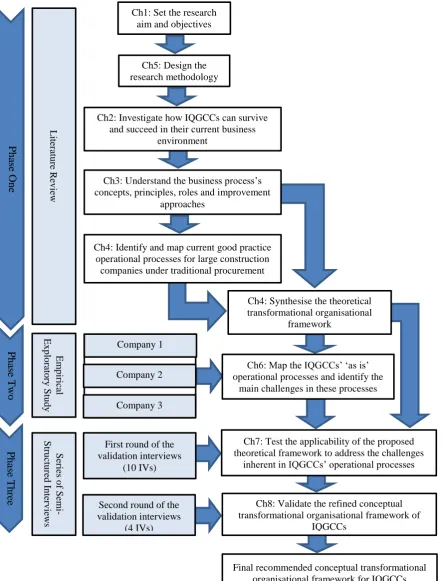
Achieving the aims and objectives of this study is a challenging task. In order to meet the objectives, a qualitative methodology is employed to: review, understand, and synthesise literature available on the related themes of the research; empirically investigate the IQGCCs’ current practices; and finally, produce a framework to improve the current practice by drawing on the experience of engaged experts. A graphical representation of the research process is depicted in Figure 1:1, which illustrates that the process of this research comprises three main phases. These phases are as follows:
1) Phase one: This phase forms the main base of this research study. It comprises the literature review that helps in defining the research aim and objectives along with designing the research methodology. This also helps in developing a better understanding of IQGCCs’ current local context, the concepts and principles of business processes, and good practice operational processes of large construction companies under traditional procurement. This phase concludes by synthesising a theoretical framework that serves as a process map enabling construction companies to systematically manage and improve their operational processes.
2) Phase two: This phase includes the conduct of an exploratory study to capture, map and
paradigm to collect and analyse the required data. By the end of this phase, a holistic map of the IQGCCs’ current operational processes, alongside a list of the key challenges in these processes with their underlying causes, will be produced.
[image:23.595.94.537.142.724.2]
Figure 1-1: Research process
L iter atu re R ev iew Company 1 Company 3 E m p ir ical E x p lo rato ry S tu d y Ser ies o f Sem i-Stru ctu red I n ter v iews
Ch4: Synthesise the theoretical transformational organisational
framework
Ch6: Map the IQGCCs’ ‘as is’ operational processes and identify the
main challenges in these processes
Ch7: Test the applicability of the proposed theoretical framework to address the challenges
inherent in IQGCCs’ operational processes
Ch8: Validate the refined conceptual transformational organisational framework of
IQGCCs
Final recommended conceptual transformational organisational framework for IQGCCs Ch4: Identify and map current good practice
operational processes for large construction companies under traditional procurement
Ch3: Understand the business process’s concepts, principles, roles and improvement
approaches
Ch2: Investigate how IQGCCs can survive and succeed in their current business
environment Ch5: Design the research methodology
Ch1: Set the research aim and objectives
First round of the validation interviews
(10 IVs) Company 2
3) Phase three: This phase involves a two stage validation processes. Both stages are achieved through conducting semi-structured interviews. The first stage aims at validating the outcomes obtained from the exploratory study and testing the applicability of the proposed theoretical framework in order to address challenges in the IQGCCs’ current practices. As a result of this exercise, amendments will be made to produce the refined conceptual transformational framework that suits the context of the IQGCCs. This version of the framework will be then taken forwards into a further confirmation stage to ensure its validity and produce the final recommended transformation organisational framework for IQGCCs.
1.7 Structure of the Thesis
This thesis is structured into nine chapters, which are summarised as follows:
Chapter one introduces an overview of the research background, research problem and main
aim and objectives. It also discusses the research scope and assumptions. Finally, this chapter provides a summary of the process employed to achieve the aim and objectives of this study, along with its structure.
Chapter two provides an overview of Iraq and investigates the impacts of the changing Iraqi
business environment on the construction industry in general and IQGCCs in particular. The chapter also briefly highlights the performance of IQGCCs under the current business conditions and why they need to change and focus on business process in order to improve their performances.
Chapter three introduces the concepts and principles of business process and business process
orientation alongside the key approaches and models developed to increase the principles of business process in an organisation. It also discusses a number of modelling techniques that can be used to map the IQGCCs’ operational process with the aim of identifying and resolving their challenges. Moreover, the chapter highlights the main process research and initiatives produced to improve the process of construction. Finally, the impact of changing businesses on organisational structure is discussed along with an analysis of the main organisational structure types that can be employed by construction companies.
Chapter four identifies, describes, and visually represents the widely accepted good practice
This chapter also synthesises a theoretical transformational organisational framework to help construction companies streamline and consciously improve their core business processes.
Chapter five explores and discusses the research philosophy and methodology with the aim of
identifying the most appropriate research approach, strategies, data collection and analysis techniques that can be used to achieve the research objectives.
Chapter six analyses the data collected through an exploratory study comprising three
construction companies selected from IQGCCs as case studies. The chapter describes and visually represents the ‘as is’ operational processes employed by each company studied during the delivery of its projects. In addition, these processes are analysed and their key challenges identified along with the main causes of these challenges.
Chapter seven is designed to test and discuss the applicability of the proposed transformational
organisational framework to address the challenges identified in the IQGCCs’ current core business processes. By employing a thematic data analysis, this chapter, step by step, analyses and discusses the interviewees’ perspectives regarding the elements of the proposed theoretical framework, the solutions suggested through these elements, and any amendments required to ensure the framework suits the IQGCCs’ context. This chapter concludes by producing a refined version of the transformational organisational framework based on the experience of IQGCCs’ experts.
Chapter eight provides a broader confirmation regarding the validity, credibility, suitability
and applicability of the refined conceptual framework produced from the first round of validation interviews. The chapter explains the procedure used in: collecting the data required at this stage; discussing the results obtained from analysing the collected data; and finally, presenting the details of the final recommended transformational organisational framework for IQGCCs.
Chapter Two - Iraqi Quasi-Governmental Construction Companies’
(IQGCCs) Performance and Need for Change
2.1 Introduction
This chapter provides an overview of Iraq’s business environment and identifies the impacts of the changing business requirements on the performances of Iraqi state-owned enterprises in general and Iraqi QGCCs in particular. It starts by introducing a general historical, geographical, and economical view of Iraq. Thereafter, the impact of changing the political and economic systems on Iraq’s construction business environment and the IQGCCs’ performances over the last 50 years is discussed. The chapter then addresses how some organisations worldwide have managed to survive and grow in a highly competitive and turbulent business environment, such as that experienced by IQGCCs nowadays. The fundamental lesson learned from companies’ experiences reveal that, in order to succeed and stay ahead of the competition, organisations need to focus on improving their operational processes. Yet, this may also mean affecting organisation change. Therefore, the final part of this chapter covers organisational change in terms of concept and types.
2.2 Iraq an Overview
Iraq is an Arabic country, governed by a federal democratic parliamentary republic system. Historically, since the ancient times, Iraq was known as Mesopotamia - the land between the rivers - which was an advanced civilisation that emerged by 4000 B.C. in a large area of the plains of the Tigris and Euphrates rivers. Sometime after 2000 B.C., this land became the centre for many civilised empires, such as the ancient Babylonian and Assyrian (Roux, 1991). In 762, Baghdad was built on the same land and became the capital and the intellectual, cultural, political and economic centre of the Islamic empire under the Abbasids’ caliphate (Corzine, 2004). However, Iraq’s current geographical borders were identified by the British occupation in 1921 when they established the Kingdom of Iraq under their control. In 1958, the republican regime was established in Iraq after the overthrow of the monarchy (Marr & Al-Marashi, 2017).
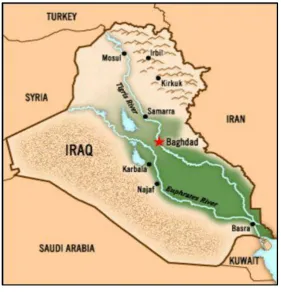
with Syria to the north-west, Jordan to the west, Saudi Arabia and Kuwait to the south, Iran to the east, and Turkey to the north. Moreover, it has a narrow section of coastline measuring 58 km (35 miles) between Umm Qasr and Al Faw on the Arabian Gulf, which makes it one of the Arab Gulf countries, as shown in Figure 2-1.
Figure 2-1: Iraq map
Source: Alhadeff (2016)
Iraq comprises eighteen administrative regions; Baghdad is the capital and commercial centre and located in the centre-east of the country. Other major cities include Al-Basara in the south, and Mosul and Arbil in the north. In Iraq; there are two main rivers, namely, the Tigris and the Euphrates that run all the way through the centre of Iraq from north to south. These rivers provide Iraq with arable land and create diverse landscapes varying from green plains to deserts, which cover most of western Asia.
goods and textiles (United Nations Educational, Scientific and Cultural Organisation, 2014). The construction industry contributes to 8% of Iraq’s GDP (Trading Economics, 2017).
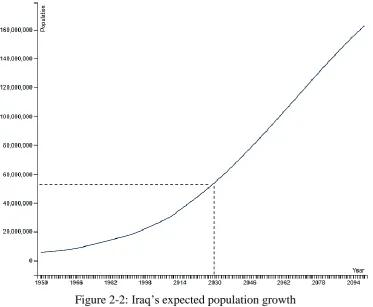
[image:28.595.126.500.254.561.2]According to estimates by the Iraqi Ministry of Planning (2013), the population of Iraq will reach than 40 million by the end of 2018 with a population growth rate of almost 2.9. In light this substantial growth in the population rate, Iraq’s population is most likely to increase in the coming years and reach a figure of around 56 million by 2030 (World Population Review, 2017). Figure 2-2 illustrates Iraq’s expected population growth over the next century.
Figure 2-2: Iraq’s expected population growth
Source: World Population Review (2017)
2.3 Iraqi Business Environment Pre and Post 2003
2.3.1 Iraq Pre-2003
From 1958 until 2003, Iraq was officially governed by a republican presidential system. In that the President of the Republic represented the highest authority in the country and also the Chairman of the Council of Ministers, which was responsible for both the executive and legislative powers. Under the bylaws promulgated in 1978, the Council of Ministers had responsibility for planning and determining the country’s internal and external policies and decision-making processes. The President assigned all Ministers, their deputies and Chief Executive Officers (CEOs) of the different ministries and public organisations and companies (Sanford, 2003).
Throughout the aforementioned era, socialist models influenced all successive governments that ruled Iraq. Therefore, they emphasised several themes that bore this stamp, such as: employment central economic planning to manage the country’s resources; elimination of foreign economic influences (notably in the oil sector), and land reform. Accordingly, several measures were taken to increase the role of the public sector in the national economy. These included: nationalising all banks, insurance companies, and many industrial and construction firms; reorganising other companies, and establishing many new state-owned enterprises in various sectors. The adoption of a socialist approach to governance accompanied by the move towards a planned economy contributed to the flight of investors and thereby their money, which meant the government had to rely completely on oil revenue as its single source of GDP (Sanford, 2003).
However, the government’s efforts to reform the national economy did not succeed. By 1989, the economic crisis deepened and the standard of living for most Iraqis significantly deteriorated. This toxic mix led to the government re-imposing control over market rates, the re-nationalisation of several firms, and the increase of government subsidy for various sectors (Chaudhry, 2002). The First Gulf War in 1991, and the subsequent draconian sanctions, lasted for the next 13 years, as the international response to the Iraq invasion of Kuwait wreaked havoc on an already distressed economy and caused a collapse in the Iraqi infrastructure (Sanford, 2003). The international economic sanctions prevented Iraq from exercising any trade or financial action with other counties.
Consequently, in the absence of investment, the Iraqi government worked on supporting and activating state-owned enterprises in different sectors with the aim of investing local resources into that which could be repaired from the destroyed infrastructure. Many of those enterprises were specialised in the construction industry and distributed over a number of the state ministries and institutions. For example, the Ministry of Housing and Construction had a number of Quasi-Governmental Construction Companies (QGCCs) specialised in different construction fields and responsible for executing most of the projects offered by the Ministry or other state entities. In other words, the majority of these companies were founded to conduct missions for the government and ministries to which they belonged. Thus these companies had no difficulties in securing new projects, where most of the government contracts were directly awarded to them without serious competition, especially with the semi-absence of the private sector due to the poor economy and the government orientation toward a centrally planned economy.
2.3.2 Iraq Post-2003
governance. Under the new government system, the executive power became the responsibility of the Cabinet headed by the Prime Minister who now has the highest executive authority in the country, whilst the legislative power has become the responsibility of Parliament. Ministers are now nominated by the Prime Minister and must be ratified by the Parliament. Otherwise, regarding the general structure and hierarchy of the government, ministries and institutions remain managed within the same traditional bureaucratic system (Sanford, 2003; Gunter, 2013).
Moreover, after 2003, the Iraqi economy witnessed great development and has considered one of the fastest developing economies in the world, with an average annual growth in Gross Domestic Product (GDP) of 6% during the last ten years (Trading Economy, 2017). This growth in the economy is mainly dependent on oil extraction. However, the construction industry, supported through large-scale government infrastructure development, such as the treatment and distribution of water, new sewer systems, roads and airports, has also contributed 8% to the national GDP (Trading Economy, 2017). Indeed, the potential of the construction industry in Iraq has no limits. In addition to the need for millions of new houses and the renovation of existing buildings, significant infrastructure regeneration is also highly necessary. According to the PressReader (2013), in 2010 the industry expanded by 4.4%, to become worth US$ 5.6 billion, and was expected to grow annually by 6.18% until 2015. Moreover, the latest National Development Plan (2013-2017) calls for spending, totalling US$357 billion, on projects that concentrate on energy, building and services, agriculture, education, transport and communications (PWC, 2014). This huge investment into developing the country’s infrastructure reflects the importance of the construction industry for Iraq.
However, among the greatest problems facing the current Iraqi government is that the national economy is mainly dependent on oil production, and continues to be dominated by SOEs who tend to be costly and low-quality producers. Therefore, any large-scale infrastructure investment will involve one or more of these inefficient SOEs (Bureau of Economic and Business Affairs, 2013; Gunter, 2013). In order to overcome these problems and further support its national economy, the Iraqi government has set up a plan to reform the economy through transforming from a centrally planned to a market economy. This plan was first proposed and applied by the Coalition Provisional Authority (CPA) through implementing a free market and free trade reforms and cutting governmental support for almost 192 SOEs with the aim of privatising them (Wing, 2013). However, all efforts to privatise SOEs have failed because of opposition from the Iraqi government, since the topic is politically sensitive. Nonetheless, they have been open to measures that would make state-owned companies more efficient and competitive through modernising these enterprises to operate commercially as competitive businesses, or employing Public Private Partnerships to attract private sector investment and expertise (Gunter, 2013; The Swedish International Development Cooperation Agency [Sida], 2014). Yet the poor performances of these organisations do not encourage investors to engage in partnerships with them (World Bank, 2004). Accordingly, the CPA has changed course and decided to reform and modernise SOEs, while maintaining employment by supporting their transition towards modern practices with the goal of becoming commercially viable entities that can attract foreign investment (Bureau of Economic and Business Affairs [BEBA], 2013; Wing, 2013; Sida, 2014). Subsequent Iraqi governments have tried to follow a similar path proposed by the CPA, and have thus taken several measures to encourage private sector and foreign investment through tax reforms, and the removal of restrictions on foreign investment including the suspension of all duties and tariffs on Foreign Investment (Moore & Parker, 2007).
implemented, and as such, conducting research into the potential avenues this reform could take would be important for all stakeholders.
2.4 The Performance of Iraqi State-Owned Enterprises and the Need for Change
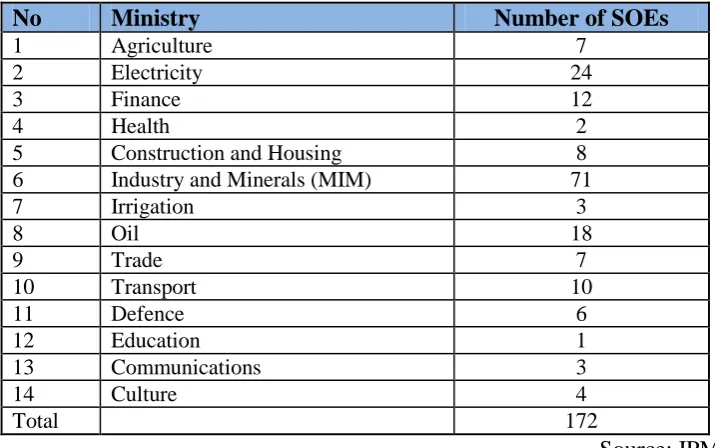
[image:33.595.134.492.243.467.2]According to the Iraqi Council of Prime Minister Office [IPMO] (2015), Iraq currently has 172 SOEs grouped under fourteen line ministries, as shown in Table 2-1, and employ over 600,000 Iraqis, many of whom are underutilised.
Table 2-1: Summary of SOEs and their affiliation with line Ministries
No Ministry Number of SOEs
1 Agriculture 7
2 Electricity 24
3 Finance 12
4 Health 2
5 Construction and Housing 8
6 Industry and Minerals (MIM) 71
7 Irrigation 3
8 Oil 18
9 Trade 7
10 Transport 10
11 Defence 6
12 Education 1
13 Communications 3
14 Culture 4
Total 172
Source: IPMO (2015)
Most Iraqi SOEs are large in size and have 5-15 medium to even small-sized branches distributed at different sites that are usually far from the main headquarters. Although these branches act as separate units in undertaking technical functions, they do not have commercial autonomy as they are not registered as legal entities. Thus, they are not permitted to sign contracts with customers or receive credit from banks (The World Bank, 2004). On account of the wars and years of international sanctions, most of these companies have suffered physical damage or under-investment, and thus become unviable economically (BEBA, 2013). Moreover, the new governments’ endeavours to implement free trade reforms have led to the lifting of tariffs and put SOEs in direct competition with a flood of cheap and better quality imports. This has resulted in the loss of Iraq’s SOE market share in several sectors, since their management systems, equipment, and production technology are obsolete (Wing, 2013).
No.22 of 1997, which is still in force, IQGCCs have been defined as self-financed, state-owned economic units that independently operate based on the profit-loss principle (Iraqi Local Governance Law Library, 2018). Accordingly, they should not be seen as public service government bodies, but should be given greater autonomy in managing their business as profitable organisations (IPMO, 2015). These companies are clustered within three ministries, as shown in Table 2-2. Collectively, they employ 17,092 Iraqis (IPMO, 2015) and this is broken down by ministry in Table 2-2.
Table 2-2: Summary of IQGCCs and their affiliation with line ministries
No Ministry Number of QGCCs Number of Employees
1 Construction and Housing 8 13700
2 Irrigation 3 2833
3 Transport 1 559
Total 12 17092
Source: IPMO (2015)
Similar to other Iraqi SOEs, IQGCCs, in fact, have not been immune to the effects of change in the Iraqi business environment and government actions to move toward an open market economy. Where after decades of domination over most publicly funded construction contracts, these companies face fierce competition from, in excess of, 3,500 local and international private firms. As a result, IQGCCs have struggled to both win contracts and generate profit (Wing, 2009). Consequently, the majority have incurred substantial financial losses and become an unsustainable burden on the national budget, as reported by the IPMO (2015) and revealed by successive annual reports of the Iraqi Federal Board of Supreme Audit [IFBSA] throughout the last decade. The resulting widespread public criticism of these companies, alongside concerns about their ongoing inability to improve their poor performance and low productivity (Al-Shikhely, 2007; Wing, 2013; IPMO, 2015) have led to calls for the Iraqi government to radically reform or even close these loss-making businesses. Particularly that the main objective of establishing these companies, as stipulated by Iraqi Law of State Companies No.22 of 1997, is to enhance the national economy through founding profitable economic units that are commercially viable.
in the new business environment, such as those facing IQGCCs nowadays. This view is further supported by Banner and Gagné (1995) who assert that the slow-moving traditional bureaucratic system is seemingly more outdated than ever before. Since, by the time a major decision goes up for review and implementation through several management layers in the hierarchy, the organisation can be too late in responding to major environmental changes. Therefore, according to Hansford (2009), in order to survive and stay ahead of competition, nowadays, organisations seem to have little choice but to adapt to the relentless pace of changes in the business environment with the aim of responding to the changes in customers’ requirements.
In fact, one of the main features in the new operational business environment is that customers have more and better choices, which make product or service providers less secure and more vulnerable to competition (Loudon & Carter, 2014). Successful organisations are those that have the ability to beat their competitors by being better, faster and cheaper (Lindfors, 2003; Loudon & Carter, 2014; Asquith, 2017). Lindfors (2003) declares that organisational efficiency is what is needed by construction companies to achieve these three features without trade-offs between them. Asquith (2017) also insists that construction companies can only respond to the need for all three success features through integrating organisational efficiency with technology. Moreover, Schmidt and Lyle (2010) emphasise that, in order to be better, faster and cheaper, companies have one way forward, which is through investment more effort, time and sometimes capital in improving their operational processes. Similarly, Asquith (2017) argues that optimising the core business process, through removing non-value added activities and bad waste, is key to improving efficiency. As such Asquith states that construction companies need to exploit the opportunity to streamline existing and embrace new processes where they can take advantage of information technology development to enhance the efficiency of their operational processes.
focusing on the continuous improvement of operational business processes, organisations can enhance their overall performance and establish a robust competitive advantage through cost reduction, quality and efficiency enhancement, and by enabling responsiveness and adaptation to the internal and external organisational changes (Hammer, 2007a; McCormach, 2007; Vergidis et al., 2012; vom Brocke & Rosemann, 2015; Khosravi, 2016). Accordingly, to improve their performance and gain a better competitive advantage in order to face dynamic changes in the market place, the Iraqi Quasi-Governmental Construction Companies (IQGCCs) need to adopt organisational change management and move away from traditional functional management systems to focus on improving and managing their business processes.
2.5 Organisational Change Management
The English Oxford Living Dictionary (2017) provides a simple and useful definition of change, which is “an act or process through which something becomes different”. Change is an inevitable event for individuals, organisations and society (Lazar, 2012). Burnes (2009) considers change as an important ever-present feature of organisational life, whether at a strategic or operational level. Thus, there should not be any doubt to organisations of the significance of identifying where the business desires to be in the future, and what is required to change in order to get there. Accordingly, organisational change should not be seen as an event separated from organisational strategy, or vice versa (Todnem, 2005; Burnes, 2009).
In addition to the project changes, construction companies are sometimes required to implement changes at the organisational level or, as is well known, organisational change. Organisational change can include a shift in organisation processes and system, structure, power distribution, culture, technology, and so forth (Cao et al., 2004, Erdogan et al., 2005). It is often brought about as a response to changes in the external surrounding business environment, such as changes in political control, the country’s economic system, technology, globalisation, laws and regulators, competition, customer requirements, and so forth (Lanning, 2001; Jamali et al., 2009; Hansford, 2009; Lazar, 2012; Bourne & Bourne, 2016). Yet it can also originate from sources inside the organisation itself; for example, management change, new market opportunities, deficiencies in the existing system, an increasingly diverse workforce, and so on (Lanning, 2001; Erdogan et al., 2005; Morris, 2007; Chen et al., 2016; Rizescu & Tileaga, 2016). Thus, the key aim of organisational change is to make changes to how business is performed in order to cope with the new requirements of the business environment and introduce improvements in an organisation’s effectiveness and efficiency (Erdogan et al., 2005; Lazar, 2012). This is significant, since without such changes, organisations would become stale and struggle to survive (Bourne & Bourne, 2016). Based on what have discussed throughout this chapter, the focus of this research lays within the scope of organisational change.
Moreover, whilst organisational changes can occur in different sizes and shapes, change management literature commonly distinguishes between two main types, which are first-order and second-order change (Levy & Merry, 1986; Porras & Robertson, 1992; Newman, 2000; Gareis, 2010; Burke, 2011; Cockrell et al., 2012; Palmer et al., 2017). The distinction between these two types is fundamentally based on the magnitude and the pace of change. More detail about these types of organisational change is presented in the following sub-sections.
2.5.1 First-Order Change
First-order changes are characterised as being less dramatic, evolutionary, often incremental
and continuous in nature (Gareis, 2010). According to Palmer et al., (2017) this type of change
can comprise minor improvements and modifications in systems, functional processes,
structures, or recognition and reward programmes, which do not essentially change the
corporate strategy, core values, or identity. Changes under the first-order are implemented in
the context of existing organisational paradigms with the aim of maintaining and developing
the organisation (Gareis, 2010). In other words, the underlying assumptions of the operation, in