T r a n s c r i bi n g s c r e e n-c a p t u r e d a t a
: t h e p r o c e s s of d e v el o pi n g a
t r a n s c ri p tio n s y s t e m fo r m u l
ti-m o d a l t e x t-b a s e d d a t a
M e r e d i t h , JM
h t t p :// dx. d oi.o r g / 1 0 . 1 0 8 0 / 1 3 6 4 5 5 7 9 . 2 0 1 5 . 1 0 8 2 2 9 1
T i t l e T r a n s c ri bi n g s c r e e n-c a p t u r e d a t a : t h e p r o c e s s of d e v elo pi n g a t r a n s c r i p tio n s y s t e m fo r m u l ti-m o d a l t e x t-b a s e d d a t a
A u t h o r s M e r e d i t h , JM
Typ e Ar ticl e
U RL T hi s v e r si o n is a v ail a bl e a t :
h t t p :// u sir. s alfo r d . a c . u k /i d/ e p ri n t/ 3 6 8 8 4 /
P u b l i s h e d D a t e 2 0 1 5
U S IR is a d i gi t al c oll e c ti o n of t h e r e s e a r c h o u t p u t of t h e U n iv e r si ty of S alfo r d . W h e r e c o p y ri g h t p e r m i t s , f ull t e x t m a t e r i al h el d i n t h e r e p o si t o r y is m a d e f r e ely a v ail a bl e o nli n e a n d c a n b e r e a d , d o w nl o a d e d a n d c o pi e d fo r n o
n-c o m m e r n-ci al p r iv a t e s t u d y o r r e s e a r n-c h p u r p o s e s . Pl e a s e n-c h e n-c k t h e m a n u s n-c ri p t fo r a n y f u r t h e r c o p y ri g h t r e s t r i c ti o n s .
1
Transcribing screen-capture data: The process of developing a
1
transcription system for multi-modal text-based data
23
Abstract
4
Transcription of audio data is widespread in qualitative research, with transcription of video-5
data also becoming common. Online data is now being collected using screen-capture or 6
video software, which then needs transcribing. This paper draws together literature on 7
transcription of spoken interaction and highlights key transcription principles, namely 8
reflecting the methodological approach, readability, accessibility, usability. These principles 9
provide a framework for developing a transcription system for multi-modal text-based data. 10
The process of developing a transcription system for data from Facebook chat is described 11
and reflected on. Key issues in the transcription of multi-modal text-based data are discussed, 12
and examples provided of how these were overcome when developing the transcription 13
system. 14
15
Keywords: Transcription, conversation analysis, screen-capture data, online interaction, text-16
based chat. 17
18
19
20
21
2
Introduction
1
A recent development in qualitative research has been the growing interest in online text-2
based data, such as online chats, e-mails, text messages, instant messaging interactions and so 3
on (e.g., Baym, 2009; Coulson, 2005; Herring, 2007). While much of this data does not need 4
to be transcribed, some online data is now being collected using screen-capture software 5
(Bhatt & de Roock, 2013), which records actions represented on a computer screen. The use 6
of these kinds of data poses challenges for transcription, which is an integral part of 7
qualitative research. Transcription most commonly involves representing an oral language, 8
with its attendant set of rules, as written language, with a different set of rules (Kvale, 1996). 9
Previous literature has described the process of transcription and has provided ‘how to’ 10
guides (e.g., Du Bois, Schuetze-Coburn, Cumming, & Paolino, 1993; Hepburn & Bolden, 11
2013; Jefferson, 2004). Transcription has also been critically examined, with many authors 12
noting that it is not a neutral process, but rather is theory-laden (Bucholtz, 2000; Davidson, 13
2009; Lapadat & Lindsay, 1999; Ochs, 1979). While most of the literature has focused on 14
transcribing spoken language, a growing literature discusses how to transcribe physical 15
aspects of an interaction, such as body language, gaze, gesture and so on (e.g. Bezemer & 16
Mavers, 2011; Goodwin, 1986; Heath, Hindmarsh, & Luff, 2010). This paper brings together 17
the previous literature on transcription and transcription principles, and uses it to show how 18
multi-modal text based data can be transcribed. 19
In the following section, I will provide an overview of the literature on transcription, 20
including reviewing the development of multi-modal transcription for both spoken and online 21
discourse. In the second section, I will identify the key principles which comprise the 22
framework for developing a transcription system. The final sections provide examples of a 23
transcription system developed for text-based screen-capture data. I will use these examples 24
3 transcription principles guided the process.
1
2
Transcripts and transcription in qualitative research
3
Transcripts are used in qualitative research to aid analysis. A transcript is “compact, 4
transportable and reproducible, and provides for easy random access unlike audio or video 5
records” (Hepburn & Bolden, 2013, p. 75). In other words, paper transcripts can be accessed 6
at any time, without needing a computer or any technical equipment. Transcripts allow data 7
to be presented to others in journal articles, conferences, data sessions and so on. However, 8
there is no ‘gold standard’ for how to transcribe spoken discourse and there is debate about 9
how much, and what kind of, information to include in transcripts (Potter & Hepburn, 2005; 10
Smith, Hollway, & Mishler, 2005). Potter and Hepburn argue that transcripts “should be 11
transcribed to a level that allows interactional features to be appreciated even if interactional 12
features are not the topic of study” (p.291). However, Smith, Hollway and Mishler suggest 13
that this stance does not consider the differing aims of different types of qualitative research, 14
and that for many approaches the inclusion of interactional features is irrelevant for the 15
subsequent analysis. This debate encapsulates the issue that transcripts are not merely 16
objective artefacts, but rather are theory-laden (Lapadat & Lindsay, 1998; Ochs, 1979). In 17
other words, “data collection and transcription are affected by the theoretical interests of the 18
analyst which inevitably determine which aspects of an interaction will be attended to and 19
how they will be represented” (Jones, 2011, p. 9). Therefore, the finished transcript is not a 20
simple record of the audio or video data, but instead is a record of the approach taken to the 21
data by the transcriber (Bird, 2005; Lapadat & Lindsay, 1998). 22
The process of producing a transcript is often considered as the first stage of analysis 23
(Edwards, 2003; Kvale, 1996; Lapadat & Lindsay, 1998, 1999), although it is also argued 24
4 (Ashmore, MacMillan, & Brown, 2004; Goodwin, 1994). The production of a transcript 1
allows the researcher to familiarise themselves with the data, and subsequently identify 2
interesting phenomena for analysis (ten Have, 2007). However, it is important that transcripts 3
are not treated as data (Hutchby & Wooffitt, 2008) nor as an adequate substitute for watching 4
or listening to the recorded data (Hepburn & Bolden, 2013; Heritage & Atkinson, 1984). 5
6
Multi-modal transcription 7
With the increased use of video in qualitative research, a number of systems for representing 8
embodied conduct have been developed (e.g., Goodwin, 1980, 1986; Heath, et al., 2010). 9
Bezemer and Mavers (2011) note that physical or bodily conduct is often simply described, 10
such as ‘shakes head’. Images are also used, including video stills, drawings and computer-11
generated images (e.g., Avital & Streeck, 2011; Goodwin, 2007; Heath & Luff, 2011), but 12
their use varies considerably. Images are sometimes used alongside transcripts, highlighting 13
particular actions or lines of dialogue (e.g., Craven & Potter, 2010). Others use images as the 14
transcript, with relevant text overlaid on the images (e.g., Norris, 2004). However, due to the 15
space which images require, these transcripts often only represent small sections of data 16
(Bezemer, 2014). There are, of course, further transcription notations for multi-modal data in 17
addition to those described above (Bezemer and Mavers, 2011), with some transcripts 18
combining different methods. For example, Richardson and Stokoe (2014) use stills 19
alongside transcripts, with relevant lines of dialogue imposed on the images as well as 20
descriptions of actions in the transcript. 21
There are few examples of transcription of text-based multi-modal data. For studies of 22
online data, authors sometimes choose to use screenshots to represent the actions occurring 23
on-screen (e.g., Keating & Sunakawa, 2011), while others provide a written transcript (e.g., 24
5 for posted messages, another column for messages in construction, and a third column for 1
embodied conduct taken from a video recording. Garcia and Jacobs, on the other hand, 2
reproduce “what is visually available to each student on the screen” (p.343), and show what 3
is appearing in the chat window, along with the message entry box for each participant. 4
While these transcription systems are used to present data, it is rare that there is a description 5
of how these systems were developed. This paper draws upon and develops previous 6
literature on transcription by discussing the specific challenges of transcribing multi-modal 7
text-based data. 8
9
Transcription principles
10
In this section, I will discuss a number of transcription principles drawn from the literature, 11
which function as a framework for guiding the development of a transcription system. As 12
previously discussed, transcription should not be seen an objective process, rather it is “a very 13
complex process involving a series of interpretive judgements and decisions” (Müller & 14
Damico, 2002, p. 300). The choices made during the transcription process are dependent 15
upon the questions the researcher asks of that data and their methodological and theoretical 16
approach (Lapadat & Lindsay, 1998; Ochs, 1979). In other words, a key principle is that the 17
transcript will, and should, inevitably reflect the analytic method and research question. 18
Another principle is that a transcript should be readable. As Ochs (1979) argues “a 19
transcript that is too detailed is difficult to follow and assess. A more useful transcript is a 20
more selective one” (p44). Therefore, a transcript will necessarily be selective, and so 21
transcribers will need to consider what should be included and excluded, based upon the 22
goals of the research (Davidson, 2009; Lapadat, 2000; Müller & Damico, 2002). 23
A third, and potentially competing principle, is that the transcript must be useful to the 24
6 and potentially future, analytic interests (Du Bois, 1991). However, a balance must be struck 1
between the transcript being usable and readable. 2
A fourth principle is that the transcript should be accessible to others in similar fields 3
of research, by using a similar layout or ‘borrowing’ symbols from other well-established 4
systems (Du Bois, 1991) . While readability and usability relate to the researcher’s use of the 5
transcript, accessibility focuses on whether others are able to use and understand it. 6
These principles are not rigid rules, but rather are a framework for guiding the process 7
of both developing a transcription system and subsequently producing transcripts. In the rest 8
of this paper I will discuss the process of developing a transcription system specifically for 9
multi-modal text based data. I will show how the principles discussed here are relevant for 10
managing the challenges of transcribing these kinds of data. First, though, I will provide a 11
brief overview of the data collected and methodological approach taken to analysis, because – 12
as discussed above – such factors impact upon the production of a transcript. 13
14
Data and methodological approach
15
The data comprised a corpus of screen-capture videos of Facebook chats. Facebook chat is a 16
text-based instant messaging service, available through the social networking site Facebook, 17
allowing users to interact with their friends in real time1. Four participants downloaded 18
screen-capture software on to their computers, and were asked to engage in Facebook chats 19
as normal, but to record their screens when doing so. All participants gave informed consent 20
to have their chats recorded, and they also gained consent from their chat partners. 47 screen-21
capture chats were collected comprising around 25 hours of recordings. 22
1 At the time of data collection, Facebook chat was a quasi-synchronous means of interacting with
7 The aim of the research was to investigate how instant messaging interaction is
1
organised, using conversation analysis (henceforth CA) to analyse the data. CA examines 2
instances of naturally-occurring interaction to analyse how social action can be seen as 3
patterned and orderly (Heritage & Atkinson, 1984). The key findings of CA are that turns-at-4
talk incorporate actions, in other words, they are ‘doing things’ such as inviting, requesting, 5
offering and so on (Drew, 2005). In addition, CA finds that talk is organised sequentially, so 6
one action will project a particular next action. CA is also concerned with how participants 7
mutually co-ordinate turn-taking in conversation (Schegloff, 2007). The broad analytic 8
interests of CA are therefore action, sequences and turn-taking, and this is reflected in the 9
types of transcripts produced. 10
CA transcripts are designed to include details of not only what is said, but also details 11
of how a turn is delivered, such as the pitch, volume, speed or prosody of a turn (Hepburn & 12
Bolden, 2013). The most common method of transcription in CA is the Jefferson (2004) 13
system, which incorporates ways of representing temporal features, utterance alignment, 14
speech delivery and intonation (Hepburn & Bolden, 2013; Roberts & Robinson, 2004). The 15
Jefferson system is based largely on notation which is familiar from written interaction, 16
including capital letters for volume, underlining for emphasis and so on (Hepburn & Bolden, 17
2013). 18
For the Facebook chat data, a transcription system was developed which would reflect 19
my research interests and which was accessible, as far as possible, to other CA researchers. 20
There were three key features which distinguished this data from spoken interaction, and 21
which posed challenges for transcription: firstly, the interaction itself was text-based, as 22
opposed to representing spoken language as text; Secondly, some data was only available via 23
the screen-capture and was not available to both participants in the chat; and thirdly, the on-24
8 needed to be accurately represented and distinguished from the chat itself. In the following 1
sections I will discuss the process of developing a transcription system, and show how these 2
issues were addressed. 3
4
Designing a multi-modal transcription system
5
In this section I will outline some initial decisions made in the process of developing the 6
transcription system. I will then discuss the layout and some of the symbols used throughout 7
the transcript. Finally, I will show how overlaps, writing and deleting are represented in the 8
transcript. 9
10
The initial decision-making process 11
Hammersley (2010) notes that a number of decisions need to be made during transcription, 12
including what to transcribe, how much to transcribe and how much detail to include. Here, I 13
will discuss the decisions involved in the initial stages of transcribing screen-capture data. 14
The first step in developing the transcription system involved watching the screen-capture 15
videos, and noting relevant details. This initial stage functioned as a ‘noticing device’ (ten 16
Have, 2007, p. 95), allowing me to identify interesting phenomena for analysis and was, 17
effectively, the first stage of analysis (Edwards, 2003). In text-based data, the main aspect to 18
be included is the actual interaction, in this case, the text of the Facebook chat. The screen-19
capture data provided additional information, including message construction, overlapping 20
writing, using other websites, and so on, which was only available to the participant 21
recording their screen. 22
There were many features in the video data which could be included, but based on the 23
principle of readability it was necessary to consider what features would be analytically 24
9 the mouse movement as this action would not assist in answering the research question. In 1
addition, the inclusion of mouse movements in multi-modal transcripts often makes the 2
transcript more complex (Laurier, Forthcoming), and thus less readable. 3
Another decision related to how much detail to include. References to activities outside 4
of the chat were included, but with fairly limited information, as demonstrated in the Figure 5
1. 6
7
1 K*: 6.0 University e-mail 8
2 ((Opens Microsoft Word))
9 10
Figure 1. Extract from Facebook chat. 11
12
K spends 6 seconds using her university e-mail (line 1), before opening word processing 13
software (line 2). These lines of text represent images but the action is described rather than 14
shown. The description of these activities is brief; there is no detail such as whether K was 15
writing, reading or organising her e-mail for example, as this was deemed irrelevant for 16
analysis. The availability of the full screen-capture video also raised another issue in terms of 17
selectivity. Participants often engaged in more than one chat simultaneously and therefore the 18
decision needed to be made whether to include all chats in one single transcript or to 19
represent each single interaction in its own transcript. Including all the interactions would 20
represent the participants’ lived experience of Facebook chat (Meredith & Potter, 2014), but 21
the aim of the research was to focus on one-to-one interaction. Therefore, guided by the 22
principle that the transcript should reflect the aims of the research (Lapadat, 2000; Ochs, 23
1979), I transcribed each single interaction separately. An additional consideration was that a 24
transcript of the entire screen would most likely have been extremely complex and therefore 25
10 One final decision at this stage was whether to use transcription software such as
1
Transana. I chose not to do this for a number of reasons. Firstly, in keeping with the principle 2
of accessibility (Du Bois, 1991), I wanted to produce the transcript as Jefferson transcripts are 3
produced, where Microsoft Word is most commonly used (Heritage, n.d.). Secondly, not 4
using transcription software allowed for work on the transcript on any computer, without 5
needing to download additional software, making it more practical. 6
So far, I have laid out the basic decision-making processes of developing a transcription 7
system. Some of these decisions are similar to those made when transcribing spoken 8
interaction, but some issues do relate to the data being transcribed. In the following section, I 9
will discuss some of the more practical decisions about the transcript, related to the layout 10
and symbols. 11
12
Layout and symbols of the screen-capture transcript 13
One key decision was whether the transcript should be in vertical, column or partiture format 14
(Edwards, 2003). Most spoken transcripts are “arranged in the conventional ‘play-script’ 15
layout” (Jones, 2011, p. 14), meaning they are read from top-to-bottom and left-to-right. 16
While some transcripts for spoken interaction use a column-based format, this can give “the 17
impression (due to left-to-right reading bias) that the speaker whose utterances are leftmost is 18
the more dominant in the interaction” (Edwards, 2003, p. 326; see also Ochs, 1979). A 19
similar issue could arise with multi-modal transcripts, as one part of the interaction – the chat 20
or on-screen actions – could be given precedence in a column-based transcript. One 21
consideration for the Facebook chat transcript was that the Jefferson system predominantly 22
uses a vertical format, although it borrows occasionally from the partiture format (ten Have, 23
2007). Therefore, using a vertical format would make the transcript more accessible to other 24
11 shown in Figure 2.
1
2
1 2 3 4 5
3
1 2.17 0.15 Isla: wait wait wait
4
2 (2.0)
5
3 I*: i i (2.0) 6
4 2.23 0.06 Callum: new
7
8
Figure 2. Extract from Facebook chat. 9
10
There are columns in the transcript, which are numbered for the purposes of this example. 11
The interaction itself is in a single column (Column 5), and therefore resembles the vertical 12
format, with both the on-screen activities and the chat in the same column; this decision was 13
made for three reasons. Firstly, breaking up the on-screen activities and the chat could mean 14
that, in the course of the analysis, the chat was given precedence. Secondly, the use of 15
columns breaks up the linearity of the interaction. Thirdly, using columns makes the 16
transcript less readable and useable for conversation analysis, as it is difficult to accurately 17
indicate the occurrence of overlaps, which are key for the analysis of turn-taking. Therefore, 18
in the screen-capture transcript, both the actions taken from the screen-capture and the chat 19
are included in a single column. 20
Columns are used in this transcript for indicating line numbers (Column 1) and 21
participant identification (Column 4), as in a Jefferson transcript. In Jefferson transcripts, 22
time between and within turns is timed to tenths of seconds and placed within the interaction 23
(Hepburn & Bolden, 2013). However, in the screen-capture transcript, due to the nature of 24
textual interaction, there are different timings to be presented. Firstly, time between sent 25
turns is relevant, and available, for both participants in the chat and these are represented in 26
12 column 2 (2 minutes 17 seconds; 2 minutes 23 seconds). Secondly, there are on-screen gaps, 1
taken from the screen-capture, when nothing is happening on-screen for the participant 2
recording the data (line 2). Thirdly, there are pauses in the construction of messages, where 3
the writer momentarily stops writing (line 3). These latter two timings are only available from 4
the screen-capture, and these are presented within the interaction itself (Column 5). The other 5
timings, available to both participants, are placed alongside the interaction, as a method of 6
distinguishing between the different timings. 7
In Column 4 the full (anonymised) name of the participant is used in lines 1 and 4, 8
whereas only the initial of the participant is used in line 3. This distinction relates to how 9
different data types can be contrasted “so that readers of a transcription will know at every 10
moment what kind of information they are taking in” (Du Bois, 1991, p. 79). In this case, the 11
distinction is between the visible interaction available to both participants, and the on-screen 12
actions, available only to one participant. When a line refers to a part of the visible 13
interaction, the participants’ full names are used. When only an initial with an asterisk is 14
used, as in line 3, the information is taken directly from the screen-capture and refers to some 15
action occurring on-screen. 16
Another way of contrasting data types was through highlighting the turns which were 17
part of the interaction and so visible to both participants (lines 1 and 4). This means that for a 18
reader who is not familiar with the transcript, it is clear which parts of the chat are visible to 19
both participants, thus making it more accessible and readable (Du Bois, 1991). 20
Figure 2 also shows some of the symbols used throughout the transcript. When 21
deciding which symbols to use, accessibility was the key principle abided by and conventions 22
from the Jefferson system were used where possible. However, while the Jefferson system 23
uses some notations from written interaction, such as capital letters, underlining and 24
13 written notations were used as part of the interaction. Therefore, symbols needed to be chosen 1
which were not commonly used in written language, but which were widely available (Du 2
Bois, 1991). In the Facebook chat transcript, symbols were chosen from the ‘Wingdings’ and 3
‘Zingbats’ fonts on Microsoft Word. The symbols were chosen because they best represented 4
the actions on-screen, but also because they seemed unlikely to be used in everyday written 5
interaction. 6
7
Writing and overlaps 8
In Facebook chat, as with most other instant messaging services, the construction and sending 9
of messages are separate, so message construction is not visible to the recipient. Therefore, 10
the issue arises when transcribing text-based screen-capture data of how to distinguish 11
between text which is not visible to the co-participant, and text which is visible to both 12
participants. While some methods have been described above, such as highlighting turns, the 13
following examples show in more detail how writing is represented. 14
15
1 I*: wait wait wait 16
2 2.17 0.15 Isla: wait wait wait
17 18
Figure 3. Extract showing writing in Facebook chat. 19
20
In Figure 3 the use of an initial in line 1, rather than a full name, indicates that this action 21
occurs on-screen. In contrast, in line 2, which is visible to both participants, the full name is 22
used and the line is highlighted. The writing symbol () is used in line 1 to show that Isla is 23
constructing a message, and it is also placed at the end of message construction, which is 24
particularly important when it occurs over a number of lines of the transcript. Du Bois (1991) 25
14 they are designed to represent. The writing symbol is ‘iconic’, as it visually represents the 1
action it is symbolising. It is also readily available through Microsoft Word and was not 2
available in Facebook chat, so would be less likely to be used during an ordinary chat. The 3
message being constructed is written in italics, to distinguish it from messages sent to the 4
chat, thus aiding readability and usability. 5
From the screen-capture video, the overlap of message construction and sending was 6
visible (as seen briefly in Figure 2) and these phenomena were included in the transcript, as 7
they were relevant to the research question. The following example shows how overlap is 8
represented. 9
10
1 I*: yeah i need to
11
2 06:36 00:21 Joe: some one tried to add
12
3 photos of me from friday
13
4 I*: cook
14
5 06:37 00:01 Isla: yeah I need to cook
15
6 (2.0)
16
7 I*: and i(2.0)[think we might watch
17
8 J*: [ writing
18
9 I*: a watch a film tod d o ]
19
10 J*: writing ]
20
11 06:48 00:11 Isla: and i think we might watch a film
21
12 too
22
13 J*: 1.0 writing
23
14 06:49 00:01 Joe: yea you need cock? …...what?
24
15 I*: who>> 25
16 06:50 00:01 Isla: who>>
26 27
Figure 4. Transcript showing overlapping writing. 28
[Figure 5 about here] 29
30
In Figure 4 the content of Isla’s message construction is available, whereas Joe’s is not, as 31
Isla is the participant recording her screen. It is possible to see that Joe is writing, as a small 32
writing symbol appears in the corner of the chat window (see Figure 5). Therefore, from 33
15 messages. As with the Jefferson system, overlaps are indicated using square brackets (lines 7 1
and 8), making it more accessible to conversation analysts. 2
Joe’s message at lines 2 and 3 is sent while Isla is constructing hers, and in line 4 Isla 3
continues to write her next turn. In the transcript this is indicated by the double headed arrow 4
(‘’), representing ‘latching’, placed at the end of line 1 and the start of line 4. This symbol 5
indicates that the writing is continuous. From lines 7 to 10, writing symbols, overlapping 6
brackets and latching symbols are used to indicate that the two parties are writing 7
simultaneously. 8
In line 1 Isla starts to construct the turn that eventually appears at line 5; an action 9
which is only available for Isla. At the end of the line, while Isla is writing ‘to’, Joe sends a 10
message to the chat (lines 2 and 3), and this is represented by the use of symbols placed 11
around the parts that occur at the same time. The symbols are placed around the entire 12
message which occurs simultaneously, even if this runs over more than one line. Here, then, 13
the partiture format is used for actions occurring at the same time, similarly to Jefferson 14
transcripts, thus making the transcript more accessible. The features highlighted here show 15
how the text-chat and multi-modal features can be represented in the same transcript using 16
symbols and descriptions, rather than images. The overlap of on-screen actions and text-chat 17
demonstrates how including the interaction in a single column makes it clearer how overlap 18
occurs. 19
The production of such a detailed transcript reflects the aims of the research, which 20
were to examine the sequential and turn-taking aspects of instant messaging conversations. 21
For example, in Figure 5 Joe’s humourous message to Isla at line 14 (‘yea you need 22
cock….what?’) appears to be unrelated to the previous turn. However, by transcribing the 23
overlapping writing, we can see that this sequential disruption occurs because of the 24
16 Joe’s message (‘yeah I need to cook’) in line 5. Isla then continues to construct another
1
message in line 7. What is apparent from the transcript is that Joe starts to construct a 2
message in line 8, while Isla is still writing her subsequent message. Isla finishes constructing 3
her message a second prior to Joe and therefore her message appears first. So, we can see, 4
firstly, how turn-taking and sequence organization are impacted by the ability to write 5
messages simultaneously (see Meredith, forthcoming). Secondly, the fact that simultaneous 6
writing is not accountable, as simultaneous speech might be (see Schegloff, 2000) means that 7
we can start to understand some of the interactional norms of instant messaging interaction. 8
9
Deleting and editing messages 10
As the Facebook chat interaction is text-based and message construction occurs separately 11
from sending, participants are able to edit their messages, which raises the question of how to 12
accurately transcribe this editing. In the transcripts, strikethrough of letters was used to 13
represent deletion, utilising methods from other forms of written communication (Du Bois, 14
1991; Hepburn & Bolden, 2013). However, due to the issues of representing moving text in a 15
static format, the representation of deletion was slightly more complex than first anticipated. 16
Consider, for example, Figure 6 which shows a message construction and deletion. 17
18
1 I*: holy (.) shit (.)t st
19
2 hit joe – wherewe e were you
20
3 lastnight night ? ? and i bet
21
4 you can’t remember a thinkg glo
22
5 g g lol (3.0) i th (1.0)
23
6 (2.0) oh dar 24
7 01.23 Isla: oh dar
25
26
Figure 6. Transcript of deletion in Facebook chat. 27
17 In this example, it is difficult to see what the deleted message was, as all the letters are
1
struck-through. As will be shown below, the detail of what is being deleted can be relevant 2
for analysis. In addition, any nuances of message construction are lost because the entire 3
message is deleted. Therefore, in order to enhance the usability of the transcript, the decision 4
to re-write the letters was taken, as shown in the following example. 5
6
1 I*: holy (.) shit tih (.) s t t st t
7
2 hit joe – wherewe ewe e were you
8
3 lastnight thgin night ? ? ? and i bet
9
4 you can’t remember a thinkg gk glo olg
10
5 g g g lol (3.0) i th ht i (1.0)
11
6 lol gniht a rebmemer t’nac uoy teb I dna ?thgin
12
7 tsal uoy erew erehw – eoj this yloh
13
8 (2.0) oh dar 14
9 01.23 Isla: oh dar
15
16
Figure 7. Revised transcript of deletion. 17
18
In Figure 7, it is easier to see how the message was constructed, moment-by-moment. The 19
letters which are being deleted are re-written in the order in which they are deleted (in 20
reverse). For minor corrections, this representation of the deleted letters is mostly 21
unproblematic. However, for the major deletion in this extract, it is difficult to see – at first 22
glance – what has been deleted. Therefore, it was decided that the letters would be re-written 23
as normal, thus enhancing the usability and accessibility of the transcripts. The following 24
example shows the final version of the transcript. 25
26
1 I*: holy (.) shit hit (.) s t t st t
27
2 hit joe – wherewe ewe e were you
28
3 lastnight night night ? ? ? and i bet
29
4 you can’t remember a thinkg kg glo glo
18
5 g g g lol (3.0) i th i th (1.0)
1
6 holy shit joe – where were you last
2
7 night? and i bet you can’t remember
3
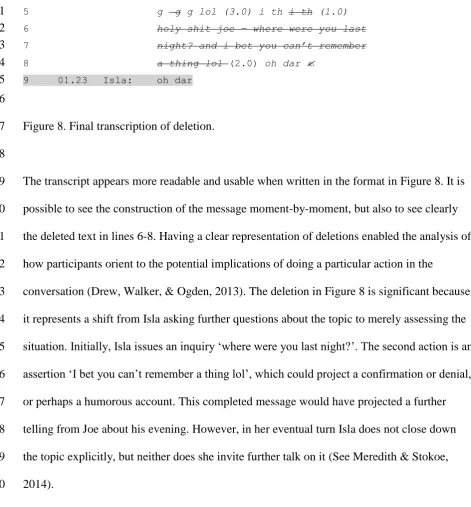
8 a thing lol (2.0) oh dar 4
9 01.23 Isla: oh dar
5
[image:19.595.49.521.66.574.2]6
Figure 8. Final transcription of deletion. 7
8
The transcript appears more readable and usable when written in the format in Figure 8. It is 9
possible to see the construction of the message moment-by-moment, but also to see clearly 10
the deleted text in lines 6-8. Having a clear representation of deletions enabled the analysis of 11
how participants orient to the potential implications of doing a particular action in the 12
conversation (Drew, Walker, & Ogden, 2013). The deletion in Figure 8 is significant because 13
it represents a shift from Isla asking further questions about the topic to merely assessing the 14
situation. Initially, Isla issues an inquiry ‘where were you last night?’. The second action is an 15
assertion ‘I bet you can’t remember a thing lol’, which could project a confirmation or denial, 16
or perhaps a humorous account. This completed message would have projected a further 17
telling from Joe about his evening. However, in her eventual turn Isla does not close down 18
the topic explicitly, but neither does she invite further talk on it (See Meredith & Stokoe, 19
2014). 20
21
Discussion
22
This paper has demonstrated how a framework of transcription principles can be used for 23
developing a transcription system for text-based multi-modal data. Previous literature has 24
shown how such data can be transcribed (e.g., Beisswenger, 2008; Garcia & Jacobs, 1999), 25
but transcripts are often presented with little explanation of the choices made (Davidson, 26
19 data collection and analysis need to be explained clearly and thoroughly in the write-up” 1
(p.217). At the outset it was suggested that there were three key challenges which multi-2
modal text-based data posed: 1) the interaction was text-based; 2) some data was only 3
available via screen-capture and not to both participants; and 3) the on-screen data involved 4
moving text. The transcript presented here demonstrates how these particular challenges can 5
be overcome. This paper therefore contributes to the literature on multi-modal transcription 6
by offering an in-depth explanation of how a transcription system was developed. 7
This transcript is, as with all transcripts, a record of the approach taken to the data 8
(Bird, 2005; Lapadat & Lindsay, 1998), that is, conversation analysis. Consequently, the 9
debates around transcription in spoken interaction (Potter & Hepburn, 2005; Smith, Hollway 10
& Mishler, 2005) are also relevant here. Potter & Hepburn argue that all interview extracts 11
“should be transcribed to a level that allows interactional features to be appreciated even if 12
interactional features are not the topic of study” (p.291). A similar argument could be applied 13
to multi-modal transcripts; that is, that details of overlaps, writing and editing should be 14
included in all transcripts. However, depending on the focus of the analysis, this level of 15
detail may not be necessary. Considering that there can be no ‘neutral’ transcription 16
(Bucholtz, 2000; Lapadat & Lindsay, 1998), ensuring that the transcript itself reflects the 17
aims of the research is perhaps most important when developing a transcription system. The 18
researcher still has to make decisions about what to include and exclude from the transcript, 19
principally based on how relevant certain details are to the research question. As a result, the 20
development of a transcription system can be seen as a key part of the analysis (Edwards, 21
2003). For conversation analysts, features such as overlap, deletion and editing are important 22
for the analysis, as demonstrated by the presentation of some brief analysis in this paper. 23
The four transcription principles were developed based on spoken interaction (e.g., 24
20 principles do not encapsulate all those discussed throughout the literature. For example, 1
Edwards (2003) includes principles around computational tractability and visual display, and 2
Du Bois’ work (1991) discusses robustness and economy. However, such transcription 3
principles are seemingly specific to transcribing spoken interaction. Therefore, the four 4
principles used in this paper are chosen because they can be applied to a broader range of 5
data. There may be questions over the extent to which the transcript is in fact readable or 6
accessible to other conversation analysts. I have used a similar format to the Jefferson system, 7
including borrowing some aspects of the partiture format, and some transcription symbols; 8
however, it clearly deviates quite significantly from a Jefferson transcript. Therefore, for 9
newcomers, it may be that this transcript is not particularly accessible or readable. However, 10
for many new to Jefferson transcripts, time must be spent learning to read and do this form of 11
transcription (ten Have, 2007). There are, for example, chapters in many introductory texts 12
which cover Jefferson transcription (e.g., Hutchby & Wooffitt, 2008; ten Have, 2007) as well 13
as a number of online tutorials providing guidance for new CA scholars (e.g., Antaki, 2011; 14
Scheloff, n.d.). By including interactional features, both in text-based multi-modal and 15
spoken transcripts, time is required to learn how to work effectively with the transcript, thus 16
impacting upon its accessibility. It is notable that even when presenting the transcript in this 17
paper, I used an image to demonstrate a feature of the technology. It is, therefore, certainly 18
not my argument that the use of images is redundant when presenting multi-modal data. 19
However, when analysing the data it is useful to have a transcript for noting observations or 20
analytic comments (ten Have, 2007). 21
One potential issue with the data used in this paper is that having access to only one 22
participant’s screen may have implications for the accuracy of the transcript. For example, a 23
message sent from one participant may not appear on the co-participant’s screen 24
21 it is not possible to examine the extent to which lag occurs and to reflect that in the transcript. 1
Another related issue is that the detail of message construction can only be transcribed for 2
one participant. The writing symbol appears in the chat window to indicate that the co-3
participant is constructing a message, but it is not possible to indicate whether they are 4
writing, deleting or editing messages or whether, perhaps, the writing symbol has merely 5
appeared in error. It is important to remember, though, that this also reflects the experience of 6
the participant recording the screen, as they also only have access to their side of the chat. 7
However, if screen-capture data were to be collected from both parties in the chat, the 8
transcript could reflect the full chat, rather than one participant’s side of it, although it would 9
be particularly important to ensure that the transcript was still readable and usable when 10
representing both participants’ actions. 11
In contrast to spoken interaction, there is significant variability in the types of online 12
interaction which could be recorded (see Herring, 2007 for a taxonomy of online 13
communication). For data from online sites such as Instagram or Tumblr, which incorporate 14
images, or sites such as Twitter, which involve far greater numbers of participants, the 15
transcription system presented is likely to be unsuitable. However, the transcription principles 16
laid out in this paper would be able to guide the development of transcription systems for 17
different types of online data. 18
For conversation analysts, this paper demonstrates that text-based multi-modal 19
interaction can be a rich source of interactional data. By collecting screen-capture data, 20
interaction can be recorded in ‘real-time’, and this paper shows that it is possible to present 21
these data in a readable transcript. Such findings should provide incentive to conversation 22
analysts to continue to work with these kinds of data. For those working with multi-modal 23
online data, this paper has provided some insight in to how such data can be presented, which 24
22 important for researchers to consider the development of methods of transcribing and
1
presenting such data as an integral part of the research and analysis (Edwards, 2003). 2
3
Conclusion
4
The aim of this paper was to demonstrate how text-based multi-modal data can be transcribed 5
using a framework of transcription principles. The framework was based on four principles of 6
transcription - accessibility, usability, readability and reflecting the aims of the research. 7
There are three key challenges for transcribing based video data: 1) managing the text-8
based interaction; 2) representing text which is available to either one or both participants; 9
and 3) representing ‘moving’ text. This article has argued that it is possible to overcome those 10
challenges, through developing a transcription system according to the four basic principles 11
of transcription. A transcription system, such as the one described in this article, can allow for 12
a clear analysis of both text and video data. It is possible that such a framework could be used 13
for developing transcription systems in the future. 14
15
Funding
16
This work was supported by the Economic and Social Research Council [Grant number: 17
ES/I903321/1] 18
19
Acknowledgements
20
I would like to thank Elizabeth Stokoe and Charles Antaki for their advice at various stages 21
of writing this article. 22
23
23 Antaki, C. (2011). CA tutorial: Transcription. From
1
http://homepages.lboro.ac.uk/~ssca1/transintro1.htm [date accessed 23/03/2015] 2
Ashmore, M., MacMillan, K., & Brown, S. D. (2004). It's a scream: Professional hearing and 3
tape fetishism. Journal of Pragmatics, 36, 349-374. 4
Avital, S., & Streeck, J. (2011). Terra incognita: Social interaction among blind children. In J. 5
Streeck, C. Goodwin & C. LeBaron (Eds.), Embodied interaction: Language and 6
body in the material world (pp. 169-181). Cambridge: Cambridge University Press. 7
Baym, N. K. (2009). The emergence of on-line community. In S. G. Jones (Ed.), 8
Cybersociety 2.0: Revisiting computer-mediated communication and community (pp. 9
35-68). London: Sage. 10
Beisswenger, M. (2008). Situated chat analysis as a window to the user's perspective: Aspects 11
of temporal and sequential organization. 5(Article 6). Retrieved from 12
http://www.languageatinternet.org/articles/2008/1532 13
Bezemer, J. (2014). Multi-modal transcription: A case study. In S. Norris & C. D. Maier 14
(Eds.), Interactions, Images and Texts: A reader in multimodality (pp.155-170). 15
Berlin: Mouton de Gruyter. 16
Bezemer, J., & Mavers, D. (2011). Multimodal transcription as academic practice: a social 17
semiotic perspective. International Journal of Social Research Methodology, 14(3), 18
191-206. 19
Bhatt, I., & de Roock, R. (2013). Capturing the sociomateriality of digital literacy events. 20
Research in learning technology, 21. Available at:
21
<http://www.researchinlearningtechnology.net/index.php/rlt/article/view/21281>. 22
doi:http://dx.doi.org/10.3402/rlt.v21.21281. 23
Bird, C. M. (2005). How I stopped dreading and learned to love transcription. Qualitative 24
Inquiry, 11(2), 226-248. 25
Bucholtz, M. (2000). The politics of transcription. Journal of Pragmatics, 32, 1439-1465. 26
Coulson, N. S. (2005). Receiving social support online: An analysis of a computer-mediated 27
support group for individuals living with irritable bowel syndrome. CyberPsychology 28
24 Craven, A., & Potter, J. (2010). Directives: Entitlement and contingency in action. Discourse 1
Studies, 12(4), 419-442. 2
Davidson, C. (2009). Transcription: Imperatives for qualitative research. International 3
Journal of Qualitative Methods, 8(2), 35-52. 4
Drew, P. (2005). Conversation Analysis. In K. L. Fitch & R. E. Sanders (Eds.), Handbook of 5
language and social interaction (pp. 71-102). Mahwah, N.J: Lawrence Erlbaum. 6
Drew, P., Walker, T., & Ogden, R. (2013). Self-repair and action construction. In M. 7
Hayashi, G. Raymond & J. Sidnell (Eds.), Conversational repair and human 8
understanding (pp. 71-94). Cambridge: Cambridge University Press. 9
Du Bois, J. W. (1991). Transcription design principles for spoken discourse research. 10
Pragmatics, 1, 71-106. 11
Du Bois, J. W., Schuetze-Coburn, S., Cumming, S., & Paolino, D. (1993). Outline of 12
discourse transcription. In J. A. Edwards & M. D. Lampert (Eds.), Talking data: 13
Transcription and coding in discourse research (pp. 45-90). New Jersey: Lawrence 14
Erlbaum. 15
Edwards, J. (2003). The transcription of discourse. In D. Schiffrin, D. Tannen & H. E. 16
Hamilton (Eds.), The handbook of discourse analysis (pp.321-348). Malden, 17
Massachusetts: Blackwell Publishers. 18
Garcia, A. C., & Jacobs, J. B. (1999). The eyes of the beholder: Understanding the turn-19
taking system in quasi-synchronous computer-mediated communication. Research on 20
Language and Social Interaction, 32(4), 337-367. 21
Goodwin, C. (1980). Restarts, pauses and the achievement of mutual gaze at turn-beginning. 22
Sociological Inquiry, 50, 372-302. 23
Goodwin, C. (1986). Gesture as a resource for the organization of mutual orientation. 24
Semiotica, 62(1/2), 29-49. 25
Goodwin, C. (1994). Professional vision. American Anthropologist, 96(3), 606-633. 26
Goodwin, C. (2007). Participation, stance and affect in the organization of activities. 27
Discourse & Society, 18(1), 53-73. 28
Hammersley, M. (2010). Reproducing or constructing? Some questions about transcription in 29
25 Heath, C., Hindmarsh, J., & Luff, P. (2010). Video in qualitative research. London: Sage 1
publications. 2
Heath, C., & Luff, P. (2011). Gesture and institutional interaction. In J. Streeck, C. Goodwin 3
& C. LeBaron (Eds.), Embodied interaction: Language and body in the material 4
world (pp. 276-288). Cambridge: Cambridge University Press. 5
Hepburn, A., & Bolden, G. B. (2013). Transcription. In T. Stivers & J. Sidnell (Eds.), The 6
Handbook of Conversation Analysis (pp. 57-76). Oxford: Wiley-Blackwell. 7
Heritage, J. (n.d.). Advice on setting up a word document for transcription Retrieved 24th 8
July 2014, from http://www.paultenhave.nl/Transcription%20-%20WORD.html 9
Heritage, J., & Atkinson, J. M. (1984). Introduction. In J. M. Atkinson & J. Heritage (Eds.), 10
Structures of Social Action: Studies in Conversation Analysis (pp. 1-15). Cambridge: 11
Cambridge University Press. 12
Herring, S. C. (1999). Interactional coherence in CMC. Journal of Computer-Mediated 13
Communication, 4(4). Retrieved from 14
http://onlinelibrary.wiley.com/enhanced/doi/10.1111/j.1083-6101.1999.tb00106.x/ 15
Herring, S. C. (2007). A faceted classification scheme for computer-mediated discourse. 16
Language@Internet, 4, Article 1. Retrieved from 17
http://www.languageatinternet.org/articles/2007/761 18
Hutchby, I., & Wooffitt, R. (2008). Conversation Analysis: Principles, practices and 19
applications (2nd ed.). Cambridge: Polity Press. 20
Jefferson, G. (2004). Glossary of transcript symbols with an introduction. In G. H. Lerner 21
(Ed.), Conversation analysis: Studies from the first generation (pp. 13-23). 22
Philadelphia: John Benjamins. 23
Jones, R., H. (2011). Data collection and transcription in discourse analysis: A technological 24
history. In K. Hyland & B. Paltridge (Eds.), The continuum companion to discourse 25
analysis (pp. 9-21). London: Continuum International. 26
Keating, E., & Sunakawa, C. (2011). "A full inspiration tray": Multimodality across real and 27
26 Language and body in the material world (pp. 194-204). Cambridge: Cambridge 1
University Press. 2
Kvale, S. (1996). InterViews: An introduction to qualitative research interviewing. London: 3
Sage. 4
Lapadat, J. C. (2000). Problematizing transcription: Purpose, paradigm and quality. 5
International Journal of Social Research Methodology, 3(3), 203-219. 6
Lapadat, J. C., & Lindsay, A. C. (1998, 13-17 April). Examining transcription: A theory-7
laden methodology. Paper presented at the Annual Meeting of the American 8
Educational Research Association, San Diego, CA. 9
Lapadat, J. C., & Lindsay, A. C. (1999). Transcription in research and practice: From 10
standardization of technique to interpretive positionings. Qualitative Inquiry, 5(1), 64-11
68. 12
Laurier, E. (Forthcoming). Captures and blow-ups: On finally being able to read video 13
recordings. 14
Meredith, J., & Potter, J. (2013). Conversation analysis and electronic interactions: 15
Methodological, analytic and technical considerations. In H. Lim & F. Sudweeks 16
(eds.), Innovative methods and technologies for electronic discourse analysis (pp.370-17
393) IGI Global, Hershey, USA. 18
Meredith, J., & Stokoe, E. (2014). Repair: Comparing Facebook 'chat' with spoken 19
interaction. Discourse & Communication, 8(2), pp.181-207. 20
Meredith, J. (Forthcoming). Affordances and practices: The use of screen-capture data to 21
understand disrupted turn adjacency in instant messaging interaction. Manuscript in 22
preparation. 23
Müller, N., & Damico, J. S. (2002). A transcription toolkit: theoretical and clinical 24
considerations. Clinical Linguistics & Phonetics, 16(5), 299-316. 25
Norris, S. (2004). Analyzing multimodal interaction: A methodological framework. London: 26
Routledge. 27
Ochs, E. (1979). Transcription as theory. In E. Ochs & B. B. Schieffelin (Eds.), 28
27 Potter, J., & Hepburn, A. (2005). Qualitative interviews in psychology: Problems and
1
possibilities. Qualitative Research in Psychology, 2(4), 281-307. 2
Richardson, E., & Stokoe, E. (2014). The order of ordering: Requests, objects and embodied 3
conduct in a public bar. In M. Nevile, P. Haddington, T. Heineman & M. Rauniomaa 4
(Eds.), Interacting with objects: Language, materiality, and social activity (pp. 31-5
56). Amsterdam: John Benjamins. 6
Roberts, F., & Robinson, J. D. (2004). Interobserver agreement on first-stage conversation 7
analytic transcription. Human Communication Research, 30(3), 376-410. 8
Schegloff, E.A. (n.d.). Transcription module. From 9
http://www.sscnet.ucla.edu/soc/faculty/schegloff/TranscriptionProject/ [date accessed 10
23/03/2015) 11
Schegloff, E. A. (2000). Overlapping talk and the organization of turn-taking for 12
conversation. Language in society, 29, 1-63. 13
Schegloff, E. A. (2007). Sequence organization in interaction: A primer in conversation 14
analysis. Cambridge: Cambridge University press. 15
Schegloff, E. A., & Sacks, H. (1973). Opening up closings. Semiotica, 8(4), 289-327. 16
Smith, J. A., Hollway, W., & Mishler, E. G. (2005). Commentaries on Potter and 17
Hepburn,‘Qualitative interviews in psychology: problems and possibilities’. 18
Qualitative Research in Psychology, 2(4), 309-325. 19
ten Have, P. (2007). Doing Conversation Analysis: A practical guide (2nd ed.). London: Sage 20