International Journal of Emerging Technology and Advanced Engineering
Website: www.ijetae.com (ISSN 2250-2459, ISO 9001:2008 Certified Journal, Volume 4, Issue 12, December 2014)
A Complexity Metric for Multi-Paradigm Programming
Languages
Olabiyisi S. O.
1, Omidiora E.O.
2, Balogun M. O.
3Department of Computer Science and Engineering, Faculty of Engineering and Technology, Ladoke Akintola University of Technology, Ogbomoso, Oyo state, Nigeria.
Abstract— Software complexity metrics are used to measure variety of software properties such as cost, effort, time, maintenance, understanding and reliability. Most of the existing metrics considered limited factors that affect software complexity, but do not consider the characteristics of multi-paradigm languages.
In this work, a Multi-paradigm Complexity Metric (MCM) for measuring software complexity was developed for multi-paradigm codes. Multi-paradigm languages that were used in this work combine the features of procedural and object oriented paradigms, therefore this research began with investigation of factors that affect the complexity of procedural code, thereafter with a more modern approach, the research was further extended by adding object oriented features, so that the developed metric could be used not only for procedural code, but also either object oriented codes or in more general meaning for multi-paradigm codes. The developed metric was then applied on sample programs written in most popular programming languages such as Python, Java and C++, and was further evaluated with other existing complexity metrics like effective line of code (eLOC), cyclomatic complexity metric and Halstead complexity measures.
The study showed that the developed complexity metric have significant comparison with the existing complexity metrics and can be used to rank competitive programs and difficulties of various modules.
Keywords— Basic control structure, complexity of distinct class, complexity of inherited class, multi-paradigm complexity measure, multi-paradigm languages.
I. INTRODUCTION
The need for better quality control of the software development process has given rise to the discipline of software engineering, which aims to apply the systematic approach exemplified in the engineering paradigm to the process of software development. ISO (2010) defines the concept of software quality with six characteristics. If a software system is functional, reliable, maintainable, portable, useable, and efficient, then it is said to be of high quality. Due to complexity of software system it is difficult to attain high level of quality.
Software metrics have always been important tools in the development of software’s. Software quality has a rising demand for decades and some definitions have been provided throughout software history.
According to (Sommerville, 2004) the most necessary software quality attributes is maintainability. To efficiently be able to maintain a software system, the codes should be understandable to the developer. To achieve high quality, reduction of complexity is essential. But in other to deal with software complexity, software metrics are used.
Metrics are indicators of complexities; they expose several weakness of a complex software system. Software metric is a measure of some property of a piece of software or its specifications. Since quantitative measurements are essential in all sciences, there is a continuous effort by computer science practitioners and theoreticians to bring similar approaches to software development. The goal is obtaining objective, reproducible and quantifiable measurements, which may have numerous valuable applications in schedule and budget planning, cost estimation, quality assurance testing, software debugging, software performance optimization, and optimal personnel task assignments.
Reason for using software metrics as ‘you cannot manage what you cannot measure’’ therefore in order to monitor and improve software quality, measurement is essential said by DeMarco in 1986. Also McCabe and Watson in 2010 defined software complexity as ‘‘one branch of software metrics that is focused on direct measurement of software attributes, as opposed to indirect software measures such as project milestone status and reported system failures’’ It is believed that for coding and modifying a software system, a higher comprehensibility of the code is required. If the comprehensibility is higher, then the complexity of the software is lower, and therefore testing is easier.
Related to the definition above, software complexity metric can be classified as follows:
Procedural paradigm
Object-oriented paradigm
Multi-paradigm
Other paradigm
International Journal of Emerging Technology and Advanced Engineering
Website: www.ijetae.com (ISSN 2250-2459, ISO 9001:2008 Certified Journal, Volume 4, Issue 12, December 2014)
II. OVERVIEW OF SOME EXISTING METRICS
According to Eclipse Metrics Plug-in 1.3.8 2010 ‘Most of the metrics used for measuring code complexity of procedural languages include Lines of Code, Cyclomatic Complexity Measure and Halstead Complexity Measures, while those of object oriented languages includes the chidamber and kemerer metrics suite, weighted class complexity just to mention but view.
A. Effective lines of code
This metric considers only the number of lines of code inside a program. It has some types. According to (Resource Standard Metrics, 2010) the types are:
i. Lines of Code (LOC): counts every line including comments and blank lines.
ii. Kilo Lines of Code (KLOC): it is LOC divided by 1000.
iii. Effective Lines of Code (eLOC): estimates effective line of code excluding parenthesis, blanks and comments.
iv. Logical Lines of Code (lLOC): estimates only the lines which form statements of a code. For example, in C, the statements which end with semi-colon are counted to be lLOC.
This type of measurement is highly dependent on programming languages. A code written in Java may be much more effective than C. Two programs that give the same functionalities written in two different languages may have very different LOC values.
B. Cyclomatic complexity measures
Cyclomatic complexity is a static software metric pioneered in the 1976 by Thomas McCabe. The cyclomatic complexity number (CCN) is a measure of how many paths there are through a method. It serves as a rough measure of code complexity and as a count of the minimum number of test cases that are required to achieve full code-coverage of the method.
McCabe’s Cyclomatic Complexity formula is given below:
m= e – n + 2 p where,
m is the cyclomatic complexity e is the number of edges n is the number of vertices p is the connected components For example, if e= 9, n=8, p=1 m = 9 – 8 + 2(1)
m = 3
C. Halstead complexity measures
This metric was presented by Halstead in 1977. Halstead makes the observation that metrics of the software should reflect the implementation or expression of algorithms in different languages, but be independent of their execution on a specific platform. These metrics are therefore computed statically from the code. Halstead's goal was to identify measurable properties of software, and the relations between them. This is similar to the identification of measurable properties of matter (like the volume, mass, and pressure of a gas) and the relationships between them (such as the gas equation). Thus his metrics are actually not just complexity metrics.
The method includes:
(i) n1: the number of distinct operators, (ii) n2: the number of distinct operands, (iii) N1: the total number of operators, and (iv) N2: the total number of operands.
Program Length => N = N1 + N2 Vocabulary Size => n = n1 + n2 Program Volume => V = N* log 2(n) Difficulty Level => D = (n1/2) * (N2/n2) Program Level => L = 1/D Effort to Implement => E = V * D Time to Implement => T = E/18 Number of Delivered Bugs => B = / 300
Further research made it cleared that all these metrics considered limited factors that affect software complexity, and neglect many other factors responsible for the complexity of a code, they do not consider the characteristics of multi-paradigm languages at all, for instance line of code only considered the effective lines we have in a particular code, cyclomatic complexity measures only make a basis path testing by measuring the flow of a program, while Halstead complexity measure only identifies the measurable properties in a code and the relationship that exist between those properties.
Chidamber and kemeree metrics suite and weighted class complexity deals with only the weight classes ,weight methods and weight of subclasses we have in a code, neglecting many other factors responsible for the complexity of such a code been considered.
III. MATERIALS AND METHODS
International Journal of Emerging Technology and Advanced Engineering
Website: www.ijetae.com (ISSN 2250-2459, ISO 9001:2008 Certified Journal, Volume 4, Issue 12, December 2014)
The developed metric
A new metric was developed for the procedural parts of multi-paradigm codes. The research was extended by considering also the object oriented parts of the codes. This means that the extended metric Multi-paradigm Complexity Measure (MCM) combines procedural and OO factors.
The factors which are responsible for the complexity of multi paradigm language are.
Factors of complexity of procedural part:
a) Variables and constants b) Basic Control Structures
Factors of Complexity of object oriented Part:
a) Attributes and constants, b) Basic Control Structures; and c) Classes.
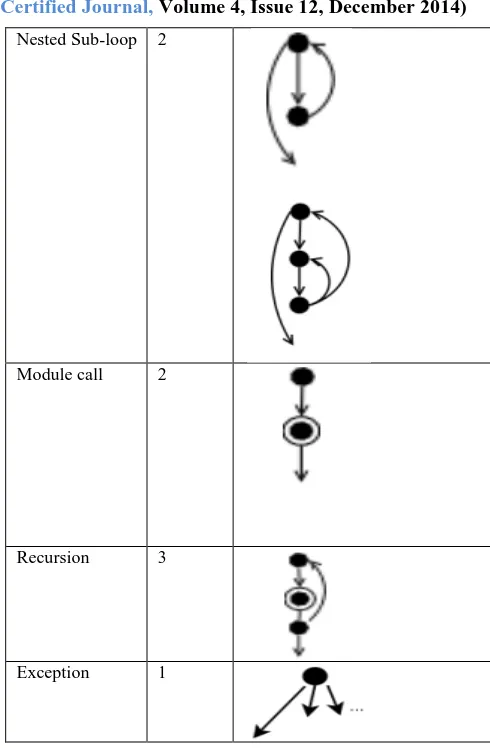
[image:3.595.307.552.121.495.2]The metric is developed in a way that it can measure OO and procedural parts separately. However, some programs may not cover OO features in a code. Then, 0 should be assigned to the parts that are not related with OO paradigm.
Table I
Basic Control Structure For Multi-Paradigm Complexity Measure (Wang And Shao 2003)
Category CWU Flow Graph
Sequence 1
Condition 2
Nested sub-condition
1
Loop 3
Nested Sub-loop 2
Module call 2
Recursion 3
Exception 1
According to further investigations of the complexity factors, the study developed a metric for multi-paradigm codes as below.
Multi-paradigm Complexity Measurement (MCM):
MCM=
Where, CIclass = Complexity of Inherited Classes CDclass = Complexity of Distinct Class
PCCM = Procedural Complexity
Although, PCCM measures the procedural complexity, it is assumed that using PCCM is difficult. MCM includes various complexity factors. PCCM, being a part of MCM, would make the metric too complex and too difficult to apply. Therefore, it is recommended that Cprocedural is used in MCM instead of PCCM. However, it is possible to use MCM with PCCM for more detailed measurement.
International Journal of Emerging Technology and Advanced Engineering
Website: www.ijetae.com (ISSN 2250-2459, ISO 9001:2008 Certified Journal, Volume 4, Issue 12, December 2014)
All these factors are defined as follows:
Cclass can be defined as complexity of a class. Cclass takes a major role in the calculation of both CDclass and CIclass. For example, for calculating CIclass, CDclass first, it is needed to calculate Cclass. Cclass is defined as,
Cclass= W (attributes) + W (variables) + W(structures) + W(objects) – W(cohesion)
Where, Cclass = Complexity of Class ………. (ii)
The reason of subtraction of cohesion is that it reduces the complexity and thus it is desirable from the point of view of software developers said by Roger in 2005.
Where, weight of attributes or variables is defined as
Where, AND = number of arbitrarily named distinct variable/ attributes
MND = Number of meaningfully named distinct variables/attributes
Weight of structure W (structures) is defined as: W (structure) = W (BCS)
Where, BCS are basic control structure.
Weight of objects, Weight (objects) is defined as: W (objects) = 2
Creating an object is counted as 2, because while creating an object constructor is automatically called. Thus, coupling occurs. Therefore, it is the same as calling a function or creating an object. Here it is meant to be the objects created inside a class.
Moreover, a method that calls another method is another cause of coupling, but that fact is added to MCM value inside Weight (structures).
Weight of cohesion is defined as:
W (cohesion) = Where, MA = Number of methods where attributes are
used
AM = Number of attributes used inside methods
While counting the number of attributes there is no any importance of AND or MND.
CIclass can be defined as;
There are two cases for calculating the complexity of the Inheritance classes depending on the architecture:
If the classes are in the same level then their weights are added.
If they are children of a class then their weights are multiplied due to inheritance property.
If there are m levels of depth in the object oriented code and level j has n classes then the Cognitive Code Complexity (CCC) of the system is given as
∏ ∑
CDclass can be defined as;
CDclass = Cclass(x) + Cclass(y) + --- (v)
Note: All classes, which are neither inherited nor derived from another, are parts of CDclass even if they have caused coupling together with other classes.
Cprocedural can be defined as;
Cprocedural = W (variables) + W (structures) + W (objects) – W (cohension) ……….. (vi)
Weight of variable W (variable) is defined as:
From equation (3.3) W (variables) =
The variables are defined globally.
Weight of structure W (structures) is defined as:
W(structures) = W(BCS) + object.method Where, BCS are basic control structure, and those
structures are used globally. ‘object.method’ is calling a reachable method of a class using an object.‘object.method’ is counted as 2, because it is calling a function written by the programmer. If the program consists of only procedural code, then the weight of the ‘object.method’ will be 0.
Weight of objects W (objects) is defined as: W (objects) = 2
Creating an object is counted as 2, as it is described above. Here it is meant to be the objects created globally or inside any function which is not a part of any class. If the program consists of only procedural code, then the weight of the ‘objects’ will be 0.
Where, NF is number of functions, and NV means number of variables. Coupling is added inside W (structures) as mentioned in the beginning of the description of the metric.
IV. DEMONSTRATION OF THE METRICS AND DISCUSSION OF THE RESULTS
International Journal of Emerging Technology and Advanced Engineering
[image:5.595.64.534.152.785.2]Website: www.ijetae.com (ISSN 2250-2459, ISO 9001:2008 Certified Journal, Volume 4, Issue 12, December 2014)
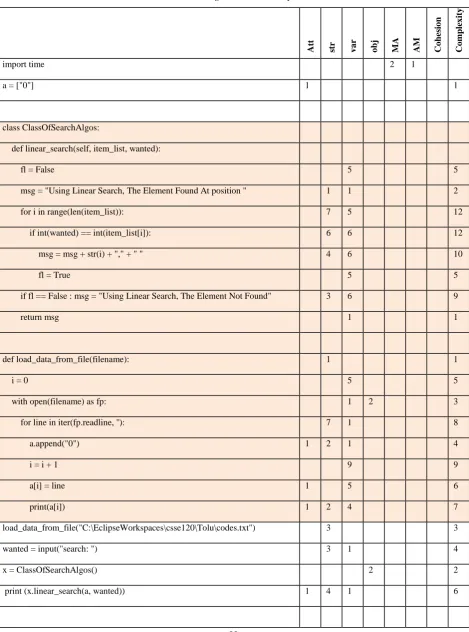
Table II
Linear Searching Demonstration in Python
Att str var ob
j
MA AM Co
h
esio
n
Co
m
p
le
x
ity
import time 2 1
a = ["0"] 1 1
class ClassOfSearchAlgos:
def linear_search(self, item_list, wanted):
fl = False 5 5
msg = "Using Linear Search, The Element Found At position " 1 1 2 for i in range(len(item_list)): 7 5 12 if int(wanted) == int(item_list[i]): 6 6 12 msg = msg + str(i) + "," + " " 4 6 10
fl = True 5 5
if fl == False : msg = "Using Linear Search, The Element Not Found" 3 6 9
return msg 1 1
def load_data_from_file(filename): 1 1 i = 0 5 5 with open(filename) as fp: 1 2 3 for line in iter(fp.readline, ''): 7 1 8 a.append("0") 1 2 1 4
i = i + 1 9 9
a[i] = line 1 5 6 print(a[i]) 1 2 4 7 load_data_from_file("C:\EclipseWorkspaces\csse120\Tolu\codes.txt") 3 3 wanted = input("search: ") 3 1 4
x = ClassOfSearchAlgos() 2 2
International Journal of Emerging Technology and Advanced Engineering
Website: www.ijetae.com (ISSN 2250-2459, ISO 9001:2008 Certified Journal, Volume 4, Issue 12, December 2014)
MCM = CIclass +CDclass + Cprocedural
From the table CIclass = 0
CDclass = 5+2+12+12+10+5+9+1+1+15+3+8+4+9+6+7 =99
Cprocedural = 1+3+4+2+6 = 16
Therefore, MCM =0 +99 +16 =115
Table III
Comparison Of The Developed Metric (Mcm) With The Existing Metrics
Program MCM eLOC CC V D E T Binary Search
C++
266 93 5 8388 61.5 515856 28659
Linear Search C++
149 51 5 4021 40 160824 8935
Binary Search JAVA
310 109 3 4893 51 249538 13863
Linear Search JAVA
193 68 3 2529 34.5 87311 4851
Binary Search Python
117 31 6 2664 38.1 101487 5638.2
Linear Search Python
115 24 5 1910 28.4 54148.5 3008.3
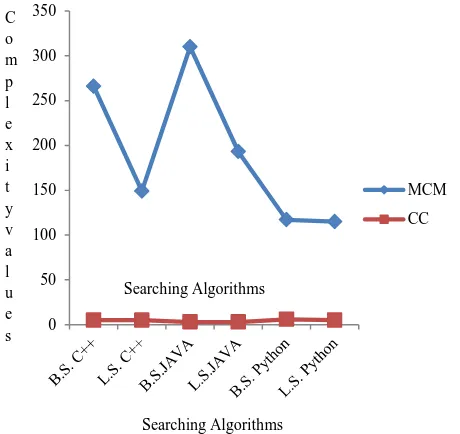
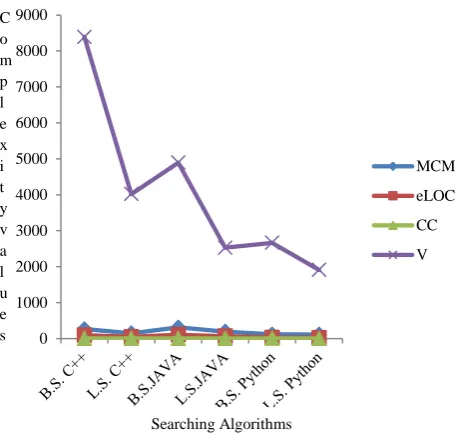
The results showed that linear search algorithm written in C++, Java and python gave 149, 193 and 115 respectively for MCM. While binary search algorithm written in C++, Java and python also revealed 266, 310 and 117 respectively for MCM. Evaluating the results with other established complexity metrics revealed that linear search algorithm coded in Java with MCM of 193, cyclomatic complexity (CC) of 3, effective line of code (eLOC) of 68 and Halstead volume (V) of 2529 has the highest complexity values.
[image:6.595.321.546.130.350.2]Furthermore binary search algorithm coded in Java with MCM of 310, eLOC of 109, CC of 3 and Halstead volume of 4893 has the highest complexity value.
Figure i: Graph of comparison between MCM and eLOC
[image:6.595.309.539.377.594.2]Figure ii: Graph of comparison between MCM and CC
Figure iii. Relative graph between MCM and CC 0
50 100 150 200 250 300 350
MCM
CC
Searching Algorithms
Searching Algorithms C
[image:6.595.53.277.550.740.2]International Journal of Emerging Technology and Advanced Engineering
[image:7.595.44.271.138.352.2]Website: www.ijetae.com (ISSN 2250-2459, ISO 9001:2008 Certified Journal, Volume 4, Issue 12, December 2014)
[image:7.595.47.277.387.604.2]Figure iv. Relative graph between MCM and eLOC
Figure v. Relative graph between MCM, eLOC, CC, V, D
V. CONCLUSION
In this study, a complexity metric was proposed to include the factors that affect the complexity of Multi-paradigm Programming Languages. The proposed metric was formulated to include the factors of procedural and object oriented languages.
Various existing software complexity metrics such as effective line of code (eLOC), cyclomatic complexity measure (CC) and Halstead complexity metric were reviewed in other to applied them to sample programs written in Multi-paradigm languages such as C++, Java and Python.
Two case studies to measure the complexity of linear search and binary search algorithms were discussed. The complexity of each of these codes were measured using Multi-paradigm complexity metric, the results was later compared with those of the existing metrics.
It was discovered that the values gotten when multi-paradigm complexity metric was applied on each of the codes are higher than that of eLOC and CC, this is because MCM includes all other factors that affect code complexity neglected by eLOC and CC. It was also found out that the values realised from the application of Halstead method are somehow too exaggerated when compared with those from other existing metrics and the proposed metric.
More so, it was found out that the complexity values gotten for both linear and binary search algorithms using Python programming language is low when compared with those of C++ and Java, this is due to the fact that python programming language is a modern interpreted language with powerful built-in features and a unique indentation features for shorting codes.
REFERENCES
[1] DeMarco, T (1986): Controlling Software Projects, Yourdon Press, New York p.217-220.
[2] Eclipse Metrics Plugin 1.3.8 (last accessed 23.02.2010)Available at: http://metrics2.sourceforge.net/
[3] Halstead M. H. (1997) Element of Software Science, Elsevier North- Holland, New York, p.670-672.
[4] International standard organisation (2010), standard for software quality metrics methodology, p1-20.
[5] McCabe( 1976) T. McCabe, A complexity measure, IEEE Transactions of Software Engineering, Vol. SE-1, p.308-320. [6] McCabe (2010) T.J., Watson, A.H. (1994): Software Complexity,
McCabe and Associates, p. 14-56. Inc. (last accessed 17.03.2010)
Available at:
http://www.stsc.hill.af.mil/crosstalk/1994/12/xt94d12b.asp [7] Resource Standard Metrics. (last accessed 18.02.2010). Available
at
http://msquaredtechnologies.com/m2rsm/docs/rsm_metrics_narrat ion.htm
[8] Sommerville, I. (2004) Software Engineering, 7thEdition, Addison Wesley, slides 6-9.
[9] Wang, Y., Shao, J.: A (2003): New Measure of Software Complexity Based on Cognitive Weights. Can. J. Elec. Computer Engineering, p. 1-5.
0 50 100 150 200 250 300 350
MCM
eLOC
0 1000 2000 3000 4000 5000 6000 7000 8000 9000
MCM
eLOC
CC
V C
o m p l e x i t y v a l u e s
Searching Algorithms
C o m p l e x i t y v a l u e s