2018 International Conference on Computer, Electronic Information and Communications (CEIC 2018) ISBN: 978-1-60595-557-5
A Detection Method of Time Slot Power Based on ARM Platform
Xian ZHANG
1, Tai-guo QU
1,2,*, Dong YIN
1,2and Yi-wen LIU
1,21
School of Computer Science and Engineering, Huaihua University, Huaihua 418008, Hunan, China
2
Key Laboratory of Intelligent Control Technology for Wuling-Mountain Ecological Agriculture in Hunan Province, Huaihua 418008, Hunan, China
*Corresponding author
Keywords: Base station, Time Division Multiple Access, Time slot power, Signal acquisition.
Abstract. In order to effectively detect the time slot power of the repeater station and the base station which the mobile communication system of time division multiple access (TDMA) communication systems, In this paper, a signal acquisition hardware circuit based on ARM platform is designed, and a method of synthetically calculating time slot power is proposed. The signal acquisition circuit used an 8 channel ADC108 chip connected to ARM through the SPI bus, the time slot power detection method is composed of signal timing acquisition module, data acquisition module and data processing module to calculate the time slot power. And the validity of the method in detecting the time slot power under the condition of system boot and normal operation is tested, the system CPU resource consumption, the error value of the tested time slot power are tested also. The results show that the proposed method can effectively detect and control time slot power of TDMA system, and it has important significance to the repeater station and the base station system network signal coverage and optimization.
Introduction
In modern mobile communication system, the communication network vendors are using standard, independent mode such as mobile, Unicom, telecom 2G network model using GSM standard. 3G network mode of Telecommunication company adopts CDMA standard; The 3G network mode of Mobile company adopts TD-SCDMA standard; The 3G network mode of Unicom adopts WCDMA standard; The 4G network mode of Mobile, Unicom and Telecommunication company adopts LTE standard[1]. And the corresponding network model using different communication technology: such as Frequency Division Multiple Access (FDMA), Time Division Multiple Access (TDMA), Code Division Multiple Access (CDMA) and so on, these technologies to business channel at different frequencies are assigned to different users.
The frequency division technology of TDAM used in the GSM system of mobile, unicom and telecom companies. TDMA technology is to divide time into non-overlapping time frames (frames), and then divide the frames into non-overlapping time slots (channels) with one-to-one correspondence with users, according to the time slot to distinguish the user signals from different addresses, thus completing the multiple access connection[2]. This TDMA communication technology is one of the multiple access communication technologies, a digital transmission technology that divides the radio frequency into different time slots to allocate a number of calls.
power, and the effectiveness of the method is tested by experiments. This design provides good monitoring for base station or direct station communication equipment, and provides the monitoring reference for the stability of user signal, and provides the condition for the intelligentization of communication equipment of base station or direct station.
Time Slot Power Analysis
[image:2.612.176.437.537.642.2]The Global System for Mobile Communication (GSM) is the most widely used Mobile phone standard. Its communication interface adopts TDMA technology, since it was put into commercial use in the middle of 90s, it has been adopted by more than 100 countries in the world. The GSM standard devices occupy more than 80% of the global cellular mobile communication equipment market. In our country cellular mobile communication numerical modulation system mainly has GSM and code division multiple access (CDMA), but its GSM system has far more users than CDMA system users[4-5]. The main transmission characteristic parameters of GSM system are shown in Table 1.
Table 1. Transmission characteristics of GSM system.
Device model GSM system
Multiple access way TDMA Frequency
/MHz
Mobile station (up) 890~915 Base station (down) 935~960 Carrier spacing /kHz 200
Number of slots 8 TDMA frame length /ms 4.615
The n-time slot (channel) of time division multiple access of GSM system is not overlapped on the time axis, so it satisfies the orthogonality formula of time division multiple access time:
( ) ( )
{
(( ))(
)
N j
i df
f x f
x i j
j i j
Ti i , 1,2...
1
0 =
= =
≠ ∆
∫
In the formula above, ∆Ti is time slot length; Xi and Xj respectively represent the signals sent by the
ith and jth time slots (channels). The TDMA timing unit of the receiving terminal controls the time gate in real time according to the system timing signal, and selects the required channel (time slot) to transmit the signal[6].
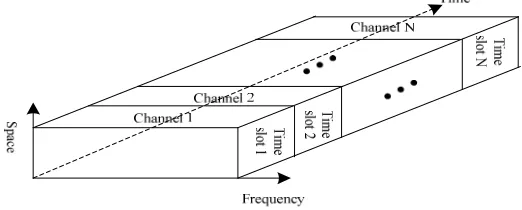
The TDMA of GSM system is represented by three dimensions: space, time and frequency, and its representation is shown in Figure 1. The channel is the artificial division that supports the business and the signaling, embodied in the space, the time slot is the actual performance of the physical space occupied frequency resources, therefore, the strength of the channel signal is the size of the time slot power[7].
Figure 1. Three dimensional figure of time division multiple access.
Through the analysis of the above knowledge, a time slot power detection circuit and a time slot power calculation method are design. The design of slot power detection needs to be considered in the following aspects.
(1) Sampling range and sampling time requirement of time slot power. The sampling period of the detection system is less than the length of each time gap period of the time slot power;
(2) The sampling accuracy and error requirement of time gap power. For industrial applications, the input and output power error of single time slot is less than 1dBm.
(3) The resource consumption and cost of time - gap power detection system. The system resource consumption of time slot power detection is less than 5% of the system running resources.
Hardware Platform Design
In order to design and build the time slot power hardware detection platform, the functional requirements should be considered first. One of the most basic functions of this test platform is to meet the demand of effective detection time slot power. The single time slot of the GSM system is 0.577ms, so the selected ADC sampling chip must satisfy the sample number of 1s more than 1/0.577
[image:3.612.152.466.499.616.2]≈ 1733. ADC sampling requires at least collect input and output power of one time slot, so at least two sampling channels are required. Therefore, the sampling chip ADC108S022 was selected, it has 8 channels, and the sampling rate was 50 KSPS ~200ksps, which met the performance indexes of the above analysis. The frequency of the master CPU should be at least 1 / 0.577 ≈ 1733 Hz (assuming that the CPU is all used for testing, this is not the case). Therefore, the main frequency of 180MHz ARM9260 chip as the main CPU. In summary, the main components of the hardware platform are shown in Table 2.
Table 2. Transmission characteristics of GSM system.
Device name Model Main parameters
the main CPU ARM9260 frequency: 180 MHz, 96 I/o port, 8Kb SRAM, 32Kb ROM ADC ADC108S022 Sample Rate(max): 200ksps, 8 sampling channel
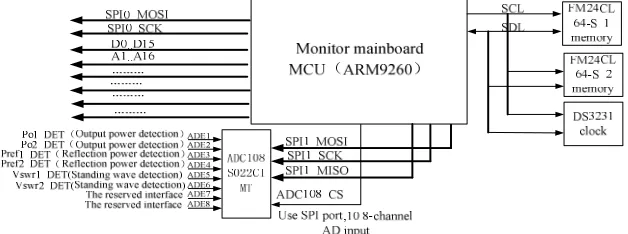
The main CPU is connected to the ADC chip through the SPI bus, the input and output power of single time slot signals are collected by two ADC sampling channels, then the main CPU process the collected data of time-gap signal to calculate the time slot power value. The design block diagram of the detailed hardware connection circuit is shown in Figure 2.
Figure 2. Connection diagram of hardware circuit.
Software Algorithm Design
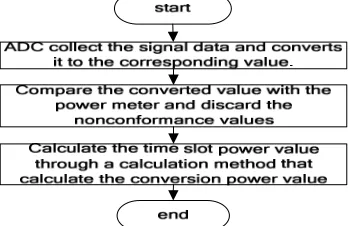
[image:4.612.219.394.212.325.2]The time slot power detection of time slot signals can be divided into several modules, such as signal timing collect module, collect data read module and collect data processing module. The detection of slot power is made up of two channels of ADC sampling circuit module to collect the input and output signal level of the time slot signal. The corresponding value is converted into the corresponding value by ADC; The data acquisition module reads out the values and converts them to the corresponding time-slot power values. In order to obtain valid time slot power value, collecting data processing module to process the power value after the conversion, and an effective calculation method is used to calculate the mean value as the time slot power value. The process flow chart of the time slot power detection is shown in Figure 3.
Figure 3. The process flow chart of the time slot power detection.
The acquisition data processing module calculates the time slot power of the time slot signal accurately, effectively and unmistakably. A new computational algorithm is used to calculate the time slot power. The basic idea of this calculation method is that the collection and processing software program has been sampling time slot power 2000 times, the power value of each test is compared with the value in the power meter, if the power value of the sample is in the power meter range, the count is incremented by 1, otherwise throw it away. When the statistical effective power number reaches 250, then the sampling cycle is broken, and then the 250 effective power values of the sample are sorted, then the maximum value is removed and the mean value of the second and third values is taken as the time slot power value.
The pseudo-code for calculating the time slot power value of time slot signals is shown in Table 3.
Table 3. Pseudo-code of the algorithm.
ADC_count =0;//count
tmpADCData[250];//Save power value for(m=0;m<2000;m++){
ADC_count =ADC_Convert(tmpADCData);//Sampling conversion comparison if(ADC_count > 250)break;}
//sort from small to large. tmpADCData[] for(i = 0; i < ADC_count; i++)
for(j = 1; j < ADC_count-i-1; j++) tmpADCData[];
//Calculate the time slot power value.
timeADCValue = tmpADCData[ADC_count-2]+tmpADCData[ADC_count-3])/2;
[image:4.612.144.448.503.621.2]Test Result Analysis
[image:5.612.94.517.186.224.2]In order to test the accuracy and real-time performance of the time-gap power of this method. The monitoring circuit is integrated on the monitoring host platform of the high efficiency tower intelligent amplifier, and the program is also integrated in monitoring software of the high efficiency tower intelligent amplifier. Detect the time slot power 100 times at startup, and test whether the time slot power can be correctly detected, then test the time slot power 100 times during normal operation, and test whether the time slot power is correct. The test results are shown in Table 4.
Table 4. Pseudo-code of the algorithm.
State Testing number Correct detection number
Startup state 100 100
normal operation state 100 100
According to the test results, this method can accurately and effectively detect the time slot power in the start-up state and normal operation state.
[image:5.612.178.437.341.436.2]Because the time slot power detection mothed is integrated in the monitoring host software based on station device or direct station device, Therefore, the consumption of CPU resources in the system is an important index to evaluate the time slot power detection method. In the actual test, monitoring software in integrated slot power detection method and unintegrated time slot power detection method are tested separately. The system CPU resource consumption is shown in Figure 4.
Figure 4. System CPU resource consumption.
As can be seen from the actual test results, the system CPU resource consumption can meet the requirements of the direct station device and base station system.
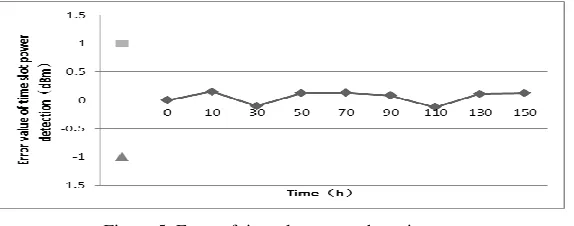
The detection error is one of the most important indexes of time slot power detection, only when the detection error can meet the requirements within the specified range. Therefore, the design experiment has tested the error condition of this time slot power detection method. The error of detecting the time slot power using this method is shown in Figure 5.
Figure 5. Error of time slot power detection.
[image:5.612.171.458.548.661.2]Summary
Considering the factors of resource, demand, performance to price and effectiveness, this paper has designed a hardware circuit that real-time detection time slot power, and designed the processing procedures of time slot power collection, and a new method for calculating the power value of time slot signal is presented. And tested the effectiveness of the proposed method were used to detect the time slot power which the base station system start-up and normal operation state, the system CPU resource consumption, the error value of the tested time slot power and so on. The test results can meet the system requirements of the time slot power detection. Therefore, the application of this method can effectively solve the time slot power detection and control of direct station device and base station system. The time slot power detection and control of the system is helpful to improve the coverage effect and coverage range of repeater and base station signal, it is of great significance to optimize network coverage.
Acknowledgement
The Research was supported in part by the grants from the Huaihua University Project (HHUY2017-13); The Research was supported by The Education Department of Hunan Province (17C1267); The Research was supported by Huaihua Science and Technology Agency Project (2017N2207).
References
[1] Fan chang-xin. White, Principles of Communications, Seventh ed., Beijing, 2016.
[2] Yang Liu, Fan Pingzhi, Hao Li. Performance Analysis of Multi-Channel Slotted ALOHA Protocol Based on Power Capture and Backoff[J]. Journal of Southwest Jiaotong University, 2013, 48(4):761-768.
[3] G.R. Mettam, L.B. Adams, How to prepare an electronic version of your article, in: B.S. Jones, R.Z. Smith (Eds.), Introduction to the Electronic Age, E-Publishing Inc., New York, 1999, pp. 281-304.
[4] Han Han, Li Ying, Dong Xu. Algorithm on joint optimization of power allocation and slot allocation in satellite communication systems[J]. Journal on Communications, 2014, 10(1):23-30.
[5] Yan Kai-qiang, Liu Hui-dong, Ren Guo-chun. Information Transmission Policy for Multi-Antenna Relay Communication System with Energy Harvesting[J]. Communications Technology, 2016, 5(1):576-581.
[6] Jens Fey, George Hallak, Gerd Bumiller. Efficient central resource management algorithm for time slotted system with high PER[C].2016 International Symposium on Power Line Communications and its Applications, 2016.