R E S E A R C H
Open Access
Approximating fixed points for continuous
functions on an arbitrary interval
Prasit Cholamjiak
*and Nattawut Pholasa
*Correspondence:
[email protected] School of Science, University of Phayao, Phayao, 56000, Thailand
Abstract
In this research article, we introduce a new iterative method for solving a fixed point problem of continuous functions on an arbitrary interval. We then prove the
convergence theorem of the proposed algorithm. We finally give numerical examples to compare the result with Mann, Ishikawa and Noor iterations. Our main results extend the corresponding results in the literature.
MSC: 47H09; 47H10
Keywords: continuous function; convergence theorem; fixed point; iteration
1 Introduction
LetC be a closed interval on the real line and letf :C→Cbe a continuous function. A pointp∈Cis called afixed pointoff iff(p) =p.
One classical way to approximate a fixed point of a nonlinear mapping was introduced in by Mann [] as follows: a sequence{xn}defined byx∈Cand
xn+= ( –αn)xn+αnf(xn) (.)
for alln≥, where {αn} is a sequence in [, ]. Such an iteration process is known as Mann iteration. In , Borwein and Borwein [] proved the convergence theorem for a continuous function on the closed and bounded interval in the real line by using iteration (.).
Another classical iteration process was introduced by Ishikawa [] as follows: a sequence {xn}defined byx∈Cand
yn= ( –βn)xn+βnf(xn),
xn+= ( –αn)xn+αnf(yn)
(.)
for alln≥, where{αn}and{βn}are sequences in [, ]. Such an iterative method is known
asIshikawa iteration. In , Qing and Qihou [] proved the convergence theorem of the sequence generated by iteration (.) for a continuous function on the closed interval in the real line (see also []).
In , Noor [] defined the following iterative scheme byx∈Cand
zn= ( –μn)xn+μnf(xn),
yn= ( –βn)xn+βnf(zn),
xn+= ( –αn)xn+αnf(yn)
(.)
for alln≥, where{αn},{βn}and{μn}are sequences in [, ]. Such an iterative method
is known asNoor iteration. Phuengrattana and Suantai [] considered the convergence of Noor iteration for continuous functions on an arbitrary interval in the real line.
In this paper, motivated by the previous ones, we introduce a new modified iteration process for solving a fixed point problem for continuous functions on an arbitrary interval in the real line. Numerical examples are also presented to compare the result with Mann, Ishikawa and Noor iterations.
2 Main results
We begin this section by proving the following crucial lemmas.
Lemma . Let C be a closed interval on the real line(can be unbounded)and let f:C→C be a continuous function.Let {αn}, {βn},{μn}, {γn} and{τn}be sequences in[, ] with
≤τn+βn≤and≤γn+αn≤.Let{xn}be a sequence generated iteratively by x∈C
and
zn= ( –μn)xn+μnf(xn),
yn= ( –τn–βn)xn+τnzn+βnf(zn), (.)
xn+= ( –γn–αn)zn+γnyn+αnf(yn), n≥, where∞n=αn=∞,limn→∞αn= ,
∞
n=βn<∞and ∞
n=μn<∞. If xn→a,then a is a fixed point of f.
Proof Letxn→aand supposea=f(a). Then{xn}is bounded. So,{f(xn)}is bounded by the continuity off. So are{yn},{zn},{f(yn)}and{f(zn)}. Moreover,zn→asincexn→a
andμn→. We also haveyn→asincezn→aandβn→.
From (.) we obtain
xn+= ( –γn–αn)zn+γnyn+αnf(yn)
=zn+γn(yn–zn) +αn
f(yn) –zn
= ( –μn)xn+μnf(xn) +γn(yn–zn) +αn
f(yn) –zn
=xn+μn
f(xn) –xn+γn(yn–zn) +αn
f(yn) –zn
=xn+μn
f(xn) –xn
+γn
( –τn–βn)(xn–zn) +βn
f(zn) –zn
+αn
f(yn) –zn
=xn+μn
f(xn) –xn+γn
( –τn–βn)μn
xn–f(xn)+βn
f(zn) –zn
+αn
=xn+μn
–γn( –τn–βn)
f(xn) –xn+γnβn
f(zn) –zn
+αn
f(yn) –zn
. (.)
Letpk=f(xk) –xk,qk=f(zk) –zkandrk=f(yk) –zk. Then we observe
lim
k→∞pk=nlim→∞
f(xk) –xk
=f(a) –a= ,
lim
k→∞qk=nlim→∞
f(zk) –zk
=f(a) –a= ,
lim
k→∞rk=nlim→∞
f(yk) –zk=f(a) –a= .
So, from (.) we obtain
xn=x+
n
k=
μk
–γk( –τk–βk)
f(xk) –xk
+
n
k=
γkβk
f(zk) –zk + n k= αk
f(yk) –zk
=x+
n
k=
μk
–γk( –τk–βk)
pk+ n
k=
γkβkqk+ n
k=
αkrk.
It is easy to see that∞k=μk( –γk( –τk–βk))pk<∞sincelimk→∞pk= and ∞
k=μk<
∞. Similarly, we have∞k=γkβkqk<∞sincelimk→∞qk= and∞k=βk<∞. This shows
that{xn}is a divergent sequence sincelimk→∞rk= and ∞k=αk=∞. This contradicts
the convergence of{xn}. Hencef(a) =aandais a fixed point off.
Lemma . Let C be a closed interval on the real line(can be unbounded)and let f:C→C
be a continuous function.Let {αn}, {βn},{μn}, {γn} and{τn}be sequences in[, ] with
≤τn+βn≤and≤γn+αn≤.Let{xn}be a sequence generated iteratively by x∈C
and
zn= ( –μn)xn+μnf(xn),
yn= ( –τn–βn)xn+τnzn+βnf(zn),
xn+= ( –γn–αn)zn+γnyn+αnf(yn), n≥,
where∞n=αn=∞,limn→∞αn= , ∞
n=βn<∞and ∞
n=μn<∞. If{xn}is bounded,then{xn}is convergent.
Proof Suppose{xn}is not convergent. Leta=lim infnxnandb=lim supnxn. Thena<b.
We first show that ifa<m<b, thenf(m) =m. Supposef(m)=m. Without loss of gener-ality, we supposef(m) –m> . Sincef is continuous, there existsδwith <δ<b–asuch that for|x–m| ≤δ,
Since{xn}is bounded andfis continuous,{f(xn)}is bounded. Hence{zn},{yn},{f(zn)}and {f(yn)}are all bounded. Using
xn+–xn= ( –γn–αn)(zn–xn) +γn(yn–xn) +αn
f(yn) –xn,
yn–xn=τn(zn–xn) +βn
f(zn) –xn,
zn–xn=μn
f(xn) –xn
,
we can easily show that|zn–xn| →,|yn–xn| → and|xn+–xn| →. Thus there exists
a positive integerNsuch that for alln>N,
|xn+–xn|<
δ
, |yn–xn|< δ
, |zn–xn|< δ
. (.)
Sinceb=lim supnxn>m, there existsk>Nsuch thatxnk>m. Letnk=k, thenxk>m. Forxk, there exist two cases as follows.
(i)xk>m+δ, thenxk+>xk–δ≥musing (.). So, we havexk+>m.
(ii)m<xk<m+δ, thenm–δ<yk<m+δandm–δ<zk<m+δby (.). So, we obtain
|xk–m|<δ<δ,|yk–m|<δ,|zk–m|<δ. Hence
f(xk) –xk> , f(yk) –yk> , f(zk) –zk> . (.)
We observe that
yk–zk= ( –τk–βk)(xk–zk) +βk
f(zk) –zk
=μk( –τk–βk)
xk–f(xk)+βk
f(zk) –zk. (.)
From (.), (.) and (.), we have
xk+=xk+μk
–γk( –τk–βk)
f(xk) –xk
+γkβk
f(zk) –zk
+αk
f(yk) –zk
=xk+μk
–γk( –τk–βk)
f(xk) –xk+γkβk
f(zk) –zk
+αk
f(yk) –yk+αk(yk–zk)
=xk+μk
–γk( –τk–βk)
f(xk) –xk
+γkβk
f(zk) –zk
+αk
f(yk) –yk+αk
μk( –τk–βk)
xk–f(xk)+βk
f(zk) –zk
=xk+μk
– (γk+αk)( –τk–βk)
f(xk) –xk+αk
f(yk) –yk
+βk(γk+αk)
f(zk) –zk
>xk.
Thusxk+>xk>m. From (i) and (ii), we havexk+>m. Similarly, we get thatxk+>m,
xk+>m, . . . . Thus we havexn>mfor alln>k=nk. So,a=limk→∞xnk≥m, which is a
(i) There existsxMsuch thata<xM<b. Thenf(xM) =xM. It follows that
zM= ( –μM)xM+μMf(xM) =xM
and
yM= ( –τM–βM)xM+τMzM+βMf(zM)
= ( –τM–βM)xM+τMxM+βMf(xM)
=xM.
Hence, we obtain
xM+= ( –γM–αM)zM+γMyM+αMf(yM)
= ( –γM–αM)xM+γMxM+αMf(xM)
=xM.
Similarly, we obtainxM=xM+=xM+=· · ·. So, we conclude thatxn→xM. Since there
existsxnk→a,xM=a. This shows thatxn→a, which is a contradiction.
(ii) For alln,xn≤aorxn≥b. Sinceb–a> andlimn→∞|xn+–xn|= , there existsN¯
such that|xn+–xn|<(b–a) forn>N¯. So, it is always thatxn≤aforn>N¯; or it is always
thatxn≥bforn>N¯. Ifxn≤aforn>N¯, thenb=liml→∞xnl≤a, which is a contradiction
witha<b. Ifxn≥bforn>N¯, thena=limk→∞xnk≥b, which is a contradiction witha<b.
Thus we conclude thatxn→a. This completes the proof.
We are now ready to prove the main results of this paper.
Theorem . Let C be a closed interval on the real line(can be unbounded)and let f :
C→C be a continuous function.Let{αn},{βn},{μn},{γn}and{τn}be sequences in[, ] with≤τn+βn≤and≤γn+αn≤.Let{xn}be a sequence generated iteratively by x∈C and
zn= ( –μn)xn+μnf(xn),
yn= ( –τn–βn)xn+τnzn+βnf(zn),
xn+= ( –γn–αn)zn+γnyn+αnf(yn), n≥,
where∞n=αn=∞,limn→∞αn= ,∞n=βn<∞and∞n=μn<∞. If{xn}is bounded,then{xn}converges to a fixed point of f.
Proof Let{xn}be a bounded sequence. Then, by Lemma (.),{xn}is a convergent se-quence. Hence, by Lemma (.), it converges to a fixed point off.
As a direct consequence of Theorem ., we obtain the following result.
Theorem . Let C be a closed interval on the real line(can be unbounded)and let f :
with≤τn+βn≤and≤γn+αn≤.Let{xn}be a sequence generated iteratively by x∈C and
zn= ( –μn)xn+μnf(xn),
yn= ( –τn–βn)xn+τnzn+βnf(zn),
xn+= ( –γn–αn)zn+γnyn+αnf(yn), n≥,
where∞n=αn=∞,limn→∞αn= , ∞
n=βn<∞and ∞
n=μn<∞. Then{xn}converges to a fixed point of f if and only if{xn}is bounded.
Corollary . Let f : [a,b]→[a,b]be a continuous function.Let{αn},{βn},{μn},{γn}and
{τn}be sequences in[, ]with≤τn+βn≤and≤γn+αn≤.Let{xn}be a sequence generated iteratively by x∈[a,b]and
zn= ( –μn)xn+μnf(xn),
yn= ( –τn–βn)xn+τnzn+βnf(zn),
xn+= ( –γn–αn)zn+γnyn+αnf(yn), n≥,
where∞n=αn=∞,limn→∞αn= ,∞n=βn<∞and∞n=μn<∞. Then{xn}converges to a fixed point of f.
If we takeτn=γn= , then we obtain the following result.
Corollary . Let C be a closed interval on the real line(can be unbounded)and let f :
C→C be a continuous function.Let{αn},{βn}and{μn}be sequences in[, ].Let{xn}be a sequence generated iteratively by x∈C and
zn= ( –μn)xn+μnf(xn),
yn= ( –βn)xn+βnf(zn),
xn+= ( –αn)zn+αnf(yn), n≥, where∞n=αn=∞,limn→∞αn= ,
∞
n=βn<∞and ∞
n=μn<∞. Then{xn}converges to a fixed point of f if and only if{xn}is bounded.
If we takeτn+βn= andγn+αn= , then we obtain the following result.
Corollary . Let C be a closed interval on the real line(can be unbounded)and let f :
C→C be a continuous function.Let{αn},{βn}and{μn}be sequences in[, ].Let{xn}be a sequence generated iteratively by x∈C and
zn= ( –μn)xn+μnf(xn),
yn= ( –βn)zn+βnf(zn),
where∞n=αn=∞,limn→∞αn= , ∞
n=βn<∞and ∞
n=μn<∞. Then{xn}converges to a fixed point of f if and only if{xn}is bounded.
Remark . Corollary . extends the main result obtained in [] from the modified
Ishikawa iteration to the modified Noor iteration.
3 Numerical examples
In this section, we give numerical examples to demonstrate the convergence of the algo-rithm defined in this paper. For convenience, we call the iteration (.) the CP-iteration.
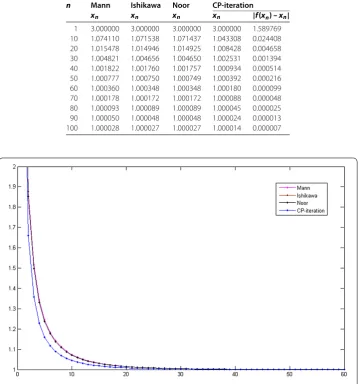
[image:7.595.119.478.320.705.2]Example . Letf : [,∞)−→[,∞) be defined byf(x) =√.lnx+ . Thenf is a con-tinuous function. Use the initial point x = and the control conditions αn= (n+)., βn=(n+).,μn=(n+).,τn=n+ andγn=.
Table 1 Comparison of the convergence rate of Mann, Ishikawa, Noor and CP iterations for the function given in Example 3.1
n Mann Ishikawa Noor CP-iteration
xn xn xn xn |f(xn) –xn|
1 3.000000 3.000000 3.000000 3.000000 1.589769 10 1.074110 1.071538 1.071437 1.043308 0.024408 20 1.015478 1.014946 1.014925 1.008428 0.004658 30 1.004821 1.004656 1.004650 1.002531 0.001394 40 1.001822 1.001760 1.001757 1.000934 0.000514 50 1.000777 1.000750 1.000749 1.000392 0.000216 60 1.000360 1.000348 1.000348 1.000180 0.000099 70 1.000178 1.000172 1.000172 1.000088 0.000048 80 1.000093 1.000089 1.000089 1.000045 0.000025 90 1.000050 1.000048 1.000048 1.000024 0.000013 100 1.000028 1.000027 1.000027 1.000014 0.000007
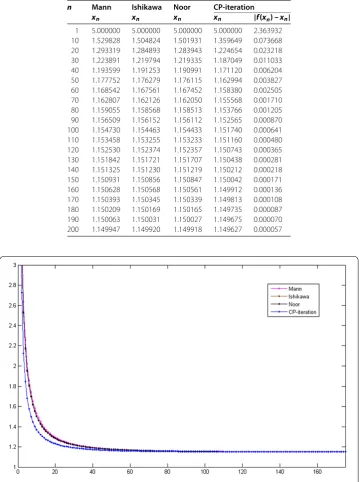
Table 2 Comparison of the convergence rate of Mann, Ishikawa, Noor and CP iterations for the function given in Example 3.2
n Mann Ishikawa Noor CP-iteration
xn xn xn xn |f(xn) –xn|
1 5.000000 5.000000 5.000000 5.000000 2.363932 10 1.529828 1.504824 1.501931 1.359649 0.073668 20 1.293319 1.284893 1.283943 1.224654 0.023218 30 1.223891 1.219794 1.219335 1.187049 0.011033 40 1.193599 1.191253 1.190991 1.171120 0.006204 50 1.177752 1.176279 1.176115 1.162994 0.003827 60 1.168542 1.167561 1.167452 1.158380 0.002505 70 1.162807 1.162126 1.162050 1.155568 0.001710 80 1.159055 1.158568 1.158513 1.153766 0.001205 90 1.156509 1.156152 1.156112 1.152565 0.000870 100 1.154730 1.154463 1.154433 1.151740 0.000641 110 1.153458 1.153255 1.153233 1.151160 0.000480 120 1.152530 1.152374 1.152357 1.150743 0.000365 130 1.151842 1.151721 1.151707 1.150438 0.000281 140 1.151325 1.151230 1.151219 1.150212 0.000218 150 1.150931 1.150856 1.150847 1.150042 0.000171 160 1.150628 1.150568 1.150561 1.149912 0.000136 170 1.150393 1.150345 1.150339 1.149813 0.000108 180 1.150209 1.150169 1.150165 1.149735 0.000087 190 1.150063 1.150031 1.150027 1.149675 0.000070 200 1.149947 1.149920 1.149918 1.149627 0.000057
Figure 2Convergence behavior of Mann, Ishikawa, Noor and CP iterations for the function given in Example 3.2.
Example . Letf : [,∞)−→[,∞) be defined byf(x) = .√x– +√x. Thenf is a continuous function. Use the initial pointx= and the control conditionsαn=(n+)., βn=(n+) ,μn=(n+).,τn=n+ andγn=.
Remark . From Table , Figure , Table and Figure , we observe that the sequence
Competing interests
The authors declare that they have no competing interests.
Authors’ contributions
PC and NP contributed equally. All authors read and approved the final manuscript.
Acknowledgements
The authors wish to thank Professor Suthep Suantai for the valuable guidance and suggestion. The first author was supported by the Thailand Research Fund, the Commission on Higher Education, and University of Phayao under Grant No. MRG5580016.
Received: 22 November 2012 Accepted: 15 April 2013 Published: 29 April 2013 References
1. Mann, WR: Mean value methods in iteration. Proc. Am. Math. Soc.4, 506-510 (1953)
2. Borwein, D, Borwein, J: Fixed point iterations for real functions. J. Math. Anal. Appl.157, 112-126 (1991) 3. Ishikawa, S: Fixed points by a new iteration method. Proc. Am. Math. Soc.44, 147-150 (1974)
4. Qing, Y, Qihou, L: The necessary and sufficient condition for the convergence of Ishikawa iteration on an arbitrary interval. J. Math. Anal. Appl.323, 1383-1386 (2006)
5. Qing, Y, Cho, SY, Qin, X: Convergence of Ishikawa iteration with error terms on an arbitrary interval. Commun. Korean Math. Soc.26, 229-235 (2011)
6. Noor, MA: New approximation schemes for general variational inequalities. J. Math. Anal. Appl.251, 217-229 (2000) 7. Phuengrattana, W, Suantai, S: On the rate of convergence of Mann Ishikawa, Noor and SP iterations for continuous
functions on an arbitrary interval. J. Comput. Appl. Math.235, 3006-3014 (2011)
8. Suwana-adth, W: The necessary and sufficient condition for the convergence of a new fixed point approximation method for continuous functions on an arbitrary interval. Thai J. Math.8, 627-632 (2010)
doi:10.1186/1029-242X-2013-214