R E S E A R C H
Open Access
Convergence and stability of the
exponential Euler method for semi-linear
stochastic delay differential equations
Ling Zhang
**Correspondence: [email protected] Mathematical Department of Teacher Education Institute, DaQing Normal University, DaQing, 163712, P.R. China
Abstract
The main purpose of this paper is to investigate the strong convergence and exponential stability in mean square of the exponential Euler method to semi-linear stochastic delay differential equations (SLSDDEs). It is proved that the exponential Euler approximation solution converges to the analytic solution with the strong order
1
2to SLSDDEs. On the one hand, the classical stability theorem to SLSDDEs is given by the Lyapunov functions. However, in this paper we study the exponential stability in mean square of the exact solution to SLSDDEs by using the definition of logarithmic norm. On the other hand, the implicit Euler scheme to SLSDDEs is known to be exponentially stable in mean square for any step size. However, in this article we propose an explicit method to show that the exponential Euler method to SLSDDEs is proved to share the same stability for any step size by the property of logarithmic norm.
MSC: 65F20
Keywords: stochastic delay differential equation; exponential Euler method; Lipschitz condition; Itô formula; strong convergence
1 Introduction
Stochastic modeling has come to play an important role in many branches of science and industry. Such models have been used with great success in a variety of application areas, including biology, epidemiology, mechanics, economics and finance. Most stochastic dif-ferential equations (SDEs) are nonlinear and cannot be solved explicitly, whence numerical solutions are required in practice. Numerical solutions to SDEs have been discussed un-der the Lipschitz condition and the linear growth condition by many authors (see [–]). Higham et al. [] gave almost sure and moment exponential stability in the numerical sim-ulation of SDEs. Many authors have discussed numerical solutions to stochastic delay dif-ferential equations (SDDES) (see [–]). Cao et al. [] obtained MS-stability of the Euler-Maruyama method for SDDEs. Mao [] discussed exponential stability of equidistant Euler-Maruyama approximations of SDDES. The explicit Euler scheme is most commonly used for approximating SDEs with the global Lipschitz condition. Unfortunately, the step size of Euler method for SDEs has limits for research of stability. Therefore, the stability of the implicit Euler scheme to SDEs is known for any step size. However, in this article
we propose an explicit method to show that the exponential Euler method to SLSDDEs is proved to share the stability for any step size by the property of logarithmic norm.
The paper is organized as follows. In Section , we introduce necessary notations and the exponential Euler method. In Section , we obtain the convergence of the exponential Euler method to SLSDDEs under Lipschitz condition and the linear growth condition. In Section , we obtain the exponential stability in mean square of the exponential Euler method to SLSDDEs. Finally, two examples are provided to illustrate our theory.
2 Preliminary notation and the exponential Euler method
In this paper, unless otherwise specified, let|x|be the Euclidean norm inx∈Rn. IfAis a
vector or matrix, its transpose is denoted byAT. IfAis a matrix, its trace norm is denoted
by|A|=trace(ATA). For simplicity, we also denotea∧b=min{a,b},a∨b=max{a,b}.
Let (, F,P) be a complete probability space with a filtration {Ft}t≥, satisfying the usual conditions. L([,∞),Rn) and L([,∞),Rn) denote the family of all real-valued F
t
-adapted processesf(t)t≥such that for everyT> , T
|f(t)|dt<∞a.s. and T
|f(t)|dt<
∞a.s., respectively. For anya,b∈Rwitha<b, denote byC([a,b];Rn) the family of
con-tinuous functions φ from [a,b] toRn with the norm φ=supa≤θ≤b|φ(θ)|. Denote by CFbt([a,b];R
n) the family of all bounded F
t-measurableC([a,b];Rn)-valued random
vari-ables. LetB(t) = (B(t), . . . ,Bd(t))T be ad-dimensional Brownian motion defined on the
probability space (, F,P). Throughout this paper, we consider the following semi-linear stochastic delay differential equations:
⎧ ⎨ ⎩
dx(t) = (Ax(t) +f(t,x(t),x(t–τ)))dt+g(t,x(t),x(t–τ))dB(t), t∈[,T],
x(t) =ξ(t), t∈[–τ, ], (.)
whereT> ,τ> ,{ξ(t),t∈[–τ, ]}=ξ∈Cb
F([–τ, ];R
n),f :R+×Rn×Rn→Rn,g:R+×
Rn×Rn→Rn×d,A∈Rn×nis the matrix []. By the definition of stochastic differential,
this equation is equivalent to the following stochastic integral equation:
x(t) =eAtξ+ t
eA(t–s)fs,x(s),x(s–τ) ds
+ t
eA(t–s)gs,x(s),x(s–τ) dB(s) ∀t≥. (.)
Moreover, we also require the coefficientsf andgto be sufficiently smooth. To be precise, let us state the following conditions.
(H) (The Lipschitz condition) There exists a positive constantLsuch that
f(t,x,y) –f(t,x¯,y¯)∨ |g(t,x,y) –g(t,x¯,y¯)≤Lx–x¯+y–y¯|
for thosex,x¯,y,y¯∈Rn.
(H) (Linear growth condition) There exists a positive constantLsuch that
f(t,x,y)∨g(t,x,y)≤L +|x|+|y|
(H) f andgare supposed to satisfy the following property:
f(s,x,y) –f(t,x,y)∨g(s,x,y) –g(t,x,y)≤K +|x|+|y| |s–t|,
whereKis a constant ands,t∈[,T]witht>s.
Leth=mτ be a given step size with integerm≥, and let the gridpointstnbe defined by
tn=nh(n= , , , . . .). We consider the exponential Euler method to (.)
yn+=eAhyn+eAhf(tn,yn,yn–m)h+eAhg(tn,yn,yn–m)Bn, (.)
whereBn=B(tn) –B(tn–),n= , , , . . . ,yn, is approximation to the exact solutionx(tn).
The continuous exponential Euler method approximate solution is defined by
y(t) =eAtξ+ t
eA(t–s)fs,z(s),z(s–τ) ds
+ t
eA(t–s)gs,z(s),z(s–τ) dB(s), (.)
where s = [hs]h and [x] denotes the largest integer which is smaller than x, z(t) = ∞
k=yk[kh,(k+)h)(t) with Adenoting the indicator function for the setA. It is not dif-ficult to see thaty(tn) =z(tn) =yn forn= , , , . . . . That is, the step function z(t) and
the continuous exponential Euler solutiony(t) coincide with the discrete solution at the gridpoint. LetC,(Rn×R
+;R) denote the family of all continuous nonnegative functions V(x,t) defined onRn×R+such that they are continuously twice differentiable inxand once int. GivenV∈C,(Rn×R+;R), we define the operatorLV:Rn×Rn×R+→Rby
LV(x,y,t) =Vt(x,t) +Vx(x,t)f(x,y,t) +
trace
gT(x,y,t)Vxx(x)g(x,y,t)
,
where
Vt(x,t) =
∂V(x,t)
∂t , Vx(x,t) =
∂V(x,t) ∂x
, . . . ,∂V(x,t) ∂xn
,
Vxx(x,t) =
∂V(x,t) ∂xi∂xj
n×n
.
Let us emphasize thatLVis defined onRn×Rn×R+, whileVis only defined onRn×R+.
3 Convergence of the exponential Euler method
We will show the strong convergence of the exponential Euler method (.) on equations (.).
Theorem . Under conditions(H), (H)and(H),the exponential Euler method ap-proximate solution converges to the exact solution of equations(.)in the sense that
lim
h→E
sup ≤t≤T
y(t) –x(t)
In order to prove this theorem, we first prepare two lemmas.
Lemma . Under the linear growth condition(H),there exists a positive constant C such that the solution of equations(.)and the continuous exponential Euler method ap-proximate solution(.)satisfy
E sup –τ≤t≤T
y(t)∨E sup –τ≤t≤T
x(t)≤C
+E|ξ| , (.)
where C=max{e|A|Tee|A|TT(T+)L,e|A|TT(T+ )Lee|A|TT(T+)L}is a constant
inde-pendent of h.
Proof It follows from (.) that
y(t) =eAtξ+ t
eA(t–s)fs,z(s),z(s–τ) ds
+ t
eA(t–s)gs,z(s),z(s–τ) dB(s)
≤eAtξ+ t
eA(t–s)fs,z(s),z(s–τ) ds
+ t
eA(t–s)gs,z(s),z(s–τ) dB(s)
. (.)
By Hölder’s inequality, we obtain
y(t)≤eAtξ+T t
eA(t–s)fs,z(s),z(s–τ) ds
+ t
eA(t–s)gs,z(s),z(s–τ) dB(s)
. (.)
This implies that for any ≤t≤T,
E sup ≤t≤t
y(t)
≤
E sup ≤t≤t
eAtξ+TE sup ≤t≤t
t
eA(t–s)fs,z(s),z(s)
ds
+E sup ≤t≤t
t
eA(t–s)gs,z(s),z(s–τ) dB(s)
≤
E sup ≤t≤t
eAt|ξ|+TE sup ≤t≤t
t
eA(t–s)fs,z(s),z(s–τ) ds
+E sup ≤t≤t
eAt t
e–Asgs,z(s),z(s–τ) dB(s)
By Doob’s martingale inequality, it is not difficult to show that
E sup ≤t≤t
y(t)≤
e|A|TE|ξ|
+Te|A|TE t
fs,z(s),z(s–τ) ds
+ e|A|TE t
e–Asgs,z(s),z(s–τ) ds
≤e|A|T
E|ξ|+TE t
fs,z(s),z(s–τ) ds
+ e|A|TE
t
gs,z(s),z(s–τ) ds
. (.)
Making use of (H) yields
E sup ≤t≤t
y(t)≤e|A|T
Eξ
+T+ e|A|T LE t
+z(s)+z(s–τ) ds
≤e|A|TEξ+ e|A|TTT+ e|A|T L
+ e|A|TT+ e|A|T L t
E sup
–τ≤u≤s
y(u)
ds. (.)
Thus
E sup –τ≤t≤t
y(t)≤e|A|TEξ+ e|A|TTT+ e|A|T L
+ e|A|TT+ e|A|T L t
E sup
–τ≤u≤s
y(u)ds. (.)
By Gronwall’s inequality, we get
E sup –τ≤t≤T
y(t)≤C, (.)
whereC= (e|A|TEξ+ e|A|TT(T+ e|A|T)L)ee|A|TT(T+e|A|T)L. In the same way,
we obtain
E sup –τ≤t≤T
x(t)
≤C, (.)
whereC= (e|A|TEξ+ e|A|TT(T+ e|A|T)L)ee|A|TT(T+e|A|T)L. The proof is
com-pleted.
Lemma . Under condition(H).Then
Ey(t) –z(t)≤C(ξ)h, ∀t∈[,T], (.)
where C(ξ)is a constant independent of h.
Proof Fort∈[,T], there is an integerksuch thatt∈[tk,tk+). We compute
y(t) –z(t)≤eA(t–tk)–I|y
k|+eA(t–tk)f(tk,yk,yk–m)(t–tk)
+eA(t–tk)g(t
k,yk,yk–m)
B(t) –B(tk)
≤eA(t–tk)–I|y
k|+eA(t–tk)
f(tk,yk,yk–m)
(t–tk)
+eA(t–tk)g(t
k,yk,yk–m)
B(t) –B(tk)
, (.)
whereIis an identity matrix. Taking the expectation of both sides, we can see
Ey(t) –z(t)≤eA(t–tk)–IE|y
k|+he|A|TEf(tk,yk,yk–m)
+he|A|TEg(tk,yk,yk–m)
. (.)
Using the linear growth conditions, we have
Ey(t) –z(t)≤eA(t–tk)–IE|y
k|+he|A|TLE
+|yk|+|yk–m|
+he|A|TLE
+|yk|+|yk–m|
≤eA(t–tk)–IC+h+h e|A|TL( + C). (.)
Since|eA(t–tk)–I
k| ≤e|A|h– ≤ |A|he|A|h≤ |A|he|A|T, we have
Ey(t) –z(t)≤C(ξ)h, (.)
whereC(ξ) = |A|Te|A|TC+ (T + )e|A|TL( + C) is a constant independent ofh.
The proof is completed.
Proof of Theorem. By (.) and (.), we have
x(t) –y(t)
≤ t
eA(t–s)fs,x(s),x(s–τ) –eA(t–s)fs,z(s),z(s–τ) ds
+ t
eA(t–s)gs,x(s),x(s–τ)
–eA(t–s)gs,z(s),z(s–τ) dB(s)
By Hölder’s inequality, we obtain
x(t) –y(t)
≤T t
eA(t–s)fs,x(s),x(s–τ) –eA(t–s)fs,x(s),x(s–τ) ds
+ T t
eA(t–s)fs,x(s),x(s–τ)
–eA(t–s)fs,z(s),z(s–τ) ds
+ T t
eA(t–s)fs,z(s),z(s–τ) –eA(t–s)fs,z(s),z(s–τ) ds
+ t
eA(t–s)gs,x(s),x(s–τ)
–eA(t–s)gs,x(s),x(s–τ) dB(s)
+ t
eA(t–s)gs,x(s),x(s–τ) –eA(t–s)gs,z(s),z(s–τ) dB(s)
+ t
eA(t–s)gs,z(s),z(s–τ)
–eA(t–s)gs,z(s),z(s–τ) dB(s)
. (.)
This implies that for any ≤t≤T, by Doob’s martingale inequality, we have
E sup ≤t≤t
x(t) –y(t)≤TE sup ≤t≤t
t
eA(t–s)fs,x(s),x(s–τ)
–eA(t–s)fs,x(s),x(s–τ) ds
+ TE sup ≤t≤t
t
EeA(t–s)fs,x(s),x(s–τ)
–eA(t–s)fs,z(s),z(s–τ) ds
+ TE sup ≤t≤t
t
EeA(t–s)fs,z(s),z(s–τ)
–eA(t–s)fs,z(s),z(s–τ) ds
+ E sup ≤t≤t
eAt t
e–Asgs,x(s),x(s–τ)
–e–Asgs,x(s),x(s–τ) dB(s)
+ E sup ≤t≤t
eAt t
e–Asgs,x(s),x(s–τ)
+ E sup ≤t≤t
eAt t
e–Asgs,z(s),z(s–τ)
–e–Asgs,z(s),z(s–τ) dB(s)
. (.)
We compute the first item in (.)
E sup ≤t≤t
t
EeA(t–s)fs,x(s),x(s–τ)
–eA(t–s)fs,x(s),x(s–τ) ds
≤E sup ≤t≤t
t
eA(t–s)–eA(t–s)Efs,x(s),x(s–τ) ds
≤LE sup ≤t≤t
t
eA(t–s)eA(s–s)–IE +x(s)+x(s–τ) ds
≤Le|A|TTeA(s–s)–I( + C). (.)
We compute the following two formulas in (.):
E sup ≤t≤t
t
EeA(t–s)fs,x(s),x(s–τ) –eA(t–s)fs,z(s),z(s–τ) ds
≤Le|A|T t
Ex(s) –z(s)+x(s–τ) –z(s)
ds
≤Le|A|T t
Ex(s) –y(s)+y(s) –z(s)
+x(s–τ) –y(s–τ)+y(s–τ) –z(s–τ) ds
≤Le|A|TTC(ξ)h
+ Le|A|T t
Ex(s) –y(s)+x(s–τ) –y(s–τ) ds (.)
and
E sup ≤t≤t
t
EeA(t–s)fs,z(s),z(s–τ)
–eA(t–s)fs,z(s),z(s–τ) ds
≤Ke|A|TTE +z(s)+z(s–τ) h
≤Ke|A|TT( + C)h. (.)
In the same way, we can obtain
E sup ≤t≤t
eAt t
e–Asgs,x(s),x(s–τ)
≤e|A|TE t
e–Asgs,x(s),x(s–τ) –e–Asgs,x(s),x(s–τ) ds
≤Le|A|TTeA(s–s)–I( + C). (.)
We compute the following two formulas in (.):
E sup ≤t≤t
eAt t
e–Asgs,x(s),x(s–τ)
–e–Asgs,z(s),z(s–τ) dB(s)
≤e|A|TE t
e–Asgs,x(s),x(s–τ) –e–Asgs,z(s),z(s–τ) ds
≤Le|A|TTC(ξ)h+ Le|A|T t
Ex(s) –y(s)
+x(s–τ) –y(s–τ) ds (.)
and
E sup ≤t≤t
eAt t
e–Asgs,z(s),z(s–τ)
–e–Asgs,z(s),z(s–τ) dB(s)
≤e|A|TE t
e–Asgs,z(s),z(s–τ) –e–Asgs,z(s),z(s–τ) ds
≤Ke|A|TT( + C)h. (.)
Substituting (.) - (.) into (.), we have
E sup ≤t≤t
x(t) –y(t)
≤TT+ e|A|T Le|A|TeA(s–s)–I( + C)
+ T+ e|A|T Le|A|T t
E sup
≤ν≤s
x(ν) –y(ν)ds
+ TT+ e|A|T Ke|A|T( + C)h
+ TT+ e|A|T Le|A|TTC(ξ)h. (.)
By Gronwall’s inequality, since|eA(s–s)–I| ≤ |A|he|A|T, we can show
E sup ≤t≤T
x(t) –y(t)
≤e|A|TT(T+ )L|A|he|A|T+Kh ( + C)
+ T(T+ )Le|A|TT(C(ξ)h
As a result,
lim
h→E
sup ≤t≤T
y(t) –x(t)= . (.)
The proof is completed.
4 Exponential stability in mean square
In this section, we give the exponential stability in mean square of the exact solution and the exponential Euler method to semi-linear stochastic delay differential equations (.). For the purpose of stability study in this paper, assume thatf(t, , ) =g(t, , ) = .
4.1 Stability of the exact solution
In this subsection, we will show the exponential stability in mean square of the exact solu-tion to semi-linear stochastic delay differential equasolu-tions (.)under the global Lipschitz condition. Next we will give the main content of this subsection.
Theorem . Under condition(H),if + μ[A] + L< ,then the solution of equations (.)with the initial dataξ∈CbF([–τ, ];R
n)is exponentially stable in mean square,that
is,
Ex(t)≤B–(τ)E|ξ|etln(B(τ))
τ
, t≥, (.)
whereB(τ) =eBτ–B
B( –e
Bτ),B= + μ[A] + L,B= L.
By Ito’s formula and the delay term of the equation, we give the proof of Theorem .. The highlight of the proof is that we give the mean square boundedness of the solution to the equation by dividing the interval into [,π], [π, π], . . . , [kπ, (k+ )π]. Then we give a proof of the conclusion byt≥,t≥π,t≥π, . . . ,t≥nπ. In the process of dealing with the semi-linear matrix, we use the definition of the matrix norm.
Definition . ([]) SDDEs (.) are said to be exponentially stable in mean square if there is a pair of positive constants λ and μ such that for any initial data ξ ∈ CFb([–τ, ];R
n),
Ex(t)≤μE|ξ|e–λt, t≥. (.)
We refer toλas the rate constant and toμas the growth constant.
Definition .([]) The logarithmic normμ[A] ofAis defined by
μ[A] = lim
→+
I+A–
. (.)
Especially, if · is an inner product norm,μ[A] can also be written as
μ[A] =max
ξ=
Aξ,ξ
Lemma . LetB(t) =eBt–B
B( –e
Bt).If B< ,B> and B+B< ,then for all t≥,
<B(t)≤andB(t)is decreasing.
Proof It is known fromB< ,B> andB+B< that for allt≥
B(t) = B+B B
eBt–B
B >
and
B(t) =eBt– +B
B
eBt– + = (B+B)(e
Bt– )
B + ≤.
For allt≥, we compute
B(t) = (B+B)eBt< .
ThusB(t) is decreasing. The proof is complete.
Proof of Theorem. By Itô’s formula and Definition ., for allt≥, we have
dx(t) =x(t),Ax(t) +ft,x(t),x(t–τ)
+gt,x(t),x(t–τ) dt
+ xT(t)gt,x(t),x(t–τ) dB(t)
≤x(t),Ax(t)+ x(t),ft,x(t),x(t–τ)
+gt,x(t),x(t–τ) dt
+ xT(t)gt,x(t),x(t–τ) dB(t)
≤Bx(t)+Bx(t–τ)dt
+ xT(t)gt,x(t),x(t–τ) dB(t), (.)
whereB= + μ[A] + L,B= L. LetV(x,t) =e–Bt|x(t)|, by Itô’s formula, we obtain
de–Btx(t) = –Be–Btx(t)dt+e–Btdx(t)
≤–Be–Btx(t)dt+e–BtBx(t)+Bx(t–τ)dt
+ e–BtxT(t)gt,x(t),x(t–τ) dB(t)
≤e–BtBx(t–τ)dt
+ e–BtxT(t)gt,x(t),x(t–τ) dB(t). (.)
Integrating (.) from totyields
e–Btx(t)≤x()+B
t
e–Bsx(s–τ)ds
+ t
Taking expected values gives
e–BtEx(t)≤Ex()+B
t
e–BsEx(s–τ)ds. (.)
For anyt∈[,τ], we have
e–BtEx(t)≤E|ξ|+E|ξ|B t
e–Bsds
≤
–B
B
e–Bt– E|ξ|. (.)
Hence
Ex(t)≤
eBt–B
B
–eBt E|ξ|=B(t)E|ξ|. (.)
For anyt∈[τ, τ], we obtain
e–BtEx(t)≤e–BτEx(τ)+B
t
τ
e–BsEx(s–τ)ds
≤e–BτB(τ)E|ξ|+E|ξ|B
t
τ
e–Bsds
=e–BτB(τ)E|ξ|+E|ξ|
–B B
e–Bt–e–Bτ . (.)
Thus
Ex(t)≤eB(t–τ)B(τ)E|ξ|+E|ξ|
–B
B
–eB(t–τ)
≤E|ξ|
eB(t–τ)–B B
–eB(t–τ)
=B(t–τ)E|ξ|. (.)
Repeating this procedure, for allt∈[kτ, (k+ )τ], we can show
Ex(t)≤B(t–kτ)E|ξ|. (.)
Hence, for anyt> , we have
Ex(t)≤E|ξ|. (.)
On the other hand, for anyt≥, one can easily show that
e–BtEx(t)≤Ex()+B
t
e–BsEx(s–τ)ds
≤E|ξ|+E|ξ|B t
e–Bsds
=E|ξ|
–B B
Therefore,
Ex(t)≤E|ξ|
eBt–B
B
–eBt =B(t)E|ξ|. (.)
Especially, we can see
Ex(τ)≤B(τ)E|ξ|. (.)
For anyt≥τ, we have
e–BtEx(t)≤e–BτEx(τ)+B
t
τ
e–BsEx(s–τ)ds
≤e–BτB(τ)E|ξ|+B
t
τ
e–BsB(s–τ)E|ξ|ds
≤e–Bτ
B(τ)E|ξ|+B(τ)E|ξ|B t
τ
e–Bsds
≤e–BτB(τ)E|ξ|+B(τ)E|ξ|
–B B
e–Bt–e–Bτ
≤B(τ)E|ξ|
e–Bτ–B
B
e–Bt–e–Bτ . (.)
Therefore,
Ex(t)≤B(τ)E|ξ|
eB(t–τ)–B B
–eB(t–τ)
=B(τ)B(t– τ)E|ξ|. (.)
Obviously, we can obtain
Ex(τ)≤B(τ)B(τ)E|ξ|≤B(τ)E|ξ|. (.)
For anyt≥τ, we can see that
e–BtEx(t)≤e–BτEx(τ)+B
t
τ
e–BsEx(s–τ)ds
≤e–BτB(τ)E|ξ|+B
t
τ
e–BsB(τ)B(s– τ)E|ξ|ds
≤e–BτB(τ)E|ξ|+B(τ)E|ξ|B
t
τ
e–Bsds
≤e–BτB(τ)E|ξ|+B(τ)E|ξ|
–B
B
e–Bt–e–Bτ
≤B(τ)E|ξ|
e–Bτ –B
B
Therefore,
Ex(t)≤B(τ)E|ξ|
eB(t–τ)–B
B
–eB(t–τ)
=B(τ)B(t– τ)E|ξ|. (.)
For anyt≥, there is an integernsuch thatt≥nτ; repeating this procedure, we can show
Ex(t)≤Bn(τ)B(t–nτ)E|ξ|≤Bn(τ)E|ξ|. (.)
By (.) and Lemma ., we obtain
Ex(t)≤Bn(τ)E|ξ|
=enτln(B(τ))
τ
E|ξ|
=e(nτ–t)ln(B(τ))τ
E|ξ|etln(B(τ))τ
≤e–τln(B(τ))
τ
E|ξ|etln(B(τ))
τ
=B–(τ)E|ξ|etln(B(τ))
τ
, (.)
which proves the theorem.
4.2 Stability of the exponential Euler method
In this subsection, under the same conditions as those in Theorem ., we will obtain the exponential stability in mean square of the exponential Euler method (.) to SLSDDEs (.) in Theorem .. It is shown that the stability region of the numerical solution to the equation is the same as that of the analytical solution, which means that our method is effective.
Definition . ([]) Given a step size h=τ/m for some positive integer m, the dis-crete exponential Euler method is said to be exponentially stable in mean square on SDDEs (.) if there is a pair of positive constantsλ¯ andμ¯ such that for any initial data ξ∈Cb
F([–τ, ];R
n),
E|yn|≤ ¯μE|ξ|e–λ¯nh, n≥. (.)
Lemma . ([]) Letμ[A]be the smallest possible one-sided Lipschitz constant of the matrix A for a given inner product.Thenμ[A]is the smallest element of the set
M=θ:exp(At)≤exp(θt),t≥. (.)
Theorem . Under condition(H),if + μ[A] + L< ,then for all h> the numerical method to equations(.)is exponentially stable in mean square,that is,
E|yn|≤(A+A)–E|y|enhln(A+A)
τ
, (.)
Proof Squaring and taking the conditional expectation on both sides of (.), noting that Bnis independent of Fnh,E(Bn|Fnh) =E(Bn) = andE((Bn)|Fnh) =E(Bn)=h,
we have
E|yn+||Fnh =eμ[A]hE|yn|+eμ[A]hEf(tn,yn,yn–m)|Fnh h
+eμ[A]hEg(tn,yn,yn–m)
|Fnh h
+ eμ[A]hEyn,f(tn,yn,yn–m)
|Fnh h. (.)
Taking expectations on both sides, we obtain that
E|yn+|=eμ[A]hE|yn|+eμ[A]hEf(tn,yn,yn–m)
h
+eμ[A]hEg(tn,yn,yn–m)
h
+ eμ[A]hEy
n,f(tn,yn,yn–m)
h. (.)
By (H) and the inequality ab≤a+b, we have
Eyn,f(tn,yn,yn–m)
≤E|yn|+Ef(tn,yn,yn–m)
≤( +L)E|yn|+LE|yn–m)|. (.)
Substituting (.) into (.), by (H), we have
E|yn+|≤eμ[A]h
+Lh+ Lh+h E|yn|+
Lh+ Lh E|yn–m|
=AE|yn|+AE|yn–m|, (.)
whereA=eμ[A]h( +Lh+ Lh+h),A=eμ[A]h(Lh+ Lh). In view of + μ[A] + L< , we haveμ[A] < and –μ[A] >max{,L}. Consequently,L–μ[A] < . Hence
L–μ[A] h+ + μ[A] + L< (.)
for allh> , which implies
+h+ Lh+ Lh< – μ[A]h+(–μ[A]h)
! <e
–μ[A]h. (.)
That is,
A+A=eμ[A]h
+h+ Lh+ Lh < (.)
for allh> . From (.), we have
E|yn|≤(A+A)[ n
So we obtain
E|yn|≤(A+A)[ n
m+]+E|y|
=e([mn+]+)ln(A+A)E|y|
≤e[mn+](m+)hln(A+A)
(m+)h
E|y|
≤e–{mn+}(m+)hln(A+A) (m+)h
E|y|enhln(A+A) (m+)h
≤e–(m+)hln(A+A) (m+)h
E|y|enhln(A+A)
(m+)h
= (A+A)–E|y|enhln(A+A) (m+)h
= (A+A)–E|y|enhln(A+A)
τ
. (.)
Thus, for alln= , . . . ,
E|yn|≤(A+A)–E|y|enhln(A+A)
τ
. (.)
The proof is completed.
5 Numerical experiments
In this section, we give several numerical experiments in order to demonstrate the results about the strong convergence and the exponential stability in mean square of the numer-ical solution for equations (.). We consider the test equation
dx(t) =ax(t) +ax(t–τ)
dt+bx(t) +bx(t–τ)
dB(t) ∀t≥. (.)
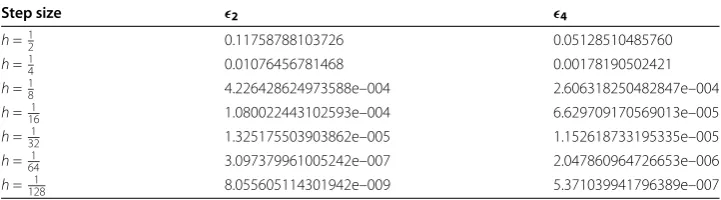
Example . Whena= –,a= .,b= ,b= .,ξ = +t,τ = . In Table , the convergence of the exponential Euler method to Example . is described. Here we focus on the error at the endpointT= , , and the error is given asE|yn(ω) –x(T,ω)|, where
yn(ω) denotes the value of (.) at the endpoint. The expectation is estimated by averaging
random sample paths (ωi, ≤i≤,) over the interval [, ], that is,
e(h) = ,
,
i=
yn(ωi) –x(T,ωi)
[image:16.595.117.478.632.732.2] .
Table 1 The global error of numerical solutions for the exponential Euler method
Step size 2 4
h=1
2 0.11758788103726 0.05128510485760
h=1
4 0.01076456781468 0.00178190502421
h=18 4.226428624973588e–004 2.606318250482847e–004
h=161 1.080022443102593e–004 6.629709170569013e–005
h=321 1.325175503903862e–005 1.152618733195335e–005
h=641 3.097379961005242e–007 2.047860964726653e–006
In Table , we can see that the exponential Euler method to Example . is convergent, suggesting that (.) is valid.
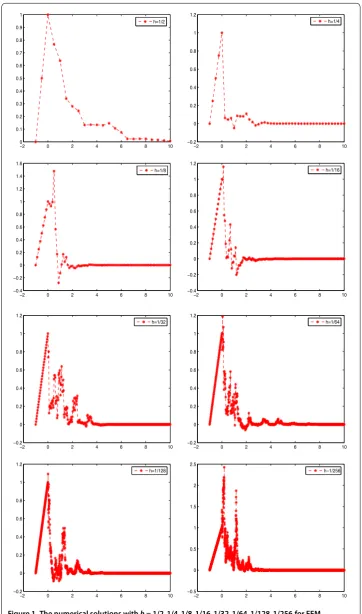
Example . Whena= –,a= ,b= ,b= .,ξ = +t,τ = . We can show the stability of the exponential Euler method to (.). In Figure , all the curves decay toward to zero whenh= /,h= /,h= /,h= /,h= /,h= /,h= /,h= /. So we can consider that our experiments are consistent with our proved results in Section .
6 Conclusions
In this paper, we study convergence and exponential stability in mean square of the numer-ical solution for the exponential Euler method to semi-linear stochastic delay differential equations under the global Lipschitz condition and the linear growth condition. Firstly, Theorem . gives the exponential Euler approximation solution converging to the an-alytic solution with the strong order to SLSDDEs. Secondly, we give the exponential stability in mean square of the exact solution to SLSDDEs by using the definition of log-arithmic norm. Then we propose an explicit method to show that the exponential Euler method to SLSDDEs is proved to share the same stability for any step size. Finally, a nu-merical example is given to verify the method, the conclusion is correct. In Table , the convergence of the exponential Euler method to Example . is described. Here we focus on the error at the endpointT= , . In Figure , all the curves decay toward zero when h= /,h= /,h= /,h= /,h= /,h= /,h= /,h= /, and there is the same conclusion for any step size. So we can consider that our experiments are consistent with our proved results in Section .
Acknowledgements
I would like to thank the referees for their helpful comments and suggestions. The financial support from the Youth Science Foundations of Heilongjiang Province of P.R. China (No.QC2016001) is gratefully acknowledged.
Competing interests
The author declares that no competing interests exist.
Authors’ contributions
All authors read and approved the final manuscript.
Publisher’s Note
Springer Nature remains neutral with regard to jurisdictional claims in published maps and institutional affiliations.
Received: 7 April 2017 Accepted: 1 September 2017
References
1. Friedman, A: Stochastic Differential Equations and Applications, Vol. 1 and 2. Academic Press, New York (1975) 2. Higham, DJ, Mao, X, Yuan, C: Almost sure and moment exponential stability in the numerical simulation of stochastic
differential equations. SIAM J. Numer. Anal.41, 592-609 (2007)
3. Mao, X: Stochastic Differential Equations and Applications. Horwood, Chichester (1997)
4. Fuke, W, Xuerong, M: Convergence and stability of the semi-tamed Euler scheme for stochastic differential equations with non-Lipschitz continuous coefficients. Appl. Math. Comput.228, 240-250 (2014)
5. Mao, X: The truncated Euler Maruyama method for stochastic differential equations. J. Comput. Appl. Math.290, 370-384 (2015)
6. Mao, X: Convergence rates of the truncated Euler Maruyama method for stochastic differential equations. J. Comput. Appl. Math.296, 362-375 (2016). doi:10.1016/j.cam.2015.09.035
7. Mao, X: Almost sure exponential stability in the numerical simulation of stochastic differential equations. SIAM J. Numer. Anal.53, 370-389 (2015)
8. Cao, WR, Liu, MZ, Fan, ZC: MS-stability of the Euler-Maruyama method for stochastic differential delay equations. Appl. Math. Comput.159, 127-135 (2004)
10. Mao, X: Numerical solutions of stochastic differential delay equations under the generalized Khasminskii-type conditions. Appl. Math. Comput.217, 5512-5524 (2011)
11. Wu*, K, Ding, X: Convergence and stability of Euler method for impulsive stochastic delay differential equations. Appl. Math. Comput.229, 151-158 (2014)
12. Mao, X: Exponential stability of equidistant Euler-Maruyama approximations of stochastic differential delay equations. J. Comput. Appl. Math.200, 297-316 (2007)
13. Kunze, M, Neerven, J: Approximating the coefficients in semilinear stochastic partial differential equations. J. Evol. Equ.11, 577-604 (2011)