2018 3rd International Conference on Information Technology and Industrial Automation (ICITIA 2018) ISBN: 978-1-60595-607-7
Development and Application of Fuzzy
PID in AGV Control System
Mengyuan Wei, Jiying Ren, Lihong Zhang, Jun Zhou,
Panling Huang and Lei Li
ABSTRACT
Automatic guided vehicle (AGV) is widely used in the field of logistics and transportation. It is a kind of automatic transportation equipment which realizes automatic navigation by means of optical, electromagnetic and other navigation technologies. The motor vehicle control system of AGV is its own brain, and the fuzzy PID control algorithm is an excellent algorithm based on the traditional PID algorithm for self-tuning PID parameters and applied to the vehicle motion control system. Based on the application of AGV at home and abroad, this paper expounds the principle of fuzzy PID control, and analyzes the structure change from PID to fuzzy PID algorithm. Comparing the application of PID and fuzzy PID, it is found that fuzzy PID has more application value and popularization in the control system. Finally, the application of fuzzy PID control algorithm in AGV control system is summarized. The results show that fuzzy PID control algorithm has good application in AGV nonlinear control problem.1
INTRODUCTION
In China, with the vigorous development of the transportation industry, industrialtransportation automation and logistics transport efficient demand, AGV is
1
Mengyuan Wei, Jiying Ren, Jun Zhou, Panling Huang. 1School of Mechanical Engineering, Shandong University, Jinan 250061, China
Mengyuan Wei, Jiying Ren, Jun Zhou, Panling Huang. Key Laboratory of High Efficiency and Clean Mechanical Manufacture (Shandong University), Ministry of Education, Jinan 250061, China
Lihong Zhang, Shandong Polytechnic College, China
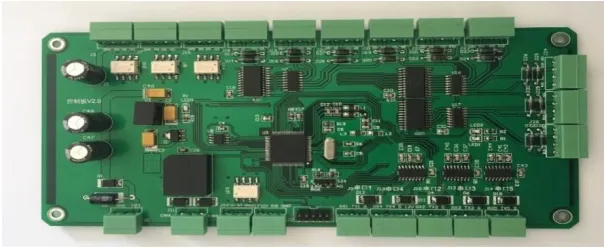
widelyused in various fields. At the beginning, AGV was mainly used in manufacturing industry, but soon it was widely used in seaside port transportation, automobile manufacturing industry, transport production line, machinery production and processing, power plant transportation line, electronic product assembly line equipment, electronics industry ultra-clean workshop and other industries [1]. The basic structure of AGV is shown in Figure 1. The main components include obstacle detection device, visual operation equipment, and lifting device, driving device, battery storehouse, controller storehouse, driving wheels and steering wheels. Among them, the control system of AGV on-board in Controller storehouse is regarded as the core of its motion control system, which plays an important role in connecting the preceding and the following. The object is shown in Figure 2, it is equivalent to human spinal nerve management in robots. It is mainly responsible for communicating with the AGV management and monitoring computer, receiving the real-time dispatch and work instructions from the AGV management and monitoring system, and completing the vehicle-borne motion tasks of the lower machine and the tasks of various application modules. In the motion control of AGV, fuzzy PID control algorithm can make up for the defect of traditional PID controller, has self-adaptive PID parameters, and has a good application prospect for nonlinear motion control which cannot establish accurate mathematical model.
Obstacle detection device Visual operation
equipment
Lifting device Driving device
Battery storehouse
Controller storehouse
Driving wheel
[image:2.612.153.460.373.495.2]Steering wheel
Figure 1. The basic structure of AGV.
[image:2.612.146.449.538.662.2]THE FUNDAMENTALS AND STRUCTURE CHANGES OF FUZZY PID
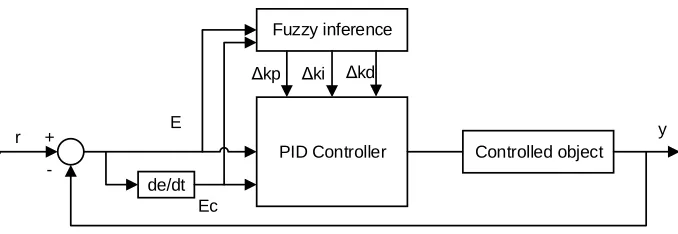
Fuzzy PID controller can realize self-adaptive PID parameter tuning .The whole structure is the combination of fuzzy controller structure and PID controller structure. It takes E (deviation) and EC (deviation rate of change) as the two input parameters of the fuzzy controller. The two input parameters are fuzzified by using fuzzy rules of fuzzy controller, and the three output parameters of fuzzy controller are Kp, Ki and Kd. The PID controller takes the corrections of the three parameters as the three output parameters of the fuzzy controller. The input can adjust its own parameters in real time, so that the PID parameters can be adjusted in time to achieve the real-time correction of the controlled object. As shown in figure 3.
Fuzzy PID algorithm can realize the nonlinearity and robustness of the control system in the process of development, and it needs to be broken through in three aspects. (1) The structure of fuzzy PID control system. (2) Determine the significance of traditional PID parameters and their relationship with fuzzy control. (3) Normalization and standardization of fuzzy PID controller structure.
In the development of fuzzy PID control, one is the combination of fuzzy controller and PID parameter adjustable controller. Chu and Teng proposed in 1999[2] that the PID control parameters were obtained by the neural network based on the amplitude-phase margin method, and the fuzzy neural network PID control parameters variable control structure was formed. The fuzzy neural network is used to deal with the nonlinear equations that are encountered when determining the PID parameters. Shen J C put forward in 2001[3] that the three parameters of PID can be determined in real time not only by the self-tuning of fuzzy PID, but also by adding neural network algorithm to the fuzzy control algorithm. The pole assignment method can be used to realize the real-time tuning of the PID parameters of underdamped objects and improve the fuzzy PID structure.
de/dt
Fuzzy inference
PID Controller Controlled object
Δkp Δki Δkd
E
Ec
y
r +
-Figure 3. System structure diagram of adaptive fuzzy PID controller.
Since the 21st century, the development of fuzzy PID has become more complex. Mann G I and Hu B G [7] have studied different fuzzy PID controllers and dealt with the design of fuzzy PID controllers as a two-level optimization problem. The proposed rule decoupling and single input rule structure has more flexibility and better functional characteristics than the traditional fuzzy PID structure. In 2014 Bardini and Nagar developed an IT2F-PID controller architecture [8], which uses a rule-based mamdaniels-type-2 fuzzy system to select the gain of a classical PID controller. This control structure reduces the computational complexity of output processing of interval 2 fuzzy logic system, and gives a more stable relationship between fuzzy control and traditional PID.
APPLICATION ADVANTAGES OF FUZZY PID
The application of fuzzy PID is based on the application change of PID controller. In the early nineteenth century, the PID controller was applied to various aspects because of its simple principle, simple structure and easy operation. Jianxin Zhang, Hailin Li, et al. [9] designed a fast and high precision temperature control system with STM32 as microcontroller unit by using proportional integral derivative (PID) control algorithm. X. He and T. Cui [10] put forward a design scheme of electric drive control system for precision seeder metering device. The closed-loop proportional integral differential (PID) algorithm was used to control the speed of seed plate, which avoided the problems of poor quality and low speed of traditional ground wheel and chain seeder. Based on R Haq and H Prayitno [11], a low-cost mobile robot based on PID controller and odometer is developed. PID controller and odometer are used to control the position of mobile robot. By applying various values of Kp, Kd and Ki constants, the final position of the mobile robot is obtained to check three different azimuths of 30, 45 and 60 degrees.
[image:4.612.132.471.83.200.2]fuzzy PID is that it overcomes the limitation of the application of PID control in engineering and combines the advantages of fuzzy controller to form a high-level improved PID controller [12].
Leonid Reznik et al. studied the practical method of effective combination design of classical PID controller and new intelligent technology in practical industrial projects [13]. In order to avoid establishing mathematical theory, the structure and method of combination of traditional PID and fuzzy control are considered in substitution of artificial control by fuzzy control. It is pointed out that the traditional PID control method cannot solve the problems of non-linearity [14], strong coupling and large time delay in VAV air conditioning system. A fuzzy adaptive PID control method is proposed, which takes the temperature control of the terminal air valve of VAV air conditioning system as the control object and realizes real-time adaptive air conditioning by collecting the deviation between setting value and room temperature. System load changes, to make accurate quick response results. For the speed control of brushless DC motor, K. Premkumar and B.V. Manikandan [15] put forward fuzzy on-line gain tuning, proportional integral and differential (PID) controller and fuzzy PID monitoring on-line ANFIS controller. The simulation results in MATLAB environment show that the on-line ANFIS controller under fuzzy PID control has better performance under various driving conditions.
APPLICATION OF FUZZY PID IN AGV MOTION CONTROL
Fuzzy PID was successfully applied in some fields such as boiler combustion control and chemical process control in 2000[16]. With the development of nearly 20 years, the application of fuzzy PID has been very broad, ranging from temperature and humidity control to robot motion control. AGV belongs to mobile robot. It has the motion commonness of mobile robot. Fuzzy PID has potential application value in motion control of AGV.
In 2012, proposed the use of fuzzy PID algorithm to improve the path tracking process of the automatic guided vehicle [17]. In the situation that it is impossible to establish an accurate mathematic model of the automatic navigation car, fuzzy PID algorithm is used to process the real-time signal output from the control system, which can improve the position and pose of the car, and then improve the matching degree between the navigation car and the ideal path in the process of path pursuit. 2015 [18] Fuzzy PID algorithm is used for obstacle avoidance and tracking control of robots to solve the problem that robots often face unpredictable changes in the environment, which has some inspiration for AGV motion control in changing environment control.
and direction of AGV through the intelligent algorithm of fuzzy inference. It is of great value in the software algorithm of AGV control system. Afterwards, Feng T and Jiao B put forward an improved fuzzy PID control method [20], which improves the robustness and accuracy of AGV control system, improves the control accuracy of AGV, and has higher anti-interference and stability.
Priyam Parikh uses fuzzy logic controller and PID controller to realize the constant speed of AGV in 2018[21]. The method of system realization algorithm is given. The comparison between PID controller and fuzzy PID controller shows that fuzzy PID control strategy helps AGV to run at a constant RPM speed and reduces the stability time, stability state error and overshoot. It shows the great advantage of fuzzy PID in AGV constant speed motion control. In the 2017, Shandong University used fuzzy PID to model and simulate the magnetic navigation differential AGV controller. Experiments show that the fuzzy PID control algorithm can effectively solve the deviation problem in AGV path tracking [22].
CONCLUSIONS
In motion control of AGV, the direction adjustment, speed adjustment and path correction of AGV are usually accomplished by PID control. However, PID control is difficult to be used in high coupling system, adaptive system, time delay system and high precision system. Fuzzy PID is a combination of PID control and fuzzy control. It does not need to establish an accurate mathematical model. It is suitable for solving the control problems such as multi-lag, nonlinear and strong coupling, such as AGV motion control. In recent years, with the rise and development of fuzzy PID control, fuzzy PID provides direction and foundation for the improvement of the PID control algorithm of AGV vehicle control system. From the point of view of current control algorithm of AGV motion system, the speed and direction of AGV vehicle motion are solved, and the deviation problem is solved by path tracking. Fuzzy PID has great application value.
ACKNOWLEDGEMENTS
This project is supported by Key R & D project of Shandong Province (Grant No. 2017CXGC0903, Grant No. 2018CXGC0601 and Grant No. 2017CXGC0215).
REFERENCES
1. Farahvash, Pooya, and T. O. Boucher.(2004). A Multi-Agent Architecture for Control of AGV Systems. Robotics & Computer Integrated Manufacturing 20.6: 473-483.
3. J. C. Shen, (2001). Fuzzy Neural Networks for Tuning PID Controller for Plants with Underdamped Responses. IEEE Press. 9 (2):333-342.
4. Mudi, R. K., & Pal, N. R. (1999). A Robust Self-Tuning Scheme for Pi- and Pd-Type Fuzzy Controllers. Fuzzy Systems IEEE Transactions on, 7(1), 2-16.
5. H. X.Li, (1997). A Comparative Design and Tuning for Conventional Fuzzy Control. Systems Man & Cybernetics Part B Cybernetics IEEE Transactions on, 27(5), 884-889.
6. Mann, G. K. I., & Harinath, E. (2001). Two-Level Tuning of Fuzzy PID Controllers for Multivariable Process Systems. IEEE Press. 31 (2) :263-269
7. Mann, G. K. I., Hu, B. G., & Gosine, R. G. (1999). Analysis of Direct Action Fuzzy Pid Controller Structures. Systems Man & Cybernetics Part B Cybernetics IEEE Transactions on, 29(3), 371-388.
8. El-Bardini, M., & El-Nagar, A. M. (2014). Interval Type-2 Fuzzy Pid Controller: Analytical Structures and Stability Analysis. Arabian Journal for Science & Engineering, 39(10), 7443-7458. 9. J. Zhang, H. Li, K. Ma, L. Xue, B. Han, & Y. Dong, et al. (2018). Design of PID Temperature
Control System Based on STM32. Materials Science and Engineering Conference Series (Vol.322).
10. X. He, T. Cui, J. Wei, J. Wei, M. Wang, & Y. Yu, et al. (2017). Development of an Electric-Driven Control System for a Precision Planter Based on a Closed-Loop Pid Algorithm. Computers & Electronics in Agriculture, 136(C), 184-192.
11. R Haq, H Prayitno, Dzulkiflih, I Sucahyo, E Rahmawati. (2018).A Low Cost Mobile Robot Based on Proportional Integral Derivative (PID) Control System and Odometer for Education. Journal of Physics: Conference Series, 997(1).
12. S. Z. He, S. Tan, F. L. Xu, & P. Z. Wang,(1993). Fuzzy Self-Tuning of Pid Controllers. Fuzzy Sets & Systems, 56(1), 37-46.
13. Reznik, L., Ghanayem, O., & Bourmistrov, A. (2000). Pidplus Fuzzy Controller Structures as a Design Base for Industrial Applications. Engineering Applications of Artificial Intelligence, 13(4), 419-430.
14. J. B. Bai, Y. Li & M. Wang, (2014). Fuzzy Adaptive Pid Control of Indoor Temperature in Vav System. Applied Mechanics & Materials, 638-640, 2092-2096.
15. Premkumar, K., & Manikandan, B. V. (2015). Fuzzy Pid Supervised Online Anfis Based Speed Controller for Brushless Dc Motor. Neurocomputing, 157, 76-90.
16. W. Li,& X. Chang, (2000). Application of Hybrid Fuzzy Logic Proportional plus Conventional Integral-Derivative Controller to Combustion Control of Stoker-Fired Boilers. Fuzzy Sets & Systems, 111(2), 267-284.
17. K. Fan, Q. Yang, W. Yan, & B. Lei, (2012). Fuzzy-PID Based Deviation-Correcting Control System for Laser Guided AGV. Proceedings of International Conference on Modelling, Identification & Control (pp.472-477). IEEE, 472-477.
18. S. Y. Chu & C. C. Teng, (1999). Tuning of Pid Controllers Based on Gain and Phase Margin Specifications Using Fuzzy Neural Network. Fuzzy Sets & Systems, 101(1), 21-30.
19. J. Jiang,(2016). A New Optimization Algorithm for Speed of Electric Vehicle Based on Fuzzy PID Control. The Workshop on Advanced Research & Technology in Industry Applications. 20. T. Feng, & B. Jiao, (2017). Research on AGV Trajectory Tracker Based on Fuzzy
Control. International Conference on Life System Modeling and Simulation International Conference on Intelligent Computing for Sustainable Energy and Environment (pp.23-32). 21. Parikh, P., Sheth, S., Vasani, R., & Gohil, J. K. (2018). Implementing Fuzzy Logic Controller
and Pid Controller to a Dc Encoder Motor—“A Case of an Automated Guided Vehicle”. Procedia Manufacturing, 20, 219-226.