A New Genomics-Driven Taxonomy of
Bacteria
and
Archaea
: Are We
There Yet?
George M. Garrity
Department of Microbiology and Molecular Genetics, Michigan State University, East Lansing, Michigan, USA; NamesforLife, LLC, East Lansing, Michigan, USA
Taxonomy is often criticized for being too conservative and too slow and having limited relevance because it has not taken into consideration the latest methods and findings. Yet the cumulative work product of its practitioners underpins contemporary microbiology and serves as a principal means of shaping and referencing knowledge. Using methods drawn from the field of ex-ploratory data analysis, this minireview examines the current state of the field as it transitions from a taxonomy based on 16S rRNA gene sequences to one based on whole-genome sequences and tests the validity of some commonly held beliefs.
M
ore than a quarter century has passed since Woese et al. (1) proposed a natural system for classifyingBacteria,Archaea,andEukaryabased on comparisons of gene sequences of the small
ribosomal subunit (SSU). In the ensuing years, this method has become a standard for identifyingBacteria andArchaea (pro-karyotes) (2). Ideally, when supplemented with additional pheno-typic and genopheno-typic data (polyphasic data), it provides a rich de-scription of each strain that places it into a biologically meaningful context (3). Coverage of the 16,343 species, subspecies, and higher taxa with validly published names is nearly complete, with each being anchored by one or more high-quality 16S rRNA reference sequences derived from type strains (4). This represents a unique and unparalleled resource in the life sciences and is analogous to a base map onto which related strains and metadata can be mapped (5,6). It also serves as the ultimate reference source against which new identification methods must be continuously evaluated and validated, and the source of new knowledge and new names that will ultimately be incorporated into systems intended for use in clinical and quality control microbiology laboratories.
Although 16S rRNA sequence analysis will remain one of the first steps in contemporary identification schemes for both cul-tured and unculcul-tured prokaryotes in the foreseeable future, there is already a movement under way to employ whole-genome se-quences (WGS) as the next logical step in classification schemes (7–12). Comparisons of WGS may overcome the principal short-coming of 16S rRNA sequence analysis (limited taxonomic reso-lution) (2,3); can provide direct evidence about the metabolic, structural, and functional potential of an organism; and can pro-vide indirect epro-vidence by inference about the same properties of closely related species. However, WGS currently has shortcomings when it is used to place species into higher taxa.
Although the transition to a genome-based taxonomy will in-troduce new steps into the taxonomist’s workflow, it will likely proceed in a fashion similar to that for the adoption of new tech-nologies in the past (10). Algorithms and heuristics for analyzing and interpreting genome-based classifications have already been adopted by the broader community (7,11,13,14), and coordi-nated efforts are under way to assemble a collection of complete or high-quality draft genomes for each type strain (12,15–19). What differs about this transition compared to earlier ones is the speed at which it is occurring because of the ease and low cost of pro-ducing sequence data and the widespread availability of the tech-nology. This is leading to an increase in the number of novel taxa
being asserted by a much larger community of microbiologists, much of it outside the taxonomic literature. However, data inter-pretation, taxonomic inference, and hypothesis generation will likely remain a human activity, at least for now. So too, will be the challenge of linking the scientific, technical, medical, legal, and general literature where inferences are made based on names that may or may not be current, be correct, or have any meaning (20). Considerable progress has been made in developing methods to delimit species-, subspecies-, and strain-level relationships based on pairwise comparisons of genome sequences. The theo-ries of techniques such as average nucleotide identity (ANI), av-erage amino acid identity (AAI), and digital DNA-DNA hybrid-ization (DDH) are presented elsewhere (7,11,13,14,21,22), but it is noteworthy that all are rooted in earlier methods. These will be discussed in the context of the challenges that they present in developing an all-encompassing taxonomy. The focus of this re-view will be the technical and social challenges we will likely encounter and will draw on insights gained from the 2-decade transition to a 16S rRNA-based taxonomy. Data used in the analyses presented here are from the NamesforLife database (www.namesforlife.com; NamesforLife, LLC, East Lansing, MI), which contains a complete record of the taxonomic and nomen-clatural record events ofBacteriaandArchaea, modeled according to the systems and methods of Garrity and Lyons (23,24).
TAXONOMY IN BRIEF
In the strictest sense, taxonomy deals with the theory and practice of classification, including the principles, rules, and methods (25,
26). In the life sciences, taxonomists typically engage in the devel-opment and maintenance of systems and methods for classifying and identifying different groups of organisms (taxa), followed by the formation and application of a name in conformance with the specific code of nomenclature (27). When novel species or higher
Accepted manuscript posted online18 May 2016
CitationGarrity GM. 2016. A new genomics-driven taxonomy ofBacteriaand Archaea: are we there yet? J Clin Microbiol 54:1956 –1963.
doi:10.1128/JCM.00200-16.
Editor:C. S. Kraft, Emory University Address correspondence to [email protected].
For a commentary on this article, seedoi:10.1128/JCM.01082-16 Copyright © 2016, American Society for Microbiology. All Rights Reserved.
MINIREVIEW
on May 16, 2020 by guest
http://jcm.asm.org/
taxa are discovered or when existing taxa are revised by either combining or splitting them, taxonomists prepare and publish formal descriptions of each to establish the names and circum-scribe the corresponding taxonomic concepts or to emend exist-ing ones to reflect their new findexist-ings. Taxonomists also will pre-pare special reference material of each new species or subspecies (type specimens) and deposit that material in the appropriate public repositories for future use by others. In botany and zool-ogy, the type material is fixed (preserved and nonviable). For pro-karyotes, the type material must be preserved and viable. The pub-lished descriptions follow specific formats and establish each name, its rank, the etymology of the name, a description of the diagnostic characteristics of the taxon by which it can be recog-nized, and information about where the type material is available (27). More recently, INSDC (International Nucleotide Sequence Database Consortium) identifiers are being included for depos-ited sequences. The description also establishes the boundaries of the taxon (e.g., other members and the parent and child taxa within the taxonomic hierarchy). The description is attributed to the taxonomist(s) who authored it and the page on which it is found in a published article or a monograph that is available to the scientific community. In the case of a taxonomic revision, emen-dation, or revival of a name, the names of other authors may also be also cited, according to the Code (27).
A biological name gains standing in nomenclature only if it conforms to all of the rules of the governing code of nomencla-ture. The code establishes how names must be formed and applied to taxonomic concepts, as well as which name is correct when referring to a given taxon When done properly, a biological name stands for all that was known about a taxon at the time it was first described or subsequently emended. But, once names and taxo-nomic concepts come into use (e.g., in identification schemes used in clinical microbiology), other members and close relatives are recognized and other genotypic and phenotypic properties that were not in the original description are revealed. This leads to gradual deviation between the taxonomic concept and the name that is used in discourse and the literature and the original or emended published description. This is a source of confusion for
many microbiologists. A solution to this problem has been pro-posed by Garrity and Lyons (23,24).
A common misconception is that there is an official taxonomy. That is true only for viruses (28). The remaining codes all protect freedom of taxonomic thought, which is essential to guarantee that taxonomies reflect current knowledge and do not become rooted in obsolete concepts. A second common misconception is that taxonomic descriptions and the corresponding names are facts. They are not. Rather they are hypotheses and falsifiable when synonymized, revised, or emended (29).
THE GLOBAL TAXONOMY OFBACTERIAANDARCHAEA
The universal applicability of 16S rRNA sequence analysis to
Bac-teriaandArchaeahas led to the emergence of a taxonomy that
encompasses all of the species within these two domains (Table 1), whether or not a given strain is cultivable. It also changed the manner in which most taxonomists work, significantly democra-tizing the field. Where most taxonomists traditionally focused on specific regions of “the tree” or on groups that had comparable physiological properties or ecological roles, sequence-based methods have allowed contemporary taxonomists to work much more broadly and to make inferences about similarities in pheno-type and ecopheno-type based on what is now commonly referred to as the “phylotype” (30).
[image:2.585.39.551.79.180.2]The current global taxonomy ofBacteriaandArchaea repre-sents a consensus view that has been undergoing constant refine-ment, revision and expansion for 35 years. It is the work product of over 17,500 authors of more than 20,600 taxonomic descrip-tions appearing in 12,195 effective publicadescrip-tions. The taxonomy includes the most recently discovered cultivable species, as well as a small number of historically relevant taxa that predate the ap-proved lists (31), some of which were described more than 150 years ago. At present, the average age of a taxon with a validly published name is 16.8 years (excluding those names published in 2015). The rate of synonymizing/reclassifying taxa is 13.8%; the rate of explicit emendation of existing taxa is 7.8%. These rates will likely change once WGS methods of classification are applied more frequently to the current type strains (11), much the same as
TABLE 1Validly published named prokaryotes used in the analysesa
Rank
No. validly published
No. covered (16S)b
No. of genomes
No. of outliers
No. of singletons
No. with taxon sizefof:
2 or 3 4 to 9 ⱖ10
Species 12,981 11,800 4,092c 274 11,800 0 0 0
Genus 2,716 2,422 1,333 131 1,166 616 437 203
Family 389 451d 343 86 121 71 79 180
Order 174 202d 161 47 52 28 34 90
Class 83 85d 69 19 23 13 14 35
Phylum 0 34e 33 9 4 4 6 20
Domain 0 2 2 2 0 0 0 2
aAs of 5 December 2015, there were 12,981 validly published named species and subspecies ofBacteriaandArchaea. b
A review of the taxonomic literature yielded 12,481 sequences (16S rRNA) that could be confirmed as derived from type strains, of which 11,800 were considered of sufficient quality to be used in analyses (⬎1,300 nt,⬍3% ambiguity); A total of 407 sequences were excluded from the analyses because of quality considerations, and 274 were flagged as outliers during the first pass through the self-organizing self-correcting classifier.
cAt present, there are 4,733 genome sequences of varying quality and completeness that can be identified with some certainty as derived from type strains. Of these, 641 are
replicates that have been sequenced 2 to 10 times and appear in GenBank with a sequence name can be positively associated with a known strain identifier or culture collection accession number for the type strain. Three of the genomes have been sequenced multiple times as synonyms.
d
There are currently 92 species that have not been placed into families, orders, and/or classes. In these instances, the lower taxa are placed into unnamed, numbered ranked categories designated asIncertae sedis.
e
Currently, the names of the phyla and domains are not covered by the International Code of Nomenclature of Prokaryotes and cannot be considered validly published.
fTaxon size is the number of members in the next lower rank. For example, 4 phyla have 2 or 3 classes, 6 phyla have 4 to 9 classes, and 20 phyla haveⱖ10 classes.
on May 16, 2020 by guest
http://jcm.asm.org/
happened with 16S rRNA sequence analysis. The possible relax-ation of Rules 27 and 30 of the Code (27), to allow genome se-quences to serve as type material, might also have a dramatic effect on the number of new taxa proposed, if the trend observed with discovery of “novel species” by 16S rRNA sequence analysis is any indication of future trends (20). The wisdom of such an action would likely lead to a much needed debate on the value of naming such taxa (see Principal 1 in the Code [27] and Sneath [32]) or if some alternative approach to tracking putatively identified novel taxa might be more useful (e.g., theCandidatusconcept [27] or the semantic model of Garrity and Lyons [23,24]).
Further examination of the bibliometric data reveals that approx-imately 90% of the authors of taxonomic proposals can be described as “occasional taxonomists,” having described 10 or fewer taxa dur-ing their careers. However, the top 100 taxonomists published 93 to 637 proposals during careers that averaged 22.1 years (see Table 1S posted athttps://www.researchgate.net/publication/302545989 _JCM00200-16-supplement). Within this group, productivity ap-pears to be a function of when they worked and the size of their collaborative network. Some of the more prolific authors began their careers more recently and are affiliated with large laborato-ries, national culture collections, or comparable organizations that are equipped with the latest technology. Other trends that can be gleaned from the published record include the number of au-thors on proposals. Many of the recent papers have 20 or more authors. It would appear that taxonomy has become a part of contemporary “big science.”
EXPLORING PROKARYOTIC TAXONOMY; RECONCILIATION OF THE NOMENCLATURE AND SEQUENCE DATA
Names of organisms fall into two broad categories: informal (ver-nacular) and formal (scientific) (32). Vernacular names are used as a matter of convenience and may include lab strain designations that may be used in combination with a taxonomic name and/or other labels such as serovar, pathovar, or biovar designation or culture collection accession number. Vernacular names are un-regulated. Most lack a clear definition and may be a synonym, a polyseme, or both. On the other hand, the formation and use of scientific names are governed, and each name stipulates a precise rank and location of a named organism or group of named organ-isms within a taxonomic hierarchy. Use of a scientific name im-plies agreement with the published description and taxonomy in which it was established. Since names and taxa can be synony-mized and emended, any given organism may bear one or more names that can be applied at a given time. The correct name within a given circumscription, position, and rank is the earliest one that conforms to the Code (27,32,33). Reconciliation of an existing nomenclature with a new or emerging theory of classification (e.g., 16S rRNA phylogeny or WGS taxonomy) is a time-consum-ing task and requires testtime-consum-ing the hierarchy implied by the names against alternative models to identify areas where there is agree-ment or disagreeagree-ment and to adjust the prevailing theory to fit reality. The same approach can be used when different taxono-mies are compared. It is important to note that evaluation of tax-onomies is an ongoing process. Refinements, explanations, and insights accumulate continuously. Adjustments must also be made continuously, while maintaining backwards compatibility and may be particularly relevant for identification schemes used in regulated environments.
Historically, our approach (6,34–36) to reconciling
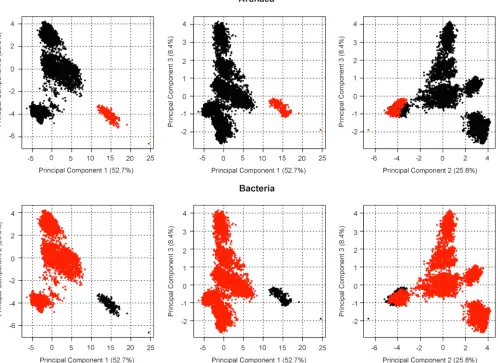
nomen-clature and 16S rRNA phylogeny was to employ methods from the field exploratory data analysis (37,38). Rather than relying on phylogenetic trees, which either lacked resolution when collapsed or were too unwieldy when viewed in full (⬎10,000 nodes), we applied principal-component analysis (PCA) to the 16S rRNA se-quence data. Preliminary experiments with Peter Sneath provided early evidence that this approach would be workable (39). Using a novel approach to both fix the derived coordinates and overlay subsets of sequences based on assigned names, we were able to quickly identify areas of disagreement between the existing no-menclature and the phylogenetic model. Scree plots revealed that the first three dimensions in the derived coordinate system ac-counted for⬎90% of the total variance, indicating the reliability of the projections (34,35). PCA also provided a unique view of the topology of bacterial and archaeal domains, which has remained remarkably stable, robust, and resistant to perturbation by differ-ent alignmdiffer-ents, differdiffer-ent implemdiffer-entations of PCA, or an almost 3-fold increase in the number of validly named species. The PCA plots suggest that there are a finite number of major groups into which the validly named species fall based on 16S rRNA sequence analysis, which correspond to the major phyla; the clear separa-tion of theBacteriaandArchaeaand the presence of “white space” in the plots appear to be inviolate (Fig. 1; see also Fig. 1S posted at
https://www.researchgate.net/publication/302545989_JCM00200 -16-supplement).
The white space suggests evolutionary constraints in the pri-mary and secondary structures of the 16S rRNA genes ofBacteria
andArchaeaand to a lesser extent, those of the dominant bacterial
phyla, especially theActinobacteria. Subsequent experiments fo-cused on potential distortion arising from the reduction in dimen-sionality by PCA, as the method is known to introduce distortions (arching and horseshoe effects) when input data are tailed or are composed mainly of closely spaced values. While views of the data can be corrected by rotation, distortion remains. Garrity and Lil-burn (6) found that such distortion could be eliminated by using estimates of the distance to external reference points rather than pairwise measurements. This principle was successfully demon-strated with a test case having a known solution (geographic data). However, a similar solution for phylogenetic data has not yet been found.
A follow-up investigation employed heatmaps for visualizing large matrices of sequence similarity data. Heatmaps are color-ized, shaded matrices and provide a distortion-free method for visualizing discrepancies in a classification. The technique is sim-ple and scalable and has an added advantage in that it can reveal the presence of nested hierarchies in data sets. The method is applicable to both symmetric (reflected) and asymmetric matrices and is therefore useful in developing identification schemes as well as taxonomies. Reordering of the underlying matrix is remarkably simple as it is based on the order or appearance of (26) a set of taxa in an input tree (or other classification).
A self-organizing self-correcting classifier (SOSCC) was subse-quently developed to automate detection and correction of classi-fication errors (40). The algorithm applies an simple criterion (e.g., a 2-standard deviation within-taxon spread in 16S rRNA similarity) at all levels of an input taxonomy while preserving no-menclatural integrity. The algorithm also smooths by recluster-ing taxa at each level of the hierarchy. The effects of the SOSCC on the global taxonomy can be seen in a series of heatmaps in Fig. 2S posted athttps://www.researchgate.net/publication/30
on May 16, 2020 by guest
http://jcm.asm.org/
2545989_JCM00200-16-supplement. Refinements and recon-ciliation of the nomenclature and taxonomy occurring be-tween 1980 and 2015 are shown in Fig. 3S posted athttps:// www.researchgate.net/publication/302545989_JCM00200-16 -supplement.
The SOSCC also supports testing of hypotheses about taxon membership based on 16S sequence similarity. For nearly 2 decades, the community has applied a heuristic that strains that shareⱕ97% sequence similarity between 16S RNA gene sequences (ⱖ1,300 nu-cleotides [nt] in length) are members of different species within the same genus, and that threshold has been gradually increasing com-pared to limited subsets of species for which DNA hybridization data were available (41,42). Additional proposals have emerged for defin-ing taxonomic relationships from the family to the phylum level based on 16S sequence similarity (42). However, an examination of the data for 11,824 type strains comprising 13,991 species and
sub-species with validly published names reveals that the distribution of pairwise similarities varies significantly. Many higher taxa are non-normally distributed, especially at the genus level (see Fig. 4S posted at
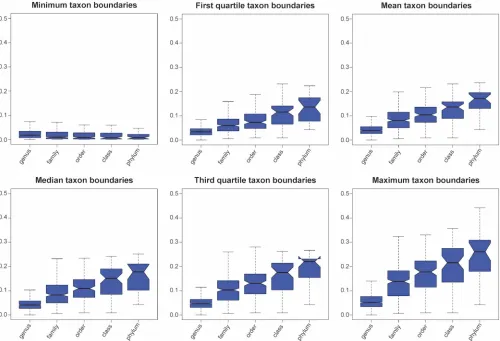
https://www.researchgate.net/publication/302545989_JCM00200 -16-supplement). There is also significant overlap in the distribution of 16S rRNA sequence scores within the higher taxa, calling into ques-tion whether the ranks of family, class, and order are justified (Fig. 2). While the grand mean of genus-level 16S rRNA sequence similarity among all of the type strains is 95.4% (n⫽10,788), the range of within-genus means is significantly greater, suggesting that the con-sensus heuristic poorly reflects the genus- or higher-level relation-ships in the consensus taxonomy (see Table 2S posted athttps:// www.researchgate.net/publication/302545989_JCM00200-16 -supplement). This is a particularly interesting problem, given that recently described taxa were formed by the application of this heuris-tic. This also suggests that if one were to adopt a taxonomy with rigid
FIG 1Principal-component analysis of 16S rRNA sequences from type strains of validly named species and subspecies ofBacteriaandArchaea. PCA was used to visualize the distribution pattern of 16S rRNA sequence in a manner similar to that previously described by Garrity and Lilburn (25) with the following modifications. High-quality, curated sequences, matched to the published taxonomic descriptions of type strains, were aligned using the most recent Greengenes alignment, and uncorrected pairwise evolutionary distances were determined in Mothur (version 1.34.1) using the default parameters (Needleman-Wunsch method, kmer searching with 8 mer). The resulting matrix was then subjected to a PCA in R (version 3.3.2, 64 bit, Mac OS). The first three principal components accounted for 86.9% of the total variance. Areas highlighted in red indicate locations of members of the two prokaryotic domains. The two outliers located in the lower right quadrant areMethanocorpusculum sinense(GenBank accession no.AF095268.1) andHalostagnicola bangensis(HF544345.1). Additional PCA plots showing the locations of the validly named orders and classes are available in Fig. 1S posted athttps://www.researchgate.net/publication/302545989_JCM00200 -16-supplement. A complete set of figures is available for viewing athttp://dx.doi.org/10.1601/tx.1.
on May 16, 2020 by guest
http://jcm.asm.org/
[image:4.585.46.544.74.437.2]cutoffs as recently suggested by Yarza et al. (42), the net effect would be a significant inflation in the number of species and higher taxa. Whether or not such an action is warranted in the absence of sup-porting data is an issue worthy of public debate as such a move would have a significant impact on the literature and public databases.
INCORPORATION OF WHOLE-GENOME SEQUENCE DATA INTO TAXONOMIC MODELS
As noted above, the recasting of the taxonomy of the prokaryotes based on WGS is already under way. New bioinformatics methods that overcome the technical limitations of classical DNA hybrid-ization measurements used to delineate prokaryotic species are now used routinely, the most common of which is ANI (7,13,14,
21). ANI provides an estimate of sequence similarity between pairs of genomes (designated the query and reference genome) and computes this value for regions in the genome that exhibit at least 70% sequence similarity across 35% or more of the alignable region, using either BLAST or MUMmer. Improvements in the method in which either the query or the query and the reference genomes are “shredded” into “fragments” of 1,020 bases to more closely mimic DDH have recently appeared.
The emerging heuristic is that species-level relationships occur
in the range of 94 to 96% ANI. However, it is important to note that ANI scores between a query and reference genome are often asymmetric because of differences in gene complements and ge-nome sizes. This asymmetry is not entirely surprising as it was often observed in reciprocal hybridization studies using labeled DNA probes in the past. However, there was no plausible expla-nation for the phenomenon at the time. Like DDH, the current implementation of ANI also has limited utility: defining species-, subspecies-, and strain-level relationships. The level of nucleotide identity occurring over more distantly related strains falls off sharply; thus, ANI in its current form does little for redefining higher taxa. This was recently discussed by Kim et al. (43) in a comparative study of 6,787 genomes from 22 phyla. These authors proposed narrowing the species-level ANI cutoff to 96% with a corresponding cutoff of 16S rRNA sequence similarity of 98.65%. It does not appear, however, that this study encompassed a signif-icant number of species from the major phyla (e.g., the
Actinobac-teria), and their data set was heavily biased toward medically
rel-evant species, which included as many as 512 genomes of a single species. The ramification of their recommendation is a significant inflation in the numbers of species and genera. One would also need to consider if it would be possible to differentiate those
spe-FIG 2Distribution of sequence similarity among taxon members. The distribution of 16S sequence similarity was determined from the output of the SOSCC analysis of the complete matrix (n⫽11,814) for each taxon for the rank of genus to domain, excluding singletons. Pairwise similarities were extracted from the lower triangle of the matrix (excluding self-identity scores on the diagonal). The five number summaries (mean, median, maximum, and first and third quartiles) (11) were computed for each taxon, and boxplots summarizing the distribution of scores at each rank were drawn. Output of the SOSCC is provided in Table S2 posted athttps://www.researchgate.net/publication/302545989_JCM00200-16-supplement.
on May 16, 2020 by guest
http://jcm.asm.org/
[image:5.585.43.543.68.409.2]cies using alternative methods, thereby substantiating such pro-posals. The impact on the higher taxonomy is unclear.
In a similar study, Varghese et al. (11) examined 13,151 micro-bial genomes representing 3,082 named species by ANI paired with an estimate of the alignment fraction of genomic DNA for each pair, creating a paired-value microbial species identifier. These authors reported a high correlation between the two mea-sures and used the combined score to group the genomes into cliques, clique groups, and singletons by application of the Bron-Kerbosch algorithm. They also reported a number of misplaced/ misclassified species (ca. 18%); however, since the study was nei-ther restricted to type strains of species with validly published names nor did it fully cover all of the validly published species of
BacteriaandArchaea, these authors wisely chose to not reclassify
or rename any of the taxa based on their method.
A NEW CONSENSUS TAXONOMY
Given that taxonomy represents a consensus opinion and the pre-vailing view is that the current taxonomy of prokaryotes may not take into consideration all of our new knowledge gained through genome sequencing, it is time to recast it again. However, rather than disregarding the current and past taxonomies, it may be pru-dent to assess where the new methods add to existing knowledge, what limitations may exist, and how to integrate the new methods so as to refine our knowledge rather than lose our knowledge. Currently,⬍40% of the type strains of validly published species and subspecies have been sequenced. Although a working strategy was recently proposed to fill in gaps with “proxytypes” (15), these cannot replace the types. The time needed to fully complete the collection and keep pace with newly described species will be lon-ger than most would expect. So too will documenting all of the sequences to establish provenance. Linkage of ecological and phe-notypic data to genome sequences is also essential to establish the role that each organism may play in a microbiome or what effect it may have on its environment. While genomes may support infer-ence of a property, confirmation requires experimental proof, much of which may already exist. Linking such observational data to the correct genomes requires accurate taxonomic information that is usually inferred through a name. Persistent linking of the correct data and metadata to particular species will become in-creasingly important as taxonomic work accelerates to keep pace with applications of new sequencing methodologies. So too, will the demand for taxonomists who assert novel taxa to verify their findings with experimental evidence, viable type material, and de-tailed comparisons with previously described taxa. Simply stating that a particular genome sequence falls above or below an arbi-trary threshold is not adequate as a hypothesis. Hopefully the ten-dency toward “assembly line” taxonomy will fade away and be replaced by more rigorous approaches. Taxonomic hypotheses require a willingness to interpret the data and literature to deter-mine not only what is new but also what is known. WGS has made data generation incredibly easy, but data analysis and interpreta-tion and synthesis of knowledge still require significant effort, in-sight, and domain expertise. New tools to mine the literature and reason across complex phenotypic and environmental data are in development and will aid taxonomists in the future as they deal with an ever-increasing body of prior knowledge. However, the ultimate decision will still fall to the individual(s) who will make the judgment call in determining the novelty of a taxon.
ACKNOWLEDGMENTS
I am grateful for constructive comments from Charles T. Parker, Brian J. Tindall, Nikos Kyrpides, David Ussery, Miriam Land, Terrence Marsh, and the three anonymous peer reviewers. I am indebted to the late P.H.A. Sneath and John W. Tukey for their numerous and helpful discussions about numerical taxonomy and exploratory data analysis early in my career.
Portions of this work were funded and supported by the Office of Science (BER), U.S. Department of Energy, under grant numbers DE-FG02-04ER63933, DE-FG02-07ER86321, and DE-SC0006191.
NamesforLife semantic resolution technology and the SOSCC systems and methods are covered under U.S. patents 7,925,444 and 8,036,997 under license from the Michigan State University Board of Trustees to NamesforLife, LLC.
NamesforLife, LLC, is an Michigan State University start-up company formed to commercialize systems and methods for classification, search-ing, and indexing text and data. The author is a cofounder and principal in the company and principal investigator on five STTR awards from the Department of Energy to further develop the technology and grants and loans from the Michigan Economic Development Corporation and the Michigan Universities Commercialization Initiative to develop prototype products for commercial applications.
FUNDING INFORMATION
This work, including the efforts of George M. Garrity, was funded by United States Department of Energy Office of Science (DE-SC0006191, DE-FG02-04ER63933, and DE-FG02-07ER86321).
Portions of the funding are through the SBIR/STTR program.
REFERENCES
1.Woese CR, Kandler O, Wheelis ML.1990. Towards a natural system of organisms: proposal for the domains Archaea, Bacteria, and Eucarya. Proc Natl Acad Sci U S A87:4576 – 4579.http://dx.doi.org/10.1073/pnas.87.12 .4576.
2.Stackebrandt E, Frederiksen W, Garrity GM, Grimont PA, Kampfer P, Maiden MC, Nesme X, Rossello-Mora R, Swings J, Truper HG, Vauterin L, Ward AC, Whitman WB.2002. Report of the ad hoc com-mittee for the re-evaluation of the species definition in bacteriology. Int J Syst Evol Microbiol52:1043–1047.http://dx.doi.org/10.1099/00207713 -52-3-1043.
3.Tindall BJ, Rossello-Mora R, Busse HJ, Ludwig W, Kämpfer P.2010. Notes on the characterization of prokaryote strains for taxonomic pur-poses. Int J Syst Evol Microbiol60:249 –266.http://dx.doi.org/10.1099/ijs .0.016949-0.
4.Yarza P, Sproer C, Swiderski J, Mrotzek N, Spring S, Tindall BJ, Gronow S, Pukall R, Klenk HP, Lang E, Verbarg S, Crouch A, Lilburn T, Beck B, Unosson C, Cardew S, Moore ER, Gomila M, Nakagawa Y, Janssens D, De Vos P, Peiren J, Suttels T, Clermont D, Bizet C, Sakamoto M, Iida T, Kudo T, Kosako Y, Oshida Y, Ohkuma M Arahal DR, Spieck E, Pommerening Roeser A, Figge M, Park D, Buchanan P, Cifuentes A, Munoz R, Euzeby JP, Schleifer KH, Ludwig W, Amann R, Glockner FO, Rossello-Mora R.2013. Sequencing orphan species initia-tive (SOS): filling the gaps in the 16S rRNA gene sequence database for all species with validly published names. Syst Appl Microbiol36:69 –73.http: //dx.doi.org/10.1016/j.syapm.2012.12.006.
5.Garrity GM.2009. Ground truth. Stand Genomic Sci1:91–92, 2009.http: //dx.doi.org/10.4056/sigs.50595.
6.Garrity GM, Lilburn TG.2002. Mapping taxonomic space: an overview of the road map to the 2nd ed ofBergey’s Manual of Systematic Bacteriol-ogy. WFCC Newsl35:5–15.
7.Auch AF, Von Jan M, Klenk H-P, Göker M.2010. Digital DNA-DNA hybridization for microbial species delineation by means of genome-to-genome sequence comparison. Stand Genomic Sci2:117–134.http://dx .doi.org/10.4056/sigs.531120.
8.Chun J, Rainey FA.2014. Integrating genomics into the taxonomy and systematics of theBacteriaandArchaea. Int J Syst Evol Microbiol64:316 – 324.http://dx.doi.org/10.1099/ijs.0.054171-0.
9.Garrity GM, Banfield J, Eisen J, Van Der Lelie N, McMahon T, Rusch
on May 16, 2020 by guest
http://jcm.asm.org/
D, Delong E, Moran MA, Currie C, Furhman J, Hallam S, Hugenholtz P, Moran N, Nelson K, Roberts R, Stepanauskas R.2013. Prokaryotic Super Program Advisory Committee DOE Joint Genome Institute, Wal-nut Creek, CA, March 27, 2013. Stand Genomic Sci8:561–570.http://dx .doi.org/10.4056/sigs.4638348.
10. Oren A, Garrity GM.2014. Then and now: a systematic review of the systematics of prokaryotes in the last 80 years. Antonie Van Leeuwenhoek
106:43–56.http://dx.doi.org/10.1007/s10482-013-0084-1.
11. Varghese NJ, Mukherjee S, Ivanova N, Konstantinidis KT, Mavrom-matis K, Kyrpides NC, Pati A.2015. Microbial species delineation using whole genome sequences. Nucleic Acids Res43:6761– 6771.http://dx.doi .org/10.1093/nar/gkv657.
12. Whitman WB, Woyke T, Klenk H-P, Zhou Y, Lilburn TG, Beck BJ, De Vos P, Vandamme P, Eisen JA, Garrity G, Hugenholtz P, Kyrpides NC.
2015. Genomic encyclopedia of bacterial and archaeal type strains, phase III: the genomes of soil and plant-associated and newly described type strains. Stand Genomic Sci10:26.http://dx.doi.org/10.1186/s40793-015 -0017-x.
13. Goris J, Konstantinidis KT, Klappenbach JA, Coenye T, Vandamme P, Tiedje JM.2007. DNA-DNA hybridization values and their relationship to whole-genome sequence similarities. Int J Syst Evol Microbiol57:81– 91.http://dx.doi.org/10.1099/ijs.0.64483-0.
14. Konstantinidis KT, Ramette A, Tiedje JM.2006. The bacterial species definition in the genomic era. Philos Trans R Soc Lond B Biol Sci.361:
1929 –1940.http://dx.doi.org/10.1098/rstb.2006.1920.
15. Federhen S, Rosella-Mora R, Klenk H-P, Tindall BJ, Konstantinidis KT, Whitman WB, Brown D, Labeda D, Ussery D, Garrity GM, Colwell RR, Nur H, Graf J, Parte A, Yarza P, Goldber B, Sichtig H, Karsch-Mizrachi I, Cark K, Mcveigh R, Pruitt K, Tatusov T, Falk R, Turner S, Madden T, Kits P, Klimke W, Kimchi A, Agarwala R, Dicuccio M, Ostell J.2016. Meeting report: GenBank microbial genomic taxonomy workshop (12⫺13 May 2015). Stand Genomic Sci11:15.http://dx.doi.org/10.1186 /s40793-016-0134-1.
16. Göker M, Klenk HP.2013. Phylogeny-driven target selection for large-scale genome-sequencing (and other) projects. Stand Genomic Sci8:360 – 374.http://dx.doi.org/10.4056/sigs.3446951.
17. Kyrpides NC, Hugenholtz P, Eisen JA, Woyke T, Goker M, Parker CT, Amann R, Beck BJ, Chain PS, Chun J, Colwell RR, Danchin A, Dawyndt P, Dedeurwaerdere T, Delong EF, Detter JC, De Vos P, Donohue TJ, Dong XZ, Ehrlich DS, Fraser C, Gibbs R, Gilbert J, Gilna P, Glockner FO, Jansson JK, Keasling JD, Knight R, Labeda D, Lapidus A, Lee JS, Li WJ, Ma J, Markowitz V, Moore ER, Morrison M, Meyer F, Nelson KE, Ohkuma M, Ouzounis CA, Pace N, Parkhill J, Qin N, Rossello-Mora R, Sikorski J, Smith D, Sogin M, Stevens R, Stingl U, Suzuki K, Taylor D, Tiedje JM, Tindall B, Wagner M, Weinstock G, Weissenbach J, White O, Wang J, Zhang L, Zhou YG, Field D, Whitman WB, Garrity GM, Klenk HP.2014. Genomic encyclopedia of Bacteria and Archaea: se-quencing a myriad of type strains. PLoS Biol12:e1001920.http://dx.doi .org/10.1371/journal.pbio.1001920.
18. Kyrpides NC, Woyke T, Eisen JA, Garrity G, Lilburn TG, Beck BJ, Whitman WB, Hugenholtz P, Klenk HP.2014. Genomic encyclopedia of type strains, phase I: the one thousand microbial genomes (KMG-I) proj-ect. Stand Genomic Sci 9:1278 –1284.http://dx.doi.org/10.4056/sigs .5068949.
19. Wu D, Hugenholtz P, Mavromatis K, Pukall R, Dalin E, Ivanova NN, Kunin V, Goodwin L, Wu M, Tindall BJ, Hooper SD, Pati A, Lykidis A, Spring S, Anderson IJ, D’haeseleer P, Zemla A, Singer M, Lapidus A, Nolan M, Copeland A, Han C, Chen F, Cheng JF, Lucas S, Kerfeld C, Lang E, Gronow S, Chain P, Bruce D, Rubin EM, Kyrpides NC, Klenk HP, Eisen JA.2009. A phylogeny-driven genomic encyclopaedia of Bac-teria and Archaea. Nature462:1056 –1060.http://dx.doi.org/10.1038 /nature08656.
20. Garrity GM, Oren A.2013. Response to Sutcliffe et al.: regarding the International Committee on Systematics of Prokaryotes. Trends Micro-biol21:53–55.http://dx.doi.org/10.1016/j.tim.2012.12.003.
21. Lee I, Kim YO, Park SC, Chun J.OrthoANI: an improved algorithm and software for calculating average nucleotide identity. Int J Syst Evol Micro-biol, in press.http://dx.doi.org/10.1099/ijsem.0.000760.
22. Richter M, Rossello-Mora R.2009. Shifting the genomic gold standard for the prokaryotic species definition. Proc Natl Acad Sci U S A106:
19126 –19131.http://dx.doi.org/10.1073/pnas.0906412106.
23. Garrity G, Lyons C.12 April 2011. Systems and methods for resolving ambiguity between names and entities.US patent 7,925,444.
24. Garrity GM, Lyons C.2003. Future-proofing biological nomenclature. OMICS7:31–33.http://dx.doi.org/10.1089/153623103322006562. 25. Dunn G, Everitt B.1982. An introduction to mathematical taxonomy.
Cambridge University Press, Cambridge, United Kingdom.
26. Sokal RR, Sneath PHA.1963. Principles of numerical taxonomy. WH Freeman, San Francisco, CA.
27. Parker CT, Tindall BJ, Garrity GM.International Code of Nomenclature of Prokaryotes. Int J Syst Evol Microbiol, in press.http://dx.doi.org/10 .1099/ijsem.0.000778.
28. David J, Garrity GM, Greuter W, Hawksworth DL, Jahn R, Kirk PM, Mcneill J, Michel E, Knapp S, Patterson DJ, Tindall BJ, Todd JA, Van Tol J, Turland NJ.2012. Biological nomenclature terms for facilitating communication in the naming of organisms. ZooKeys2012:67–72.http: //dx.doi.org/10.3897/zookeys.192.3347.
29. Gaston KJ, Mound LA.1993. Taxonomy, hypothesis testing and the biodiversity crisis. Proc R Soc B Biol Sci251:139 –142.http://dx.doi.org /10.1098/rspb.1993.0020.
30. Denniston C.1974. An extension of the probability approach to genetic relationships: one locus. Theor Popul Biol6:58 –75.http://dx.doi.org/10 .1016/0040-5809(74)90031-8.
31. Skerman VBD, McGowan V, Sneath PHA.1980. Approved lists of bac-terial names. Int J Syst Evol Microbiol30:225– 420.http://dx.doi.org/10 .1099/00207713-30-1-225.
32. Sneath PA.2005. Bacterial nomenclature, p 83⫺88.InBrenner D, Krieg N, Staley J, Garrity G (ed), Bergey’s manual of systematic bacteriology, 2nd ed. Springer, New York, NY.
33. Tindall BJ.1999. Misunderstanding the Bacteriological Code. Int J Syst Bacteriology49(Pt 3):1313–1316.http://dx.doi.org/10.1099/00207713-49 -3-1313.
34. Garrity GM, Bell JA, Lilburn T.2015. The revised road map to the Manual. John Wiley & Sons, Inc., Hoboken, NJ.
35. Garrity GM, Holt J.2001. The road map to theManual, p 119 –166.In Boone DR, Castenholz RW, Garrity GM (ed), Bergey’s manual of system-atic bacteriology, 2nd ed. Springer, New York, NY.
36. Lilburn TG, Garrity GM.2004. Exploring prokaryotic taxonomy. Int J Syst Evol Microbiol54:7–13.http://dx.doi.org/10.1099/ijs.0.02749-0. 37. Tukey JW.1977. Exploratory data analysis. Addison-Wesley Publishing
Co., Reading, MA.
38. Venables WN, Ripley BD, Venables WN.2002. Modern applied statistics with S, 4th ed. Springer, New York, NY.
39. Krieg N, Garrity G.2005. On using theManual, p 15⫺20.InBrenner D, Krieg N, J Staley, Garrity G (ed), Bergey’s manual of systematic bacteriol-ogy, 2nd ed. Springer, New York, NY.
40. Garrity GM, Lilburn TG.2005. Self-organizing and self-correcting clas-sifications of biological data. Bioinformatics21:2309 –2314.http://dx.doi .org/10.1093/bioinformatics/bti346.
41. Stackebrandt E, Ebbers J.2006. Taxonomic parameters revisited tar-nished gold standards. Microbiol Today33:152⫺155.
42. Yarza P, Yilmaz P, Pruesse E, Glöckner FO, Ludwig W, Schleifer K-H, Whitman WB, Euzéby J, Amann R, Rosselló-Móra R.2014. Uniting the classification of cultured and uncultured bacteria and archaea using 16S rRNA gene sequences. Nat Rev Microbiol12:635– 645.http://dx.doi.org /10.1038/nrmicro3330.
43. Kim M, Oh HS, Park SC, Chun J.2014. Towards a taxonomic coherence between average nucleotide identity and 16S rRNA gene sequence simi-larity for species demarcation of prokaryotes. Int J Syst Evol Microbiol
64:346 –351.http://dx.doi.org/10.1099/ijs.0.059774-0.
on May 16, 2020 by guest
http://jcm.asm.org/
George Garrityis Professor of Microbiology and Molecular Genetics at Michigan State versity (MSU). His doctorate is from the Uni-versity of Pittsburgh Graduate School of Public Health (1980). He was Editor-in-Chief of Bergey’s Manual of Systematic Bacteriology (1996 to 2006), vice-chair of the Judicial Com-mission of the International Committee on Sys-tematics of Prokaryotes (ICSP) (2005 to 2008), and chair of the ICSP (2008 to 2014). He is a core member of the Genomic Standards
Con-sortium, founding editor ofStandards in Genomic Sciences, and a nomencla-ture/list editor for theInternational Journal of Systematic and Evolutionary Microbiology. He is a Fellow of the American Association for the Advance-ment of Science and of the Society for Industrial Microbiology (SIMB), a recipient of the van Niel International Prize for Studies in Bacterial System-atics (2011), and President-Elect of the SIMB. He has coauthored⬎170 publications and 121 taxonomic proposals, and is a coinventor on 75 patent applications/grants. Before joining MSU, he was a scientist in the natural products screening program at Merck & Co. (1981 to 1996). His research interests are in semantics, classification, and visualization of big data and knowledge engineering.