2017; 2(4): 62-66
http://www.sciencepublishinggroup.com/j/jeece doi: 10.11648/j.jeece.20170204.11
Influence of a Radition on Technical and Operational
Qualities of Gasoline
Lala Cabbarova, Islam Mustafayev
Institute of Radiation Problems of Azerbaijan National Academy of Sciences, Baku, Azerbaijan
Email address:
Azerbaijan [email protected] (L. Jabbarovа), [email protected] (I. Mustafayev)
To cite this article:
Lala Cabbarova, Islam Mustafayev. Influence of a Radition on Technical and Operational Qualities of Gasoline. Journal of Energy, Environmental & Chemical Engineering. Vol. 2, No. 4, 2017, pp. 62-66. doi: 10.11648/j.jeece.20170204.11
Received: September 27, 2017; Accepted: October 19, 2017; Published: January 3, 2018
Abstract:
As a research object it has been used the samples of petrol AI-92 from the oil of Azerbaijan. Laboratory studies have been conducted on gamma-source Co60 at dose rate P=0,18 Gy/s within the absorption dose range D=15-150 kGy. The results of chromatographic, IR-spectroscopic studies have been given. The viscosity and density of the samples have been determined. Concentration, radiation-chemical yields of the obtained gases at different absorption doses of the samples of petrol AI-92 have been determined and their radiation resistance has been evaluated. The methods applied to determination of radiation stability are based on radiation of a product and the subsequent determination of the changes which happened in it. Impact of radiation on operational characteristics of fuels in static conditions on a regular technique before radiation was researched. Radiation oxidations of processes considered in the field of low temperatures when chain processes don't happen. The purpose of this work is the research of radiation firmness of fuels from oils of Azerbaijan. Results of such researches allow to estimate radiation stability of fuels, to find out influence of irradiation on general composition of fuels and possible changes of qualities of fuels.Keywords:
Petrol, Fuel, Radiolysis IR-Spectrum, Gases1. Introduction
Petrol is a mixture of hydrocarbons of various structures of С4-С12. It is flammable liquid with a density of 700-780
kg/m3, poignant smell, evaporates quickly, does not dissolve in water, burns without a trace. The boiling temperature is from 30°C to 200°C. All fuels are organic compounds of different complexity and under the influence of radiation energy there occurs a change in physical and chemical properties of fuels. The influence of radiation exposure on petrol composition, establishment of the links between the requirements for petrol composition and its radiation resistivity are of practical interest. Excited molecules, radicals are formed and gases escape under ionizing radiation influence on hydrocarbons. Chemical transformations are accompanied by the changes in physical properties of fuel. While selecting fuel for being used under irradiation it is necessary to find out whether the fuel has sufficient radiation resistance, whether it is possible to increase its stability due to changes in the composition or introduction of special additives. Stability – the ability of fuel to keep its chemical
structure under operating conditions within temperature changes, radiation, influence of metals. It is necessary to maintain the thermal stability of jet engine fuel for aircrafts even at low radiation doses. When it is not feasible, new types of fuels with adequate radiation resistance should be developed.
We studied several operational performance of fuel under static conditions in the usual manner before and after irradiation. The results of experimental studies of the effect of radiation on various oil products were previously conducted in the papers [1-8].
2. Methodology
The samples (petrol AI-92 in 2,5 ml) placed in ampoules and sealed in vacuum, were irradiated at room temperature on gamma-source Co60 at dose rate P=0,18 Gy/s at different absorption doses: within the range of 15-150 kGy in vacuum so as to trace the kinetics of the current processes. As an ionizing radiation it was used Υ-radiation source Co6060 of type MPX Υ-30.
registered on spectrometer VARIAN 640-IR (VARIAN Company) in the wavelength range (4000-400cm-1). The samples were removed in the form of film with a thickness of d=1. Assignment of the bands of the obtained spectra was carried out as described in [9-10]. Gas products were analyzed by gas chromatography method. The density was determined by a pycnometer according to GOST 3900-85. The viscosity was determined according to GOST 33-66 by a viscometer of VPJ-2 type corresponding to GOST 10028-81.
The aim of the work is the study of radiation resistance of the petrol AI-92 from Azerbaijan oil
3. Experiments and Results
Below are the kinetic curves of gas accumulation at gamma-radiolysis of the petrol AI-92 from Azerbaijan oil (figure 1).
(a)
(b)
Figure 1. ( a, b) Kinetic curves of gas accumulation at gamma-radiolysis of the petrol AI-92 from Azerbaijan oil.
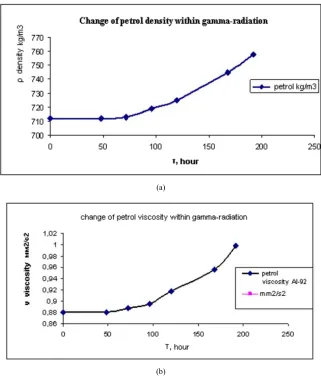
The changes in viscosity and density of the initial petrol and after radiation exposure at different absorption doses are given below in figure 2 (a, b).
(a)
(b)
Figure 2. (a, b) Changes in viscosity and density of petrol before and after radiation exposure.
Total radiation-chemical yields of gases of petrol AI-92 within absorbed dose range of 15-150 kGy have been presented in the table 1.
Table 1. Radiation-chemical yields of gases of petrol AI-92 within absorbed dose range of 15-150 kGy.
Gases H2 CH4 C2H6 C2H4 ΣC3 ΣC4 ΣC5 ΣC6 ΣC7
Petrol AI-92 0,446 0,0074 0,0040 0,0057 0,0053 0,132 0,322 0,091 0,006
Figure 3. IR - spectra of original petrol AI-92 (without irradiation).
3905.857 0.314 3875.403 0.202
3857.588 0.945 3847.360 0.838
3828.120 0.529 3798.382 0.226
3732.367 0.235
3369.281 0.049 2958.073 0.601 2928.569 0.646
2358.021 0.314
2338.327 0.352
1994.278 0.201
1378.490 0.114
1021.764 0.119 878.440 0.126
807.215 0.192 (3)
3800 3600 3400 3200 3000 2800 2600 2400 2200 2000 1800 1600 1400 1200 1000 800 600 400
0.8
0.7
0.6
0.5
0.4
0.3
0.2
Wavenumber
A
b
s
o
rb
a
n
c
(a)
(b)
Figure 4. (a, b). IR-spectra of irradiated petrol a) (120 hours irradiation), b) (240 hours irradiation).
Out of plane deformation oscillation of C-H group in the range of 1000-650 cm-1. After 120 hours irradiation, twice decrease in (1000-650) cm-1- intensity of out of plane deformation oscillations C-H, as well as decrease in deformation oscillation of -CH3- groups (1370-1380 cm
-1
) are observed. (1440-1480) cm-1- deformation oscillation of CH2
-group is formed. 2252, 2283, 2392-(2860-2960 cm-1) - valence oscillation of CH3-group and 2940-2915 cm
-1
- oscillation of -СН2 bonds in alkanes decrease. There appears
(3200-3400) cm-1 imines C=NH.
After 240 hours irradiation, (1600-1440) cm-1- valence oscillation of = CH bonds is formed, 1650-1580 cm-1 pyridines and quinolines appear, the intensity of the bands of 2300-2230cm-1 - azo compound and (3310-3200) cm-1- the absorption band of alkyne and triple bonds increase. Intensity of band of CH3 group attached to heteroatoms (2860- 2975)
cm-1 decreases.
4. Discussion of the Results
At big height hydrocarbonic fuel on planes can appear under the influence of space particles of big energy. However
the processes which have arisen in connection with radiolizy can develop after the radiation termination for a long time that leads to change of composition of fuel. It is especially characteristic of the oxidizing processes which are followed by formation of peroxides. It is very important to keep thermal stability of jet fuels for supersonic planes at least at small doses of radiation. Every year use of organic materials - polymers of lubricants, fuels, heat carriers under operating conditions when they are affected by ionizing radiation, in operating conditions of atomic reactors, accelerators of electrons, in the conditions of space extends. Researches have shown that organic materials are sensitive to radiative effects, real terms of service of concrete technical products depend on their ability to keep initial properties in radiation fields.
All fuels are organic compounds, therefore different radiation lead to chemical degradation and formation of new chemical structures. Study of the irradiation influence on the composition of oil fuel, establishment of link between the demand for fuel composition and its radiation resistance is of practical importance. Unstable fuel are those which have unsaturated compounds and tar. Sunlight and radiation
4001.610 0.723
3659.175 0.190 3238.221 1.718
2956.664 0.637 2924.962 0.953
2856.093 0.730 2392.752 0.917 2283.673 0.561
2252.656 1.789
1462.206 0.864 1377.744 0.266
806.811 0.197 782.674 0.421 (4)
3800 3600 3400 3200 3000 2800 2600 2400 2200 2000 1800 1600 1400 1200 1000 800 600 400 0.55 0.50 0.45 0.40 0.35 0.30 0.25 0.20 0.15 Wavenumber A b s o rb a n c e
3659.027 0.238
3251.831 68.341
2956.851 -0.443 2923.738 1.314
2856.581 1.006
2387.419 9.035 2281.625 0.296
2229.877 5.942
1606.505 0.347
1461.640 1.115 1377.322 0.330
1038.558 0.330 782.608 0.485 (5)
3800 3600 3400 3200 3000 2800 2600 2400 2200 2000 1800 1600 1400 1200 1000 800 600 400
significantly increase the rate of tar formation in diesel oil. Within radiolysis of hydrocarbon mixtures the initial impact energy is rapidly absorbed by liquid and chemical changes occurring under radiation influence are caused by the effect of electrons with the energy less than 100 eV. As a result of γ-radiation in the irradiated medium fast electrons occur, which have high energy and are capable to change the chemical properties of molecules. In this case chemical bonds are broken and free radicals, ions are formed which have free valences and excess energy. Simultaneously with the low molecular compounds of fragmental character, dimers and polymers are formed as the products of recombination of radicals and ions as a result of cracking, dehydrogenation, isomerization and polymerization of hydrocarbons. Radiolysis of alkanes leads to some of their dehydrogenating with disengagement of free hydrogen, radicals and ions. Secondary, especially tertiary and quaternary C-C bonds and secondary C-H bonds easily burst under radiolysis influence. The yield of gaseous products, including hydrogen is reduced within the irradiation of ethylenes. Total yield of radiolysis products, in which polymers are dominant, increases. More stable ones to radiation effect are polynuclear aromatic hydrocarbons, consisting of 2-4 rings, which were the basis to recommend this class of compounds for using as hydraulic fluid and lubricants working under the conditions of relatively high temperatures and radioactive radiation influence. Such compounds showed high radiation resistance even under intense γ-radiation [11-12].
5. Results
Chemical processes, changes in density and viscosity occur in petrol within absorbed dose range 15-150 kGy. The effect of radiation influence on hydrocarbons of fuel depends on chemical structure, fuel composition. When the formation of radicals slow down at low temperatures, small amount of seal products are formed in hydrocarbon medium as a result of radiation. But operational performance of oil fuels deteriorate and compress sprayer even in a slight resin formation at the temperature of ambient air. In the future, it will be necessary to select such composition of oil fuel, which will withstand the effect of irradiation by changing hydrocarbon composition of oil products due to minor changes in the composition and introduction of additives.
References
[1] L. Y. Jabbarova, I. I. Mustafayev. Researches of Impact of Ionizing Radiation on Some Characteristics of Diesel Fuel. Journal of Energy, Environmental & Chemical Engineering. USA. Volume 2, Issue 4, August 2017, Pages: 41-45 Received: Jun. 7, 2017; Accepted: Jun. 27, 2017; Published: Jul. 27, 2017.
[2] I. I Mustafaev,. L. Y. Jabbarova, N. G Gulieva., R. S. Rzaev., and S. F. Alieva. “Effect of Ionizing Radiation on Lube Oil Fractions of Heavy Bituminous Oils.” M. «High Energy Chemistry», 2014, Vol. 48, No. 5, p. 315–320.
[3] I. I. Mustafayev, L. Y. Jabbarova, Z. O. Nabizadeh, N. E. Ibadov. “Study of radiation-chemical transformation of synthetic oil from oil-bituminous rock”. M. “High Energy Chemistry”, 2013, № 6, p. 449-455.
[4] I. I. Mustafaev, L. Y Jabbarova., N. Q., Gulieva K. M. Yagubov. “Radiation thermal refining of oil-bituminous rocks”. Journal of Radioanalytical and Nuclear Chemistry. Budapest, Akademia Kiado, 2004, vol. 262, №2, P. 509-511.
[5] L. Y. Jabbarova, S. M. Aliev, S. Z. Melikova. “The impact of ionizig Radiation on Diezel fuel”. Journal of Radiation Research. Volum 2, № 2, Baku, Azerbaijan, 2015, p. 71-7.
[6] L. Y. Jabbarova., I. I. Mustafaev, Z. O. Nabizade, R. S. Rzayev S. F. Akhmadbayova. “Radiation Chemical Conversion of Oil Derived from Oil–Bitumen Rock.” Chemistry Journal of Moldova. General, Industrial and Ecological Chemistry. 2014, 9 (1), p. 80-84.
[7] L. Y. Jabbarova, N. E. Ibadov. “Alternativ Energy Sources”. Azerbaijan Chemikal. Journal, №3, 2010, p. 128-132.
[8] I. I. Mustafaev., L. Y Jabbarova, N. G. Gulieva, K. M. Yagubov. “Radiation-thermal refining of organic parts of oil-bituminous rocks”. Radiation Safety Problems in the Caspian Region. Kluwer Academic Publishers. Printed in the Nethrlands. 2004, p. 141-146.
[9] K. Nakanisi “Infra-red spectra and structure of organic compounds” M.: Mir, 1985 p. 210.
[10] L. J. Bellami “Infra-red spectra of complex molecules.” -M.: IL 1963, p. 592.
[11] A. Svollou. “Radiation chemistry.” Trans. from eng. -M.: Atomizdat, 1976. p. 278.