On: 13 April 2015, At: 06:18 Publisher: Routledge
Informa Ltd Registered in England and Wales Registered Number: 1072954 Registered office: Mortimer House, 37-41 Mortimer Street, London W1T 3JH, UK
Click for updates
Annals of the Association of American Geographers
Publication details, including instructions for authors and subscription information: http://www.tandfonline.com/loi/raag20Transforming Household Consumption: From
Backcasting to HomeLabs Experiments
Anna R. Daviesa & Ruth Doylea a
Department of Geography, Trinity College Dublin Published online: 02 Mar 2015.
To cite this article: Anna R. Davies & Ruth Doyle (2015) Transforming Household Consumption: From Backcasting to HomeLabs Experiments, Annals of the Association of American Geographers, 105:2, 425-436, DOI: 10.1080/00045608.2014.1000948
To link to this article: http://dx.doi.org/10.1080/00045608.2014.1000948
PLEASE SCROLL DOWN FOR ARTICLE
Taylor & Francis makes every effort to ensure the accuracy of all the information (the “Content”) contained in the publications on our platform. Taylor & Francis, our agents, and our licensors make no representations or warranties whatsoever as to the accuracy, completeness, or suitability for any purpose of the Content. Versions of published Taylor & Francis and Routledge Open articles and Taylor & Francis and Routledge Open Select articles posted to institutional or subject repositories or any other third-party website are without warranty from Taylor & Francis of any kind, either expressed or implied, including, but not limited to, warranties of merchantability, fitness for a particular purpose, or non-infringement. Any opinions and views expressed in this article are the opinions and views of the authors, and are not the views of or endorsed by Taylor & Francis. The accuracy of the Content should not be relied upon and should be independently verified with primary sources of information. Taylor & Francis shall not be liable for any losses, actions, claims, proceedings, demands, costs, expenses, damages, and other liabilities whatsoever or howsoever caused arising directly or indirectly in connection with, in relation to or arising out of the use of the Content.
This article may be used for research, teaching, and private study purposes. Terms & Conditions of access and use can be found at http://www.tandfonline.com/page/terms-and-conditions
Transforming Household Consumption: From
Backcasting to HomeLabs Experiments
Anna R. Davies and Ruth Doyle
Department of Geography, Trinity College Dublin
Following the rhetoric of an impending “perfect storm” of increasing demand for energy, water, and food, it is recognized that ensuring sustainability will require significant shifts in both production and consumption pat-terns. This recognition has stimulated a plethora of future-oriented studies often using scenario, visioning, and transition planning techniques. These approaches have produced a multitude of plans for future development, but many valorize technological fixes and give limited attention to the governance and practice of everyday consumption. In contrast, this article presents empirical findings from a practice-oriented participatory (POP) backcasting process focused on home heating, personal washing, and eating. This process provided spaces for collaborative learning, creative innovation, and interdisciplinary interaction as well as producing a suite of ideas around promising practices for more sustainable household consumption. Further action is required, how-ever, to explore how such ideas might be translated into action. The article concludes by outlining how collab-orative experiments among public, private, civil society, and citizen-consumers, or HomeLabs, provide a means to test and evaluate the promising practices developed through POP backcasting. Key Words: governance, social practices, socioecological systems, sustainable consumption, transformations.
随着对能源、水与粮食的需求逐渐增加的 “超完美风暴” 将至之修辞而来的是,人们已认知到,若要确 保可持续性,那麽生产与消费模式皆必须有显着的转变。此一认知,已激发众多以未来为导向、并且运 用剧本、想像力及变迁规划技术的研究。这些方法,为未来的发展生产出诸多计画,但其中许多仅稳定
技术修补,并对每日消费的治理与实践,投以相当有限的关注。反之,本文呈现出聚焦家户暖气、个人 洗涤和饮食、并以实践为导向的参与式(POP)回溯过程之经验发现。此一过程,提供了空间给合作式
学习、创造性发明与跨领域互动,并生产一系列有关更具可持续性的家户消费的有为实践之概念。但仍 需要进一步的行动,探讨这些概念如何能够被转译成行动。本文于结论中概述,公共、私人、公民社会 与公民—消费者之间的合作式实验,抑或称之为 “家庭实验室”,如何提供方法,测试、评价随着POP回 溯方法建立的有为实践。关键词:治理,社会实践,社会生态系统,可持续消费,变革。
Siguiendo la retorica de una inminente “tormenta perfecta” relacionada con la creciente demanda de energıa, agua y alimentos, se reconoce que para asegurar la sostenibilidad al respecto se requeriran cambios significativos tanto en los patrones de produccion como en los de consumo. Este tipo de reconocimiento ha estimulado una pletora de estudios de dimension futurista en los que se usan tecnicas de planificacion sobre escenario, vision y transicion. De tales enfoques resultan infinidad de planes de desarrollo futuro, pero muchos de ellos dan priori-dad a recetas tecnologicas, prestando atencion muy limitada a la gobernanza y la practica del consumo coti-diano. Por contraste, el presente artıculo exhibe los hallazgos empıricos de un proceso participativo de prospeccion inversa orientado a la practica (POP), focalizado en la calefaccion de la casa, la lavanderıa personal y la comida. Este proceso genero espacios para aprendizaje colaborativo, innovacion creadora e interaccion interdisciplinaria, al tiempo que produjo una suite de ideas sobre practicas prometedoras para un consumo hogareno m~ as sostenible. No obstante, se requiere de mayor trabajo para explorar la manera como tales ideas podrıan convertirse en accion. El artıculo concluye delineando el modo como los experimentos de colaboracion entre consumidores publicos, privados, sociedad civil y ciudadanıa en general, o LabHogares, proveen unos medios para ensayar y evaluar las practicas prometedoras desarrolladas a traves de la prospeccion inversa POP.
Palabras clave: gobernanza, practicas sociales, sistemas socioecologicos, consumo sostenible, transformaciones.
C
ombining observations from the fifth Assess-ment Report of the United Nations (UN) Intergovernmental Panel on Climate Change(IPCC) with socioeconomic and demographic trends, predictions have been made for a “perfect storm” of food, water, and energy shortages by 2030
ÓA. R. Davies and R. Doyle
This is an Open Access article. Non-commercial re-use, distribution, and reproduction in any medium, provided the original work is prop-erly attributted, cited, and is not altered, transformed, or built upon in any way, is permitted. The moral rights of the named authors have been asserted.
Annals of the Association of American Geographers, 105(2) 2015, pp. 425–436
Initial submission, October 2013; revised submissions, March and August 2014; final acceptance, September 2014 Published with license by Taylor & Francis, LLC.
unless immediate and dramatic socioecological transformations are initiated. Explicit within all IPCC reports has been the need to change the way humans interact with their wider environment, essentially the need to transform socioecological systems of production and consumption (UN 2013). Meanwhile, the inherently normative, highly politi-cal, and ultimately fundamental questions regarding what kind of transformed socioecological system people might wish to inhabit in the future and, importantly, how such transformations should occur, remain marginal to IPCC outputs to date. Nonetheless, having some kind of navigational compass calibrated toward a vision of a desirable future is widely seen as an important component of creating impetus for transformation (De Gues 2002). It is such thinking that has stimulated a bur-geoning array of futures-based techniques that seek to anticipate and shape the way we might live in times to come.
Beyond the modeling of climate change so influ-ential in IPCC reporting, there are other anticipa-tory approaches emerging based on risks related to socioecological transformation in spheres such as transspecies epidemics, transboundary food risks, and even terrorism (e.g., de Goede and Randalls 2009; Anderson 2010). Within these spheres of anticipation, preemption, and precaution, action is taken in the present on the basis of what has not yet happened and might never come to pass at all, whether that be through commodification and trade on futures markets, the drafting of contracts such as household mortgages, or the forward planning of neighborhoods, cities, regions, and even nations. Inevitably, such actions taken in the present as a means to prevent, mitigate, or adapt to perceived risks are imbued with particular assumptions about “the future” that are frequently characterized by conditions of uncertainty and indeterminacy but are also infused with normative judgments of what is good or bad and ultimately what is valued (Anderson 2010).
In addition to attempts to extrapolate probable futures, there are manifold examples where creative and imaginative skills have been developed as a way of thinking through what the future might hold. Most visible in design and literary communi-ties, and often characterized as part of a utopian– dystopian tradition, the goal of imagining futures is not prediction per se but rather a means to stimu-late thinking about possible alternative futures. The
future is seen as a safe space to envision disruptive innovations, to elaborate weak signals in social trends or roll-out of prototypical technologies. As a result, studies explicitly focused on imagining alter-native socioecological futures are expanding through a range of foresight methods including visioning, backcasting, and transition planning, methods that are orchestrated by a variety of actors and organizations across scales and sectors (Tukker and Fedrigo 2009; Davies, Doyle, and Pape 2012). As critiqued by those emphasizing the importance of social practices, however, these techniques often focus on elite perspectives, valorize technological fixes, and give limited attention to the governance and practice of everyday consumption, thus limiting their capacity to achieve substantive societal trans-formations (Shove and Walker 2008).
In light of these critiques, this article reflects on the experience of developing and conducting an experi-mental practice-oriented, participatory (POP) back-casting process and its contribution to imagining socioecological transformations aimed at promoting sustainable consumption. Initially, core concepts of socioecological systems and transformations are briefly outlined, with attention paid to scholarly and policy developments informed by key insights from transi-tions management and social practice approaches. This is followed by an overview of the POP backcast-ing process, which adapted participatory backcastbackcast-ing techniques by taking social practices as the fundamen-tal units for problem framing, solving, and innovation. The process then sought to counterbalance visioning and backcasting exercises that prioritize ecological modernization strategies, instead exploring alternative possibilities that place sufficiency, well-being, and sociocultural change as central strategies for transi-tions in everyday practices (Jackson 2009). Reflecting on this experiment, it is concluded that the POP back-casting procedure created unique and valued moments for civic engagement, collaborative learning, and transdisciplinary interaction among participants, par-ticularly around the dynamics of consumption practi-ces. As such, POP backcasting and similar endeavors could offer creative spaces (both material and virtual) where attention to the transformation of everyday practices can be collectively imagined and critically debated. The article closes with a brief discussion of ongoing HomeLabs research that is interrogating the conversion of promising practice ideas derived from POP backcasting into practical household interventions.
Imagining Futures: Socioecological
Systems and Practicing Transformations
As detailed elsewhere in this special issue, connect-ing the terms social and ecological has become associ-ated with emergent discourses of resilience and sustainability transformation (Fischer-Kowalski and Rotmans 2009). In particular, transitions theorists and transition management advocates have examined how large-scale transformations in sociotechnical regimes, such as shifts from horse-drawn to motor vehicles, or from water wells to water main systems, occurred (see Rip and Kemp 1998; Geels 2010). This research led to the emergence of the multilevel perspective (MLP) for understanding how innovations (mainly technologi-cal) come to be adopted, upscaled, and ultimately mainstreamed through system transitions. Drawing on the MLP, and with a view to designing deliberate interventions within socioecological systems, transi-tion management techniques have been applied within policy settings as tools of governance and inno-vation. These frequently encompass exploratory or predictive scenario-building processes in collaboration with stakeholders ultimately leading to the formation of long-term policy and technology innovation plans (Meadowcroft 2009). Although the forward-looking and collaborative mechanisms of transitions manage-ment are often lauded (Tukker and Fedrigo 2009), their conception of sustainability problems as issues of resource management, to be addressed through hierar-chical transformations (from niche to mainstream) in systems of provision, primarily supported by innova-tive technological fixes, has been subject to critique.
It has been argued that there is insufficient consid-eration of power and politics, the nature of human behavior–technology interactions, and lifestyle change within much transitions research (Bailey and Wilson 2009; Brown, Vergragt, and Cohen 2013). In addition, the importance of horizontal transfers of technologies, norms, and expectations across cultures—such as the spread of washing machines redefining the meaning of cleanliness and the skill of clothes washing or trends for air conditioning leading to expectations of stan-dardized indoor temperatures irrespective of climate— that can affect the configuration of everyday practices remains weakly articulated (Shove and Walker 2008). As a result, researchers have begun to look toward a well-established, albeit highly diverse body of work on social practices that identify the complex of social and material elements that shape the way people live, including stuff (for personal washing, stuff would
include showers and taps); skills (practical know-how on how and when to wash); understandings (social expectations of cleanliness; Warde 2005; Shove et al. 2008); and, adopting a macro focus, broader rules (that often relate to systems of provision and regula-tion; Spaargaren 2003). Stability in social practices arises when stuff, skills, understandings, and rules are integrated and reproduced, and practices are trans-formed as the links between elements are broken or new elements added (Pantzar and Shove 2010). Con-ceptualized in this way, any deliberate attempts to transform specific practices require coordinated and complementary actions across these social and mate-rial elements by a range of actors including citizens as the ultimate performers of practices. Yet, this presents challenges for contemporary governance of household consumption that has tended to favor voluntary agree-ments, information campaigns, and fiscal measures as isolated interventions (Davies et al. 2010). It also raises highly contentious specters of social engineering for sustainability (Shove and Walker 2007).
Although social practice approaches provide for a more nuanced understanding of the complexity of these diverse factors and actors, they have also been critiqued for their tendency to focus on configurations of past or current social practices, rather than contributing to debates about how life might be lived more sustainably in the future (Kuijer and De Jong 2012). Equally, prac-tice-oriented empirical studies are frequently design led, exhibiting an overriding emphasis on the stuff of practices (Scott, Bakker, and Quist 2012), with less attention to broader questions of governance and how practices can or should be shaped through nonmaterial interventions. Although recent social practice research has begun to engage explicitly with the diffusion of resource-intensive technologies from a complex system perspective, it remains the case that consideration of how technologies might lead to more rather than less sustainable practices is marginal to current activity (Brown, Vergragt, and Cohen 2013).
Clearly, social practice and transition approaches exhibit different vocabularies and emphases. Never-theless, both are bound by a common recognition of the need to move beyond product innovation, eco-effi-ciency, or redesign strategies, to consider integrated sociocultural, technological, and organizational changes to achieve transitions toward sustainable ways of life. It is with these commonalities in mind that the following sections describe and reflect on the explicitly POP backcasting experiment. POP backcasting aimed to build on the strengths of backcasting (with its
normative future focus and practical participatory gov-erning techniques) while recasting the unit of analysis from environmental resources or technologies to broader cross-cutting social practices.
POP Backcasting: Combining Practice
Thinking and Transition Approaches
Backcasting describes an overarching, multiphase process involving the cocreation of desirable future vision(s), followed by working back (or backcasting) from that future alternative to the present to design sequential steps for its achievement. The normative dimension of backcasting, focusing on desirable visions, contrasts with explorative scenario traditions, exemplified in Shell’s energy scenario research and commonly applied in transitions studies where likely futures are extrapolated from technological, political, or socioeconomic trends and are said to be limited in their ability to achieve trend-breaking solutions (Ver-gragt and Quist 2011). Backcasting studies vary greatly in their units of analysis, ranging from urban visioning projects (Eames and Egmose 2011), to sustainable resi-dential energy (Svenfelt, Engstr€om, and Svane 2011), to water governance (Kok et al. 2011). Others have adopted a lifestyle approach, such as the European Union project SPREAD (2013) and SusHous (Quist et al. 2001). Interestingly, however, a review of the lit-erature found no backcasting study with an explicit
focus on everyday social practices as units of problem definition, problem solving, and innovation (Doyle and Davies 2013). Equally, although emergent projects like SPREAD are producing a plethora of recommen-dations for social innovation, such as community gar-dens or shared tool facilities, the implications of such innovations on everyday practices (their skills, stuff, and understandings) remains underevaluated.
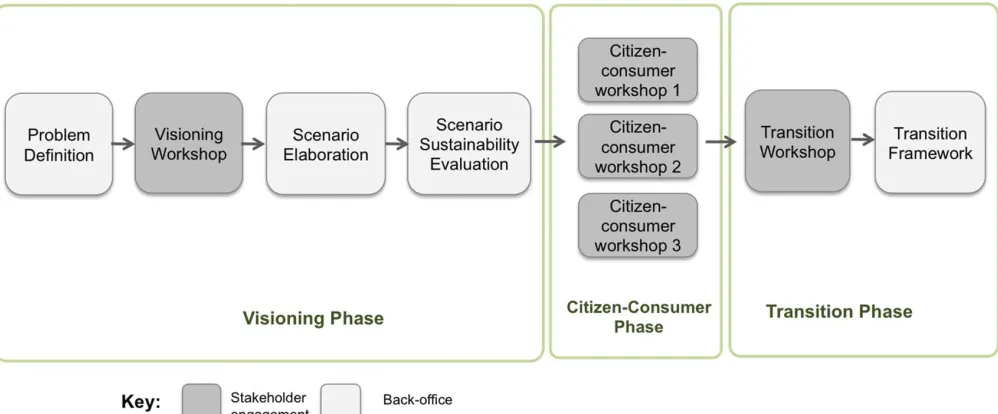
Set within a wider project examining consumption, environment, and sustainability (see Davies, Fahy, and Rau 2014), the POP backcasting procedure was devel-oped to explore the possibilities and challenges created by adopting a future focus and participatory ethos while also adopting social practices as the unit of anal-ysis. As such, the research was experimental and examined both the process enacted and its emergent products with respect to practices of personal washing, home heating, and eating. It is this explicit and foun-dational focus on practices and practice transforma-tion (rather than technology diffusion or social acceptance) that differentiates it from many other backcasting procedures. Essentially, our intent was to explore what it means and what might be gained by putting practices at the center of analysis of everyday household consumption. The multiphase POP back-casting process (Figure 1) included the following essential phases, many of which are common to partic-ipatory backcasting experiments: problem definition, a stakeholder visioning workshop, elaboration of scenarios, scenario sustainability evaluation,
citizen-Figure 1. Practice-oriented participatory (POP) backcasting. (Color figure available online.)
[image:5.612.44.543.477.684.2]consumer workshops, and a final stakeholder transition workshop. This process was applied in parallel for each of the three practices studies: heating, washing, and eating.
Having established the main sustainability chal-lenges for each practice, participation was secured from a range of stakeholders from public, private, and civil society to take part in the first visioning workshop phase of the backcasting process. This diversity of inter-ests and expertise sought to encourage a fusion of “knowledge across disciplines, sectors and institutions” seen as integral to creative problem solving and over-coming institutional and political impasses to making transitions to more sustainable living (Jansen 2003, 237). More than eighty stakeholders ranging from designers and communications experts to policymakers and commercial operators attended visioning work-shops for the heating, washing, and eating studies. As elaborated in Doyle and Davies (2013), structured workshop sessions were orchestrated where participants were encouraged to imagine alternative sustainable practices in the year 2050. The year 2050 was invoked to allow participants to perceive the possibility of radi-cally altered ways of living, while also being close enough to the present to connect to lived experiences and system interventions in the short, medium, and long term. Brainstorming took place in small multiciplinary groups, each with a facilitator to stimulate dis-cussion, record ideas, and ensure that participants focused on all practice elements. Participants were prompted to brainstorm ideas for innovations and inter-ventions in four key dimensions of social practices, namely, skills, stuff, understandings, and rules (includ-ing regulations and infrastructures of provision) that together could promote sustainability transformations in the everyday practices under consideration.
The visioning brainstorms thus drew on microcon-ceptualizations of social practice theory while also considering the sociotechnical regimes (energy, water, and food) within which these practices were situated and that are areas of typical concern in transitions visioning studies. Attention was paid to the role of commercial and government forces in shaping market conditions, infrastructures, and the rules of access to resources that simultaneously influence socially con-structed and contextually dependent expectations, norms, and needs of home energy, water, and food consumption. A key focus was identifying or creating new ways to achieve the desired needs and end results of the practices being considered, noting that these needs might evolve through time. For example, in the
case of washing, key needs identified included cleanli-ness, refreshment, and hygiene; heating needs included comfort and warmth; and eating needs were grounded in ideas of health, sustenance, and relation-ships. This practice perspective elevates emotional and cultural needs, rather than having a primary focus on functional needs as, for example, applied in transi-tion management studies such as the Dutch Sustain-able Technology Programme (Quist, Thissen, and Vergragt 2011). It was thus intended that the resultant outcomes would include not only new technology ideas but also social innovations and interventions designed to challenge unsustainable expectations and norms. This framing contrasts with the “productized,” corporate visions of the future as seen in Philips’s Design Probes, IBM’s Smarter Planet, or Sony’s FutureScapes, in which new technologies are often envisaged as being transplanted into typically Western social contexts where values and norms of the present day pervade.
The visioning brainstorms each generated more than 130 raw ideas for innovation in practice elements— from the linking of new material developments for odor-eating clothing to enhanced understanding of what is required for effective bodily hygiene to new norms for community-based food sharing facilitated by social networking and smart technologies. During the closing phase of the workshops, these ideas were clus-tered and ranked by participants. Following further par-ticipant deliberation and voting on these proposals through an online portal, three distinct scenarios were formulated by the research team (elaborated in Doyle and Davies 2013), each representing a new configura-tion of daily washing, eating, and heating practices. Each scenario implied varying degrees of sociocultural, technological, and organizational change and was rep-resented visually and in “day in the life” narratives explaining how a person would carry out that practice. This involved articulating the underlying cues, motiva-tions, and drivers along with the tools and institutional settings that might be involved in living in this imag-ined future. Citizen-consumer workshops provided fur-ther participatory engagement with the POP backcasting process. Three citizen-consumer workshops were conducted for each practice (washing, heating, and eating) across the Republic of Ireland and North-ern Ireland. Participants were drawn from already formed groupings such as community clubs or residents’ associations and the workshops were primarily discur-sive in nature but also included preference indication through voting on preferred scenario proposals. Initial
personal reactions were recorded individually and then shared among the group to generate discussion. In-depth analyses of these debates and participatory proce-dures are detailed extensively elsewhere (see Davies [2014] and Davies, Fahy, and Rau [2014]) and were
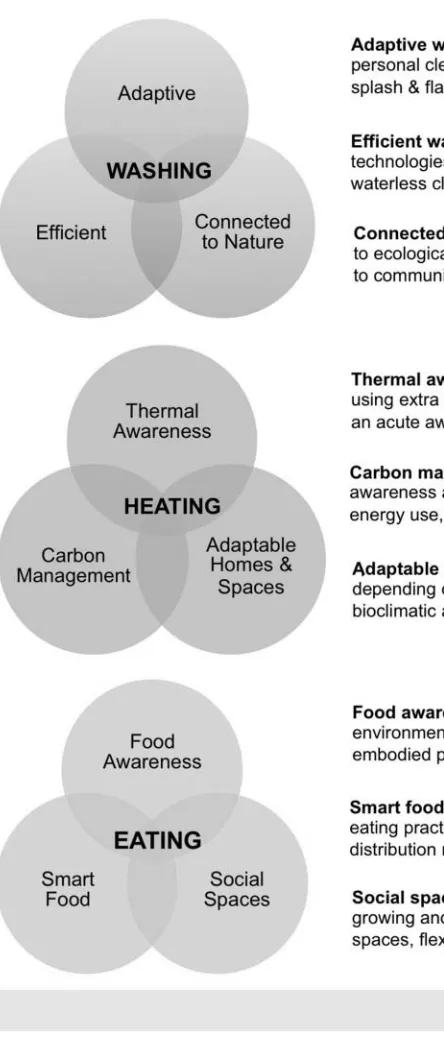
[image:7.612.57.279.87.608.2]found to reveal important insights on the degrees of willingness to accept reconfigured allocations of respon-sibility and competency (Jelsma 2003) among people, technology, and government in the performance of the future practices. It was on the basis of the stakeholder Figure 2. Promising practices for heating, washing, and eating.
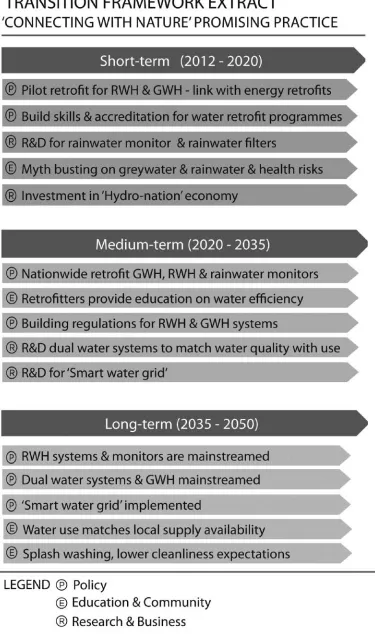
Figure 3. Illustrative transition frameworks.
visioning process and citizen-consumer findings that promising practices were identified for each area of study (summarized in Figure 2). These represent alter-native strategies to be explored and contain combina-tions of complementary tools, skills, norms, regulacombina-tions, and systems of provision.
Each promising practice was distinguished by its promotion of a particular guiding principle or “how-to” rule for that practice; for example, “adaptability,” where, in the case of washing practices, people adjust their responses in accordance with natural fluctuations in water availability. This draws on work by Akrich and Latour (1992), whereby everyday objects are con-sidered to reflect and reinforce, or script certain values (e.g., sustainability) and rules of practice (e.g., product design guiding room temperature settings or signaling appropriate frequencies of usage). In this case, how-ever, it was considered that systems of provision and related regulations should also be considered for their capacity to script particular principles; for example, rainwater harvesting systems to build understanding of fluctuations in water supply or variable water charges based on water availability, both of which would encourage and necessitate adaptive washing practices.
Although transitions studies do consider cultural drivers, these are typically ascribed to the landscape level, often considering polarities in cultural trends like localism versus globalism, and cultural conditions affecting acceptance of technology that are typically considered as external forces beyond the remit of influ-ence (Bailey and Wilson 2009). This limited under-standing of how cultural norms and motivations are cultivated by everyday systems, services, and technolo-gies was then addressed in POP backcasting through its scripting approach. In the promising practices that emerged in relation to heating, eating, and washing, commonalities can be seen in the scripting of princi-ples of adaptiveness (challenging standardized, unre-flective practices), efficiency (rules to curtail resource use and technologies to enable efficient consumption), personal awareness (e.g., of personal bodily warmth, cleanliness, and nutrition needs), ecological connect-edness (practices that are responsive to natural limits, seasonal or daily resource fluctuations), and sociality (e.g., where collaborative consumption promotes sus-tainability). In the final transition phase of the research, stakeholders were invited to brainstorm interventions to build toward the future promising practices that had been identified. During this second phase of brainstorming they were encouraged to think
of complementary policy interventions (e.g., economic tools, voluntary codes of practice, or design and build-ing regulations), education and engagement activities, and even new business models (e.g., interactive experi-ential learning programs, ICT-enabled peer–peer shar-ing initiatives), as well as research and development strategies nested along a short-, medium-, and long-term timeline. These ideas were discussed among the participants and formulated into transition frameworks for each practice. An illustrative promising practice from one transition framework is provided in Figure 3.
As outlined earlier, although critical analyses of the relative strengths and limitations of both transitions and social practice research processes are relatively well developed, constructive dialogue between the two perspectives remains comparatively rare. Instead, interaction has predominantly been manifest through critique, defense, and clarification of established posi-tions (Rotmans and Kemp 2008; Shove and Walker 2008; Geels 2011). Even where attempts have been made to foster dialogue, the work has either remained at the conceptual level (McMeekin and Southerton 2012) or has been a retrospective analysis of empirical studies focused on current practices rather than on how practices might evolve more sustainably in the future (Hargreaves, Longhurst, and Seyfang 2013). Nonetheless, there appears to be a growing appetite to “forge intellectual bridges . . . and [develop] . . . a shared language of discourse” (Brown, Vergragt, and Cohen 2013, 3). As such, the POP backcasting experi-ment presents an explicit attempt to engage with per-spectives proposed by both approaches through empirical research in a way that involves creatively and collaboratively imagining how socioecological transformations of core household practices might unfold in the future in a more sustainable fashion. So what lessons can be drawn from this experiment in putting practices at the center of participatory back-casting techniques when the goal is socioecological transformation toward more sustainable consumption practices in the home?
Conclusion: Creating Space for Imagining
SocioEcological Transformations
Qualitative surveys were disseminated to more than eighty stakeholders who participated in the backcast-ing study. These were explicitly designed to evaluate learning processes and stakeholder perceptions of POP backcasting approaches. The responses from the survey
indicate that many found the experiment provided them with a new space for interaction, collaboration, and nexus thinking (Davies, Doyle, and Pape 2012). The process brought together stakeholders from differ-ent arenas, many of whom are either frequdiffer-ently in con-flict (e.g., environmental groups and industry) or operating in dislocated spheres of activity (e.g., com-munity activists and product developers). Although long-established rivalries or poor interpersonal rela-tionships are hard to overcome, the future perspective and the focus on solutions rather than critique within POP backcasting was seen as assisting in the develop-ment of a generally cooperative ethos among partici-pants. As found in the work of Quist, Thissen, and Vergragt (2011), such benefits may be found in many participatory backcasting processes, but did the prac-tice orientation bring any additional benefits to the interactions?
Certainly, participants mentioned that reorienting discussions away from end-of-pipe environmental problems (e.g., water shortages or climate change) toward questions of the needs that practices fulfill enabled them to drill down to the underlying drivers of unsustainable consumption in ways that took account of the manifold interactions of actors, agen-cies, and technologies. Rather than simply extrapolat-ing current behaviors (and hence resource consumption) into a technologically enhanced “tomorrow’s world,” the approach permitted attention to how more sustainable practices (new and familiar) might be developed to meet or indeed disrupt current needs and desires. Such reframing also, at least to some extent, diffused potential tensions between stakeholders precisely because it removed the focus from particular industries, products, or services and concentrated instead on how needs might be met dif-ferently in the future through the combined influences of new technologies, policies, or social change. This solutions-oriented perspective encouraged participants to think about how practices might be recrafted such that their resource-intensive elements might be addressed; for example, how less sustainable elements embedded within practices might be substituted by more sustainable ones and how practices might inter-lock, as is the case between personal washing and home heating (Spurling et al. 2013). Essentially, beyond the interpersonal learning, capacity-building, and networking that occurred both during and beyond the workshops, taking practices as the fundamental unit of analysis created space for participants to rethink the ways in which they engaged with heating,
washing, and eating. Such problem and solutions redefinition suggested higher order learning (Davies, Doyle, and Paper 2012), said to allow space for the emergence of behavioral or procedural alternatives (Quist, Thissen, and Vergragt 2011) and potentially increasing the likelihood of adoption of the backcast-ing proposals.
Yet, as with all participatory processes, POP back-casting experiments struggle to ensure complete inclusivity or representativeness. Nor do the result-ing outputs necessarily have the authoritative and affective power to transform socioecological systems. For example, the formation of the new centralized state body to manage water provision in Ireland (Irish Water) by its very creation allocates signifi-cant power to actors within the organization (some of whom were involved in the POP backcasting pro-cess) to form new directions for the collection, treat-ment, and provision of water to householders. Decisions and actions by Irish Water will inevitably contribute to the shaping of household washing practices, particularly through proposed mechanisms for water charging. It would be simplistic, however, to assume that the activities of Irish Water alone shape how and why people wash. The horizontal cir-culation of multiple messages about health and hygiene, along with promises of new bathing sensa-tions, are constantly relayed through advertising by geographically dispersed commercial actors seeking to compete for enhanced market share. These delib-erate and explicit interventions are [re]interpreted through peer networks (online and offline) and familial socialization processes, which in turn could feed into future market research and development for washing products and services. All of these actors, including citizen-consumers, as well as the devices and regulatory frameworks they formulate and implement, contribute to the way practices endure or change over time. Not only do they affect the way that practices are performed, they could also—through combination, tension, and sometimes contradiction—create more widely experienced shifts in the practices of washing, heating, or eating.
The POP backcasting experiment detailed in this article explicitly created spaces for the delineation, discussion, and debate of coordinated interventions expressly for the purpose of reducing the material intensity of everyday practices that involve the use of constrained resources but also seeking to build social capacity and economic security. It was ultimately an experiment in collaboration for future-oriented
governance of everyday household activities with an explicit focus on sustainability innovation, which adopts social practices as the basic unit of enquiry. How much further POP backcasting gets us along the road to actualizing more sustainable consumption depends on the collective imagination and actions of multiple actors (in organized and informal processes) to think about and enact new modes of interaction and hence social relations across spheres of society (public, private, and civil society); to untangle the complex and often global forces lying behind produc-tion and consumpproduc-tion patterns; and to face head-on the ways in which sociotechnical and socioecological interrelations play out in quotidian household practices.
As it is changes in practices rather than the articu-lation of visions and plans that will ultimately lead to socioecological transformations, additional research is necessary to experiment with implementing the prom-ising practices identified and to evaluate the resulting outcomes. Building on the POP backcasting visions and transition frameworks, the HomeLabs project (see http://www.consensus.ie/homelab) responds to this need by drawing inspiration from collaborative “Living Lab” strategies taking place between industry and research institutes (Green 2007), as well as academic studies that are actively prompting altered practice performances (e.g., Higginson, Thomson, and Bhamra 2014). The HomeLabs are constituted by combined information, technology, and regulatory interventions that are introduced into households and then tested and evaluated by householders in conjunction with the research team for their capacity to support practice transformation. For example, during the washing HomeLabs, households are being provided with infor-mation designed to promote understanding of the ori-gins of their water supply (e.g., location information for reservoirs or aquifers, photographs, data on capac-ity), targets or rules for reducing water use for washing (based on international guidelines for sustainable water use), enabling tools to enhance visibility and consciousness of water use in real time (smart water meters, timers), and products to assist in meeting the needs associated with personal washing in ways that are not so consumptive of water (from spot cleaning to dry shampoos). Within the HomeLabs experiment, the researcher acts as a filter, providing information on, for example, ways in which washing needs might be achieved with lower resource use and also how needs that are currently met through the use of water
but that do not necessarily require water (e.g., to wake up in the morning or relax in the evening) could be satisfied by other nonconsumptive means (e.g., mind-fulness or stretching). The researcher also acts as a facilitator, prompting discussion about the implica-tions of alternative ways of meeting washing needs. Given the prototypical nature of many enabling devi-ces for more sustainable consumption, the researcher plays a pivotal role as an interface between these tech-nologies and the participants, particularly in the ICT-led smart water meter arena. Enacting such experi-mental HomeLabs affords another layer of meaning to better understand the relationship between sociotech-nical change and its socioenvironmental consequen-ces. It critiques the assumption that radical technical change takes place “in the context of relative social stasis, rather than technological and social change being interwoven through social practices” (Spurling et al. 2013, 7) and puts attention to the mechanics and cultures of everyday practice back on a par with novelty and innovation transfer (Hargreaves, Long-hurst, and Seyfang 2013). Nevertheless, a challenge for these experiments, and indeed for all research proj-ects focused on both understanding consumption prac-tices and seeking to provide assessments of interventions to shift those consumption practices in more sustainable directions, is how positive outcomes identified in bounded experimental sites might be rolled out. The intensity of human resources involved in establishing, running, and evaluating HomeLabs-style initiatives means a simple scaling up nationwide is unrealistic. Equally, issues of power, knowledge, and politics course through the veins of everyday life, eas-ily derailing any assumption that findings from one set-ting can be simply replicated in another. Rather than seeing HomeLabs themselves as outcomes to be rolled out in this way, we argue instead that they are more usefully seen as test beds for grounding and interrogat-ing collaboratively designed scenarios for more sus-tainable household consumption futures. Further research and analysis is required before it is possible to say whether particular configurations of interventions (including the crucial roles of actors as filters, facilita-tors, and interlocutors) have wider potential to disrupt unsustainable household consumption practices in dif-ferent settings. Nonetheless, the risks of untrammeled household consumption are so great, and gains made from governing approaches to date are so limited, that experimenting with different ways of approaching con-sumption governance is essential.
Acknowledgments
Thanks go to all of the research participants who contributed to the backcasting and HomeLabs experiments.
Funding
We would like to acknowledge funding from the Environmental Protection Agency of Ireland through the STRIVE Research Programme that supported the research on which this article is based: Project Number 2008-SD-LS-1-S1.
References
Akrich, M., and B. Latour. 1992. A summary of a conve-nient vocabulary for the semiotics of human and non-human assemblies. In Shaping technology, building society: Studies in sociotechnical change, ed. W. Bijker and J. Law, 259–64. Cambridge, MA: MIT Press.
Anderson, B. 2010. Preemption, precaution, preparedness: Anticipatory action and future geographies.Progress in Human Geography34:777–98.
Bailey, I., and G. Wilson. 2009. Theorizing transitional pathways in response to climate change: Technocen-trism, ecocenTechnocen-trism, and the carbon economy. Environ-ment and Planning A41:2324–41.
Brown, H., P. Vergragt, and M. Cohen. 2013. Societal inno-vation in a constrained world: Theoretical and empiri-cal perspectives. In Innovations in sustainable consumption: New economics, socio-technical transitions and social practices, ed. M. Cohen, H. Brown, and P. Vergragt, 1–30. Cheltenham, UK: Edward Elgar. Davies, A. R. 2014. Co-creating sustainable eating futures:
Technology, ICT and citizen-consumer ambivalence.
Futures: The Journal of Policy, Planning and Futures Stud-ies62:181–93.
Davies, A. R., R. Doyle, and J. Pape. 2012. Future visioning for sustainable household practices: Spaces for sustain-ability learning?Area44 (1): 54–60.
Davies, A. R., F. Fahy, and H. Rau. 2014.Challenging con-sumption: Pathways to a more sustainable future. London and New York: Routledge.
Davies, A. R., F. Fahy, H. Rau, and J. Pape. 2010. Sustain-able consumption and governance: Reflecting on a research agenda for Ireland.Irish Geography43:59–79. de Goede, M., and S. Randalls. 2009. Precaution, preemption:
Arts and technologies of the actionable future. Environ-ment and Planning D: Society and Space27:859–78. De Gues, M. 2002. Ecotopia, sustainability and vision.
Organization and Environment15:187–201.
Doyle, R., and A. R. Davies. 2013. Towards sustainable household consumption. Journal of Cleaner Production
48:260–71.
Eames, M., and J. Egmose. 2011. Community foresight for urban sustainability: Insights from the Citizens Science
for Sustainability (Suscit) project. Technological Fore-casting and Social Change78 (5): 769–84.
Fischer-Kowalski, M., and J. Rotmans. 2009. Conceptualiz-ing, observConceptualiz-ing, and influencing social–ecological transi-tions.Ecology and Society14:3–20.
Geels, F. W. 2010. Ontologies, socio-technical transitions (to sustainability) and the multi-level perspective.
Research Policy39:495–510.
———. 2011. The multi-level perspective on sustainability transitions: Responses to seven criticisms. Environmen-tal Innovation and SocieEnvironmen-tal Transitions1:24–40.
Green, J. 2007.Democratizing the future: Towards a new era of creativity and growth. Philips Electronics N.V. Hargreaves, T., N. Longhurst, and G. Seyfang. 2013. Up,
down, round and round: Connecting regimes and prac-tices in innovation for sustainability.Environment and Planning A45:402–20.
Higginson, S., M. Thomson, and T. Bhamra. 2014. “For the times they are a-changin”: The impact of shifting energy-use practices in time and space.Local Environ-ment19:520–38.
Jansen, L. 2003. The challenge of sustainable development.
Journal of Cleaner Production11:231–45.
Jelsma, J. 2003. Innovating for sustainability: Involving users, politics and technology.Innovation: The European Journal of Social Sciences16:103–16.
Kok, K., L. Van Vliet, M. Dubel, J. Sendzimir, and I. B€arlund. 2011. Combining participative backcasting and exploratory scenario development: Experiences from the SCENES project.Technological Forecasting and Social Change78:835–51.
Kuijer, L., and A. De Jong. 2012. Identifying design oppor-tunities for reduced household resource consumption: Exploring practices of thermal comfort. Journal of Design Research10 (1–2): 67–85.
McMeekin, A., and D. Southerton. 2012. Sustainability transitions and final consumption: Practice and socio-technical systems. Technology Analysis and Strategic Management24:345–61.
Meadowcroft, J. 2009. What about the politics? Sustainable development, transition management, and long term energy transitions.Policy Sciences42 (4): 1–18.
Pantzar, M., and E. Shove. 2010. Understanding innovation in practice: A discussion of the production and re-pro-duction of Nordic walking. Technological Analysis and Strategic Management22:447–61.
Quist, J., M. Knot, W. Young, K. Green, and P. Vergragt. 2001. Strategies towards sustainable households using stakeholder workshops and scenarios.International Jour-nal of Sustainable Development4 (1): 75–89.
Quist, J., W. Thissen, and P. Vergragt. 2011. The impact and spin-off of participatory backcasting: From vision to niche.
Technological Forecasting & Social Change78:883–97. Rip, A., and R. Kemp. 1998. Technological change. In
Human choice and climate change: Resources and technol-ogy, ed. S. Rayner and E. L. Malone, 327–99. Colum-bus, OH: Batelle Press.
Rotmans, J., and R. Kemp. 2008. Detour ahead: A response to Shove and Walker about the perilous road of transition management.Environment and Planning A40:1006–12. Scott, K., C. Bakker, and J. Quist. 2012. Designing change
by living change.Design Studies33 (3): 279–97.
Shove, E., and G. Walker. 2007. CAUTION! Transitions ahead: Politics, practice and sustainable transition management.Environment and Planning A39:763–70. ———. 2008. Transition ManagementTM and the politics
of shape shifting.Environment and Planning A40:1012– 14.
———. 2010. Governing transitions in the sustainability of everyday life.Research Policy39:471–76.
Shove, E., G. Walker, and S. Brown. 2014. Transnational transitions: The diffusion and integration of mechani-cal cooling.Urban Studies51 (7): 1506–19.
Shove, E., M. Watson, J. Ingram, and M. Hand. 2008.The design of everyday life. New York: Berg.
Spaargaren, G. 2003. Sustainable consumption: A theoreti-cal and environmental policy perspective. Society and Natural Resources16 (8): 687–701.
SPREAD. 2013. SPREAD sustainable lifestyles 2050. Brus-sels, Belgium: European Commission FP7 Project. http://www.sustainable-lifestyles.eu/
Spurling, N., A. McMeekin, E. Shove, D. Southerton, and D. Welch. 2013. Interventions in practice: Re-framing policy approaches to consumer behaviour.SPRG Report 2013. http://www.sprg.ac.uk/ (last accessed 27 February 2014).
Svenfelt, A., R. Engstr€om, and O. Svane. 2011. Decreasing energy use in buildings by 50% by 2050—A backcast-ing study usbackcast-ing stakeholder groups. Technological Fore-casting and Social Change78:785–96.
Tukker, A., and D. Fedrigo. 2009.Blueprint for European sus-tainable consumption: Finding the path of transition to a sustainable society. Brussels, Belgium: EEB.
United Nations. 2013. Latest IPCC findings a clarion call for global community to accelerate efforts to combat climate change and steer humanity out of danger zone. United Nations Official Press Release on IPCC 5AR.
Warde, A. 2005. Consumption and theories of practice.
Journal of Consumer Culture5 (2): 131–53.
Correspondence to:Department of Geography, Trinity College Dublin, Ireland, e-mail: [email protected] (Davies); [email protected] (Doyle).