Journal of Criminal Law and Criminology
Volume 29
Issue 1
May-June
Article 10
Summer 1938
Some Problems Regarding Murder Detection
Hans Von Hentig
Follow this and additional works at:
https://scholarlycommons.law.northwestern.edu/jclc
Part of the
Criminal Law Commons
,
Criminology Commons
, and the
Criminology and Criminal
Justice Commons
This Criminology is brought to you for free and open access by Northwestern University School of Law Scholarly Commons. It has been accepted for inclusion in Journal of Criminal Law and Criminology by an authorized editor of Northwestern University School of Law Scholarly Commons.
Recommended Citation
1930
Editor:
FREDE.
INBAUSOME PROBLEMS REGARDING MURDER
DETECTION
HuNs voN HENTxt
The battle formation in the fight against crime is a four-line
echelon: the front line consists of investigation, while the three
supporting lines are criminal procedure, sentence, and execution.
These last three proceedings are ruled by fixed regulations and
have been methodically developed through the centuries.
Detec-tion to the contrary, has been singularly neglected. It has been
left growing wild. There has been neither a systematic and
teach-able transmission of the many experiences made by skillful experts,
nor has a science of detection been evolved.
The selective mechanism of criminal law runs neutral, as soon
as the investigating agencies do not supply it with living material.
Practically all validity and efficacy of the law and its periodical.
oscillations from mild to rough and from rough to mild depend upon
one sole presumption: detection.
This statement seems evident,
and the only astonishing thing is the silence which prevails about
detection, its results, and its failures.'
The great departments of
t Formerly Professor of Criminal Law and Criminal Science, University of Bonn, and Editor of the Monatsschrift fur Kriminal-Psychologie. Recently with the Attorney General's Survey on Release Procedures, Washington, D. C.
1 It means silence to me, if assertions are as contradictory as the following:
"There is a very interesting factor in connection with Mr. Hoover's paper, and that is that the police are highly successful in catching most of the offenders." Mr. Ewing Cockerell, U. S. Federation of Justice, Warrensburg, Missouri
criminal investigation sometimes do not hesitate to point at the
inertia, the weaknesses, and the chronic bad crops of the
adminis-tration of criminal justice. All these objections can easily be
veri-fied by statistics of previous convictions and previous paroles. The
official statistics discuss these defects frankly.
2But ought not
de-tection likewise assume its share in the improvability of all the
crime combating agencies?
It has been said that the grave hides the mistakes of the
medi-cal men. But what is it then that hides the errors and mistakes
of
the
bureaus of investigation?
They have the humanly
under-standable interest of a certain publicity, if success has crowned their
efforts. They have the humanly understandable interest, as well,
not to exhibit the accidents of misfortune, blunder, or miscarriage.
This wish may account for the refusal of aids offered by independent
sources, which at times have been complained of.
3And as they,
they alone, dispose of the facts and their interpretation, so they
order as well the final disposal of the crimes that have been
re-ported to them.
Science is to fill this gap, and science shall fill it. The
construc-tive and necessary criticism, now directed at the deficiencies of the
law, the judges, of the parole boards and the prison practices, ought
to be extended to the work of the detective bureaus. This
exam-ination will be a sound corrective to the backward agencies, an
acknowledging incentive to the many able or hard working chiefs,
and a pavement for future reforms and progressive developments.
'Are
could attempt to arrive at the "mortality" rate of a single
ceedings of the Attorney General's Conference on Crime, Washington, 1935, p. 75).
Mr. Ioover's asseition was: "I might state that the conviction record of the Bureau of investigation for the last year was approximately 94%. In other words, only about six men out of every hundred who were tried, escaped conviction."
Ibid. p. 27. On the other hand Professor Thorsten Sellin stated: "In 1933 there
were probably a minimum of 1.300,000 serious crimes known to the police of this country. In three-fourths of these crimes no one was brought to justice." Ibid. p. 381.
2 "There is a wide-spread dissatisfaction with the administration of criminal
justice in this country. It has been felt for a long time, that too many guilty offenders escape merited punishment. The defects of criminal justice have in-spired numberless books, magazine and newspaper articles and speeches." Judi-cial Criminal Statistics for 1934 (Washington, 1936) at p. 1.
3 'Unwilling and unable to avail itself of the inventions and processes of
crime or a selected group of so-called serious crimes,4 but such data are, and remain, rather incomplete. In addition to the absence of a standard to discern what is the relation of actual crimes and re-ported crimes, the Census Bureau has no statistics on the numerous cases eliminated by the preliminary hearing, by the grand jury, or by the prosecutor's refusal to file an information.'
The Judicial Criminal Statistics for the year 1934 present an incomplete but nevertheless not quite useless summary of proced-ural dispositions.0 Twenty-six "major" offenses and twenty-five states are comprehended by these statistics.
TABLE 1
PROCEDURAL DISPOSITIONS (1934)
Number Percentage
Defendants before the court in 25 states ... 157,910 100.0 Cases pending at end of year ... 17,982 11.4 Defendants disposed of during year ... 139,928 88 6 Defendants disposed of during year ... 139,928 100.0 Disposed of without conviction ... 42,563 30.4 Convicted of offense charged ... 92,911 66.4 Convicted of lesser offense ... 4,454 3.2
The writer has reckoned out the corresponding relations in two groups of federal offenses: the violations of liquor laws and drug laws.7 It must be borne in mind that, in general, 11-12% of all defendants are not disposed of during one year. A certain addition therefore has to be made to the cases disposed of without conviction, and a certain subtraction of cases belonging to the preceding year.
TABLE 2
PROCEDURAL OUTCOME OF OFFENSES AGAINST LIQUOR LAws
AND DRUG LAWS-PERCENTAGES (1934)
Violations of
Liquor Laws Drug Laws
Total defendants disposed of ... 100.0 100.0 Disposed of without conviction ... 43.1 16.1 Found guilty of offense charged ... 56.2 83.7 Found guilty of lesser offense ... 0.7 0.2
4 Can one consider "major" offenses not taken to be such by public opinion? "In many cities," says the Judicial Criminal Statistics for 1934, t p. 4, "there
is a prejudice against the enforcement of liquor, gambling and prostitution laws, which undoubtedly is reflected in the decisions of the judges and jurymen."
5 Judicial Criminal Statistics for 1934, at p. 3.
6 Ibid. p. 3.
Here again it is quite obvious that the stated number of individuals violating liquor laws and drug laws in 25 states8 does not reach,
by far, real conditions. Innumerable cases are not known or are not reported, a further indeterminate number is eliminated by the preliminary hearing, or by the prosecutor's refusal to file an in-formation. Thus the defendants "disposed of" represent a
van-ishing minority.0
It can hardly be just, therefore, to derive a so-called Zonvic-tion record from the very last stage of judicial proceedings, the trial. There is a great number of preliminary dispositions, founded on facts or on law, which eliminate suspected or non-suspected, de-fendants or non-dede-fendants. The individuals who go to trial repre-sent a diminutive sediment, one which has been boiled down-and it can be boiled down at will-by the most diverse proceedings and activities. No wonder there is a large proportion of guilty pleas-for the simple reason that the guilty plea is the principal reason pleas-for bringing such defendants to trial."0 Very often it takes the place of good investigation work. Eighty-two per cent of the defendants convicted for forgery, auto theft, burglary, larceny and embezzle-ment pleaded guilty in 1934.11 The average of 26 "major" offense$ was 75.8%. Parking violations head the enumeration with 99.0%. On the other hand, no more than 42.0% of'the individuals charged with murder pleaded guilty. Unfortunately we have no data as to
8 "The area covered by this report contains approximately 42.8% of the popu-lation." Judicial Criminal Statistics for 1934, at p. 1. As Rhode Island and Vermont are excluded from the analysis, 25 states remain of a total of 27. The percentage therefore remains slightly under 40% of the whole population.
9 It is critical to try a rough estimation, but the writer believes that no more than 2-4% of convictions would be left, if we could enlarge the "partial" insight (Judicial Criminal Statistics, at p. 3) into a complete and thorough one. By obvious reasons such a task is beyond human power. •
1OThe writer has discussed the whole problem at length in former years. See "Das Leugnen," Schweizerische Zeitschrift fur Strafrecht (1937) 201-11; "Das Gestaendnis," ibid. (1929) 23-45; "Zur Psychologie der Ausrede," Festschrift fur Gustav Aschaffenburg (Heidelberg, 1926), 97-106. Very instructive is the recent statement of Dr. W. N. East, "Medical Aspects of Crime" (London, 1936) at p. 369, that of 200 sane murderers 48.5% confessed; of 300 insahe murderers, 65.0%. The high rate in insane murderers is probably due to the considerable proportion of depressives and of the patients suffering from illusions. Whoever believes or is believed to be in self-defense "admits" but does not plead guilty, nor does he intend to do. so.
"1 Judicial Criminal Statistics for 1934, at p. 15: "Pleas of guilty are more numerous in offenses against property than in offenses against the person." That the plead of guilty is mainly a measure of defense is shown by the instance of forgery. Forgery has the high rate of pleading guilty of 88%. The result is that only 44.6% of the defendants sentenced for forgery are sent to state prisons or reformatories. In 32.4% of all cases of forgery the court arrived at probation or a suspended sentence with or without supervision. Judicial Criminal Statistics for
how many negroes were among the 367 murderers pleading guilty in 25 states.
If the lack of data prevents us from proceeding further and if we desire to obtain more than a "partial" insight, the crime
of murder presents the opportunity to approach closer the actual
conditions that underlie the subsequent police investigations and
judicial proceedings. Murder is not only a legal abstraction but a medical phenomenon. We possess mortality statistics, and if these statistics could be compiled in the ideal manner every murder would stand out as one death caused by illegal interference. It
would not be difficult to trace this violent death through to the rate
of convictions for murder. In general, one conviction would cor-respond to one death occurring under special circumstances.2
The mortality figures for homicide are available for the whole country after Texas entered in 1933 as a full registration state."3 The figures of convictions for homicide are only given for 25 states; these areas contain approximately 40% of the total population. It is doubtful that we come very close to the truth by adding to these figures 60% more convictions, because other powerful forces in-terfere, such as age distribution, sex ratio, and many other factors. Nevertheless the following table will prove serviceable for com-parative purposes:
TABLE 3
HOMICIDE AS DEATH CAUSE AND CONVICTIONS FOR HOMICIDE (1934)
Cases of death by homicide14 ... . . . 12,055 Convictions for homicide'5 (estimation)16 ... 3,659
The conviction rate would thus be 30.2% of all cases in which the
death cause "homicide" is registered by the mortality statistics."
12 Complete conformity is prevented by the fact that several individuals can
be involved in one homicide, and that more than one person can be murdered by one perpetrator.
-Mortality Statistics for 1934 (Washington, 1936).
'4 Ibid. p. 16.
15 Figures of convictions for murder and manslaughter in Judicial Statistlc for 1934, at p. 14, have been added.
,6 To the 1,523 convictions for murder and manslaughter in 25 states, 60% have
been added to arrive at an estimate for the whole country.
The same result is attained by comparing all homicide deaths
and the reported arrests for homicide.
TABLE 4
HOMICIDE AS DE:ATH CAUSE AND ARRESTS FOR HoMICIDE (1934)
Cases of death by homicide ... 12,055 Arrests for homicide1 8 (estimation) ... 13,000
The arrest figures of the Uniform Crime Reports do not clarify
the situation. No police e-€pert need be told that ten and more
arrests are not uncommon in one murder case. The paradoxon is
even admissible: the less the murderer is known, the more the
number of arrests.
Figures of arrests would only be useful if
they were compiled according to the number of murder cases
investigated.
The comparison of deaths by homicide and the number of
con-victions for homicide (Table 3) deserves more thorough and more
serious consideration. The number of convictions is solidly
estab-lished, although it went through proceedings of an estimation. The
numerical foundation provided by 25 states is sound.
But the
second ingredient of the comparison,.the deaths caused by homicide,
cannot escape the most reasonable doubts.
Murder seeks concealment.
With rare exceptions the fact of
a death cannot be concealed. The motives and causes of violent
death, however, might be obscured or hidden. A few kinds of
homicide do not escape widest publicity. They frequently occur
in public streets or in public houses. They are often featured by
the press and, in gang killings, by the fighting gangs themselves,
in the manner of a war bulletin.
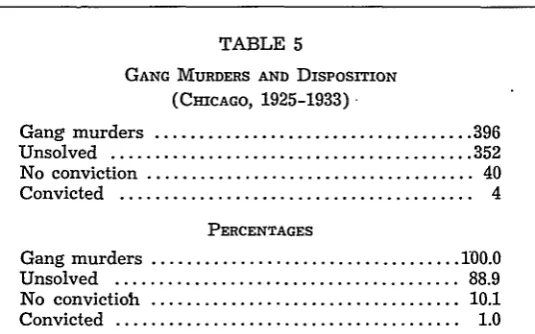
Bruce Smith'
9has published figures in such cases. A summary
of his figures is presented in the following table, which indicates
a very low conviction rate:
Police. By reading through the Roll of Honor of the New York police force we meet 14 people killed by officers on duty. Annual Report (1936) 73-84.
18 Uniform Crime Reports, Vol. 5 (Washington, 1935) p.'28.
TABLE 5
GANG MURDERS AND DISPOSITION (CHICAGO, 1925-1933)
Gang murders ... 396
Unsolved ... 352
No conviction ... 40
Convicted ... 4
PERCENTAGES Gang murders ... 100.0 Unsolved ... 88.9 No Convictioh ... 10.1 Convicted ... 1.0 The validity of all death figures, caused by homicide is open to question from another angle. Brearley20 has emphasized how these figures come about and how far they correspond to reality. He directs our attention to the psychology and sociology of the death certificate. It is usually prepared within a few hours in order that the undertaker may be permitted to move the body. More-over, physicians do not like to testify in court. "Many certificates, therefore, that might be reported as homicides are actually stated to be accidents. Other terms used to smooth over the situation temporarily are: 'probably an accident,' 'gunshot wound of un-known origin,' 'unun-known cause,' 'violent death,' 'fractured skull,' etc. In such cases letters of inquiry from the bureau of vital sta-istics often remain unanswered." Breanley's assumptions are strongly supported by a glance at the statistics of accidents in the latest mortality statistics. The "ill-defined" and "not specified or unknown" causes of death alone surpass by far the homicide figures. TABLE 6 MORTAL ACCIDENTS21
(1937)
Accidental deaths ... 101,139 Accidental mechanical suffocation ... 1,124 Traumatisms by firearms ... 3,023 Traumatisms by cutting or piecing instruments 1,254 Traumatisms by fall ... 23,828 Accidental absorption of poisonous gas ... 1,695 Poisoning by food ... 73820 Brearley, H. C., Homicide in the United States (1932) 13 et seq.
[image:8.431.73.341.73.240.2] [image:8.431.53.335.465.566.2]No doubt that among these 101,139 deadly accidents and among
the 20,929 deaths by ill-defined and unknown causes an
undeter-minate but considerable number of homicides is hidden.
The same holds true for the 18,828 cases of suicide. It is
fur-ther evident that among the enormous number of 1,243,952 deaths
from "natural causes"
22in 1934 there would be a considerable
number to whom this deduction applies. The following table gives
a short summary of the main death causes in which the ambiguity
of malady symptoms is conspicuous.
TABLE 7
AMBIGuoUS NATURAL DEATH CAUSES22
(1934)
All natural death causes
...
1,243,952
Cerebral hemorrhage
...
108,110
Diseases of the heart, other and unspecified 49,986
Diarrhea and enteritis
...
23,201
Next to the physician, coroners and jurors are ordered to
in-vestigate suspicious causes of death. "When violence is suspected
a coroners investigation is held."
"This may, however," remarks
Brearley, "do little to clarify the record, since the inquests are often
hasty and superficial.
''2 4A last group where homicide cases might be suspected are the
missing persons and the unidentified dead. The missing persons do
not, by obvious reasons, appear in any mortality statistics.
22 Ibid. p. 14: "In many deaths there is no attending physician to certify the cause. The registrar of deaths accepts the word of the parents or relatives." Brearley, H. C., Homicide in the United States (1932) 14. It is well known that a large number of homicides are family tragedies, and the same members of the family dispose* of the designation of the death cause.
23 Supra note 21 at p. 15. "Physicians state that they are quite willing to certify the medical situation . . .but that they wish to avoid statements of a legal nature, such as 'homicide' or 'suicide.' Accordingly, when reporting violent deaths, they attempt to avert criticism and antagonism by minimizing the gravity of the situation, whenever the facts are not generally known or clearly estab-lished." Brearley, op. cit. supra note 20, at p. 13.
24 "Unless the evidence is unequivocal, the jurors hesitate to charge that a
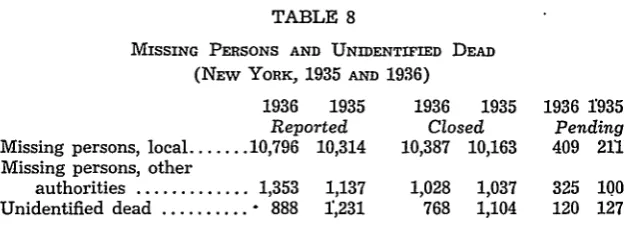
Data for the whole country are not available;25 but the figures of the New York Police Department are significant enough.26
TABLE 8
MISSING PERSONS AND UNIDENTIFIED DEAD (NEw YORK, 1935 AND 1936)
1936 1935
Reported
Missing persons, local ... 10,796 10,314 Missing persons, other
authorities ... 1,353 1,137 Unidentified dead ... 888 1,231
1936 1935
Closed
10,387 10,163
1936 I935
Pending
409 211
1,028 1,037 325 100 768 1,104 120 127
Without entering into a discussion about the meaning and the
extent of the term "Closed," and omitting the missing persons who
were not local cases, the following instructive table of pending
missing persons and pending unidentified dead is opposed to the homicide convictions of New York:
TABLE 9
MISSING PERSONS, UNIDENTIFIED
DEAD (PENDING) 27 NEW YORK,
1935
AND1936
1936 1935 Missing persons, pending..409 211 Unidentified dead, pending 120 127
Total ... 529 338
HOMICIDE CASES AND CONVICTIONS
FOR HOMICIDE
2 8
NEW YORK, 1935 AND 1936
1936 1935 Deaths (death cause
homicide) ... 443 443 Convictions for homicide..104 94
The convictions for homicide amount merely to 19.6o (1936)
and 27.8% (1935) of the missing persons or unidentified dead.
29The expert knows, moreover, that mistakes, even frauds, are not
uncommon in the identification of corpses. We ought to have more exact dates about missing persons, covering a sufficient period and a sufficient area. 0
2 5
In Washington, D. C., out of 3,501 missing person cases reported during the fiscal year 1936-1937, 3333 were located. This leaves the number of 168 persons still missing.
26 Annual Report for the Year 1936, Police Department, City of New York
(1937) at p. 8.2 7
Supra note 25, at p. 104.
28 Supra note 25, at p. 104.
29 Convictions would descend to 10.7% (1936) and 12% (1935) if we include the
deaths by homicide as proved by the mortality statistics. Our death figures are not available for the years 1936 and 1935, but only for 1934.
[image:10.431.54.367.108.221.2]The result of this survey is discouraging. Reforms are needed, but no reform can be accomplished without understanding and without reform mindedness. Even if this nation would rise to estab-lish a center of teaching the tactics and the strategy of the internal defense, a West Point of Law Administration and Law Enforce-ment, the necessity of a change has to be impressed upon public opinion. What the writer fears most is an hasty effervescence and an hasty collapse.. Calm and tenacious determination is needed, that does not talk very much, does not promise miracles, that does not work for the present alone but for future generations.
The situation is discouraging, but not hopeless. Detection and conviction have likewise a very low success rate in other countries, especially regarding murder. East"' has lately given figures for England:
TABLE
10
DIsPosrTIoN OF 343 INDIVIDUALS INVOLVED IN 338 MURDER
CASEs KNOWN TO THE POLICE (ENGLAND, 1929-1932)
Not arrested ... 27 or 7.9% Suicide3 2 ... . .. .. .. .. ... . ... . ... .. .. .. 132 or 38.5% Discharged and not convicted33 ... .. .. .. 129 or 37.6% Convicted ... 55 or 16.0%
If the excellent English Police arrive at a conviction rate of only 16% of the murders known to the police, we need not lose courage. We must bear in mind two trends in reading the English figures. A considerable number of murders keep outside the cases "known to the police." On the other hand 86 persons of the number of the non-convicted were taken over as insanes by other protective agen-cies and therefore removed from free life.3 4
Furthermore, the English figures apply to murder exclusively; its detection rate ig
lower than in manslaughter.
How can detection be improved? Detection has two sides: a purely technical one and a psychological one. The technical
prog-ccncealed. The newspapers occasionally report the finding of an unidentified skeleton and thus controvert the familiar proverb: Murder will out." Brearley,
op. cit. supra note 20, at p. 14. Proverbs mainly answer the conditions that
pre-vailed at the time of their origin. It is dangerous to rel' on proverbs under fundamentally altered circumstances. Today for instance a corpse can be an-nihilated by chemical means without the slightest trace left.
slEast, W. N., Medical Aspects of Crime (1936) 368.
32 One case of a suspect dying during trial (no suicide).
3 Discharged at police court, 8; no true bill, 1; acquitted, 34; insane on ar-raignment, 26; guilty but insane, 60.