Munich Personal RePEc Archive
Small price change response to a large
devaluation in a menu cost model
Bruchez, Pierre-Alain
3 April 2007
Online at
https://mpra.ub.uni-muenchen.de/3541/
Small Price Change Response to a Large
Devaluation in a Menu Cost Model
Pierre-Alain Bruchez
y3 April 2007
I would like to thank my thesis advisor Professor Philippe Bacchetta for useful com-ments, as well as, along with Olivier Jeanne, for getting me launched in this research direction. I would also like to thank the members of my thesis committee: Professors Harris Dellas, Jean Imbs and Giovanni Favara.
yMailing address: Gesellschaftsstrasse 79, 3012, Bern, Switzerland.
Small Price Change Response to a Large
Devaluation in a Menu Cost Model
Abstract
In an empirical paper based on …ve large devaluation episodes in
Ar-gentina, Brazil, Korea, Mexico and Thailand, Burstein and al. (2005a) …nd
a very slow adjustment in the prices of non-tradable goods and services
af-ter large devaluations. Burnstein and al. (2005b) develop a quantitative
general-equilibrium model that can account for this phenomenon. I consider
an alternative, simpler model and explore under which conditions moderate
menu costs can explain the muted response of the prices of non-tradables.
The key new element in this alternative model is a nominal friction in
wage-setting (generated by menu costs for changing wages). I …nd, for example,
that although my model is based on menu costs, it is able to deliver not only
constant prices of non-tradables, but also small price changes (in reality these
prices do change, albeit by far less than the exchange rate). I also discuss
the existence of multiple equilibria and the role of central-bank credibility.
Keywords: large devaluation, exchange rate, pass-through, sticky prices,
1
Introduction
In an empirical paper based on …ve large devaluation episodes in Argentina,
Brazil, Korea, Mexico and Thailand, Burstein and al. (2005a) …nd a very
slow adjustment in the prices of non-tradable goods and services to large
de-valuations. Burnstein and al. (2005b), henceforth BER, address the question
of why the rate of in‡ation for non-tradable goods is so much lower than the
rate of devaluation. They develop a quantitative general-equilibrium model
that can account for this phenomenon. They assume menu costs for changing
a price and show that producers of non-tradables might prefer not to change
their price at all even if the devaluation is large. There are also cases in
which it is not sustainable as an equilibrium phenomenon for …rms in the
non-tradables sector not to change their prices at all (in these cases it is
argued that real shocks are the primary driver of real exchange-rate
move-ments). They incorporate several assumptions into their model that mute
the response of the price of non-tradables to the exchange-rate shock. First,
the share of tradable goods in the consumer price index (CPI) is small.
Sec-ond, there are domestic distribution costs associated with the sale of traded
goods. Third, there is a low elasticity of the demand for exports. Fourth,
non-tradables.1 Moreover, they deviate from the Dixit-Stiglitz model, adopting
Kimball’s (1995) assumption that the elasticity of demand for the output
of a monopolistic producer is increasing in its price relative to the prices of
its competitors’ goods. They conclude, however, by noting a shortcoming of
their paper: the price of non-tradables does not change at all, while in reality
these prices do change, albeit by far less than the exchange rate.2
Like BER, I aim at explaining why the rate of in‡ation for non-tradable
1The price of tradables will change after an exchange-rate shock. The direct impact of
this price change on non-tradables will, however, be small since BER assume a moderate elasticity of substitution between tradables and non-tradables. But even if this elasticity were zero, there would still be other channels through which price adjusments could be induced. For example households would ask for higher wages in order to mute the impact of the increase of the prices of tradables on their real wages. This would incite …rms to increase their prices in order to pass the price increase of the labor input on to consumers. However, incorporating several assumptions that mute responses allow BER to get sticky prices with moderate menu-costs.
2BER focus on rationalizing an equilibrium in which non-tradable goods prices do not
goods is so much lower than the rate of devaluation. I consider an
alter-native, simpler model and explore under which conditions moderate menu
costs can explain the muted response of the prices of non-tradables. The key
new element in this alternative model is a nominal friction in wage-setting
(generated by menu costs for changing wages).3 For tractability, I consider a
partial-equilibrium model rather than a general-equilibrium model like that
of BER.
The intuition as to why this may explain small (but possibly not zero)
changes in the prices of non-tradables is the following. In a setting in which
the markup is a constant proportion of the marginal cost, the desired price
varies in the same proportion as the marginal cost. The marginal cost can
vary through two channels: a productivity change (due to a change in the
quantity produced if returns to scale are not constant) or a change in the
prices of production factors. A devaluation increases the price of imported
goods and tends to move consumption toward non-tradables, thus increasing
the quantity of non-tradables produced and reducing marginal productivity
(assuming decreasing economies of scale). Since I use the moderate elasticity
3I owe the idea of introducing wage stickiness, and, more generally, the model I use
of substitution between tradables and non-tradables assumed by BER, this
…rst channel by itself motivates a price change, albeit by far less than the
exchange rate. This leaves the second channel: the wage (I assume that labor
is the only production factor). If workers do not want to reset their wage, this
second channel is not active. Then the desired price change of non-tradables
…rms is small, and this small change will occur if their menu cost is small
enough. But why would workers not reset their wage after a large devaluation
although they have two incentives to do so: i) to preserve their real wage and
ii) to compensate for higher labor disutility due to the increased quantity of
labor they must furnish? These two incentives may be so weak that they do
not outweigh even a moderate menu cost of resetting wages. First, the change
in price level is moderate since the change of the price of non-tradables is
small and the share of pure tradables (exclusive of distribution costs) in the
CPI is assumed, as in BER, to be moderate. Second, the change of labor
is also moderate since, as discussed above, production of non-tradables does
not increase much (and the production of tradables doesn’t change much
either, since the prices of tradables are assumed to adjust completely and
there is no substitution between domestic and foreign tradables4).
exoge-I will try to avoid the shortcoming of BER consisting in not explaining
small positive changes in the prices of non-tradables. The di¤erence between
a small price response and no price response may seem to be irrelevant. It
is not. A small di¤erence may matter a great deal if it casts doubt upon
the underlying theory. In our case, one could think that a simple
menu-cost model can explain that prices do not change at all, if the menu menu-cost
is high enough, but would not be able to explain (without an exogenous
price-staggering process) why prices adjust only partially. If a …rm pays the
menu cost, why would it not adjust fully? This paper shows that a
menu-cost model can explain partial adjustment. In another setting, the same
concern has been expressed, for example, by Midrigan (2006) (he proposes
an extension of the state-dependent model in order to explain small price
changes and other micro-economic facts): “The large number of small price
changes observed in the micro-price data might lead one to conclude against
state-dependent pricing models.”
Assuming staggered price setting (like the Calvo process) and strategic
complementarity in price setting is the standard way to generate partial
ad-justment. However, assuming a time-dependent process is particularly
able after a large shock. Moreover, whereas the Calvo process is motivated
by menu costs, these menu costs do not appear explicitly. Since I want to
examine how high these menu costs need to be to explain incomplete price
adjustment after a large devaluation, I need to explicitly have these costs in
the model.
For realistic values of the parameters, I get strategic complementarity
in price and wage setting. If all …rms and workers adjust their prices and
wages, then any agent choosing to deviate would bear a large cost. Thus,
the equilibrium at which all agents adjust always exists for realistic menu
cost values. There may however also be other equilibria. If no agent adjusts,
then no agent would gain much by adjusting. Since this gain can be wiped
out by a small menu cost, no adjustment will also be an equilibrium as long
as the menu cost is not too small.
Interestingly, there are still other equilibria. In particular, workers may
prefer not to change their wages at all after a transitory devaluation. In
this case, …rms in the non-tradables sector will not choose to fully adjust
their prices to the devaluation. I compute the minimal menu cost for wages
increases by a small amount. The existence of this equilibrium, and more
generally the discussion of multiple equilibria, are the main contributions
of this paper, whereas BER focus on rationalizing an equilibrium in which
non-tradable goods’ prices do not change at all. At the core of my paper are
…gures that make it possible to understand how the set of multiple equilibria
depends on values of menu costs.
I also discuss the role of central-bank credibility. A credible central bank
can eliminate the equilibrium in which all agents adjust. If the central bank
is not credible, it will have to generate a recession to achieve this result.
The plan of this paper is as follows. The assumptions of the model are
presented in section 2. Section 3 presents the equilibrium equations. Section
4 shows that small menu costs are enough to prevent a large change in the
non-tradables price and that it is possible for the prices of non-tradables to
change by a small amount. Section 5 shows that wage rigidity plays a crucial
role in getting this result. Section 6 discusses the importance of central-bank
2
Assumptions of the model
This is a small open economy model. Non-tradables are produced with labor,
and there is a domestic endowment of tradables. The non-tradable goods
market, as well as the labor market, are cleared. Producers of non-tradables
are price setters and households are wage setters. The timing is as follows:
…rms and households predetermine nominal prices before the occurrence of a
devaluation shock. First, domestic producers set their prices and households
set their nominal wages. Then the state of the world (devaluation or
no-devaluation) is revealed, and price and wage setters decide to maintain prices
and wages at the preset levels, or to pay the menu cost and change them in
response to the shock.
Firms maximize pro…t. There are two sectors: the tradables and the
non-tradables sectors. There is a continuum of di¤erentiated non-tradable
goods produced by a mass 1 of monopolistic producers i 2 [0;1] with the
production function yi =ANLi.
The country exports or imports a tradable good (balanced trade account
is not assumed) for which the law of one price applies. Normalizing the dollar
to the exchange rate S:
PT =S .
For simplicity’s sake, the country is assumed to receive an exogenous
endowment of tradable goods.
There is a continuum of mass 1 of atomistic households indexed by h.
Each household provides its particular brand of labor, and the labor used in
production is a CES composite of the di¤erent brands given by
Li =
Z
l 1
h;i
1
; >1 ,
wherelh;i is the amount of labor provided by householdhto …rmi. The total
amount of this labor composite in this economy is given by L=
1
Z
0
Lidi.
Households maximize the following utility
uh =ch
lh1+
1 +
under the budget constraintchP =whlh, whereP = PT1 + (1 )P
1
N
1 1
is the general price level, wh is the wage received by householdh, and ch is
a CES index of the consumption of tradable and non-tradable goods
C = 1C 1
T + (1 )
1 C
1
N
1
Notice that pro…t revenues are not included in the budget constraint.
This will simplify the expression for the household’s opportunity cost of not
adjusting its wage after an exchange-rate shock. This assumes that workers
have only labor income, while non-tradables producers earn pro…ts but no
labor income and do not consume any non-tradables.
The consumption of non-tradable goods is itself a CES composite of
dif-ferent varieties:
CN =
Z
C 1
N;i di
1
; >1 .
The structure of nominal stickiness is as follows. In the non-tradables
sector, nominal prices are set before the occurrence of the shock, and can be
changed after this occurrence at a certain cost to the price-setter (all …rms
have the same menu cost): if a …rm chooses to adjust its prices, then menu
costs are subtracted from its pro…ts. Prices can be changed at no cost the
next period. This is the same assumption, as for example, in Fishman and
Simhon (2005). Their interpretation is that …rms receive new inventories in
odd-numbered periods, at which time labels must be applied to newly-arrived
units. Therefore, in an even-numbered period, changing a unit’s price relative
to the preceding period involves the additional cost of changing labels; in
a price change is costless. Thus, prices are assumed to be sticky for at most
one period. In the same way, wages are set by the households for one period
before the occurrence of the shock and can be changed after this occurrence
at a certain cost (the same menu cost for all households): if a household
chooses to adjust its wages, then menu costs are subtracted from its utility.
Alternatively, the exchange-rate shock can be assumed to be transitory and
to last (and be expected to last) only one period.
After prices have been set, the economy can be in one of two states
char-acterized by di¤erent nominal demands and exchange rates. The state of
no-devaluation occurs with a probability that, for simplicity’s sake, is
as-sumed to be very small, so that the dependence of the preset levels on what
would happen in case of a shock can be disregarded although anticipations are
rational. In the no-devaluation state, the exchange rate is given by S =Sf
and domestic nominal demand is given by PN;fCN;f +PT;fCT;f = Nf. In
the devaluation state this becomes S = Sd and PN;dCN;d +PT;dCT;d = Nd,
where Sd Sf
Sf is the rate of devaluation. Nf and Nd are exogenous. Notice
that PNCN +PTCT = N can also be written C P = N. There are two
ways to interpret the exogeneity of N. First, one could assume that a
real money balances: C = M
P , whereM is the nominal money stock. ThenN
is simply equal to M chosen by the central bank.5 A second interpretation
of the exogeneity of N is that it is a way to capture other shocks.
What-ever the interpretation, C is given by N
P whereN is exogenously given. This
exogeneity explains why the impact on demand of interests paid or received
from the rest of the world need not be considered.
3
Equilibrium equations
The equilibria are given by the six following equations. Each variable in
this system of equations is a ratio of the corresponding variable in case of a
shock to this variable in the absence of a shock (labelled by the name of the
corresponding variable with an index "r").6
5The choice ofM would also have an impact on the exchange rate. If we want to keep
the exchange rate shock exogenous in this interpretation, we need to assume that there is a (transitory) disconnect between the exchange rate andM.
6w
r for wages,Pr for the price level, PN r for the price of the non-tradable aggregate,
Cr = NPr
r for the CES index of the consumption of tradable and non-tradable goods,Nr
3.1
Optimization by …rms in the non-tradables sector
Since the probability of a devaluation is assumed to be very small, the
pre-set price can be considered equal to the price that would maximize pro…ts in
the absence of a shock. Assuming that the …rm is committed to satisfying
any demand at the chosen price, pro…ts in cases of price adjustment a
(menu costs not yet subtracted) and without price adjustment n can be
computed. The di¤erence between a and n yields the …rm’s private cost
of not adjusting (as it is well known, the social cost is higher because of
externalities) during the sole relevant period (by assumption the impact of
the shock is transitory). To get a sense of its magnitude, it is useful to take
the ratio of this di¤erence to pro…t in the absence of a shock. This yields:
a n
= (wr)
( 1)
[1 (1 1 ) ] Z
1
[1 (1 1 ) ]
1 1 1
1
Z wrZ
1
1 1 ,
(1)
whereZ = (PN r) (Pr) Cr andCr = 1(except for section 6, real
consump-tion will be assumed, for simplicity’s sake, to be constant).
If GN is the cumulative of non-tradables …rms’ menu costs (expressed
adjust their prices is given by N = GN a n . Since GN is assumed to
be degenerated (all …rms have the same menu cost), N is either 0 or 1
depending on whether a n is smaller or larger than the common menu
cost ( N may take an intermediate value in the special case when a n is
exactly equal to the common menu-cost, since some …rms may adjust while
other …rms do not).
3.2
Optimization by households
Similarly, the ratio of the household’s utility cost of not adjusting (Ua Un)
to its utility in the absence of a shock (U) can be computed, whereUa is the
utility in case of wage adjustment (menu costs not yet subtracted) and Un is
the utility if the household does not adjust its wage. This household’s private
cost of not adjusting its wage during the sole relevant period (expressed as a
proportion of its utility in the absence of a shock) is:
Ua Un
U = Pr Lrwr 1+
1+ 1 1
1
1 +
! 1"
Pr 1Lrwr (Lrwr)
1+ 1
1
1 +
#
.
(2)
pro-portion of U), then the proportion w of households that adjust their wages
is given by w = Gw UaUUn . Again, the cumulative is assumed to be
de-generate (all households have the same menu cost).
3.3
De…nitions and market clearing conditions
The aggregate wage level is given by w =
2
4
1
Z
0
(wh)1 dh
3
5
1 1
where wh is
the wage set by household h. Knowing that a proportion w of households
adjust their wages, and knowing which proportion of adjusting households
will change their wages, wr can be computed:
wr = w
h
Pr(Lr) (wr)
i 1 1+
+ (1 w)
1 1
. (3)
A similar computation can be made for the aggregate price for
non-tradables, the aggregate price level and aggregate labor:
PN r =
(
N
h
(wr) (Pr) (1 )(Cr)1 (PN r)( )(1 )i
1
[1 (1 1 ) ] + (1
N)
) 1 1
,
(4)
Pr =
"
(PT r)1 + (PN r)1 + 1
# 1 1
where = PTCT
PNCN ,
Lr = N (wr) (PN r) (Pr) Cr
1
[1 (1 1 ) ] +(1
N) (PN r) (Pr) Cr
1 .
(6)
4
Cases when wages are not adjusted
A change in the price of tradables has an impact on the price of non-tradables
through the goods market (if 6= 0) and through wages (I assumeCr
exoge-nous and equal to 1). If households’ menu costs are high enough for wages
to stay constant (and thus wr = 1), then there is only the goods market
channel left, through which the impact might not be strong if the elasticity
of substitution is close enough to 0 (BER set = 0:4)7.
Formally, equation (4) becomes:
(PN r)1 = N
8 < : " PT r PNr 1 +1 +1
# (1 ) 1
(PN r) (1 )
9 =
;
1
[1 (1 1 ) ]
+ (1 N),
where N is given by equation (1).
7Intuitively, if w
r= 1and = 0, then we should have PN r = 1since there is no open
channel left. Formally, equation (4) becomes in this case: PN r1 = NP
(1 ) 1
1 +
N r +1 N
If the menu costs of …rms are su¢ciently high, thenPN r = 1. This
hap-pens if their menu costs are higher than their private costs of not
adjust-ing their prices, which is equal (accordadjust-ing to §3.1) to the followadjust-ing
criti-cal value: Z 1
[1 (1 1 ) ] h
1 1 1 i 1hZ Z1 1 1 iwhere
Z = (Pr) and Pr =
h
(PT r)1 +1
+1
i 1 1
. The assumption that wages are
not adjusted implies (according to §3.2) that households’ menu costs are
larger than (Pr) Lr
1+
1+ 1 1
1
1+ 1
(Pr) 1Lr (Lr)1+ 1
1
1+
where Lr = (Pr) and Pr =
h
(PT r)1 +1
+1
i 1 1
.
If non-tradables …rms have small enough menu costs then they will
change their prices. Then N = 1 (I assume that …rms’ menu costs are
strictly smaller than the critical value and do not discuss the case in
which they are exactly equal to the critical value). Equation (4)
be-comes: (PN r)1
1
( + 1) = PT r
PN r
1
+ 1. This implicit equation
forPN r has only one solution. KnowingPN r andwr, critical menu costs
Numerical example
Let’s numerically evaluatePN r and the critical menu costs for the
follow-ing calibration:
Value Justi…cation
= 0:4 BER. They quote Stockman and Tesar (1995), Lorenzo, Aboal and
Osimani (2003), and Gonzales-Rozada and Neumeyer (2003).
= 0:25 BER. This value implies a labor-supply elasticity that coincides with
the standard value used in the real business-cycle literature.
= 1=3 Implies that the pre-devaluation share of tradable goods in CPI
(distribution costs not included) is 25%. Burnstein et al. (2005a)
argue that tradable goods (distribution costs included) account for
roughly 50% of the CPI basket, but that about half of their costs
are distribution costs. This leaves a share of 25% for pure
tradable goods.
= 6 This is a benchmark in the literature.
= 2 Naknoi (2005) referring to the study by Huang and Liu (2002) who
…nd that it can vary from 2 to 4.
= 2=3 Is a realistic value for the share of labor income in GDP.
Cr = 1 Real consumption is assumed not to be a¤ected by the devaluation.
PT r = 2 The devaluation shock is such that the domestic currency loses
half of its value and the price of tradables doubles.
not change their prices if their menu costs are larger than2:4 10 3. In this
case, households’ menu costs must be larger than 2:8 10 2 for households
not to change their wages. If non-tradables …rms have menu costs small
enough to change their prices, then they adjust their prices by a factorPN r =
1:04. The critical …rms’ menu cost, below which they adjust their prices, is
4:3 10 2. This critical value is larger than the critical value obtained
in the case that other non-tradables …rms do not adjust (2:4 10 3) since
adjustment of other non-tradables prices create an extra incentive for a given
non-tradables …rm to adjust its price. This means that for a menu cost
between 2:4 10 3 and 4:3 10 2 a non-tradables …rm will adjust its price
or not depending on whether other …rms do or not (multiple equilibria). The
menu cost of households has to be larger than 3:3 10 2 for them not to
increase their wage although the prices of non-tradables have increased.
For this calibration, this numerical example shows that a low small …rms’
menu cost is enough to be consistent with non-tradables …rms not changing
their prices. Since the price of non-tradables does not change, a quite low
households’ menu cost is enough for households not changing their wage to
be an equilibrium. Moreover, I also obtain the possibility that the price
obtained in the BER model).
5
Cases when wages are adjusted
Let’s assume now that households’ menu costs are small enough for all wages
to adjust. Then equation (3) yieldswr=Pr(Lr) where the amount of labor
depends, according to (6), on the quantities the …rms want to produce, and
thus on the prices they set.
If non-tradables …rms have large enough menu costs to prevent them
from adjusting their prices, then PN r = 1, Lr = (Pr) , wr = (Pr)1+
and the critical menu costs under which these results yield can be
computed.
Non-tradables …rms will adjust if they have small enough menu costs.
In this case equations (3) and (4) yield(PN r) + (1 )= (wr) (Pr) (1 )
and wr = Pr (wr) (PN r) (Pr) [
1 (1 1 ) ]
. Plugging equation (5)
for Pr into these equations yields two curves in the plane< PN r;wr >.
The solution is the intersection. Then knowingPN r andwr, the critical
For the above calibration I get the following values. A non-tradables …rm
will not adjust its price when other non-tradables …rms do not adjust if its
menu cost is larger than 0:11. This critical value is higher than what it was
when households did not adjust their wages since wage adjustment creates
an additional incentive for …rms to adjust their prices (households multiply
their wages by a factor1:3which is smaller than the exchange-rate shock but
is still large enough to create a big incentive for …rms to change their prices).
This critical value is so large that in this model it is very unlikely that a
…rm will not adjust its price while the households are adjusting their wages.
This is the case even when the other non-tradables …rms do not adjust their
prices. If they do, then the incentive to join them is even greater. I …nd that
for any realistic menu-cost values, an agent will always adjust when all the
other agents (households and non-tradables …rms) do, and in this case price
and wage adjustments are complete. Thus, for this calibration I do not get
sticky prices for low …rms’ menu costs if households’ menu costs are small
enough for them to change their wages. Wage stickiness was crucial to get
the results of the previous section.
The equilibria discussed in this and in the preceding section are shown as
below, other equilibria exist but they are unstable).
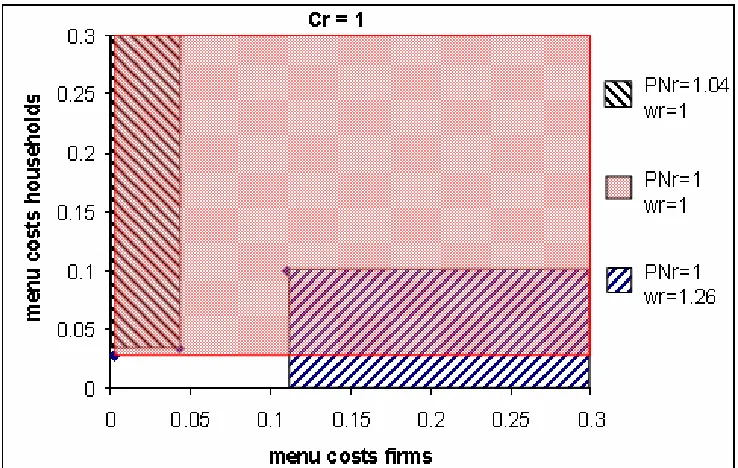
Figure 1: Stable equilibria as a function of menu costs for Cr = 1
= 0:4, = 0:25, = 1=3, = 6, = 2, = 2=3, Cr = 1,PT r = 2.
This …gure shows that full adjustment is an equilibrium for all realistic
values of menu costs. If menu costs are su¢ciently small, this is the only
equilibrium. However, there are multiple equilibria for some larger menu
costs. For these parameter values, the equilibrium (hatched slanting to the
adjust while the wages adjust, exists only for unrealistically high …rms’ menu
costs. But it is possible that neither the prices of non-tradables nor wages
adjust (shaded area). It is also possible that wages do not adjust while prices
do adjust (hatched slanting to the left).
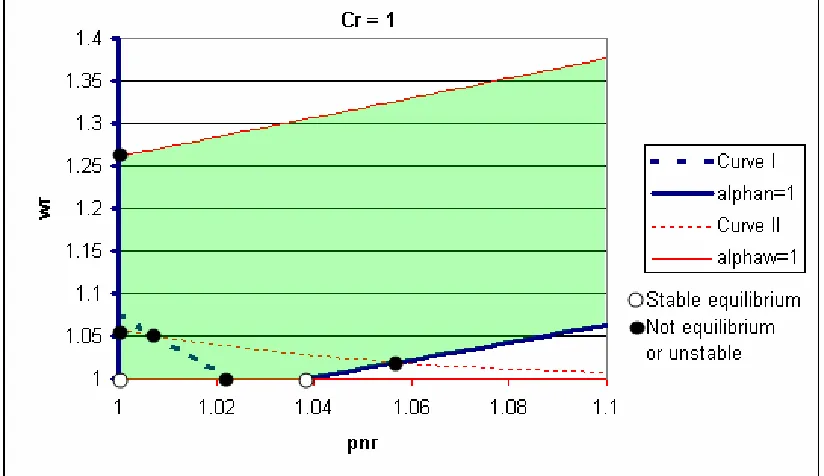
This …gure gives the equilibria as a function of …rms’ and households’
menu costs. A …gure showing the equilibria in the plane < PN r;wr > can
also be drawn. If the menu cost of …rms is 2% and the menu cost of households
Figure 2: Potential equilibria (zoom) for Cr= 1
= 0:4, = 0:25, = 1=3, = 6, = 2, = 2=3, Cr = 1,PT r = 2,
…rms’ menu costs= 2%, households’ menu costs = 4%.
In this …gure there are two types of curves: the ones in bold focus on
non-tradables …rms while the other ones focus on households. There are three
curves in bold. One curve corresponds to the case in which all …rms adjust
( N = 1). The vertical axes (PN r = 1) correspond to the case in which
the case in which the menu cost is exactly equal to the private cost of not
adjusting (and thus some non-tradables …rms might choose to adjust while
others choose not to adjust). If a point < PN r;wr > is located above this
curve, then the cost of not adjusting is larger than the menu cost and all …rms
would prefer to adjust. At a point located below this curve, no non-tradables
…rm would prefer to adjust. Similarly, there are three curves not in bold
(horizontal axe included). The shaded area is the locus of points for which
0 N 1and0 w 1. Thus, points outside the shaded area should be
disregarded. Even a point in the shaded area cannot be an equilibrium if it
is not at the intersection between a curve in bold and another curve. But the
reverse is not true: an intersection is not necessarily an equilibrium. Whether
a given intersection is or is not an equilibrium depends on the values of the
menu costs for …rms and households. For example, the intersection between
PN r = 1 and w = 1 is not an equilibrium because it is located above Curve
I (the …rms prefer to adjust their prices rather than stay at PN r = 1). But
if the menu cost of …rms became su¢ciently high, then Curve I would move
to the upper right-hand corner and would eventually have moved enough for
this intersection to be located below that curve. Thus, an intersection is a
the menu costs. In addition to the intersection shown in Figure 2 (which is a
zoom) there is an intersection at <2; 2> corresponding to full adjustment.
Figure 2 also helps to discuss the stability of these equilibria. For example
the intersection between Curve II and N = 1 is unstable: starting from a
point at the right but still near this intersection on the curve N = 1, such a
point would be above Curve II and all households would want to adjust their
wages, increasing wages and prices even more until the equilibrium<2; 2>
is reached. It can be seen that each of the four equilibria shown in Figure 1
is stable for menu-cost values for which it is indeed an equilibrium.
It may be surprising to see in Figure 1 that no amount of change of one
critical value can make up for a change in the other critical value in order to
yield the same equilibrium. As an example, let’s discuss this for thePN r = 1
& wr = 1 equilibrium. If the households’ menu cost is a little bit smaller
than the needed critical value then this equilibrium vanishes. No change
in the menu cost of …rms can make up for it. In Figure 2 it is clear what
happens. The point< PN r;wr >= <1; 1 >is located below Curve II when
the households’ menu cost is equal to 4%. However, if the menu cost of
be located above Curve II and all households would want to adjust their
wages. Increasing the menu cost of …rms would move Curve I, but would not
change the fact that < 1; 1 > is located above Curve II. Intuitively, if the
households’ menu cost is too small then households will adjust their wage
whatever non-tradables …rms do.
One could reply that this example is special: the price of non-tradables
should have an impact on whether a household adjusts or not (and by how
much), but the price of non-tradables is a given in this example in which
non-tradables …rms do not adjust. Thus let’s consider the equilibrium
< PN r;wr > = <1:04; 1 > at which the price of non-tradables adjusts. As
before, this equilibrium disappears if the households’ menu cost is too small.
A decrease ofPN r would indeed decrease the households’ cost of not adjusting
and could compensate a small decrease in the households’ menu cost. But a
change in the non-tradables …rms’ menu cost would have no impact on PN r
except if it was so large that non-tradables …rms prefer not to adjust their
prices (in which case the equilibrium < PN r;wr > =<1:04; 1 >disappears
and the economy would be at < PN r;wr > = < 1; 1 >). Intuitively, one
could expect that the strong impact that a small menu cost change has
assumption that all …rms have the same menu cost and all households as
well. I conjecture that if the menu cost distribution is not degenerated, then
a change in the …rms’ menu cost would have an impact on the proportion
of …rms that adjust (and maybe on the price chosen by adjusting …rms) and
thus on the aggregate price of non-tradables. In this case there would exist
a continuum of equilibria (di¤ering by PN r and/orwr) and a little change of
the average menu cost would usually not have a strong impact.
6
The importance of central-bank credibility
The central bank sets the real consumption of workers through setting money
supply (Cr = M=P).8 The central bank chooses Cr such that prices of
non-tradables do not increase (or do not increase much) since it wants to
avoid the exchange-rate shock leading to in‡ation. The problem is that
there are usually multiple equilibria. The set of equilibria depends on Cr.
8I assume that monetary policy can indirectly determine real consumptionCby
choos-ing the nominal money supplyM sinceC=M
P. Notice that all our equilibrium equations
are still valid if we consider that M rather than Cr is exogenous. The reason is that the
…rst-order equations are derived assuming that agents takeP as exogenous. Thus M P will
If the central bank is credible, it only needs its preferred equilibrium to
belong to the set of equilibria (it will become the focal equilibrium). This,
however, is not su¢cient if the central bank is not credible. In that case, even
if its preferred equilibrium belongs to the set of equilibria, agents will not
necessarily focus on it. Thus, when the central bank is lacking in credibility, it
will have to generate a large enough recession (chooseCr small enough) that
the equilibrium it wants to avoid no longer belongs to the set of equilibria.
Let’s assume that the monetary authorities want to avoid in‡ation and
thus want …rms of the non-tradables sector to choose not to adjust their
prices. Monetary authorities can achieve this goal by choosing a Cr such
that not (or barely) changing prices is the only optimal decision for
price-setters. This is always possible by choosing Cr su¢ciently small. Figure 3
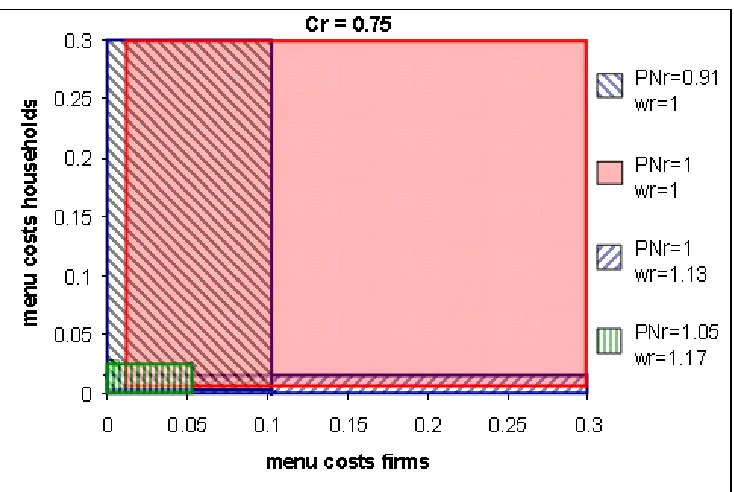
reproduces Figure 1 for Cr = 0:75 instead of 1, and shows how these stable
Figure 3: Stable equilibria for Cr = 0:75
= 0:4, = 0:25, = 1=3, = 6, = 2, = 2=3, Cr = 0:75, PT r = 2.
Compared with Figure 1, the most important di¤erence is that the area
corresponding to the menu cost values for which there is an equilibrium, at
which all agents adjust, has shrunk. In Figure 1 it took up the entire area
visible on the graph (I didn’t designate the corresponding zone in order not
to overburden the …gure). Here, the corresponding zone (hatched vertically)
is smaller. For example, this equilibrium is no longer obtained if the …rms’
non-tradables do not change their prices much when all agents adjust: they
increase them by only 5%. Thus, when Cr = 0:75 there is not much danger
of an increase of PN r and this increase would be small in any case (but there
is a possibility of a decrease of PN r: the surface (hatched slanting to the left)
corresponding toPN r = 0:91).
If the central bank wants to avoid an increase of PN r, it can do so by
choosing Cr low enough. But how low Cr has to be (that is, how large the
recession needs to be) depends on the credibility of the central bank. If the
central bank is not credible, then it will need to chose aCrlow enough for no
adjustment to be the only possible equilibrium at the given menu cost values
(or at least to exclude equilibria which imply an inordinately large increase
of PN r). If the central bank is credible, then it does not need to reduce Cr
that much (depending on the menu costs, it might not need to reduce Cr at
all) : it is enough that not adjusting belong to the multiple equilibria. This
implies that two identical countries that di¤er only by the credibility of their
central bank can end up with di¤erent Cr after an identical exchange-rate
shock. For example, if the menu cost is 2% for …rms and 4% for households,
then, with the above parameter values, a credible central bank can keep real
credibility would have to decrease real consumption by a large amount. One
could ask what the maximum value ofCrwould be such that the equilibrium
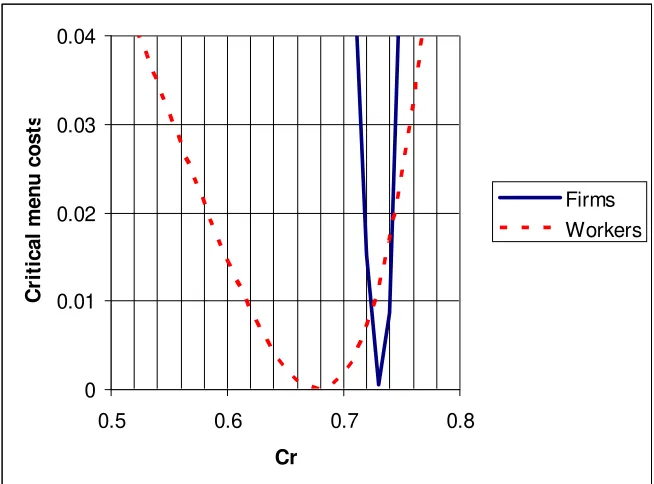
at which all agents adjust is excluded for the above parameter values. Figure
4 (a zoom on the relevant zone) shows, as a function ofCr, the critical menu
costs for …rms and households such that all agents adjust only if menu costs
[image:36.612.141.468.382.624.2]are smaller than these critical values.
Figure 4: Critical menu costs for the equilibrium at which all
agents adjust
0 0.01 0.02 0.03 0.04
0.5 0.6 0.7 0.8
Cr
Cr
it
ical
m
enu
cost
s
Firms Workers
To exclude the equilibrium at which all agents adjust, it is enough that
one of the menu costs is above the corresponding critical value. When the
menu cost of …rms is 2% and the menu cost of households is 4%, then the
equilibrium at which all agents adjust is excluded at Cr = 0:76. Notice that
the curves are steep: a small change in Cr can have a large impact on the
menu-cost values compatible with all agents adjusting.
7
Conclusion
I have shown that menu costs can explain not only why the price of
non-tradables may remain unchanged after a large devaluation, but also why
it may change by a small amount. I usually obtain multiple equilibria. If
monetary policy is credible, the equilibrium preferred by the central bank
will be selected. If monetary policy is not credible, then the central bank
will have to generate a recession large enough that the equilibrium it wants
to be certain of avoiding is no longer one of the multiple equilibria.
This paper could be extended in several directions. It would be interesting
to extend the model to general equilibrium (for example, foreign demand for
relax simplifying assumptions (for example, the assumption that prices are
fully ‡exible following the …rst period after the shock could be dropped), to
introduce savings and the interest rate (and maybe a monetary policy using
this interest rate as an instrument), to model the cause of the exchange-rate
shock (and its possible links to monetary policy), to integrate substantial
dynamics, and to allow for di¤erent …rms having di¤erent menu costs (idem
for households). One may also want to explain in terms of menu costs faced
by producers of tradables why the price of tradables adjusts whereas the
price of non-tradables adjusts only to a small extent (intuitively, one could
expect that a …rm’s opportunity cost of not adjusting its price is higher in
References
Burstein Ariel, Eichenbaum Martin and Sergio Rebelo (2005a), "Large
Devaluations and the Real Exchange Rate," Journal of Political Economy,
vol. 113(4), pages 742-784, August.
Burstein Ariel, Eichenbaum Martin and Sergio Rebelo (2005b),
"Model-ing Exchange Rate Passthrough After Large Devaluations," Discussion Paper
No. 5250, CEPR, September.
Fishman Arthur and Avi Simhon, (2005) “Can Small Menu Costs Explain
Sticky Prices?”, Economics Letters 87(2), pages 227-230.
Gonzales-Rozada Martín and Pablo Andres Neumeyer (2003), "The
elas-ticity of substitution in demand for non-tradable goods in Latin America
case study: Argentina," mimeo, Universidad T. Di Tella.
Huang Kevin and Zheng Liu (2002), "Staggered price-setting, staggered
wage-setting and business cycle persistence," Journal of Monetary Economics
49, pages 405-433.
of substitution in demand for non-tradable goods in Uruguay," mimeo,
Inter-American Development Bank Research Project.
Midrigan Virgiliu (2006), “Menu Costs, Multi-Product Firms, and
Ag-gregate Fluctuations,” mimeo. January.
Naknoi Kanda (2005), "Real exchange rate ‡uctuations, endogenous