Taking the Next Step - Implementing a
Currency Transaction Development Levy
Kapoor, Sony and Hillman, David and Spratt, Stephen
Comissioned by the Norwegian Ministry of Foreign Affairs
February 2007
Online at
https://mpra.ub.uni-muenchen.de/4054/
by David Hillman, Sony Kapoor
and Stephen Spratt
The Government will: Act as a spearhead for international agreements on new global financing sources that can contribute to a redistribution of global wealth and the strengthening of the UN institutions, such as aircraft tax, carbon dioxide tax, tax on arms trade or duty on currency transactions.
From the Norwegian Government’s Declaration on International Policy (The Soria Moria Declaration)
Commissioned by
gap between these goals and the financing available to reach them, Norway finds it imperative to help stimulate additional efforts, including through new and innovative mechanisms… Such levies can be easy to implement, their collection costs can be made minimal, national tax sovereignty need not be affected, and they…can be implemented without waiting for universal participation.’
‘… [in respect of the first solidarity development levy] proceeds will be used to combat HIV/AIDS, malaria and tuberculosis, through the new international drug purchase facility UNITAID. This facility, officially launched in New York on 19 September 2006 will be hosted by the World Health Organisation… It is an important pilot project, which we believe will demonstrate the virtues of pooling resources mobilised by way of innovative financing schemes.’
While this message refers to the Airline Ticket Levy, this report comprehensively shows how the exact same analysis – easy implementation, minimal collection costs, no affect on national tax sovereignty and unilateral feasibility applies to a Currency Transaction Development Levy and calls on the Leading Group to respond to some of the most urgent development challenges by implementing the CTDL and leveraging the proceeds in a strategic way to target the ‘weak spots’ in the international development effort.
From the Norwegian Government’s Declaration on International Policy (The Soria Moria Declaration):
‘World poverty is an infringement of human worth, a violation of human rights and a threat to global security and the environment. The fight against poverty and for the right to economic development, democracy, human rights and sustainable development constitutes the greatest challenge for the world community and a principal task for the Government.’
Acknowledgements
This report draws extensively on A Sterling Solution, a report published by Stamp Out Poverty, in its 2nd edition in September 2006, and written by Dr Stephen Spratt, the Head of Research at Intelligence Capital Limited, an economic think-tank and financial advisory firm.
The report also draws heavily on several other existing and forthcoming publications on the financial markets by Sony Kapoor.
Foreword
While this report examines an industry that is global and highly profitable, it is not anti-profit or anti-globalisation. That said, the banking sector’s profitability and global nature is an important backdrop to this study. The global airline industry has a good year when profits reach $2 billion. The global banking sector delivered $100 billion of profit in 2005 – a substantial part of which is related to globalisation: the financing of trade and arranging of capital flows.
Today, government ability to raise national taxes is hampered by the globalisation of well-paid individuals and large corporations. At the same time, voters are demanding more global goods such as a clean environment and physical security. Consequently, we need to embrace global taxes that may in time replace national taxes. It would be odd if in doing so we end up taxing airlines but not banks. Separately, when considering how to finance initiatives that support those less positively affected by globalisation, it would seem fair that the main beneficiary of globalisation should make a contribution. Banks recognise this. They are involved in a number of initiatives to support education and community lending around the world. But these are often too small or diffuse to make more than a public relations impact.
Unsurprisingly, given the sector’s size and profitability, it has one of the strongest lobbies. This lobby projects a view about the fragility and elusiveness of global finance that does not sit with today’s reality of highly regulated banking institutions. But in their lobbying they are often supported by politicians who generally have a low level of understanding of finance and a high level of fear of doing anything that might jeopardise the jobs, taxes and political contributions of the sector. Some of you will know me as a former leading currency analyst and senior manager of currency trading businesses at JP Morgan and State Street and I have witnessed much of this at first hand.
It was with some apprehensiveness, however, that Intelligence Capital accepted the invitation to provide an objective and expert opinion on the feasibility of a unilateral currency levy. You never know where good research will take you until the end. I am now convinced that given the Basel Capital Adequacy Accord for internationally systemic banks, the Financial Action Task Force on money laundering and the new continuous linked, real-time settlements system for global foreign exchange, that a currency transaction development levy would now be relatively easy for any country to adopt, hard for any bank to evade and possible for most countries to implement unilaterally. I recommend this report to you.
By Avinash Persaud
Taking the
next step
Implementing a Currency Transaction
Development Levy
David Hillman, Sony Kapoor and Stephen Spratt, December 2006
Commissioned by The Norwegian Ministry of Foreign Affairs (MFA).
This report represents the views of the authors and may not reflect the views of the MFA.
Foreword
3
Contents
5
Introduction
7
1
Progress and next steps: the case for the
9
Currency Transaction Development Levy
2
Implementing a Currency Transaction Development Levy
15
3
Responding to objections
28
4
Meeting needs strategically: potential uses for CTDL revenue
34
5
Conclusion
39
Abbreviations and acronyms
40
Bibliography
41
Introduction
As we approach the half-way point for the achievement of many of the Millennium Development Goals (MDGs) the spotlight is shining ever more intently on the urgent need for new sources of revenue to pay for them. With the first international development duty launched, in the form of the ‘pilot’ solidarity levy on air travel, the momentum needs to continue to the implementation in quick succession of a second such initiative to provide another long term predictable source of additional finance.
Innovation is required not just in financing but also in delivery. UNITAID’s mission is to transform a situation of high cost drugs for the treatment of the few to low cost drugs for the care of the many. In so doing its potential value is exponentially greater than a simple addition of extra revenue. The choice of how and where the next new stream of finance is spent also needs to be to be similarly strategic.
The Core Group1 Governments rightly pride themselves on an international development
policy that has, as one of its pillars, the tackling of global inequality which has risen rapidly in the latest phase of globalisation. For example President Chirac opened the Paris conference held in February 2006 in Paris stating that ‘despite the continuous increase in global wealth, a third of humankind still lives on less than a euro a day’, and that ‘…globalisation, far from bridging the (poverty) gap, is widening it even further’.
In this report, we offer some suggestions for tackling global inequality through concrete proposals for both raising substantial new revenue equitably and spending it in ways that strategically target the ‘weak spots’ in the international development effort.
The financial services industry has been one of the biggest beneficiaries of globalisation. Annual turnover in the global market for currencies, has, for instance, expanded from about $4 trillion in 1973 to $40 trillion in the mid 1980s to more than $450 trillion now – a more than 100 fold increase.2 Profits at financial services firms are also at a record high
with the top two most profitable banks, Citibank and HSBC, posting more than $40 billion of profits between them in 2005 alone.
At the same time as industries such as airlines and financial services have benefited from globalisation, populations in many of the poorest countries, especially those in sub-Saharan Africa, have been left behind – or worse, harmed. Average life expectancy in these countries is in fact down from 50 years in 1990 to 45 years now, just over half the almost 80-year life expectancy in countries such as Norway. The health, education and productivity problems caused by a lack of access to basics such as clean drinking water and sanitation facilities, the added decimation wrought by global pandemics such as HIV/AIDS on the ability of the populations and systems in poor countries to cope, and the increased vulnerability linked to climate change, all threaten to undermine and, in fact, roll back the slow progress that has been made to date towards meeting the MDGs.
1 The Core Group: Brazil, Chile, France, Norway and the UK – the principal countries at the heart of progress with UNITAID.
In Section 2 we demonstrate in some detail how, by introducing a very small levy of less than a hundredth of one per cent on currency transactions, many countries can unilaterally generate substantial resources for development from those who can most afford to pay. Such a levy is simple and inexpensive to apply in this age of electronic transfers. Whilst this proposal is specific to the currency market, it can be generalised to apply to other financial markets many of which already pay some form of a levy.
The possible uses for this revenue that we propose in Section 4 have been shaped by the need to lever maximum results from the resources generated. The three potential areas for immediate financing that we have identified would generate positive additional outcomes towards the achievement of several seemingly unrelated development goals. First, provision of clean water and sanitation, as it is a
foundation stone that underlies the ability to make meaningful progress with the vast majority of the MDGs. Second, providing human resources for health, because without sufficient trained health workers, medicines and infrastructure are simply not enough on their own to contain the raging pandemics of HIV/AIDS, TB and malaria. Third, providing a long term predictable source of funds to an expanded UN
Central Emergency Response Fund, to create a more robust response to the growing
1
Progress and next steps: the general case for
the Currency Transaction Development Levy
‘If current trends persist, there is a risk that many of the poorest countries
will not be able to meet many of [the Millennium Development Goals].
Considering how far we have come, such a failure would mark a tragically
missed opportunity… As I said in my March report: let us be clear about the
costs of missing this opportunity: millions of lives that could have been saved
will be lost; many freedoms that could have been secured will be denied; and
we shall inhabit a more dangerous and unstable world.’
Kofi Annan, UN Secretary-General, 2005.
Context
The ‘Leading Group on Solidarity Levies to Fund Development’ have followed an important principle that lies at the core of recent progress with the Air Ticket Levy. Broadly speaking, those most benefiting from globalisation can provide additional, long-term, predictable financing to those so dramatically left behind. Airlines and financial services have been amongst the biggest beneficiaries of globalisation, having grown exponentially in the last few decades. The poor, especially in the Least Developed Countries, have fared badly, with average income levels and life expectancy in most sub-Saharan African countries lower now than 25 years ago.
Progress – from words to action
One year ago innovative sources of development financing were aspirations. In the last few months alone UNITAID has been launched, swiftly followed by the International Financing Facility for Immunisation (IFFIm). Between them, these two ‘pilot’ initiatives will raise approximately $1.3 billion in the forthcoming year to both treat and prevent disease. Reducing the price of drugs and rolling out huge inoculation programmes have the potential for wide impact in addressing the Millennium Development Goals (MDGs). It is clear, however, that to bridge the funding gap required to meet the MDGs, further complementary initiatives need to come on stream at the earliest opportunity. As we look to take the next step, it is important to concentrate on ‘innovative’ initiatives targeted at presently under-funded ‘weak spots’ in global development efforts.
The Currency Transaction Development Levy (CTDL) proposal and potential
use of CTDL income
In respect of where income could be channelled, we have chosen to target three potential sectors:
● The provision of clean water and basic sanitation
● Greater funding for efforts to fight global pandemics and disease
● Provision of far greater support for poor countries affected by humanitarian
emergencies.
Progress in these areas could have a significant knock-on effect in the achievement of a number of sometimes seemingly unrelated development goals, and provide progress on a number of fronts such as reducing child and maternal mortality, reducing poverty and hunger, increasing gender equality and increasing access to education.
The Leading Group and the MDGs
Since the MDGs were adopted in the year 2000, it has become increasingly clear that unless greater financial commitments were also made, the Goals would remain unrealised, condemning hundreds of millions to abject poverty, resulting in tens of millions of preventable deaths. It was the recognition that taking the ‘business as usual’ approach would mean the MDGs would not be realised, which galvanized many of the Leading group governments into action. ‘We are convinced that the Millennium Development Goals will simply not be achieved in many countries at present levels of aid flows.’ 3
It was also recognised that progress on increasing traditional official development assistance (ODA) would in itself not be enough to address the problem. This led to a search for ‘innovative mechanisms’, which were explored in detail in both the Chirac commission (Landau) report and the Action Against Hunger and Poverty report, both published in 2004.4
Both reports emphasised the logic of transferring resources from the winners of globalisation to those who have been left behind and explored in some detail how implementing levies on the transport sector (such as air travel) and financial markets (such as currency markets) could help generate significant revenues and provide resources to make real progress on meeting development goals.
From the winners of globalisation to those who have been left behind
President Chirac addressing the first Leading Group conference in Paris in February 2006 stated that ‘despite the continuous increase in global wealth, a third of humankind still lives on less than a euro a day’, and that ‘…globalisation, far from bridging
the [poverty] gap, is widening it even further’. Extreme inequality in the world is an undeniable phenomenon. Three hundred thousand of the most wealthy US citizens, less than 0.1% of the population, for example, earn more than one and a half billion poor people – a quarter of the world’s population.5 Almost 90% of the world’s wealth is now
concentrated in the hands of less than 20% of its inhabitants.6
3 Declaration on Innovative Sources of Financing, September 14 2005, New York 4 Landau report:
www.diplomatie.gouv.fr/actual/ pdf/landau_report.pdf Action Against Hunger and Poverty report, launched September 2004:
www.diplomatie.gouv.fr/actual/ pdf/Reportfieng.pdf 5 Authors’ estimate using data
from the World Bank and New York Times.
While globalisation has meant for example that the financial services industry (and the players in it) have grown from strength to strength commanding an increasing share of global wealth, it has also meant that many of the world’s poorest and most vulnerable people – the least able to take advantage of globalisation – have been left behind. Worse, the ‘economic adjustment costs’ associated with globalisation have also increased deprivation resulting in a loss of livelihoods for many in some of the poorest countries.
Global pandemics, such as HIV/AIDS have thrived in this age of easy travel, multiplying spread of the disease. Additionally, hundreds of millions of people, especially those who live in low-lying or semi-arid poor countries, will increasingly find their way of life, or even the mere preservation of their lives, threatened by the onset of global warming and climate change. Those who have generally not benefited from globalisation are paying the price of the economic activity and large-scale emissions generated by the rich world at the expense of the poor.
It is for this reason that conversation concerning redistribution has been present in Leading Group discussions. It is also why imposing a levy on financial market trading has been one of the flagship proposals within both the Landau and Action Against Hunger and Poverty reports.
Taxing financial markets
‘The proposal to levy a tax on financial transactions at a very low rate would
lead to the collection, on a stable and predictable basis, of a significant amount
of resources for development, while not interfering with the normal functioning
of the market.’
President Chirac of France, President Lula of Brazil, President Escobar of Chile and Prime Minister, Zapatero of Spain, from the Action Against Hunger and Poverty report.7
The enormous size of these markets means they have a large revenue potential
Turnover in the global market for currencies, has, for instance, expanded from about $4 trillion in 1973 to $40 trillion in the mid-1980s to $450 trillion in 2004 – a more than 100-fold increase. Turnover in world equity (stock) markets has registered a seven-fold increase to $51 trillion in a period of just 12 years since 19938 and the wealth held in
the global bond market has increased more than three-fold to almost $60 trillion now9
over the same period.
Just skimming these vast financial markets, taking a tiny slice off the top, has the potential to generate billions of dollars that can be redistributed to save lives and achieve sustainable development.
7 Action Against Hunger and Poverty report, launched September 2004:
www.diplomatie.gouv.fr/actual/ pdf/Reportfieng.pdf 8 World Federation of Exchanges 9 Bank for International
Small transaction levies do not damage financial markets and are simple
to implement
Applying small transaction levies, of the order of a few hundredths of one per cent, can raise vast sums of money, and because these transfers are carried out electronically, it makes implementation simple and each transaction traceable. Many such transaction taxes already operate successfully and raise billions of dollars of revenue for countries as varied as the UK and Brazil.
The existing transaction tax regimes show that financial markets are comfortably able to shoulder the burden of such levies especially when the rate is kept low. Liquidity and market structure are not affected adversely and income generation is predictable and stable in the long term.
Such levies are collected electronically at minimal cost, on average about 50 times less than the corresponding costs for the collection of income taxes. Once the collection has been plumbed into the electronic system it is automatic and very difficult to avoid.
Currency markets – principle reasons to implement a
development levy
‘A tax on foreign exchange transactions is technically feasible.’
President Chirac of France, President Lula of Brazil, President Escobar of Chile and Prime Minister, Zapatero of Spain, from the Action Against Hunger and Poverty report.10
The growth of profits
The financial services industry is responsible for the vast majority of currency
transactions. It has seen record levels of profits with the top three banks earning more than $50 billion between them in 2005. Profits on currency trading are not always disclosed separately but in 2003, the latest year for which figures are available, the same banks made almost $5 billion from currency trading alone.11 It is important to
remember that participation in the currency markets confers enormous advantage on financial institutions over and above the direct profits generated from FX trading.
The incidence of the levy
Most transactions in the FX markets are conducted between banks themselves or with other large players in the financial services industry. Transactions with individuals (for overseas travel for example) constitute less than 0.1% of total transactions and trade-related transactions amount to less than 10%. A significant proportion of the tax burden is thus likely to be borne at least initially by the financial services industry itself with some of the costs being passed on to trade related transactions. The financial services industry is disproportionately used by the richer segments of the society so
10 Action Against Hunger and Poverty report, launched September 2004:
the tax incidence is likely to be socially progressive and is unlikely to affect the majority of the population in any tangible way. The incidence of the levy is discussed in greater detail later in the report.
Other
taxes
Other financial markets such as stock markets and bond markets already pay a trans-action levy in many countries. In the UK, for example, a 0.5% stamp duty is levied on the purchase of stocks. This generates substantial revenues of about $7 billion every year. Countries such as Germany, Belgium and Switzerland tax bond transactions. Many countries in Latin America, such as Brazil, Colombia, Peru and Venezuela currently levy a generalised financial transaction tax. A stamp duty or levy on currency transactions is simply a natural extension to the financial transaction taxes that already exist.
Technical
issues
The CTDL can be levied unilaterally on all FX transactions in a particular currency wherever they take place in the world. The levy can be collected in an inexpensive and efficient way at the point of transaction settlement through either the Continuous Linked Settlement Bank (CLS Bank) or the real time gross settlement mechanisms (RTGS) that are run for all major currencies by their respective central banks. The fact that all FX transactions are electronic makes collection cheaper and evasion very difficult. A levy that includes the euro will need a consensus from all euro area members. However, countries such as the UK, Switzerland, Sweden, Norway and Denmark could implement a CTDL unilaterally for little expense in cost, time and effort, if they so wished.
Quality not just quantity
Taxing financial transactions such as currency transactions to fund development is important not just in terms of the increase in quantity of money raised but also because of improvement in the quality of aid disbursed to poorest countries.
The CTDL is not the Tobin tax but a solidarity levy
It is important to clarify that the levy that we are proposing on currency transactions is not the same as a Tobin tax, an idea with which it is often mixed up.
James Tobin’s original 1970s idea was for a tax to alter motivation in the foreign exchange market. The purpose of his tax was to impede daily currency trading12 and to
discourage speculative activity. When he advanced his proposal the currency market had a daily value of $18 billion, it is now worth almost $2,000 billion per day. The rate he proposed was 1%, 200 times the 0.005% rate set out here, and the income was not designated to a specific purpose, such as development. Tobin was actively seeking to alter the structure of the market through the imposition of such a tax.
The Currency Transaction Development Levy (CTDL), the focus of this report, is entirely different. Its raison d’etre is as a financing instrument for development. Its rate is designed specifically not to hamper normal market operations but instead to skim a tiny fraction of the volume traded. The two proposals have but one element in common, they are both associated with currency. The CTDL fundamentally differs from the Tobin tax, therefore, in that it is born of a different time, proposed at a different rate and designed for a different purpose.
The CTDL – an ideal levy
The CTDL is an ideal levy providing a substantial long term, predictable income stream from a financial market, which is not just the largest in the world but has grown exponentially with the advent of globalisation and continues to do so. This revenue can be raised cheaply with little risk of avoidance and without altering the structure and operation of the market. Resources can be used to address the weak spots in the architecture of meeting the Millennium Development Goals. This offers some redress to the imbalance of globalisation by having its winners contribute to those that have not been so fortunate.
2
Implementing a Currency Transaction
Development Levy
Financial Transaction Taxes (FTTs)
Taxes on financial transactions, such as taxes on share trading, bond trading, house purchases or bank debits have a long history and most have operated successfully for many years raising substantial amounts of revenue with no apparent negative impact on the market. In fact all of the G10 countries except Canada have levied financial transaction taxes at some time. Of these, the United States13, UK, France, Belgium
and Switzerland have existing FTT regimes. The other G10 members have (relatively recently) dismantled FTTs they had: Japan (1999), Italy (1998), Sweden and Germany (1991) and the Netherlands (1990).
However, while there has been some movement towards the removal/reduction of transaction taxes, this is counterbalanced by recently imposed FTT regimes in India (2004), Peru (2003), Argentina and Colombia (2000), Ecuador (1999), Greece (1998) and Finland (1997). In fact, Greece doubled its transaction tax on share trading in 1999. The table in the Appendix provides a more comprehensive list of various financial transaction taxes.
Common objections to the introduction of financial transaction taxes are that they will: a) distort the market and b) drive investors/financiers out of the economy or sector to other, untaxed economies. The reality, however, is often very different. In the UK, for example, a stamp duty on share transactions generates as much as $7 billion every year – at a collection cost that is 50 times cheaper than the cost for collecting income tax. Despite having this 0.5% (50 basis points) stamp duty on share transactions, the UK continues to be one of the top financial centres and the London Stock Exchange one of the premier exchanges in the world.
In 2003 the Peruvian government introduced a 0.1% general financial transaction tax, with the aim of raising finance for the education sector. At this time, the national and international financial press, concerned private investors and international financial institutions such as the IMF predicted severe negative consequences to the Peruvian economy. In particular, they feared that bank deposits would be withdrawn, adversely affecting the availability of credit in the economy, and thereby restraining growth rates. Figure 1 overleaf illustrates what actually happened.
As can be seen, far from reducing bank deposits and therefore credit, the period following the introduction of the financial transaction tax saw both bank deposits and access to credit increase steadily.
In fact, for many of the transaction taxes introduced in recent years such as in
Colombia and Argentina, the financial sector has adapted itself to the transaction tax with no major repercussions, and this is despite the fact that the rate at which these taxes are levied are many multiples of the CTDL rate we propose in this report. The tax rates levied are in the range of 20 to 80 basis points and raise substantial amounts of revenue every year at very low collection costs and with few problems of evasion. Moreover, the taxes have been collected mainly by electronic means through banks at minimal cost on behalf of the government. Income has ranged between 0.3% and 3.5% of GDP or 1.5% to 26.7% of total tax revenue in different countries, at different times.14
In summary, here are some key elements of FTTs:
● It is not unusual for financial transactions to be taxed in some form or other – this
ranges from the duty on share trades in the UK, the tax on corporate bond trading in Germany and the generalised levy on financial transactions in Peru
● Where FTTs have been levied, financial markets have generally adopted them with no
major repercussions
● FTTs raise substantial amounts of revenue
● In most cases, this income is collected electronically at the point of settlement with
minimum cost to the governments
● Evasion has not proved a serious problem.
One of the key points that emerge from this discussion is that the foreign exchange market is unusual for not yet being taxed. Given that it is the largest financial market in the world, a levy on foreign exchange trading would be expected to raise substantial amounts of revenue provided a suitable collection mechanism could be designed at the point of trade settlement. With the tax designed at an appropriate low rate it would not have an adverse impact on the day to day operation of the market. The income could
FIGURE 1 Bank deposit and credit levels following Peru’s introduction of a financial transaction
tax in 2003
Source: Superintendencia de Banca y Seguros, Lima. December, 2005
10,000 11,000 12,000 13,000 14,000 15,000 16,000
Dec 02 April 03 Aug 03 Dec 03 April 04 Aug 04 Dec 04 April 05 Aug 05 Dec 05
Total deposits
Direct credit
US$ millions
then be mobilised to such ends as the implementing government(s) should wish, such as international development.
We present here a proposal for countries to unilaterally implement a very small levy on currency transactions and collect the proceeds using existing systems of electronic settlement.
Our Currency Transaction Development Levy proposal
The proposal is for all foreign exchange transactions in a particular currency wherever they take place in the world to be subject to a levy of 0.005%. The past two decades have seen significant changes in the way FX transactions are settled both nationally using Real Time Gross Settlement systems and internationally using the Continuous Linked Settlement (CLS) Bank (see Box 2: International payment and settlement systems).
Therefore, whilst Central Banks have responsibility for ensuring the effective functioning of systemically important country-based payments systems, a country is not an island in this respect. Rather, it operates in an interconnected – and interdependent – global network of central banks and national payment systems, and cooperates in the oversight of cross-border payment systems, such as the CLS Bank.
These developments have today made a unilaterally implemented CTDL feasible. A leading scholar in this field is Professor Rodney Schmidt, who put the issue as follows in the year 2000:
‘…the infrastructure for settling foreign exchange trades is increasingly formal, centralized and regulated. This is due to new technology, subject to increasing returns to scale, and to cooperation between trading and central banks to reduce settlement risk. Settling a foreign exchange trade requires at least two payments, one of each of the currencies traded. Settlement risk is eliminated when payment obligations are matched and traced to the original trade, and then payments are made simultaneously. The technology and institutions now in place to support this make it possible to identify and tax gross foreign exchange payments, whichever financial instrument is used to define the trade, wherever the parties to the trade are located, and wherever the ensuing payments are made.’ 15
‘The payment system is an important part of a country’s economic and financial
infrastructure. Smoothly functioning payment systems make it possible to execute safe and timely payment transactions – for the settlement of goods and services purchases, capital transfers, securities and foreign exchange trading,…and these transactions are made by private customers, banks enterprises and government agencies. These transactions result in claims between the payers’ and payees’ banks, and these claims are settled through the banks’ accounts in Norges bank. Banks and the central bank are thus the core of the payment system.’16
BOX 1 The importance of the settlement system and central bank role in Norway
15 Schmidt (2000)
The last two decades have seen significant changes in the practice of payments and settlement systems globally. As overseeing authorities have sought to reduce settlement risk and enhance systemic efficiency, Deferred Net Settlement (DNS) systems have given way to Real Time Gross Settlement (RTGS) systems, where – at least domestically – settlement risk is effectively eliminated due to the use of payment versus payment (PvP) and delivery versus payment (DvP). In general terms, advances in IT have led to greater uniformity, as heterodox forms have gradually been replaced by a more homogenous approach based on commonly used technical platforms, thereby greatly reducing costs through increased efficiency. Major Large Value Payment Systems (LVPS) in developed countries are increasingly interdependent. They rely on the same technological infrastructures, which ensure that this interdependence functions smoothly and effectively.
The messaging function pioneered by SWIFT (Society for Worldwide Interbank Financial Telecommunications) has become central to this process, as economies of scale considerations have made it increasingly sensible for all global players to use the same system. SWIFT, which is owned by the finance industry, now supplies messaging services to more than 8,000 financial institutions in 206 countries and territories, and thus accounts for an important part of the financial infrastructure both nationally and internationally. While the Norges Bank, Bank of England and the European Central Bank do not oversee SWIFT’s activities separately, they lend support to the oversight carried out by the Belgian central bank under the auspices of the G10 group in the Bank for International Settlements.17
For the purpose of this report it is important to understand how currency settlement operates. In the UK, for example, the Clearing House Automated Payment System (CHAPS) is a key body in this regard. CHAPS is the organisation through which most high-value wholesale payments are processed, and it operates an RTGS system. Sterling currency transactions are settled either through CHAPS or the Continuous Linked Settlement (CLS) Bank.
The Norwegian equivalent is the Norges Bank’s (the Central Bank of Norway) own settlement system, NBO. The Norges bank has also authorised two other payment and settlement systems – DnB NOR Bank ASA and Norwegian Interbank Clearing System (NICS) – but these settle smaller amounts and, in fact, operate under the supervision of the central bank.
For the settlement of large value euro transactions the European Central Bank (ECB) operates the TARGET system which interlinks the national level RTGS systems of the euro area’s 15 countries to provide automated settlement. This was designed to provide common procedures – especially messaging functions which allow payment orders (for settlement) to move seamlessly between the national level RTGS systems.
FX related euro transactions are mostly settled thorough the CLS or the TARGET systems and in the case of the Norwegian krone through the NBO or through the CLS.
Internationally, cross-border FX Herstatt18 Risk – one of the last remaining outposts of
settlement risk in the global financial sector – has also been addressed with the launch of the CLS Bank, which enables FX transactions in different time-zones to be settled on a PvP basis. As with national Large Value Payment Systems, this effectively eliminates settlement risk.
BOX 2 International payment and settlement systems
17 Annual Report on Payment Systems 2005, Norges Bank (May 2006), and Bank for International Settlements 18 On 26th June 1974 at 15:30
To be effective a CTDL would need to have the following attributes:
● It could be implemented relatively easily and cheaply, using existing market
infrastructure and networks
● It would capture the vast majority of transactions carried out in a particular currency
globally
● It would be set at a sufficiently modest level as to neither distort the market nor
provide incentives for financial institutions to move outside current systems in order to avoid paying the CTDL.
Below we explain in some detail how such a CTDL would work using examples of the UK sterling and Norwegian krone, and also how the proposal meets each of these three criteria.
Implementing a CTDL
Since the launch of the CLS Bank in 2002, a growing share of FX transactions have migrated to it. Today it is estimated that a little over 60% of all global sterling, krone and euro trades are conducted through the CLS system.19 Of the remainder, the
overwhelming majority are processed through the UK’s CHAPS, the Norges Banks’ NBO and the ECB’s TARGET System for their respective currencies. These currency specific systems are therefore directly connected to the CLS member banks, and through this link also connected with the other major national RTGS systems.
To be effective, therefore, the CTDL must be implemented at a number of levels. The most straightforward of these is through the CLS Bank. As pointed out above, more than 60% of all sterling, krone and euro transactions are settled in the CLS system, where it would be a straightforward task to identify them. For example, the UK Treasury has accepted the validity of this point, not least because it would be practically straightforward and that, if implemented in the UK, would have to be adhered to by the CLS Bank.
‘Technically, it is possible to apply a unilateral sterling CTT via CLS… CLS Bank settle in fifteen currencies, and in doing so must apply the relevant laws in each jurisdiction – including, for example, a unilateral sterling currency transaction tax.’20
Having accounted for more than 60% of all sterling, krone and euro FX trades, the CTDL must also address the remainder – though, as described above, this ‘remainder’ is likely to become an ever-smaller proportion in the years ahead. By far the most important organisations, in this regard, are the LVPS – CHAPS, NBO and TARGET for each of the three regions specifically. Here, the developments in the LVPS sector are key to the feasibility of implementing an effective CTDL.
How would the CTDL be raised in practice?
In Norway, for example, we can imagine a situation where NorwayBank1 wishes to purchase a Norwegian financial asset from NorwayBank2. If the sale price is agreed, NorwayBank1 sends a SWIFTNet message to the relevant LVPS with an instruction to debit its settlement account at the Norges Bank, and to credit the settlement account
19 CLS Issue Brief October 2006, assuming that the CLS settles the same proportion of trades in all currencies.
of NorwayBank2. At the same time, NorwayBank2 sends a SWIFT message requesting ownership of the relevant asset be transferred to NorwayBank1. SWIFT then matches the two messages, and after requesting and receiving confirmation from both banks, transfers both the krone amount and the ownership of the asset. In this instance, both sides of the transaction are in krone and therefore represent a domestic transaction that does not attract the CTDL.21
Internationally, however, the situation is rather different. Suppose NorwayBank1 wishes to buy US dollars for krone. NorwayBank1 makes an offer to USBank1 (through any of a number of possible channels) and the offer is accepted. As with the domestic example, NorwayBank1 then sends a SWIFT message to the LVPS requesting it to debit its settlement account at the Norges Bank for the appropriate quantity of krone, and to credit the account of NorwayBank2 at the central bank (we assume that USBank1 keeps its krone holdings with an account at NorwayBank2 as an escrow account, which reflects standard international banking practice). At the same time, USBank1 sends a message to its LVPS requesting that the appropriate dollar amount is transferred from its balance to that of USBank2 (again, we assume that NorwayBank1 keeps its US dollar holdings in an account with USBank2).
In Norway, SWIFT requests confirmation of the trade from NorwayBank1, upon receipt of which it debits NorwayBank1’s account at the Norges Bank, and credits that for NorwayBank2. Unlike the domestic transaction, however, it is unable to match the message from NorwayBank1 to another krone-based message in the system. Therefore, although domestically the PvP process requires matching of trades and removes settlement risk, an international FX trade cannot be settled on a PvP basis in a national system such as NBO, as each leg of the trade takes place in different domestic LVPS, often operating in different time-zones. It is this failure to match both legs of a transaction in krone that identifies the transaction as an FX trade, upon which the CTDL can be levied.
In this way a CTDL could feasibly be implemented unilaterally in Norway, with the overwhelming majority of krone transactions undertaken globally being identified through the CLS system and the NBO. As the stylised example above makes clear, this is based on PvP systems in domestic LVPS, as well as the PvP approach employed by the CLS Bank. The ‘oil’ that lubricates this process and makes it possible, however, is the ubiquity of standardised messaging formats within the financial sector.
A key feature of the various interlinked systems through which FX transactions can be settled is their use of the SWIFTNet messaging system. Importantly, SWIFT also provides messaging services for major electronic FX trading platforms such as FXall, as well as for the major global bilateral and multilateral FX netting systems, past and present. This global reach offers the chance to further extend the scope of the CTDL, and ensure that all FX related sterling trades in CHAPS, krone trades in NBO, and euro trades in TARGET, are identified.
Within each of the systems in which it operates, SWIFTNet provides secure payment messaging between members through its FIN system and, crucially, has a dedicated message form – the MT300 – which is used to confirm individual FX trades. That is, whether in the CLS system, CHAPS, NBO, TARGET, FXall or a multilateral netting
system, an FX trade is confirmed between the counterparties by means of a SWIFTNet FIN MT300 message, or one of its variants.
The MT300 message is initially exchanged by or on behalf of the parties that have agreed to a foreign exchange contract. The fact that MT300 messages also provide notification of amendments to contracts and cancellations of previously held
confirmation is important for the purposes of this proposal, as it ensures that the CTDL is only levied on sterling, krone or euro FX transactions in the form in which they are ultimately transacted. Also, because MT300 messages confirm individual FX trades, they precede any subsequent bilateral netting process that may occur, after which identifying the individual trades concerned may not be possible.
Within each MT300 message, a number of fields must be completed. For an FX trade, the currencies concerned and the amounts bought and sold are included here. In the Mandatory Subsequence sections of the MT300 message, the relevant sections are B1 (Tag 32b) for the currency and amount bought, and B2 (Tag 33b) for the currency and amount sold. Consequently, all the information needed to identify sterling, krone or euro transactions is already in place. No dedicated infrastructure is required.
The MT300 messaging system can therefore capture the lion’s share of sterling, krone or euro transactions in the ‘traditional’ FX market. However, this still leaves the area of the OTC derivatives market. In one important respect, this market is also covered by the MT300 messaging series, which is used to confirm that FX options have been executed. In this case, MT305 and MT306 are used as messaging formats. All other FX OTC derivative contracts are contained within the third category of SWIFTStandard messaging formats, which range from MT300 to MT341 and from MT350 to MT399. As with the traditional market, messages require the currency, amount and counter parties to be identified within the message, as well as the facility to amend or cancel contracts.
The next piece of ‘plumbing’ is to gather relevant messages of this form in a central location, to enable the CTDL to be levied. Again, however, it is possible to ‘piggy-back’ upon existing networks by using the SWIFTNet FIN Copy messaging function. The majority of recipients of SWIFT FIN Copy messages are central banks, as the messages facilitate settlement in the centralised RTGS systems. The ideal template is FINInform, where copied messages are triggered to the central bank depending on either the identity of the parties or the type of message sent.
A key aspect of the proposal is therefore to establish a SWIFTInform messaging service, which is triggered by the sending of an MT300–MT399 FX message, in either the traditional or the OTC derivatives market. In this instance, a copy of parts of the message – currency, volume and counterparties – is automatically sent to, for example, the Bank of England for every FX transaction involving sterling. As with all aspects of the proposal, this process would be automated and would require no dedicated infrastructure. The next section deals with how the CTDL would be collected with the help of the information gathered.
FIGURE 2 The global sterling
payment and settlement system
Money flows SWIFT messages
Settlement
accounts at BOE
(CHAPS + CLS)
Bilateral and multilateral
netting institutions
Financial
institutions
CLS Bank
Bank of England (BOE) regulatory oversight
FIGURE 3 The global sterling payment and settlement system with the sterling stamp duty
Money flows SWIFT messages New money flows New SWIFT messages
Settlement
accounts at BOE
(CHAPS + CLS)
Bilateral and multilateral
netting institutions
Financial
institutions
CLS Bank
Inland
Revenue
SSD account
at BOE
Collecting the CTDL and preventing avoidance
Once identified in the manner described above, collecting the CTDL would be a
relatively straightforward process. To be able to participate in the CLS system, financial institutions must hold an account with the CLS Bank. However, in practice, UK-based CLS Bank members actually hold their accounts within the Bank of England, Norway-based members with the Norges Bank and euro area members with their respective central banks. These accounts can then be credited and debited by the institution in accordance with their liquidity requirements for CLS Bank. To collect the CTDL from the CLS system, therefore, the levy could be directly taken from the relevant accounts.
Similarly, in order to be a member of CHAPS, NBO or euro area RTGS systems, a financial institution must hold a settlement account at the respective central bank. Therefore, once the tax to be paid is identified and traced to the RTGS member, it can be transferred from the relevant settlement account held at the central bank to the account of the finance ministry also held at the central bank.
The SWIFT messaging system in general, and the FINInform Copying function in particular, is completely automated on a day-to-day basis. Consequently, though the relevant systems would have to be slightly modified to facilitate tax identification and tax-take from the appropriate centrally held accounts, the changes would be relatively minor. Furthermore, once the fixed, start-up costs were met, the marginal cost of operating the system would be very low.
Direct members of both the CLS System and country-level LVPS are relatively few in number, with a significant proportion of all trades being undertaken by members on behalf of their third-party customers. Whilst these market participants would not be directly taxed, they would be affected by the CTDL, which would be directly reflected in the spread charged them by the CLS Bank/CHAPS/NBO/other RTGS members in exchange for executing their FX business.
The remaining sterling, krone or euro trades undertaken – by corporations, for example – would still be identified by use of the SWIFTNet messaging service described.
Furthermore, these trades would be settled by correspondent banks on behalf of the underlying corporate. These correspondent banks would hold accounts with the respective central banks, the CLS Bank, or both. Consequently, such FX trades would ultimately also incur the CTDL.
Running
costs
On average SWIFT messages cost approximately £0.067 (0.82 krone or 0.1 euro) each. The CLS Bank settles 200,000 transactions a day, which is more than half of all FX trades. To capture the entire FX market, therefore, would equate to about 400,000 messages a day. The following table lists some of the estimated costs for implementing SWIFT copy messaging for the three currencies under discussion.22
Having established the feasibility of a) identifying FX transactions, and b) collecting the CTDL, the final question relates to the appropriate level at which to set the levy. The objective is not to maximise income per se, but to strike a balance between raising sufficient revenue to make a contribution to meeting the MDGs, and avoiding market distortions.
In 2004, the sterling, krone and euro accounted respectively for 8.5%, 0.7% and 18.6% of all FX trades globally, out of an average daily total of $1,880 billion. This equates to a potentially taxable daily total of around $160 billion, $13 billion and $350 billion for the three currencies respectively.
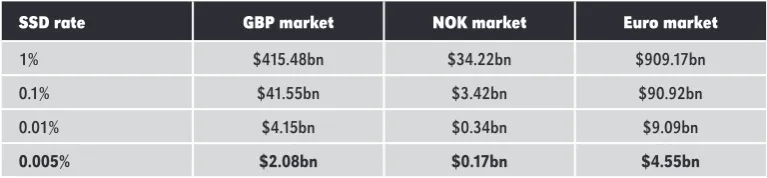
The table below illustrates the potential annual revenue from differing CTDL rates assuming 260 trading days in the year.23
As can be seen, a 1% tax could hypothetically raise hundreds (or tens) of billions. However, a CTDL at such a level would certainly have a distorting effect on the market, reducing volumes traded drastically. At the 0.10% level the annual revenue would still, theoretically, be substantial. However, it is likely that a 10 basis points (bp) tax rate would also have a sizeable impact on the market as the typical market spreads (differences between the sale and purchase price) are below this level. In particular, it may provide a disincentive to trade, with the result that transaction volumes could fall, with the income from the levy therefore also falling by the equivalent amount.
A more realistic rate at which to set the CTDL would be 0.01%, or 1 basis point, where annual revenues would be in the order of $4.15 billion, $34 billion and $9.09 billion for the sterling, krone and euro, respectively. While it is likely that a 1 basis point CTDL would not cause major disruptions in the respective currency market, this rate is not proposed. Rather, the proposal is to set the CTDL at half of one basis point: 0.005%. At this low rate, it is difficult to argue that the tax would distort the market. It would, however, still raise substantial amounts of revenue.
SSD rate GBP market NOK market Euro market
1% $415.48bn $34.22bn $909.17bn 0.1% $41.55bn $3.42bn $90.92bn
0.01% $4.15bn $0.34bn $9.09bn
[image:27.595.139.540.85.190.2]0.005% $2.08bn $0.17bn $4.55bn
TABLE 2 Estimates of potential
annual revenue generated at various tax rates
GBP market NOK market Euro market
SWIFT transactions daily
average $67,600 $5,600 $148,800
Additional copy messages
annual cost $1.178mn $1.190mn $3.888mn
[image:27.595.155.539.421.510.2]Approx total annual costs $2–3mn $2–3mn $8–12mn TABLE 1
Estimated costs for implementing SWIFT copy messaging
Based on a conservative assumption we, therefore, estimate that the CTDL would produce annual revenues of $2.08 billion, $170 million and $4.55 billion, for the UK, Norway and the Eurozone region, respectively. Of course, this assumes that the implementation of the CTDL has no impact upon volume traded. Given the extremely low level of the tax, this is not an unreasonable assumption. However, in order to err on the side of caution, we assume a 2.5% reduction in the volume of currencies traded, and this would amount to an annual receipt of $2.03 billion, $167 million and $4.43 billion. The 2.5% figure is based on a report written for the UN on the revenue raising potential of currency transaction taxes (Nissanke, 2003).24,25
As with other taxes, the respective tax authorities would be the agency with statutory power to collect the CTDL. The mechanics of collection, however, would be greatly eased by taxable funds being held in accounts at the central banks. For example, in the UK, it is already possible to pay taxes through the CHAPS system, which suggests that the simplest method of collection would be for the tax to be paid directly into a dedicated revenue authority CHAPS account, also held at the Bank of England and have equivalent arrangements in the case of other currencies.
In this entire discussion we have chosen to be highly conservative by focusing only on the traditional market and ignoring the OTC derivative market to arrive at our estimates of potential revenue. This market trades $2,317 billion worth of currencies every day, a sum even larger than the traditional market. As seen from the discussion earlier in this section, implementing a levy on this market is no more complicated than implementing it for the traditional market. Hence, assuming that the proportion of traditional and OTC trades in a particular currency are roughly similar, the actual potential revenue available from a 0.005% levy on sterling, krone and euro transactions is at least double the amount we have calculated thus far.
Economic
footprint
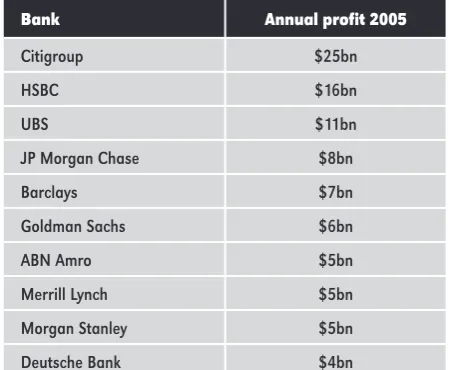
The ‘economic footprint’ of the CTDL would, in the first instance, fall upon the large financial institutions that are members of the CLS Bank and RTGS system’s such as NBO and CHAPS. These are primarily international banks and the largest domestic banks. If this was as far as the process went, there is little doubt that major international banks could comfortably absorb this as shown by Tables 3 and 4 overleaf.
Large international banks dominate the global FX market. Together with the large domestic financial institutions in the respective currency areas, these institutions account for the vast majority of the FX trades in all currencies including sterling, krone and euro. These banks’ trades are ultimately undertaken for a wide range of clients – for example, the CLS Bank estimate that an average of 200,000 separate transactions are settled every day, which gives some sense of the number of ultimate participants in the global FX market.
Let us briefly examine the general incidence and impact on corporations of a CTDL on sterling. As we have seen, the CLS bank processes an average of 200,000 FX transactions every day. In line with the global picture, we assume that 17.5% of these have sterling on one side of the trade, which gives 34,000 sterling transactions in
24 Some of the fall in volume could reflect a migration to stock exchanges, where FX deals can be executed by trading stocks denominated in different currencies. This practice already occurs to some extent, though its potential growth is limited. However, traded stocks are also settled in centralised systems of the kind described in this report, and could therefore be brought within the ambit of the CTDL relatively easily.
the CLS system per day. However, the CLS Bank settles only around half of all FX transactions, which suggests a global figure of 68,000 sterling trades per day. Over a year, therefore, we can estimate the total number of sterling transactions to be of the order of 17.7 million. The impact of the CTDL would be spread very widely internationally with tens of thousands of participants carrying out the 17.7 million transactions. The cost would be in the region of $117 per trade, on an average trade size of a little over $2 million.
For corporations, however, the situation is clearly different. For example, the UK exports somewhere in the region of $380 billion worth of goods and services per year. Based on the profit margins of UK companies from 1990 to 2002, we assume an average margin of 10%.28 Ten per cent of $380 billion is $38 billion, which we take as a rough
estimate of the annual profit of the UK’s export sector. The impact of the CTDL on UK corporates would be somewhere in the region of $115 million. Consequently, the impact on UK exporters would be just 0.3% of their annual profits, which is very small when set against the many other factors that influence company profitability. For example, over the past ten years, UK companies’ average profitability has fluctuated by up to 10% per year. It is therefore clearly the case that when compared to the impact of changes to general business conditions, and movements in indicators such as interest rates and the sterling exchange rate, a CTDL of 0.005% will have hardly any discernable impact. This analysis is also applicable to the impact of the CTDL on the euro and the krone.
Bank Annual profit 2005
Citigroup $25bn
HSBC $16bn
UBS $11bn
JP Morgan Chase $8bn
Barclays $7bn
Goldman Sachs $6bn
ABN Amro $5bn
Merrill Lynch $5bn Morgan Stanley $5bn Deutsche Bank $4bn
Bank Annual profit 2005
Nordea $4bn
DnB NOR $2bn
Handelsbanken $2bn Skandinaviska $1bn TABLE 4
[image:29.595.154.379.86.271.2]2005 profits for major banks in Norway 27
TABLE 3 2005 profits for major
international banks 26
26 US banks’ data: http://money.cnn.com/ magazines/fortune/fortune500/ full_list/index.html
Non-US banks’ data: each institution’s consolidated financial statements 2005. US Dollar figures for non-US banks converted at exchange rate of 3/1/2006 – rounded figures.
Consequently, we estimate that at least half of the impact of the CTDL will eventually be passed on by banks to their global clients in the form of a slightly higher spread. The impact of the CTDL would therefore be dispersed widely throughout the global financial system, and not fall disproportionately on any single institution.
Conclusion
To summarise, we have seen how developments in international payment and
settlement systems, have resulted in an interrelated global network, which is lubricated by common technological and communication systems. It is precisely this highly interdependent network that makes it feasible today to unilaterally implement a CTDL on any currency. In order to avoid producing market distortions, the proposal is that the duty be set at a rate of 0.005% on all FX transactions of a specific currency. As well, the mechanism through which the CTDL could be efficiently identified and collected has been demonstrated.
We have produced highly conservative estimates of the likely annual revenue that would be raised through the CTDL based on unilateral implementation by the UK: $2.07 billion, Norway: $170 million and the euro area: $4.3 billion. When compared with the estimated running costs of the system, it is clear that the cost of administration and collection of the duty would be minimal, maximising the amount available for international development purposes.
Finally, we have shown that for financial institutions that would be effected by the CTDL, the impact would be highly diffused throughout the financial system – both domestically and overseas – and would amount to, for example in the UK, just $117 on an average FX trade of $2 million.
3
Responding to objections
In this section we start with the two most standard criticisms of proposals to tax currency transactions, then describe why the CTDL is entirely different from the Tobin tax, before answering most commonly raised points of issue.
The two classic ‘avoidance’ criticisms
● Unless every country implements a CTT at the same time the currency trade would
re-locate to avoid paying the levy. (The so-called multilateral argument has for many years been used to block progress on this issue and it is important that it is dealt with first).
● Even if the CTT could not be avoided through re-location of the trade an adapted or
new foreign exchange instrument would be employed to circumvent payment.
The proposed CTDL overcomes these obstacles and many historical issues for the following two principle reasons:
The CTDL is implemented by a country on its own currency, wherever it is traded in the world, as opposed to on all currencies traded in the country. This is a critical distinction. This is it the key to feasibility not least because it allows unilateral progress by one country or a group of like-minded countries. It works because (as indicated by the Norges bank report in Box 1, in the previous section) a country’s Central Bank features at the heart of trades of its own currency, wherever they are transacted in the world, including tax havens. The payment of a CTDL would be a legal obligation, like payment of any other tax. To avoid it risks an institution’s reputation not warranted for the sake of paying a very small levy. (This is expanded upon below).
The proposed rate of the CTDL is 200 times smaller than the original CTT proposal. This is clearly a key factor with an array of consequences affecting many of the historical concerns traditionally pitted against it. At 0.005% the proposed rate is too small to impact on the normal functioning of the market. Equally, it is not sizeable enough to warrant elaborate invention in order to avoid. At this rate, as we show below, a financial institution would lose more avoiding it, than it would gain. A CTDL at 0.005% is
essentially uneconomic to avoid.
The CTDL is not the Tobin tax
James Tobin’s original 1970s idea was for a tax to alter motivation in the foreign exchange market. The purpose of his tax was to impede daily currency trading29 and to
discourage speculative activity. When he advanced his proposal the currency market had a daily value of $18 billion, it is now worth almost $2,000 billion per day. The rate he proposed was 1%, 200 times the 0.005% rate set out here, and the income was not designated to a specific purpose, such as development.
The CTDL is entirely different. Its raison d’etre is as a financing instrument for
development. Its rate is designed specifically not to hamper normal market operations but instead to skim a tiny fraction of the volume traded. The two proposals have but one element in common, they are both associated with currency. The CTDL fundamentally differs from the Tobin tax, therefore, in that it is born of a different time, proposed at a different rate and designed for a different purpose.
Historical points of issue
Would financial actors get around a CTDL by inventing new FX instruments
or shifting their currency trading to offshore tax havens and other non-taxed
jurisdictions?
Contrary to what critics say, incentive for avoidance of a CTDL levied on a currency (as opposed to the jurisdiction in which a currency trade takes place) is very limited. Incentive to circumvent the CTDL (or any tax) is to a large extent based on the level of the tax. Banks and other financial institutions will weigh the potential cost of evasion (penalty, suspension of licence, reputation risk and the actual technical costs of evasion through new legal entities and new instruments) against the costs of compliance (a tiny fraction of their total profits or a fractional increase in costs charged to a client). At the very low rate of 0.005% the incentive to get around the levy would seem to be very small, with the costs of avoidance appearing much higher than the cost of compliance.
The scope for avoiding the CTDL by using new instruments is also very limited. In our proposal we suggest that the CTDL be levied on all transactions regardless of their type and duration. There is little scope for using exotic financial instruments as each type of foreign exchange instrument serves a unique function and finding a perfect substitute that is not subject to the levy would be difficult. Even if inventive measures were taken to get around the CTDL, tax regimes in a country are not static. The collection of taxes, such as income tax, is a cat and mouse game in which tax payers constantly try and pay as little as possible and the tax authorities try to collect as much as possible. Moves to circumvent tax regulation can be countered by authorities keeping a watch on market developments. Also, due to the nature of the market, evasion is now technically difficult as foreign exchange transactions can be electronically traced. Moreover, payment systems are so important for financial stability that it is inconceivable that regulators will allow financial institutions to circumvent them for tax reasons or otherwise. What is required is the political will to implement the CTDL and provide the necessary legal enforcement to ensure payment and penalise avoidance.
Whilst it may have been the case in the past that a CTDL could not be implemented unilaterally, this is no longer so. Historically, the global foreign exchange market has consisted of disparate parts with little or no links between them. Trades were executed manually by phone between counterparties, and settled through a variety of systems with few linkages between them. Today, the different components of the global FX market are built on the same technical platforms, use the same electronic messaging providers and trade electronically using the same systems all of which are closely supervised and monitored by regulators.
Economic incidence: who pays the CTDL? How spread is the incidence?
Would the levy change market operation?
Although relatively few in number, large international banks dominate the global FX market. The ‘economic footprint’ of the CTDL would, in the first instance, fall upon these large financial institutions that are members of the CLS Bank and the Real Time Gross Settlement systems (RTGS). There is little doubt that they could comfortably absorb the levy given the size of their profits, however, they will as far as possible pass on these costs to their wide range of clients in the form of a slightly higher spread. The CLS Bank estimates that it settles an average of 200,000 separate transactions (about half of the global total) every day, which gives some sense of the number of ultimate participants in the global FX market. The impact of the CTDL on a specific currency would therefore be dispersed widely throughout the global financial system, with minimal impact on any one institution.
In further addressing this point we will use the example of a 0.005% CTDL on sterling. As discussed, the CLS bank processes an average of 200,000 FX transactions every day. In line with the global picture, we assume that 17.5% of these have sterling on one side of the trade, which gives 34,000 sterling transactions in the CLS system per day. However, the CLS Bank settles only around half of all FX transactions, which suggests a global figure of 68,000 sterling trades per day. Over a year, therefore, we can estimate the total number of sterling transactions as being somewhere in the order of 17.7 million carried out by tens of thousands of participants. For the 17.7 million ultimate transactions, the impact of the CTDL would be in the region of $117 per trade, on an average trade size of a little over $2 million.
For corporations, however, the situation is clearly different. The UK exports somewhere in the region of $380 billion worth of goods and services per year. Based on the profit margins of UK companies from 1990 to 2002, we assume an average margin of 10%.30
Ten per cent of $380 billion is $38 billion, which we take as a rough estimate of the annual profit of the UK’s export sector. The impact of the CTDL on UK corporates would be somewhere in the region of $115 million. Consequently, the impact on UK exporters would be just 0.3% of their annual profits, which is very small when set against the many other factors that influence company profitability. For example, over the past ten years, UK companies’ average profitability has fluctuated by up to 10% per year. It is therefore clearly the case that when compared to the impact of changes to general business conditions, and movements in indicators such as interest rates and the sterling exchange rate, a CTDL of 0.005% will have hardly any discernable impact.