http://dx.doi.org/10.4236/aces.2016.62015
How to cite this paper: Narayanan, C.M. and Das, S. (2016) Computer Aided Design and Performance Analysis of Inverse Fluidized Bed Biofilm Reactors with Special Reference to Bioplastic Synthesis. Advances in Chemical Engineering and Sci- ence, 6, 130-139. http://dx.doi.org/10.4236/aces.2016.62015
Computer Aided Design and Performance
Analysis of Inverse Fluidized Bed Biofilm
Reactors with Special Reference to
Bioplastic Synthesis
*
C. M. Narayanan, Shrijita Das
Department of Chemical Engineering, National Institute of Technology, Durgapur, India
Received 3 March 2016; accepted 12 April 2016; published 15 April 2016
Copyright © 2016 by authors and Scientific Research Publishing Inc.
This work is licensed under the Creative Commons Attribution International License (CC BY). http://creativecommons.org/licenses/by/4.0/
Abstract
Poly Laevo Lactic Acid (PLLA), in spite of being an excellent bioplastic, has exorbitantly high mar-ket price due to the high cost of raw material (lactose, glucose, sucrose). Hence, its manufacture is being attempted starting from waste effluents such as cheese whey and molasses. Earlier studies on the same in fluidized bed and semifluidized bed biofilm reactors yielded encouraging results. The present study therefore involves design and analysis of inverse fluidized bed biofilm reactors for lactic acid synthesis. The performance features of the bioreactor have been studied both ma-thematically as well as experimentally. The inverse fluidized bed biofilm reactor has been found to provide more than 75% conversion of sucrose/lactose even at high capacities (high feed flow rates) exceeding 56,000 L/hr, within a reasonably low reactor volume. The fractional substrate conver-sion increases, though sluggishly, with increase in feed flow rate due to bed expanconver-sion and also with increase in cell mass concentration in biofilm due to enhancement in intrinsic rate of bioconver-sion. The inverse fluidized bed biofilm reactor of proposed design could be safely recommended for the commercial synthesis of polymer grade lactic acid from waste effluents such as cheese whey and molasses. The low operating cost of the bioreactor (due to downflow mode of operation) enhances the economy of the process. This would also help in significantly lowering the market price of the green plastic (PLLA) and shall promote its large scale manufacture and utilisation.
Keywords
Inverse Fluidized Bed Biofilm Reactors, Computer Aided Design, Bioplastics, Lactic Acid Synthesis, Software Development
1. Introduction
Inverse fluidization technology is not a new concept, though the application of this technology to the design of bioreactors has been investigated only during the recent past. In the most conventional design, inverse fluidized beds are composed of particles that are of lower density than the liquid (feed solution). Consequently, though the liquid is fed from the top and executes downflow, these particles remain suspended in the descending stream of liquid and thus form a fluidised bed. In the present study, particles made of polymer composites (that are lighter than water) each surrounded by a biofilm (a thin film of microbial solution) are used and these particle-biofilm aggregates remain fluidised in the down-flowing substrate solution (feed solution).
Studies on hydrodynamic characteristics of liquid-solid inverse fluidised beds have been reported by Ulaga-nathan and Krishnaiah [1] and Banerjee, Basu and Ganguly [2]. Both of these investigators have considered flow of Newtonian fluids (water and aqueous solutions) through inverse fluidised beds composed of polymer beads and granules. Non-Newtonian flow (flow of CMC-carboxy methyl cellulose-solutions) in inverse fluidized beds has been analysed Vijayalakshmi [3] et al. For the estimation of minimum inverse fluidization velocity,
( )
mfU inv , a modified form of the correlation proposed by Ulaganathan and Krishnaiah [1] has been used in the
present study:
( )
3 0.202(
)
0.382.93 10
mf L Sm L
U inv = × − Ar ρ −ρ ρ (1)
where,
(
)
3 2L sm Pm L L
Ar=
ρ
−ρ
gdρ µ
(2)(
1)
Sm f L f S
ρ = ρ + − ρ (3)
(
3 3)
1 P Pm
f = − d d (4)
2
Pm P
d =d + δ (5)
δ
= biofilm thickness (assumed constant).In the above equations, ρSm and dPm are density and effective size respectively of particle-biofilm aggre-gates and Ar is the modified Archemedes number. The parameter f represents the volume fraction of biofilm
in particle-biofilm aggregate. The above correlation is valid for 106<Ar< ×7 107 and 0.4<
(
ρL−ρSm)
ρL<0.9. The operating velocity of the feed solution, UL, is then chosen as at least 20% higher than this minimum.The above authors [1] have also proposed a correlation for the estimation of expanded bed height
( )
Lf .(
)
0.92 0.345(
)
0.210.572
f S L Sm L
L L = Re Ar− ρ −ρ ρ − (6)
where,
.
Pm L L L
Re=d ρU µ (7)
The voidage of the bed, εf (which is equal to the fractional liquid holdup, εfL) could be then estimated from a solid balance as
(
)
1 1
f LS Lf P
ε = − −ε (8)
where εP is the voidage of the original static bed (of height, LS).
As stated earlier, reported studies on design and analysis of inverse fluidised bed bioreactors are scarce in lit-erature. Performance characteristics of immobilized enzyme inverse fluidized bed bioreactors of modified de-sign that employ nanosilica particles as support media have been analysed by Narayanan [4] et al. The superior performance features of such reactors have been effectively highlighted by these authors.
We have therefore selected molasses and cheese whey as the starting materials which are waste effluents dis-charged from cane sugar manufacturing industries and milk processing plants and thus are available practically free of cost. Our earlier investigations [5]-[7] have successfully demonstrated that these two are promising raw materials for commercial manufacture of polymer grade lactic acid in fluidised bed biofilm reactors [5], in semifluidized bed biofilm reactors [6] and in fluidised bed biofilm reactors of diverging-converging geometry [7]. In the present project, design and analysis of inverse fluidised bed bioreactors have been attempted for lactic acid synthesis from molasses and cheese whey permeate (the permeate left behind after the separation of pro-teins from raw cheese whey by ultrafiltration).
2. Mathematical Modeling
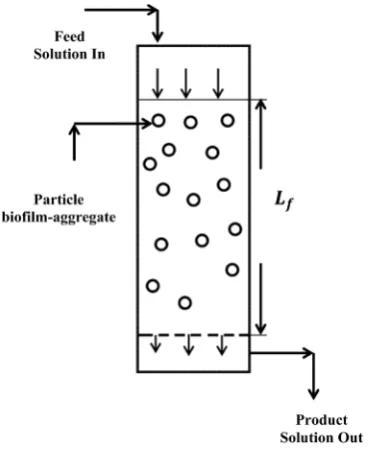
A schematic view of Inverse fluidised bed biofilm reactor is shown inFigure 1. Assuming dispersed flow of substrate solution through the reactor column, the performance equation for the bioreactor is,
(
)
(
)
(
2 2)
( )( )
d d d d
L f S Lf S S
U ε C z D C z η r int
− + = − (9)
where, UL = operating superficial velocity of feed solution (selected as at least 20% higher than the minimum, as stated earlier)
(
2)
. π 4
O
Q D
= (10)
O
Q = volumetric flow rate of feed solution employed, m3/s.
Lf
D = axial dispersion coefficient, m2/s.
η
= effectiveness factor, dimensionless.( )( )
−rS int = intrinsic rate of bioconversion of sucrose/lactose, g/(L.s).In the case of sucrose from molasses being fermented to lactic acid using Enterococcus faecalis as biocatalyst or lactose from cheese whey being fermented to lactic acid using Lactobacillus helveticus as biocatalyst, the in-trinsic kinetics of bioconversion follows Monod-type kinetic equation. Thus,
( )( )
−rS int =µm(
app C)
S(
KS +CS)
(11)where, µm
(
app) (
= µm Y)
( )(
x ff 1−εf)
εf (12) f [image:3.595.222.408.480.705.2]x = biomass concentration in the biofilm (assumed constant).
Y = overall yield coefficient for cell mass production.
The values of kinetic constants reported by Anjana and Kumar [8] for lactic acid synthesis from molasses are,
(
)
13.33 hr
m Y
µ
= −and KS =0.1 g L.
In case of lactic acid synthesis from cheese whey permeate using a microbial culture of Lactobacillus helve-ticus, the kinetic constants reported by Schepers [9] et al. are, 0.7 hr 1
m
µ = − ,
0.22 g L
S
K = , Y=0.65.
All the above values of kinetic constants have been verified experimentally by us and then utilised in the pre-sent analysis.
The parameters
(
δ,xf)
have been assumed to remain more or less unaltered during the entire period of op-eration of the bioreactor. This, in fact, is a well-justified assumption. Cell growth and multiplication do take place in the biofilm. And so are cell death or cell decay. However, as the biomass concentration exceeds a par-ticular value, the biofilm gets detached from the particle surface (the phenomenon being known as sloughing) and it gets replenished immediately by a new layer of microbial cells. Also, as dead cells fall out from the bio- film, they are at once replaced by living cells. As a consequence, both the biofilm thickness
( )
δ as well as thebiomass concentration in the biofilm
( )
xf remain more or less constant during the entire operation of thebio-reactor.
It is also to be noted that due to the high magnitude of cell mass concentration in the biofilm (the value of xf
often exceeds 5 - 10 times the substrate concentration in the feed solution), the rate of bio-conversion attained shall also be substantially large.
The effectiveness factor
( )
η is computed from the correlation proposed by Gottifreddi and Gonzo [10]:( ) (
2)
2( )
2{
(
)
2}
(
)
21η = 1ηd +exp 6 ϕ′ 5 1+β − 1ηd (13)
where,
(
)
(
)
{
(
)
}
1 22 1 ln 1
d
η = ϕ′ +β β β − +β (14)
(
)
(
)
1 26
P m e S
L app D K
ϕ′ = µ (15)
(
CSP KS)
β = (16)
(
) (
)
(
3 3)
2characteristic dimension
volume of biofilm surface area of biofi
6
lm P
Pm P Pm
L
d d d
= − = = (17) e
D = effective diffusivity of substrate into biofilm.
The substrate concentration at the biofilm surface (at the liquid-biofilm interface), namely CSP, depends on the rate of substrate transfer from the liquid bulk to the biofilm surface. However, due to the large degree of turbulence in the fluidized bed, the liquid to particle mass transfer coefficient has been observed to be signifi-cantly large. As a result, without any serious error, it could be assumed that substrate concentration (sucrose concentration/lactose concentration) at the liquid-biofilm interface
( )
CSP is more or less equal to that in the liquid bulk at any cross-section of the bioreactor( )
CS . In other words, in the case of the bioreactor under con-sideration, we may safely assume that:.
SP S
C ≈C (18)
Computation of effectiveness factor
( )
η from the above equations, Equations (12) to (15), has beenper-formed based on the above assumption. An experimental value of axial dispersion coefficient (DLf =0.03125 m s2 )
is used in computations.
(where z = 0, CS =CSe). Computations were continued upward until CS =CSO and z=Lf. The fractional conversion of sucrose/lactose is then given by:
(
CSO CSe)
CSO.α = − (19)
The software package is re-executed at different values of feed flow rate (QO) and at different CSe-values. In
[image:5.595.217.409.192.314.2]each case, the fractional substrate conversion (α) attained and the required height of reactor column (Lf) are computed. Typical results are illustrated graphically inFigures 2-6.
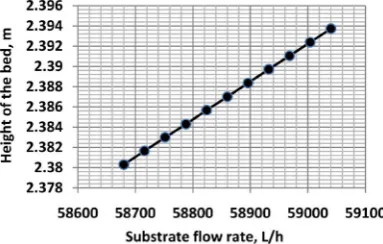
Figure 2. Variation of height of the fluidised bed (Lf ) with substrate flow rate (QO). Feed
[image:5.595.216.411.365.505.2]solu-tion = molasses, dP = 12.5 mm, xf = 500 g/L.
Figure 3. Variation of height of the fluidised bed (Lf ) with substrate flow rate (QO). Feed
[image:5.595.217.410.555.687.2]solu-tion = molasses, dP = 12 mm, xf = 500 g/L.
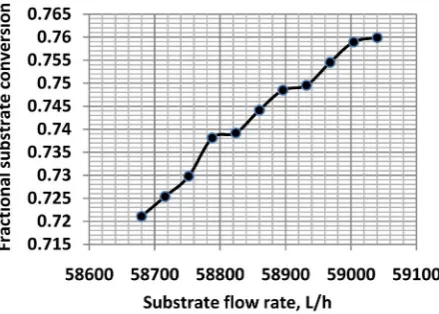
Figure 4. Variation of fractional substrate conversion (α) with substrate flow rate (QO). Feed
Figure 5. Variation of fractional substrate conversion (α) with substrate flow rate (QO). Feed
solution = molasses, dP = 12 mm, xf = 500 g/L.
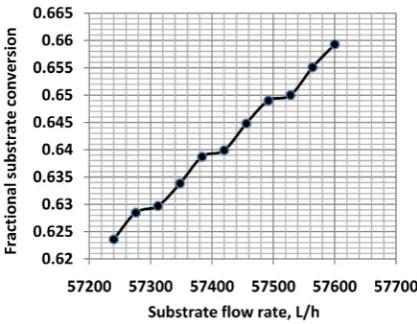
Figure 6. Variation of fractional substrate conversion (α) with substrate flow rate (QO). Feed
solution = cheese whey permeate, dP = 12.5 mm, xf = 150 g/L.
3. Experimental Study
The purpose of experimental work was to test the accuracy and reliability of the software package developed (described above). For this, the numerical values of system/operating parameters (expanded bed height, frac-tional substrate conversion) computed using the developed CAD software were compared against the experi-mental data complied on pilot plant scale. Out of 25 data points collected on a pilot plant bioreactor 0.5 m in diameter, 1.5 m height, composed of PP composite beads each surrounded by 0.3 mm biofilm, with clarified molasses as feedstock, 15 of them deviated by 12% (max) from the results (α-values) computed from the de-veloped software package and the remaining deviated by less than 10%. With cheese whey as charge stock (cheese whey collected from dairy farms was subjected to ultrafiltration, after preliminary treatments, to sepa-rate all the milk proteins and the UF permeate is then used as the feedstock for lactic acid synthesis), the com-puted values and the experimental values of α deviated by 15% (max) and 5% (min). The developed software could be thus treated as reasonably accurate and reliable.
[image:6.595.205.425.293.450.2]4. Results and Discussion
Two typical plots of expanded bed height versus feed flow rate (QO) are shown inFigure 2 and Figure 3. Within the range of feed flow rate handled, the increase in Lf with increase in liquid flow rate is not large (Lf
varies within 2.35 to 2.5 m). This is true for all the three particle sizes considered. (dP = 11 mm, 12 mm, 12.5 mm). The variation, however, is close to linear.
4.1. Effect of Feed Flow Rate on Reactor Performance
The dependence of fractional conversion of sucrose/lactose attained on feed flow rate (α versus QO) is illus-trated inFigures 4-7.Figure 4 andFigure 5 are for fermentation of molasses with xf = 500 g/L (cell mass concentration in biofilm being maintain constant at 500 g/L) and for different support particle sizes such as dP
= 12 mm, 12.5 mm. The biofilm thickness remains the same (
δ
= 0.3 mm) for particles of all sizes. It can be seen that the bioreactor provides more than 75% conversion of sucrose at feed flow rates exceeding 55,000 L/hr when the particle size (dP) employed is 12.5 mm. With 12 mm particles, the conversion attained is slightly lower (though more than 65%) at comparable flow rates. As stated earlier, the expanded height of the bed (ef-fective height of reactor column) is less than 2.5 m, the column diameter being 0.5 m. It can be thus inferred that this bioreactor is capable of providing large degree of bioconversion (large yield of lactic acid) within a low re-actor volume. The fractional substrate conversion attained is higher at larger particle size.The observation is exactly similar in the case of fermentation of cheese whey permeate as well (Figure 6and
Figure 7). Here also, the fractional conversion of lactose (to lactic acid) attained is more than 75% even at large feed flow rates (more than 56,000 L/hr) when dP = 12.5 mm. No doubt, α (attained) is lower at lower parti-cle size (dP = 12 mm). The cell mass concentration maintained in the biofilm (xf) in this case is 150 g/L. To note that lactose concentration in the cheese whey permeate (feed solution) is 9.0 g/L, while CSO = sucrose concentration in feed molasses = 150 g/L.
The magnitude of α (attained) does increase, but sluggishly, with increase in QO, as can be seen from
Figures 4-7. This is due to the increase in expanded bed height (Lf ) and a simultaneous increase in εf (bed voidage).
[image:7.595.208.417.524.686.2]4.2. Effect of Cell Mass Concentration in Biofilm on Reactor Performance
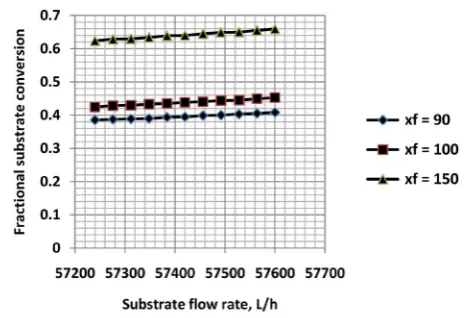
Figure 8effectively demonstrates that a large value of cell mass concentration in biofilm (xf ) helps in attaining larger degree of substrate (here, sucrose) conversion at any selected feed flow rate (QO). The situation is
analo-gous with lactose fermentation as well (Figure 9). Though the plots shown are for dP = 12 mm, the phe-nomenon has been observed to be identical at all particle sizes considered. This observation is not surprising, since larger the biomass concentration, larger shall be the intrinsic rate of bioconversion,
( )( )
−rS int , as isFigure 7. Variation of fractional substrate conversion (α) with substrate flow rate (QO). Feed
Figure 8. Variation of fractional substrate conversion (α) with substrate flow rate (QO) at
dif-ferent values of biomass concentration in biofilm (xf). Feed solution = molasses, dP = 12 mm.
Figure 9. Variation of fractional substrate conversion (α) with substrate flow rate (QO) at
dif-ferent values of biomass concentration in biofilm (xf ). Feed solution = cheese whey permeate,
P
d = 12 mm.
evident from Equations (11) and (12). However, too large biomass concentration in the film could make the biofilm unstable and it shall have pronounced tendency to get detached from the particle surface.
4.3. Operating Cost of Bioreactor
The downflow mode of operation is another exquisite advantage of inverse fluidized bed bioreactors. This brings down the operating cost of the reactor as compared to the conventional fluidized bed/semifluidized bed reactors where the fluid is to be pumped upward. Another advantage due to the downflow mode of operation is that problems related to entrainment of particles or particle-biofilm aggregates in the outgoing product solution are absent in bioreactors of this category.
5. Conclusions
1) Performance characteristics of inverse fluidized bed biofilm reactors are analysed with special reference to synthesis of polymer grade lactic acid from waste effluents such as molasses and cheese whey.
2) A multi-parameter software package has been developed which predicts the performance of the bioreactor satisfactorily. The reliability of the package has been verified by comparing with pilot plant data.
[image:8.595.195.432.285.444.2]4) The fractional substrate conversion does increase with increase in cell mass concentration in the biofilm, though large values of xf are difficult to maintain in industrial bioreactors.
5) Since the feed solution is not required to be pumped upward and it executes downflow under gravity, the operating cost of this bioreactor is lower than that of fluidized bed/semifluidized bed bioreactors which handle an ascending stream of fluid. This downflow mode of operation also inhibits entrainment loss of particles in the product solution discharged.
6) This bioreactor also permits use of large size support particles and thus larger size particle-biofilm aggregates, though the particle material must be so chosen that its density is sufficiently lower than the substrate solution handled.
6. Future Research Areas
At large liquid velocities, the particles experience large hydrodynamic forces and as a result, these particles could have a tendency to aggregate (or accumulate) at the bottom of the column, just above the bottom porous plate and thereby tend to form a compact packed bed there (similar to what occurs in a semifluidized bed). Such a rearrangement of particles, if occurs, could very much affect the overall performance of the reactor. More ela-borate studies are required to throw more light on this feasible phenomenon.
Acknowledgements
We are grateful to all the fellow members of our International Research Group and to a number of consultancy firms of India whose assistances were invaluable for the successful completion of this project.
References
[1] Ulaganathan, N. and Krishnaiah, K. (1996) Hydrodynamic Characteristics of Two-Phase Inverse Fluidized Bed. Bio-process Engineering, 15, 159-164. http://dx.doi.org/10.1007/bf00369620
[2] Banerjee, J., Basu, J.K. and Ganguly, U.P. (1999) Some Studies on the Hydrodynamics of Reverse Fluidization Ve-locities. Ind. Chem. Engr., 41, 35-38.
[3] Vijayalakshmi, A.C., Balamurugan, M., Sivakumar, M., Newton, T.S. and Velan, M. (2000) Minimum Fluidization Velocity and Friction Factor in a Liquid-Solid Inverse Fluidized Bed Reactor. Bioprocess Engineering, 22, 461-466. http://dx.doi.org/10.1007/s004490050759
[4] Narayanan, C.M., Tejaswi, M., Prasad, H. and Chakraborty, N. (2014) Studies on Performance Analysis and Computer Aided Design of Inverse Fluidized Bed Bioreactors with Nano-Support Particles. International Journal of Chemical Reactor Engineering, 12, 303-315. http://dx.doi.org/10.1515/ijcre-2014-0027
[5] Narayanan, C.M. (2015) Case Studies on Synthesis of PLLA Bioplastic Starting from Food and Agricultural Wastes. Int. J. Chem. Eng. Processing, 1, 1-13.
[6] Narayanan, C.M. and Das, S. (2015) Studies on Synthesis of Lactic Acid from Molasses and Cheese Whey in Semiflu-idized Bed Biofilm Reactors. Proc. Golden Jubilee Int. Conf. Recent Dev. in Chem. and Biochem. Eng., NIT Durgapur.
[7] Narayanan, C.M., Basak, A., Saha, A. and Jha, S. (2014) Studies on Performance Characteristics of Diverging-Con- verging Fluidized Bed Biofilm Reactor with Special Reference to Lactic Acid Synthesis from Molasses and Cheese Whey. International Review of Chemical Engineering, 6, 142-152.
[8] Anjana, D.N. and Kumar, S. (2008) Kinetic Modelling of Lactic Acid Production from Molasses Using Enterococcus faecalis RKY1. Biochemical Engineering Journal, 38, 277-284. http://dx.doi.org/10.1016/j.bej.2007.07.014
[9] Schepers, A.W., Thibault, J. and Lacroix, C. (2002) Lactobacillus helveticus Growth and Lactic Acid Production dur-ing pH-Controlled Batch Cultures in Whey Permeate/Yeast Extract Medium. Part-I. Multiple Factor Kinetic Analysis. Enzyme and Microbial Technology, 30, 176-186. http://dx.doi.org/10.1016/S0141-0229(01)00465-3
Nomenclatures
Ar modified Archemedes number.
Se
C substrate concentration in product solution, g/L.
SO
C substrate concentration in feed solution, g/L.
P
d diameter of support particle, m.
Pm
d diameter of particle-biofilm aggregate, m.
e
D effective diffusivity of substrate into biofilm, m2/s.
Lf
D axial dispersion coefficient, m2/s.
f volume fraction of biofilm in particle-biofilm aggregate, dimensionless.
S
K Monod’s kinetic constant, g/L.
f
L height of fluidised bed, m.
P
L characteristic dimension, m.
S
L height of original static bed, m.
O
Q substrate flow rate, L/h.
Re modified Reynolds number.
( )( )
−rS int intrinsic rate of bioconversion, g/(L.s).L
U superficial velocity of liquid, m/s.
( )
mf
U inv minimum inverse fluidization velocity, m/s.
f
x biomass concentration in biofilm, g/L.
Y overall yield coefficient, mg/mg. α fractional conversion, dimensionless.
δ
biofilm thickness, m.f
ε total voidage (=liquid holdup) of fluidised bed.
P
ε total voidage (=liquid holdup) of original static bed.
η
effectiveness factor, dimensionless.m
µ maximum specific growth rate, s−1.
L
µ viscosity of fluid, kg/m·s.
L
ρ density of fluid, kg/m3.
S
ρ density of support particle, kg/m3.
Sm
ρ density of particle-biofilm aggregate, kg/m3.