Acceptability of self-taken vaginal for early detection
of HPV DNA in women with limited access to health
services: An alternative to increase the coverage in a
state of the Mexican Republic
Terán-Figueroa Yolanda1, Muñiz-Carreón Patricia1, Gallegos-Arévalo Yolanda Graciela2, Gaytán-Hernández Darío1, Gutiérrez-Enríquez Sandra Olimpia1*
1Nursing Faculty, Autonomic University of San Luis Potosí, San Luis Potosí, México; *Corresponding Author: [email protected] 2Faculty of Nurse and Nutriology, Autonomic University of Chihuahua, Chihuahua, México
Received 5 November 2013; revised 8 December 2013; accepted 21 December 2013
Copyright © 2013 Terán-Figueroa Yolanda et al. This is an open access article distributed under the Creative Commons Attribution
License, which permits unrestricted use, distribution, and reproduction in any medium, provided the original work is properly cited.
ABSTRACT
Objective: To determine the acceptability of self- taken vaginal to detect HPV DNA in women liv- ing in marginalized areas as an alternative to increase the coverage of health services. Meth- ods: A cross-sectional study from March 2009 to April 2011 in 20 municipalities with the highest marginalization in the Huasteca Region of the State of San Luis Potosi, México. We applied a non-probabilistic quota sampling, which was composed of 608 women aged 25 years and more. The recruitment of women was performed through loudspeakers, leaflets and community meetings. A survey consisted of two sections: socio-demographic data and risk factors, which was validated by construct. We checked the re- liability by Cronbach’s Alpha (0.90). Acceptabil- ity was determined by considering three indi- cators: perceived comfort, acceptability of the test and the reasons of acceptability. Results: 41.4% of this woman had 31 - 40 years. 70.5% were married. 35.3% finished high school and 6.7% had not education experience. 67.4% began their sexual life at 18 years or younger. 85.5% preferred self-collection and 14.5% Pap. These re- sults show a clear acceptability of self-making on the other screening method. Regarding the reason for the preference is that 99.4% of women prefer self-take because they feel more comfort- able compared to 0.6% who prefer the Papani- colaou. On the perception of comfort 91% men- tioned feel very comfortable with self-making compared with 9% of Pap. There was a statisti-
cally significant correlation between preference reasons that women have to choose the screen- ing test and the perception of comfort (X2p = 0.000). Conclusions: The self-taken vaginal HPV DNA detection is a well accepted method in women who live in marginalized areas; therefore, it is an alternative that can be considered in the uterine cancer detection testing program.
Keywords:Self-Taken Vaginal HPV; Cervical Cancer; Acceptability of Self-Making
1. INTRODUCTION
Cervical cancer (CC) remains one of the most frequent causes of death in women [1] and a public health prob- lem worldwide especially in underdeveloped countries, with an annual report of 510,000 cases [2,3], an esti- mated 274,883 deaths in 2008. In México the disease ranks second in incidence and is a major cause of cancer death in women older than 25 years [4]. The cause of cervical cancer deaths that occur in México each year mostly affects women living in marginalized areas. For 2007, México recorded that a mortality rate of 14.2 per 100,000 women and specifically in the state of San Luis Potosi (SLP), which has indigenous settlements, was between 17 and 17.5 [5]. Prevention efforts worldwide have focused on the screening of patients at risk using Pap test (Pap) and treatment of precancerous lesions. In México the early detection of cervical cancer program has more than 20 years in operation and avoided less than 13% of preventable cases [6].
nique for early detection of cervical cancer and precan- cerous lesions. Based on the fact that cells of the cervical epithelium layers are shed continuously. To remove cells requires professional or technical staff. For obtaining cells women must be in the gynecological position, the speculum of metal or plastic is inserted into the vagina in order to observe the cervix. Once located proceed to col-lect the cells by special instruments such as Ayre spatula and cytobrush. The cellular material extends in a glass slide, fixed with alcohol and sent to the laboratory for analysis and interpretation. For this study the woman must expose their private parts so that the doctor or nur- sing staff take the sample. In México, one of the main factors limiting the success of cervical cancer prevention in addition to those related to the organization of health systems is the socio-cultural aspect that hinders proper implementation of preventive measures.
One explanation for the low coverage is the limited use and poor accessibility of women to the Papanicolaou (PAP) due to cultural and institutional barriers such as: discomfort with the pelvic exam, their husbands or sex- ual partners are not allowed to take Pap, previous nega- tive experiences with service providers, ignorance of the Pap, perception and the long waiting time for delivery of results [7]. The limited success of this programs has been the estimating testing for DNA Human Papillo- mavirus (HVP). Several studies have evaluated the cli- nical utility of the Hybrid Capture (CH2) in cervical cancer screening. The sensitivity was 86% for any type of HLG (low grade lesions) and 93% for LAG (High Grade Lesions), compared with 60% and 73% of Pap [8]. Screening of High-Risk HPV has been shown to be a highly sensitive tool in the early detection, and it has been successfully used in clinical and epidemiological studies showing that it is suitable for population pro-grams obtaining the sample that is much easier, and the interpretation of the result. Recent large-scale studies in women, who do not participate in conventional screening program, have shown that the supply of self-take for HPV detection, and an effective alternative to attract up to 30% of these patients [9-12] have increased the cov-erage. San Luis Potosi in 2010 began to implement HPV testing [13]. However, the accessibility of the service and the cultural aspect has not been resolved, like time con-straints, discomfort, this is how the idea of promoting the patient’s own take of the sample (self-making) represents an option that involves social and economic benefits, which together with other actions would lead to a de-crease in the incidence of cervical cancer. The objective of this study was to determine the acceptability of self- taken vaginal to detect HPV DNA in women living in marginalized areas as a possible alternative to increase the coverage of health services.
2. PATIENTS AND METHODS
2.1. Data Source
Cross-sectional study conducted in the period March 2009 to April 2011 in the 20 municipalities with the highest marginalized rating in the Huasteca region of the State of San Luis Potosi, México. The level of poverty data were obtained from CONAPO (National Council of Population), which considers five units: Very Low, Low, Medium, High and Very High level of poverty, based on the indicators: private homes inhabited, percentage of population 15 years or more without complete primary illiterate, percentage of occupied private housing inhab- ited with no toilet and no electricity, percentage of occu- pied private housing without piped water availability, average occupants per room in occupied private housing with floor and have no refrigerator. The universe of women in municipalities is 79.946. Due to the difficulty in locating women given the characteristics of the geo- graphic area we applied a non-probabilistic sampling fee, which was composed of 608 women aged 25 years and over, distributed as follows: Aquismón 38, Axtla de Ter- razas 36, Ciudad Valles 92 Coxcatlán 18, Ébano 45, El Naranjo 14, Huehuetlán 10, Matlapa 35, San Antonio 5, San Martin Chalchicuautla 29, San Vicente Tancuayalab 13, Tamasopo 16, Tamazunchale 88, Tampacán 16, Tampamolón Corona, 15, Tamuín 35, Tancanhuitz 13, Tanlajás 20, Tanquián of Escobedo 16 and Xilitla 48. The recruitment of women was carried out through loud- speakers, leaflets and community meetings. A group of promoters gave a talk about HPV and vaginal self-take to build awareness. The women took the samples in the bathrooms of the health centers. To collect the data, a survey consisting of two sections: socio-demographic data and risk factors which was validated by construct, and the reliability was verified through Cronbach’s Al- pha (0.90).
2.2. Materials
times we used appropriate language for understanding according to the characteristics of the population in each community. When necessary, they requested support from translators in order to communicate with women who only speak a native dialect (Tenek or Nahuatl).
2.3. Sample Processing
Each sample was labeled using a bar code and stored at 4˚C. The HR-HPV infection was determined by Hy- brid Capture (Digene Hybrid Capture ® 2). Samples were processed in the Laboratory of Molecular Biology Diagnostics on the device INSP Rapid Capture System
Digene DML 2000.
2.4. Map Production
It was used ILWIS 3.3 software which is an acronym for the integrated management of land and water in a Geographic Information System (GIS) with image proc- essing capabilities developed by the International Insti- tute for Aerospace Survey and Earth Sciences Enschede, Netherlands, which allows you to view different areas at one time. To create the map were obtained databases of geographic coordinates of the locations of the Huasteca, which were converted to Universal Transverse Marker (UTM). He placed the Digital Terrain Model (DTM), and polygon map to identify the boundaries of each mu- nicipality.
2.5. Data Analysis
We used SPSS (Statistical Program Social Science) v. 15.0. For the interpretation of the data descriptive statis- tics were used. To verify whether there was a relation- ship between the variables: “preference reasons” of self- making as a screening with the “comfort women per- ceived” to be tested (self-making) was applied Pearson
X2.
2.6. Ethical Considerations
All participants gave their consent to participate in the study. The project was evaluated and accepted by the H. Research Ethics Committee of the Faculty of Nursing UASLP, 0028HCEI key.
3. RESULTS
In México there are 84,769 localities, of which 26.4% (22,443) are classified as highly marginalized degree, while 73.5% (62,326) are highly marginalized (National Institute of Statistics, Geography and Informatics INEGI, 2010). Specifically in the State of San Luis Potosi, 2.2% of the population (781 seats) has a very high level of poverty and 32.9% (3001 seats) are highly marginalized (INEGI, 2010) (Figure 1, panel A and B respectively).
On the other hand, in the region where this study was done, it appears that women of all municipalities partici- pants living in high to very high levels of marginalization. This is an indigenous settlement area (Figure 1, panel
C).
Socio-demographics characteristics were studied. 41.4% were located in the age group of 31 to 40 years, followed by the group of 41 to 50 years with 31.5%. Most women are married (70.5%). The highest level of schooling was to complete high school (35.3%). It is important to show that 6.7% does not have any study. Most women (76.8%) are housewives. 67.4% began their sexual life at 18 years or younger (Table 1).
In relation to Acceptability of self-collected vaginal test, 85.5% prefer the self-collected and 14.5% Papani- colaou (Figure 2).
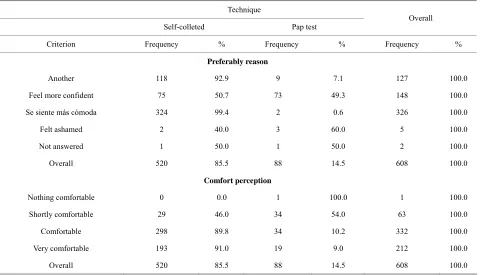
With regard to the reasons for preference of each method 99.4% prefer self-take because they feel more comfortable compared to 0.6% who prefer the Pap. The 92.9% reported other reasons for preferring self-taken as the following “easy”, “simple”, “feel more confident”, “is faster”, “comfortable”, “do not bother or do not hurt”, “making it yourself”, “practice”, “safe”, “is more per-sonal”, “painless”, “no scrape or hurt instruments”, “is material unique”, “instruments are used only once”, “is toilet”, “not embarrassed or ashamed”, “the instrument is personal”, “on-irritating”, “does not open from the va-gina” With regard to the perception of comfort 91% mentioned feeling very comfortable with self-taken com- pared with 9% of Pap. It was considered desirable to check whether there was a relationship between the rea-sons for preference for self-collected vaginal test with the perception of comfort in women who participated in the study. The result was that the perception of comfort influencing the choice of technique (X2p = 0.000) (Table 2).
4. DISCUSSION
Source: CONAPO estimations based in INEGI, population and housing census 2010. Main results by location.
Consejo Nacional de Poblaciόn www.conapo.gob.mx
GOBIERNO FEDERAL SEGOB
Océano Pacífico 0 200 400 600 Km
Golfo de México
Guatemala
El Salvador Honduras
Bel
ic
e
Consejo Nacional de Población www.conapo.gob.mx
SEGOB GOBIERNO FEDERAL
0 25 50 75 Km.
Tamaulipas
Aguascalientes Zacatecas
Nuevo León
N
(B)
[image:4.595.61.539.81.571.2]0 10 20 40 kilometers
Figure 1. Degree of marginalization in which women who participated in all municipalities live. (A) Map of México in which points
light and dark are shown locations with very high and high marginalized respectively (circulated San Luis Potosi region). (B) Map of San Luis Potosi shown circulated the Huasteca Potosina region. The light and dark spots indicate the various degrees of marginaliza-tion (Etimamarginaliza-tions based in INEGI populamarginaliza-tion and housing census 2010). (C) Map of Huasteca Potosina region. Dark areas show very high and high marginalization locations. Graphics show percentage of marginalization location. Maps were obtained from CONAPO, México.
cal cancer compared to Caucasians [15]; a decreased risk of developing this disease is associated with more ad- vanced education. The increased risk associated with low socioeconomic status is attributed to the lack of testing, a failure in the treatment of precancerous conditions, and lack of knowledge about the prevention of HPV infection [16]. Women who participated in this study are in this
poverty. Therefore, it is possible that if access to screen- ing tests such as vaginal self-making, and other measures of health were improved, the race of the person would not be proved to be a significant risk factor.
Table 1. Socio-demographic data and first intercourse of wo-
men who live in the Huasteca region of San Luis Potosi, México.
Variable No. %
Age group
30 or less 101 16.6
31 - 40 252 41.4
41 - 50 192 31.5
51 - 60 55 9.0
61 or over 7 1.1
Not answered 1 0.0
Marital status
Married 429 70.5
Free unión 118 19.4
Single 37 6.0
Widow 14 2.3
Divorced 9 1.4
Not answered 1 0.0
Schooling
None 41 6.7
Incomplete elementary 92 15.1
Completed elementary 179 29.4
Incomplete secondary 38 6.2
Completed high 215 35.3
Incomplete bachelor 7 1.1
Completed bachelor 31 5.0
Technical career 1 0.1
Unfinished degree 1 0.1
Degree completed 2 0.3
Not answered 1 0.0
Ocupation
Housewives. 467 76.8
Self-employment 69 11.3
Employee 59 9.7
Business 6 0.9
Cooperative member 5 0.8
Laborer 1 0.1
Not answered 1 0.0
Age of first intercourse
18 or less 410 67.4
19 or over 197 32.4
Not answered 1 0.0
n = 608.
14.5 %
85.5 %
Papanicolaou
Self-collected vaginal test
Figure 2. Acceptability of self-collected vaginal test in women
who live in marginalized areas of the Huasteca Potosina region.
considering HPV detection as a surrogate marker of ab-normal cytology. A study in the USA showed that the timing of self-sampling does not affect HPV detection (intercourse menstrual cycle or pre-shot), plus the num- ber of days since the last sampling does not affect repro- ducibility of viral detection, which enables the test be repeated at short intervals (days or weeks), important for the practical aspects of screening programs for the possi- bility of loss, as they cannot be processed or have be re- peated rapidly [17].
The acceptability of self-making depends largely on cultural factors. The results of this research in women living in marginalized regions of the Huasteca region indicate that the perception of comfort is related to the acceptability of the test and that the reasons are related to the preferred screening method, so that you can evidence that the comfort of the test is what leads to their accep- tance as well. Women do not feel embarrassed and feel more confident in the result. A study by Torres-Poveda in 2008 mentions that in programs for indigenous people whose cultural barriers can be an obstacle to the accep- tance of common gynecological, procedures and access of women to them obtaining samples for their own fea- tures suitable for use in the HPV DNA test can be a sat- isfying and culturally acceptable procedure [18]. Heide- man in 2012 mentioned that the women report preferring self-takes to the sample by a professional. The reasons women gave are very similar to those presented in this study as follows: the point of sampling, privacy and the simplification of the technique compared to the Pap that causes pain and shame [19]. Given this preference is not surprising that the supply of self-taken for HPV DNA detection attracts up to 30% of women not participating or unwilling to make use of regular screening program [20]. This is encouraging to be implemented in our envi- ronment, thereby increasing the coverage and thus achiev- ing the goal of reducing mortality rates in México.
Table 2. Reason of preference and perception of comfort with self-taken vaginal and Pap.
Technique
Self-colleted Pap test Overall
Criterion Frequency % Frequency % Frequency %
Preferably reason
Another 118 92.9 9 7.1 127 100.0
Feel more confident 75 50.7 73 49.3 148 100.0
Se siente más cómoda 324 99.4 2 0.6 326 100.0
Felt ashamed 2 40.0 3 60.0 5 100.0
Not answered 1 50.0 1 50.0 2 100.0
Overall 520 85.5 88 14.5 608 100.0
Comfort perception
Nothing comfortable 0 0.0 1 100.0 1 100.0
Shortly comfortable 29 46.0 34 54.0 63 100.0
Comfortable 298 89.8 34 10.2 332 100.0
Very comfortable 193 91.0 19 9.0 212 100.0
Overall 520 85.5 88 14.5 608 100.0
a single round of screening with HPV testing substan- tially reduced the risk of death from cervical cancer in a follow-up of eight years compared to women who were not offered the test, indicating that the former were half as likely to develop or die from this disease [22]. Women with DNA positive for high risk HPV in samples ob- tained by self-making, currently were advised to do the Pap with a significant risk of loss to follow-up. In the future, this step can probably be avoided by direct appli-cation of molecular markers. It is therefore considered that the time has come to introduce self-sampling as an alternative screening by testing for viral DNA [17].
gram for early detection of cervical cancer, even in de-veloped countries. For those who have not achieved 100% coverage, for example in the Netherlands, the pro-gram has been since the 70s, and has a participation rate of 67% and together with opportunistic smears and di-agnostic coverage of 75% [9], therefore, implement self- making is an opportunity for decision makers, mainly in countries where the magnitude of this problem is still very large.
REFERENCES
These results are important for the management of public services. The health programs should have special characteristics according to the population it is intended. In this particular case of indigenous communities, health personnel should be trained on the new technologies for cervical cancer screening in order to offer to clients and a safe and reliable screening, guidance on the importance of self-care, because the poorer women are those that generally require treatment for advanced forms of CC, due to the fact that they are those who have had limited access to early detection services likely cultural reasons. This situation of inequality in health in sexual and re-productive health of the indigenous population is socio-logically determined and in different cultural contexts is difficult to interpret the epidemiological risk for devel-oping cervical cancer. Increase coverage has been a con-cern of all countries that implement a public health pro-
[1] Alterio, G., Mendoza, I., Mendoza, R., Peraza, E., Pérez, H. and Sánchez, A. (2007) Cytological findings and pa-thology risk factors for preinvasive and invasive cervical cancer. Area of influence of urban ambulatory type II.
Revista Public Health and Nutrition, 8, 1-29.
http://www.respyn.uanl.mx/index.html
[2] López, A. and Lizano, M. (2006) Cervical cancer and human papilloma virus that does not end the story. Jour- nal of the National Cancer Institute Mexico, 1, 31-55.
[3] Castellano, M.R. (2003) Cervical cancer and HPV. De- tection options. Revista de la Facultad de Medicina, 46,
63-65.
[4] Ferlay, J., Bray, F., Pisani, P. and Parkin, D.M. (2000) GLOBOCAN: Cáncer, incidence, mortality and preva- lence worldwide.Versión 1.0. IARC Cancer Base No. 5. Lyon: IARC.
Sta-tistics, Geography and Informatics. Morbidity and mor-tality statistics by state. INEGI, Mexico DF.
[6] Lewis, M.J. (2004) Situational analysis of cervical cancer in Latin America and the Caribbean. Pan American Health Organization/World Health Organization (OPS/ OMS), 1-33.
[7] Lazcano-Ponce, E.C., Castro, R., Allen, B., Nájera-Agui- lar, P., Alonso-de-Ruiz, P. and Hernández-Ávila, M. (1999) Barriers to early detection of cervical uterine cancer in Mexico. Journal of Women’s Health, 8, 399-408.
http://dx.doi.org/10.1089/jwh.1999.8.399
[8] Cox, J.T., Lorincz, A.T., Schiffman, M.H., Sherman, M.E., Cullen, A. and Kurman, R.J. (1995) Human papillomavi- rus testing by hybrid capture appears to be useful in tri- aging women with a cytologic diagnosis of atypical squa- mous cells of undetermined significance. American Jour- nal of Obstetrics & Gynecology, 172, 946-954.
http://dx.doi.org/10.1016/0002-9378(95)90026-8
[9] Snijders, P. (2011) Milestones in a decision process. HPV
Today Newsletter of Human Papillomavirus. Holland Spe- cial Edition. www.hpvtoday.com
[10] Gok, M., van Kemenade, F.J., Heideman, D.A., Berkhor, J., Rozendaal, L., Spruyt, J.W., et al. (2010) HPV testing
on self-collected cervicovaginal lavage specimens as screening method for women who do not attend cervical screening: Cohort study. BMJ, 340, c1040.
http://dx.doi.org/10.1136/bmj.c1040
[11] Sanner, K., Wilkström, I., Strand, A., Lindell, M. and Wilander, E. (2009) Self-sampling of the vaginal fluid at home combined with high-risk HPV testing. British Jour- nal of Cancer, 101, 871-874.
http://dx.doi.org/10.1038/sj.bjc.6605194
[12] Gök, M., van Kemenade, F.J., Heideman, D.A., Berkhof, J., Rozendaal, L., Spruyt, J.W., et al. (2012) Experience
with high-risk human papillomavirus testing on vaginal brush-based self-samples of non-attendees of the cervical screening program. International Journal of Cancer, 130, 1128-1135. http://dx.doi.org/10.1002/ijc.26128
[13] García Rodríguez, M.C. (2011) Structure, organization and prospects of the State Program for Cervical Cancer. In: Gallegos-García, V., Gutiérrez-Enríquez, S.O., Terán- Figueroa, Y. and Velázquez-Mota, G.P., Eds., Experiences in the Implementation of the Programme of Cervical
Cancer Screening, Editorial Universidad Autónoma de
San Luis Potosí, San Luis Potosí, 33-37.
[14] Instituto Nacional de Salud Pública (2008) Programme for early detection of cervical cancer with HPV testing: Morelos. Organization and Procedures Manual. Cuerna-
vaca Morelos, 24.
[15] Khan, M.J., Partridge, E.E., Wang, S.S. and Schiffman, M. (2005) Socioeconomic status and the risk of cervical in- traepithelial neoplasia grade 3 among oncogenic human papillomavirus DNA-positive women with equivocal or mildly abnormal cytology. Cancer, 104, 61-70.
http://dx.doi.org/10.1002/cncr.21129
[16] Serrano, R.O., Pérez, C.J.U., Martínez, L.A.D. and Ro- mero, Y.R.D. (2004) Risk factors for uterine cervical can- cer. Revista Colombiana de Obstetricia y Ginecología, 55,
146-160.
[17] Álvarez, M., Chiarello, A., Espinal, E., Reigosa, A. and Marrero, M. (2010) Detection of human papillomavirus (HPV) in a group of patients with clinical and/or pa- thological infection by VPH. Salud Rev de la Facultad de
Ciencias de la Salud. Universidad de Carabobo, 4, 19-
26.
[18] Torres-Poveda, K.J., Arredondo-López, A.A., Duarte- Gómez, M.A. and Madrid-Marina, V. (2008) The indige- nous women vulnerable to cervical cancer: Perspectives from conceptual models of public health. Revista Salud en Tabasco, 14, 807-815.
[19] Heideman, D.A.M. (2012) Auto-sampling in cervical screening programs: Current practice to future practice.
HPV Today Newsletter of Human Papillomavirus,
Hol-land Special Edition, 24, 10-11.
[20] Szarewski, A., Cadman, L., Mesher, D., Austin, J., Ash-down-Barr, L., Edwards, R., Lyons, D., et al. (2011) HPV
self-sampling as an alternative strategy in non-attenders or cervical screening: A randomised controlled trial. Brit- ish Journal of Cancer, 104, 915-920.
http://dx.doi.org/10.1038/bjc.2011.48
[21] Harper, D.M. (2004) Self-sampling for HPV: What me- thod to use? Today Newsletter of Human Papillomavirus,
5, 12.
[22] Sankaranarayanan, R. (2011) Prevention of mortality from cervical cancer in rural India: The value of an HPV test.
HPV Today Newsletter of Human Papillomavirus, 23, 1-