Munich Personal RePEc Archive
Is it really different? Patterns of
regionalization in the post-Soviet Central
Asia
Libman, Alexander and Vinokurov, Evgeny
Frankfurt School of Finance and Russian Academy of Sciences,
Eurasian Development Bank
February 2010
Online at
https://mpra.ub.uni-muenchen.de/21062/
1
Is It Really Different? Patterns of Regionalization in the Post-Soviet
Central Asia
by
Alexander Libman,
Frankfurt School of Finance and Russian Academy of Sciences
and
Evgeny Vinokurov,
Eurasian Development Bank
2
While the regional economic integration in the former Soviet Union turns out to be highly
inefficient, there appears to be a stronger interest to the regionalism in smaller groups of more
homogenous and geographically connected countries of the region, specifically, Central Asia.
This paper attempts to understand whether the preconditions for the regional integration in
Central Asia are indeed better than in the CIS in general. Using a new dataset of the System of
Indicators of Eurasian Integration of the Eurasian Development Bank, it finds that although
the economic links between the Central Asian countries are more pronounced than between
that of the CIS in several key areas, this advantage has been disappearing fast over the last
decade. In addition, the trend of economic integration of Central Asia seems to strongly
correlate with that of the CIS in general, while Russia persists as the dominant gravitation
pole for all of Central Asia. Currently Central Asia should be treated as a sub-region of the
post-Soviet world rather than a definite integration region.On the other hand, however, we
find that Kazakhstan emerges as a new center for regional integration, which can bear some
potential for regionalism in Central Asia.
Keywords: regionalization, economic integration, post-Soviet space, Central Asia
1. Introduction
The last two decades of independence of the former Soviet Union (FSU) republics
clearly demonstrated what was probably hidden beyond the centralized Soviet hierarchy – an
extremely high heterogeneity of the new independent states: both in terms of political and
economic formal and informal institutions and also results of economic reforms and economic
performance. This extreme heterogeneity certainly contributed to the emergence of
sub-regionalism as a new regional integration strategy, focusing particularly on the interaction of
subgroups of (supposedly) more homogenous FSU states (see Dwan and Pavliuk, 2000, for an
encompassing survey of this process). Classic examples of this potential sub-regional
cooperation are the triad of Eastern European countries — Russia, Belarus and Ukraine, and
the five Central Asian states. And, whereas the need for greater cooperation and integration of
Eastern European states is being seriously questioned, e.g. in the light of the alternative EU
path to integration, many researchers from Russia and the West alike believe that further
integration of Central Asian states is at least generally speaking warranted (see e.g. Bartlett,
2001, Gleason, 2001, or Geyikdagi, 2005). However, the success of the formal cooperation
initiatives in Central Asia has been so far negligible, in spite of proliferation of regional
bilateral and multilateral agreements (Akiner, 2007; Pomfret, 2009).
Geographic and economic studies on Central Asia proliferated in the 1990s only to
subdue in 2000s as the prospect – and, indeed, the distinctive identity of this particular region
– became much less promising. Central Asia is still perceived as an “emerging region”
(Kazantsev, 2008) with multiple competing concepts of its institutionalization and structure,
and from this point of view its place in the multiple “economic geographies of Asia” and the
world economy (Yeung and Lin, 2003) is not entirely clear. Fuelled by mushrooming
economic activities and the importance of its geographic location, the region however draws a
body of literature on strategic and economic policy implications for various international
actors including the U.S., European Union, Russia, and China (Rumer et al. 2007, Melvin
2008). A number of studies focuses on the Central Asia’s potential role of an emerging
cross-road region (Olcott 1996, Rail 2006) while the region’s former land-lockedness in the heart of
Eurasia is increasingly viewed as an advantage rather than drawback. At the same time,
UNDP (2005) stresses numerous challenges to development and regional integration such as
the vulnerability of infrastructure, land-lockedness, high levels of poverty, weak state
4
This failure of regional cooperation is in fact not surprising, considering the
non-democratic nature of political regimes in all countries of the region, numerous territorial
disputes and economic protectionism implemented at least by some countries (like
Uzbekistan). The aim of this paper, however, is to examine the problem of non-cooperation in
Central Asia from a slightly different perspective. Using some indirect evidence from a very
new dataset of the System of Indicators of Eurasian Integration (SIEI) provided by the
Eurasian Development Bank (EDB) in 2009 (see Vinokurov, 2010), we intend to compare the
development of regional economic ties between Central Asian countries and in the FSU
region in general. Indeed, the positive expectations for the Central Asian regionalism are
strongly linked to the assumption that this group of countries “is different” from the rest of the
Commonwealth of Independent States in the sense of more close economic linkages between
them, which potentially provides a better basis for regional cooperation than in the CIS
framework. However, as we will show in what follows, there is no evidence of these
“differences”: in fact, even in the areas where Central Asia experienced closer economic ties
than on average between the FSU countries, this advantage has been almost lost during the
last decade.
In addition, we intend to look at two more specific options, which could make
regionalism in Central Asia more feasible than in the FSU in general. First, Central Asia can
be “different” in terms of the influence of an extra-regional actor, potentially able to have an
impact regional cooperation: so, we examine the role of economic connections outside the
post-Soviet space – for example, China – and their ability to re-shape the economic
development in the region. Although the increasing economic interconnections with China
and other non-FSU countries are well-documented in the literature, we do not find any
evidence that the extra-regional economic ties have been strong enough to change the pattern
of the evolution of economic ties in Central Asia: in fact, they are strongly correlated with that
of the rest of the FSU. Second, Central Asia can exhibit a different power structure than the
FSU in general, which could be more beneficial for the regional cooperation. Indeed, we find
some evidence that Kazakhstan slowly turns into a more important “integration pole” with its
“gravity field” stretching beyond the actual Central Asian regions towards the whole FSU
space: however, even in this case we remain cautious as to which consequences this change
The paper is organized as follows: the next section discusses the dataset and the key
definitions used in this paper. The third section provides an overview of the regional
integration trends in Central Asia as recorded by the SIEI data. The following section looks at
three main empirical questions of this paper: the existence of close economic ties in Central
Asia, the role of China and the rise of Kazakhstan. The last section concludes.
2. Definitions and data
Before we proceed to the empirical analysis, it is necessary to clarify the key
definitions and concepts, as well as to give a brief description of the data. The former task is
particularly relevant because of the ambiguity of the term “regionalism”, which can in fact
include a number of distinct varieties (see Hurrell, 1995). In this paper we refer to
“regionalism” or “regional cooperation” while describing the conscious multilateral or
bilateral cooperation between individual governments, reflecting itself in establishment of
regional agreements and institutions. “Regionalization” or “regional integration”, on the other
hand, describes the economic linkages between countries, which can emerge because of the
regionalism attempts, but also persist independently of them and even originate instead of
formal cooperation. An advantage of the SIEI database is that it measures specifically the
regionalization, using a wide variety of indicators reported by the various public agencies and
statistical authorities in the FSU countries.
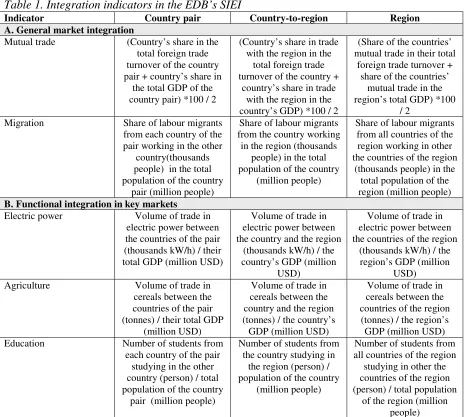
The SIEI includes five main indicators describing economic linkages between
countries. Two of them refer to the “aggregate” linkages in trade in goods and services and in
labour migration. The remaining three indicators look at the integration in three specific
“functional” areas: agriculture (grain trade), education and energy (power utilities). The
separate discussion of these areas allows us not to underestimate the interdependence in the
key areas shaping the economic development of the countries even if the “overall” integration
is low. These five indicators are calculated on three levels: ties between country pairs; the
level of integration of the region in general; and the integration of individual countries into the
region’s economic exchange structure. The first index allows sustainable economic clusters to
be identified; the second index reflects the evolution of intraregional integration over time;
and the third index illustrates the significance of the region for the foreign trade of individual
member countries. The summary of the calculation approach for the indicators is provided in
6
Table 1 about here
A special advantage of the SIEI data, which makes it particularly suitable for this
study, is that the indicators are calculated for three regions. One of them (defined as CIS-12)
includes all FSU countries with the exception of Baltic states, which are now members of the
EU (and, to be more precise, also includes Georgia and Turkmenistan, which are actually not
members of the CIS). Hence, it reflects the overall integration patterns in the post-Soviet area.
The second region (EurAsEC-5) refers to the group of countries, which are currently members
of the Eurasian Economic Community (Russia, Belarus, Kazakhstan, Kyrgyz Republic and
Tajikistan), a Russia-led group which attempts to go beyond the objective achievable in the
CIS framework (specifically, towards a customs union). This region can be particularly
interesting for the comparative analysis, because it indicates a probably “best possible”
combination of post-Soviet countries in terms of their attitude towards regional cooperation
with Russia, which could be compared to the Central Asian regional cooperation. The main
focus of this paper is to look at the third region, Central Asia (denoted as CA-4), which
includes Kazakhstan, Kyrgyz Republic, Uzbekistan and Tajikistan.
Hence, one can see that of five post-Soviet Central Asian countries CA-4 covers four,
excluding Turkmenistan. Given Turkmenistan’s closed economic system with strong
governmental control and severe restrictions on external economic activity, as well as its
extreme scepticism towards any form of multilateral or bilateral cooperation on the
governmental level, the exclusion of this country, once again, provides a “best possible”
picture of the Central Asian region, excluding the “most problematic” country (which would
probably provide much worse characteristics of the regionalization process in Central Asia).
The composition of the index is also partly due to the data availability, since there is very
little coherent statistical information on Turkmenistan present. In what follows we will use the
terms CA-4 and Central Asia as synonyms, referring to the group of four (relatively) more
It is worth noticing that the SIEI is incomplete at least from two points of view. First,
it does not include any information on the cross-border investment flows: in fact, measuring
cross-border investments in Central Asia remains a particularly difficult task given very low
quality of statistical data. Second, SIEI concentrates on interpreting official statistics, which
can be manipulated due to political reasons and, what is more important, disregards informal
economic ties. We will discuss this problem, which will become important at least for one of
the three main research questions of this paper, in what follows. However, in spite of its
limitations, SIEI as a source of consistent and systematic information on cross-border linkages
in the FSU region still provides a good set of proxies for measuring the regionalization
patterns in Central Asia.
3. Intraregional integration and disintegration processes in Central Asia
To start with, we will summarize the main results of the empirical evidence obtained
from the SIEI to give a picture of the overall regionalization process in Central Asia. SIEI
summarizes the information for almost ten years (1999-2008) and therefore excludes the first
decade of disintegration in the FSU region following the collapse of the Soviet Union. Once
again, we are looking at the “best possible” scenario, disregarding the unavoidable initial
“disintegration push” after the dissolution of the common state and the deep economic crisis
of the 1990s, which also almost certainly resulted into a contraction of international economic
ties (for a more detailed discussion see Libman and Vinokurov, 2010). In what follows we
will systematically consider all five indicators of the SIEI and look at the evidence they
generate for the Central Asian region.
As for trade integration in the CIS, the SIEI allows us to conclude that the highest
levels of integration are demonstrated by country pairs which comprise neighbouring states:
Russia-Ukraine, Russia-Belarus, Azerbaijan-Georgia, Ukraine-Belarus and
Russia-Kazakhstan. This group of highly integrated country pairs also includes Kazakhstan–Ukraine,
the only exception to the rule. In the light of this observation, CA-4 is special in that the
geographic proximity of its member states does not seem to be an impetus to their trade
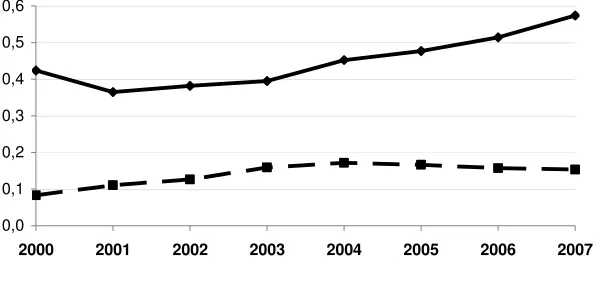
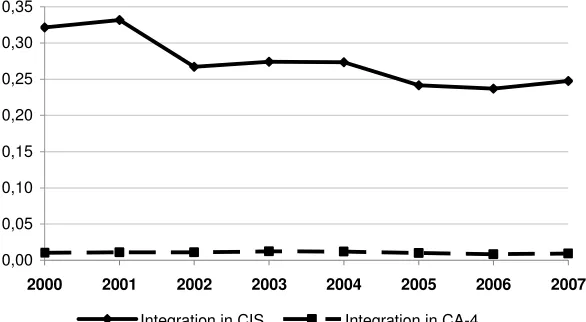
integration. Each CA-4 country demonstrates a high level of trade integration with CIS-12,
Kyrgyzstan and Tajikistan being the leaders in this respect, and a much lower level of
integration with CA-4. The leaders in intraregional trade in CA-4 are also Kyrgyzstan (Figure
8
Figures 1 – 3 about here
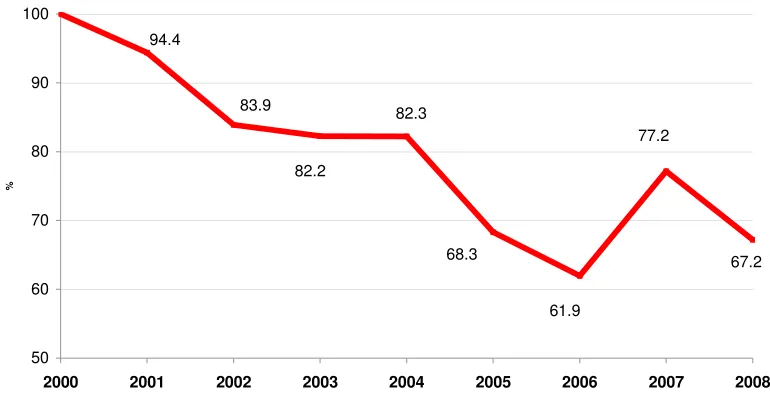
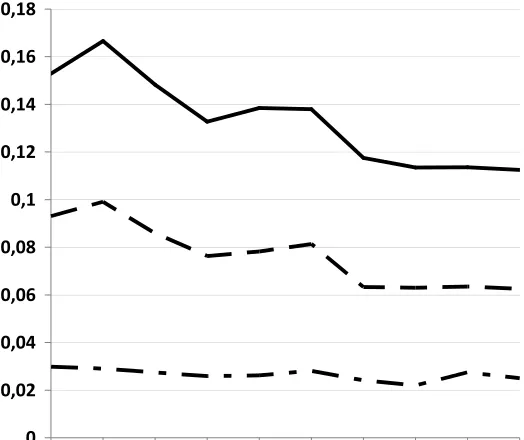
The index of intraregional trade in CA-4 in 2000-2008 showed negative dynamics.
However, a similar picture was observed in all other groupings: CIS-12, EurAsEC-5 and
EurAsEC-3 (Figures 4 and 5). In this respect CA-4 simply followed the overall trend of the
post-Soviet space.
Figures 4 – 5 about here
The SIEI data on labour migration integration indicate that migration flows in the
post-Soviet space are aimed at a few large target economies which need foreign workforce. In
2008 these target economies were Russia, Ukraine and Kazakhstan. Unlike trade integration,
labour migration integration in the post-Soviet space boomed during the last decade. The most
distinct positive trends in labour migration were observed in the analysis of integration at the
regional level in CA-4 (Figure 6), which demonstrated sustained growth from 2004, peaking
in 2006. It should be noted that this growth started from a very low base level and was
attributable principally to registered labour migration from Kyrgyzstan to Kazakhstan. This
country pair was a leader in 2008. Another notable observation in CA-4 was the positive
dynamics in that same country pair, Kazakhstan-Kyrgyzstan, which allows us to conclude that
Kazakhstan is becoming a new centre of migration. Kazakhstan-Azerbaijan ranked second.
Our analysis of the levels and dynamics of market integration in CA-4 in the energy,
agriculture and education sectors allows us to draw the following conclusions. Cross-border
trade in electric power is confined to a few countries. CA-4 appears to be the most dependent
on cross-border flows of electric power among other post-Soviet groupings. The absolute
leader in this aspect of integration is Uzbekistan-Tajikistan. Tajikistan’s export of electric
power is very important for both these economies in the context of their size and also as a
component of the scheme of hydro-power exchange between them. Tajikistan-Turkmenistan
and Tajikistan-Kyrgyzstan rank second and third, respectively. Tajikistan also has the highest
index of integration with CA-4, followed by Uzbekistan and Kyrgyzstan. The lowest level of
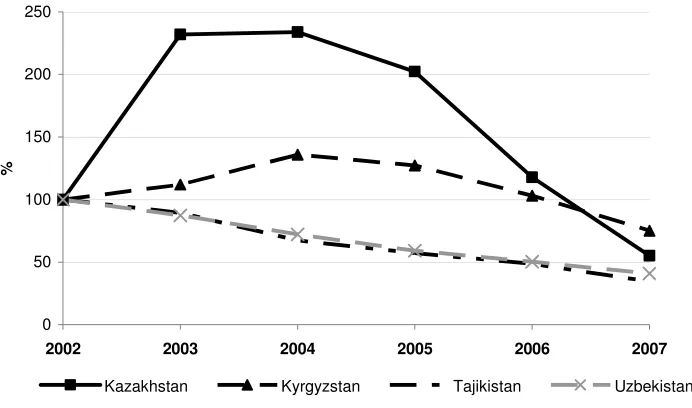
integration with CA-4 is demonstrated by Kazakhstan. In 2002-2008 the energy integration
index in CA-4 was declining (Figure 7). This decline was especially evident in Kazakhstan,
and, to a lesser extent, Tajikistan and Uzbekistan.
Figure 7 about here
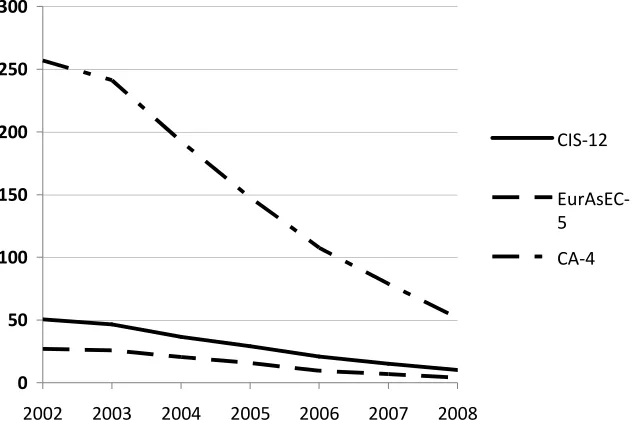
The energy integration index was decreasing all across the CIS and the five groupings.
This decrease was especially pronounced in CA-4 which, nonetheless, remains the leader in
the integration of electric power markets (Figure 8).
Figure 8 about here
The SIEI assessments of agriculture integration are based on data on trade in cereals
which indicate intensive interaction between Central Asian countries and Kazakhstan’s
leadership in the post-Soviet space. The latter country is present in all three leading country
pairs: Kazakhstan-Azerbaijan, Kazakhstan-Turkmenistan and Kazakhstan-Kyrgyzstan. In this
context the integration of neighbouring Central Asian and Caspian states is based on the
export of cereals from Kazakhstan. Trade in cereals between other CIS countries is
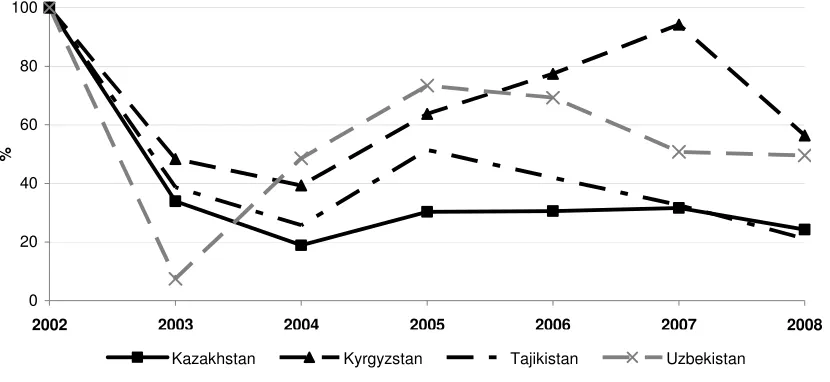
insignificant in relation to their economy size. The level of agriculture integration in CA-4
declined significantly in 2002-2008 (Figure 9), although in the second half of the period
under review this decline levelled out into a plateau. The biggest decline in this index was
observed in Kazakhstan; Uzbekistan and Kyrgyzstan ranked second and third, respectively.
10
The SIEI data on education suggests that the most intensive student exchange occurs
between geographically and culturally close countries, and CA-4 is no exception. The highest
levels of education integration at the country pair level were demonstrated by
Kyrgyzstan-Uzbekistan and Kazakhstan-Kyrgyzstan. Large countries like Russia or Ukraine are
traditionally very attractive for students from all over the CIS, but their number remains
insignificant in relation to these countries’ population. The largest increase in this index was
recorded in the Uzbekistan-Kazakhstan country pair, followed by Kyrgyzstan-Kazakhstan.
Kyrgyzstan and Uzbekistan also demonstrated the highest levels of integration with CA-4
(Figures 10 and 11). CA-4 is the leading post-Soviet grouping in terms of education
integration (although with its advantage is minimal), but its student exchange dynamics is not
nearly as good. Studying in neighbouring Central Asian countries is becoming less prestigious
than studying elsewhere.
Figures 10-11 about here
The SIEI data casts light on some interesting trends in post-Soviet Central Asia. We
will attempt to use this quantitative data to find the answers to the three key questions posed
in the introduction above.
3. Is Central Asia different?
We have started the paper by claiming that regionalism in Central Asia can be more
successful because it is somehow “different” from the post-Soviet world in general,
particularly because of the existence of intensive economic ties. Indeed, there are several
arguments favouring the emergence of regional cooperation in more “connected” regions in
terms of economic activity. First, if one looks at the regional integration as a public good, it
makes sense to produce it at the level of governance at which it can be “internalized”
completely, which is probably determined by the extent of regionalization in a particular
geographical space. Second, regionalization supports social ties, and hence leads to greater
homogeneity of preferences. In addition, it can simply be indicative of greater homogeneity,
suggesting that the transaction costs of trade in this area are smaller. Third, it can also
generate stronger demand for economic integration from the private sector (Herrmann-Pillath
2006). However, our results for even the “best possible” Central Asia (without Turkmenistan)
are not entirely consistent.
On the one hand, in all the three areas of functional integration (energy, agriculture
and education), integration levels are higher in Central Asia than in the post-Soviet space in
general. This can be explained by the existence of extensive infrastructural links and a
common social space which is much older than the CIS and even Soviet Union (or, probably,
even Russian rule over the region). However, the dynamics of sub-regional integration in
agriculture and education was negative throughout the 2000s; particularly, a decline in the
education integration index effectively nullified the advantages CA-4 had had over CIS-12. In
migration integration, CA-4 demonstrated a much slower increase in the index than CIS-12 or
even EurAsEC-5 (in absolute figures).
As for total trade, an increase in indices suggests that, as mentioned, each CA-4
country demonstrates a high level of trade integration with the post-Soviet space and a much
lower level of trade integration with CA-4, and this trend is becoming stronger. It can be
safely said that Russia is a more important trade partner for all CA-4 countries (with the
possible exception of Kyrgyzstan) than any Central Asian country (at least, in terms of formal
trade). It should be stressed that we are referring to intraregional trade lagging behind
economic growth and the development of intraregional links, not the shrinkage of absolute
trade figures. CA-4 demonstrates a slower pace of increase and lower absolute figures of
intraregional trade: in 1999-2008 this trade grew in CIS-12 by 5.8 times, whilst CA-4
increased by 4.0 times. The pace of increase was slower in CA-4 than in CIS-12 in all years
12
Figure 12 about here
We can conclude that, even if we can describe Central Asia’s potential for
sub-regional integration (which generally exceeds that of the CIS), this potential tended to decline
during the past decade. It would appear that this can be explained by frictions between Central
Asian states over distribution of resources, differences in their political courses, and strict
protectionist policies in foreign trade. However, this is true of Central Asia as a whole only,
and individual country pairs (e.g., Kazakhstan—Kyrgyzstan) still demonstrate sound potential
for integration, becoming stronger over time. It should also be noted that the SIEI data only
included formal trade, whilst informal trade in Central Asia remained strong, despite the
protectionist policies - or even benefited from them (Megoran et al., 2005). Central Asian
states have taken measures to control this informal trade in border regions (e,g,, Uzbekistan’s
campaign to “strengthen the border” in the Fergana Valley in 2008-2009, which included
building a fully functional right-of-way, concrete walls and trenches). Even the most
commonplace events – like a cow crossing the border between Uzbekistan and Tajikistan in
February 2010 (Novyi Region, 2010, February 2) or Uzbekistan and Kyrgyz Republic one
month earlier (RIA Novosti, 2010, January 19) – can result in serious diplomatic conflicts
with strong media influence..
Therefore, the SIEI data suggest that currently Central Asia should be treated as a
sub-region of the post-Soviet world rather than a definite integration sub-region. As we have stressed
above, CA-4 countries have stronger political and economic ties with Russia than with each
other, and the current level of economic co-operation within CA-4 is no match for these
countries’ economic and resource dependence on Russia. These factors may well have shaped
the dynamics of formal regional cooperation projects in Central Asia during the last fifteen
The Central Asian Union (CAU) was founded with the signing of an economic union
treaty by Kazakhstan, Kyrgyzstan and Uzbekistan in 1993. In 1994 a treaty on a common
economic space was signed. In 1998 the CAU was joined by Tajikistan and the organisation
was renamed the Central Asian Economic Community (CAEC). The CAEC set itself the goal
of creating a common market of goods, services and capital in Central Asia in several phases,
from a free trade zone to a customs union, a payments union and a currency union. To this
end, about 250 agreements were adopted. However, the obligations on free circulation of
goods merely existed on paper, as did the plans to abolish customs duties, reduce taxes,
remove other barriers to trade and simplify customs regulation (cf. Kumar, 1998). In 2002 the
CAES was liquidated after the presidents of its member states signed the Agreement
Establishing the Central Asian Co-operation Organisation (CACO). Russia joined the new
organisation in 2004, and in 2005 the members adopted the resolution through which CACO
was integrated into the Eurasian Economic Community. In January 2006, a protocol was
signed through which CACO was integrated into EurAsEC. After the Parliament of
Uzbekistan ratified this Protocol, the CACO was liquidated.
In other words, the most successful attempt at economic unification of Central Asian
countries so far was a project with Russia’s participation: the CAEC/CACO could not
compete with an integration project with a wider post-Soviet format. This statement should
not be understood as a positive assessment of integration in EurAsEC — the latter,
undoubtedly, encounters many problems , as it will be discussed once again in the conclusion.
However, the CAEC/CACO proved incapable of competing even with this not particularly
efficient structure.
14
The SIEI data only partially confirm that regionalisation is more successful in Central
Asia than in the post-Soviet space in general. However, one can also consider the same
problem from a different perspective: it is possible that the basis for comparison selected is
not perfect. One of the most interesting issues of post-Soviet integration is associated with the
transition from the post-Soviet integration proper to the Eurasian format of integration. For
example, whereas in the western part of the CIS the subject of discussion is essentially the
impact of the European Union and its neighbourhood policy, in the east, China is readily
accepted as a new potential centre of gravity for Eurasia — primarily by Central Asian
countries. The latter fact is illustrated by recent integration initiatives at the regional and
sub-regional levels (Savkovich 2006, Paramonov et al., 2008; Kasenova 2009), and by the
practical co-operation of Chinese and Central Asian players (Wu, Chen, 2004; Peyrouse,
2007), both formal and informal (cf. . Levinsson, Svanberg, 2000; Swanstroem 2003;
Raballand, Andresy 2007; Kaminski, Raballand 2009), although there are also some less
optimistic assessments of the scale of interaction between China and Central Asia (Li, Wang
1999). It is certainly possible to mention other potential partners like Iran and Turkey, which
also seem to have keen interest in the region and can have influenced its economic
development – although China seems currently the most interesting country to explore.
The presence of strong extra-regional actor can in turn have significant consequences
for the Central Asian regionalism, both positive and negative. In our opinion, the SIEI data
can be used to assess the relevance of this problem for Central Asia. If, say, China (or any
other neighbouring country) is really exerting a decisive influence on co-operation in the
region, it would be logical to expect significant deviation of Central Asia’s integration trends
from the post-Soviet mainstream. In that case, any differences between the development
trends of Central Asia and the rest of the post-Soviet world may be interpreted as signs of the
strengthening of the role of extra-regional actors . But our data suggest that integration in
Central Asia almost fully follows the trends observed in the CIS. This is true of all integration
and macroeconomic indices without exception; any possible deviations relate to dynamics,
not the development trends. Therefore, based on these indirect indices we can assume that the
role of China and other “non-FSU” neighbours falls short of that of a dominant player in the
In any event, Central Asia remains part of the post-Soviet space, also (as shown in the
previous sub-section) in rapidly following the overall trend of the disintegration in the FSU.
Hence, it is not surprising that Myant and Drahokoupil (2008) claim that the degree of
self-sufficiency of Central Asian states has increased since the Soviet epoch, although the slow
process of integration into the global economy continues. Hence, being part of the FSU space
does not mean that the post-Soviet space format is optimum for Central Asia’s integration into
the global economy or that it can provide it (and the rest of the post-Soviet space) with an
impetus for economic growth – on the contrary, it simply suggests that no viable and
attractive alternative has been realized yet. Given high transportation costs and low access to
international markets (Raballand et al., 2005; World Bank, 2009), in this context, the search
for other multilateral integration alternatives in Eurasia (Linn, Tiomkin 2006) deserves close
attention. Regionalism in Central Asia should be extraverted rather than introverted in nature
(Boonstra, Emerson, 2010).
The conclusions drawn in this section should not be overestimated. Firstly, they are
based on indirect indices, as our data do not allow us to make any direct assessment of the
flow of benefits and production factors in the region. In addition, they, as mentioned, ignore
informal trade. Secondly, our analysis does not allow us to differentiate between the external
influence by post-Soviet countries on Central Asia and the internal factors, which might be
similar in SIC-12 and CA-4 and, therefore, lead to similar development trends. It is important
to understand this difference in order to assess the prospects for formal integration or select
countries for the purposes of formulating economic policies for private or state players.
Whereas external influence warrants integration initiatives and an analysis of groupings when
formulating a foreign trade strategy at the CIS level (not CA-4, as we covered in the previous
section), any uniform internal factors leading to disintegration worsen the prospects for
Central Asian and CIS integration alike. The latter factors also make the very interpretation
of CIS-12 and CA-4 as a region questionable, calling for bilateral relations based on the
specific features of individual countries. The conclusions shown in the previous section
suggest that we consider the combination of internal factors (protectionist foreign trade
policies) and external influence (the close ties with Russia), but that at this stage we cannot
16
Thirdly, and particularly important, the key assumption on which our analysis is based
can be criticised. It is possible that, say, China’s influence on Central Asian countries
produces the same effects as Russia’s and post-Soviet space influence – therefore, we should
not expect any deviations in the development trajectory of Central Asia. Although we would
not be able to answer this criticism using our data, some arguments in favour of our
interpretation do exist. Consider specifically the case of China as the strong “external” player.
China and the post-Soviet space having similar influence on the development of Central Asia
appears to be questionable not least because Chinese businesses use Central Asian countries
(Kyrgyzstan and, to a lesser extent, Kazakhstan) as a springboard to the region’s economy as
a whole. In that case, the activity of these businesses would have translated into an increase in
intraregional trade, whereas the latter fell, even in comparison with the CIS (remember that
we disregard informal trade). Russia, at the same time, is less interested in such springboards,
as Russia traditionally has strong positions in all these countries, and is less active in
consumer markets (where this springboard strategy makes sense). In any case, we must
emphasise that our conclusions require careful interpretation.
Finally, it is possible that the impact of the extra-regional agents resulted not in a
change of path of the integration or disintegration, but rather in the change of speed.
Specifically, one could expect faster disintegration of the Central Asian region than of the rest
of the FSU, if the influence of extra-regional players (China or Turkey) were increasing.
However, in this case, first, one would not observe the correlation between FSU and Central
Asia in the areas where regional integration showed a positive trend (like labour migration) –
however, there seems to be a strong correlation in our data. And second, the degree of
“internal” disintegration within Central Asia would be more slowly than that between Central
Asian countries and Russia – however, the SIEI data demonstrate that the latter in fact
declined more slowly than the former. So, even if the extra-regional agents indeed caused the
“fast track” disintegration in Central Asia, it has been “just” enough to dissipate the specific
sub-regional integration advantages, but “not enough” to reduce its links to the FSU
significantly.
Our analysis suggests that Central Asia retains its status as a sub-region of the
post-Soviet space. On the other hand, it is generally agreed that regionalisation in the CIS
progresses in an asymmetric manner with Russia being a dominant player (which is
inevitable, bearing in mind in the size of the Russian economy). Integration is principally
confined to bilateral relations between Russia and individual CIS countries. In the meantime,
our data indicates that a new centre of regionalisation is emerging in the post-Soviet space:
Kazakhstan.
In particular, we can point to two directions of Kazakhstan’s development as an
independent integration core whose activities are not influenced by Russia. The first direction
is labour migration. Kazakhstan attracts workforce from the rest of the post-Soviet space for
many reasons: its rapid economic growth in the 2000s, the problems encountered by labour
migrants in Russian society, etc. Kazakhstan is especially attractive for migrants from its
closest neighbours, the Central Asian states. From 2002, Azerbaijan also demonstrated
sustained growth of labour migration to Kazakhstan.
The second direction is trade integration. In particular, as mentioned, all leading
country pairs trading in cereals include Kazakhstan; this trade covers Central Asia (even
including Turkmenistan) and the Caucasus. According to the SIEI data on these leading
country pairs, an increase in an individual country’s index of integration with CA-4 coincides
with an increase in that country’s index of integration with Kazakhstan (Figures 13, 14 and
15). These trade relations are different in content: for example, Kazakhstan’s integration with
Caucasus involves, on the one hand, grain transit through Azerbaijan and subsequently Iran
and Georgia to foreign markets in North Africa and Middle East, and second, grain exports
through Baku to three states of Southern Caucasus themselves, with the first factor being far
more important. Moreover, as discussed, the only country pair which has no common border
but is leading in terms of total trade indices is Kazakhstan-Ukraine; notably, this pair also
demonstrated the biggest increase in trade integration in the post-Soviet space in 1999-2008.
In other words, unlike the situation in migration integration, Kazakhstan shows signs of
activity outside Central Asia.
18
Undoubtedly, the evolution of Kazakhstan into an independent integration core was
made possible by its high GDP level, unmatched by any other Central Asian country. This
makes Kazakhstan very attractive to its neighbours in terms of trade and migration integration
and increases its importance as a source of investment. Indeed, according to some empirical
studies (Golovnin, 2009; Vinokurov, 2009), Kazakhstan is a leader in terms of investment and
banking expansion in the CIS. Consequently, the perception of the post-Soviet space as a
unequivocal single-centre region needs to be revised, although its two regionalisation cores
are very unequal in size.
4. Conclusion
This paper attempted to look at the process of regional integration in Central Asia
using a new comprehensive dataset of the SIEI. Our goal was, specifically, to understand,
whether Central Asia is in any respect “different” from the rest of the former Soviet Union:
first, whether the degree of regional integration between the countries of Central Asia is
higher, than between, say Russia and Central Asian states, and second, whether the trends of
economic integration in Central Asia are different from the rest of the FSU (suggesting, for
instance, an influence of an external party like China). So far we are cautiously able to say no
to both of the questions. While Central Asia has exhibited higher level of integration in some
functional areas in the later 1990s, in the 2000s the decline of this integration was more
pronounced than in the rest of the FSU and currently the advantage seems partly to have been
lost. Moreover, the difference between Central Asian countries and the rest of the FSU has
been rather the speed of (dis)integration than the direction of changes.
Although this evidence is indirect, it could suggest that the economic, political and
cultural heritage of the Soviet period (common infrastructure, language, similar governance
and education systems, etc.) and Russia’s continuing economic and political influence in the
region are more persistent than specific factors attributed just to Central Asia. On the one
hand, from the theoretical perspective it implies that studying Central Asia separately from
the FSU space is still unpromising: the links to the FSU can be stronger than within the CA-4
group. On the other hand, from the policy perspective it means that a purely Central Asian
regional cooperation project at the moment seems to be hardly viable – as the OCAC
The latter claim, however, should be interpreted with caution – although we see
limited possibilities for the introverted regionalism in Central Asia, the chances for a
successful regional integration project within the FSU framework (say, CIS or even
EurAsEC) are questionable, too (although the establishment of the
Russia-Kazakshstan-Belarus Customs Union in 2010 is thought-provoking) . From this point of view, this paper
suggest rather a pessimistic view on regionalism in Central Asia: the most “appropriate”
format for the cooperation according to the existing economic linkages is at the same time
also highly problematic in terms of feasibility of any regional cooperation on a deeper level.
Hence, the way to even stronger disintegration and autarky, also supported by internal
developments in politics of the Central Asian countries, seems to be open.
A slightly more optimistic point of view is possible for our third result. Another trend
we were able to find is the evolution of Kazakhstan into the second integration core in the CIS
and, in particular, Central Asia. Kazakhstan is the leader in labour migration and student
exchange. This was made possible by its high GDP level, unmatched by any other Central
Asian country, which makes Kazakhstan very attractive to its neighbours in terms of trade,
migration and education integration and increases its importance as a source of investment.
The emergence of Kazakhstan as an integration core could have particular importance for
Kyrgyz Republic, which even now has very strong economic and political ties to its northern
neighbour. However, even here we believe that caution is necessary because of the natural
resource-driven nature of Kazakhstani strong economic growth in the 2000s., which could be
unsustainable in the future
Sources
Akiner, S. (2007) Regional cooperation in Central Asia. School of Oriental and African Studies, University of London.
Bartlett, D. L. (2001) Economic Development in the Newly Independent States: The Case for Regionalism. European Journal of Development Research. 2001. Vol. 13. No. 1
Boonstra, J., and Michael Emerson M. (2010) Into EurAsia – Monitoring the EU’s Central Asia Strategy. Final Report. CEPS, Fride: Brussels, Madrid.
Dwan, R., and Pavliuk O. (2000, eds.): Building Security in the New States of Eurasia: Subregional Cooperation in the Former Soviet Space. ME Sharpf
Geyikdagi, N.V. (2005) Regional Integration in Central Asia. Journal of Asia Pacific Business 6(4):61-75
20
Golovnin, M. (2009) Perspektivy sovmestnogo razvitija infrastruktury fondovyh rynkov. [The Prospects for Joint Development of Stock Market Infrastructure]. Eurasian Economic Integration, No.1, pp. 41-48.
Herrmann-Pillath C. (2006) Endogenous Regionalism. Journal of Institutional Economics
2(3):297-318
Hurrell, A. (1995) Regionalism in Theoretical Perspective, in: Fawcett, Louise, and Andrew Hurrell (eds.): Regionalism in World Politics: Regional Organization and International Order. Oxford: Oxford University Press
Kaminski, B., and Raballand, G. (2009) Entrepot for Chinese Consumer Goods in Central Asia: The Puzzle of Re-Export through Kyrgyz Bazaars. Eurasian Geography and Economics 50(5):581-590.
Kasenova, N. (2009) China as an Emerging Donor in Tajikistan and Kyrgyzstan. IFRI Russia/NIS Working Paper no.36, January.
Kazantsev, Andrei (2008) Bol’shaya Igra s Neizvestnymi Pravilami: Mirovaya Politika i Central’naya Asiya. Moscow: Fond Nasledie Evrazii
Kumar, R. S. (1998) Central Asian Economic Integration: Emerging Trends. Economic and Political Weekly 33(18):1013-1017
Levinsson C., and I Svanberg I. (2000): Kazakhstan-China Border Trade Thrives after Demarcation Treaty. CACI Analyst, February 16
Libman, A. and Vinokurov E, (2010): Regional Integration and Economic Convergence in the Post-Soviet Space: Experience of the Decade of Growth. Mimeo
Li, Hak Yin, and Zhengxu Wang (2009) Assessing China’s Influence in Central Asia: A Dominant Regional Power? University of Nottingham China Policy Institute Briefing No. 53
Linn, J.F., and Tiomkin D. (2006) The New Impetus towards Economic Integration Between Europe and Asia. Asia Europe Journal 4(1):31-41
Megoran, N., Raballand, G., and JBouyjou J. (2005) Performance, Representation and Economics of Border Control in Uzbekistan. Geopolitics 10(4):712-740
Melvin N.L. (2008) Engaging Central Asia. Brussels, CEPS.
Myant, M., and Drahokoupil J. (2008) International Integration and the Structure of Exports in Central Asian Republics. Eurasian Geography and Economics 49(5): 604-622
Olcott, M.B. (1996) Central Asia's New States: Independence, Foreign policy, and Regional security.Washington, D.C.: United States Institute of Peace Press.
Rall, T. (2006) Silk Road to Ruin: Is Central Asia the New Middle East? New York: NBM Publishing.
Paramonov V., Strokov A., Stolpovsky O. (2008) Rossija i Kitajj v Central'nojj Azii: politika, ekonomika, bezopasnost'. [Russia and China in Central Asia: Politics, Economics, Security]. Bishkek, Aleksander Knyazev’s Publichnyj Fond.
Peyrouse, S. (2007) The Economic Aspects of the Chinese-Central-Asia Rapprochement, Silk Road Papers, Washington DC: The Central Asia and Caucasus Institute.
Pomfret, R. (2009) Regional Integration in Central Asia. Economic Change and Restructuring
42(1-2):47-68
Raballand, G., and Agnes A. A. (2007) Why Should Trade Between Central Asia and China Continue to Expand? Asia Europe Journal 5(2): 235-252
Raballand, G., Kunth, A., and Richard A. (2005) Central Asia’s Transport Burden and Its Impact on Trade. Economic Systems 29:6-11
Savkovich, E. (2006) Proekty ekonomicheskoj integracii Kitaja i Kazakhstana. [The Projects of Economic Integration of China and Kazakhstan]. Agentstvo politicheskih novostej – Kazakhstan [The Political News Agency – Kazakhstan], 28 August 2006.
Swanstroem, N. (2003) Chinese Business Interests in Central Asia: A Quest for Dominance.
CACI Analyst, June 18
UNDP (2005) Central Asia Human Development Report: Bringing Down Barriers. Bratislava, UNDP.
Vinokurov, E. (2009) Mutual Investment in The CIS Banking Sector, The Euromoney Central Asia & CEE Financial Markets Handbook 2009/10, Euromoney, pp. 4-9.
Vinokurov, E. (ed.) (2010) EDBSystem of Indicators of Eurasian Integration. EDB, Almaty. Available at www.eabr.org/rus/publications/projects as of 01.02.2010
World Bank (2009) World Development Report 2009: Reshaping Economic Geography.
Wash.: World Bank.
Wu, Hsiu-Ling, and Chien-Hsun Chen (2004) The Prospects for Regional Economic Integration Between China and the Five Central Asian Countries. Europe-Asia Studies
56(7):1059-1080.
22
Table 1. Integration indicators in the EDB’s SIEI
Indicator Country pair Country-to-region Region A. General market integration
Mutual trade (Country’s share in the total foreign trade turnover of the country pair + country’s share in
the total GDP of the country pair) *100 / 2
(Country’s share in trade with the region in the
total foreign trade turnover of the country +
country’s share in trade with the region in the country’s GDP) *100 / 2
(Share of the countries’ mutual trade in their total
foreign trade turnover + share of the countries’
mutual trade in the region’s total GDP) *100
/ 2 Migration Share of labour migrants
from each country of the pair working in the other
country(thousands people) in the total population of the country
pair (million people)
Share of labour migrants from the country working
in the region (thousands people) in the total population of the country
(million people)
Share of labour migrants from all countries of the region working in other the countries of the region
(thousands people) in the total population of the region (million people)
B. Functional integration in key markets
Electric power Volume of trade in electric power between the countries of the pair (thousands kW/h) / their total GDP (million USD)
Volume of trade in electric power between the country and the region
(thousands kW/h) / the country’s GDP (million
USD)
Volume of trade in electric power between the countries of the region
(thousands kW/h) / the region’s GDP (million
USD) Agriculture Volume of trade in
cereals between the countries of the pair (tonnes) / their total GDP
(million USD)
Volume of trade in cereals between the country and the region (tonnes) / the country’s GDP (million USD)
Volume of trade in cereals between the countries of the region
(tonnes) / the region’s GDP (million USD) Education Number of students from
each country of the pair studying in the other country (person) / total population of the country
pair (million people)
Number of students from the country studying in
the region (person) / population of the country
(million people)
Number of students from all countries of the region
studying in other the countries of the region (person) / total population
Figure 1. Kyrgyzstan’s trade integration index
0,0 0,1 0,2 0,3 0,4 0,5 0,6
2000 2001 2002 2003 2004 2005 2006 2007
Integration in CIS Integration in CA-4
24
Figure 2. Tajikistan’s trade integration index
0,00 0,20 0,40 0,60 0,80 1,00
2000 2001 2002 2003 2004 2005 2006 2007
Integration in CIS Integration in CA-4
Figure 3. Kazakhstan’s trade integration index
0,00 0,05 0,10 0,15 0,20 0,25 0,30 0,35
2000 2001 2002 2003 2004 2005 2006 2007
Integration in CIS Integration in CA-4
26
Figure 4. The dynamics of the intraregional trade index in CA-4 in 2002-2008
67.2 77.2
61.9 68.3
82.2
82.3 83.9
94.4
50 60 70 80 90 100
2000 2001 2002 2003 2004 2005 2006 2007 2008
%
Figure 5. The dynamics of trade integration in three post-Soviet groupings
0 0,02 0,04 0,06 0,08 0,1 0,12 0,14 0,16 0,18
1999 2000 2001 2002 2003 2004 2005 2006 2007 2008
CIS-12
EurAsEC-5
CA-4
28
Figure 6. The dynamics of the intraregional labour migration index in CA-4 in 2002-2008
0.00 0.02 0.04 0.06 0.08 0.10
2000 2001 2002 2003 2004 2005 2006 2007 2008
Figure 7. The dynamics of the energy integration index in CA-4 in 2002-2008
0 50 100 150 200 250
2002 2003 2004 2005 2006 2007
%
Kazakhstan Kyrgyzstan Tajikistan Uzbekistan
30
Figure 8. The dynamics of energy integration in three post-Soviet groupings
0 50 100 150 200 250 300
2002 2003 2004 2005 2006 2007 2008
CIS-12
EurAsEC-5
CA-4
Figure 9. The dynamics of the cereals trade integration index in CA-4 in 2002-2008
0 20 40 60 80 100
2002 2003 2004 2005 2006 2007 2008
%
Kazakhstan Kyrgyzstan Tajikistan Uzbekistan
32
Figure 10. The dynamics of the education integration index in CA-4 in 2002-2008
0 1000 2000 3000 4000 5000 6000 7000 8000
2000 2001 2002 2003 2004 2005 2006 2007 2008
%
Kazakhstan Kyrgyzstan Tajikistan Uzbekistan
Figure 11. The dynamics of education integration in three post-Soviet groupings
0 100 200 300 400 500 600
2000 2001 2002 2003 2004 2005 2006 2007 2008
CIS-12
EurAsEC-5
CA-4
34
Figure 12. Increase in intraregional trade in CA-4 and CIS-12
-20% -10% 0% 10% 20% 30% 40% 50% 60% 70%
2000 2001 2002 2003 2004 2005 2006 2007 2008
CA-4 CIS-12
Figure 13. Azerbaijan’s index of agriculture integration
89,33
70,16
30,66 74,09
10,46 8,23
18,31
1,55 14,96
17,06
8,6
3,63 7,02 2,71
0 20 40 60 80 100
2002 2003 2004 2005 2006 2007 2008
Azerbaijan - CA-4 Azerbaijan - Kazakhstan
36
Figure 14. Kyrgyzstan’s index of agriculture integration
103,44
40,68
97,45
58,3
2,16 80,09
65,86 50,01
2,6 2,3
1,59 2,93
6,29 3,29
0 20 40 60 80 100 120
2002 2003 2004 2005 2006 2007 2008
Kyrgyzstan - CA-4 Kyrgyzstan - Kazakhstan
Figure 15. Turkmenistan’s index of agriculture integration
5,11
8,78
0,09
2,38
1,02 0,02
0 2 4 6 8 10
2006 2007 2008
Turkmenistan - CA-4 Turkmenistan - Kazakhstan