Possibility of using the beet dyes as a laser
gain medium
Abdelaziz Hagar Abdelrahman1,2*, Malik A. Abdelrahman3,4, Mohammed Khaled Elbadawy3
1Laser Institute, Sudan University for Science and Technology (SUST), Khartoum, Sudan; *Corresponding Author: [email protected]
2Physics Department, Collage of Science & Arts, Muznab, Qassim University, Qassim, KSA 3Chemistry Department (SUST), Khartoum, Sudan
4Chemistry Department, Collage of Applied Medical Sciences, (TURUBA), Taif University, Taif, KSA
Received 27 July 2013; revised 27 August 2013; accepted 4 September 2013
Copyright © 2013Abdelaziz Hagar Abdelrahman et al. This is an open access article distributed under the Creative Commons Attribu- tion License, which permits unrestricted use, distribution, and reproduction in any medium, provided the original work is properly cited.
ABSTRACT
Nowadays the dye lasers play as an important tool and are used in many applications including spectroscopy, medicine and dermatology. This research was carried out to study the possibility of using the beet dyes as a laser gain medium. The fluorescence quantum yield was determined by the comparative method with rodamine b as an organic dye standard. The value of the fluore- scence quantum yield was found about (0.14) and the fluorescence quantum yield was devel- oped until reaching about (0.323). The increas- ing of fluorescence quantum yield of dye solu- tion as a result of increasing the viscosity of solvent was observed clearly. The study con- cluded that the beet dyes are so sensitive to fluorescence and it is very suitable to be used as a laser gain medium.
Keywords:Beets; Lasing; Solvents; Quantum Yield
1. INTRODUCTION
From the mid 60s, dye lasers have been attractive sources of coherent tunable radiation because of their unique operational flexibility [1]. Light amplification by stimulated emission of radiation, that is lasers, has be-come an important tool in chemistry and many sciences. A dye laser can be defined as a laser utilizing dye [2]. Some of the most popular and heavily investigated are the rho-damines and coumarins. Dye lasers have many advan-tages over their liquid counterparts. They are nontoxic, nonflammable, and can be engineered to be rugged and compacted by eliminating the dye flow hardware that is necessary in a liquid system. Liquid dye lasers rely on dye
flow through the laser cavity to avoid thermal problems and the buildup of photo degradated dye molecules which decrease the lasing efficiency [3].
The knowledge of fluorescence quantum efficiency of organic dyes is important in selecting efficient dye laser media [4]. Organic dyes dissolved in suitable liquid sol-vent have found wide application in laser technology serving as an active gain medium for generation of co-herent tunable radiation [5].
A dye laser is a laser which uses an organicdye as the lasing medium, usually as a liquidsolution. For effective performance, dye molecules should have strong absorp-tion at excitaabsorp-tion wavelength and minimal absorpabsorp-tion at lasing wavelength. Applications of lasers are wide and varied today. They are found in communication tech-niques, microsurgery and medicine [6].
2. QUANTUM YIELD
The quantum yield of a radiation-induced process is the number of times that a defined event occurs per photon absorbed by the system. Thus, the quantum yield is a measure of the efficiency with which absorbed light produces some effect [7].
Quantum yield is essentially the emission efficiency of a given fluoro chrome. Since not all photons are absorbed productively, the typical quantum yield will be less than 1 [8].
The fluorescence quantum yield is defined as the ratio of the number of photons emitted to the number of pho-tons absorbed or we can written as .[9].
number of photons emitted number of photons absorbed
QY (2.1)
excita-tion [9]. We may re-write Equaexcita-tion (2.1) as:
fraction of light absorbednumber of photons detected
QYF
(2.2)
where α and β are constants related to the fraction of emitted light entering the light collection optics of the fluorimeter and the intensity of the excitation source at the excitation wavelength, respectively. In this equation, the number of photons detected is the integrated area under the corrected fluorescence spectrum and the fraction of light absorbed (F) is obtained from the absorbance at the excitation wavelength by;
1 10 D
F (2.3) where (D)defined as an optical density of a medium is the measure of its transmittance for a radiation of particular wavelength. The relationship between the optical density and transmittance (T) is an inverse, which expressed as [10].
10
log 1
D T (2.4)
Hence, for sample X, we can write:
x x
x
A QY
F
(2.5)
where Ax is the integrated area under the corrected
fluo-rescence spectrum. For a “standard” material, S, for which the quantum yield of fluorescence is already known, we can similarly write:
s s
s
A QY
F
(2.6)
Comparative measurements on solutions of sample X
and a suitable standard, S, can then be used to estimate the fluorescence quantum yield of X by dividing Equation (2.4) by Equation (2.5):
x x s s s x
QY A F
QY A F (2.7)
where upon the unknown constants αand βcancel out. Hence:
x s
x s
s x
A F
QY QY
A F
(2.8)
where all terms on the right hand side of Equation (2.7) are known. It is assumes that measurements on solutions of X and S are made under identical conditions of excita-tion wavelength and aperture settings. If different solvents are used for X and S, then Equation (2.7) should be further modified to allow for the effect of refractive index on the relative amount of fluorescence collected by the fluori- meter detection optics. The final equation for estimation of fluorescence quantum yields by the Comparative Method then becomes:
2
x s x
x s
s x s
A F n
QY QY
A F n
(2.9)
where the ns and nx are the refractive indices of the
sol-vents used for the two solutions fluorescence spectra are always fully corrected using the installed correction function of the Jobin Yvon Fluorolog spectro fluorimeter. This function corrects for the variation with wavelength of the sensitivity of the photomultiplier and the spectral characteristics of the detection optics (gratings, mirrors, etc.) [9].
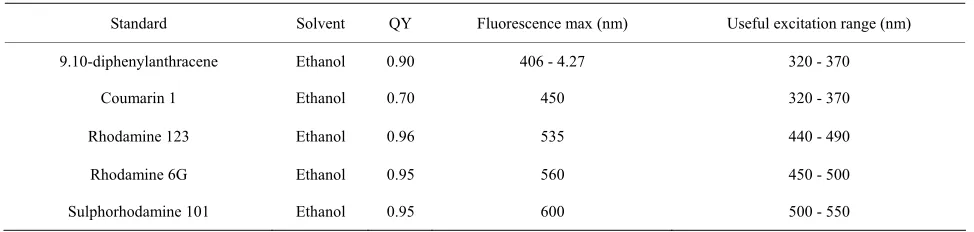
In practice at nanotechnologies, solutions of quantum yield material are compared with solutions of organic fluorophores of known quantum yield under the same conditions of excitation. Absorbance’s of all solutions are adjusted so as to be preferably in the range (0.02 - 0.07) and not greater than ca. 0.1 at the excitation wavelength. If possible, it is best to arrange for the absorbencies of the sample and standard solutions to be the same (or nearly the same) at the exciting wavelength. Organic controls that have been used are as shown in Table 1 [9].
3. CHOICE OF SOLVENT
[image:2.595.55.542.621.737.2]Prepared laser dye solutions usually contain very small quantities of dye. Typical dye concentrations are 10−2 to 10−5 molar. For this reason, the solvent in which the dye is dissolved plays an important role when defining physical properties and potential hazards.
Table 1. Quantum yields determined by this method are reliable to about ±10%.
Standard Solvent QY Fluorescence max (nm) Useful excitation range (nm)
9.10-diphenylanthracene Ethanol 0.90 406 - 4.27 320 - 370
Coumarin 1 Ethanol 0.70 450 320 - 370
Rhodamine 123 Ethanol 0.96 535 440 - 490
Rhodamine 6G Ethanol 0.95 560 450 - 500
Lasing wavelength and energy are very sensitive to the choice of solvent. Most laser dyes are polar molecules, and excitation into their lowest-lying singlet state is ac-companied by an increase in the dipole moment. Ac-cordingly, solvent polarity plays an important role in shifting the lasing wavelength. In a majority of circum-stances, increasing solvent polarity will shift the gain curve toward longer wavelength. In the case of more polar dyes, the shift can be as high as 20 - 60 nm.
The output power of dye lasers is strongly dependent on the purity of the solvent. Impurities and additives may strongly affect upper state lifetime of the dye or may catalyse photochemical reactions. Therefore, for best results, only high quality solvents are to be recommended [11].
With the exception of water, all solvents should be considered hazardous. In many instances, the solvent in which the dye is dissolved plays a major role in the hazard presented by the final solution.
Water is called the universal solvent because more substances dissolve in water than in any other chemical. This has to do with the polarity of each water molecule. The hydrogen side of each water (H2O) molecule carries a slight positive electric charge, while the oxygen side car-ries a slight negative electric charge. This helps water dissociate ionic compounds into their positive and nega-tive ions. The posinega-tive part of an ionic compound is at-tracted to the oxygen side of water while the negative portion of the compound is attracted to the hydrogen side of water.
These hazards must be addressed carefully in dye han-dling and solution preparation. Nearly all solvents are highly flammable. Therefore, a small fire extinguisher should be installed near the laser in a readily accessible and unobstructed area.
A particular fire hazard that is not commonly known occurs with nonpolar and, hence, nonconductive solvents. If these solvents are circulated at a high speed through plastic tubings, the pump unit acts as a van de Graff gen-erator, producing up to 100 kV, and sparks may pierce the tubing and ignite the solvent. The dye selectors use grounding wires inside the plastic tubings to eliminate these problems. However, when using such solvents, check first for static electricity before opening the reser-voir. Static electricity is present when hair on the back of your hand or forearm is attracted to the plastic tubing. do not circulate dye solutions made with such solvents for more than a minute, unless the cuvette has been placed into the crate and is grounded [12].
4. BEET ROOTS AND BEET DYES
The beet (Beta vulgaris) is a plant in the amaranth family. It is best known in its numerous cultivated varie-ties, the most well-known of which is probably the red
root vegetable known as the beetroot or garden beet. However, other cultivated varieties include the leaf vegetables chard and spinach beet, as well as the root vegetables sugar beet, which is important in the produc-tion of table sugar, and mangel-wurzel, which is a fodder crop. Three subspecies are typically recognized. All cul-tivated varieties fall into the subspeciesBeta vulgaris
subsp. vulgaris, while Beta vulgaris subsp. maritima, commonly known as the sea beet, is the wild ancestor of these and is found throughout the Mediterranean, the Atlantic coast of Europe, the Near East, and India. A second wild subspecies, Beta vulgaris subsp. adanensis, occurs from Greece to Syria.
Betacyanins (Bc) is extracted dyes from beetroot or beet red (Beta vulgaris). The two hydro-soluble com-pounds: betacyanin (Bc) and betaxanthins (Bx), which present absorption bands at 540 and 480 nm, respectively are obtained from aqueous extraction of beet red [13] as seen in Figure 1.
5. METHODOLOGY
5.1. Sample Preparation
The beet samples were collected from local markets in Khartoum state and the dye solution was extracted by water and the extracted was separated by filtration. Then the ability of dyes solution to work as a laser gain medium has been testified.
The dye solution was extracted by 0.1% aqueous TFA
(Tetra Fluoro Acetic acid).
Sample one: 1 ml of dye 0.1 solution was added to 100
ml of water (the absorbance of sample was adjusted to be less than 0.1 au. Four different concentrations were pre-pared by water dilution in the range of (0.1 - 0.01 au abs).
Sample two: 1 ml of dye solution was added to 100 ml
of glycerin-water (1:10) solution. Four different concen-trations were prepared by dilution in the range of (0.1 - 0.01 au abs).
Sample three: 1 ml of dye solution was added to 100
[image:3.595.311.536.581.699.2]ml of glycerin-water (2:10) solution. Four different con-
centrations were prepared by dilution in the range of (0.1 - 0.01 au abs).
Sample four: 1ml of dye solution was added to 100 ml
of glycerin-water (4:10) solution. Four different concen-trations were prepared by dilution in range of (0.1 - 0.01 au abs).
5.2. Measurement Procedure
First step the absorbance at 538 nm for solution of sample one was recorded, second one the fluorescence spectrum of the same solution was recorded in 10 mm fluorescence cuvette. Step 1 and 2 were repeated for four solutions with increasing concentration of sample one.
Ostwald Device was used to determine the viscosities of samples solvents.
Refractive indices and densities were determined by using the mettler Toledo DR40 refractometer. Then the fluorescence quantum yields of the solvents were deter-mined by using the value of the refractive indexes which given above.
[image:4.595.311.537.403.536.2]6. RESULT AND DISSECTION
Table 2 shows relationship between the maximum
wavelength of light absorption (λmax) and beet dyes on different pH was observed. The λmax of light absorption is shifted as a result of the pH varying and the dye solution showed instability at pH more than 8
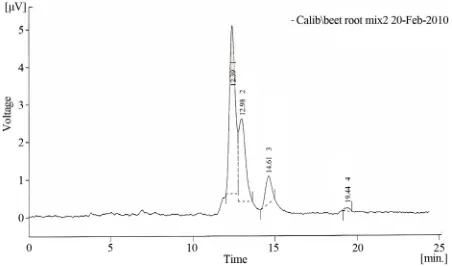
Figure 2 showed four peaks and the HPLC
fluores-cence was running in 530 nm excitation wave length and the emission wave length at 630 nm the result also showed four strong peaks. One of the four components displayed high emission peak this might mean that the dye solution should have a significant fluorescence quantum yield.
Fluorescence of a molecule depends on the structure and environment of the molecule such as interaction with solvent and other dissolved compounds in the matrix, the pH and concentration of the fluorescing species. Uncal- Calib\beet root mix2 shown in Table 3.
The dye solutions of various concentrations were pumped by a He-Ne flash lamp laser and the scatter light was collected at 90˚ from the cuvette but unfortunately the source of laser emission is weak at green area which is absorbed by the dye solution, the results showed fluo-rescence λmax that differ from fluorescence λmax of He-Ne flash lamp laser (632.8 nm) that means the dye solution should have a significant fluorescence quantum yield.
7. CALCULATION OF FLUORESCENCE
QUANTUM YIELD
To get fluorescence efficiency of various concentra-tions of beet dyes a He-Ne flash lamp laser pumped them to obtain fluorescence spectra peaks. Fluorescence spectra peaks of various concentrations of beet dyes which are pumped by a He-Ne flash lamp laser.
7.1. Density and Refractive Indices of Solvents Samples Were Determined as in Table 4
7.2. Fluorescence Quantum Yields
To calculate the fluorescence quantum yields for beet dyes on different solvents, one can use the comparative method by this equation;
[image:4.595.57.534.582.613.2]Figure 2. HPLC-fluorescence for beet dyes solution.
Table 2. λmax depend on pH of solvent.
pH 3.15 4.07 5.15 6.30 7.19 8.24 9.03 10.15 11.00 12.00
[image:4.595.61.539.642.735.2]λmax(nm) 485 485 475 475 480 --- --- 395 --- ---
Table 3. Shows (Uncal-Calib\beet root mix2).
W05 [min] Height [%]
Area [%] Height [mV]
Area [mV.s] Reten. Time [min]
0.42 59.7
57.3 0.895
22.533 12.388
1
0.47 29.4
32.2 0.441
12.664 12.984
2
0.43 9.8
9.4 0.147
3.703 14.612
3
0.43 1.2
1 0.018
0.398 19.436
4
100 100
1.5 39.298
Table 4. Densityand refractive indices of solvents of beet dyes solutions.
Refractive indices
Density (g⁄cm3) at 23˚C
No of sample
1.334 0.9979 1 1.342 1.0229 2 1.361 1.0563 3 1.380 1.0890 4 Grand Ф Ф Grand X X X ST ST ST
(7.1)
where, ФX,ФST, Ƞx, ȠST stand for fluorescence quantum
field of sample, fluorescence quantum field of standard, refractive index of sample solventand refractive index of standard solvent respectively. The value of ФX of four
samples were obtain, as shown in Table 5.
Calculation of the viscosity of solvents:
The calculation of the viscosity of solvents were shown in Table 6.
The relationship between fluorescence quantum yield and viscosity of solvent isrepresented as in the Figure 3.
The result gave a logarithmic function. The values of Log Fluorescence quantum yieldand Log Viscosity of solvent were presented in Table 7.
The relation of Log Fluorescence quantum yield and Log Viscosity of solvent were presented in Figure 4.
The relationship between fluorescence quantum yield (Ф) and the viscosity (λ) of the solvent has been derived analytically and experimentally and is known as the Forster-Hoffmann equation
logФ C xlog
where C is a temperature-dependent constant and x is a dye- dependent constant [14].8. CONCLUSIONS
The fluorescence quantum yields of beet dyes solutions were determined by the comparative method with rho-damine b as standard. The fluorescence quantum yield was developed by increasing the viscosity of solvents as shown in Tables 6 and 7.
The result in Table 4 established that the beet dyes
solution has a high fluorescence quantum yield to act as a laser gain medium.
Figure 2 shows four peaks, one of these components
displayed high emission, and this means that the dye solution should have a significant fluorescence quantum yield, which leads the solvent to act as gain medium.
The increasing of fluorescence quantum yield value as a result of increasing the viscosity of solvent means that the dye behaves like intramolecular charge transfer (ICT) compounds because of the nitrogen atom attached the -conjugation system [14].
Table 5. The values of fluorescence quantum yields for beet dyes on different solvents.
No Sample Gradx GradST ФST ȠST Ƞx Фx 1 313.5 899 0.31 1.334 1.344 0.114 2 483 899 0.31 1.334 1.342 0.169 3 577.7 899 0.31 1.334 1.361 0.200 4 874.2 899 0.31 1.334 1.380 0.323
Table 6. Viscosity values of solvents.
No Sample Solvent (ml:ml) Viscosity (cent-poise) 1 Water 0.9325 2 Water-glycerin (23:2) 2.1092 3 Water-glycerin (20:5) 3.7860 4 Water-glycerin (17:8) 7.6730
Table 7. Logarithmic data.
Log Fluorescence quantum yield Log Viscosity of solvent
−0.943 −0.0303 −0.772 0.3228 −0.699 0.5782 −0.491 0.8900 0 0.05 0.1 0.15 0.2 0.25 0.3 0.35
0 2 4 6 8
Fl uor e sce n ce qua nt um y iel d
Viscosity (centi poise)
10
Figure 3. Relationship between fluorescence quantum yield and viscosity of solvent.
-1 -0.8 -0.6 -0.4 -0.2 0
-0.2 0 0.2 0.4 0.6 0.8 1
log f
q y
log viscosity
Figure 4. Function linearization.
possible. This is in agreement with the results of fluores-cence quantum yield values of beet dyes solutions.
The measurements showed that the lasing wavelength depends on the pH of the solvent and also the efficiency of fluorescence depends on the viscosity of solvent.
REFERENCES
[1] Namoori, V.P.N. and Vallabhan, C.P.G. (2002)Studies on fluorescence efficiency and photodegradation of rhoda-mine 6G doped PMMA using a dual beam thermal lens technique, Laser Chemistry, 20, pp. 99-110.
[2] Steen, M. (year) Laser materials processing.
[3] Sathy, P., Rejiphilip, V.P., Nampoori, N. and Vallabhan, C.P.G. (1990) Fluorescence quantum yield of rhodamine 6G using pulsedpbotoacoustictecbnique, Pramana Jour- nal of Physics, 34, 585-590.
[4] Shankarling, G.S. and Jarag, K.J. (2010) Laser dyes. In- stitute of Chemical Technology, Matunga Mumbai, 400 019.
[5] Schaefer F.P. (1977) Dye Lasers. 2nd Edition, Verlag, New York.
[6] Schaefer, F.P. (1973/1977) Structure and properties of laser dyes. In: Drexhage, K.H., Ed., Dye Laser Vol. 1 Topics in Applied Physics, Springer Verlag, Hamburg. [7] Maeda, M. (1984) Laser dyes, properties of organic com-
pounds for dye lasers. Academic Press, Inc., Orlando, 1. [8] Drexhage, K.H. (1990) Structure and properties of laser
dyes in topics in applied physics. Springer-Verlag, Berlin, 21-22,167-169.
[9] Ahluwalia, G.S. (2008) Cosmetic application of laser and light-based system. William Andrew, 101.
[10] Tian, K., Thomson, K.A., Liu, F.S., Snelling, D.R., Smallwood, G.J. and Wang, D.S. (2004) Determination of the morphology of soot aggregates using the refractive optical density method for the analysis of TEM images. In: Daintith, J., Ed., Combustion and Flame 144-(2006) -782-791, Dictionary of Chemistry, Oxford university Press, Elsevier, 475.
[11] Tuchin, V.V. (2007) Tissue optics: Light scattering method and instruments for medical diagnosis. SPIE Press, 642.
[12] (2008) Protocol for Fluorescence Quantum Yield Deter-mination Employed by Nanoco Technologies Ltd. [13] Bonacin, J.A., Engelmann, F.M., Severino, D., Toma, H.E.
and Baptista, M.S. (2009) Singlet oxygen quantum yields (φΔ) in water using beetroot extract and an array of LEDs. Journal of the Brazilian Chemical Society, 20, 31-36. [14] Haidekker and Theodorakis (2010) Intrinsic and extrinsic