Munich Personal RePEc Archive
Interpersonal communication pattern of
farmers through key communicators
regarding some selected Gram Panchayat
activities
Goswami, Rupak and Sarkar, Ashutosh
Bidhan Chandra Krishi Viswavidyalaya
2009
INTERPERSONAL COMMUNICATION PATTERN OF FARMERS THROUGH KEY COMMUNICATORS REGARDING SOME SELECTED GRAM PANCHAYAT ACTIVITIES
Rupak Goswami1, Ashutosh Sarkar2
1
and 2 Department of Agricultural Extension, Faculty of Agriculture, Bidhan Chandra Krishi Viswavidyalaya, Mohanpur, Nadia, West Bengal, 741252, India
ABSTRACT
Devolution of power to the grassroot organisations has increasingly been supported in recent years within the context of participatory development. The role of interpersonal communication to actualise such development has also become an area of fresh enquiry. To explore the pattern of interpersonal communication regarding the functioning of panchayati raj institutions (PRI), hence, was taken up for the present study. Key communicator network of farmers was studied as neighbourhood, friendship and discussion group pattern to explore farmers’ interpersonal communication pattern regarding PRI activities. Sociometric technique was employed to identify the key communicators and their networks. Neighbourhood pattern of interaction showed least dense key communicator network and least dependence of farmers on these key communicators for securing information. Friendship pattern of interaction featured higher number of respondents seeking information from more than one key communicator; whereas, discussion group pattern of interaction showed least number of key communicators and highest inter-key communicator interaction. These networks can be fruitfully used to identify and facilitate information flow regarding PRI functioning; at the same time capacity building of key communicators can contribute towards the smooth functioning of these grassroot organisations.
Key words: panchayati raj institutions, interpersonal communication, key communicator, key communicator network
INTRODUCTION
There has been an overwhelming enthusiasm and widespread experimentation with decentralisation in India in recent years. The post-independence era has witnessed the changing approaches of legislators and flimsy attitude of political parties from the setting up of study team under Balvantray G. Mehta in 1957 to the enactment of Constitution Act 1992 (73rd amendment). But never before the enactment of the Extension Act, 1996, were the Panchayat bodies so much democratic and participatory and giving rise to more emphasis on devolution of power rather than delegation of power.
communication pattern and identification of some important actors in the path of information flow is of special interest.
Although, literatures on interpersonal communication against adoption of innovations and media studies are legion (Some important works can be found from Singh et al., 1971 (key communicator); Mathur et al., 1974; Hossain et al., 1991 (communication pattern and socio-economic status); Bhaskaran and Rao, 1985 (correlates of communication behaviour); Mangla, 1995 (interpersonal communication and kinship system)), there has been little research conducted on interpersonal communication pattern regarding grass root organisational activities. Keeping this reality at the backdrop one of the objectives of the study was to study the interpersonal communication pattern of the farmers as (a) friendship pattern, (b) neighbourhood pattern and (c) discussion group pattern. Neighbourhood pattern has been operationalised as exchange of information, ideas, opinions etc. occurring among the relatives and fellow individuals having either homogeneous or heterogeneous socio-personal attributes within the local social system/boundary on concerned issues and problems. When such exchange occurred among peers it was thought to be as friend ship pattern and when took place among members of informal or formal, regular and irregular groups it was coceptualised as discussion group pattern of interaction.
The selected gram panchayat activities, against which communication pattern was studied, included agriculture, health and education.
MATERIALS AND METHODS
The study was conducted at Payaradanga Gram Panchayat of Ranaghat-I Block of Nadia district, West Bengal, India during the year 2001-2002.
Multistage random sampling technique was employed for the selection of District, Block and Gram Panchayat. Electoral booth was selected purposively which included a social village completely and was predominantly inhabited by the farming community. A total of 100 farmers were selected as a sample for the study.
Sociometric technique was followed to identify the key communicators. The respondents were asked to indicate their choices (necessarily within the social village) from whom they received information regarding gram panchayat activities. Respondents were allowed to make unlimited choices without any specification of ordering. The data collected was, hence, binary in nature (individuals receiving choice – 1 and not receiving choice – 0). The choices were also directed in nature, i.e. seeking information and providing information were distinguished. The number of received choices by the respondents was then ranked. The respondents of the upper quartile were considered as the key communicator for the study (support can be found for such classification in Lindzey and Byrne, 1968).
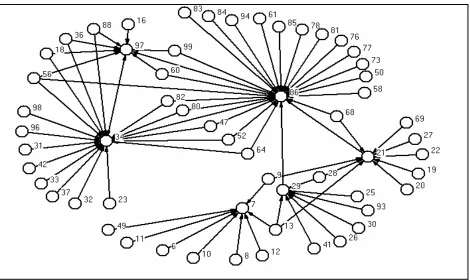
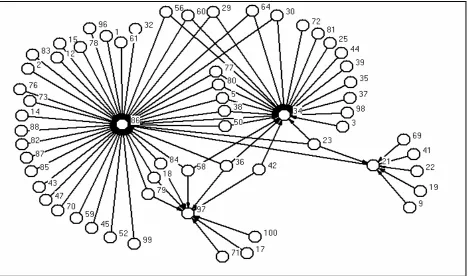
Findings from the analysis of data have been presented in the form of three network diagram around key communicators corresponding to the three communication pattern mentioned earlier.
Figure 1. Interaction through key communicators: The neighbourhood pattern
As the neighbourhood pattern of interaction is very much spatially influenced the number of choices received by key communicators has not been very high especially in comparison to friendship and discussion group patterns. Still, the key communicators can be easily distinguished from the rest. The interaction pattern is less dense and centres round these key communicators. The settlement pattern of the community can be anticipated from Figure 1 by following the subgroups of respondents around key communicators. The separate blocks under the influence of key communicators and the individuals acting as the bridge (liaison) between such blocks are of special interest and can be addressed separately.
Figure 2. Interaction through key communicators: The friendship pattern
Figure 3. Interaction through key communicators: The discussion group pattern
Figure 3 shows the discussion group pattern of interaction among the respondents with a high degree of communication integration around respondent no. 86 and 34. Similar finings were found by Manohari (2002) while working in the Koya sub-tribe setting in Andhra Pradesh. The number of key communicators has been lower in comparison to neighbourhood and friendship pattern of communication. Respondent no. 97 and 21 have been common key communicators for friendship and discussion group pattern of interactions. Here also, almost extensive reciprocal choices can be found among the key communicators.
From the above three patterns of interaction it can be generalised that –
1. Neighbourhood pattern of interaction shows least dense key communicator network and least dependence of them for seeking information.
2. Friendship group pattern of interaction features higher number of respondents seeking information from more than one key communicator.
3. Discussion group pattern of interaction shows least number of key communicators and highest inter-key communicator interaction.
laws, new schemes, minikit distribution, health related campaigns, and other regular activities of the panchayats. Secondly, the capacity building of key communicators can be proved instrumental in smooth and meaningful functioning of grassroot self-governing organiations.
REFERENCES
Bhaskaran, C. and Rao, S. M. K. (1985). Correlates of interpersonal communication behaviour of farmers in differentially progressive villages. Indian Journal of Extension Education,
18(3&4): 193-221.
Borgatti, S. P., Everett, M. G. and Freeman, L. C. (2002). Ucinet for Windows: Software for Social Network Analysis, Analytic Technologies, Harvard.
Granovetter, M. S. (1973). The strength of weak ties. American Journal of Sociology, 78: 1360-1380.
Hossain, S. M. A., Couch, B. R. and Chamala, S. (1991). Economic aspects of interpersonal communication: a choice for extension work. Journal of Extension System, 7(2): 96-110.
Lindzey, G and Byrne, D. (1968). Measurement of social choice and interpersonal attractiveness In Lindzey, E. and Aronson, E. (eds.) The Handbook of Social Psychology, Vol. II, Second Edition, Addison Wesley Publishing Company: USA, pp. 452-525.
Mangla, A. P. (1995). Keenship and interpersonal communication in a rural community. South Asian Anthropologist, 16(2): 67-71.
Manohari, P. L. (2002). Key communicator networks used in dissemination of agricultural information: a study in Koya sub-tribe setting. Manage Extension Research Review
3(1): 36-41.
Mathur, J. C., Ward, W. B. and Wright, C. (1974). Radio programming and programme exchange in south-east Asia, UNESCO report and papers on mass communication, UNESCO.
Sahar, D. K. (1977). The communication process in family planning in West Bengal village.
Journal of Family Welfare, 23(4): 70-75.
Singh, R. P., Sinha, S. and Mishra, A. P. (1971). A study on the potential of interpersonal communication in the flow of agricultural information at different stages of adoption.
Indian Journal of Extension Education, 9(1&2): 38-41.