http://dx.doi.org/10.4236/jgis.2013.56053
High-Speed Rail Route and Regional Mobility with a
Raster-Based Decision Support System: The Texas
Urban Triangle Case
Hwan Yong Kim1, Douglas F. Wunneburger1, Michael Neuman2
1Department of Landscape Architecture and Urban Planning, Texas A&M University, College Station, USA 2Built Environment, The University of New South Wales, Sydney, Australia
Email: [email protected]
Received October 30, 2013; revised November 30, 2013; accepted December 6,2013
Copyright © 2013 Hwan Yong Kim et al. This is an open access article distributed under the Creative Commons Attribution License, which permits unrestricted use, distribution, and reproduction in any medium, provided the original work is properly cited.
ABSTRACT
This study addresses sustainable transportation in the Texas Urban Triangle at the regional scale. Its aim is to determine the most suitable corridor for new transport infrastructure by employing a spatial decision support system proposed in this project. The system is being tested through its application to a prototype corridor parallel to Interstate 35 between San Antonio and Austin. The basic research questions asked are spatial in nature, so accordingly the geographic infor- mation system is the primary method of data analysis. The overall modeling approach is devoted to answering the fol-lowing questions: What are the considerations to support sustainable growth? What scale or type of infrastructure is necessary? And how to adequately model the transportation corridors to meet the demands and to sustain the living en-vironment at the same time?
Keywords: Spatial Decision Support System; Texas Urban Triangle; Geographic Information Systems; High Speed
Rail
1. Introduction
The Texas Urban Triangle (TUT) is comprised of the metropolises of Dallas-Fort Worth, Houston, and San Antonio, and is distinguished among megalopolises be- cause it is not linear but rather triangular. The axis from San Antonio to Dallas is on its way to becoming fully urbanized due to the proximity of the string of cities along Interstate 35. In contrast, on Interstate 45 between Dallas and Houston, and on Interstate 10 between Hous-ton and San AnHous-tonio, there are only small villages and towns along these arteries. Further, the urban develop- ment between its metropolises is not physically contigu- ous. The Texas Urban Triangle, with its massive number of inhabitants and area of more than 60,000 square miles, is the economic motor of Texas and hub of the national transportation network operating in a global economy. The Triangle is emerging as a new urban megaregion in its own right, competing with Los Angeles and New York, by virtue of its extensive internal connections and activities.
Accordingly, freight and passenger mobility within
and among the Triangle’s metro areas, as well as outward across the continent, are critical to economic and social development, and to the preservation of its natural assets. The initial analysis about the Triangle fringe revealed that over the next 20 years, population in the area will account for over 80 percent of the state’s total [1]. The TUT is projected to account for 8,407,000 of the state’s 10,979,000 new inhabitants, or 77 percent of all of Texas’s growth [1]. The overall findings provide a base- line foundation for policy guidance to decision makers at all levels of government—especially state and federal— and the private sector.
making based on emerging realities could pave the way for a wider range of options for transportation that are sustainable.
This study addresses sustainable transportation in the Texas Urban Triangle at the regional scale. Its aim is to determine the most suitable corridor for new transport infrastructure by employing a spatial decision support system (SDSS) proposed in this project. The SDSS is being tested through its application to a prototype corri- dor parallel to Interstate 35 between San Antonio and Austin. The basic research questions asked are spatial in nature, so accordingly the geographic information sys- tems (GIS) are the primary method of data analysis. The overall modeling approach is devoted to answering the following questions: What are the considerations to sup- port sustainable growth? What scale or type of infrastruc- ture is necessary? And how to adequately model the transportation corridors to meet the demands and to sus-tain the living environment at the same time?
2. Review of the Existing Transportation
Decision Support Systems
There are a wide range of decision support systems for transportation investments. Increasing relationship be- tween transportation and land use developed relevant software packages. As a result, a large amount of deci- sion support models are implemented by different or- ganizations. In this section, a few different existing deci- sion support systems are reviewed.
2.1. TransDec2.0
Developed by the Texas Transportation Institute (TTI) under National Cooperative Highway Research Program (NCHRP), TransDec is a multimodal investment model that takes into account many factors not easily measured in traditional benefit-cost assessments of project desir- ability, such as air quality considerations, gross mobility impacts, community livability factors, and aesthetic con- siderations [3]. TransDec uses multi-criteria utility analy- sis methods to assess tradeoffs between transportation modes, planning methods, and priorities set by project evaluators.
2.2. Development of Intercity Passenger Network in Texas (TxDOT Project 0-5930)
This project developed a state-wide network to move people between urban regions by either passenger rail or intercity bus services. For each intercity corridor, a set of criteria was developed to compare the suitability of each corridor against the others. Criteria utilized for this pro- ject include the population along each corridor, popula- tion density, projected population growth, total employ- ees, number of public or private universities, air passen-
ger travel between corridor airports, vehicular traffic, percent trucks, and average number of corridor flights per day [4]. The outcome of this evaluation will be the recommendation of which corridors are most likely to support an intercity transit system and whether bus or rail is most suitable.
2.3. MicroBENCOST Model
The MicroBENCOST software was developed by TTI researchers in the mid-1990s [5]. It provides a planning- level economic analysis tool that can be used to analyze a variety of transportation projects. MicroBENCOST is designed to analyze different types of highway corridors. Benefits are calculated for existing and induced traffic, as well as for diverted traffic. Eight different traffic alloca- tion options exist, depending on the traffic year and the nature of the marginal user costs considered.
2.4. UPlan
This is a GIS-based urban growth model that runs in the Windows version of ArcView. The model was designed by the research team to rely on a minimum amount of data, but it allocates urban growth in several land use types for small (parcel-sized) grid cells [6]. It is a sce- nario-testing model and rule based; i.e., it is not strictly calibrated on historical data and uses no choice or other statistical models. The result can be applied to various urban impact models to forecast soil erosion, local ser- vice costs, and other impacts.
2.5. The “ALLOT” Model
This model is an early prototype of the SDSS developed in 1992 in an attempt to provide governmental jurisdic- tions and private landowners with more economically efficient and environmentally sound land use and devel- opment patterns than usually occur [7]. It employed a GIS land suitability analysis model and multi-attribute value method that helped to determine the location of lands suitable for different land uses.
driven by transportation infrastructure in turn create im- pacts on surface and groundwater resources in terms of water quantity and quality. Conversely, consideration about water availability and waste assimilative capacity can be used as a driver of infrastructure planning deci- sions to achieve greater long-term sustainability.
The SDSS provides a composite foundation for policy analysis and support policy making for a comprehensive sustainable regionalism. The SDSS can be modified by users to support location decisions regarding local and state transportation corridors, in addition to metropolitan- and regional-scale corridors. Moreover, it can be used to evaluate other types of infrastructure corridors that can be placed in shared rights of way within or alongside transportation corridors. Unlike the previously reviewed models, the SDSS is multi-scalar in addition to multi- attribute, and represents an advance in decision support system model development.
The proposed SDSS compiles decision criteria into a land suitability analysis model [8], employing GIS to map strategic social, economic, and environmental char- acteristics, and overlay them to assess which locations are most and least suitable for regional transportation networks and urban-scale growth. The vastly changed transportation investment decision panorama in Texas and the United States implies a new type of decision- making that considers more than just capital costs and environmental constraints. It needs to consider the eco- nomic, demographic, social, ecological, infrastructural, and fiscal parameters influencing decisions.
3. Pre-Modeling
3.1. Identify Factors
[image:3.595.306.539.97.226.2]“Factors” in the SDSS refers to the individual criteria used in the model to assess the most suitable location for placing transportation corridors on the landscape. Utiliz- ing the Delphi panel discussion technique, a set of ex- perts panel was formed and initially selected 83 factors that could be included in the SDSS criteria. They are organized into seven categories: culture; demographics; engineering; environment; hazard; natural resources; and lands. After thorough deliberation, 38 factors appropriate for a transportation corridor were identified, and this study adopts seven of them to examine the modeling process.
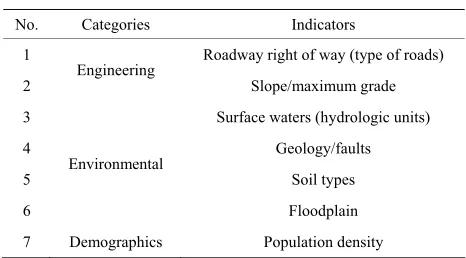
Table 1 presents the list of factor selection. Type of
roads, Floodplain, and Surface waters are selected to minimize the probability in constructing additional struc- tures to cross any highways or rivers. Slope, Geology, and Soil types are chosen to represent the construction suitability (i.e. earthworks or foundation enhancements). Finally, Population density is used to minimize any con- flicts in relocating people and goods.
Table 1. Selected factors.
No. Categories Indicators
1 Roadway right of way (type of roads)
2 Engineering Slope/maximum grade
3 Surface waters (hydrologic units)
4 Geology/faults
5 Soil types
6
Environmental
Floodplain
7 Demographics Population density
In some cases, a factor is simple binary, such as pre- sent or not present, or should or should not exist within the transportation corridor. In other cases the factors are quantitative, and in still other cases the factors are quali- tative. Some factors mark a gradient or a range within which there are acceptable (suitable) or non-acceptable (non-suitable) values. Since this is closer to a pilot test, we decided to implement these factors into the limited geographic area, and test the model operation as intended. Accordingly, six counties: Travis, Hays, Caldwell, Co- mal, Guadalupe, and Bexar, were selected to represent the locations for a possible route between Austin and San Antonio.
3.2. Data Sources and Preparation
Based on factor identification, corresponding datasets for each factor are gathered. In specific, population datasets are collected from the US Census Bureau. The Texas Natural Resource Information System (TNRIS) website provides comprehensive datasets for the State of Texas, and the author obtained hydrology and transportation data. Transportation datasets are obtained from the Texas Department of Transportation (TXDOT). The Federal Emergency Management Acts (FEMA) provides datasets about the floodplains. Vertical slope or the maximum grade is calculated using the Digital Elevation Model (DEM) easily accessible at the US Geological Survey (USGS). The USGS website has a massive amount of geographical datasets, from which geology data are also acquired. Finally, soil data are discovered using the Na- tional Resources Conservation Services (NRCS) website. Some other governmental agencies such as the Capital Area Council of Governments (CAPCOG) or the Alamo Area of Council of Government (AACOG) are also helpful sources for collecting datasets.
information, such as temperature or vegetation covers [9]. By implementing raster datasets, users can operate pixel values and GIS provides several functions to analyze or recreate information by manipulating pixel values. This information-processing step is the key to setting up the optimal path in route modeling.
In addition, raster format has to be in the same pixel size. In this case, a 30 M × 30 M cell size was imple- mented. The main reason is to minimize the information loss during the data processing period. When users use many datasets, the best way to handle the information loss is aligning to the minimum cell size across the data- sets. In this case, all the vector datasets are converted into 30 M × 30 M grid because the initial Digital Eleva- tion Model (DEM) used to calculate the vertical slope was in 30 M format, and the previous studies indicate that the typical right-of-way of a high-speed rail is 30 M for one way [10].
3.3. Classification
Factor classification refers to assigning the values, on a scale of 1 to 5, to each pixel of the factors (decision cri- teria) in the SDSS. A value of five is the highest score in a factor and reflects a negative value for locating a transportation corridor in that places—the least suitable location. A value of 1 is the lowest score in a factor and reflects a positive value for locating a transportation cor- ridor—the most suitable location.
Some factors such as roads and hydrology were classi- fied into binary (present or not present type). For exam- ple, the author concluded that constructing a high-speed rail over an interstate highway requires a complex deci- sion-making process as well as higher costs. In this sense, having a rail route over an interstate highway receives a higher score (less suitability) than doing so over a local street. Similar logic applies to the hydrology. The major stream category receives a higher score (less suitability) than the others. This reclassification process involves intensive inputs from both professionals and previous studies. Based on relevant literature reviews, each factor is scored. Some other factors without strong theoretical backgrounds utilized experts’ opinions instead.
This classification process is important because it pro- poses a window to reflect various inputs from the general public. If relevant stakeholders could involve in this clas- sification process, the outcome would become more par- ticipatory. For now, the model utilizes inputs only from the experts. But in future, developing a method that will incorporate public participation in this reclassification as well as some other processes will greatly enhance the reliability of the outcome. This possibility distinguishes the proposed SDSS with other decision support systems, and opens up for more participatory GIS.
3.4. Factor Weights
Importance of factors to the route implies a few different meanings and in this case, the cost side of HSR is more considered than the others features such as environment or operation as this is closer to model-testing. Conse- quently, a weight matrix is created to define the relation- ship between the factors, and named as the factor weights matrix. Factor weights refer to the relative value of fac- tors compared to each other. Thus, the most important factor to consider for locating a HSR in the Texas Urban Triangle is weighted as the highest, the second most im- portant factor is the next, and so on, until the least im- portant factor.
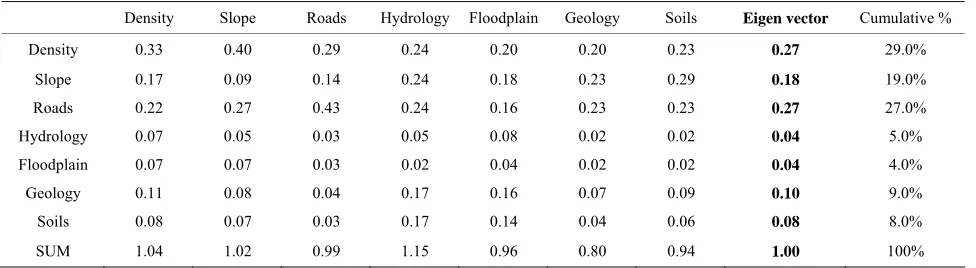
In order to determine appropriate factor weights, the Analytic Hierarchy Process (AHP) is applied. Developed by Thomas Saaty in the 1970s, the AHP helps organize and analyze complex decisions. It is based on the well- defined mathematical structure of consistent matrices and their associated right eigenvector’s ability to generate true or approximate weights [11]. The AHP is a widely accepted decision-making strategy, especially when deal- ing with various datasets with multiple criteria. In this case, the relationship between seven selected factors is tested with the AHP. Table 2 illustrates the AHP result.
Eigen vectors show the factor weight for each factor and are standardized values.
Weights are allocated in a subsequent order: Popula- tion Density ≥ Slope > Roads > Geology > Soil Type > Hydrology = Floodplain. This order is based on the de- grees of anticipated difficulties in railroad construction. Relocating people from one place to another not only requires cost, but also needs extensive amount of conflict resolution. Constructing a railroad on the ground with more than 3.5% slope is not impossible, but requires ex- cessive costs. A Californian study limits vertical slope to 3.5% as it is in the exceptional grades range [10]. There- fore, slope is considered as important as relocating peo- ple and goods, and set to the same weight as density. Roads are one of the significant obstacles in railroad con- struction, and valued as the third highest. The most ex- pected problem in Roads factor is crossing. If a route encounters a freeway in the middle of its operation, it should either detour or find a new way to go across.
Table 2. AHP result.
Density Slope Roads Hydrology Floodplain Geology Soils Eigen vector Cumulative %
Density 0.33 0.40 0.29 0.24 0.20 0.20 0.23 0.27 29.0%
Slope 0.17 0.09 0.14 0.24 0.18 0.23 0.29 0.18 19.0%
Roads 0.22 0.27 0.43 0.24 0.16 0.23 0.23 0.27 27.0%
Hydrology 0.07 0.05 0.03 0.05 0.08 0.02 0.02 0.04 5.0%
Floodplain 0.07 0.07 0.03 0.02 0.04 0.02 0.02 0.04 4.0%
Geology 0.11 0.08 0.04 0.17 0.16 0.07 0.09 0.10 9.0%
Soils 0.08 0.07 0.03 0.17 0.14 0.04 0.06 0.08 8.0%
SUM 1.04 1.02 0.99 1.15 0.96 0.80 0.94 1.00 100%
λmax = 7.7070, consistency index (CI) = 0.1178, random index (RI) = 1.32 (n = 7) consistency ratio (CR) = 0.0893 < 0.1.
ously. Users decide to which regard the factors to be valued, or to develop a possible scenario with the given weights. This is important because implementation of user judgment in weigh allocation opens up for another possibility for participatory GIS.
One way to determine the reliability of the created weight matrix is using the Consistency Ratio (CR). CR indicates the consistency of weight matrix if the AHP process is done repeatedly [12]. In our case, the CR came out to be less than 10% (8.93%), and this implies that the created weight matrix has an error variance less than 10 percent. In most studies applying AHP, a CR value less than 10 percent is considered a reliable measure [13].
The relationship between the factors and factor weights are a crucial part of the entire SDSS process. The way the factor weights are determined could give different result to the final routes. How participants set up factor weight creates different route options and gives different implications in terms of transportation investment. Com- paring diverse results with participants’ own goals is one of useful tactics in decision-making process. In this case, setting up the relevant importance of each factor was done with in-depth discussions between the author and factor experts. Similar to the internal classification proc- ess, it is possible for the participants to elaborate the weighting process based on their own goals and objec- tives, and this is another possibility of incorporating par- ticipatory GIS environment to the proposed SDSS.
4. GIS-Modeling
Based on the previous steps, raster-based GIS modeling is utilized. The raster-based modeling is powerful when new information is in demand based on existing condi- tions. By converting all datasets into raster formats, we obtain new information in a pixel level. For example, if we decide that population density less than 10 (10 peo- ple/acre) is equal to a suitability score of 2, then all the pixels with population density less than 10 are converted into a score of 2. This process involves two particular
steps: creating cost surfaces with the given weights of factors and extracting the shortest path on a cell-by-cell basis.
4.1. Cost Surfaces
Using factor weights, an equation is derived to create a unified cost surface. By adding up the factors multiplied with their relevant weights in AHP result, a single map implying suitability scores is created. As mentioned ear- lier, all factor datasets are prepared in a 30 M × 30 M gird format. In other words, all the pixels in a factor dataset have a value of 1 through 5 as set in the classifi- cation step. Multiplying weights to factors implies multi- plying factor weights to the entire pixel values in dataset. Therefore, the cost surface is also in a grid format with 30 M × 30 M pixels. The map algebra can be written as follows:
Final Suitability Surface
kw xk ij (1) (where wk: external weight for factor k, xij: value of a grid cell ij in factor k.)Figure 1 represents the results of using the equation
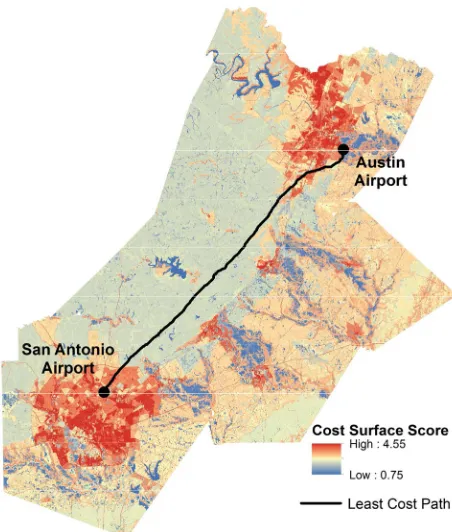
with the factors. By adding up all the factors, pixels in the cost surface acquire the suitability scores. This score is standardized to fit into a 1-to-5 scale, meaning that a pixel value closer to 5 indicates negative suitability for a HSR route. Unlike the convention, a reversed scale is used because finding the shortest path in GIS is based on the least possible pixel scores between the departure and destination. In other words, the optimal route will be drawn by connecting all the least possible scores between the origin and destination. The lower the suitability scores, the better fit for the shortest path.
geology, soil type, and slope factors made low suitability on the east part of the study area.
4.2. Least Path Analysis
The next step is to perform the shortest path analysis. GIS finds the pixels with the least possible scores be- tween the two designated points. After setting up the locations of origin and destination points, combined functions in GIS seek for the least possible scores around each proceeding pixel. The least possible scores are con- stantly identified and connected until the path reaches its final destination.
[image:6.595.309.536.85.344.2]For research convenience, the departure and destina- tion points were set to two cities’ major airports. Station location involves a different set of decision-making pro- cedure and could become a highly political agenda. Therefore, the author decided to drop station location decision at this moment, and arbitrary set to two major airports: Austin-Bergstrom Airport and San Antonio In- ternational Airport. Whether the location is set to airports or different geographic locations, the route modeling process does not change and the result will be drawn accordingly.
Figure 2 represents the suitability map with the short-
est path extracted. This path is drawn based on each pixel’s suitability score. As can be seen, the route inten- tionally avoids major population centers. In addition, because most of low suitable areas are located on the southeast side of the study boundary, the route rather indicates as a straight line. Because this line is basically a vector line connected with pixel by pixel, however, the shape is not a curve and thus, requires a post-smoothing process.
4.3. Smoothing Process
The shortest path analysis finds the most suitable route by searching each pixel’s score in the cost surface. The result is in a vector line connecting the most suitable 30 M × 30 M pixel. However, post-processing is required to smooth the line to the parameters required for construc- tion. Construction parameters applied to high-speed rail require turns must be limited to curves defined by a minimum of 4.5-mile radius [14]. This restriction is hard to apply in the proposed model because this is closer to a master plan stage, not a specific engineering process.
Using GIS, however, users are able to comply with such restrictions in a few different ways. For example, the moving window analysis will be a good starting point to analyze the radius of a route, but may require signifi- cant time and resources to analyze all the pixels within that regard. In this case, the study used “Smooth” func- tion provided in the Advanced Editing toolbox. The ex- tent of smoothing is set by indicating the maximum al-
Figure 1. Final cost surface with AHP result.
Figure 2. Least cost path with the cost surface.
[image:6.595.310.536.376.642.2]reality with the radius restriction.
5. Result
During the previous sections, an optimal HSR route was extracted based on the initial judgment criteria and input factors. The route is designed to intentionally avoid population center, which is the study’s purpose at the beginning, and find out the least conflict in construction suitability, which is determined by geology, soil type, and slope factors. In this case, the subsequent step would be understanding the result. There are a few different ways to interpret the route, and in this study we focus on the total length, travel time, and expected construction estimates. As this study is prototype modeling test and a part of a longitudinal research project, more elaboration about the final route will be followed in the later studies.
[image:7.595.310.539.100.180.2]In 2011 summer, the TUT team at Texas A&M Uni- versity had an opportunity to have a meeting with a Ko- rean engineering firm. The meeting was about technol- ogy consultation and transfer. During the meeting, re- searchers had a chance to receive a detailed estimate of the Korean HSR construction costs. As the State of Texas has not decided which HSR vehicles to use, this study implements the Korea HSR specification to esti- mate anticipated costs for its construction.
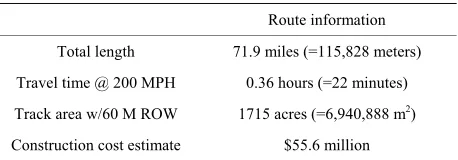
Table 3 represents the total length of the final route
with the 60 M of right-of-way (ROW). A 60 M ROW is used because it is for a two-way HSR track [16]. In addi- tion, the Korean HSR is operating with the speed of 200 mile/hour. Although the average speed across the entire route will slower than 200 MPH, the constant speed was assumed because the total length is relatively short and less number of stations between the two points are ex- pected.
As can be seen, the extracted route consumes 1715 acres of lands for its rail tracks and takes about 22 min- utes to reach the San-Antonio International Airport from the Austin-Bergstrom International Airport with the speed of 200 mile per hour. In addition, the estimated total construction costs using the Korean HSR specifica- tions came out as $55.6 Million, which is approximately $0.77 million for one-mile of railroad construction.
6. Conclusion
The proposed SDSS is robust, meaning that it is support- ed by valid theory, developed by using a sound method- ology, and based on reliable and accurate data. This ro- bust quality, coupled with the wide range of factors in the SDSS model, enables it to be adapted to a wide range of geographic and technological circumstances beyond Texas and its Urban Triangle, depending on the intended use. A wide range of geographic conditions means two things: places throughout the United States and the world,
Table 3. Cost estimate and travel time.
Route information
Total length 71.9 miles (=115,828 meters)
Travel time @ 200 MPH 0.36 hours (=22 minutes)
Track area w/60 M ROW 1715 acres (=6,940,888 m2)
Construction cost estimate $55.6 million
not just Texas; and a range of scales from the municipal- ity to the multi-state region. The wide range of techno- logical circumstances means any type of ground trans- portation technology or mode, whether rail, road, or mul- timodal.
Furthermore, the adaptability and flexibility of the model is afforded by the ability of any user to tailor the input factors to suit the scale and territory to which it is applied. For example, if a region is heavily forested and topographically rugged, those two environmental char- acteristics can be bolstered with additional factors, and those two factors can be adjusted to suit the specific local conditions. Moreover, end users can organize both the internal classifications within each factor and the external weights among the factors as compared to the other fac- tors selected. The capacity of this decision support sys- tem can be expanded to make more complex decisions by incorporating other, diverse characteristics and using them as additional inputs into the SDSS. By doing so, not only does new transportation infrastructure mean an op-portunity for new economic possibilities and new urban development, but its right of way can also be located to support sustainable development for the future.
The study analyzed a possible HSR route emphasizing the construction aspect of HSR. The result indicates that the initial investment of $55.6 million would be required to build a HSR route in between San Antonio and Austin. In addition, the optimized rail track will consume around 1700 acres of lands with the two-way ROW, and will reduce the travel time to 22 minutes, compared to that which takes about 1.5 hours with an automobile. The suggested modeling process and interpretation of the result imply a possible way to conceptualize the route information with the given criteria. More importantly, this study provides a foundation that will be implemented to further studies regarding participatory GIS in deci-sion-making environment.
metropoli-tan planning organizations and councils of governments in the Triangle, as well as the Texas Department of Transportation.
In addition, future users should modify the SDSS to address perceptions held by stakeholders. For example, additional factors may be beneficial for analyzing and mitigating adverse impacts of large ownerships by frag- mentation. To comprehend the limitation, more studies are under review to improve the overall modeling proc- ess.
7. Acknowledgements
This study is part of a longitudinal study about Texas Urban Triangle. The author gratefully acknowledges the University Transportation Center for Mobility at the Texas Transportation Institute for support. The author would also like to thank POSCO Engineering, Inc. for their provision of the Korean high-speed rail information.
REFERENCES
[1] M. Neuman and E. Bright, “Texas Urban Triangle: Framework for Future Growth,” Southwest Region Uni- versity Transportation Center, College Station, 2008. [2] Governor’s Business Council Transportation Task Force,
“Shaping the Competitive Advantage of Texas Metro- politan Regions,” Governor’s Business Council, Austin, 2006.
[3] S. Roop, “TransDec 2.0: Project Planning Decisions Made Easy. Texas Transportation Researcher,” Texas Transpor- tation Institute, College Station, 2003.
[4] C. A. Morgan, B. R. Sperry, J. E. Warner, A. A. Protopa- pas, J. D. Borowiec, L. L. Higgins and T. B. Carlson, “Potential Development of an Intercity Passenger Transit System in Texas,” Texas Transportation Institute, College Station, 2010.
[5] British Columbia Ministry of Transportation, “Micro- BENCOST Guidebook: Guidelines for the Benefit Cost Analysis of Highway Improvement Projects in British Columbia,” British Columbia Ministry of Transportation, British Columbia, 2005.
[6] R. A. Johnston, D. R. Shabazian and S. Gao, “UPlan: A Versatile Urban Growth Model for Transportation Plan- ning,” Transportation Research Record 1831 (2003), 2007, pp. 202-209.
[7] E. M. Bright, “The ‘Allot’ Model: A PC-Based Approach to Siting and Planning,” Computers, Environment and Urban Systems, Vol. 16, No. 5, 1992, pp. 435-451.
http://dx.doi.org/10.1016/0198-9715(92)90004-B
[8] I. L. McHarg, “Design with Nature,” J. Wiley, New York, 1994.
[9] C. P. Lo and A. K. W. Yeung, “Concepts and Techniques of Geographic Information Systems,” Pearson Prentice Hall, Upper Saddle River, 2006.
[10] Parsons Brinckerhoff, “Technical Memorandum: Align- ment Design Standards for High-Speed Train Operation TM 2.1.2. California High-Speed Train Project,” Califor- nia High-Speed Rail Authority, Sacramento, 2009. [11] T. L. Saaty, “The Analytic Hierarchy Process: Planning,
Priority Setting, Resource Allocation,” RWS Publications, Pittsburgh, 1990.
[12] R. Ramanathan, “A Note on the Use of the Analytic Hi- erarchy Process for Environmental Impact Assessment,”
Journal of Environmental Management, Vol. 63, No. 1, 2001, pp. 27-35.
http://dx.doi.org/10.1006/jema.2001.0455
[13] E. H. Forman, “Random Indices for Incomplete Pairwise Comparison Matrices,” European Journal of Operational Research, Vol. 48, No. 1, 1990, pp. 153-155.
http://dx.doi.org/10.1016/0377-2217(90)90072-J
[14] The European Parliament and of the Council, “Directive on the Interoperability of the Rail System within the Community,” Official Journal of the European Union, Brussels, 2008, pp. 1-191.
[15] ArcGIS Resource Center, “Smooth Line (Cartography),” 2010.
http://resources.arcgis.com/en/help/main/10.1/index.html #//007000000012000000