Full Length Research Article
HUMAN ERROR RISK ANALYSIS IN EMERGENCY MUSTERS IN ONSHORE GAS REFINERIES
*
1Amir Bayati, Nader
1Nabhani,
2Fereshteh Jaderi and
1Bahram Ghasemi
1
Petroleum University of Technology, Abadan, Iran
2
Research Center of Environment and Sustainable Development, Department of Environment, Iran
ARTICLE INFO ABSTRACT
In muster actions decisions must be taken very quick. So human error will take an important role. Hence it is very important to predict human error probability and the associated risk. Human Error Probability Index is a methodology for analyzing human error in emergency muster actions. The objective of this study was to analyze the risk of human error in muster action in emergency conditions in South Pars Gas Complex and obtain the HEPI reference graphs to be used in all onshore gas refineries. Calculations was based on SLIM and the judges were selected from SPGC. Finally, HEPI reference graphs was obtained and presented.
Copyright©2016, Amir Bayati et al. This is an open access article distributed under the Creative Commons Attribution License, which permits unrestricted use, distribution, and reproduction in any medium, provided the original work is properly cited.
INTRODUCTION
Human reliability assessment (HRA) involves the use of qualitative and quantitative methods to assess the human contribution to risk. There are many and varied methods available for HRA, with some high hazard industries.The study of human factors is a scientific discipline that involves the systematic application of information regarding human characteristics and behavior to enhance the performance of man-machine systems. The preponderance of work in human error prediction has come from the nuclear power industry through the development of expert judgment techniques such as SLIM and the Technique for Human Error Rate Prediction (THERP) (Swain, A.D. and Guttmann, H.E., 1983). The need for expert judgment techniques lies in the systemic lack of human error data and serious nuclear industry accidents such as Chernobyl. Analogously, the Piper Alpha and Ocean Ranger disasters have generated a greater awareness of the effects and ramifications of human error in hydrocarbon processing. Humans play a significant role in both accident causation and in emergency response (Bellamy, 1994). The importance of human factors in oil and gas industrial operations has been recognized through several reports published by the Health and Safety Executive (UK) dealing with the inclusion of human factors in this industry (Widdowson, 2002).
*Corresponding author: Amir Bayati,
Petroleum University of Technology, Abadan, Iran.
These reports provide guidance for the integration of human factors principles in the industrial system design and development processes. HEPI provides a very useful and complete regulatory basis for human errors to take roll in the management decisions and risk assessment. But it was built just for offshore industries and there was the lack of reference graphs which can be applied to onshore industries. The main objective of this study is to develop HEPI reference graphs for use in all onshore refinery industries.
HEPI development and applications
Dino G. Dimattia et al. first developed Human Probability Index (HEPI) in his PhD graduating thesis based on the SLIM technique as a framework for predicting the human error probability in an offshore oil platform muster (DiMattia, 2004). HEPI applies the mean PSF weights and ratings of a relatively large group of judges and does not standardize the PSF weights by equalizing their values (i.e. all PSF weights = 100). Dimattia et al. (Khan, F.I., Amyotte, P.R. and DiMattia, D.G., 2005) defined three scenarios (man overboard, gas release and fire and explosion) and six PSFs. A relatively large number of judges (24) was used in his work for the elicitation of PSF weights and ratings. The judges exhibited a wide range of years of experience and training, and the elicitation was conducted on an individual basis over an extended period of time, lowering the possibility of joint work (i.e. conditional dependence). An opinion forwarded by Apostolakis et al. (Apostolakis, 1988) concerns the level of independence
ISSN: 2230-9926
International Journal of Development Research
Vol. 06, Issue, 11, pp.9898-9906, November, 2016
DEVELOPMENT RESEARCH
Article History: Received 12thAugust, 2016
Received in revised form 28thSeptember, 2016
Accepted 22ndOctober, 2016
Published online 30thNovember, 2016 Key Words:
between the PSF weights and the task ratings. The elicitation of the PSF weights and ratings for HEPI was conducted independently. The weighting of the PSFs for a muster sequence are clearly distinguishable from the task PSF ratings. Responses from the elicitation review team (ERT) were scrutinized to determine if they followed the intention of the elicitation. If the response was not consistent with the intent, it was discarded as opposed to re-presenting the questionnaire to the judge. This avoided the risk of lowering the level of
independence in the judges’ responses due to coaching.
Dimattia et al. (Khan, F.I., Amyotte, P.R. and DiMattia, D.G., 2005) provided reference graphs based on PSF ranking and n-weights and ratings for each action and PSF. He also compared the results with a risk matrix and provided a basis for defining actions to lower the Human error Probability were necessary. In 2011 Dimattia used the same frame work for a risk analysis in the LNG tanker Emergencies (D.G., 2011). Saremi et al. (Saremi, et al., 2014) used the framework provided by Dimattia to analyze the risk of human errors in muster action in the SPD3 platform South Pars. She defined 3 scenarios
(MO, GR & F&E) the same as Dimattia. She didn’t detailed
the procedure of calculating HEPs. Saremi concluded that the most human error probability is in egress and evaluation phase and the least is in the recovery phase. She recommended to increase the trainings and enhance maintenance programs. Mohammad Fam I. (Mohamadfam, et al., 2013)used the HEPI framework to identify and assess the risk of human error in muster action in a power plant. He studied two muster scenarios including Fire and explosion and earthquake. The scenarios were ranked using the questionnaire provided by Dimattia. Then weighting and rating for each PSF were obtained from the reference graphs provided by Dimattia. The main concern in this study is that the reference graphs provided by Dimattia et al. (Khan, F.I., Amyotte, P.R. and DiMattia, D.G., 2005) are provided for the offshore platforms and cannot provide good level of accuracy for onshore industries because of the basic differences between the emergency conditions in the offshore platforms and onshore plants. In this work we reviewed the HEPI frame work with the onshore plants approach and re-provide the reference graphs based on the judgment of experts chosen from different jobs in different refineries of the South Pars Gas Complex (SPGC).
MATERIALS AND METHODS
Calculation of HEPs are based on SLIM, which is made of three components preparation of questionnaires, elicitation of PSF weights and ratings and calculation of HEPs. Finally, data are analyzed and a risk assessment is done at the end. SLIM is an expert-judgement method, based on questioners which should be filled by experts. The detailed instructions of how to answer the PSF rating and weighting questioners was provided to all judges. The experts had worked independently and several meetings and reviews was done to ensure that a common understanding is achieved. The core review team (CRT) was made up of three individuals (Judges A through C) who met the set of criteria outlined in Table 1. The CRT judges spanned a range of professions knowledgeable in industrial operations and muster scenarios. Their backgrounds are varied and their job types were specific to various aspects of the gas industry. Each judge was met with independently to discuss the purpose of the work and their responsibilities. These three judges were utilized to establish the basis of the elicitation phases. The CRT is made up of a process engineer,
health and safety professional and operation supervisor. A key facet of the CRT was that these individuals were able to commit their time and efforts to perform this work. There was no gratuity or motivation offered and the judges were permitted to perform the work at their own pace. This philosophy was applied in all aspects of the data gathering stages. This approach lengthened the time it took (about 4 months data gathering) to conduct the work but promoted continuity, as judges remained part of the total process. Two
muster scenarios were established using Dimattia’s studies and
confirmed by the CRT to encompass the widest possible range of credible muster initiators. The five criteria used in the establishment of the muster scenarios are found in Table 2. The two muster scenarios become the reference sequences from which other scenarios are ranked through HEPI. The muster scenarios chosen as anchors were gas release (GR), and fire and explosion (F&E). The details of each anchor muster were developed in the process of establishing the PSF rating forms. A Hieratical Task Analysis was done for each muster scenario and the steps were used in the questionnaire. Dimattia D.G. (DiMattia, 2004) determined 11 PSFs from his CRT and selected 6 PSFs among 11 by pairwise comparison. In this study these PSFs are used, which are as followed:
Stress Complexity Training Experience Event factors Atmospheric factors
Table 3 provides a description of each PSF which was supplied with the PSF weight and rating questionnaires to ensure a common interpretation by all judges. 50 individuals, including the CRT members, were solicited to be part of the elicitation review team (ERT). A wide range of experience and background was sought in the formation of this group of judges. Of the 50 individuals contacted, 30 became judges. The remaining individuals were unable to provide feedback due to time constraints. Of the 30 judges, the responses of 8 were inconsistent with the given instructions or did not answer at time and were discarded. Each judge is identified by a capital letter ranging from A to V (22 judges), consistent with the method of identifying CRT members.
Determining PSF weights
Judges were instructed to first consider all PSFs to be as severe as possible foreach scenario. Then they were to choose the PSF that, if improved, would afford thegreatest possibility of completing the task successfully. That PSF was given a value of100 and is denoted as PSF100. The remaining PSFs were weighted against PSF100, from 0to 90; that is, if PSFi is deemed to be 50% as important as PSF100 then PSFi is given aweight of 50, and so on. The five remaining PSFs may be of duplicate value.
Determination of PSF Ratings
Table 1. Selection criteria for core review team members (DiMattia, 2004)
No. Description
1 Is actively involved in industrial activities as a member of company
2 Has actively participated in musters or is evolved in the design or evaluation of unit safety systems. 3 Has participated or led risk assessments in the unit activities
4 Has a minimum of 10 years of industrial experience in hydrocarbon processing.
5 Is capable of dedicating the required time to perform evaluation and is committed to participate as required in the development of HEPI 6 Does not work directly for any other member of the CRT or with any member of the CRT on a daily basis.
7 Is available to meet in person during work hours.
Table 2. Muster scenario criteria (DiMattia, 2004)
Table 3. PSF descriptions (DiMattia, 2004)
PSF Description
Stress PSF to complete actions as quickly as possible to effectively muster in a safe manner. The effect from muster initiator on the consequences of not completing the task.
Complexity PSF that affects the likelihood of a task being completed successfully because of the intricacy of the action and its sub-actions. This, combined with a high level of stress, can make actions that are normally simplistic in nature complicated and/or cumbersome. Can cause individuals to take shortcuts (violations) to perform task as quickly as possible or not to complete the task.
Training PSF that directly goes to an individual’s ability to most effectively identify muster alarm and perform the necessary actions to complete muster effectively. Training under simulation can provide a complacency factor as a highly trained individual may lack a sense of urgency because of training’s inherent repetitiveness.
Experience PSF related to real muster experience. Individual may not be as highly trained as other individuals but will have experienced real muster(s) and the stressors that accompany real events. Strong biases may be formed through these experiences.
Event factors PSF that is a direct result from the muster initiator and the location of the individual with respect to the initiating event. Distractions that can affect the successful completion of a muster include smoke, heat, fire, pressure wave and noise.
Atmospheric factors PSF that influences actions due to weather. High winds, rain, snow or sleet can affect manual dexterity and make egress paths hazardous by traversing slippery sections. Extremely high winds negatively impact hearing and flexibility of movement.
Table 4. GR scenario description
Component Description
Situation A hydrocarbon gas release in the process units
Muster person in question An experienced (three years) operator who at the time of muster alarm is changing filters in a solids removal unit Weather The incident occurs in cold, wet weather
[image:3.595.92.514.569.685.2]Time of day The muster is conducted during daylight hours Location of muster initiator The operator is on the same unit as the gas release
Table 5. GR scenario components and related PSFs
PSF Muster scenario
Stress muster initiator is a gas release
mustering individual is on the same unit as the gas release Complexity muster initiator is a gas release
job at time of muster is changing filters on a solids filter Training mustering individual has three years of offshore experience
mustering individual is an operator
Experience mustering individual has three years of offshore experience Event factors muster occurs during daylight hours
muster initiator occurs on the same unit
Atmospheric factors muster event occurs in the winter with some wind and it is raining
Table 6. F&E scenario description
Component Description
Situation A fire and explosion in the process units
Muster person in question An inexperienced (six months) operator who at the time of muster is in the process units working valves to isolate a vessel
Weather The incident occurs during extremely hot weather with dust and strong wind Time of day The muster is conducted during night time hours
Table 7. F&E scenario components and related PSFs
PSF Muster scenario
Stress Muster initiator is a fire and explosion
Mustering individual is an operator who is in close proximity to the muster initiator Complexity Muster initiator is a fire and explosion
Job at time of muster is in the process units working valves to isolate a vessel Training Mustering individual has six months of industrial experience
Mustering individual is an operator
Experience Mustering individual has six months of industrial experience Event factors Muster occurs during the nighttime
Muster initiator occurs on the same unit
[image:4.595.73.509.81.196.2]Atmospheric factors Muster event occurs during cold weather with dust and strong wind
Table 8. The main steps of HEPI (DiMattia, 2004)
Step Description Result
1 Complete muster questionnaire Sets up muster scenario so that PSF rankings can be calculated.
2 Rank each PSF The ranking value for each PSF permits the determination of PSF weights and ratings through reference graphs for each action
3 Determine PSF weights and ratings through reference graphs The weights and ratings are used to determine each muster action’s SLI. 4 Calculate SLI for each action The SLIs are converted to HEPs for each action by another set of reference
graphs
5 Determine HEPs and assign consequences for each action The HEP and consequence allow the determination of risk through a risk matrix 6 Estimate risk level and decide if acceptable If risk is acceptable, then no re-rating is required
7 Apply risk mitigation measures to reduce risk. Actions are re-rated based on mitigating measures and new HEPs and consequences are determined
8 Determine revised risk level. Apply further mitigation if risk is not acceptable and re-rate
Table 9. HEPI reference musters - PSFs' ranking
[image:4.595.32.555.236.352.2]Stress Complexity Training GR F&E GR F&E GR F&E 130 260 150 280 50 90 Experience Event factors Atmospheric factors GR F&E GR F&E GR F&E 50 80 60 100 30 70
Table 10. F&E stress ranking (260) with n-weights and ratings for actions 1-6
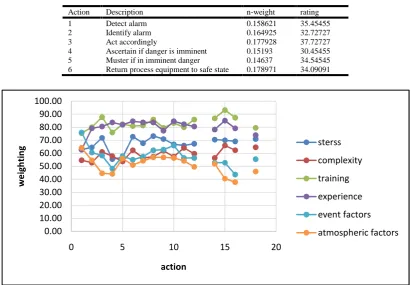
Action Description n-weight rating 1 Detect alarm 0.158621 35.45455 2 Identify alarm 0.164925 32.72727 3 Act accordingly 0.177928 37.72727 4 Ascertain if danger is imminent 0.15193 30.45455 5 Muster if in imminent danger 0.14637 34.54545 6 Return process equipment to safe state 0.178971 34.09091
Figure 1. PSF weights (GR)
0.00 10.00 20.00 30.00 40.00 50.00 60.00 70.00 80.00 90.00 100.00
0 5 10 15 20
w
ei
gh
tin
g
action
[image:4.595.91.503.479.764.2]Figure 2. PSF weights F&E
[image:5.595.109.483.68.518.2]Figure 3. PSF ratings (GR)
[image:5.595.114.476.523.759.2]Figure 5. Mean SLI for each action
Figure 6. Calculated HEPs for both scenarios
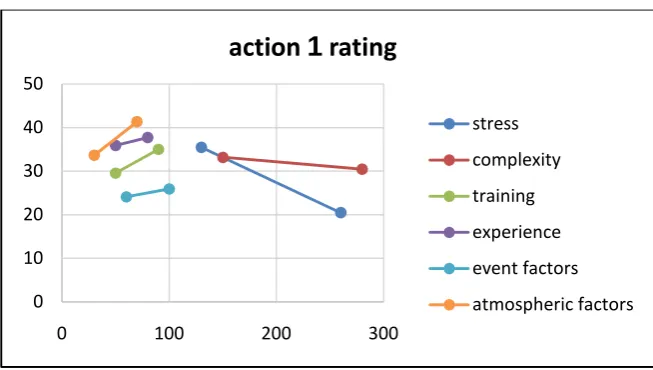
Figure 7. Action 1 n-weight reference graph
0 5 10 15 20 25 30 35 40 45
0 5 10 15 20
F&E mean SLI GR mean SLI
0 0.05 0.1 0.15 0.2 0.25 0.3 0.35 0.4 0.45
0 5 10 15 20
F&E HEP GR HEP
0 0.05 0.1 0.15 0.2 0.25
0 100 200 300
action 1 n-weight
[image:6.595.134.470.557.762.2]The scales were applied in an identical manner to both muster scenarios. A rating of one hundred represents the optimal optimal condition for each PSF. PSFs were permitted to have condition of the PSF. Conversely, a rating of 0 is the least the same rating for a given action. Ratings are not provided for action 13 and 17 (collect personal survival suit if in accommodations at time of muster and Don personal survival suit or TSR survival suit if instructed to abandon) as the reference muster scenarios do not contain these actions in the plant under study.
Determination of Human Error Probabilities
The HEPs for each action (j), under each muster scenario, were determined from the solicited weights and ratings provided by the ERT. The replies from each judge were reviewed to ensure procedures were followed before proceeding with HEP calculations. A set of weights for a muster action can be written as equation (1) (Embrey, D.E., Humphreys, P.C., Rosa, E.A., Kirwan, B. and Rea, K., 1984).
= ∑ (1)
Where
i = PSFs (1 to 6)
j= muster actions (1 to 18) w = weight provided to each PSF
θi= sum of weights for action j
The weights were normalized (σij) for each action as shown in
equation (2) (Embrey, D.E., Humphreys, P.C., Rosa, E.A., Kirwan, B. and Rea, K., 1984). The sum of the normalized weights is unity, equation (3) (Embrey, D.E., Humphreys, P.C., Rosa, E.A., Kirwan, B. and Rea, K., 1984).
= (2)
∑ = 1 (3)
σij= normalized weight of PSF (i) wij= weight of PSF (i) for action (j)
The success likelihood index (SLI) is the product of the normalized weight and the rating for each PSF, equation (4-4) (Embrey, D.E., Humphreys, P.C., Rosa, E.A., Kirwan, B. and Rea, K., 1984).
= × (4)
Where
δij= rating for PSF (i) and action (j)
ψij= SLI for PSF (i) and action (j)
The sum of the SLIs for a given action, equation (5), is utilized in determining the probability of success (POS) for each action (Embrey, D.E., Humphreys, P.C., Rosa, E.A., Kirwan, B. and Rea, K., 1984).
Ω = ∑ (5)
Where
Ωj= total of SLIs for a given action
The POS is determined through a logarithmic relationship, equation (6), as developedby Pontecorvo (Pontecorvo, 1965) and as has been the foundation for all versions of SLIM in thedetermination of HEPs.
log = Ω + (6)
Where
κ = probability of success (POS) or (1- HEP)
Ωjm = arithmetic mean of SLIs for action j
a, b = constants
The arithmetic mean of the calculated SLIs is utilized as opposed to the geometric mean as the geometric mean cannot be used in conjunction with data that are less than or equal to 0. As the weight and rate scales run from 0 to 100 there exists the possibilitythat the calculated SLI (Ωj) is zero for any judge
and given action. In order to determine the constants (a, b) in equation (6), Dimattia (DiMattia, 2004) obtained the HEPs of the actions with the greatest and lowest SLIs. These base HEPs (BHEPs) permit the solution of the constants a and b. The remaining 16 HEPs may then be determined.
RESULTS
Gas Release PSF Weight Results
[image:7.595.134.461.54.239.2]The mean PSF weights for all actions within the gas release scenario are shown in Figure 1. Gas releases can be small in
Figure 8. Action 1 rating reference graph
0 10 20 30 40 50
0 100 200 300
action
1
rating
nature, localized, and detected through local instrumentation. They can also be very severe and lead to expanding vapour clouds with the potential for detonation or jet fire if the leak is from a high pressure source through a flange break. As shown in Figure 5-1 experts believe that training is the most important PSF in most of the muster actions. Also there are some exceptions as in actions 4, 6, 7, 10 and 11 experience had gained the higher weighting.
Fire and Explosion PSF Weight Results
The mean PSF weights for all actions within the Fire and Explosion scenario are shown in Figure 2. This scenario provides the greatest level of risk through all phases of the muster scenario and can lower local area tenability including that in the TSR. Because of the specific conditions in the case of fire and explosion the experts believe that experience, is the most important PSF. After that training and stress are the next levels.
Gas Release PSF Ratings Results
The GR scenario was setup as shown in Table 4. The muster sequence occurred during the day in less than optimal weather conditions. The mustering individual has notable but not extensive experience (i.e. three years) and is changing filters on a solids removal unit at the time of muster initiation. The muster event is a gas release which occurs on the same deck as the operator, thus providing a heightened level of danger. Table 5 relates the components of the muster with the PSFs. The mean ratings for all actions in the gas release muster are shown in Figure 3.
Fire and Explosion PSF Rating Results
The F&E scenario (Table 6) was set up so that the muster sequence occurred during the night time in very poor weather conditions. This is the most severe muster event. The mustering individual has little experience (i.e. six months). The muster event is a fire and explosion which occurs on the same unit as the operator, providing an extreme level of danger. The fire and explosion (F&E) scenario provided the most significant issues during the muster scenario because of the nature of the incident and the location of the individual at the time of muster initiation. Table 7 relates the components of the muster with the six PSFs. There is considerable potential for a direct effect on the operator’s surroundings, lowering the
tenability of their environment. The mean ratings for all actions in the fire and explosion muster are shown in Figure 4. Success Likelihood Index Results
The total SLI for each action is the sum of the PSFs SLI values. Figure 5 is a trend of the mean SLI (SLI) for each action. Prediction of Human Error Probabilities. Calculated HEPs for both scenarios are shown in figure 6.
Human error probability index
The main steps of HEPI process is shown in table 8. Included in Table 9 are the applicable PSFs for each question. The response to each question influences the weight and rating of these PSFs. Each question has a multiple choice answer that has a corresponding value (rank) as shown in Table 9. The values in Table 9 that formulate the rankings for the two
muster scenarios (GR and F&E) can be identified through a legend (for more details refer to the MSc. Thesis Bayati, 2016, Petroleum University of Technology). The PSFs are ranked by summing the values associated with each question that is relevant to that PSF. For example, the ranking for the PSF, training, would be the sum of the values from questions 5, 6, and 12.
HEPI Reference Graphs
The first step to develop HEPI reference graphs was to complete the ranking process for each of the three reference musters and sum the ranks for each PSF.The PSF rankings are summarized in table 10. The next step was to pair the PSF n-weights and ratings with the PSF rankings for the two reference muster scenarios. An example of set of n-weights and ratings is provided in Table 11.The result is two pairs of data consisting of PSF ranks and PSF n-weights for each muster action. Similarly, two pairs of data are formed from the PSF ranks and PSF ratings for each muster action. These data sets form the reference curves for each muster action. To determine the PSF n-weight or rating for a given action, the value is interpolated based on the PSF ranking. Each muster action has six reference curves (one for each PSF) to determine the n-weights and ratings. These curves have been placed on a single graph resulting in 16 n-weight reference graphs (one for each muster action) and 16 rating reference graphs. There are 18 muster actions, but actions 13 and 17 (collect personal survival suit if in accommodations at time of alarm and Don personal survival suit or TSR survival suit if instructed to abandon) is not part of the two reference musters and thereforenot included. These reference graphs are conducted from the study in south pars gas complex but applicable to all onshore refinery units. Figures 7 and 8 shows the reference graphs for action 1. Other graphs can be found in the MSc. thesis (Bayati, 2016, Petroleum University of Technology).
REFERENCES
Apostolakis G. E. A Critique of Recent Models for Human Error Rate assessment [Journal] // Reliability Engineering and System Safety. - 1988. - Vol. 22. - pp. 201-217. Bellamy L.J. The Influence of Human Factors Science on
Safety in the Offshore [Journal]. - [s.l.] : Journal of Loss Prevention in the Process Industries, 1994. 4 : Vol. 7. -pp. 370-375.
D.G. Dimattia predicting human error probabilities for muster actions during lng tanker emergencies [Conference] // International Gas Union Research Conference. - 2011. DiMattia D.G. Human Error Probability Index for Offshore
Platform Musters [Report] : PhD- Thesis. - Nova Scotia : Dalhousie University, Halifax, 2004.
Embrey, D.E., Humphreys, P.C., Rosa, E.A., Kirwan, B. and Rea, K. SLIM-MAUD: An Approach to Assessing Human Error Probabilities Using Structured Expert Judgment [Report]. - New york : Department of Nuclear Energy, 1984. - NUREG/CR-3518 (BNL-NUREG-51716).
Khan, F.I., Amyotte, P.R. and DiMattia, D.G. HEPI: A New Tool for Human Error Probability Calculation for Offshore Operation [Journal] // Safety Science. - 2005.
Management and HSE Conference in vital arteries. -Tehran : [s.n.], 2013.
Pontecorvo A.B. A Method of Predicting Human Reliability [Journal] // Annals of Reliability and Maintainability. -1965. - Vol. 4. - pp. 337-342.
Saremi M., F. Forooghi Nasab and M. Jabari risk management of human errors in muster actions [Conference] // first conference on seabased sustainable development. -Khoramshahr : [s.n.], 2014.
Swain, A.D. and Guttmann, H.E. Handbook of Human Reliability Analysis with Emphasis on Nuclear Power Plant Applications [Report]. - Washington : Nuclear Regulatory Commission, 1983. - NUREG/CR-1278. Widdowson A. and Carr, D. Human Factors Integration:
Implementation in the Onshore and offshore industries [Book]. - Sudbury, United Kingdom : HSE books, 2002.