IJPSR (2015), Vol. 6, Issue 9 (Research Article)
Received on 26 February, 2015; received in revised form, 27 April, 2015; accepted, 30 July, 2015; published 01 September, 2015
PHYTOCHEMICAL SCREENING AND ANTIOXIDANT ACTIVITY OF LEAVES AND STEM
BARK EXTRACTS OF GARCINIA IMBERTI - AN ENDANGERED PLANT
K. Rajkumar 1, R. Shubharani *1, 2 and V. Sivaram 1
Laboratory of Biodiversity 1, Department of Botany, Bangalore University, Jnana Bharathi, Bangalore –
560056, Karnataka, India
V. Sivaram Research Foundation 2, #132, Rajarajeswarinagar, Bangalore – 560056, Karnataka, India
ABSTRACT: Garcinia imberti Bourd. a critically endangered tree belongs to the family Clusiaceae found only in India. The phytochemicals and antioxidant studies were carried out for the methanolic extracts of Garcinia imberti leaves and stem bark using DPPH and ABTS radical scavenging assay. Preliminary phytochemical screening of methanolic extracts of Garcinia imberti revealed the presence of various bioactive components like alkaloids, flavanoids, steroids, glycosides, phenols, saponins, terpenoids, resins, carbohydrates and tannins in both leaves and stem bark. The quantitative analysis of phytochemicals of the extracts showed the presence of high amount of tannins (0.92 ± 0.23mg/gm) and alkaloids (0.83 ± 0.48mg/gm) in leaf and high concentration of flavanoids (0.65±0.16mg/gm) and tannins (0.78±1.12mg/gm) in bark extract. The result of the present study concluded that the methanolic extracts of Garcinia imberti leaves and stem bark possess antioxidant activity due to the presence of significant amount of phenolic compounds which are the major contributors of antioxidant activity. The finding of this study suggests that the studied plant is a potential source of natural antioxidant that could have great importance as therapeutic agents in preventing or slowing the progress of oxidative stress related degenerative diseases.
INTRODUCTION: Plants are one of the most
important sources of natural medicine and number of modern drugs has been isolated from them. Over 80% of world population relied on the traditional
form of medicine for their basic health care 1. Use
of medicinal herbs has become an important part of daily life despite the progress in modern medical
and pharmaceutical research 2. Epidemiological
studies on medicinal plants support that the constituents such as phenols, flavanoids, alkaloids, tannins etc. are capable of exerting protective effect
against oxidative stress 3.
QUICK RESPONSE CODE
DOI:
10.13040/IJPSR.0975-8232.6(9).4016-21
Article can be accessed online on:
www.ijpsr.com
DOI link: http://dx.doi.org/10.13040/IJPSR.0975-8232.6(9).4016-21
They are effective in treatment of several human
diseases such as cancer, arthritis,
neurodegenerative disorders, aging process and
diabetes 4. In recent years the research on medicinal
plants has become more important to know their
constituents and biological activity 5. Therefore it is
also necessary to have knowledge of chemical constituents of plants before using it as medicine.
Garcinia imberti Bourd. a critically endangered tree belongs to the family Clusiaceae found only in India. The tree grows up to 15m tall in evergreen forest of Western Ghats, Agasthyamalai, Kerala. The plant is dioecious and has yellowish bark with mild fragrance. Leaves are simple, elliptic, green turns grayish on drying, midrib prominent on both surfaces. Male flower in terminal fascicles of 1 to 9, pedicels short, sepals 4 greenish yellow, petals 4, yellow, orbicular to broadly ovate, female flowers
Keywords:
Garcinia imberti, Antioxidant, Phytochemicals, DPPH, ABTS
Correspondence to Author: Shubharani R
Laboratory of Biodiversity, Department of Botany, Bangalore University, Jnana Bharathi, Bangalore – 560056, Karnataka, India,.
terminal, solitary or in pairs, berries globes and smooth.
Recently, phytochemical analysis and therapeutical
activity of many species of Garcinia have been
carried out by many scientists. The chemical constituents and biological activities of fruit rind of
Garcinia indica has been reported 6, 7. Garcinol, a
polyisoprenylated benzophenone purified from G.
indica fruit rind displays antioxidant, anticancer,
antiulcer and anti-obesity properties8, 9, 10, 11.
Preliminary phytochemicals of Garcinia
gummigutta has been analyzed and reported 12. The essential oil composition and antimicrobial activity of Garcinia imberti has been studied 13.There is no report on the medicinal use and phytochemicals of
leaf and stem bark extracts of G. imberti. In this
context, the present study were focused on the screening for the presence of active principles and antioxidant activity of methanolic extract of
G.imberti leaves and stem bark. Natural products of endangered plants may also provide a new source of therapeutic agent.
MATERIALS AND METHODS:
The fresh leaves and stem bark of G.imberti were
collected from evergreen forest of Agasthyamalai, Kerala, after identified and authenticated from Tropical Botanical Garden and Research Institute, Palode, Trivandrum, Kerala (herbarium specimen no:11412) and also Botanical Survey of India, Coimbatore, Tamil Nadu (herbarium specimen no:162084).
Extraction of plant material:
Freshly collected leaves and stem bark of G.
imberti were washed, shade dried, powdered and extracted with methanol. The crude methanol extract was concentrated using rotary evaporator. The dried extract obtained was dissolved in known
amount of methanol and used for the
phytochemical analysis and antioxidant assay.
Preliminary phytochemical analysis:
The methanolic extract were used for preliminary screening of active constituents such as proteins, carbohydrates, phenols, flavanoids, alkaliods, tannins, steroids, resins, saponins, terpenoids and glycosides by following the standard procedure to
understand the nature of phytoconstituents present
14, 15
.
Quantification of total Phenols, Flavanoids, Tannins and Alkaloids:
The total phenolic content in methanolic extracts of
G. imberti leaf and stem bark were determined according to method employed by using catechol as
standard 16. One milliliter of plant extracts was
mixed with 1mL of FC reagent and 3mL of 20%
Na2Co3 solution. The mixture was incubated for
40min at room temperature and absorbance was measured at 760nm.
An aluminum chloride colorimetric method was
used to determine the flavanoid content17.The plant
extracts was mixed with 0.5mL of aluminum chloride (1.2%) and 0.5mL of 120mM potassium acetate. The mixture was allowed to stand for 30min at room temperature. The absorbance was measured at 415nm. Flavanoid content was expressed in terms of Rutin equivalent.
The tannin content of samples was determined
calorimetrically using Folin–Denis reagent 18. To
1mL of plant extracts, 75mL of distilled water, 5mL of Folin-Denis reagent and 10mL of sodium carbonate was added, read the absorbance at 700nm after 30min. The standard graph was prepared by using standard Tannic acid.
The total alkaloid content of the samples was
measured using 1, 10-phenanthroline method 19.
The reaction mixture contained 1mL plant extract,
1mL of 0.025 M FeCl3 in 0.5 M Hydrochloric acid
and 1mL of 0.05 M of 1, 10-phenanthroline in ethanol. The mixture was incubated for 30 min in hot water bath with maintained temperature of 70ºC. The absorbance of red colored complex was measured at 510nm against reagent blank. Alkaloid contents were estimated and it was calculated with the help of standard curve of colchicines.
Antioxidant activity by DPPH and ABTS assay:
Antioxidant activity of methanolic extracts of G.
imberti leaf and stem bark was estimated using
DPPH 20. One mL of extract prepared in multiple
concentrations (50-300µg/mL) was mixed with 3mL of DPPH prepared in methanol. The mixture
was measured at 517nm using a spectrophotometer. A decrease in DPPH solution absorbance indicates an increase in radical scavenging activity. The percent of DPPH radical scavenging activity of the sample was calculated.
The radical-scavenging ability of extracts was also determined by ABTS radical cation decoloration
assay21. ABTS was dissolved in water to 7mM
concentration with potassium persulfate (2.45mM) and incubate in the dark for 16 hours at room temperature before use and the solution was diluted in methanol to get the absorbance 0.7 ± 0.02 at 734nm. After adding 1mL of diluted ABTS solution to different aliquots of sample in methanolic extracts, the absorbance was measured
at 30oC after 30min of initial mixing.
The percentage of antioxidant activity of tested samples was calculated by determining the decrease in absorbance at different concentration by using the equation: E = (Ac-At)/Ac) x100 where At and Ac is the respective absorbance of tested
samples and control DPPH or ABTS 22. All assays
were performed in triplicate for each sample and at each concentration.
Statistical Analysis:
The experiments were conducted in triplicates and data were expressed as mean ±SD. It was analyzed
using mega stat model 23.
RESULTS AND DISCUSSION: The therapeutic
effect of plants is because of the presence of active
compounds 24. In the present study the preliminary
phytochemical analysis revealed the presence of phenols, terpenoids and flavanoids in mild level. Alkaloids, carbohydrate and glycosides were present in moderate level.
Saponins, steroids, tannins and resins were in high concentration in leaves. In stem bark, steroids, terpenoids and resins were detected in the high concentration whereas carbohydrate, glycosides and tannins were in moderate concentration and alkaloids, saponins, phenols and flavanoids were found in low concentration. Analysis revealed the presence of protein in very mild level in stem bark extract whereas proteins were absent in leaf extract (Table 1).
TABLE 1: QUALITATIVE ANALYSIS OF METHANOLIC EXTRACTS OF GARCINIA IMBERTI
Sl.No. Phytochemicals Leaf Stem bark
1 Alkaloids ++ +
2 Carbohydrates ++ ++
3 Proteins - +
4 Saponins +++ +
5 Glycosides ++ ++
6 Phenols + +
7 Steroids +++ +++
8 Terpenoids + +++
9 Tannins +++ ++
10 Flavanoids + +
11 Resins +++ +++
+: present at mild concentration; ++: present at moderate concentration;
+++: present at high concentration
Table 2 summarized the results of quantitative assessment of phytochemical composition of
methanolic extracts G. imberti leaf and stem bark
with a focus on phenols, flavanoids, tannins and alkaloids. Phenolic compounds are major plant secondary metabolite which has several biological functions. The total phenolic contents of the leaf and stem bark samples were calculated with a standard curve using Catechol. The results indicate that phenol content is higher in leaf extract (0.71mg/gm) and moderate in stem bark extracts (0.62mg/gm). The concentration of flavanoids in studied samples was determined with aluminum chloride by using calorimetric method and the total flavanoid content of methanolic extract of leaf (0.82 mg/gm) was higher than stem bark (0.65 mg/gm).
Tannins are the most abundant antioxidants and they exhibit many biologically important functions which include protection against oxidative stress
and degenerative diseases 25. The tannin content of
methanolic leaf and stem bark extracts was 0.92mg/gm and 0.78mg/gm respectively. Alkaloids have been reported to be the most efficient
therapeutically active substances 26.
Pure alkaloids and their derivatives are known to have many pharmaceutical properties. According to
the present result (Table 2), the total alkaloid
content were found to be maximum in leaf extract
(0.83mg/gm) and minimum in stem bark
extracts have considerable amount of phenol, flavanoids, tannins and alkaloids content. However,
tannins were found in higher levels both in leaf and stem bark.
TABLE 2: QUANTIFICATION OF PHYTOCHEMICAL CONTENT OF METHANOLIC EXTRACTS OF GARCINIA
IMBERTI
Sl.No Phytochemicals Leaf
(mg/gm)
Stem bark (mg/gm)
1 Phenol 0.71 ± 0.14 0.62 ± 0.32
2 Flavanoids 0.82 ± 0.86 0.65 ± 0.16
3 Tannins 0.92 ± 0.23 0.78 ± 1.12
4 Alkaloids 0.83 ± 0.48 0.55 ± 0.25
The DPPH and ABTS free radical scavenging assay are the commonly used methods for evaluation of proton donating antioxidants. DPPH is stable at room temperature and accepts electron or hydrogen free radical to form a stable diamagnetic molecule. This ability of DPPH to undergo reduction by an antioxidant is measured in
terms of decrease in its absorbance at 517nm 27.
DPPH is stable nitrogen centered free radical which produces violet in ethanol solution. It was reduced to a yellow coloured product, diphenyl picryl hydrazine, with the addition of the fractions in a concentration dependent manner. The reduction in number of DPPH molecule can be correlated with
the number of available hydroxyl group28.
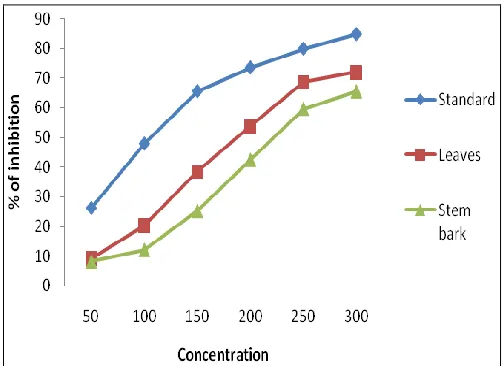
Antioxidant capacity of extracts was determined based on the reaction of DPPH absorbance by calculating percentage of antioxidant activity (Fig.1). Concentration of the sample necessary to
decrease initial concentration of DPPH (IC50) under
the experimental condition was calculated. Lower
value of IC50 indicates higher antioxidant activity.
The IC50 values of the methanolic stem bark, leaf
extract and standard was found to be 274.24µg/mL, 218.11µg/mL and 137.58µg/mL respectively. The extracts were found to have less antioxidant activity than the standard. Radical scavenging activity is likely to be related to the nature of phytochemicals and their hydrogen donating ability to reactive free radicals converting them into more stable.
ABTS assay is based on the inhibition of the absorbance of the radical cation. ABTS is converted to its radical cation which is blue in color by addition of potassium persulfate and absorbs light at 734nm. During the reaction, blue colored ABTS radical cation change to colorless when the
free radicals were scavenged by antioxidant29.
According to the present investigation, the methanolic extract of leaf has highest activity when
compared to stem bark extract (Fig.2). The IC50
value was found to be 118.00µg/mL, 198.74µg/mL and 232.14µg/mL in standard, leaf and stem bark respectively.
FIG.1: ANTIOXIDANT ACTIVITY OF METHANOLIC
EXTRACTS OF LEAVES AND STEM BARK OF GARCINIA
IMBERTI BY DPPH METHOD
FIG. 2: ANTIOXIDANT ACTIVITY OF METHANOLIC EXTRACTS OF LEAVES AND STEM BARK OF GARCINIA
[image:4.612.90.515.116.189.2] [image:4.612.314.565.304.482.2] [image:4.612.313.564.530.713.2]CONCLUSION: Plants produce a very diverse group of secondary metabolites with antioxidant potential. Antioxidants block the action of free radicals which have been implicated in the prevention of many diseases and in the aging
process. Alkaloids, carbohydrates, proteins,
saponins, glycosides, phenols, steroids, terpenoids, tannins, flavanoids and resins were analyzed qualitatively which are known to possess antioxidant activities and these phytochemicals are valuable sources of raw material for traditional
medicine 30. Humulene and beta-caryophyllene are
the major constituents of G. imberti stem bark oil
13
.
The present study also exhibited significant antioxidant activity in both DPPH and ABTS assay. Leaf showed the highest antioxidant activity compared to stem bark. The antioxidant activity may be due to the presence of significant amount of phenolic compounds which are the major contributors of antioxidant activity. The finding of this study suggests that the studied plant is a potential source of natural antioxidant that could have great importance as therapeutic agents in preventing or slowing the progress of oxidative stress related degenerative diseases. Further investigation on the isolation and characterization of the antioxidant constituent is required. The IUCN was declared that the population of
G.imberti was declared as critically endangered and there is an urgent need to conserve these valuable tree species before extinction.
ACKNOWLEDGEMENT: We extend our thanks
to the Ministry of Environment and Forest, Government of India for providing research grant under the All India Coordinated Project (AICRP) on Reproductive Biology of RET Tree species ( F No. 22/10/2010-RE) to undertake the present investigation. The authors are also thankful to the Department of Botany, Bangalore University, Bangalore - 560056 for providing facilities and Kerala Forest Department for providing necessary permission to locate the plants in Agasthyamalai forest range.
REFERENCES:
1. Tinrat S, Akkarachaneeyakorn, inghapol C: Evaluation of antioxidant and antimicrobial activities of Momordica
cochinchinensis spreng (gac fruit) ethanolic extract.
International Journal of Pharmaceutical Sciences and Research 2014; 5(8): 3163-3169
2. Mohd Mazid, Taqi Ahmed Khanb, Firoz Mohammada: Medicinal plants of rural India: A Review of use by Indian Folks. Indo Global Journal of Pharmaceutical Sciences 2012; 2(3): 286-304
3. Ness AR, Powles JW: A review: Fruit and vegetables and cardiovascular disease. International Journal of Epidemiology 1997; 26 (1): 1-13
4. Sowndharajan K, Jince MJ, Arunachalam K, Manian S: Evaluation of Merremia tridentates (L.) Hallier f. for
in-vitro antioxidant activity. Food Science and Biotechnology
20l0; 19 (3): 663-669
5. Narender Prasad D, Ganga Rao B, Sambasivarao E, Mallikarjunarao T, Praneeth D: Quantification of constituents and In-vitro antioxidant activity of Ficus
semicordata leaves extracts. International Journal of
Pharmacy and Pharmaceutical Sciences 2012; 4 (2): 619-622
6. Nagendra K, Kusum R, Ramachandran HD: Evaluation of phytochemical screening and in-vitro antioxidant activities of total phenolics and flavonoids contents from fruit of
Garcinia indica. International Journal of Innovative
Sciences and Research 2014; 2 (8): 1688-1695
7. Adegboye MF, Akinpelu DA, Okoh A: The bioactive and phytochemical properties of Garcinia kola (Heckel) seed extract on some pathogens. African Journal of Biotechnology 2008; (21): 3934-3938
8. Akanksha M, Mrinal M, Bapat, Jai C, Tilak, Devasagayam T A: Antioxidant activity of Garcinia indica (kokam) and its syrup. Current Science 2006; 91 (1): 90-93
9. Amol BD, Vinayak DS, Neelam LD, Nilofer SN: Antiulcer activity of Garcinia indica linn fruit rinds. Journal of Applied Pharmaceutical Science 2011; 1 (5): 151-154
10. Yamaguchi F, Saito M, Ariga T, Yoshimura Y, Nakazawa H: Antioxidative and anti-Glycation activity and antiulcer activity of Garcinol from Garcinia indica fruit rind. Journal of Agriculture and Food Chemistry 2000; 48 (6): 2320-2325
11. Rastogi NK, Nayak CA: Forward osmosis for the concentration of anthocyanin from Garcinia indica Choisy. Separation and Purification Technology 2010; 71 (2): 144-151
12. Madappa, Bopaiah: Preliminary phytochemical analysis of leaf of Garcinia gummigutta from Western Ghats. Journal of Pharmacy and Biological Science 2012; 4 (1): 17-27
13. Ramesh Kumar KB, Shiuraj S, George V: Constituents and antibacterial activity of the stem bark oil of Garcinia
imberti. Journal of Tropical Medicinal Plants 2005; 6 (2):
271-273
14. Harborne JB: Phytochemical methods. Chapman and Hall Ltd, London, 1992; 7-8
15. Antitha Roy, Geetha RV: Preliminary phytochemical screening of the ethanolic extract of Dioscorea villosa tuber and estimation of Diosgenin by HPLTC technique. International Journal of Drug Development and Research 2013; 5 (3): 377-381
16. Slinkard K, Singleton VL: Total phenol analyses: automation and comparison with manual methods. American Journal of Enology and Viticulture 1977; 28(1): 49-55
colorimetric methods. Journal of Food and Drug Analysis 2002; 10:178-182
18. Polshettiwer SA, Ganjlwale RO: Spectrophotometric estimation of total tannins in some Ayurvedic eye drops. International Journal of Pharmaceutical Sciences 2007; 69 (4): 574-576
19. Singh DK, Srivastava B, Sahu A: Spectrophotometric determination of Rauwolfia alkaloids: estimation of reserpine in pharmaceuticals. Analalytical Science 2004; 20(3): 571-573
20. Blios MS: Antioxidant determination by the use of stable free radicals. Nature 1958; 26 (5): 1199-1200
21. Re. R, Pellegrin N, Proteggente A, Pannala M, Yang C, Rice Evans: Antioxidant activity applying an improved ABTS radical cation decolorization assay. Free Radical Biology and Medicine 1999; 26 (9-10): 1231-1237 22. Bedawey AA: Characteristics of antioxidant isolated from
some plants sources. Cairo: Shibin El-Kom 2010; 1-11 23. Orris JB: Megastat (Version 9.1). Butler University:
Indianapolis, USA
24. Czinner E, Hagymazi K, Blazovics A, Kery A, Szoke E, Lemberkovics E: The in vitro effect of Helichysi flos on microzomal lipid peroxidation. Journal of Ethanopharmacology 2001; 77: 31-35
25. Wasnik Ujwala, Singh Vijender, Ali Mohammad: In-Vitro Antioxidant activity of isolated tannins of alcoholic extract
of dried leaves of Phyllanthus Amarusschonn and Thonn, International Journal of Drug Development and Research 2012; 4(1): 274-285
26. Ibe C, Maduagwu NL: Antibacterial activity of Psidium
guajava linn. stem bark extracts on multidrug resistant
(MDR) community acquired methicillin-resistant staphylococcus aureus (CA-MRSA). Journal of Evolution of Medical and Dental Sciences 2013; l2 (33):6251-6260 27. Dildar A, Muhammad AA: Antioxidant and free radical
scavenging potential of Otostegia limbata. Asian Journal of Chemistry 2010; 22 (6): 4524-4532
28. Suganya G, Sampath Kumar P, Dheeba B, Sivakumar R: In Vitro Antidiabetic, Antioxidanta and Anti-Inflammatory activity of Clitoria ternatea L. International Journal of Pharmacy and Pharmaceutical Sciences 2014; 6(7): 342-347
29. Li XC, Wang XZ, Chen DF, Chen SZ: Antioxidant activity and mechanism of protochatechuic acid in-vitro. Journal of Functional Food in Health and Disease 2011; 1: 232-244
30. Ravi Kiran CH, Madhavi Y, Raghava Rao T: Evaluation of Phytochemicals and Antioxidant Activities of Ceiba pentandra (Kapok) Seed Oil. Bioanalysis & Biomedicine 2012; 4(4): 068-073
All © 2013 are reserved by International Journal of Pharmaceutical Sciences and Research. This Journal licensed under a Creative Commons Attribution-NonCommercial-ShareAlike 3.0 Unported License.
This article can be downloaded to ANDROID OS based mobile. Scan QR Code using Code/Bar Scanner from your mobile. (Scanners are available on Google Playstore)
How to cite this article:
Rajkumar K, Shubharani R and Sivaram V: Phytochemical Screening and Antioxidant Activity of Leaves and Stem Bark Extracts of