3962
SMS SPAM DETECTION USING ASSOCIATION RULE
MINING BASED ON SMS STRUCTURAL FEATURES
1NOOR GHAZI M. JAMEEL
1Lecturer. Department of Computer Networks, Technical College of Informatics, Sulaimani Polytechnic
University, Kurdistan Region, Iraq E-mail: 1[email protected]
ABSTRACT
The popularity of using mobile phones has led to an increase in sending SMS messages. SMS messages are considered as a rapid way of communication due to its low cost and easy usage. As a result, SMS was target for many types of threats, one of these is spamming. SMS spam is unwanted message sent to many mobile phone users, and cause many problems like annoyance, consuming mobile network bandwidth and other real threats like scam, stealing personal information and installing malware. In this paper, a new system is proposed to detect spam SMSs using Apriori algorithm. This algorithm is used to generate association rules which applied to new SMSs to classify them into spam or legitimate. The system used structural features only instead of textual features or tokens. These features extracted from two publicly available datasets which consists of spam and legitimate SMSs. The rules are generated with different minimum support and minimum confidence values. The generated rules are applied to the test dataset then the rules which achieved higher accuracy are used in the proposed system. The aim of this work is presents a new and fast approach to detect spam SMS using structural features only and to find out if structural features are enough to detect spam SMSs instead of bag of words which depends on preprocessing and consists of many steps like parsing, tokenization, stop word removal and stemming. Good accuracy achieved with 97.65% using rules generated by Apriori association rule mining algorithm with minimum support 0.2 and minimum confidence 0.8 based on SMS structural features only.
Keywords:SMS, SMS Spam, Association Rule Mining, Apriori Algorithm
1. INTRODUCTION
Short Message Service (SMS) is one of the common communication methods for people through mobile devices or internet connected computers. Due to rapid increase in the number of mobile phone users around the world, this increase attracted spammers to send spam SMS or sometimes called junk SMS. Spam SMS is unwanted message sent in large quantities often for commercial or advertising purposes to many recipients [1], [2], [3]. According to Truecaller report in 2017, found that 56% of American adults claimed to receive SMS spam and texts at least one every month, with approximately one of every four, (23%) claiming six or more spam texts received a month. On average, Americans receive 8.4 spam text messages in an average month approximately 30% from 2015 [4].
Short messages often consist of only a few words, limited message length, symbols, specific linguistic with abbreviations which is called SMS language, therefore present a challenge to
3963 “!”, “$”) and numeric characters (e.g., phone numbers) are commonly encountered in spam messages. Finally, URL links are usually observed in SMS spam as well [2]. The work in this paper presents a new approach to quickly detect spam SMS by considering all structural characteristics and extract them from SMS messages instead of bag of words. Then according to these features, rules are generated using Apriori association rule data mining algorithm. The rules are used to classify SMS into spam or legitimate, then the specificity, recall and accuracy of the system are computed with different values for minimum support and minimum confidences. The aim of this work is find out if structural features are enough to detect spam SMSs instead of bag of words, if so then the process of detecting spam SMS will be fast since extracting bag of words consists of many steps and it is a time consuming process. And according to the results the proposed system presented a good accuracy. This paper is organized as follows. Section 2, illustrates related works for filtering and classification spam and legitimate SMS. In Section 3, SMS concept and Apriori algorithm are explained. Section 4, the proposed system is described. In Section 5 the results and performance analysis of our suggested method is discussed. The last section addresses conclusions and future work.
2. RELATED WORKS
Recently, there are many researchers conducted studies for filtering, detection and classifications SMS messages. below are some of related works in this field:
Rafique and Abulaish [9] used graph based learning to classify SMS into spam and legitimate. labeled messages are represented as a graph of words then the probability of occurrence and joint distribution among the tokens of spam and legitimate SMSs is computed. KL-Divergence is used to classify new SMSs based on the computed probabilities. Results show that the system achieved 98% detection rate with false alarm rate of less than 0.08 during the classification of spam SMS in 10-fold cross validation. Anchal and Sharma [10] proposed SMS spam filtering technique by applying principle component analysis algorithm and custom neural network with Independent Component analysis algorithm to classify SMS into spam and legitimate. Ishtiaq et al [11] used Navïe Bayes classifier and Apriori algorithm to classify SMS into spam and ham based on words in the SMS. UCI Data Repository was used as a dataset for training and testing and the achieved accuracy 98.7% compared
3964 using WEKA tool and five machine learning algorithms: Naïve Bayes, Decision Table, Logistic Regression, J48, and Random Forest. According to the results, Random Forest algorithm achieved the best result with 96.1% as a true positive rate.
Most of previous works used either textual features which requires preprocessing and consists of many steps: parsing, tokenization, stop word removal and stemming in which it is a time consuming process. Others used combination between textual and structural features. In this work, just 6 structural features are used with two combined spam SMS datasets to generate association rules using Apriori association rule mining algorithm to detect Spam SMS messages.
3. CONCEPTS AND METHODS
In this section, the concepts and theoretical aspects are illustrated.
3.1 Short Message Service (SMS)
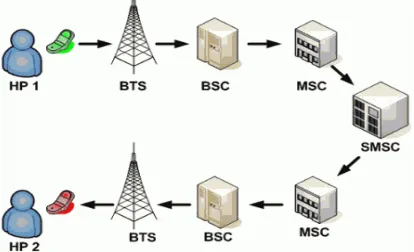
[image:3.612.92.299.412.538.2]SMS stands for Short Message Service, and it is the commonly way for making a connection between the sender and the receiver through a mobile. The concept of sending and receiving SMS is shown in figure 1.
Figure 1: SMS Transmission
First the message is sent from the user to the base transceiver station (BTS) in which a wireless connection is established between the user and the network. The message is delivered to the receiver through the mobile switching center (MSC) which is accountable for routing voice calls and SMS, and short message service center (SMSC). The maximum message length in SMS in the beginning was 128 bytes carrying 146 characters using 7 bits for each character. This size enhanced to be 140 bytes as 160 characters for each SMS [18], [19].
3.2 Association Rule Mining
Association rule is one of the most research areas in data mining and machine learning. Association rule mining is a valuable tool that has been used widely in various areas [20]. Association rule uses two criteria, support and confidence. It identifies the relationships and rules generated by analyzing data for frequently used if/then patterns. Association rules are usually needed to satisfy a user-specified minimum support which is computed by equation (1) and a user specified minimum confidence which is computed by equation (2) [21].
Rule: X ==> Y
Support= (1)
Confidence= (2)
Where:
Support (s) = Fraction of transactions that contain both X and Y
Confidence(c)= Measures how often items in Y appear in transactions that contain X.
To produce association rules with specified minimum support and confidence. There are two stages:
3965 Stage 2: From each item set determining
the rules that have the specified minimum confidence. If only rules with a single test on the right side were sought, it would be simply a matter of considering each condition in turn as the consequent of the rule, deleting it from the item set, and dividing the support of the entire item set by the support of the resulting subset— obtained from the hash table—to yield the confidence of the corresponding rule.
3.3 Apriori Algorithm
Apriori algorithm is one of the efficient algorithms of association rules mining. The algorithm finds frequent itemsets and used level-wise search. It generates the rules by two steps [22]:
1. Find all the frequent itemsets that satisfy minimum support.
2. Generate all the rules that satisfy minimum confidence using the frequent itemsets.
Itemset consists of set of items, the frequent itemset is an itemset that has support above minimum support. The frequent individual items in the database are identified and extended to larger and larger itemsets as long as those itemsets appear sufficiently in the database. After all frequent itemsets are found, it generates rules [21] [22].
4. THE PROPOSED SYSTEM
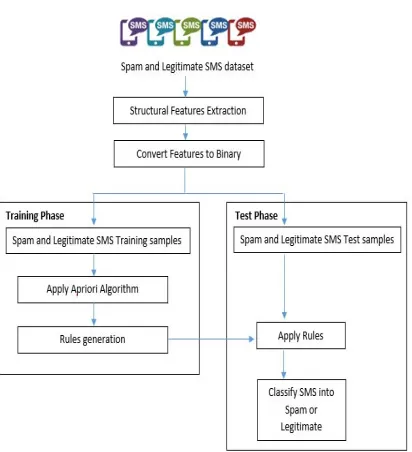
[image:4.612.316.522.87.313.2]SMS contains some proprieties and characteristics, these proprieties are from text of the SMS which is treated as bag of words and some of these proprieties are structural features. From these characteristics, SMS(s) can be classified into spam and legitimate. In this paper, the proposed system classifies SMS into spam or legitimate using association rule data mining by Apriori algorithm based on structural features only. However, set of steps are performed: SMS collection, features extraction, convert features into binary, rules generation using Apriori data mining algorithm to classify SMS into spam and legitimate SMS. The overall process is described in general in the block diagram in figure 2 and discussed below:
Figure 2: The Proposed System
4.1 SMS Collection
Two publicly available datasets are used in our proposed system: SMS Spam Collection v.1 UCI Machine learning repository which consists of 5574 SMSs of spam and legitimate (https://archive.ics.uci.edu/ml/datasets/sms+spam+c ollection), and data from DIT SMS Spam dataset which consists of 1353 spam SMS
(http://www.dit.ie/computing/research/resources/sm sdata/). Both datasets are combined together to be used for features extraction process. The dataset is divided randomly into two subsets: The first contains 60% of spam and legitimate SMSs and the second contains 40% of spam and legitimate SMSs. The proposed system works in two steps the training will be performed with the first subset and the testing will be performed with the second. Table 1 illustrate the number and percentage of spam and legitimate SMS used in the proposed system.
Table 1: Statistics of the SMS Dataset
Type of SMS Number of messages Percentage
Legitimate 4827 69.68%
Spam 2100 30.32%
Total 6927 100%
4.2 SMS Structural Features Extraction
3966 features are extracted from spam and legitimate SMS dataset and these features are illustrated in table 2. The feature extraction process is developed by Visual Basic. Net programming language.
Table 2: Statistics of the SMS dataset [2]
No. Feature Description
SF1 Message Length Number of all characters in the SMS
SF2 Number of Terms Number of tokens or terms
in the SMS SF3 Uppercase Character
Ratio
Number of uppercase characters divided by the message length.
SF4 Non alphanumeric
Character Ratio
Number of Non alphanumeric characters divided by the message length.
SF5 Numeric Character Ratio
Number of numeric characters divided by the message length.
SF6 Existence of URL Check if SMS contains
URL or No
The proposed system focuses on specifying the relevant features that differentiate spam SMS from legitimate SMS. In order to specify the relevant features, certain statistical analysis and calculations were carried out on the SMS dataset with total of 2100 spam messages and total of 4827 legitimate messages. Since some of the structural features has continuous value and Apriori algorithm cannot handle these values so based on 6 heuristics, features (SF1, SF2, SF3, SF4, SF5) were defined. And according to these heuristics the features are converted to binary and stored as 10 features. The last feature (F6) is a binary value if the URL exists in the SMS the feature value is stored as 1 else its value is 0. Then these features are subjected to association rule mining to effectively determine the legitimate and spam SMS.
Heuristic 1: Message Length
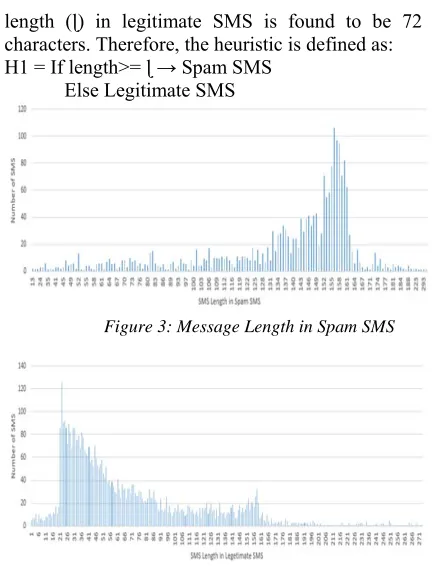
SMS is a limited length text. It consists of uppercase, lowercase letters, numbers, non-alphanumeric characters. For each SMS in the dataset, SMS message length is extracted and examined. For the input data set (2100 spam SMSs and 4827 legitimate SMSs), message length is analyzed for spam and legitimate SMSs. The distribution of the message length for spam SMS is shown in figure 3 and the average length of the message (ɭ) in spam SMS is found to be greater than or equal 136 characters. The distribution of the message length for legitimate SMS is shown in figure 4 and the average length of the message
length (ɭ) in legitimate SMS is found to be 72 characters. Therefore, the heuristic is defined as: H1 = If length>= ɭ → Spam SMS
[image:5.612.317.528.102.244.2]Else Legitimate SMS
Figure 3: Message Length in Spam SMS
Figure 4: Message Length in Legitimate SMS
Heuristic 2: Number of Terms
In this work, the number of terms in SMS is considered as a feature to identify spam and legitimate SMS. The number of terms (μ) examines in spam and legitimate SMSs. For the input data set (2100 spam SMSs and 4827 legitimate SMSs), the number of terms is analyzed for spam and legitimate SMSs. The distribution of number of terms in the spam SMSs and legitimate SMSs are analyzed and shown in figure 5 and figure 6 respectively. The result shows that the average number of terms (μ) in spam SMS is found to be greater than 23 and the average number of terms (μ) in legitimate SMS is found to be 14.
[image:5.612.89.299.152.346.2]H2 =If (number of terms) > µ → Spam SMS Else Legitimate SMS
[image:5.612.317.520.576.687.2]3967
Figure 6: Number of Terms in Legitimate SMS
Heuristic 3: Uppercase Character Ratio
SMS contains uppercase and lowercase characters, computing uppercase character ratio considered as one of the features for identifying spam and legitimate SMSs. For the input dataset (2100 spam SMSs and 4827 legitimate SMSs), the uppercase character ratio is analyzed for spam and legitimate SMSs and are plotted in figure 7 and figure 8 respectively. The Result shows that the uppercase character ratio (α) in spam SMS is greater than 0.1 and the uppercase character ratio (α) in legitimate SMS is 0.05. Therefore, the heuristic is defined as: H3= If (uppercase character ratio) <α → legitimate
SMS
[image:6.612.314.520.187.426.2]Else Spam SMS
Figure 7: Uppercase Character Ratio in Spam SMS
Figure 8: Uppercase Character Ratio in Legitimate SMS
Heuristic 4: Non Alphanumeric Character Ratio SMS contains non-alphanumeric characters, computing non-alphanumeric character ratio considered as one of the features for identifying spam and legitimate SMSs. The distribution of
[image:6.612.319.518.191.305.2]non-alphanumeric character ratio for spam SMS is plotted in figure 9. The average value for non-alphanumeric ratio (∂) in the spam SMS is found to be greater than 0.04. The distribution of non-alphanumeric ratio for legitimate SMS is plotted in figure 10. The average value for non-alphanumeric character ratio (∂) in the legitimate SMS is found to be 0.068. the heuristic defined as follows:
H4= If (non-alphanumeric ratio) >∂→ Spam SMS Else Legitimate SMS
Figure 9: Non Alphanumeric Ratio in Spam SMS
Figure 10: Non Alphanumeric Ratio in Legitimate SMS
Heuristic 5: Numeric Character Ratio
Numeric characters ratio is computed from the SMS. The distribution of numeric character ratio for spam SMS is plotted in Figure 11. The mean value for numeric character ratio (Ω) in the spam SMS is found to be greater than or equal 0.01. The distribution of numeric ratio for legitimate SMS is plotted in figure 12. The mean value for numeric character ratio (Ω) in the legitimate SMS is found to be 0.004. the heuristic defined as follows: H5= If (numeric character ratio) >= Ω → Spam
SMS
Else, Legitimate SMS
[image:6.612.93.300.542.643.2] [image:6.612.316.521.594.720.2]3968
Figure 12: Numeric Character Ratio in Legitimate SMS
Heuristic 6: Existence of URL
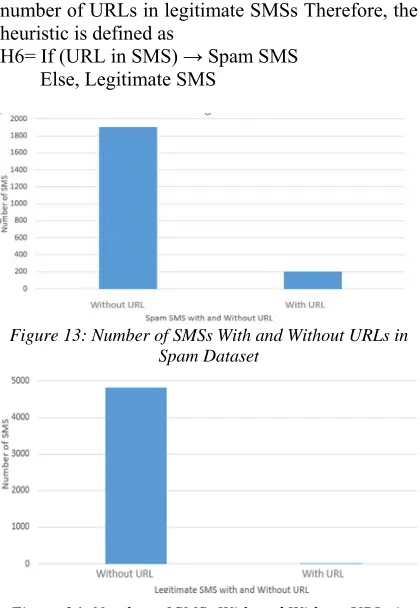
In the dataset, the existence of URL in SMS is examined. It was found that 9.5 % of spam SMS contained URL. And 0.04% of the legitimate SMS contained URL. Figure 13 shows the number of URLs in spam SMSs and figure 14 shows the number of URLs in legitimate SMSs Therefore, the heuristic is defined as
H6= If (URL in SMS) → Spam SMS Else, Legitimate SMS
[image:7.612.90.300.282.586.2]Figure 13: Number of SMSs With and Without URLs in Spam Dataset
Figure 14: Number of SMSs With and Without URLs in Legitimate Dataset
4.3 Training Phase
The dataset is divided into training and testing samples. The number of training samples is 4200 legitimate and spam SMSs. Which are used to generate the rules for classifying SMSs using Apriori association rule mining algorithm.
4.3.1 Apply apriori algorithm
The mechanism to classify SMS is generated using Apriori algorithm in which the different heuristics are used to convert SMS structural features to
binary to be used by the Apriori algorithm. The generated rules are used to check the SMS before it sent to the user’s mobile. Rules are extracted from the SMSs and collected over 4200 SMSs. Applying Apriori algorithm and rules generation were performed using WEKA 3.8 data mining tool which consists of different machine learning algorithms.
4.3.2 Rules generation
3969 subset that is not frequent. The test for infrequent subsets is shown in procedure has infrequent subset [23].
Figure 15: Apriori Algorithm [23]
Table 3 shows the rules generated for spam SMS and provide higher accuracy for classifying spam and legitimate SMSs achieved by using minimum support value 0.2 and minimum confidence 0.8. Figure 16 shows the number of rules generated for spam SMS training set with different minimum support and minimum confidence values.
Table 3: Generated Rules by Apriori Algorithm for Spam SMS
Rule No.
Rule Confidence
1 message-length >= 136, numeric-ratio> 0.01 ==>
class= spam
0.94
2 message-length>= 136, number-terms> 23, numeric-ratio> 0.01
==> class= spam
0.94
3 number-terms> 23, numeric-ratio> 0.01==> class=spam
0.91
4 non-alphanumeric> 0.04, numeric-ratio> 0.01==> class=spam
0.89
5 uppercase-ratio> 0.05 ==>
class=spam 0.86
6 numeric-ratio> 0.01==> class=spam
0.85
7 number-terms> 23,
non-alphanumeric> 0.04 ==> class=spam
0.83
Figure 16: Number of rules for spam SMS training dataset
4.4 Testing Phase
For Test Phase, 2727 legitimate and spam SMSs are used as test dataset. By applying the generated rules from training phase on test dataset. specificity, recall and accuracy are computed.
5. RESULTS
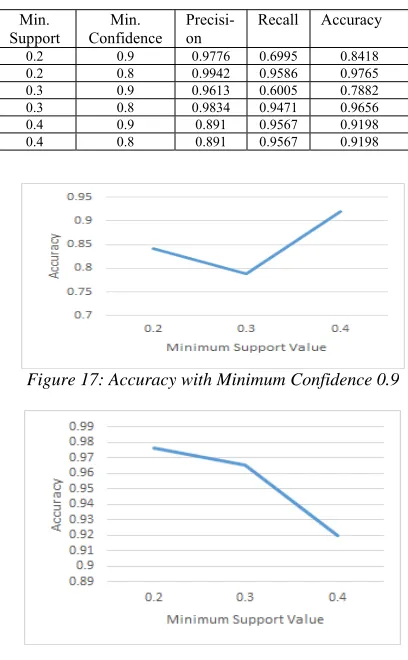
The algorithm generated different number of rules and the confusion matrix for different minimum support and minimum confidence is computed which is shown in table 4. Based on the test results, the true positives TP (number of spam SMS messages identified as spam), the false positives FP (number of legitimate SMS messages identified as spam), true negatives TN (number of legitimate SMS messages identifies as legitimate), and the false negatives FN (number of spam SMS messages identified as legitimate) are computed. Also different precision, recall and accuracy values using different valued for minimum support and minimum confidence are computed and the result is shown in table 5. The rules which were generated by Apriori algorithm with minimum support value 0.2 and minimum confidence value 0.8 achieved higher accuracy with 97.65% and they are selected to be used in the proposed system to classify spam and legitimate SMSs. the following metrics were deduced: precision, recall and accuracy in equations (3), (4), and (5) respectively. Figure 17 shows the accuracy values when the minimum confidence is 0.9. Figure 18 shows the accuracy values when the minimum confidence is 0.8.
ܲݎ݁ܿ݅ݏ݅݊ = (3)
ܴ݈݈݁ܿܽ = (4)
[image:8.612.100.295.134.418.2]3970
Table 4: The Confusion Matrix
Minimum Support
Minimum Confidence
FP FN TP TN
0.2 0.9 0.016 0.301 0.7 0.984
0.2 0.8 0.006 0.041 0.959 0.994
0.3 0.9 0.024 0.4 0.601 0.976
0.3 0.8 0.016 0.053 0.947 0.984
0.4 0.9 0.117 0.043 0.957 0.883
0.4 0.8 0.117 0.043 0.957 0.883
[image:9.612.88.292.233.563.2]Table 5: The Values of Precision, Recall and Accuracy
Figure 17: Accuracy with Minimum Confidence 0.9
Figure 18: Accuracy with Minimum Confidence 0.8
6. DISCUSSION
In order to demonstrate the effectiveness of the proposed system, the system result was compared with some of the previous work in this field. The results show that using just 6 structural features achieved good accuracy which is 97.65% using rules generated by Apriori association rule mining algorithm with minimum support 0.2 and minimum confidence 0.8. the importance of using just structural features was to reduce features extraction time compared to the use of bag of works
extracted from SMS messages. Most researchers used bag of words extracted from SMS messages such as in [3], [9], [11], [12], [15] and [17] achieved accuracy between 68% and 98% depends on the algorithm which they used. So according the results from the previous works compared to the work in this paper, the proposed system achieved good results with less number of features and less processing time for feature extraction process using Apriori association rule mining algorithm.
7. CONCLUSION
In this paper, a new system is proposed to detect and classify SMSs into to spam and legitimate using Apriori association rule algorithm which is used to discover the patterns among the SMS structural features. Two publicly available datasets are used. the proposed scheme is evaluated with different values for minimum support and minimum confidence which are used to generate the rules. The rules are tested on test dataset. the accuracy was computed. The rules which achieved higher accuracy where selected to be used on the proposed system. Higher accuracy 97.65% achieved using rules generated with minimum support 0.2 and minimum confidence 0.8 and less number of features. According to the results, this approach achieved good accuracy based on extracting only six structural features from the SMS instead of textural features which requires many preprocessing steps for tokens extraction in which require more time for feature extraction step to detect spam SMS. At this point and based on the results, structural features are considered enough to detect spam SMS messages with low false positive rate. For Future work other association rules algorithms will be used and compared with the results of Apriori algorithm since apriori algorithm is considered slow and requires many database scans. The proposed system as a future work will also be applied to detect spam messages sent through Instant Messaging applications (e.g., WhatsApp, Viber...etc.), because they have similar properties and different techniques and algorithms will be used.
REFRENCES:
[1] “Short Message Service Security”, The Government of the Hong Kong Special Administrative Region, 2008.
[2] A. K. Uysal, S. Gunal, S. Ergin, and E. Sora Gunal, “The Impact of Feature Extraction and Selection on SMS Spam Filtering”,
Min. Support
Min. Confidence
Precisi-on
Recall Accuracy
0.2 0.9 0.9776 0.6995 0.8418
0.2 0.8 0.9942 0.9586 0.9765
0.3 0.9 0.9613 0.6005 0.7882
0.3 0.8 0.9834 0.9471 0.9656
0.4 0.9 0.891 0.9567 0.9198
3971 ELEKTRONIKA IR ELEKTROTECHNIKA Vol. 19, No. 5, 3013.
[3] Mohamed El Boujnouni, “SMS Spam Filtering Using N-gram Method, Information Gain Metric and an Improved Version of SVDD Classifier”, Journal of Engineering Science
and Technology Review, Vol. 10, No. 1, 2017,
pp. 131- 137. [4]
https://blog.truecaller.com/2017/04/19/truecal ler-us-spam-report-2017/
Truecaller Insights Special Report: An Estimated 22.1M Americans Lost $9.5B in Phone Scams Last Year, 2017
[5] Gordon V. Cormack, José María Gómez, and Enrique Puertas Sánz, “Spam Filtering for Short Messages”, Proceedings of the sixteenth ACM conference on Conference on information and knowledge management Lisbon, Portugal, November 06 - 10, 2007, pp. 313-320.
[6] Iosif Androulidakis, Vasileios Vlachos, and Alexandros Papanikolaou, “FIMESS: FIltering Mobile External SMS Spam”, Proceedings of the 6th Balkan Conference in
Informatics, Thessaloniki, Greece, September
19 - 21, 2013, pp. 221-227.
[7] Tiago A. Almeida, José María Gómez, and Akebo Yamakami, “Contributions to the Study of SMS Spam Filtering: New Collection and Results”, Proceedings of the 11th ACM symposium on Document
engineering, Mountain View, California,
USA, September 19 - 22, 2011, pp. 259-262. [8] M. Taufiq Nuruzzaman, Changmoo Lee, and
Deokjai Choi, “Independent and Personal SMS Spam Filtering”, IEEE International Conference on Computer and Information
Technology, Pafos, Cyprus, 31 Aug.-2 Sept.
2011, pp. 429–435.
[9] Muhammad Zubair Rafique and Muhammad Abulaish, “Graph-Based Learning Model for Detection of SMS Spam on Smart Phones”, Wireless Communications and Mobile
Computing Conference (IWCMC),
L
imassol,Cyprus , Aug 27-31, 2012.
[10] Anchal and Abhilash Sharma, “SMS Spam Detection Scheme Using Custom Neural Network with ICA”, Global Journal of
Advanced Engineering Technologies, Vol. 3,
No. 3, 2014, pp. 269-273.
[11] Ishtiaq Ahmed, Donghai Guan, and Tae Choong Chung, “SMS Classification Based on Naïve Bayes Classifier and Apriori Algorithm Frequent Itemset”, International
Journal of Machine Learning and Computing,
Vol. 4, No. 2, 2014.
[12] Sin-Eon Kim, Jung-Tae Jo, and Sang-Hyun Choi, “SMS Spam Filtering Using Keyword Frequency Ratio”, International Journal of
Security and Its Applications, Vol. 9, No. 1,
2015, pp. 329-336.
[13] Kamahazira Zainal, and Mohd Zalisham Jali, “A Review of Feature Extraction Optimization in SMS Spam Messages Classification”, SCDS 2016, CCIS 652, 2016, pp. 158-170.
[14] Tiago A. Almeida, Tiago P. Silva, Igor Santos, and José M. Gómez Hidalgo, “Text Normalization and Semantic Indexing to Enhance Instant Messaging and SMS Spam Filtering”, Knowledge-Based Systems, 2016, 108: 25-32.
[15] Dima Suleimana, and Ghazi Al-Naymata, “SMS Spam Detection using H2O Framework”, the 8th International Conference
on Emerging Ubiquitous Systems and Pervasive Networks, Procedia Computer
Science 113, 2017, pp. 154–161.
[16] Naresh Kumar Nagwani , “ A Bi-Level Text Classification Approach for SMS Spam Filtering and Identifying Priority Messages “, The International Arab Journal of
Information Technology, Vol. 14, No. 4, July
2017.
[17] Neelam Choudhary, and Ankit Kumar Jain “Towards Filtering of SMS Spam Messages Using Machine Learning Based Technique”,
ICAICR 2017, CCIS 712, Springer Nature
Singapore Pte Ltd, 2017, pp. 18–30.
[18] L. Novak and M. Svensson, "MMS- Building on the success of SMS", Ericsson Rev, Vol. 78, No. 3, 2001, pp. 102-109.
[19] F. Hillebrand, F. Trosby, K. Holley and I. Harris, "Short Message Service (SMS), the Creation of Personal Global Text Messaging",
John Wiley and Sons Publication, 2010.
[20] Alaa Al Deen Mustafa Nofal, and Sulieman Bani-Ahmad, “Classification Based on Association-Rule Mining Techniques: A General Survey and Empirical Comparative Evaluation”, Ubiquitous Computing and
Communication Journal, Vol. 5, No. 3, 2011.
[21] Trupti A. Kumbhare, and Santosh V. Chobe “An Overview of Association Rule Mining Algorithms”, International Journal of Computer Science and Information
Technologies, Vol. 5, No. 1, 2014, pp.
3972 [22] Bing Liu, Yiming Ma, and Ching-Kian Wong,
“Classification Using Association Rules: Weaknesses and Enhancements”, Data Mining for Scientific and Engineering
Applications, Vol. 2, 2001 pp. 591-605.

![Figure 15: Apriori Algorithm [23]](https://thumb-us.123doks.com/thumbv2/123dok_us/8903258.955745/8.612.100.295.134.418/figure-apriori-algorithm.webp)