Full Length Research Article
ENERGY MANAGEMENT SYSTEM AND
DEVELOPMENTS IN SMART GRID
1*
Ganeshkumaran, S.,
2Dr. Singaravelu, S. and
3Vivekanandan, K.
1
Department of EEE, Arunai Engineering College, Affiliated to Anna University, Tamilnadu, India
2Department of EEE, Annamalai University Tamilnadu, India
3
Department of EEE, Arunai Engineering College, Affiliated to Anna University, Tamilnadu, India
ARTICLE INFO ABSTRACT
Energy Management System Decentralized architecture that uses regional energy management, Information technology (IT). It is computer aided used for control, monitor performance optimization in transmission system. The control and monitoring uses advance application like SCADA PMU etc. This paper deals with a brief review on EMS and its development in smart grid system.
Copyright © 2014 Ganeshkumaranet al. This is an open access article distributed under the Creative Commons Attribution License, which permits unrestricted use, distribution, and reproduction in any medium, provided the original work is properly cited.
INTRODUCTION
EMS supplies dispatch training simulator (DTS). EPRI is a non-EMS DTS also used for control and monitoring.EMS used often for control (Hochgraf et al., 2010) devices like HVAC and lighting system at different purposes like transmission system, commercial buildings, appliances management, metering, support for decision making on energy activities etc. EMS supplies dispatch training simulator (DTS). EPRI is a non-EMS DTS also used for control and monitoring (Bressan
et al., 2010). EMS used often for control devices like HVAC
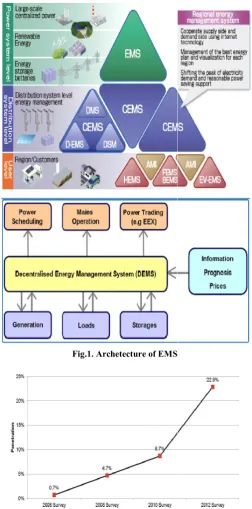
and lighting system at different purposes like transmission (O’Neill, 2007) system, commercial buildings, appliances management, metering, support for decision making on energy (Garrity, 2008) activities etc. Fig.1 shows the architecture of EMS and it decentralization.
Architecture of EMS
AMI: advance metering infrastructure
BEMS: building and energy management system
*Corresponding author: Ganeshkumaran, S.,
Department of EEE, Arunai Engineering College, Affiliated to Anna University, Tamilnadu, India
CEMS: community energy management system. D-EMS: distributed energy management system DMS: distribution management system. DSM: demand side management EMS: energy management system.
EV-EMS: electric vehicle energy management system FEMS: factory energy management system
HEMS: Home energy management system
Advance Metering Infrastructure (AMI)
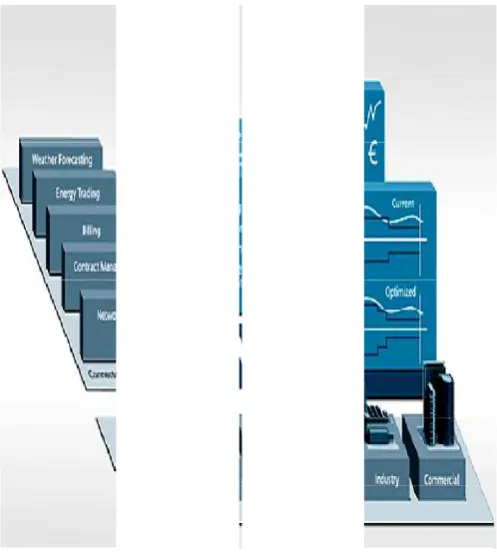
It is fundamental grid modern provides framework for meet out the modern principal characteristics to ensure intelligent connection with the consumers and operators. Fig-2 shows the AMI growth worldwide. AMI (Hart, 2008) has many technologies are
Communications (Gungor and Lambert, 2006)
infrastructure
Meter Data Management Systems (MDMS)
Home area networks (HANs)
Smart meters
Gateways
ISSN:
2230-9926
International Journal of Development Research
Vol. 4, Issue, 3, pp. 647-653, March,2014
International Journal of
DEVELOPMENT RESEARCH
Article History:
Received 08th January, 2014
Received in revised form 11th February, 2014
Accepted 15th February, 2014
Published online 14th March, 2014
s
Available online at http://www.journalijdr.com
Key words:
EMS, energy,
Management in smart gird, Control techniques, Developments,
Fig.1. Archetecture of EMS
Fig. 2. AMI and its growth world wide
Communications Infrastructure
Provides Bidirectional wide band width of communication with modern grid infrastructure (Leon et al., 2007)
interaction with the utility and the consumers .This provides a standard information and control with man
from Broadband over power lines (BPL), Power Line Carrier (PLC), wireless (Akyol et al., 2010) communication
al., 2010), internet, fiber optic etc.
Smart Meters (Katz, 2008)
These are more than a conventional energy meters called green meters which can provides information about the demand response lead to emission and reduction, facilitates greater energy efficiency performs additional information and
Fig. 2. AMI and its growth world wide
Provides Bidirectional wide band width of communication ., 2007) and a close interaction with the utility and the consumers .This provides a standard information and control with many feature aspects from Broadband over power lines (BPL), Power Line Carrier communication (Best et
These are more than a conventional energy meters called green meters which can provides information about the demand response lead to emission and reduction, facilitates greater energy efficiency performs additional information and
functions dynamic price, consumption
restoration, remote ON/OFF, demand response, prepay, power quality monitor intelligent communications etc.
Home Area Networks (HAN)
HAN with link meters interface wit
devices, energy management that consist of
awareness of energy usage, cost, preferences, utility limitations and controls. this implemented with the ways like consumer portal location, neighbor
Goodman, 2005) collector, stand alone utility an gateway.
Meter Data Management System
MDMS analytical tool with interactive enabled information with the operational gateways with these aspects that are outage management, consumer information, mobile work force management, enterprise
geographic information, load management. Despite of the disturbance these MDMS provides valid estimation and control.
Gateways
The operational gateways that deals with the following aspects
Advanced Distribution (Ganeshkumarn Operations (ADO)
ADO deals with the outage management, distribution management, volt/VAR control, FLISR with the different DERs available which enables the high speed operation, ensured protection (Anderson and Fuloria
with advance grid components by considering the
geographical view. Advanced Transmission Operations (ATO) (Ganeshkumarn et al., 2013
subsystem, high speed information modeling 2009), visualizing tools, operational applica
Advanced Asset Management (AAM) that
information of operational system, asset managing, work and resource managing transmission and distribution planning and maintenance with geographical data available.
Building Energy Management Systems
Transact energy and its impact on BEMS
Transact energy in SG is low voltage distribution grid enables the participation in market with DERs bidding generation of MW/ KW of powers. Convergence
policies, technologies denotes the transact energy active market with EVs, micro grid and other assets. Energy transactions will have critical role in grid mo
considerably consumes 40% of nations energy. The investment on crucial factors by the occupants reduces the energy use and self generation delivery. The vulnerability of sustained/momentary power outages increases with both the human and natural causes. The less productive, less occupant safety, grid related outages reduce the life style of the buildings and their occupants. Without considering the delivery of status of SGs the building are commands premium prices with the different occupants and tenants, it’s introduces a new variable. For
, consumption (Hochgraf et al., 2010) restoration, remote ON/OFF, demand response, prepay, power quality monitor intelligent communications etc.
(HAN)
HAN with link meters interface with controllable electric rgy management that consist of consumer awareness of energy usage, cost, preferences, utility limitations and controls. this implemented with the ways like consumer portal location, neighbor (McGranaghan and collector, stand alone utility and supplied
Meter Data Management System (MDMS)
MDMS analytical tool with interactive enabled information with the operational gateways with these aspects that are outage management, consumer information, mobile work force management, enterprise resource and its plan, geographic information, load management. Despite of the disturbance these MDMS provides valid estimation and
The operational gateways that deals with the following aspects
(Ganeshkumarn et al., 2013)
ADO deals with the outage management, distribution management, volt/VAR control, FLISR with the different DERs available which enables the high speed operation, Anderson and Fuloria, 2010) and control
advance grid components by considering the
Advanced Transmission Operations (ATO) ., 2013) that includes automated subsystem, high speed information modeling (Jiang et al., visualizing tools, operational applications, markets.
Advanced Asset Management (AAM) that includes
information of operational system, asset managing, work and resource managing transmission and distribution planning and maintenance with geographical data available.
Building Energy Management Systems (BEMS)
Transact energy and its impact on BEMS (Conti et al., 2010). Transact energy in SG is low voltage distribution grid enables the participation in market with DERs bidding generation of MW/ KW of powers. Convergence of financial drivers, policies, technologies denotes the transact energy active market with EVs, micro grid and other assets. Energy transactions will have critical role in grid modern, building are consumes 40% of nations energy. The ent on crucial factors by the occupants reduces the energy use and self generation delivery. The vulnerability of sustained/momentary power outages increases with both the human and natural causes. The less productive, less occupant tages reduce the life style of the buildings and their occupants. Without considering the delivery of status of SGs the building are commands premium prices with the different occupants and tenants, it’s just
more intelligent, self sufficient energy made buildings nowadays. These are self configured with the needs of commissioning through the data obtained from energy generation, consumption assets, activities of occupant, weather reports. Fig -3 shows the BEMS worldwide growth. BEMS has to be developed in following ways to accommodate the gap created technically. BEMS exchange data from building to building, not just building to grid. It has to be small buildings not only for large buildings. BEMs are
[image:3.595.40.289.180.445.2]scalable and communicative, user friendly.
Fig. 3. BEMS growth world wide
The impacts of policy related have a greater foot on utilities than the building owners and facilities managers. Apart from the Smart Grid Investment Grants (SGIG) regulated utilities are not interrupted much. The cost of real factors is not concentrated for the regulatory decisions nowadays. The reliability just based on regional based guidelines. (Automate Demand Response) micro grid generation, b – based energy storage for the assets of transaction base markets. The current markets are pushed downstream to retail or distribution grid level, expanded for ac
energy storage. Large-scale with decentralized market are participated by large funds as well as individual investors. Building strategies with transitive energy future in SG s plays major role.
Community Energy Management System (CEMS
Ecamion developed energy storage system base on lithium batteries called as community energy storage (CES). Developed first on sustainable development technology Canada (SDTC) its collaborative work is made with university of Toronto. CES unity is community tied centre connected with power grids. CEMS are having better performance, lower costs with high power systems. 98% efficient operating temperatures are -20°C up to 60°C. Its influence is increased with the conventional system and switch gears. Integrates seamless with utilities, maintains and operation
649 International Journal of Development Research,
[image:3.595.309.558.353.630.2], self sufficient energy made buildings nowadays. These are self configured with the needs of commissioning through the data obtained from energy generation, consumption assets, activities of occupant, weather wide growth. BEMS has to be developed in following ways to accommodate the gap created technically. BEMS exchange data from building to building, not just building to grid. It has to be small buildings Ms are to be affordable
Fig. 3. BEMS growth world wide
The impacts of policy related have a greater foot on utilities than the building owners and facilities managers. Apart from Grants (SGIG) regulated utilities are not interrupted much. The cost of real factors is not concentrated for the regulatory decisions nowadays. The reliability just based on regional based guidelines. ADR (Automate Demand Response) micro grid generation, building based energy storage for the assets of transaction base markets. The current markets are pushed downstream to retail or distribution grid level, expanded for accommodation of scale with decentralized market are by large funds as well as individual investors. Building strategies with transitive energy future in SG s plays
(CEMS)
Ecamion developed energy storage system base on lithium energy storage (CES). Developed first on sustainable development technology Canada (SDTC) its collaborative work is made with university CES unity is community tied centre connected with power grids. CEMS are having better performance, lower sts with high power systems. 98% efficient operating 20°C up to 60°C. Its influence is increased with the conventional system and switch gears. Integrates seamless with utilities, maintains and operation
Cems and its Advantages
Improved designs and patent pending module, design and cooling. Grid support up to 150 homes. Flexible up to 250KWh, Smart battery management systems (BMS). Integration and co-ordination, automation
al., 2013) and control is obtained with the Intelligent based
controls.
Distributed Energy Management System
DEMS uses the advantage using multi
profitable operation in SG with energy market. Based on competitive price prediction and risk, profitable bidding is double auction bidding used on trading strategy. The auction manages the use of DER receives bids from buyers asked from the sellers. Artificial immune base algorithm
et al., 2010) applied on case studies by assuming real market
prices with power and distributed genera
costs. Economically and profitably the results of DEMS are improved. Virtual power plants are increases in
energy management system. DEMS are having two features graphic tool for data, run time system with user interface, us friendly. System uses minute reserves, Regulates the energy market. Fig-4 shows the DEMS architecture.
Fig. 4. DEMS overview
The growing distributed and renewable energy resources and its integration. The virtual power plants are
grids. DEMS tools should gives advance models with ease in parameters and handling. The graphic tool for engineering data is the additional tool it works with the models developed from the energy topologies. Software catalogue, users sho the pre defined models and data. Then user position them with connecting elements matches with material and energy flows. A check is required based on working and experience than the previous management system with the errors, entry missing and security. New software is implemented on distribution International Journal of Development Research, Vol. 4, Issue, 3, pp. 647-653, March,2014
patent pending module, design and cooling. Grid support up to 150 homes. Flexible up to 250KWh, Smart battery management systems (BMS). ordination, automation (Ganeshkumarn et and control is obtained with the Intelligent based
Distributed Energy Management System (DEMS)
DEMS uses the advantage using multi-agent system for profitable operation in SG with energy market. Based on competitive price prediction and risk, profitable bidding is on trading strategy. The auction manages the use of DER receives bids from buyers asked from the sellers. Artificial immune base algorithm (Mohsenian-Rad applied on case studies by assuming real market prices with power and distributed generators bids, operational Economically and profitably the results of DEMS are power plants are increases in DEMS for energy management system. DEMS are having two features graphic tool for data, run time system with user interface, user friendly. System uses minute reserves, Regulates the energy
4 shows the DEMS architecture.
Fig. 4. DEMS overview
growing distributed and renewable energy resources and its integration. The virtual power plants are important on smart tools should gives advance models with ease in parameters and handling. The graphic tool for engineering data is the additional tool it works with the models developed from the energy topologies. Software catalogue, users should use the pre defined models and data. Then user position them with connecting elements matches with material and energy flows. A check is required based on working and experience than the previous management system with the errors, entry missing urity. New software is implemented on distribution
controls and transfers the control parameters in time sequentially. DEMS systems time and its effort will reduce the power plant cost by 60% when compared to the previous ones.IEC 60870-5-104 standards and it’s to be followed by the load/storage systems, this is communicated by DEMS except for the control of virtual power plants and its development. DEMS decentralized management also used with aggregators. The system would improve their greater market potential by using the renewable energy resources. DMES and its energy portfolio will give the possibility for the operators of micro grid with effective network operation eco friendly solutions for setting the intelligent power supply networks in smart grids. Carbon emission reductions are ensured in comparison with the recent trends.
Distribution Management System (DMS)
The DMS is tool for management of distribution (Barmada et
al., 2011) network provides the acquisition of data of different
points and provides associated control through load flow programs for the benefit of utilities and improves Grid investments.
The Network Model
DMS maintains Including all the aspects of distribution network and associated control device necessary models are created with the load demand points for quality of supply.
The Dynamic Data
The SCADA and OMS (Outage Management System) control and its telemeters data will provide control for the load flow program and its functions in advance DMS system. Quick access and control through reliable data, storage, history of data are the ease of control for DMS.
The Unbalanced Load Flow Algorithm
The advance DMS will works on fast load flow algorithm with the telemeter data from different field, the associative tool for handling data, state estimation (Bobba et al., 2010), economic dispatch through analyzing geographic view. The advance functionality of DMS has the following operating areas and constraints.
Operations Planning and Analysis, Loss Minimization
Real-time analysis of data and optimizing the network power and reducing the losses/energy wastage through detailed knowledge.
Supporting Outage Management Activities
Advance DMS will provide strong functionality on fault (D´an and H. Sandberg, 2010; Cho et al., 2010; Chertkov et al., 2011) location, identification and service restoration (FLSIR), enables the analytical support with reliable data it maintains the automated switching states for outage management and island restoration.
Volt/Var Control
Power quality stability and reliability consumer attractive plans are advance with advance DMS, volt/VAR control is
also an important aspect. Volt/VAR control and geographical view on voltage profile are helps to control and maintain the voltage profile. Additional functions, capital costs and times are required for strengthening network.
Demand Response
It’s a main function in DMS for control and maintenance of demand and awareness on both utilities and consumer side with many optional programs and software. There are many options for consumer and their impact are shown below DSDR (distribution system demand response) to maintain the volt/VAR control with demand response in time. Voltage reduction depends on the awareness of consumers with their loads and its demands. Instead of considering system under wide basis feeder/feeder segments are considered for managements. Dynamic DR and its lack of impact on utilities is the main reason for advance DMS implements.
Distributed Generation
Different DERS and their maintenance would require advance DMS. It provides topology reliability in case of dynamic demands on distribution network Islanding operation is safer in distribution network. DMS manage network optimizing losses, reliability, or cost of operation and new operating approaches. Advance DMS will provide budgeting and planning reliability and maintenance of quality of service. Demand forecast is the ultimate aim of DMS (long term/short-term
Direct Load Control
Direct load controls are increased with its capabilities and control for many applications these uses radio controlled devices located on each points. Customer impacts are reduced by these direct load control by rotational power cuts. Different optional programs and it choices lead the utilities to select according to their requirement affordability. HAN continuous contribution and revolution on it is made by these direct load controlled DMS. These DMS will have direct load control with associated feeders segments with integrated control.
Interruptions
Some demand response fails/disconnects this made interrupts and its priorities. Interruption rates are supported by the regulators utilities have optional programs on such conditions. Depending upon the health of the distribution network, its danger utilities has to exercise interruptions. Priority dispatch, decision making is unavoidable in some situations.
Demand Side Management (DSM)
DSM Features
DSM described under four major sectors like bulk transmission, generation, transmission and distribution.
Generation Capacity, Plant Utilization and Efficiency
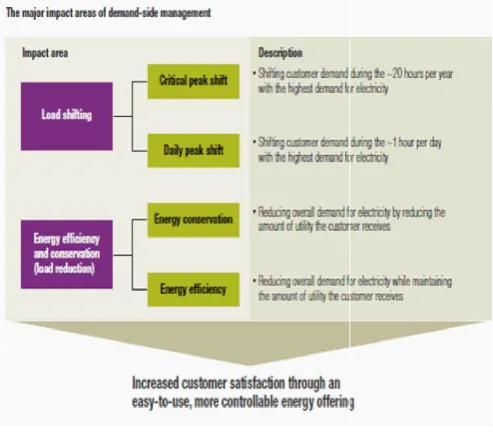
makes the DSM energy efficient and increases the generation efficiency. Significant utilization makes low marginal cost of the plant about 85% load factor. So highest fuel cost plants will operates for fewer hours. So shifting of load from peak to off-peak load easier and will reduces the fuel costs and improves the investments. Fig-5 shows the DSM and its energy efficient load shifting.
Fig. 5. DSM and load shift
Utilization of Transmission and Distribution Networks
Historical overview of demands, philosophy of large generation systems will supports large scale generation without any outages due to faults (Cai et al., 2010)
the loading of interconnected system always below 50%.The cost of obstruct and with generation are managed by the respective investments in network capacity.
DSM active management techniques to be developed with the operation of distribution networks with integrated generation. The problem on real time control is resolved at planning stage itself. These will increase the utility of the network
Key features of demand
Demand is uncontrollable time variable, summer nights its minimum and 30% during winter. Diversity is one of the key features which have an impact on system design and operation. Only 10% of capacity itself enough to feed individual household is self sufficient. Distribution networks achieve the benefit of load diversity though no material gain is obtained on Supply system when households increase. Demand and coincide factors depends on number of households. The coincide factor is the ratio between maximum coincident total demand and sum of maximum demands of individual consumers. In Distribution side demand and balancing is significantly inefficient.
Load diversity and DSM
For undesirable effects natural diversity of loads is disturbed by the DSM techniques. Load control, devices requires usually the easy reschedule operation when interruptions with the use of storages. The storage usually the form of thermal chemical or mechanical energy. DSM will not reduce the energy consumed by the devices. Load reduction is preceded by load 651 International Journal of Development Research,
and increases the generation efficiency. Significant utilization makes low marginal cost of the plant about 85% load factor. So highest fuel cost plants will operates for fewer hours. So shifting of load from peak to he fuel costs and 5 shows the DSM and its
nd Distribution Networks
overview of demands, philosophy of large supports large scale generation ., 2010) and ensures the loading of interconnected system always below 50%.The cost of obstruct and with generation are managed by the apacity. To associate the to be developed with the th integrated generation. problem on real time control is resolved at planning stage itself. These will increase the utility of the network assets.
Demand is uncontrollable time variable, summer nights its minimum and 30% during winter. Diversity is one of the key features which have an impact on system design and operation. Only 10% of capacity itself enough to feed if each individual household is self sufficient. Distribution networks achieve the benefit of load diversity though no material gain is obtained on Supply system when households increase. Demand and coincide factors depends on number of ncide factor is the ratio between maximum coincident total demand and sum of maximum demands of individual consumers. In Distribution side demand and
For undesirable effects natural diversity of loads is disturbed by the DSM techniques. Load control, devices requires usually the easy reschedule operation when interruptions with the use of storages. The storage usually the form of thermal chemical hanical energy. DSM will not reduce the energy consumed by the devices. Load reduction is preceded by load
recovery. Duration of outages and load recovery the storage sometimes the losses
The load reduction and recovery process to be managed rather than direct Control of appliances and the key factor is diversity factor. The load diversity reduction will increase the load recovery period. Rather than controlling if load is witched off makes the system inefficient. D
to maximize the efficiency and control of load with its competitiveness is one of the challenge.
Drivers for DSM
The key features of using DSM are efficiency, investment on generation and the transport of electricity Market a deregulation of electricity in industry helps in decision making and used in future development of the system.
the choice and support for the consumers. It disables the cross subsidies among consumers. Development in information communication (ICT), climate change challenge are accelerated by DSMDG Distributed generation and CHP combined heat power are concentrated to improve system efficiency and reduce carbon emissions, Demand management mainly depends on reserves to meet peak load in ti Management tool has risks to meet the fluctuating prices and floating load, DSM ensures cross subsidies are avoided.ICT are playing major role in DSM nowadays.
is improves depends on its utility and investment on future. Benefits of DSM and future opportunities
applications of DSM and its value and competitiveness Margin reduction of DSM. For ensuring the security of supply the total capacity of installed generation must be larger than the systems maximum demand. Current elec
not deals with the statutory security standards with 24% margin.
Long term reserves on DSM ensures this knowledge on frequency, magnitude
its potential shortfall. Size of shortfall depends on the frequency of interruptions. In case of Infrequent interruptions the DSM depends on the cost of alternative provisions this has it own difficulties and it has an direct impact on the cost of generation, delays in planning process and lack in power building process. Even though other renewable energies may contribute with conventional ones but not to that much extent so the supply ensure should be meet out by the required stand by ones to make the DSM effective. PMUs with time stamped measures parameters are sustained at high sampling rates. Improving transmission grid investment, efficiency with DSM .Power system security is to tackle the outages immediately through dispatching of generating un
an 24hrs, 365days of complete
within the cost limits. Outages due to over loads, faults are effectively eliminated with corrective actions. Some loads curtailed at appropriate locations, ICT usage
with change in operating philosophy. By customers are in the acceptable range loads in time in emergency conditions, an made on DSM since the value of it depends and preventive, operational costs.
Improvement of Distribution Network Investment Efficiency through DSM
Potential benefits in terms of new investment, distributed generation and its increase, power problems, outage International Journal of Development Research, Vol. 4, Issue, 3, pp. 647-653, March,2014
on of outages and load recovery depends on he storage sometimes the losses will make this less effective. overy process to be managed rather than direct Control of appliances and the key factor is diversity factor. The load diversity reduction will increase the load controlling if load is witched off DSM is designed in such a way to maximize the efficiency and control of load with its competitiveness is one of the challenge.
The key features of using DSM are efficiency, investment on generation and the transport of electricity Market and deregulation of electricity in industry helps in decision making and used in future development of the system. DSM will gives the choice and support for the consumers. It disables the cross subsidies among consumers. Development in information tion (ICT), climate change challenge are accelerated by DSMDG Distributed generation and CHP combined heat power are concentrated to improve system efficiency and reduce carbon emissions, Demand management mainly depends on reserves to meet peak load in time. Management tool has risks to meet the fluctuating prices and floating load, DSM ensures cross subsidies are avoided.ICT are playing major role in DSM nowadays. The scope of DSM is improves depends on its utility and investment on future. M and future opportunities Potential d its value and competitiveness. reduction of DSM. For ensuring the security of supply the total capacity of installed generation must be larger than the systems maximum demand. Current electricity markets are not deals with the statutory security standards with 24%
ng term reserves on DSM ensures outage free service for owledge on frequency, magnitude and its duration with its potential shortfall. Size of shortfall depends on the frequency of interruptions. In case of Infrequent interruptions the DSM depends on the cost of alternative provisions this has it own difficulties and it has an direct impact on the cost of generation, delays in planning process and lack in power Even though other renewable energies may contribute with conventional ones but not to that much extent so the supply ensure should be meet out by the required stand the DSM effective. PMUs with time stamped measures parameters are sustained at high sampling rates. Improving transmission grid investment, efficiency with DSM .Power system security is to tackle the outages immediately through dispatching of generating units, so the system ensures 365days of complete maintenance of power quality within the cost limits. Outages due to over loads, faults are d with corrective actions. Some loads are curtailed at appropriate locations, ICT usage gives more future
nge in operating philosophy. By assuming some ers are in the acceptable range to curtail or postpone loads in time in emergency conditions, an initial studies are since the value of it depends on conventional , operational costs.
Improvement of Distribution Network Investment
Potential benefits in terms of new investment, distributed generation and its increase, power problems, outage
management, enhance security, reducing carbon emissions etc. Increasing load conditions it’s impossible to replace the transformers with large capacity in such a case there is an way ice cooling for the transformers, facilities aimed at increase in short term capacity rating at peak conditions.DSM reduces the peak flow through transformers and its cables and increases the distributed generation network. The knowledge of DSM should be more to increase the power handling capacity efficiently.
DSM in managing demand–supply balance in a system with intermittent renewable, Renewable energy resources are increased nowadays which has less CO2 emissions. The on and OFF shore wind power is available in large scale which is dominant to be in 2020.To maintain the ability of the system with a balance between demand and supply system requires flexibility, variability and non controllability of sources. In wind powers system for uncertainty reserves to be increased this relates to combined synchronized and standing reserves. To provide reserves for synchronized units it must run at part loaded and efficiency loss between 10% and 20%If part loaded is supplied by reserves then originally allocated unit for balance will run at reduced output. With the synchronized reserving plants for balancing task is provided by the standing reserves like OCGTS, with increase in fuel costs or new techniques like DSM, storage facilities used. DSM implementation would improves the performance of system and increases the wind power amount with the scheduled units relevant to high wind conditions at low demand and hence reduces the fuel burnt. By considering the dynamic behaviors of system with its ability to frequent turn ON/OFF and run at low levels. Inflexible power plants cannot be turned ON/OFF frequently. So segment of generation are made as partly flexible With some limitation.
Electric Vehicle Energy Management System (EH-EVMS)
Implementations of Electric Vehicles (Corripio et al., 2006; Armenia and Chow, 2010). For Load Management In SG, Difference Between Load And EVs. EVS are emerging techniques in SM. It depends on improvement of light EVS response to the energy consumption and delivered especially at peak load. It improves the capacity of electric utility helps in managing load by scheduled charging outside peak hours. This improves the capacity and power handling capability of SGs at peak load. EVS has it own barriers to commercialization, in distance limitations and overall cost, use of EVS considerably increased for decades now.EVS growth as long term by International Energy Agency (IEA) so for is 1million, 1.6million in 2020 and it will be 31 million in 2035. In 2035 the contribution of 31million is said to be merely 0.1% of the total projected electricity consumption. However the increase of EVS has its impact with its own barrier cost of its reduced, government support required. Battery EVs (BEVs) and plug-in hybrid EVs (PHEVs) has influence over traditional fuel based vehicles but with need of electricity for charging is reduced. The Energy Technology Perspectives (ETP) given that CO2 emission will be is reduced about 50% by 2050. IF demand is 1%, peak load increase is 4%, 2/3 of all EVS charging time is 4 hours in evening, then system load factor is 0.5 for both EV demand and total Demand during charging. EVS effect depends on the batteries and replacement of batteries in time especially in night time will be helpful for low tariffs.
Optimized Charging
In SGs Daily load curve is flattened by the use of EVS reduces needs and investments.CO2 emissions reduced, enables two way flow of power and information with scheduled charging with less tariffs. Profit obtained during Peak time while reversal of power to grid. Sophisticated protocol controls with advance meters will make the scheduled charging especially at off-peak loads. This will be the most effective debit management cost effective
EVS at Peak Load
In long term The E2Vs and V2Gs in SGs feeds or consumes energy effectively will reduces the cost and regulates the power at peak loads by enabling peak sharing. EV batteries helpful in sudden surges, interrupts in load unless the need of V2G power transfer even at the peaky hours. The total capacity depends on number of EVS and the capacity of batteries. Usually BEVS have more capacity than PHEVS.
Factory Energy Management System (FEMS)
FEMS (Armenia and Chow, 2010; Huang, 2006) manages and controls energy in both the directions on manufacturing side which utilizes distributed cogeneration with renewable energies increases the benefit. It uses ICT and different sensing technologies which facilitates labour saving, improved
productivity through reliable information, ease of
understanding information, waste management etc. It provides balance between lower operating cost and stable operation. These are enhanced by solar power systems and energy storage systems, integrated management and power production systems through ITC and advance sensing devices.
Home Energy Management System (HEMS)
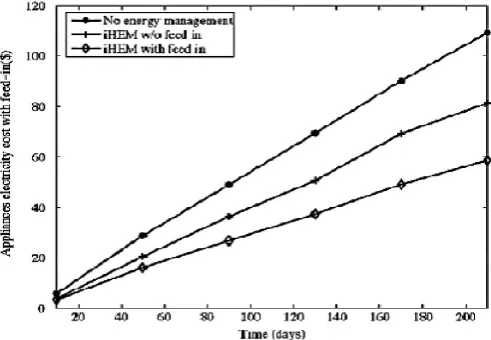
[image:6.595.311.557.588.758.2]Home energy management (Armenia and Chow, 2010; Erol-Kantarci and Mouftah, 2010; Huang, 2006) system are related to home development for creating smart home which utilizes optimum power and smart control. It provides a range of community based services with many techniques like cloud computing etc which creates a balance between reduced CO2 emissions and Fig-6 shows the HEMS applications and efficiency.
Quality Of Life (QOL)
An environment friendly life
It creates energy visualization for save, control and optimizes energy.
Convenient and comfort
Easily control home appliances through remote control, mobile phones gives ease way of control at any distance. Turn off lights inadequate, Air conditioners before arriving home.
Safe and secure
HEMS provides electric lock when away from home, check visitors with intercom integration, warnings gives safe and secure home.
Enriching enjoyable
Home cloud enables entertainment and health care, education programs. Different community increases new way on life.
REFERENCE
Ganeshkumarn, S., S. Singaravelu and K. Vivekanandan. ”Advance techniques, challenges and developments in smart grid system”, International journal of engineering and
advance technology, vol: 3, Issue: 1, oct-2013.
Ganeshkumarn, S., S. Singaravelu and K. Vivekanandan.
“Advance distribution automation systems and its
development in smart grid”, International journal of scientific
and technical research, vol:4, issue:3, oct-2013.
Jiang, Z. and H. Rahimi-Eichi, “Design, modeling and simulation of a green building energy system,” presented at the 2009 IEEE Power Energy Soc. Gen. Meet., Calgary, AB, Canada, PESGM2009-000636.
Katz, J. S. “Educating the smart grid,” presented at the IEEE Energy2030 Conf., Atlanta, GA, Nov. 17–18, 2008.
O’Neill, R. “Smart grids sound transmission investments,” IEEE
Power Energy Mag., vol. 5, no. 5, pp. 104–102, Sep.–Oct.
2007.
Huang, Y. J. “The impact of climate change on the energy use of the US residential and commercial building sector,” Lawrence Berkeley Nat. Lab.. Berkeley, CA, 2006.
Conti, J. J., P. D. Holtberg, J. A. Beamon, A. M. Schaal, G. E. Sweetnam, and A. S. Kydes, Annual energy outlook with projections to 2035, report of U.S. Energy Information Administration (EIA), Apr. 2010 [Online]. Available: http://www.eia.doe.gov
Garrity, T. F. “Getting smart,” IEEE Power Energy Mag., vol. 6, no. 2, pp. 38–45, Apr.–Mar. 2008.
Mohsenian-Rad, A.-H., V. W. S. Wong, J. Jatskevich, and R. Schober, “Optimal and autonomous incentive-based energy consumption scheduling algorithm for smart grid,” presented at the IEEE PES Innov. Smart Grid Technol. Conf., Gaithersburg, MD, Jan. 2010.
Erol-Kantarci, M. and H. T. Mouftah, “Using wireless sensor networks for energy-aware homes in smart grids,” in Proc.
IEEE Symp. Comput. Commun. (ISCC), Jun. 2010, pp. 456–
458.
Bobba, R. B., K. M. Rogers, Q. Wang, H. Khurana, K. Nahrstedt, and T. J. Overbye, “Detecting false data injection attacks on DC state estimation,” the First Workshop on Secure Control Systems10, 2010, pages 1–9.
Hart, D. G. ”Using AMI to realize the smart grid. IEEE Power and Energy Society General Meeting 2008, “Conversion and Delivery of Electrical Energy in the 21st Century, 2008, pages 1–2.
Leon, R., V. Vittal, and G. Manimaran,” Application of sensor network for secure electric energy infrastructure,” IEEE
Trans. Power Del., 2007 22(2):1021–1028.
Bressan, N., L. Bazzaco, N. Bui, P. Casari, L. Vangelista, and M. Zorzi, “The deployment of a smart monitoring system using
wireless sensors and actuators networks,” IEEE
SmartGridComm’10, 2010, pages 49–54.
Armenia, A. and J. H. Chow, “A flexible phasor data concentrator design leveraging existing software technologies,” IEEE
Trans. Smart Grid, 2010, 1(1):73–81.
Best, R. J., D. J. Morrow, D. M. Laverty, and P. A Crossley,” Synchro phasor broadcast over Internet protocol for distributed generator synchronization,” IEEE Trans. Power
Del, 2010, 25(4):2835–2841.
Barmada, S., A. Musolino, M. Raugi, R. Rizzo, and M. Tucci,” A wavelet based method for the analysis of impulsive noise due to switch commutations in power line communication (PLC) systems’, IEEE Trans. Smart Grid, 2011, 2(1):92–101. Corripio, F. J. C., J. A. C. Arrabal, L. D. del R´ıo, and J. T. E.
Munoz. “Analysis of the cyclic short-term variation of indoor power line channels,” IEEE J. Sel. Areas Commun, 2006, 24(7):1327–1338.
Gungor, V. C. and F. C. Lambert,” A survey on communication networks for electric system automation, “Computer
Networks, 2006, 50(7):877–897.
McGranaghan, M. and F. Goodman, “Technical and system
requirements for advanced distribution automation”, 18th
International Conference and Exhibition on Electricity Distribution, 2005, pages 1–5.
Hochgraf, C., R. Tripathi, and S. Herzberg, “Smart grid charger for electric vehicles using existing cellular networks and sms text messages,” IEEE Smart Grid Comm’10, 2010, pages 167–172.
Akyol, B., H. Kirkham, S. Clements, and M. Hadley,” A survey of wireless communications for the electric power system,” Prepared for the U.S. Department of Energy, 2010.
Britz, D. M. and R. R. Miller, ”Mesh free space optical systems: A method to improve broadband neighborhood area network backhaul,” Local & Metropolitan Area Networks, 2007.
LANMAN 2007, 15th IEEE Workshop on, June 2007 37 - 42.
Anderson, R. and S. Fuloria, ”Who controls the off switch?,”
IEEE SmartGridComm’10, 2010, pages 96–101.
Cho, H. S., T. Yamazaki, and M. Hahn, “Aero: Extraction of user’s activities from electric power consumption data,” IEEE Trans. Consum. Electron., 2010, 56(3):2011–2018.
D´an, G. and H. Sandberg, “Stealth attacks and protection schemes for state estimators in power systems,” IEEE
SmartGridComm’10, 2010, pages 214–219.
Chertkov, M., F. Pan, and M. G. Stepanov, “Predicting failures in power grids: The case of static overloads,” IEEE Trans. Smart
Grid, 20112(1):162– 172.
Cai, Y., M.-Y. Chow, W. Lu, and L. Li, “Statistical feature selection from massive data in distribution fault diagnosis,” IEEE Trans. Power Syst., 2010, 25(2):642–648.