ORIGINAL RESEARCH ARTICLE
EVALUATION OF KNOWLEDGE OF NURSES REGARDING COMPLICATIONS RELATED TO
MECHANICAL VENTILATION
*
1Yara de Oliveira Sampaio,
2Natasha Marques Frota,
3Rayane de Sousa Batista,
4Rafael Melo Lopes,
5Jaqueline Diógenes da Silva,
5Joanna Darlen de Sousa Pereira,
5
Synara de Fátima Bezerra de Lima,
6Francisco Germano Ferreira da Silva,
7Felipe Silva Santos,
8Elis
Regina Bastos Alves,
9Laércia Ferreira Martins,
10Francisco Lailson de Oliveira,
10Thereza Emanuelle Alves de Oliveira,
10Rafaella Alice da Rocha and
10
Maria Jociele Rodrigues Santana
1Nurse, Specialist in Urgency and Emergency the State University of Ceará (UECE), Professor from the faculty Atheneum,
Fortaleza, (CE), Brazil
2Nurse, PhD in Nursing from the Federal University of Ceará (UFC), Professor from the University of International
Integration of Afro-Brazilian Lusophony (UNILAB), Fortaleza, (CE), Brazil
3Nurse, Post-Graduation in Intensive Care Unit from the University of Quixeramobim(UNIQ), Fortaleza, (CE), Brazil 4Nurse, Specialist in Family Health at the Faculdade Terra Nordeste (FATENE), Professor from the faculty Atheneum,
Fortaleza, (CE), Brazil
5Graduating in Nursing at Fortaleza Metropolitan Faculty (FAMETRO), Fortaleza, (CE), Brazil 6Graduating in Nursing at Estácio do Ceará University Center (ESTÁCIO), Fortaleza, (CE), Brazil
7Nurse at Estácio do Ceará University Center (ESTÁCIO), Fortaleza, (CE), Brazil
8Nurse, Specialist in Urgency and Emergency the Estácio do Ceará University Center (ESTÁCIO), Fortaleza, (CE), Brazil 9Nurse, Master in Nursing from the State University of Ceará (UECE), Fortaleza, (CE), Brazil
10Graduating in Nursing at faculty Atheneum, Fortaleza, (CE), Brazil
ARTICLE INFO ABSTRACT
The aim of this study was to evaluate nurses' knowledge about complications related to mechanical ventilation. It is a descriptive, exploratory and quantitative approach, elaborated from the data collection structured by a questionnaire with nurses of a tertiary-level hospital in the city of Fortaleza / Ce, from February to July 2017. The results were submitted to simple regressive statistics using the Statistical Package for Social Sciences (SPSS) 20.0. Of the nurses interviewed, 86.36% reported not having enough information to care for a patient under mechanical ventilation during graduation, and 77.52% of the respondents claimed that they would not know the complications related to mechanical ventilation. It is concluded that nurses need to be trained and trained about ventilation-related complications, so that these professionals effectively participate in the construction of their evidence-based practice process, propagating a safe and holistic care to the patient.
Copyright © 2018,Yara de Oliveira Sampaio et al. This is an open access article distributed under the Creative Commons Attribution License, which permits
unrestricted use, distribution, and reproduction in any medium, provided the original work is properly cited.
INTRODUCTION
Mechanical ventilation (MV) consists of the use of a machine that intermittently inflates airways with air volumes, totally or
*Corresponding author:Yara de Oliveira Sampaio,
Nurse, Specialist in Urgency and Emergency the State University of Ceará (UECE), Professor from the faculty Atheneum, Fortaleza, (CE), Brazil.
partially replacing ventilatory activity, playing the role of physiological mechanisms, restoring balance between supply and demand of oxygen and reducing the respiratory workload
(Guimarães et al., 2012). According to the Brazilian
Guidelines for Mechanical Ventilation, VM is classified into two groups: invasive mechanical ventilation and non-invasive mechanical ventilation. In both, artificial ventilation is possible with the application of positive pressure in the airways,
ISSN: 2230-9926
International Journal of Development Research
Vol. 08, Issue, 05, pp.20555-20559, May, 2018
Article History:
Received 18th February, 2018 Received in revised form 21st March, 2018 Accepted 17th April, 2018 Published online 31st May, 2018
Key Words:
Artificial Breathing, Respiratory Insufficiency, Nursing care, Health promotion.
Citation: Yara de Oliveira Sampaio, Natasha Marques Frota, Rayane de Sousa Batista et al., 2018. “Evaluation of knowledge of nurses regarding
complications related to mechanical ventilation”, International Journal of Development Research, 8, (05), 20555-20559.
differing only in the form of pressure release (Barbas et al.,
2014).The aim of MV is to allow ventilatory support in order to optimize some physiological and clinical aspects of the patient, such as sustaining pulmonary gas exchange, normalizing alveolar ventilation, obtaining an acceptable level of arterial oxygenation, reversing hypoxemia, treating respiratory acidosis, preventing and treat atelectasis, revert fatigue of respiratory muscles, prevent sedation or neuromuscular block, decrease systemic and myocardial consumption, reduce intracranial pressure, and stabilize the chest wall (Cintra, 2008). Because it involves many variables, the VM becomes complex and thus requires that the professionals who are involved in its manipulation have the competence and ability to provide a safe assistance (Rodrigues
et al., 2012). The presence of a critical patient in the use of the
MV is part of the daily routine of a hospital, however, it is noticed that, in clinical practice, many professionals present a deficit of knowledge and experience in the management of this
clientele (Guimarães et al., 2012). According to Mendes, Tallo
and Guimarães (2012), once the MV triggers a series of interventions inherent to the treatment, from the moment of orotracheal intubation to extubation or eventual tracheostomy. At each stage, complications can occur due to the direct effect of the MV itself, due to necessary and unavoidable procedures, such as the insertion of airway prostheses, the use of sedatives, the use of probes and enteral nutrition.
In this context, Amorim and Gomes (2012) emphasize that the effective training of nurses for the systematization of nursing care in the different moments of the MV is of paramount importance since the installation, handling, actions to control infection, care with equipment and in the prevention and control of complications. Patients receiving prolonged ventilatory support are exposed to a variety of complications such as pneumothorax, atelectasis, barotrauma, increased intracranial compression, abdominal distension, sodium and water retention, pressure injury, arrhythmia, hypotension and pneumonia, be avoided with interpersonal, technical and
scientific competence (Tallo et al., 2013). Lack of knowledge
of the identification of complications during treatment with MV may lead to adverse events. The presence of competent professionals will contribute to the reduction of these patients'
intercurrences in the intensive care setting (Rodrigues et al.,
2012). The handling of the MV requires knowledge of the functioning of the equipment, its particularities and the various modalities of ventilatory support. With a better understanding of respiratory physiology, pathophysiology of pulmonary diseases and mechanical ventilators, it is possible to develop ventilatory support strategies that, in addition to reducing complications and even mortality, triggered by ventilator and oxygen toxicity (Camelo, 2012). The risks generated by the artificial ventilatory support are many, the chances of irreversible damages linked to VM are even greater, the damages caused by failure in risk management in order to prevent injuries can be irreparable. The knowledge, which is fundamental for the nursing team, should be appreciated when
assisting a patient who requires MV care (Melo et al., 2014).
Thus, it is necessary the presence of a multiprofessional team, especially the nursing team because it is at the bedside, able to provide the necessary care in a holistic way to these users. Therefore, when we come across clinical practice, the lack of technical and scientific knowledge of nurses in relation to ventilatory support is notorious, both regarding the handling and assembly of this equipment and the care given to patients using MV. Faced with this reality, it is necessary to critically
reflect on the lack of technical and scientific knowledge of nurses in the perception of these iatrogens, since if not analyzed previously can lead to irreparable damage in the lives of these users, devaluing the trinomio ser-saber- nurses, and the quality of the care provided to the subject. Therefore, this study is relevant for discussion and reflection on the need for nurses' empowerment in the care provided to patients using ventilatory support, in order to prevent each risk resulting from the use of MV, in order to achieve effective results in the care and in promoting the health of these patients. The present study aims to evaluate the knowledge of nurses regarding complications related to mechanical ventilation.
MATERIALS AND METHODS
It is a descriptive, exploratory and quantitative approach. The study was carried out in a tertiary-level hospital in the city of Fortaleza-Ce, developed by the members of the Clinical Research Nucleus from February to July 2017. The study population consisted of all the nurses that make up the team of the referred institution. The inclusion criteria for the survey will be all nurses who have more than six months of experience. All substitute nurses or those who are away on leave and / or vacation leave will be excluded from the survey. Data collection was through a structured questionnaire, which included questions related to identification, professional training and specific knowledge regarding mechanical ventilation. It should be emphasized that the nurses answered the questionnaire in the unit itself and had up to two hours to complete, without the direct participation of the interviewer, not being able to make any bibliographic consultation. The questionnaires with answers above 70% were considered with knowledge. For the preparation of the questionnaire, the researchers were based on the recommendations of the Brazilian guidelines on mechanical ventilation. The data were organized in Microsoft Excel and submitted to simple regressive statistics using the Statistical Package for Social Sciences (SPSS) 20.0, the results being presented in tables and graphs. The study was approved by the Research Ethics Committee, and compliance with the recommendations of Resolution No. 466/12, referring to the research carried out with humans (Brazil, 2012), was approved, under the number of CAAE 68752317.4.0000.5034.
RESULTS
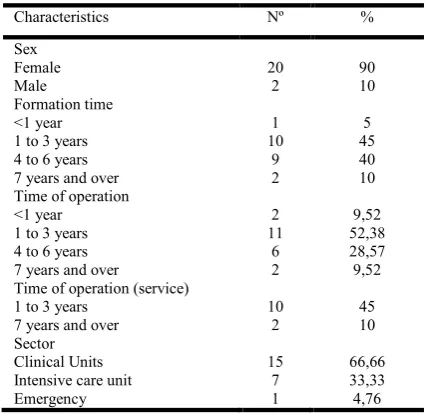
Table 1. Distribution of the number of nurses, according to sex, length of training, time of professional activity and sector.
Fortaleza, CE, Brazil, 2017
Characteristics Nº %
Sex Female Male 20 2 90 10 Formation time <1 year 1 to 3 years 4 to 6 years 7 years and over
1 10 9 2 5 45 40 10 Time of operation
<1 year 1 to 3 years 4 to 6 years 7 years and over
2 11 6 2 9,52 52,38 28,57 9,52 Time of operation (service)
1 to 3 years 7 years and over
[image:3.595.55.269.95.302.2]10 2 45 10 Sector Clinical Units Intensive care unit Emergency 15 7 1 66,66 33,33 4,76
Table 2. Distribution of the number of professionals according to their knowledge about mechanical ventilation. Fortaleza, CE,
Brazil, 2017
Variables Nº %
Very good 0 0
Good 4 19,09
Regular 11 51,14
Bad 7 23,80
With respect to the institution's work sector, 14 (66.66%) worked in the clinical units, 7 (33.33%) in the Intensive Care Unit and 1 (4.76%) worked in the Emergency Medicine Unit. As for academic training, 11 (50%) of the professionals interviewed received specialization. It was verified that none of the professionals had masters and or doctorates. Regarding the level of knowledge about mechanical ventilation, none of the professionals interviewed chose the concept VERY GOOD, 4 (19.09%) classified as BOM, and a significant amount was observed in the worst REGULAR concepts with 12 (51.14%) and RUIM with 6 (23.80%) professionals, revealing the disinformation of these nurses on a primordial issue in all sectors of a hospital institution. Of the 22 professionals interviewed, 12 (55.55%) performed some training regarding mechanical ventilation, and it was found that 19 (86.36%) reported not having received enough information during the gym to care for a patient under mechanical ventilatory support. Regarding the development of articles on mechanical ventilation only 1 (4.76%) professional has already written some work on the subject. In relation to having participated in any research group 19 (85%) responded that they had participated. About participation in events, 17 (77.27%) participated in congresses, 16 (72.72%) in lectures and only 5 (54.54%) attended a seminar. Regarding whether the respondents would know the complications related to mechanical ventilation in their professional life, 17 (77.52%) of the nurses answered that they did not. All 22 (100%) of the nurses interviewed agreed that it is incumbent on nurses to continue their education with their team, in order to highlight the importance of prevention measures in the manifestation of these diseases. Regarding whether the respondents would like to receive specific training on mechanical ventilation, the percentage was extremely significant 22 (100%) showed an
interest in training and improving their knowledge on the subject in question. Regarding the assignments of each professional in the mechanical ventilatory support, related to aspiration 22 (100%) attached this function to the physiotherapist, 20 (90.90%) to the nurse and 1 (4.54) the medical staff. In question at weaning, the great majority also related the function to the physiotherapist 17 (77. 27%) and only 5 (22.72%) to nursing.
Table 3. Distribution of the number of professionals, according to their attributions in the handling of Mechanical ventilation.
Fortaleza, CE, Brazil, 2017
Atribuições Nº %
Aspiration Physiotherapist Nurse Medical team 22 20 1 100 90,90 4,54 Weaning Physiotherapist Nurse 17 5 77,27 22,72 Extubation Physiotherapist Nurse Medical team 15 7 20 68,18 31,81 90,90 Featured in the performance
Physiotherapist Nurse Medical team 18 21 21 81,81 95,45 95,45
Regarding extubation, the medical team was highlighted with 20 (90.90%), physiotherapists 15 (68.18%) and the nursing team with 7 (31.81%). And, regarding the perception of which professional was predominantly active in mechanical ventilation, there was concomitance between nursing and medical staff, with 21 (95.45%) and physiotherapists 18 (81.81%). Concerning infectious complications related to mechanical ventilation, 15 (70%) were able to identify paranasal sinusitis, tracheobronchitis, VAP, ischemic labial lesions, bronchopleural fistula, hemodynamic changes, alterations in central nervous system level, tracheal lesions, distension abdominal, barotrauma and volutrauma as complications and 7 (30%) could not identify all of them. Regarding the factors related to accidental extubation, expressive 20 (89.9%) considered as the change of tube fixation, measurement of the cuff because of the weight of the device that can draw the tube, the transfer of the patient from bed to bed by mobility headache, change of position and bathing in the bed as risk factors and only 2 (10.1%) could not identify. Concerning the nursing assignments to the patient in mechanical ventilation, all 22 (100%) of the respondents agreed that care with the circuit, filters and humidifiers, cleaning and maintenance of the equipment, bathing in the bed, oral hygiene, oral feeding and enteral and care in the change of decubitus are attributions of nursing.
DISCUSSION
According to the data, there was a predominance of females with 20 (90%) over males, with 2 (10%) coinciding with the
profile of Brazilian nurses (Guerrer et al., 2008). Concerning
[image:3.595.347.519.199.352.2]frame with 48.8% of professionals with less than 5 years of
training (Rodrigues et al., 2012). It was found that 19
(86.36%) reported not having received sufficient information during the academy to care for a patient under mechanical ventilation, demonstrating that in relation to the mechanical ventilator, the lack of knowledge accompanies these professionals since graduation to practice professional. Thus, we deduce that for the formation of a general nurse all aspects involving the management of a serious patient as basic life support, emergency-related diseases in the respiratory tract, basic acids disorders, respiratory failure, call the CRA and so many others, should be addressed and discussed further during
the academy. Massaroli et al. (2015) affirm that in the daily
life of the hospitals, the nurse is frequently confronted with the criticality of the health status of the users, requiring the continuous development of highly complex technical procedures. The dynamics among the professionals, the critical condition of the patients and the use of numerous technologies require the nursing of different orders and if we take this factor into account, the MV is indispensable in the management of these patients.
When questioned whether they feared for the safety of a VM patient being cared for by them, there was a predominance in both responses, with half of those responding to SIM. The Federal Nursing Council (2011) was emphatic in determining, through Law n. 7.498 / 86, which is the responsibility of nurses to perform direct nursing care for critically ill patients at risk of death, as well as nursing care of greater technical complexity, requiring scientifically based knowledge and decision-making capacity. Likewise, as a member of the health team, it is incumbent upon nurses to systematically prevent and control damages that may be caused to clients during nursing care (Brazil, 2012). When analyzing the data in table 3, we noticed that nurses are getting more and more distant from the ventilatory support, transferring this responsibility to other professionals of the team, in principal we verify the physiotherapist. According to Rodrigues et al (2009), the previously specific nursing practices, such as ventilator assembly, definition of initial parameters, airway aspiration, gasometric monitoring, ventilatory weaning, among others, are being practiced by professionals from other areas. However, this reality, of distancing the ventilator nurse, does not occur only in the hospitals of the city of Fortaleza. A study carried out in a clinical and surgical center of intensive care in the South Zone of Rio de Janeiro identified that the nursing team, perhaps due to accumulation and overload of activities, together with the lack of ideal team design, has been increasingly left for the physiotherapy team the responsibility for providing patient care in mechanical ventilation (Massaroli
et al.,2015).
We assume that this distancing occurs due to the numerous attributions that are dismissed to the nurse or the deficiency in
their knowledge. MV is a multiprofessional and
interdisciplinary activity in which the unifying focus is the patient. Each team member has specific features and functions that interact and complement each other. It is worth mentioning that, when nurses do not participate or become distant from the care related to the needs of patients on
mechanical ventilation, they become vulnerable to
complications such as accidental extubation, infections, tracheal stenosis, hypoxemia, respiratory and cardiac arrhythmias , thus making the environment of intensive care
unsafe for them (Guerrer et al., 2008). It was observed in this
study that almost half of those surveyed, 10 (46.1%) had some knowledge deficit about the complications about the MV. Thus, these results could lead to the promotion of inadequate care for these users, since, in our study, the nurses did not present the set of knowledge necessary for their execution. In this context, about the insecurity of these professionals in caring for a patient with MV, we emphasize that insecure care increases the gap between possible and achieved outcomes. Unsafe care is expressed by the increased risk of unnecessary harm to the patient, which may have a negative impact on health care outcomes, showing the importance of periodic assessment of knowledge through standardized instruments and continuing education with training on key updates about the subject.
Final thoughts
Through the study, it was observed the importance of the education and orientation for the professionals on the nursing care to the patient with mechanical ventilatory support, it was verified that 100% of the professionals considered the idea of receiving training and qualification about this subject. This percentage was extremely significant, since it shows that most of the nurses of the institution show an interest in training and improving their knowledge about the subject in question. In view of the above, it is concluded that there is a need for constant training and training of nursing professionals about complications related to mechanical ventilation, so that nurses can effectively participate in the construction of their evidence-based practice process, propagating a safe and holistic care to the patient.
REFERENCES
Amorim, M.M. and Gomes, S.R. 2015. Ações de enfermagem para prevenção de Infecções Associadas à Ventilação Mecânica na Unidade de Terapia Intensiva Neonatal.
Revista Interdisciplinar do Pensamento Científico.1 (2),
pp. 72- 288.
Barbas, C.S. et al. 2014. Recomendações brasileiras de
ventilação mecânica. Rev Bras Ter Intensiva., 26(3), pp.
215-239.
Brasil. Ministério da Saúde. 2012. Conselho Nacional de Saúde. Comissão Nacional de Érica em Pesquisa. Resolução nº. 466, de 12 de dezembro de 2012. Diretrizes e normas regulamentadoras de pesquisas envolvendo seres humanos.
Camelo, S.H.H. 2012. Competência do profissional de enfermagem para atuar e Unidades de Terapia Intensiva: uma revisão integrativa. Revista Latino-americana de
Enfermagem, 20 (1), pp. 192-200.
Cintra, E.A. 2008. Assistência de Enfermagem ao Paciente Gravemente Enfermo. São Paulo: Atheneu.
Cofen. Resolução Nº 390, de 18 de OUTUBRO DE 2011. Diário Oficial da União – seção 1. Disponível em: <http://novo.portalcofen.gov.br/wp-content/uploads/ 2012/ 03/resolucao_390_2011.pdf>. Acesso em: 26 de agosto de 2017.
Guerrer, FJL. and Bianchi, ERF. 2008. Caracterização do estresse nos enfermeiros de unidades de terapia intensiva.
Rev Esc Enferm, USP. 42 (2), pp. 355-62.
Guimarães, P.V., Haddad, M.C.L. and Martins, E.A.P. 2015. Validação de instrumento para avaliação de pacientes
graves em ventilação mecânica, segundo o ABCDE. Rev
Massaroli, R. et al. 2015. Trabalho de enfermagem em unidade de terapia intensiva e sua interface com a sistematização da
assistência. Escola Anna Nery Revista de Enfermagem., 19
(2), pp. 252-258.
Melo, E.M. et al. 2014.Cuidados de enfermagem ao utente sob
ventilação mecânica internado em unidade de terapia
intensiva. Revista de Enfermagem Referência, 1 (1), pp.
55-63.
Mendes, N.T., Tallo, F.S. and Guimarães, H.P. 2012. Guia de ventilação mecânicapara enfermagem. São Paulo: Editora Atheneu.
Rodrigues, Y. C. S. J. R. et al. 2012.Ventilação mecânica:
evidências para o cuidado de enfermagem. Esc. Anna Nery,
16 (4), pp. 789 – 795.
Tallo, F.S. and Guimarães, H.P. 2012. Guia de Ventilação Mecânica para Enfermagem. São Paulo: Atheneu.
Tallo, F.S. et al. 2013. Ventilação mecânica invasiva na sala
de emergência: uma revisão para o clínico. Rev Bras Clin
Med., 11 (1), pp. 48-54.