5003
THE ACCOUNTING INFORMATION SYSTEM QUALITY
IMPROVEMENT THROUGH INTERNAL CONTROL AND
TOP MANAGEMENT SUPPORT EFFECTIVENESS
1,2AZMI FITRIATI, 3AZHAR SUSANTO
1Lecturer, Departement of Accounting, Univ. Muhammadiyah Purwokerto – Indonesia and
2Student, Accounting Doctoral, Padjadjaran University – Indonesia
3Professor, Departement of Accounting, Padjadjaran University – Indonesia
E-mail: 1[email protected]
ABSTRACT
Information is needed for effective decision making. Thus, quality accounting information generated by a qualified accounting information system. This study uses two components of the DeLone & McLean Information System Success Model such as system quality and information quality which identified as the entry key to the information system succeess. Besides, internal control and top management support are important factors that affect AIS quality. The objectives of this study are to measure (1) the influence of internal control and top management support on AIS quality and (2) the influence of AIS quality on the quality of accounting information. The population were Muhammadiyah higher education institutions and choosing samples by simple random sampling technique. PLS-SEM was used as an analytical tool. Primary data were collected by questionnaires as research instruments. The results have shown that the AIS quality can be reflected by integration, flexibility, ease of use and accessibility dimensions. Thus, the quality of accounting information was reflected of relevant, accurate, timely and complete dimensions. Besides, AIS quality was enhanced by the effective implementation of internal control and top management support. The implementation of qualified AIS had been caused accounting information to be qualified as well.
Keywords: Internal Control, Top Management Support, Information System Success, Accounting
Information System Quality, Accounting Information Quality
1. INTRODUCTION
Information has become an important resource for managing the organization [22]. Organizations need information to make effective decision [38]. Therefore the quality of information will affect any decision taken by organizations. Information is generated from information systems [22]. According to Gorla et al. (2010), Azhar Susanto
(2015) accounting information quality is
determined by AIS quality [19] [7]. A well-designed AIS can provide the information needed for decision making [38].
Once factors that AIS have not qualified is the ineffective implementation of internal control [2] [32] [34] [49]. Internal control is used as a mechanism to protect the organization from risk or to minimize the impact of risk if the risk occurs [29]. According to Yang et al. (2011) to ensure the reliability of financial reporting, internal control mechanisms must be built into the information system [51].
According to Stair & Reynold (2012:368), Daft & Marcic (2013:316) top management support also contributes to AIS implementation success [13] [46]. Top management will uses various techniques and policies to AIS implementation. Top management support is relating top management understands on the AIS function and activities [35].
DeLone & McLean (1992) were identified six components of information system success.
These components are interrelated and
interdependent, forming an information system success model (D&M IS Success Model), such as system quality (technical level), information quality (semantic level), usage, user satisfaction, individual impact, and organizational impact (level of influence) [15]. Thus, DeLone & McLean (2003) updated the information system success model (Updated D&M IS Success Model) by adding service quality components and replacing individual impact components and organizational impacts with net benefits [16].
5004 argued that DeLone & McLean (1992: 2003) identified system quality and information quality as the initial key to the success of information systems [33], but this model have not linked. The novelty is this study linked both of the quality of the system and the quality of information, as Sacer et al. (2013) argued that accounting information quality depends on AIS quality because accounting information is the output of it [40]. Similarly, according to Raymond & Bergeron (2008), Gorla et al. (2010), Al-Mamary et al. (2014) there is a
relationship between system quality and
information quality [4] [19] [36]. The objectives of study are to measure influence of (1) internal control and top management support to AIS quality; and (2) AIS quality to accounting information quality.
It is necessary to conduct a study of the influence of internal control and top management support effectiveness on quality of AIS and its implication on quality of accounting information at private higher educations in Indonesia based on previous researches and theoritical framework
2. LITERATURE REVIEW
2.1 Internal Control
Moeller (2010:8) defines internal control as a process designed by boards of directors, management and other personnel to purpose effectiveness and efficiency of the operations, reliability of financial reporting and compliance with applicable laws and regulations [31]. This similarly argued by [22] [23] [28] [38].
Moeller (2010:14) argued the internal control of AIS including in the component of control activities. The effectiveness of control activities is the most important component of COSO internal control framework. Control activities are actions taken through policies and procedures to reduce risks in the purposes achievement. In this study, there undertaken to provide the confidence of financial reporting reliability.
The information system controls consisted of general controls and application controls [6] [22] [28] [31]. General controls include software controls, physical hardware controls, computer operations controls, data security controls, controls over implementation of system processes, and administrative controls. Application controls include input, process and output controls [28].
2.2 Top Management Support
Top management support is defined as the top management participation to involve and successive the objectives actively [44] [50]. According to Ragu-Nathan et al. (2004) and Štemberger et al (2011) top management support refers to the degree to which top management understands on the importance of function and involves on the information systems implementation [35] [47].
Štemberger et al (2011) was reflected top management support in four indicators, such as top management is aware of the importance of information systems functions, top management actively participates in information system planning, top management sponsors initiatives taken by information system personnel and top
management has sufficient knowledge of
information systems [47]. McLeod & Schell (2007: 202) states that top management plays important role in (1) establishing policies that ensure the objectives of information system are congruent with the organizational goals; (2) providing funds for information systems needs; and (3) resolving conflicts in the information systems implementation [29]. Ifinedo (2008) and Mir et al. (2014) states top management support means how to top manager provides the company resources, directs and authorities in the implementation of information system [25] [30]. According to Young & Jordan (2008) that top management support means how to top management involves actively, able to solve the problems and facilitates the information systems implementation [52].
2.3 Accounting Information System Quality
According to Romney & Steinbart (2012: 30); Stair & Reynold (2010: 11); O'Brien & Marakas (2011: 30), accounting information system is a collection of resources, such as people and equipment, that are designed to transform financial and other data into information [34] [38] [46]. The objectives of AIS are to collect, process and produce any information that is relating on financial aspects of business activities [18].
Azhar Susanto (2013:30) stated that the information system success is an effective information system and can be used by users to improve their control, efficiency and rapidity [6]. A quality of AIS is required to produce qualified information, then assist management on making right decisions [24].
5005 auditability, and security [38]. Thus, according to Heidmann (2008:87-90), the system quality of accounting systems includes integration, flexibility, accessibility, formalization, and media richness [24]. According to Reis & Carvalho (2013:423-425) the AIS quality includes usability, adaptability, flexibility, reliability, efficiency, effectiveness, security and accessibility [37]. A quality information system is usually flexible, efficient, accessible, and timely [46].
2.4 Accounting Information Quality
According to Romney & Steinbart (2012: 30); Hall (2011: 11); Stair & Reynold (2012: 5-6); Gelinas & Dull (2008: 17), data are facts that are collected, recorded, stored, and processed by an information system. Information is data that has been organized and processed to provide meaning and improve the decision-making process [18] [22] [38] [46]. Information of high quality is information products whose characteristics, attributes, or qualities make the information more valuable to decision makers [34].
Quality of information characteristics include relevant – up to date problem related, can reduce uncertainty and improve decision-making ability; accurate or reliable - free from error/bias; Timely - information is provided when needed; Complete - provides a complete picture on a particular problem or solution [18] [22] [29] [38] [46].
3. THEORITICAL FRAMEWORK
3.1 The Influence of Internal Control on AIS
Quality
Laudon & Laudon (2012:320) argued the implementation of internal control effectiveness can improved the quality and reliability of information system [28]. Hayes et al. (2005:232) stated that once of the management objectives of designing an internal control system is to ensure the reliability of financial reporting [23]. O'Brien & Marakas (2011:569) argued that internal control makes efforts to maintain the accuracy, integrity, and security on the implementation of information system. Internal control is designed to ensure data entry, processing techniques, storage methods, and output of appropriate information, so that effective implementation of internal control can minimize errors, fraud, and losses in the implementation of information system [34]. Similarly, Yang et al., 2011; Abbas & Iqbal, 2012; Badara & Saidin,
2013; Sacer & Oluic, 2013 have concluded that internal control is essential to ensure the success of an information system [1] [10] [40] [51].
Teru & Hla (2015) stated internal control is
implemented to ensure the objectives
accomplisment and performance of the information system implementation [49]. According to Neogy (2014), internal control ensures the effectiveness and efficiency of business operations, compliances with management policies, asset securities, prevention and fault and fraud detection, accuracy and accounting records completeness, and ensures the information system can produces the quality information [32]. The internal control systems have some purposes such as to eliminate the threats, detect some errors and restore information systems when threats occured [38]. Effective internal control implementation will be prevent, detect and correct errors and failures that may occur in the implementation of AIS [20] [53].
3.2 The influence of Top Management Support on AIS Quality
Schwalbe (2010:54) suggests that top management is a major support in the information systems implementation. There is very important because the information system requires adequate resources
and visibility of information systems
implementation [43]. The development and implementation of AIS successiveness is influenced by it [38]. If there is no support from top management, the organization will not take serious efforts [11]. According to Daft & Marcic (2013: 316), top management will use various ways for in implementing project successively [13].
Top management have power to the organization controlled. With its power, they can ensure adequate resource allocation and act as a change agent to create a more conducive
environment in the information system
implementation [48]. Dezdar & Ainin (2011); Al-Hiyari et al (2013) also state top management who play an role in the information system implementation actively will be involved and have a willingness to allocate resources, they become drivers and make employees motivated and aligned in implementing information system [3] [14].
5006 successful of information systems implementation. Top management play a strategic role in allocating resources for the implementation of information systems running effectively [26] [39]. Young & Jordan (2008) stated that the essence of it is related to effective decision making to authorize changes in the organization as well as to solve problems related to the implementation of information systems. It is an important factor and provides a powerful explanation of succeed or failed the information system implementation [52].
3.3 The Influence of AIS Quality to Accounting Information Quality
An effective of AIS can provide information that appropriate the user's needs [18] [28] [34]. If the information system is not qualified, then the risk that may occur is the information discrepancies in lower, middle and upper level management. The next is the unsyinchronized of decision makings and activities in various level of the organization,
which ultimately leads to organizational
performance become ineffective, unefficient and uncontrolled [6].
Salehi et al. (2010), Alzoubi (2011), and Sambasivam & Assefa (2013) concluded that AIS integrated will improve the relevance of accounting information and reduce the level of uncertainty on making decisions [5] [41] [42]. According to Gabriel & Obara (2013), an effective information system is able to produce timely and accurate information and result in efficiency and effectiveness in the organization ultimately [17]. Similarly, according to Azmi Fitriati & Sri Mulyani NS (2015a,b), the successful implementation of AIS can result the quality accounting information, as relevant, accurate, timely and complete, so that it can be used in decision making [8] [9].
4. METHODOLOGY
Quantitative methods were used this study. Data collection using questionnaires. Sampling is based on simple random sampling technique at Muhammadiyah higher education institutions in Indonesia. The data were measured using Likert scale five-point. Structural Equation Modeling based on component or variance (PLS-SEM) is used for analysis tool. Evaluation of PLS-SEM model includes evaluation of measurement model (outer model) and structural model (inner model).
In this study, exogenous and endogenous variables are latent variables. The latent variable measurement model in this research includes: (1) the first order is the dimension measurement model
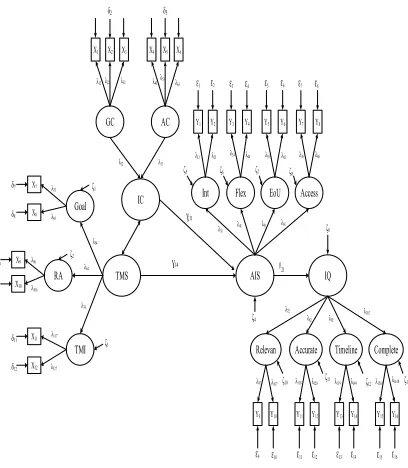
of the indicator, and (2) the second order is the latent variable measurement model for its dimension. Thus, the measurement model of the internal control variable is reflective in the first order and formative in the second order. Top management support variables are reflective in both first and second orders, as well as AIS quality variables. The model used in this study as in Figure 1.
Goal
GC AC
IC
IQ AIS
TMS
TMI RA
Int Flex EoU
Relevan Accurate Timeline Complete
X1 X2 X3 X4 X5 X6
Y4 Y3 Y2 Y1
X7
Y5 Y6
Y16 Y15 Y14 Y13 Y12 Y11 Y10 Y9 X12
X10 X9 X8
X11
Y7
λ97 ζ4
ζ9 δ5
δ2
δ12 δ11 δ9
δ8 δ7
Ɛ1 Ɛ2 Ɛ3 Ɛ4 Ɛ5 Ɛ6 Ɛ7
Ɛ9 Ɛ10 Ɛ11 Ɛ12 Ɛ13 Ɛ14 Ɛ15 Ɛ16 ɣ11
ɣ14 ᵝ21
λ12λ22 λ32 λ43λ53 λ63
λ75
λ85
λ96
λ106
λ117
λ127 λ54
λ64
λ74
ζ5 ζ6 ζ7 λ13
λ12
λ31 λ41 λ51 λ13 λ23 λ34 λ44 λ55 λ65 λ76
λ72
λ82 λ92 λ102
λ107 λ118 λ128 λ139 λ149 λ1510 λ1610 ζ1
ζ2
ζ3
ζ10 ζ11 ζ12 ζ13 Access
λ61 Y8
λ86 ζ8
[image:4.612.316.520.197.431.2]Ɛ8
Figure 1: SEM Model
5. RESULT
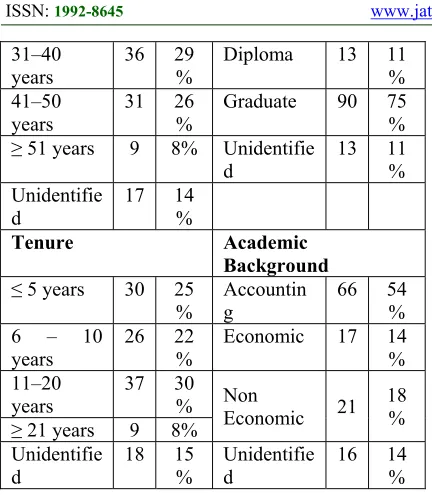
The number of respondents analyzed by 120 respondents. Characteristics of respondent as in Table 1. There table indicates that most (56%) of the respondents are women, aged under 40 years (52%), tenure of more than 10 years (38%) with manager positions (62%) approximately. Most respondents passed graduate education (75%) and more a half (54%) have accounting background.
Table 1. Characteristics of Respondents
Character
istics N % Characteristics N %
Gender Position
Male 42 36
% Manager 75 62%
Female 68 56
%
Staff 33 28
% Unidentifie
d 10 8% Unidentified 12 10%
Age Strata
≤ 30 years 27 23
5007 31–40
years
36 29
%
Diploma 13 11
% 41–50
years 31 26% Graduate 90 75%
≥ 51 years 9 8% Unidentifie
d 13 11%
Unidentifie d
17 14
%
Tenure Academic
Background
≤ 5 years 30 25
% Accounting 66 54%
6 – 10
years 26 22% Economic 17 14%
11–20
years 37 30% Non Economic 21 18%
≥ 21 years 9 8%
Unidentifie d
18 15
%
Unidentifie d
16 14
%
This study uses reflective measurement model to measure the relationship between indicators and its dimensions. Reflective and formative measurement models are used for measure the relationship between the dimensions and their latent variables or constructs. Tests on the measurement model are presented in Table 2.
The factor loading values of all indicators and dimensions are above 0.7 with p-values are less than the significance level α 0.05, thus it means all indicators is valid to measure their dimensions and all dimensions is valid to measure their constructs. Based on test results of all indicators and
dimensions have R2 more than 0.5. This indicates
that all indicators and dimensions have reliable
criteria. All dimensions and variables have AVE more than 0.5, that it means all indicators and dimensions have convergence validity criteria.
Table 2 indicates the value of Composite Reliability (CR) in all dimensions and variables is greater than 0.7, so it means all indicators in each dimension and all dimensions in each construct have a good internal consistency. The discriminant validity test were used the Fornell-Lacker criterion [21]. Based on this resulted have shown that the measurement model has valid and reliable criteria. It means that all indicators used in this study has reflected the dimensions and constructs.
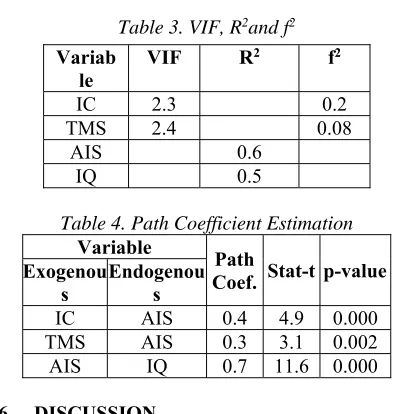
Furthermore, the testing of structural models includes testing of collinearity, significance of path coefficients, R2 and f2. The results of the structural model testing are presented in Tables 3 and 4.
Table 3 indicated that the exogenous variables of internal control and top management support have VIF below 5, it means that there are
[image:5.612.88.304.73.325.2]no collinearity problems between those variables. R2 of AIS quality and accounting information quality are 0.6 and 0.5. This means that the variability of AIS quality can be explained by internal control and top management support of 60% approximately. The variability of accounting information quality is explained by the AIS quality of 50%. Then f2 for internal control and top management support are 0.2 and 0.08. This indicates that internal control have a strong effect while top management support has a weak effect the AIS quality.
Table 2. Factor Loading, R2, AVE and CR
VarVEA CR Dimen
sion
Fact or Load
ing
R2 A
VECR Indicator LoadingFactor R
2
IC
GC 0.8 0.9
GC-1 0.8 0.7
GC-2 0.9 0.8
GC-3 0.9 0.8
AC 0.8 0.9
AC-1 0.9 0.8
AC-2 0.9 0.9
AC-3 0.9 0.8
TMS0.6 0.9 Go
al 0.8 0.8 0.8 0.9
Goal-1 0.9 0.8
Goal-2 0.9 0.8
RA 0.8 0.8 0.8 0.9 RA-1 RA-2 0.9 0.9 0.80.8 TM
I 0.8 0.8 0.8 0.9
Tmi-1 0.9 0.8
Tmi-2 0.9 0.8
AIS 0.6 0.9
Int 0.8 0.8 0.9 0.9 Int-1 Int-2 0.9 0.9 0.90.9 Fle
x 0.8 0.8 0.8 0.9
Flex-1 0.8 0.8
Flex-2 0.9 0.8
Eo
U 0.9 0.8 0.9 0.9
EoU-1 0.959 0.9 EoU-2 0.955 0.9 Acce
ss 0.8 0.7 0.6 0.7
Acc-1 0.936 0.8 Acc-2 0.761 0.5
IQ 0.6 0.9 Rele
vant 0.8 0.7 0.9 0.9
Re-1 0.938 0.9 Re-2 0.945 0.9 Accu
rate 0.8 0.7 0.8 0.9
Act-1 0.900 0.8 Act-2 0.898 0.8 Time
line 0.8 0.9 0.9 0.9
Tl-1 0.940 0.8
Tl-2 0.939 0.9
Com
plete 0.8 0.8 0.9 0.9
[image:5.612.311.528.224.637.2]5008 Table 3. VIF, R2and f2
Variab le
VIF R2 f2
IC 2.3 0.2
TMS 2.4 0.08
AIS 0.6
IQ 0.5
Table 4. Path Coefficient Estimation
Variable Path
Coef. Stat-t p-value
Exogenou
s Endogenous
IC AIS 0.4 4.9 0.000
TMS AIS 0.3 3.1 0.002
AIS IQ 0.7 11.6 0.000
6. DISCUSSION
Table 4 indicates the path coefficient of influence of internal control on AIS quality is 0.4 (p-value <0.05). It can be explained that the application of internal control effectiveness has positive impact on qualified AIS implementation.
General controls and application controls had implemented in Muhammadiyah higher education institutions. The internal control
implementation will support the AIS
implementation that an integrated, flexible, easy to use and easy to access. However, there several uneffective findings on information system control implementation, such as (1) hardware and software maintenance have not done routinely; (2) uneffective usage of username and password; and (3) lack of database security. Thus, other findings is (4) the less of effective input, process and output controls, includes, unavailability of facilities/ features that can reduce the risk of data input, program logic, formulas errors, that the resulting information becomes inaccurate. Implementation of ineffective internal control led to the AIS
implementation in Muhammadiyah higher
education institutions to be less qualified.
Based on statistical results indicated that internal control has a considerable effect on the quality of AIS. It has shown the implementation of internal control in Muhammadiyah Higher Education have affected to the improvement of SIA quality significantly.
The Muhammadiyah Higher Education Management realizes their institutions are non-profit organizations whose sustainability is based on the principle of trust. They should be able to provide trust / confidence to stakeholders for the institutions management continuously. Effective management will have impacted on improving the
quality of higher education and trust of public. Besides, the strong awareness to the vision and mission of Muhammadiyah and improving effort to employee attitude continuously made possible to decreased the mistake and fraud of AIS implementation.
As illustrated on Table 4, the path coefficient of top management support on AIS quality is 0.3 (p-value <0.05) approximately. It can be explained that the top management support have positive effect to AIS implementation qualified.
Top management support includes active
participation on the alignment of the objectives of the AIS implementation with the organization goals, human resources and financial allocation and active involvement in the AIS implementation. Thus, the alignment of organization vision, mission and goals can be facilitate in integrating the functions or units, and reduce the resistance and conflict in the AIS implementation.
Top management that supported the implementation of information systems have shown the high interest and understanding of the function of information systems as a strategic resource in the organization. Based on this understanding, they make serious effort to taking advantage of the information systems implementation. They also seeks to avoid recurring conflicts and errors for it successfully.
Top management have important performed to planning, design and implementation of information system optimally, so it can be eliminate the risk of failure and loss of strategic values of IS implementation. They always monitored and facilitated the this action continously. It was included the efforts to improve user expertise to ensure the information system can function optimally.
Kearns (2006) stated the success of AIS implementation is influenced by top management
support on directing alignment between
organizational strategy and AIS [27]. In its implementation, top management support have important role to prepare vision, mission, goals and strategies for integration of departments and units within the organization [45].
5009 support, ie by ensuring human and technical resources in the AIS implementation [3] [12] [26].
The others is provided as the main subjectof
active involvement and employee participations in the AIS implementation. Top management makes, monitors and evaluates on the AIS implementation policies and procedures, and becomes the initiator and motivator of its implementation.
Based on the results of structural model testing (Table 4), there is known that the path coefficient of AIS quality on accounting
information quality is 0.7. It is explained that to
improve the accounting information quality must improve the AIS quality. High qualities of AIS will produce a high quality of accounting information. AIS quality can be realized by integrating all components, providing flexible and easy-to-use systems, and designing ease of access. AIS quality can meet the needs of information that changes quickly and efficiently, leading to the release of relevant, accurate, current and detailed information, which implies a high quality of information.
The result shown the quality of AIS were explained by internal control and top management support only 60% respectively. There were 40% factors unexplained. In addition, top management support variable has least coefficient and effect on the quality of AIS (Table 3). Whereas previous research it is important factor [26]. [35]. [52].
In future research it is necessary to add variable such as organizational commitment because based on the research findings, top management support and internal control variables have a weak effect on improving the quality of AIS. This is because the commitment to the employee organization in in this study is quite high (52% of the tenure of employees were 6-20 years). So that top management support is only necessary as a motivator and dynamicator in the implementation of AIS.
7. CONCLUSION
The AIS quality is influenced by the effectiveness of internal control implementation and the high of top management support. Internal control will ensure AIS can be implemented optimally. Top management support will optimize in achieving AIS goals. The implementation of an AIS qualified will have an impact on the quality of the information resulted like relevant, accurate, timely and complete. It’s consitent with the theory and the previous research. Furthermore, the results of this study are replicable by other researchers by adding variables, dimensions or indicators used.
8. ACKNOWLEDGMENT
This research was supported by Directorate General of Higher Education, Ministry of Research, Technology and Higher Education Republic of Indonesia, PP Muhammadiyah, We thank our colleagues from Muhammadiyah Higher Education Institutions throughout Indonesia and who provided insight and expertise that greatly assisted the research, although they may not agree with all of the interpretations/conclusions of this paper.
REFRENCES
[1] Abbas, Q. & Iqbal, J., “Internal Control
System: Analyzing Theoretical Perspective &
Practices”, Middle-East Journal of Scientific
Research. Vol.12 (4), 2012, pp. 530-538
[2] Abu-Musa, A.A., “Evaluating The Security
Controls of CAIS in Saudi Organizations: The
Case of Saudi Arabia”, The International
Journal of Digital Accounting Research, 6
(11), 2006, pp. 25-64
[3] Al-Hiyari, A., Al-Mashregy, M.H.H., Mat,
Nik K. N. & Alekam, J. M. E., “Factors that Affect Accounting Information System Implementation and Accounting Information Quality: A Survey in University Utara
Malaysia”, American Journal of Economics.
Vol. 3(1), 2013, pp. 27-31
[4] Al-Mamary, Y.H., Shamsuddin, A. & Aziati,
N., “The Relationship of System Quality, Information Quality and Organizational
Performance”, International Journal of
Knowledge and Research in Management & E-Commerce. Vol. 4 (3), 2014, pp. 7-10
[5] Alzoubi, A., “The Effectiveness of the
Accounting Information System Under the Enterprise Resources Planning (ERP) A Study on Al Hassan Qualified Industrial Zone’s
(QIZ) Companies,” Research Journal of
Finance and Accounting. Vol 2 (11), 2011, pp.10 – 18
[6] Azhar Susanto. Sistem Informasi Akuntansi:
Struktur Pengendalian Resiko Pengembangan.
Lingga Jaya, Bandung, 2013
[7] Azhar Susanto. “What Factors Influence The
Quality of Accounting Information?” IJABER.
Vol. 13 (6), 2015, pp. 3995 – 4014
[8] Azmi Fitriati & Sri Mulyani NS., “Factors
That Accounting Information System Success and Its Implication on Accounting Information
Quality”, Asian Journal of Information
Technology. Vol. 14(5), 2015a, pp.154-161
[9] Azmi Fitriati & Sri Mulyani NS., “The
5010 Information System Success and Its Impact on
Accounting Information Quality”, Research
Journal of Finance and Accounting. Vol.
6(11), 2015b, pp. 167-173
[10] Badara, M. S. &, Saidin, S. Z., “Impact of the
Effective Internal Control System on the Internal Audit Effectiveness at Local
Government Level”, Journal of Social and
Development Science. Vol. 4(1), 2013, pp. 16-23
[11] Bateman, T. S. & Snell, S. A. Mana-gement:
Leading & Collaborating in a Competitive World. 11th edition. McGraw-Hill, New York, 2013.
[12] Boonstra, A. “How Do Top Managers Support
Strategic Information System Projects and Why Do They Sometimes Withhold This
Support?” International Journal Project
Management. Vol. 31, 2013, pp. 498–512
[13] Daft, R.L. & Marcic, D. Understanding
Management. 8th edition. South-Western
Cangage Learning, 2013
[14] Dezdar, S. & Ainin, S., “The influence of
organizational factors on successful ERP
implementation”, Management Decision. Vol.
49 (6), 2011, pp. 911-926
[15] DeLone, W.H. & McLean, E.R. “Information
Systems Success: The Quest for the
Dependent Variable” Information Systems
Research, Vol. 3 (2), 1992, pp. 60-96
[16] DeLone, W.H. & McLean, E.R., “The DeLone
and McLean Model of Information Systems
Success: A Ten-Year Update”, Journal of
Management Information Systems. Vol. 19
(4), 2003, pp. 9-30
[17] Gabriel, J.M.O. & Obara, L.C., “Management
Information Systems And Corporate
Decision– Making: A Literature Review”, The
International Journal Of Management. Vol 2
(3), 2013, pp.78 - 82
[18] Gelinas, Ulric J. & Richard B. Dull.
Accounting Information System. 7th edition. Thompson. South-Western, 2008
[19] Gorla, N., Somers, T.M. & Wong, B.,
“Organizational Impact of System Quality, Information Quality and Service Quality”, Journal of Strategic Information Systems. Vol. 19, 2010, pp.207 – 228.
[20] Guan, Y.. “A Study on The Internal Control of
AIS” International Confrence on Computer
and Communication Technologies in Argiculture Engineering, Januari, 12, 2006
[21] Hair, Jr. J. F., G.T.M. Hult, C.M. Ringle & M.
Starstedt. A Premier on Partial Least Squares
Structural Equational Modeling (PLS-SEM).
Sage Publication. Inc, California, 2014
[22] Hall, James A. Accounting Information
System. 7th edition. Cengage Learning. South-Western, 2011
[23] Hayes, R., Dassen, R., Schilder, A., Wallage,
P. Principles Of Auditing An Introduction to
International Standards, 2ndedition. Prentice Hall. Pearson Education, 2005
[24] Heidmann, M. The Role of Management
Accounting Systems in Strategic Sensemaking.
Universitäts-Verlag Wiesbaden, Germany: Deutscher, 2008
[25] Ifinedo, P., “Impacts of Business Vision, Top
Management Support, and External Expertise
on ERP Success”, Business Process
Management Journal, Vol. 14(4), 2008, pp.
551-568
[26] Jitpaiboon, T. & Kalaian, S.A., “Analyzing
The Effect of Top Management Support on IS Performance Across Organizations and
Industries Using Hierarchical Linear
Modeling”, Journal of International
Technology & Information Management. Vol. 14(2), 2005, pp.131-143
[27] Kearns, G.S., “The Effect of Top Management
Support of SISP on Strategic IS Management: Insights from The US Electric Power
Industry”, Omega 34, 2006, pp.236 – 253
[28] Laudon, Kenneth C., Jane P. Laudon.
Management Information System. Managing
The Digital Firm. 12th edition. Pearson
Prentice Hall, New Jersey, 2012
[29] McLeod, J. Raymond & George P. Schell.
Management Information System. 10th edition. Prentice Hall, 2007
[30] Mir, U.R., Sair, S.A. & Malik, M.E., “Effect Organizational Culture and Top Management
Support on ERP Implementation”, Science
International, Vol.26 (3), 2014, pp.1361-1369
[31] Moeller, Robert R. IT Audit, Control, and
Security. New Jersey: John Wiley & Sons, Inc, 2010
[32] Neogy, T.K., “Evaluation of Efficiency of
AIS: A Study on Mobile Telecommunication
Companies in Bangladesh,” Global Disclosure
of Economic & Business. Vol 3(1), 2014, pp. 40 – 55
[33] Nelson, R.R., Todd, P.A. & Wixom, B.H.,
“Antecedents of Information and System Quality: An Empirical Examination Within
The Context of Data Warehousing”, Journal
of Management Information Systems, Vol. 21
5011
[34] O’Brien, J.A., Marakas, G.M., Management
Information System. 10th edition McGraw
Hill/Irwin, New York, 2011
[35] Nathan, B.S, Apigiah, C.H.,
Ragu-Nathan, T.S., Tu, Q., “A Path Analytic Study of The Effect of Top Management Support for
IS Performance”, The International Journal of
Management Science. Vol. 32, 2004, pp.
459-471
[36] Raymond, L. & Bergeron, F., “Project MIS:
An Empirical Study of Their Impact on Project Managers and Project Success”,
International Journal of Project Management,
Vol. 26 (2), 2008, pp. 213-220
[37] Reis, J.L. & Carvalho, J.A. Advances in
Information Systems and Technologies.
Rocha, A. et al. (eds). Springer-Verlag, Berlin
Heidelberg, 2013
[38] Romney, B.M. & Steinbart, J.P. Accounting
Information System. 12th edition. Pearson
Education Limited, 2012
[39] Sabherwal, R., Anand, J. & Chowa, C.,
“Information System Success: Individual and
Organizational Determinants”, Management
Science, Vol. 52 (12), 2006, pp.1849-1864
[40] Sacer, Ivana M. & Oluic, Ana, “Information
Technology and AIS’ Quality in Croatian
Middle and Large Companies”, Journal of
Information & Organization Society, Vol. 37 (2), 2013, pp. 117-126
[41] Salehi, M., Rostami, V., Mogadamet, A.,
“Usefulness of AIS in Emerging
Economy:Empirical Evidence of Iran”, International Journal of Economics and Finance, Vol. 2(2), 2010, pp. 186 - 195
[42] Sambasivam, Y. & Assefa, K.B., “Evaluating
the Design of AIS and its Implementation in
Ethiopian Manufacturing Industries”,
Research Journal of Science and IT Management, Vol.2 (7), 2013, pp.16-29
[43] Schwalbe, K., Information Technology Project
Management. 6th edition. Boston: Cangage Learning, 2010
[44] Siau, K., Cross-Disciplinary Models and
Applications of Database Management:
Advancing Approaches. IGI Global, 2012
[45] Singh, R.K., “Prioritizing The Factors for
Coordinated Supply Chain Using Analytic
Hierarchy Process (AHP)”, Meas. Business
Excell. 17(1), 2013, pp. 80–97
[46] Stair, R.M. & Reynold, G. W., Fundamental
of Information System, 6th edition Boston, Cangage Learning, 2012
[47] Štemberger, M. I., Manfreda, A. & Kovačič,
A., “Achieving Top Management Support with Business Knowledge and Role of IT/IS
Personnel”, International Journal of
Information Management, Vol. 31(5), 2011,
pp. 428-436
[48] Thong, J.Y.L., Yap, C.S. & Raman, K.S.,
“Top Management Support, External
Expertise and IS Implementation in Small
Business”, Information System Research.
Vol.7 (2), 1996, pp. 248-267
[49] Teru, S. P. & Hla, T. D., “Appraisal of
Accounting Information System and Internal
Control Frameworks”, International Journal
of Scientific and Research Publication, Vol. 5 (9), 2015, pp. 1-3
[50] Tipton, H.F. & Kruse, M. Information
Security Management Handbook. 6thedition
Taylor & Francis Group, 2007.
[51] Yang, M.H., Lin, W.S, Koo, T.L. “The Impact
of Computerized Internal Controls Adaptation
on Operating Performance”, African Journal
of Business Management, Vol. 5(20), 2011,
pp. 8204-8214
[52] Young, R. & Jordan, E, “Top Management
Support: Mantra or Necessity?” International
Journal of Project Management, Vol. 26 (7), 2008, pp. 713–725
[53] Zhang, H., Guo, C. & Sun, Q, “A Study on the
Internal Control of Accounting Information Processing System under the Computer
Environment”, International Journal of