Munich Personal RePEc Archive
Estimation of a preference based single
index from the sexual quality of life
questionnaire (SQOL) using ordinal data
Ratcliffe, J and Brazier, J and Tsuchiya, A and Symonds, T
and Brown, M
The University of Sheffield
November 2006
HEDS Discussion Paper 06/06
Disclaimer:
This is a Discussion Paper produced and published by the Health Economics and Decision Science (HEDS) Section at the School of Health and Related Research (ScHARR), University of Sheffield. HEDS Discussion Papers are intended to provide information and encourage discussion on a topic in advance of formal publication. They represent only the views of the authors, and do not necessarily reflect the views or approval of the sponsors.
White Rose Repository URL for this paper:
http://eprints.whiterose.ac.uk/11031/
Once a version of Discussion Paper content is published in a peer-reviewed journal, this typically supersedes the Discussion Paper and readers are invited to cite the published version in preference to the original version.
Published paper
Ratcliffe J, Brazier J, Tsuchiya A, Symonds T, Brown M. Using DCE and ranking data to estimate cardinal values for health states for deriving a preference-based single index from the sexual quality of life questionnaire. Health Economics [in press].
The University of Sheffield
ScHARR
School of Health and Related Research
Health Economics and Decision Science
Discussion Paper Series
November 2006
Ref: 06/6
Estimation of a preference based single index
from the sexual quality of life questionnaire (SQOL) using ordinal
data.
Ratcliffe J1, Brazier J1, Tsuchiya A1, Symonds T2, Brown, M2
1. Health Economics and Decision Sciences, ScHARR,
University of Sheffield
2. Worldwide Outcomes Research, Pfizer Global
Pharmaceuticals, Pfizer Ltd
Corresponding Author: Julie Ratcliffe
Health Economics and Decision Science School of Health and Related Research University of Sheffield
Regent Court, Sheffield, UK S1 4DA
Email: [email protected]
Abstract
There is increasing interest in using ordinal methods to estimate cardinal
values for health states to calculate quality adjusted life years. This paper
reports the estimation of models of rank data and discrete choice experiment
(DCE) data to derive a preference-based index from a condition specific
measure relating to sexual health and to compare the results to values
generated from time trade-off valuation (TTO). The DCE data were analysed
using a random effects probit model and the DCE predicted values were
re-scaled according to the highest and lowest predicted TTO values
corresponding to the best and worst SQOL health states respectively. The
Rank data were analysed using a rank ordered logit model and re-scaled
using two alternative methods. Firstly, re-scaling the rank predicted values
using identical methods to those employed for DCE and secondly, re-scaling
the rank model coefficients by dividing each level coefficient by the coefficient
relating to death. The study raises some important issues about the use of
1. Introduction
Health state values are usually obtained using cardinal methods such as
standard gamble (SG), time trade-off (TTO) or visual analogue scaling (VAS).
However, there are a number of concerns with these techniques (Brazier et al,
1999). The direct and choice-less nature of the VAS task has been criticised
(Bleichrodt and Johannesson 1997) and VAS data may be subject to end
point and context bias (Torrance et al, 2001). Although SG and TTO are often
identified as preferred over VAS due to their choice based theoretical
underpinnings (Brazier et al, 2006), the values produced by these methods
are influenced by factors beyond the respondents preference for the health
state including time preference, risk attitude and loss aversion (Bleichrodt,
2002) . For these reasons, there is increasing interest in using ordinal
methods to estimate cardinal values for health states to calculate quality
adjusted life years
Until very recently, the use of ordinal data in health state valuation such as
from ranking or discrete choice experiments (DCE) has largely been ignored.
Ranking exercises have traditionally been included in health state valuation
studies as a warm up procedure to familiarise the respondent with the set of
health states to be valued and with the relative value of health states. Often
these data may not be used at all in data analysis, or they may be used to
check consistency between the ordinal ranking of health states and the
ranking of health states according to their actual values obtained using a
theoretical basis for deriving cardinal values from rank preference data (Kind,
1996). Thurstone’s method considers the proportion of times that one health
state (A) is considered worse than another health state (B). The preferences
over the health states are represented by a latent cardinal utility function and
the likelihood of health state A being ranked above health state B when health
state B is actually preferred to health state A is a function of how close to
each other the states lie on this latent utility function.
Salomon (2003) used conditional logistic regression to model rank data from
the UK MVH valuation of the EQ-5D. He was able to estimate a model that
was comparable to the original TTO model by rescaling the worst state using
the observed TTO value. Other methods of rescaling were also considered,
including normalization to produce a utility of 0 for death, but these were
found not to provide the best fitting predictions. McCabe et al (2006), using
similar methods, presented evidence to suggest that rank data that produced
cardinal health state valuation models for two generic measures of health
status, the HUI2 and SF-6D, were very similar to the original SG models.
DCEs have their theoretical basis in random utility theory (McFadden, 1973;
Hanemann, 1984; Ryan 1996). Although DCEs have become a very popular
tool for eliciting preferences in health care, the vast majority of published
studies using DCE methodology have tended to focus upon the possibility that
individuals derive benefit from non-health outcomes and process attributes in
addition to health outcomes. A limited number of studies have used DCEs to
estimate values for different health state profiles (Hakim and Pathak, 1999;
to date have linked these values to the full-health dead scale required for the
calculation of QALYs.
This study sought to examine the potential of ranking and DCE data to
estimate a preference-based index for a condition specific measure related to
sexual quality of life, and to compare the results to models estimated using
TTO data and observed TTO health state values.
2. Methods
2.1. Sexual quality of life questionnaire
The sexual quality of life questionnaire (SQOL) was originally developed as a
measure of sexual quality of life for use in a clinical trial setting (Symonds et al
2005). The SQOL has 3 dimensions and 18 items with 6 responses each from
completely agree to completely disagree. Each dimension is scored by
summing the responses to each item (where each response is coded from
one: completely agree to six: completely disagree). In its current form SQOL
has a very limited role in assessing cost effectiveness. To extend the scope of
the SQOL for use in economic evaluation, values were required to be elicited for
health states derived from the SQOL in order to make it preference based .
The current SQOL would generate many millions of health states that would
be too large for valuation. The first task of this study was to derive a health
state classification amenable to valuation. A preliminary study was
(Brazier and Ratcliffe, 2004). The resultant health state classification system,
the SQOL-3D comprised three dimensions: sexual performance, sexual
relationship and sexual anxiety; with four levels attached to each dimension
(Table 1). A health state is formed by selecting one level from each dimension
and in this way 64 health states can be defined (i.e. 4*4*4) by the SQOL-3D .
Table 1 here
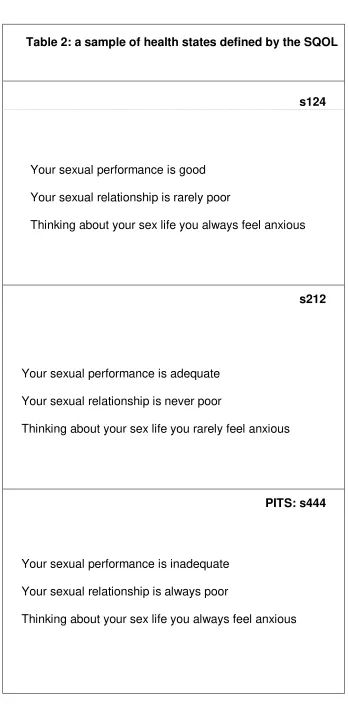
Each respondent was asked to value eight health states plus the PITS state -
the health state comprising the lowest level on each of the three dimensions
(see Table 2 for a sample of health states defined by the SQOL). These 64
states were grouped into 8 samples or blocks of 8 states to reflect a range of
health states defined by the classification rather than predominantly a ‘good’
or ‘bad’ selection of health states.
Table 2 here
2.2: Valuation survey
Interview
The aim was to interview a representative sample of 200 adult members of
the general population. Consenting adults were visited in their home by an
interviewer to conduct the valuation study. A small pilot study (n=18) was
undertaken in advance of the main study to check that interviewees
Prior to the elicitation of health state values using the TTO method,
respondents were asked to rank a set of health states from best to worst.
The ranking set contained 11 health states in total, the 9 health states
which were subsequently valued using the TTO (including the PITS state),
plus the best SQOL health state containing the most desirable levels on all
dimensions and immediate death. The second stage of the interview
involved obtaining TTO valuations of the health states defined by the
classification. The main valuation survey was undertaken using the
Measurement and Valuation of Health (MVH) group version of TTO with a
visual prop (MVH Group, 1995).
The TTO elicitation task asks people to imagine they will be in a state (j) for
10 years, and then asks them to consider a number of shorter periods in
perfect health (p). At the point where respondents are unable to choose
between state j and time period p in perfect health, the value of state j is given
as p/10. It is important to note that the upper anchor was therefore perfect
health and not the best state defined by the SQOL classification. This is
different from the valuation of generic preference based measures such as
the EQ-5D which used the best state defined by the EQ-5D classification. This
is because the best state defined by a condition specific measure like the
SQOL is not likely to be perfect health. For calculating QALYs it is necessary
to ensure that the results lie on the scale where 1 is perfect health and 0 is
equivalent to being dead. Respondents were initially taken through a practical
TTO to help them understand the task. They were then asked to undertake a
questions. Finally, they were asked whether they would be willing to
participate in a further postal survey.
Follow-up postal survey
In order not to over burden respondents at the interview, it was decided to
administer the DCE by post four weeks after the interview.
A computer programme developed by Huber and Zwerina (2000) used in the
statistical package SAS was applied to obtain an optimal statistical design for
the DCE based upon (i) level balance (ii) orthogonality (iii) minimum overlap
and (iv) utility balance. Such a design reduces the possible combinations of
attributes and their respective levels (or scenarios) to a manageable number
for the purposes of a mail out survey questionnaire whilst retaining maximum
statistical efficiency for the estimation of model parameters.
The programme produced 12 pairwise choices for comparison. The 12
pairwise choices were randomly distributed between two versions of the
questionnaire comprising 6 pairwise choices in each. For each health state
pair, respondents were asked to indicate which health state they considered
as better (see Appendix 1 for an example of a discrete choice question
included within one of the choice sets).
The two versions of the DCE questionnaire were randomly administered by
post to all consenting adults approximately four weeks after the completion
of the TTO interview. A reminder was sent out to all non-respondents
2.3. Data analysis - TTO
The data from the TTO valuation exercise were analysed using two main
approaches based upon aggregate and individual level modelling
respectively (Brazier et al, 2002). Firstly, ordinary least squares (OLS) was
used to estimate a mean level model: Model 1. The mean health state
values were the dependent variable and the independent variables were a
series of dummy explanatory variables representing each level of the three
dimensions of the SQOL. The mean level model is defined as:
Yi = f(β⁄xij) + Єi (1)
Where the dependant variable Yi is the value (mean TTO value) for each
health state (i) and xis a vector of dummy explanatory variables (x∂λ) for each
level λ of dimension ∂ of the simplified SQOL classification. For example, x31
denotes dimension ∂= 3 (sexual anxiety), level λ = 1 (thinking about your sex life you never feel anxious). For any given health state x∂λ will be defined as:
x∂λ=1, if for this state dimension ∂is at level λ
x∂λ =0, if for this state, dimension ∂is not at level λ
There are 9 of these terms in total with level λ = 1 acting as a baseline for each dimension. Hence for a simple linear model, the intercept (or constant)
represents state 111, and summing the coefficients of the ‘on’ dummies
derives the value for all other states. Єiis the error term which is assumed to
Secondly, a one way error components random effects model: Model 2 was
specified which takes account of the repeated measurement aspect of the
data whereby multiple responses are obtained from the same individual
(Diggle et al, 2002).
The random effects model is defined as (Brazier et al, 2002):
Yij = f(β’xij) + Єij (2)
Where i=1,2 …n represent individual health state values and j = 1,2…m
represents respondents. The dependant variable Yij is the disvalue (1-mean
TTO value) for health state i valued by respondent j, x is a vector of dummy
explanatory variables (x∂λ) defined as previously and Єij is the error term which
is subdivided as follows:
Єij = uj + eij (3)
Where uj is respondent specific variation and eij is an error term for the ith
health state valuation of the jth individual, and this is assumed to be random
across observations. A one way error components fixed effects model can
also be specified. This differs from the random effects specification in that the
respondent specific effects are not assumed to be random but are a set of
fixed effects to be estimated, together with the vector of coefficients on the
explanatory variables. The selection of the most appropriate model
specification was informed by the Hausman test (Hausman, 1978).
2.4 Data analysis: DCE
The data from the DCE survey were analysed using a random effects probit
equation (2). The estimated coefficients and their statistical significance (or
otherwise) indicate the relevant importance of the different levels of the
dimensions on individual preferences.
2.5 Data analysis: Ranking
The rank ordered logit model was used to analyse the ranking data: Model 4.
This model is based upon the assumption that the respondent makes a series
of selections from smaller and smaller groups. Thus in ranking 11 health
states (as was the case for this study with 9 states being valued plus full
health and immediate death) we assume that the respondent chooses the
most preferred state from the full set, then chooses the most preferred state
from the remaining 10 etc until all health states have been assigned a rank
between 1 and 11. The independence of irrelevant alternatives assumption is
required to characterise this process as equivalent to a series of pairwise
choices i.e. the ranking of the pair is not affected by the other states that are
ranked in the same exercise (Luce, 1959).
The rank ordered logit model states that respondent j has a latent utility
function for state i, Uji and given the choice of two states i and k, the
respondent will choose state i over state k if Uji > Ujk.
The expected value of each unobserved utility was assumed to be a linear
function of the categorical levels on the dimensions of the SQOL. Following
the approach taken by Salomon (2003) and McCabe et al (2006), the general
= µ + єij where µj is representative of the tastes of the population and єij
represents the particular tastes of the individual. If the error term є has an extreme value distribution, then the odds of choosing state j over state k are
exp{µj - µk}.
2.6 Scaling
The DCE and rank model values (Models 3 and 4) produce predicted
valuations on an interval scale such that meaningful comparisons of
differences are possible but the origins and units of the scale are defined
arbitrarily by the identifying assumptions in the model (Salomon, 2003). In
order to infer cardinal valuations from the DCE and rank models on a scale
where zero is dead and one is perfect health it is necessary to re-scale the
estimated valuations for health states. Two alternatives were considered.
Firstly, re-scaling both the rank and DCE predicted values such that the
lowest value (relating to the PITS state) was anchored at the lowest value for
the PITS state predicted by the mean level TTO model (0.672) and the
highest value (relating to the best SQOL heath state) was anchored at the
highest value for the best SQOL state predicted by the mean level TTO model
(0.946). Secondly, re-scaling the rank model coefficients by dividing each
level coefficient by the coefficient relating to death: Model 5. This re-scaling
option normalises the rank data to produce a utility value of 0 for death
(Salomon, 2003). Unfortunately, this method could not be used to re-scale the
DCE data also since none of the pairwise health state comparisons included
2.4 Results
Out of the 376 useable addresses contacted for interview, 207 individuals
agreed to participate (a 55% response rate). For the DCE postal follow up
survey a response rate of 49% was achieved (102/207) after one reminder.
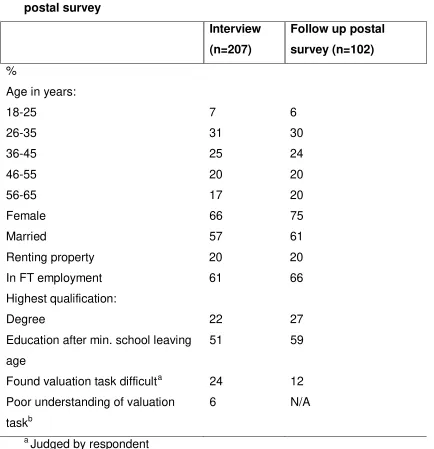
The characteristics of the respondents to the interview and the follow up
postal survey respectively are presented in Table 3. The characteristics of
respondents to both the interview and the survey were broadly similar with the
majority of respondents being female, married and in full-time employment.
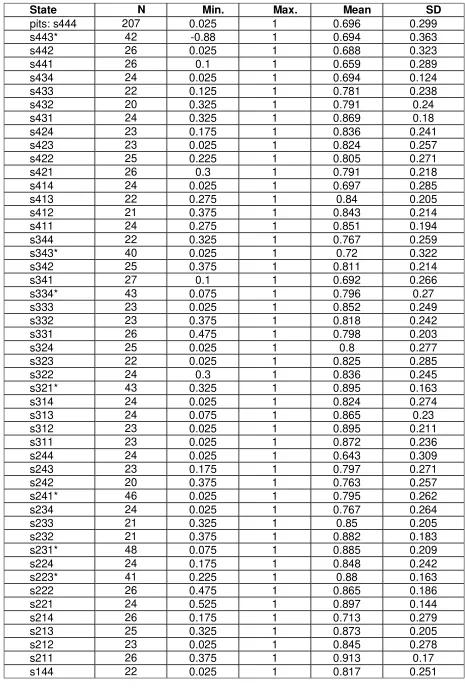
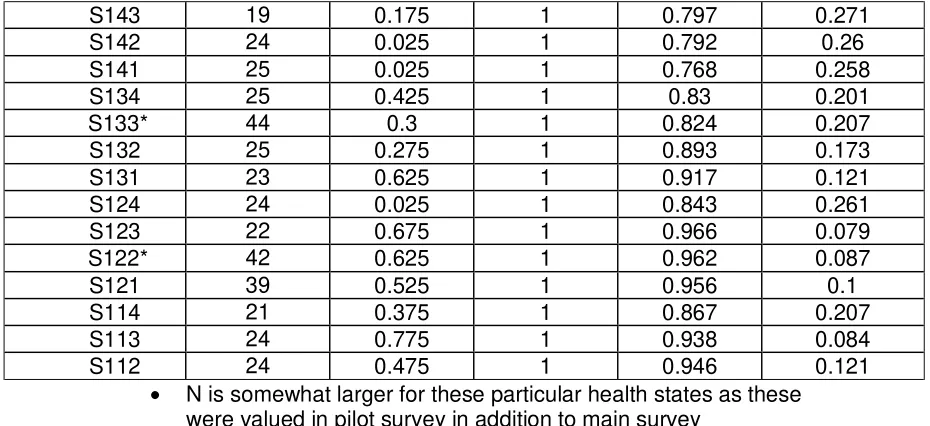
Descriptive statistics for the 64 health states are presented in Table 4. Mean
TTO health state values range from 0.643 to 0.966 and standard deviations
between 0.10 and 0.36. Most health states had 20-30 observations with the
PITS state having 207 (i.e. all respondents).
Table 3 here
Table 4 shows the results for the mean and random effects models for the
TTO, the DCE and ranking models. The dimension level dummies represent
progressively worse problems on each dimension compared to the baseline.
As such the coefficient estimates are expected to be negative and increasing
in absolute size. An inconsistent result occurs where a coefficient on the main
effects dummies decreases in absolute size with a worse level.
For the mean level TTO (Model 1) all of the coefficients have the expected
negative sign, with the exception of the movement from level 1 to level 2 in
sexual relationship which is positive (though very small and not signficant).
Five of the 9 dimension level coefficients are statistically significant (p<0.05),
along with the constant term. With the exception of level 2 to 3 of the
dimension relating to sexual performance, the coefficient estimates increase
with absolute size as the level of each dimension worsens. The explanatory
power of the mean level model is 0.517.
The Hausman test suggests that random, rather than fixed effects is the most
appropriate model specification (Chi2 = 7.50 p Chi2 = 0.221). For the random
effects TTO (Model 2) the results are quite similar in that all of the coefficients
have the expected negative sign and increase with size as the level worsens.
In total, 8 of the 10 coefficients are statistically significant (p<0.05).
The ability of the mean level TTO model to predict observed TTO values is
superior to the random effects model, resulting in fewer errors greater than
0.05 and 0.10 in absolute value. Furthermore, the mean model has a mean
absolute error (MAE) of 0.040 compared to 0.072. In both models the
predictions are unbiased (t-test) indicating that neither model systematically
over or under estimates the observed mean TTO. However, the Ljung-Box
(LB) statistics reveal auto correlation in the prediction errors of both models,
when the errors are ordered by actual mean health state valuation.
For the DCE model (Model 3), all of the coefficients have the expected
The coefficient estimates increase with absolute size as the level of each
dimension worsens with the exception of the movement from level 2 to level 3
in sexual anxiety (although this inconsistency is small and does not relate to
statistically significant dimension levels). For the rank ordered logit models:
Models 4 and 5 the results have the expected negative sign and increase with
size as the level worsens with the exception of the movement from level 1 to
level 2 in sexual anxiety. In total, 9 of the 10 coefficients are statistically
significant (p<0.05).
The ability of the DCE and ranking models to predict observed mean TTO is
broadly similar both in terms of their MAEs compared to observed mean TTO
and in the number of differences compared to observed TTO greater than
0.05 and 0.10 in absolute value. In contrast to the TTO models, the DCE and
both ranking models produce biased predictions (t-test). The LB test found
evidence of a systematic pattern in the differences of the predictions from the
ranking model though not the DCE model. As would be expected, neither the
ranking or DCE models perform as well as the mean level TTO model in
terms of their ability to replicate TTO observed values.
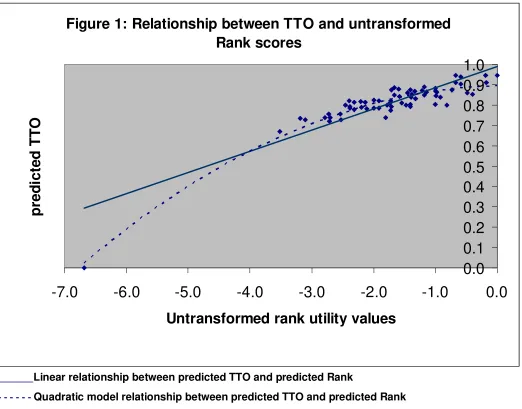
Figure 1 illustrates how re-scaling the raw rank predicted values (Model 4)
according to the predicted TTO values for the best and worst SQOL health
state effectively assumes a linear relationship and fits the predicted mean
level TTO values well. However, probably because even the worst SQOL
health is relatively mild in terms of severity, this method of re-scaling does not
to produce a value of 0 for death (Model 5) the predicted values for the rank
data do not correspond as well to the mean level TTO values.
Figure 1 here
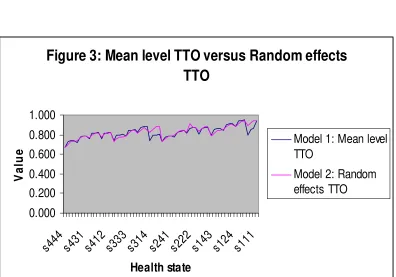
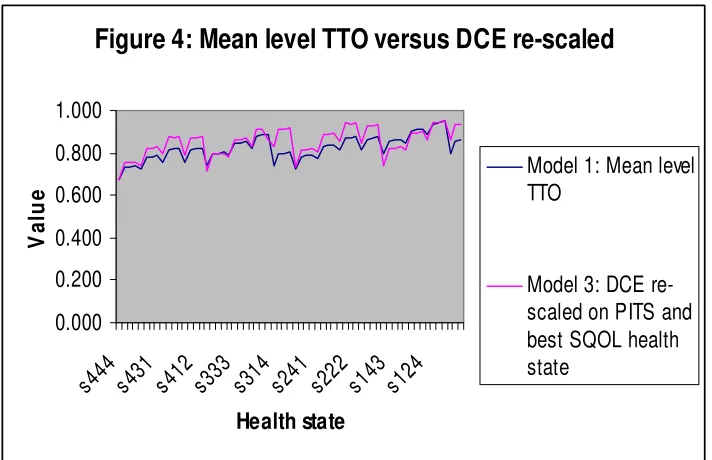
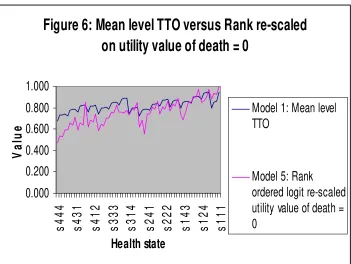
The predictions of Models 1-5 are compared graphically in Figures 2-6. The
health states have been ordered simply in terms of their state number, with
444 at the start as the most severe state (i.e. level 4 on all dimensions) to the
best state 111. This does not represent a monotonic scale, but broadly
speaking the value of states increases when moving from left to right along
the horizontal axis. It can be seen from Figure 2 that values predicted by the
mean level TTO model (model 1) follow fairly closely the observed TTO
values, with no discernible pattern. Figure 3, suggests very little differences
between the RE TTO (model 2) and the mean level TTO values where as the
mean level TTO values lie above the DCE values re-scaled according to the
values for the pits and best SQOL health states (Model 3) for the vast majority
of states (Figure 4). By contrast, the rank values re-scaled in an identical
manner (Model 4) shown in Figure 5 lie below the predicted TTO values for
more severe states and converge towards the predicted mean TTO values at
very mild states with the exception of the PITS state and the best SQOL
health states which are set to be equal. When the rank values are re-scaled
using death as the bottom anchor (Model 5), the results, presented in Figure
6, indicate that the re-scaled rank values lie markedly below the predicted
TTO values for more severe states and above the predicted TTO values for
Figures 2-6 here
Finally, we have examined the ability of the models to predict the logical
ordering of pairs of SQOL states, where one state should be preferred to
another because it is better on at least one dimension, but no worse on any
other dimension. In this respect we found that both the mean level TTO
(model 1) and the random effects TTO (model 2) performed best with no
logical inconsistencies whereas the ordinal models fare worst with the DCE
(model 3) exhibiting 7 logical inconsistencies and rank models (models 4 and
5) having 17 and 15 logical inconsistencies respectively.
3. Discussion
The paper has presented the results of estimating a preference-based index
for a condition specific health state classification using rank and DCE data
and comparing the results to a conventional TTO model. Previous research
has used rank data, but to our knowledge this is the first study to use DCE
data to estimate health states values on the full health-dead scale required to
calculate QALYs.
As would be expected the TTO models faired better than the ordinal models in
replicating observed TTO valued. The RE TTO model (2) performed only
slightly better than the rank (4 and 5) and DCE models (3) in terms of MAE.
However, the latter two models suffered from the presence of bias and
from modelling rank data for the HUI2 and SF-6D where the rank data were
broadly comparable to actual SG (McCabe et al, 2006), though the analysis of
rank data for the EQ-5D found differences for the rescaling against being
dead (check Salomon, 2004). As commented on in McCabe et al (2006),
there is no reason why models estimated from ordinal data should generate
the same values as those produced by conventional cardinal methods. More
research is needed to compare ordinal and cardinal methods, but these
results support the view that they do generate different values.
This paper has also compared the ability of TTO to predict the logical
orderings of health states compared to the ordinal methods. It might be
expected that models estimated from ordinal data would perform better in this
regard. However, the random effects TTO model performed best. This may be
due to the biases found in both the DCE and ranking models
This study has highlighted a number of methodological issues which warrant
further investigation. In relation to the ranking data analysis, the
independence of irrelevant alternatives assumption which characterises the
selection process as equivalent to a series of pairwise choices and assumes
that the ranking of the pair is not affected by the other states that are ranked
in the same exercise is a strong assumption which may be criticised as
unrealistic (McCabe et al, 2006). In this respect, other variants of ordinal and
discrete choice data collection strategies which do not rely upon this
assumption, e.g. best worst scaling (Marley and Louviere, 2005) warrant
further investigation in a health care context. In addition, further empirical
by ordinal valuation techniques to framing effects that may produce significant
differences in responses including subtle variants in question wording, context
and modes of administration.
We found that the two ordinal methods produced different results. DCE data
produced substantially higher values than the ranking data. However, it can
be argued that the DCE values were not based upon a ‘pure’ test of this
method since the values were anchored externally using the predicted TTO
value for the PITS and best SQOL health states. The DCE was administered
by post following the TTO interviews and so the respondents were ‘warmed
up’ in that they were already familiar with the health states to be compared.
Furthermore, only a sub- sample responded to the postal survey although
they were broadly similar in characteristics to respondents from the main
interview study.
Ordinal measurement strategies such as ranking or DCE may have
considerable practical advantages over TTO and SG because it can be
argued that they place a lower cognitive burden on respondents and do not
require such a high degree of abstract reasoning. However, this assertion
needs to be subject to further research. In addition ordinal measurement
strategies are not contaminated by issues relating to time preference or
attitudes to risk, factors affecting TTO and SG generated health states values
respectively. Further empirical studies are required to more fully determine the
Whilst re-scaling the raw rank and DCE predicted values in reference to the
lowest and highest predicted TTO values (Models 3 and 4) provided better
fitting estimates in this study than re-scaling the rank model coefficients in
reference to the value for death (Model 5), fixing the scale in reference to a
value of zero for death may be considered more appropriate in facilitating
normalisation on a scale that will enable the estimation of QALY’s because it
does not need to rely upon information derived from another valuation method
(i.e. TTO). In this respect, the inclusion of the state dead within the DCE
pairwise health state comparisons would also enable this method of re-scaling
to be employed for DCE data. However, it should also be noted that for
condition specific instruments where the worst health state appears relatively
mild on the full health death scale, this approach can be problematic, as was
found with the SQOL. Further empirical work is required to investigate the
optimal method of re-scaling raw rank and DCE predicted values for generic
and condition specific instruments and the extent to which this may vary
References
Brazier JE, Deverill M, Harper R, Booth A (1999). A review of the use of
health status measures in economic evaluation. Health Technology and
Assessment 3 (9).
Brazier J, Ratcliffe J (2004). Survey comparing original response choices to
items of the SqoL to the levels of the SQoL state classification – Preliminary
findings. Report for Pfizer limited.
Brazier J, Ratcliffe J, Salomon J, Tsuchiya A (2006). The measurement and
valuation of health benefits for economic evaluation. Oxford University Press,
Oxford.
Brazier J, Roberts J, Deverill M. The estimation of a preference based single
index measure for health from the SF-36 (2002). Journal of Health Economics
21: 271-292.
Brazier J, Tsuchiya A, Busschbach J, Stolk E (2002). Issues in estimating a
preference based index for condition specific measures. Presentation at the
International Health Economics Association meeting, San Francisco, USA.
Brooks R, Rabin R, De Charro F (2004). The measurement and valuation of
health status using EQ-5D: a European perspective. Kluwer Academic
publishers, London.
Diggle PJ, Heagerty P, Liang KY, Zeger SL (2002). Analysis of longitudinal
data (2nd edition). Oxford University Press, Oxford.
Dowie J (2002). Decision validity should determine whether a generic or
condition specific HRQOL measure is used in health care decisions. Health
Feeny DH, Furling WJ, Torrance GW et al (2002). Multiattribute and single
attribute utility function – the health utility index mark 3 system. Medical Care
40: 113-128.
McCabe C, Brazier J, Gilks P, Tsuchiya A, Roberts J, O’Hagan A, Stevens K
(2006). Using rank data to estimate health state utility models. Journal of
Health Economics 25(3): 418-431.
MVH Group (1995). The measurement and valuation of health: Final report on
the modelling of valuation tariffs. Centre for Health Economics, University of
York.
Propper C (1995).The disutility of time spent on the United Kingdom’s
National Health Service waiting lists. The Journal of Human Resources, 30:
677-700.
Revicki DA, Leidy NK, Brennan-Diemer F et al (1998). Integrating patients
preferences into health outcomes assessment: the multiattribute asthma
symptom utility index. Chest 114: 998-1007.
Ryan M, Farrar S (1994). A pilot study of using conjoint analysis to establish
the views of users in provision of orthodontic services in Grampian. Health
Economics Research Unit Discussion Paper 07/94. University of Aberdeen,
Aberdeen.
Ryan M (1996). The application of conjoint analysis in health care. Office of
Health Economics publications, London.
Salomon JA (2003) Reconsidering the use of rankings in the valuation of
health states: a model for estimating cardinal values from ordinal data.
Salomon JA, Murray CJ (2004). A multi-method approach to measuring health
Stolk EA, Busschbach JJV (2003). Validity and feasibility of the use of
condition specific outcome measures in economic evaluation. Quality of Life
Appendix 1: Example of choice question included in DCE questionnaire
Pair 1
Health State A Health State B
Your sexual performance is good Your sexual performance is adequate
Your sexual relationship is never poor Your sexual relationship is rarely poor
Thinking about your sex life you some times feel anxious
Thinking about you sex life you rarely feel anxious
Which health state do you think is better? (please tick one box only)
Table 1: Dimensions and levels chosen for the simplified SQOL
classification
1. Sexual performance
• Your sexual performance is good
• Your sexual performance is adequate
• Your sexual performance is sometimes inadequate
• Your sexual performance is inadequate
2. Sexual relationship
• Your sexual relationship is never poor
• Your sexual relationship is rarely poor
• Your sexual relationship is sometimes poor
• Your sexual relationship is always poor
3. Sexual anxiety
• Thinking about your sex life you never feel anxious
• Thinking about your sex life you rarely feel anxious
• Thinking about your sex life you sometimes feel anxious
Table 2: a sample of health states defined by the SQOL
s124
Your sexual performance is good
Your sexual relationship is rarely poor
Thinking about your sex life you always feel anxious
s212
Your sexual performance is adequate
Your sexual relationship is never poor
Thinking about your sex life you rarely feel anxious
PITS: s444
Your sexual performance is inadequate
Your sexual relationship is always poor
Table 3 : Characteristics of respondents to interview and follow up
postal survey
Interview
(n=207)
Follow up postal
survey (n=102)
%
Age in years:
18-25 7 6
26-35 31 30
36-45 25 24
46-55 20 20
56-65 17 20
Female 66 75
Married 57 61
Renting property 20 20 In FT employment 61 66 Highest qualification:
Degree 22 27
Education after min. school leaving age
51 59
Found valuation task difficulta 24 12 Poor understanding of valuation
taskb
6 N/A
a
Judged by respondent
b
Table 3: Descriptive statistics for the TTO valuations of the SQOL-3D
State N Min. Max. Mean SD
pits: s444 207 0.025 1 0.696 0.299
s443* 42 -0.88 1 0.694 0.363
s442 26 0.025 1 0.688 0.323
s441 26 0.1 1 0.659 0.289
s434 24 0.025 1 0.694 0.124
s433 22 0.125 1 0.781 0.238
s432 20 0.325 1 0.791 0.24
s431 24 0.325 1 0.869 0.18
s424 23 0.175 1 0.836 0.241
s423 23 0.025 1 0.824 0.257
s422 25 0.225 1 0.805 0.271
s421 26 0.3 1 0.791 0.218
s414 24 0.025 1 0.697 0.285
s413 22 0.275 1 0.84 0.205
s412 21 0.375 1 0.843 0.214
s411 24 0.275 1 0.851 0.194
s344 22 0.325 1 0.767 0.259
s343* 40 0.025 1 0.72 0.322
s342 25 0.375 1 0.811 0.214
s341 27 0.1 1 0.692 0.266
s334* 43 0.075 1 0.796 0.27
s333 23 0.025 1 0.852 0.249
s332 23 0.375 1 0.818 0.242
s331 26 0.475 1 0.798 0.203
s324 25 0.025 1 0.8 0.277
s323 22 0.025 1 0.825 0.285
s322 24 0.3 1 0.836 0.245
s321* 43 0.325 1 0.895 0.163
s314 24 0.025 1 0.824 0.274
s313 24 0.075 1 0.865 0.23
s312 23 0.025 1 0.895 0.211
s311 23 0.025 1 0.872 0.236
s244 24 0.025 1 0.643 0.309
s243 23 0.175 1 0.797 0.271
s242 20 0.375 1 0.763 0.257
s241* 46 0.025 1 0.795 0.262
s234 24 0.025 1 0.767 0.264
s233 21 0.325 1 0.85 0.205
s232 21 0.375 1 0.882 0.183
s231* 48 0.075 1 0.885 0.209
s224 24 0.175 1 0.848 0.242
s223* 41 0.225 1 0.88 0.163
s222 26 0.475 1 0.865 0.186
s221 24 0.525 1 0.897 0.144
s214 26 0.175 1 0.713 0.279
s213 25 0.325 1 0.873 0.205
s212 23 0.025 1 0.845 0.278
s211 26 0.375 1 0.913 0.17
Table 3: Descriptive statistics for the TTO valuations of the SQOL-3D (cont.)
S143 19 0.175 1 0.797 0.271
S142 24 0.025 1 0.792 0.26
S141 25 0.025 1 0.768 0.258
S134 25 0.425 1 0.83 0.201
S133* 44 0.3 1 0.824 0.207
S132 25 0.275 1 0.893 0.173
S131 23 0.625 1 0.917 0.121
S124 24 0.025 1 0.843 0.261
S123 22 0.675 1 0.966 0.079
S122* 42 0.625 1 0.962 0.087
S121 39 0.525 1 0.956 0.1
S114 21 0.375 1 0.867 0.207
S113 24 0.775 1 0.938 0.084
S112 24 0.475 1 0.946 0.121
• N is somewhat larger for these particular health states as these
30 Table 4: Comparison of mean level TTO, random effects TTO, DCE and Ranking model results
Model 1: Mean level TTO
Model 2: Random effects TTO Model 3: Random effects DCE Model 4: Rank ordered logit
Model 5: Rank ordered logit
re-scaled utility value of death = 0
Lev2 performance -0.072* -0.064* -0.095*
-0.735* -0.110*
Lev3 performance -0.060* -0.069* -0.308
-0.998* -0.149*
Lev4 performance -0.126* -0.127* -0.712*
-1.726* -0.258*
Lev2 relationship 0.001 -0.010 -0.052
-0.187 -0.028
Lev3 relationship -0.035 -0.042* -0.458*
-0.181* -0.027*
Lev4 relationship -0.084* -0.111* -1.183*
-0.975* -0.146*
Lev2 anxiety -0.002 -0.001 -0.076
-0.482 -0.072
Lev3 anxiety -0.009 -0.028* -0.071
-0.406* -0.061*
Lev4 anxiety -0.065* -0.060* -0.904*
-0.812* -0.121*
Constant 0.946* 0.961* 0.070
N/A N/A
Death dummy
N/A N/A N/A -6.685* -1.000*
N 64 207 64 189 189
Inconsistencies1 1 0 0 0 0
MAE (compared to actual TTO)_
0.037 0.072 0.077 0.069 0.083
Adjusted R2 0.517 0.207 0.203 0.198 0.198
No. > 0.05 19 (30%) 19 (30%) 18 (28%) 20 22 (34%)
No. > 0.10 45 (70%) 38 (60%) 45 (70) 42 (66%) 44 (69%)
t (mean=0) -0.301
(p=0.765) 0.942 (p=0.439) -13.664 (p=<0.001) -9.465 (p=<0.001) -7.227 (p=<0.001)
LB 4.099
(p=0.848) 86.21 (p=<0.001) 10.568 (p=0.227) 36.120 (p=0.076) 63.973 (p=<0.001)
Figure 1: Relationship between TTO and untransformed
Rank scores
0.0
0.1
0.2
0.3
0.4
0.5
0.6
0.7
0.8
0.9
1.0
-7.0
-6.0
-5.0
-4.0
-3.0
-2.0
-1.0
0.0
Untransformed rank utility values
p
re
d
ic
ted
T
T
O
_______Linear relationship between predicted TTO and predicted Rank
32
Figure 2: Mean level TTO versus
observed TTO
0.000 0.200 0.400 0.600 0.800 1.000
s
444 s431 s412 s333 s314 s241 s222 s143 s124 s111
Health state
V
a
lu
e Model 1: Meanlevel TTO
Observed TTO Values
Figure 3: Mean level TTO versus Random effects
TTO
0.000 0.200 0.400 0.600 0.800 1.000
s444 s431 s412s333 s314 s241 s222 s143 s124 s111
Health state
V
a
lu
e Model 1: Mean levelTTO
[image:35.595.145.541.372.649.2]33
Figure 4: Mean level TTO versus DCE re-scaled
0.000 0.200 0.400 0.600 0.800 1.000
s444 s431 s412 s333 s314 s241 s222 s143 s124
Health state
V
a
lu
e
Model 1: Mean level TTO
Model 3: DCE re-scaled on PITS and best SQOL health state
[image:36.595.105.464.381.657.2]
Figure 5: Mean level TTO versus Rank re-scaled
on PITS and best SQOL health state
0.000 0.200 0.400 0.600 0.800 1.000 s 4 4 4 s 4 3 1 s 4 1 2 s 3 3 3 s 3 1 4 s 2 4 1 s 2 2 2 s 1 4 3 s 1 2 4 s 1 1 1 Health state V a lu e
Model 1: Mean level TTO
34
Figure 6: Mean level TTO versus Rank re-scaled
on utility value of death = 0
0.000 0.200 0.400 0.600 0.800 1.000 s 4 4 4 s 4 3 1 s 4 1 2 s 3 3 3 s 3 1 4 s 2 4 1 s 2 2 2 s 1 4 3 s 1 2 4 s 1 1 1 Health state V a lu e
Model 1: Mean level TTO