http://dx.doi.org/10.4236/ijg.2014.56051
The Physics of Rotational Flattening and the
Point Core Model
Hanno Essén
Department of Mechanics, Royal Institute of Technology (KTH), Stockholm, Sweden Email: [email protected]
Received 26 February 2014; revised 24 March 2014; accepted 21 April 2014 Copyright © 2014 by author and Scientific Research Publishing Inc.
This work is licensed under the Creative Commons Attribution International License (CC BY). http://creativecommons.org/licenses/by/4.0/
Abstract
The effect of rotation on the shape (figure) and gravitational quadrupole of astronomical bodies is calculated by using an approximate point core model: A point mass at the center of an ellipsoidal homogeneous fluid. Maclaurin’s analytical result for homogenous bodies generalizes to this model and leads to very accurate analytical results connecting the three observables: oblateness
( )
, gravitational quadrupole( )
J2 , and angular velocity parameter( )
q . The analytical results arecompared to observational data for the planets and a good agreement is found. Oscillations near equilibrium are studied within the model.
Keywords
Rotation, Angular Velocity, Oblateness, Flattening, Figure of Celestial Body, Gravitational Quadrupole, Point Core Model, Moment of Inertia
1. Introduction
The subject of the flattening of rotating astronomical bodies is thus quite mature. The classical theory is due mainly to Clairaut, Laplace, and Lyapunov. Also Radau, G. H. Darwin, de Sitter, Chandrasekhar and many oth- ers have made important contributions. More recent accounts of the theory can be found in, for example, Jef- freys [5], Jardetzky [6], Zharkov et al. [7], Cook [8], Moritz [9] and, partly in Chandrasekhar [10]. Some peda- gogical efforts can be found in Murray and Dermott [11], or in Kaula [12]. As is plain from these references, the theory is quite involved. Only the unrealistic assumption that the body is homogeneous gives compact analytical results. Otherwise a specified radial density distribution is needed and one resorts to cumbersome series (multi- pole) expansions, or purely numerical methods, for quantitative results. Here we will present analytical results based on the assumption that the body consists of a central point mass surrounded by a homogeneous fluid, the so called point core model. By varying the relative mass of the fluid and the central point mass one can interpo- late between the extreme limits of Newton’s and Maclaurin’s homogeneous body and the Roche model [13] with a dominating small heavy center. The point core model goes back to the work of G. H. Darwin. More re- cently, it has been used to study the shape of outer planet moons, see Hubbard and Anderson [14], Dermott and Thomas [15].
Apart from the basic approximation of a 1) point core, further approximations are made. These are: 2) that the shape is determined by energy minimization of gravitational and kinetic energy 3) under the constraint that the shape is ellipsoidal and that 4) there is a unique constant angular velocity vector (rigid rotation). These are not consistent. Since, according to Hamy’s theorem, see Moritz [9], the exact equilibrium shape is not ellipsoidal, but the deviation is quite small for normal values of the relevant parameters. Differential rotation, which is common in gaseous bodies, is not treated, nor wobbling of the rotation axis. On the other hand, fixed volume (“bulk incompressibility”) need not be assumed; the equilibrium volume problem separates from the shape problem. In spite of these approximations, which are standard in the literature, the mathematics can be quite in- volved. In this article, I hope to clarify and simplify it as much as possible.
This article is organized as follows. First we discuss the parameterization of the ellipsoid. Three degrees of freedom correspond to the three semi axes of the ellipsoid (a, b, c) but these are transformed to three, possibly new, generalized coordinates that describe size (or volume), R, spheroidal, ξ, and triaxial, τ, shape changes, see Equation (3). Then we consider the mass distribution and calculate the relevant moments of inertia. After that the gravitational quadrupole
( )
J2 , the external potential energy, hydrostatic equilibrium, centrifugal potential, and the rotational parameter (q), are introduced. A simple relation between J2, q, and ellipticity
arising froma linear approximation is given in (1.28). The results of this formula are later compared to the more accurate non-linear formulas derived here, e.g. (1.61)-(1.62).
After these preliminaries we calculate the gravitational and rotational energies. The total energy is then mini- mized to find the equilibrium value of the flattening. It is pointed out that the shape problem (value of ξ) sepa- rates from the volume problem (value of R) when the parameters introduced here are used. We then study the shape equilibrium equation and find a very accurate analytical result for the correct oblateness. After that, vari- ous comparisons with observational data are made. The oblateness of the Sun is estimated. So far the problem has been one of static equilibrium in the appropriate rotating system. In a final section, we study small oscilla- tions around the equilibrium. This gives useful insight into the physics of free stellar or planetary oscillations and their coupling to rotation. Our approximations are, however, too severe for these results to be of quantitative interest.
The main results are the simple formulas, Equations (1.59)-(1.61), relating the observables, rotation parameter,
q, gravitational quadrupole, J2, and eccentricity squared, e 2
. These appear to be, partly, new, and their usefulness is demonstrated by comparing with empirical data for the Sun and the rotating planets of the solar system. Varia- tional methods have been used before to study similar problems, see for example Abad et al. [16]. Denis et al.
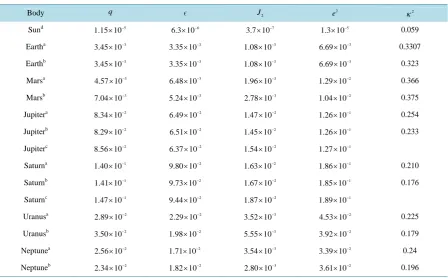
[17] have pointed out that variational methods generally fail to provide estimates of their accuracy. Therefore the agreement of our formulas with empirical data, as demonstrated inTable 1, is important and demonstrates that our model catches the essential physics of rotational flattening.
2. Basic Geometric Quantities
Assume that x, y, z are rectangular Cartesian coordinates in three-dimensional space of a point with position vector
.
x y z
x y z
= + +
Table 1. Values of 3 2
q=Rω GM, of oblateness, , and gravitational quadrupole, J2, ellipticity squared, e
2
,and dimen-
sionless moment of inertia 2 2
I MR
κ = .
Body q
2
J 2
e κ2
Sund 5
1.15 10× − 6
6.3 10× − 7
3.7 10× − 5
1.3 10× − 0.059
Eartha 3
3.45 10× − 3
3.35 10× − 3
1.08 10× − 3
6.69 10× − 0.3307
Earthb 3
3.45 10× − 3
3.35 10× − 3
1.08 10× − 3
6.69 10× − 0.323
Marsa 3
4.57 10× − 3
6.48 10× − 3
1.96 10× − 2
1.29 10× − 0.366
Marsb 3
7.04 10× − 3
5.24 10× − 3
2.78 10× − 2
1.04 10× − 0.375
Jupitera 2
8.34 10× − 2
6.49 10× − 2
1.47 10× − 1
1.26 10× − 0.254
Jupiterb 2
8.29 10× − 2
6.51 10× − 2
1.45 10× − 1
1.26 10× − 0.233
Jupiterc 2
8.56 10× − 2
6.37 10× − 2
1.54 10× − 1
1.27 10× −
Saturna 1
1.40 10× − 2
9.80 10× − 2
1.63 10× − 1
1.86 10× − 0.210
Saturnb 1
1.41 10× − 2
9.73 10× − 2
1.67 10× − 1
1.85 10× − 0.176
Saturnc 1
1.47 10× − 2
9.44 10× − 2
1.87 10× − 1
1.89 10× −
Uranusa 2
2.89 10× − 2
2.29 10× − 3
3.52 10× − 2
4.53 10× − 0.225
Uranusb 2
3.50 10× − 2
1.98 10× − 3
5.55 10× − 2
3.92 10× − 0.179
Neptunea 2
2.56 10× − 2
1.71 10× − 3
3.54 10× − 2
3.39 10× − 0.24
Neptuneb 2
2.34 10× − 2
1.82 10× − 3
2.80 10× − 2
3.61 10× − 0.196
Footnote a: The first row for each planet gives literature [23] data. These are observational except κ2
which are based on theoretical calculations. Footnote b: The second row for each planet gives the corresponding calculated values as given by formulas (1.59)-(1.63) in such a way that for each pair of observational q, J2, and, e2 the missing third is calculated. The moment of inertia is calculated from observational q and J2 using formula (1.25),
2 2
2
2J e
κ = , with 2( ) 2
,
e q J from formula (1.61). Footnote c: The third row for Jupiter and Saturn gives data calculated in a similar way to that in the second row except that the first order formula (1.28) has been used to find the third value from two observational values. Footnote d: For the Sun
, J2 and e2 have been calculated from an observation based q-value discussed in the text and a theoretical κ2 [23], using formulas (1.66), (1.67)
and 2
2
e = respectively.
An ellipsoid, with semi-axes a, b, c, is the solid defined by
1 2
2 2 2
1.
x y z
a b c
+ + ≤
(1.2)
If we put
(
)
(
)
(
)
12 2
, ,
a= ξ τ+ R b= ξ τ− R c= ξ −τ − R (1.3) and define
(
)
1 2 2
2 2
2 2 1
; ,
( )
x y z
E ξ τ
ξ τ ξ τ ξ τ −
≡ + + + − −
r (1.4)
the ellipsoid is the set of points that fulfill
(
; ,)
,E r ξ τ ≤R (1.5)
where R is the geometric mean (or volumetric) radius 3
R= abc. The formula for the volume of an ellipsoid now gives
3
4π 3 4π 3,
and we see that changes of
ξ
and τ do not change the volume, only the shape of the ellipsoid.In what follows, we will also consider the special case of spheroids. A spheroid is an ellipsoid with two equal semi-axes. We take a= ≠b c. This means that we take τ =0 in the formulas above so that
2
, ,
a= =b ξR c=ξ− R (1.7)
and (1.4) becomes
(
)
1 2 2
2 2
2
; , 0 x y z .
E
ξ
ξ
ξ
ξ
−
= + +
r (1.8)
A spheroid is thus defined as the set of points that fulfill
(
; , 0)
E r ξ ≤R (1.9)
Here R is the (geometric) mean radius and
ξ
is a parameter that determines the shape in such a way that1
ξ < corresponds to a prolate spheroid, ξ =1 to a sphere, and ξ >1 to an oblate, or flattened, spheroid. More familiar parameters used to define the shape of a spheroid are the ellipticity and the eccentricity e. The ellipticity is defined by
3
1 .
a c a ξ
−
−
≡ = −
(1.10)
This is sometimes also called the (geometric) oblateness or the flattening (denoted f). Solving this equation, and expanding around =0, we have
( )
2 3
3
1 1 2
1 .
3 9
1 O
ξ = = + + +
− (1.11)
One notes that is positive for oblate and negative for prolate spheroids respectively. The eccentricity
0
e≥ is defined as the usual eccentricity of the ellipse that is the intersection of the spheroid and a plane con- taining the z-axis. One finds that
2 2
2 6
2 1
a c
e
a ξ
−
−
≡ = − (1.12)
gives the eccentricity of these ellipses in the oblate case. For the prolate case e2= −1 ξ6.
3. The Mass Distribution
Consider a non-rotating spherically symmetric body consisting of point particles with masses mi and position vectors
0 0 0 0
i =xi x+yi y+zi z
r e e e . (1.13)
Assume that rotation induces a deviation of the positions so that the new positions, ri = f r
( )
i0 , are given by( )
(
)
0(
)
0(
2 2)
1 0,
i ξ τ xi x yi y zi z ξ τ xi x ξ τ yi y ξ τ zi z
−
= + + = + + − + −
r e e e e e e . (1.14)
This implies that we assume that the elastic displacement field can be parameterized by the shape parameters ξ τ, with non-rotating positions corresponding to ξ = 0, = 0τ . One notes that points r0 that obeyed
(
0)
; 1,0E r =r i.e. were found on a sphere of radius r<R, move to the surface given by
(
; ,)
.E r ξ τ =r (1.15)
The sphere is thus assumed to deform to an ellipsoid.
constant density with a central point mass, the assumption is not approximate, since any surface is an equidensi- ty surface, only the shape of the outer surface matters.
Thus we now assume such a mass distribution. To be precise we assume that a mass M1 is distributed with
constant density
1≡M V1
(1.16)
inside the surface, E
(
r; ,ξ τ =)
R, and that the point mass M0 is at the center, r=0, of the ellipsoid. The density ρ is thus given by( )
0 3( )
1 if(
; ,)
0 otherwise
M δ + E ξ τ ≤R
=
r r
r
(1.17)
where δ3 is the three-dimensional Dirac delta function.
4. Moments of Inertia and the Quadrupole Tensor
If we put mi for the masses of the particles, the inertia tensor of the body is given by
(
)
,i i i i i
i
Iαβ =
∑
m x xγ γδ
αβ−x xα β where we have put, xi =x1i,yi =x2i,zi =x3i and δαβ is the usual Kroneckerdelta. The inertia tensor for the non-rotating body is diagonal with all diagonal elements equal and given by
( )
2( ) ( )
2 20 0 0
.
zz i i i
i
I≡M κR =I =
∑
m x + y (1.18)Here we have introduced the total mass,
0 1,
i i
M ≡
∑
m =M +M (1.19)as well as the dimensionless radius of gyration
κ
. The square of this parameter,κ
2, also appears in the litera- ture denoted I MR2 (or C Ma2, or simply k) and is also called the moment of inertia coefficient.We calculate the dimensionless moment of inertia
κ
2 for the undeformed ρ of Equation (1.17). Using Equation (1.18) and r2 =x2+y2+z2 we find( )
2(
2 2)
1 2 2 21 0 3 1
3
2 2
d 4π d ,
3 4π 5
R r R
M
I M R x y V r r r M R R
κ ≤
= =
∫
+ =∫
= (1.20)where dV =4π dr2 r and Equation (1.16) has been used. This is the usual moment of inertia for a solid sphere of mass M1. This implies that
2 2 1 2 0
5 5
M M M
M M
κ = = − (1.21)
is the squared (dimensionless) radius of gyration of the undeformed body. Note that 2
0≤κ ≤2 5 since the model can go between the limits of a point
(
κ
2→0)
and a homogeneous sphere(
κ
2 =2 5=0.4)
.For the deformed body one gets, using (1.14),
(
2 2)
( )
2(
2 2) (
2 2)
.zz i i i
i
I =
∑
m x +y =M κR ξ +τ =I ξ +τ (1.22)Izz is often denoted by C. For spheroids
(
τ =0)
the other moments of inertia become(
6)
21 1 2
xx yy
I =I = I +ξ− ξ . For these one frequently finds the notation A, and B, respectively, in the literature. The quadrupole tensor, Dαβ, is given in terms of the inertia tensor by Dαβ =Iγγ αβδ −3Iαβ. It is identically ze- ro for the undeformed body and diagonal for the same axes as the inertia tensor. For the spheroidal
(
τ = 0)
body its components are given by(
6)
21
1 ,
2
xx yy
D≡D =D = I −ξ− ξ (1.23)
5. Potential and Hydrostatic Equilibrium
One measure of the oblate shape that is of great interest is the, so called, gravitational quadrupole J2. This di-
mensionless quantity, gives the deviation of the gravitational potential,
φ
, outside the body, from the simple1r-dependence of spherically symmetric bodies. The first two terms in the multipole expansion of this potential are, see e.g. Stacey [19],
( )
2 2 23cos 1
, 1 ,
2
GM a
r J
r r
ϑ
φ ϑ = − − −
(1.24)
where ϑ is the polar angle (colatitude) in spherical coordinates, M the total mass, and a the equatorial radius of the body. One can show [19] that J2 of formula (1.24) is given by
( )
2
2 .
J =D Ma Use of D given in (1.23), and a=ξR, then gives
(
6)
2 2 22 2
1 1
1 ,
2 2
D
J e
Ma ξ κ κ −
≡ = − = (1.25)
for the quadrupole. Here we have also used a=ξR and Equation (1.12). Note that J2=J2
( )
e2 is indepen-dent of R, but directly proportional to the eccentricity squared.
Assuming the oblateness to be small, and due to hydrostatic equilibrium in the combined gravitational and centrifugal force fields, one can derive a formula connecting J2 with the angular velocity and the ellipticity. One
uses that the shape of the surface is determined by the hydrostatic equilibrium equation
(
c)
0,p φ φ
∇ + ∇ + = (1.26)
where p is pressure, mass density, and
( )
1 2 2 2, sin
2
c r r
φ ϑ = − ω ϑ (1.27)
is the potential of the centrifugal force in a system rotating with angular velocity ω about the z-axis. This means that the surface of the body must be an equipotential surface of φ φ+ c. The constancy of φ
( )
r,ϑ φ+ c( )
r,ϑ onthe surface of the body can be used to derive the approximate relationship
2
3 1
2J 2q
= +
(1.28)
[8]. Here we have introduced the ratio q of equatorial centrifugal to gravitational acceleration,
2 2 3 2 2
2
3 . 4π
R R R q
g GM R GM G
ω ω ω ω
≡ = = =
(1.29)
Here =M V is the mean density. Instead of q the notation m occurs in the literature, see Zharkov et al.
[7], who reserve q for the corresponding quantity with the equatorial radius a replacing the mean radius R (recall
3 2
R =a c). The advantage of the definition (1.29) is that it makes q independent of flattening. The relationship (1.28), is only valid to first order in small quantities, so here the difference does not matter, but we will go to higher order below, so take notice. This relationship between the three quantities q (or m), (or f), and J2, can
thus be used to test the hypothesis of hydrostatic equilibrium empirically. This will be done below, using more exact results. For Jupiter and Saturn these will improve significantly on (1.28).
6. Rotational and Gravitational Energy
To study a rotating body, we go to the rotating system, and assume that all particles are affected by the centri- fugal and gravitational potential energies. If the system is rotating rigidly about the z-axis with angular velocity vector ω=ωez, the potential energy of particle i in the centrifugal force field is mi cφ
(
ri,ϑi)
. The total centri- fugal potential energy of the body (system of particles) is(
2 2)
2 21 1
.
2 2
c i i i zz
i
m x y ω I ω
Φ = −
∑
+ = − (1.30)(
2 2)
2( )
2(
2 2)
21 1
2 2
c I ξ τ ω M κR ξ τ ω
Φ = − + = − + (1.31)
for the total potential energy of the particles in the centrifugal potential.
The gravitational potential from an ellipsoid (1.2), of constant density 1, at an interior point is [20]
(
)
1 0 2 2 2 2 2 2( )
d
, , π 1 x y z s ,
x y z G abc
P s a s b s c s
φ = − ∞ − − −
+ + +
∫
(1.32)
where P s
( )
=(
a2+s)(
b2+s)(
c2+s)
. Since(
)
0 0, 0, 0
M φ is the interaction energy of the homogeneous el-
lipsoid with a point particle of mass M0 at the origin one finds the expression
( )
0 0 1 0
3 d
4
s GM M
P s ∞
Φ = −
∫
(1.33)for this interaction energy. Here abc=R3 and Equation (1.16) has been used.
An elementary calculation based on (1.32), see Landau and Lifshitz [21], also shows that the gravitational self-energy of the ellipsoid is
( )
2
1 1 0
3 d
. 10
s GM
P s
∞
Φ = −
∫
(1.34)Use of the definitions (1.3) and the substitution s=R u2 gives
( )
(
)
(
)
(
)
0 0 2 2 2
2 2
d 1 d
.
s u
P s R
u u u
ξ τ ξ τ ξ τ
∞ ∞
−
=
+ + − + − +
∫
∫
(1.35)If we define
( )
(
)
(
)
(
)
0 2 2 2
2 2
1 d
, ,
2
s
s s s
χ ξ τ
ξ τ ξ τ ξ τ
∞
−
= −
+ + − + − +
∫
(1.36)we find that the total gravitational energy of the mass distribution (1.17) is given by
( )
01 1
1 0
3 3
, ,
5 2
M GM M
R χ ξ τ
Φ = Φ + Φ = +
(1.37)
where χ
( )
1, 0 = −1. We define the constant ν , the dimensionless gravitational radius, through( )
2
, . GM
Rν χ ξ τ
Φ = (1.38)
Comparing with (1.37) and using M =M0+M1 together with the result (1.21), a small calculation reveals that the dimensionless gravitational radius, ν , is given by
(
)
2(
2)
1
ν
= 15 8κ
2 3−κ
. (1.39)It is interesting to note that the gravitational energy of a density (1.17), with fixed mass M and radius R, is minimized for κ =2 1 3 (this is incidentally very close Earth’s value).
Using the definition (1.36), it is easy to find the Taylor expansion of χ around ξ =1,τ=0. This gives
( )
, 1 4(
1)
2 4 25 15
χ ξ τ = − + ξ− + τ + (1.40)
For spheroids we define
( )
( )
, 0ψ ξ =χ ξ (1.41)
to be the dimensionless gravitational potential energy. For τ =0 the integral in (1.36) can be found in terms of elementary functions. Several different alternative expressions exist and they are always different depending on whether
ξ
is greater or less than unity. However, noting that, arctanh iz=i arctanz, the two expres- sions in( )
(
)
(
)
2 6
6
2 6
6
arctanh 1
for 0 1 prolate case 1
arctan 1
for 1 oblate case . 1
ξ ξ ξ
ξ ψ ξ
ξ ξ ξ
ξ
−
− < ≤
−
=
− − ≤ < ∞
−
(1.42)
are equivalent and can be used for all 0≤ ≤ ∞ξ . These are really the same real function if only the correct branch is chosen when passing through ξ =1. Series expansion, of either alternative, around ξ =1 gives
( )
4(
)
2 92(
)
3 29(
)
4(
)
51 1 1 1 1 .
5 105 105 O
ψ ξ = − + ξ− − ξ− + ξ− + ξ− (1.43)
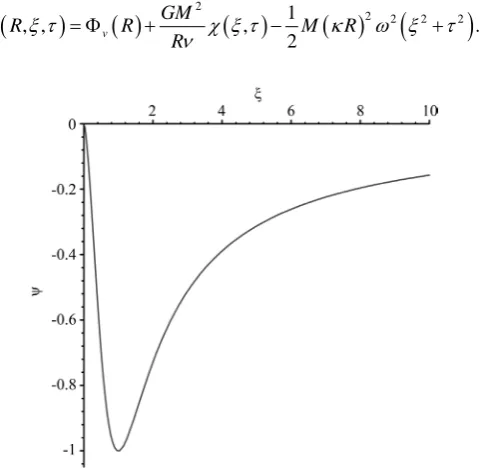
This function, which is shown inFigure 1, has the following properties. The prolate limit, ξ →0, of an in-
finite line is zero:
( )
0lim 0
ξ→ψ ξ = . The oblate limit,
ξ
→ ∞, an infinite circular disc, is also zero: ξlim→∞ψ ξ( )
=0.The sphere
(
ξ =1)
corresponds to a minimum of ψ ξ( )
so that ψ( )
1 = −1, ψ ′( )
1 =0, and ψ ′′( )
1 =8 5.7. Minimizing the Energy
The total energy, U, of a static body (star or planet) will, apart from the centrifugal energy, Φc of Equation (1.31), and gravitational energy, Φ of Equation (1.38), also consist of some volume dependent energy, Φv
( )
R . We can then write this total energy it in the form(
)
( )
2( )
1( )
2 2(
2 2)
, , , .
2
v
GM
U R R M R
R
ξ τ χ ξ τ κ ω ξ τ
ν
[image:8.595.197.443.442.678.2]= Φ + − + (1.44)
Figure 1. The function ψ ξ
( )
of equation Equation (1.42) which givesthe dimensionless gravitational energy of a homogeneous spheroid with
By minimizing this energy, we can find out whether a system tends to be triaxial or spheroidal. For small an- gular velocities the spheroidal case is known to be relevant [10] [22]. We thus put τ =0 here and get
(
)
( )
2( )
1( )
2 2 2, .
2
v
GM
U R R M R
R
ξ ψ ξ κ ω ξ
ν
= Φ + − (1.45)
Using this we can find out if the body will be prolate or oblate and how this is affected by rotation. Since we concentrate on stars and planets surface forces and other neglected shape dependent forces are normally very small compared to the gravitational and centrifugal energies.
The equilibrium equations can be written
( )
2
2 2 2
2
d
0, d
v
U GM
M R
R R Rν ψ ξ κ ω ξ
Φ ∂
= − − =
∂ (1.46)
( )
( )
2
2 2
0,
U GM
M R
R ψ ξ κ ω ξ
ξ ν
∂ ′
= − =
∂ (1.47)
where we have denoted differentiation by
ξ
with a prime. If we multiply the first equation by R and the second byξ
and subtract we get, after rearrangement,( )
( )
2
2
d
. d
v GM
R Rν ψ ξ ψ ξ ξ
Φ ′
= + (1.48)
This is essentially an equation of hydrostatic equilibrium. Note that it determines the equilibrium R-value with no direct reference to the angular velocity ω. The second equation, (1.47) can be written
( )
( )
2
2 2
, GM
M R
Rν ψ ξ′ = κ ω ξ (1.49)
and this expresses a balance of the shape dependent part of the gravitational force with the centrifugal force. If we put
3 2
2 2
, R
k q
GMω νκ νκ
≡ = (1.50)
this turns into the concise expression
( )
k .ψ ξ′ = ξ (1.51)
Since ψ ′
( )
1 =0 this will cause a shift of the shape from the spherical equilibrium, at ξ =1, to ξ >1, as long as ω >0. Use of (1.39) shows that(
)
(
2)
8 15 2 3
k= q −
κ
. (1.52)The equilibrium
ξ
is thus entirely determined by q and the moment of inertiaκ
2.8. Finding the Position of the Minimum
To investigate Equation (1.51), we use the second variant for ψ ξ
( )
in Equation (1.42) and get, after some al- gebra,(
) (
3)
(
)
6 2 6 6 6
1 3 1 arctan 1 3 1 .
k= ξ − − +ξ − ξ − − ξ −
(1.53)
This looks simpler if we introduce the new variable
η ξ
( )
=ξ
6−1. Use of Equation (1.12) shows that6 2
1 e 1 e ,
η
≡ξ
− = − (1.54)so that η can also be regarded as a function of the eccentricity η
( )
e . Now we get(
2)
33 arctan 3 .
For the homogeneous case k=2q 3 and this formula, written in terms of the eccentricity by means of the
identity,
(
2)
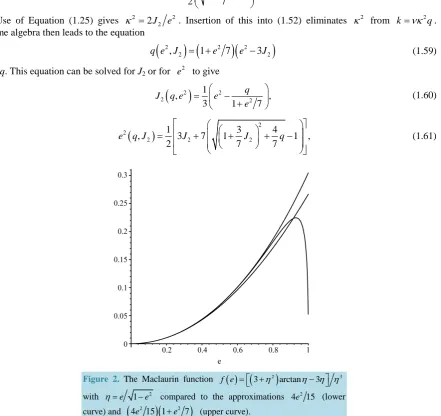
arctan e 1−e =arcsine, is equivalent to the celebrated Maclaurin’s formula [10] from 1742. Taylor expansion of the Maclaurin function around e = 0 only contains positive even powers of e. The coeffi- cient of e6 vanishes so a very good approximation for this function is implied by
(
2)
3 4 2 1 2( )
83 arctan 3 1 .
15e 7e O e
η η η η
+ − = + +
(1.56)
The two term approximation is nearly perfect for all planetary e-values, seeFigure 2. Saturn has maximum e = 0.43 and the absolute error at this value is 2 × 10⁻⁵ and the relative error is 4 × 10⁻⁴. The relative error even re- mains below 1% up to e = 0.75.
Using this approximation we must solve
2 2
4 1
1
15 7
k= e + e
(1.57)
and solving this for e2 gives
2 7 1 15 1 .
2 7
e = + k−
(1.58)
Use of Equation (1.25) gives κ =2 2J2 e2. Insertion of this into (1.52) eliminates
κ
2 from k=νκ2q. Some algebra then leads to the equation(
2) (
2)(
2)
2 2
, 1 7 3
q e J = +e e − J (1.59)
for q. This equation can be solved for J2 or for e2 to give
( )
2 22 , 2 ,
7 1
3 1
q J q e e
e
= − +
(1.60)
(
)
22
2 2 2
1 3 4
, 3 7 1 1 ,
2 7 7
e q J J J q
= + + + −
[image:10.595.101.543.298.714.2](1.61)
Figure 2. The Maclaurin function
( )
(
2)
33 arctan 3
f e = +η η− η η
with 2
1
e e
η= − compared to the approximations 2
4e 15 (lower
curve) and
(
2)(
2)
respectively. These results, together with
(
)
2
2 2 ,
e = − ≈ (1.62)
2
1 1 e ,
= − −
(1.63)
are thus more exact versions of Equation (1.28). Already the approximation 4e2 15, to the Maclaurin function, gives only a 3% error for Saturn, and simpler formulae, but use of these more exact versions removes all nu- merical considerations from the problem.
9. Theory versus Observational Data
Table 1 compares modern data with the predictions of Equations (1.59)-(1.63). Observed data for q, , and J2
from Lodders and Fegeley [23] are given in the first (horizontal) row of data for each of the major rotating pla- nets. In the same line e2 calculated from e2=
(
2−)
is then given. The last value in the row is the dimen- sionless moment of inertia κ =2 I MR2 as given by Lodders and Fegeley [23]. These values are based on cal- culation. For original sources the reader may consult The Planetary Scientist’s Companion by Lodders and Fe- geley [23].For each pair of the values q, J2, and e 2
, in the first row, the third value is calculated using (1.59)-(1.61) and the results are displayed in the second row of data for each planet inTable 1.
is then found from Equation (1.63). For Jupiter and Saturn there is a third row of data inTable 1. This row is analogous to the second row except that the data are calculated from observational pairs of data using the first order formula (1.28) so that qis given by observational and J2 according to q=2−3J2, is found directly from (1.28) using the ob-
servational q and J2, and so on. These rows illustrate the fact that the non-linear formulas of this work are more
accurate than first order results, in spite of the point core approximation. Even for the Earth the first order for- mula gives discrepancies in the third digit.
Table 1shows clearly that the observational data and theory are in reasonable agreement for the planets with the exception of Mars and Uranus. The perfect agreement for the Earth is probably due to the fact that the ob- lateness is determined from the shape of the geoid (the equipotential surface at sea-level). For Mars the disagree- ment may depend on the fact that oblateness is determined from geometrical shape rather than from the shape of an equipotential surface. Also, of course, the assumption of hydrostatic equilibrium may not be perfect for Mars. The problems with the Uranus data, and to some extent those for Neptune, are probably due to observational uncertainty.
10. Oblateness and Moment of Inertia
Instead of eliminating the moment of inertia (or mass ratio) κ2 of Equation (1.21) from the equations as done above one can retain it and try to use observed data to get information about κ2. Series expansion of Equation (1.55) with η expressed in terms of appropriate variables gives
( )
2 3
2 2
3 14
2 3 2 3
q q
O q
κ κ
= + +
− −
(1.64)
for the flattening, or oblateness, expressed in terms of q and the dimensionless moment of inertia. For a homo-
geneous body κ =2 2 5 so 5 75 2
( )
34q 224q O q
= + +
and the old Newtonian result, 5
4q
=
, is obtained, to
first order. In the opposite (Roche) limit of dominating central mass
(
κ
2 =0)
and one finds( )
2 3
1 3
2q 56q O q
= + +
.
In a similar way we get from J2 of Equation (1.25) that
( )
2 2
2 3
2 2 2
8 21
2 3 2 3
J κ q κ q O q
κ κ
= + +
− − (1.65)
plies 2 1 8 2
( )
32 525
J = q+ q +O q . In the opposite limit of κ →2 0 one finds that J2 goes to zero.
Our results (1.64) and (1.65), to first order, are
( )
22 1
,
2 3 q
κ
κ
= −
(1.66)
( )
22
2 2 ,
2 3
J κ κ q
κ =
− (1.67)
and imply that 2
2
J =κ . These may be compared to similar expressions derived by G. H. Darwin using the Radau equation [8]
( )
(
)
2
2 2
40
, 16 25 2 3
q
κ
κ =
+ −
(1.68)
( )
(
)
(
)
2 2 2
2 2
2 64 25 2 3
. 48 75 2 3
J κ κ q
κ
− −
=
+ − (1.69)
These two have the same values at 2
2 5
κ = , the homogeneous sphere, and the same derivatives with respect to κ2 at this point, as (1.66) and (1.67) respectively. The simple expressions (1.66) and (1.67), derived here, however, also have natural limits for κ =2 0, in contrast to e.g. (1.69), which becomes negative for κ <2 2 15.
We now use Equation (1.25) i.e. κ =2 2J2 e2 and Equation (1.61) for 2
(
)
2 ,e q J to calculate κ2 in terms of the observed q and J2. The last entry in the second row for each planet ofTable 1gives κ2,
(
)
(
)
2 2
2 2 2
, 2 , ,
q J J e q J
κ = (1.70)
as calculated from observational, first row, q and J2. Since q and J2 are easier to measure accurately than flat-
tening this should give more reliable values than using the observed ellipticity directly. In this way, one obtains information about the radial mass distribution in the interior of the planet from purely external data. The result- ing κ2-values are given last in the second line for each planet inTable 1. The data obtained in this way are
compared with published and tabulated κ2-values for the planets (Lodders and Fegley [23]). For Earth and Mars the agreement is reassuring. For the outer planets there is naturally a lot of uncertainty but at least the in- creasing trend from a minimum at Saturn is a common feature.
One problem with the outer planets is that the angular velocity is not constant. For a recent study of Saturn’s rotation, see Anderson and Schubert [24]. Also for the Sun, it is hard to decide what angular velocity,
ω
, should be used to find q. Since these bodies have differential rotation some average must be used. There is a well-defined theoretical average angular velocity (Essén [25]) but it is not directly observable. Once an average angular velocity has been selected for the Sun, one can use the present theory and a theoretical κ2-value (0.059)to estimate the solar oblateness and J2. The definition of average angular velocity in [25] indicates that an angu-
lar velocity near the radius of gyration κ ≈R 0.24R should be appropriate. The further assumption that angular velocity is constant on coaxial cylinder surfaces (Kippenhahn and Weigert [13], Ulrich and Hawkins [26]) indi- cates that an angular velocity near the poles of the Sun rather than equatorial angular velocity is relevant.
A handbook value [23] for the polar angular velocity of the Sun is ω=2.1 10 rad s× −6 −1. Use of this gives the
q-value (1.15 × 10⁻⁵) inTable 1. The precise numbers are not important here. What is important is that, because of the small κ2, an angular velocity near the pole rather than an equatorial angular velocity is used. Otherwise
the flattening will be exaggerated. Use of q=1.15 10× −5 and κ =2 0.059 from Lodders and Fegley [23], to- gether with formulas (1.66) and (1.67), gives the results in the top row ofTable 1, that is, ~ 6.3 10× −6, and
7 2~ 3.7 10
J × − . These values are, at least, of the same order of magnitude as the currently best motivated values [3] [4] [26]-[28] which are roughly ~ 9 10× −6 and J2~ 2 10× −7.
11. Small Oscillations near Equilibrium
radius and let Rλ be the variable radius. λ is thus a dimensionless variable which is equal to unity at the undeformed geometry. We parameterize the positions of the particles of the system as follows
(
)
(
)
(
)
(
2 2)
1, , .
i λ ξ τ Rλ ξ τ xi x ξ τ yi y ξ τ zi z
−
∗ ∗ ∗
= + + − + −
r e e e (1.71)
The xi,yi,zi
∗ ∗ ∗ are then the non-rotating equilibrium dimensionless position coordinates of the particles.
Equilibrium corresponds to λ ξ= =1, τ =0, see Section 2. λ is a dilatation (or radial pulsation) degree of freedom, while ξ ≠1 corresponds to spheroidal deformations and τ ≠0 to triaxial deformations.
The velocities of the particles are
(
)
(
)
(
)
(
)
(
)
(
)
(
)(
)
1 2 2 2 2 2 , , , , , 2 .i i x i y i z
i x i y i z
R x y z
R x y z
λ ξ τ λ ξ τ λ ξ τ ξ τ ξ τ
λ ξ τ ξ τ ξξ ττ ξ τ
− ∗ ∗ ∗ − ∗ ∗ ∗ = + + − + − + + + − − − −
v e e e
e e e
(1.72)
An elementary computation shows that the kinetic energy, 1 2
2 i i i
T =
∑
mv , becomes(
)
2 2 22 3 3
2 2
2 2 2 2 2
4 4 4
1 1 1
, , , , , 2 1 2 1
2 2
2 2
1 1 4
I
T λ ξ τ λ ξ τ ξ τ λ λξ λξ λτ λτ
δ δ δ
ξ τ ξτ
λ ξ λ τ λ ξτ
δ δ δ
= + + + − + + + + + + − (1.73)
Here δ ξ≡ 2−τ2 and 2 2 i i2 2 2
i
I= R
∑
m x∗ =MRκ
.The potential energy is given in Equation (1.44). To get an explicit potential energy we must find some ex- pression for the volume dependent (pressure) energy Φv
( )
Rλ . As a model for this part of the energy we take the simple expression2 1 1 1 1 v n GM n νR λ +
Φ =
+ (1.74)
where we must take n>0 if the corresponding force is to balance gravity and prevent collapse. Putting these together we thus find the total potential energy
(
)
2 2( )
2 2 2 2(
2 2)
1
1 1 1 1
, , , ,
1 n 2
GM GM
U MR
n R R
λ ξ τ χ ξ τ κ ω λ ξ τ
ν λ + ν λ
= + − +
+ (1.75)
If we use the definition of k in Equation (1.50), we find the expression
(
)
(
)
( )
(
)
2
2 2 2
1
1 1 1
, , , , 2 1 n GM U k R n
λ ξ τ χ ξ τ λ ξ τ
ν λ + λ
= + + − +
(1.76)
for the potential energy of the system.
Combining T of Equation (1.74) with U to the Lagrangian L
(
λ ξ τ λ ξ τ
, , , , ,)
= −T U, we can get the dynam- ics of this three degree of freedom system exactly by finding and solving the Euler-Lagrange equations of the system. Here we will instead assume small oscillations and make a normal mode analysis. We first Taylor ex- pand U to quadratic terms around λ ξ= =1,τ=0, and then solve for the zeroes of the first derivatives of this quadratic to get the position of the minimum. The result is(
)
(
) (
)
0
8 5
1 1 ,
8 5 3
k k k
n k n k k n
λ = + + ≈ +
− − + (1.77)
(
)
(
) (
)
0
5 5
1 1 ,
8 5 3 8
k n k
k
n k n k k
ξ = + + ≈ +
− − + (1.78)
0 0.
We now introduce new variables, ρ σ, through
0, 0;
ρ λ λ σ ξ ξ= − = − (1.80)
then, of course, ρ λ σ ξ= , = . In the kinetic energy, we replace λ ξ τ, , , in the coefficients with the equili- brium positions λ ξ τ0, 0, 0 and expand to first order in k. In the potential energy, we make the same replacement in the quadratic Taylor expansion, expand to first order in k and throw away constant terms. The result is that
(
)
(
)
2 2
2 2 2 2 2 2
3 15 2
3 3
2 2 2
MR k k
T
n
κ ρ σ τ ρσ σ σ τ
= + + + − + +
(1.81)
and that
(
)
2
2 2 2 2 2 2
8 15 15
3 4 .
2 15 8 8
GM n k
U
Rν ρ σ τ ρ ρσ σ τ
= + + − + + +
(1.82)
Only the degrees of freedom ρ and
σ
are coupled and only when k>0. For k=0, the spheroidalσ
- mode and the triaxialτ
-mode are degenerate (have the same frequency). The value n=4 5 is special since for that value all three modes have the same frequency.For the ρ -mode pressure is restoring force in the contracting phase of the motion and gravity in the expand- ing phase. For the other two modes,
σ
, τ , gravity alone acts to restore the spherical minimum. If we put(
)
2 2
0 3 2 3
8
2 3 15
GM GM Rνκ R κ
Ω ≡ = − (1.83)
Equation (1.50) shows that
2
2 0 8 15
k= ω
Ω , and Equation (1.57), with 2
2
e ≈ , that 8
15
k= . For n>4 5 we then get the approximate eigen frequencies
2 2 2
0
5 2
,
4 3
n
ρ
ω = Ω − ω (1.84)
2 2 2
0
16
1 ,
15n
σ
ω = Ω + − ω
(1.85)
2 2 2
0
16
1 ,
15n
τ
ω = Ω − + ω
(1.86)
to first order in k. From this one easily finds the following first order results
0
2π 2 4
1 ,
15 5
T
n n
ρ =Ω +
(1.87)
0
2π 1 16
1 1 ,
2 15
T
n
σ = − −
Ω (1.88)
0
2π 1 16
1 1 ,
2 15
T
n
τ =Ω + +
(1.89)
for the corresponding periods.
The free radial oscillation mode for the Earth is known [29] to have Tρ=20.45 min=1228 s. This means that one can calculate n and find it to be n = 13.19 for the Earth. Since the equilibrium radius of the rotating Earth is Rλ0 Equation (1.78), and a small calculation, now shows that Earth’s mean radius is 863 m larger due to rotation compared to the non-rotating case. The fairly large n also shows that the g mode periods are essen- tially independent of n. For the Earth one finds that the
τ
-mode has period Tτ =83.22min. Due to the rota-tional splitting, which is given by
0
2π ,
T Tτ Tσ
∆ = − = Ω (1.90)
min (see Udias [29]). The main explanation for the discrepancy is probably that the model neglects elastic forces. Though not quantitatively reliable from this point of view, the model has the advantages of showing in a simple way how rotational splitting of the modes arises and the order of magnitude of such splittings.
12. Conclusion
The basic non-linearity of the problem of rotational flattening of a gravitationally bound body is illustrated by the fact that even the simplest conceivable model leads to a cubic equation [30]. Here some apparently new re- sults relating to the classic theory of the figure of rotating bodies have been presented. The basic model, a point mass at the center of a homogeneous fluid, is characterized by their mass ratio, and interpolates between the lim- its of an ellipsoidal homogeneous fluid and a body dominated by a small central mass concentration. It allows simple analytic treatment but is still flexible enough to correctly describe the essential hydrostatics of real rotat- ing planets as well as stars. Such models are always useful, especially when one wishes to analyze, compare, and understand large numbers of observational data. In spite of the simplicity, there is no perturbation order to which the results are valid. The nonlinearity of the basic equations can be retained. To be more precise, Equation (1.56) shows that the formulas are valid to seventh order in the eccentricity (within the basic model with its sim- plified mass distribution). As demonstrated by the numerical experiments on Jupiter and Saturn data, this is es- sential. In fact, Table 1indicates that the geometric oblateness of the surface equipotential surface of Mars and Uranus determined from observed q and J2 values using (1.61) probably are more reliable than current observa-
tional data. Finally the dynamics of the model reveals the essentials of the coupling and rotational splitting of the most basic free oscillations of a planet without recourse to expansion in spherical harmonics.
Acknowledgements
Constructive comments from Dr. John D. Anderson on a previous version of this manuscript are gratefully ac- knowledged.
References
[1] Todhunter, I. (1873) A History of the Mathematical Theories of Attraction and the Figure of the Earth. Macmillan and
Company, London. (Reprinted: Dover Publications, New York, 1962)
[2] Will, C.M. (1993) Theory and Experiment in Gravitational Physics. Cambridge University Press, Cambridge.
http://dx.doi.org/10.1017/CBO9780511564246
[3] Godier, S. and Rozelot, J.-P. (1999) Quadrupole Moment of the Sun. Gravitational and Rotational Potentials. Astrono-
my & Astrophysics, 350, 310-317.
[4] Laskar, J. (1999) The Limits of Earth Orbital Calculations for Geological Timescale Use. Philosophical Transactions
of the Royal Society A, 357, 1735-1759. http://dx.doi.org/10.1098/rsta.1999.0399
[5] Jeffreys, H. (1962) The Earth, Its Origin History and Physical Constitution. 4th Edition, Cambridge University Press,
Cambridge.
[6] Jardetzky, W.S. (1958) Theories of Figures of Celestial Bodies. Interscience, New York.
[7] Zharkov, V.N. and Trubitsyn, V.P. (Editor Hubbard, W.B.) (1978) Physics of Planetary Interiors. Pachart Publishing
House, Tuscon.
[8] Cook, A.H. (1980) Interiors of the Planets. Cambridge University Press, Cambridge.
http://dx.doi.org/10.1017/CBO9780511721748
[9] Moritz, H. (1990) The Figure of the Earth. Wichmann, Karlsruhe.
[10] Chandrasekhar, S. (1969) Ellipsoidal Figures of Equilibrium. Yale University Press, New Haven and London.
[11] Murray, C.D. and Dermott, S.F. (1999) Solar System Dynamics. Cambridge University Press, Cambridge.
[12] Kaula, W.M. (2000) Theory of Satellite Geodesy. Dover, Mineola.
[13] Kippenhahn, R. and Weigert, A. (1990) Stellar Structure and Evolution. Springer-Verlag, Berlin.
http://dx.doi.org/10.1007/978-3-642-61523-8
[14] Hubbard, W.B. and Anderson, J.D. (1978) Possible Flyby Measurements of Galilean Satellite Interior Structure. Icarus,
33, 336-341. http://dx.doi.org/10.1016/0019-1035(78)90153-7
http://dx.doi.org/10.1016/0019-1035(88)90084-X
[16] Abad, S., Pacheco, A.F. and Sañudo, J. (1995) Variational Methods to Calculate the Hydrostatic Structure of Rotating
Planets. Geophysical Journal International, 122, 953-960. http://dx.doi.org/10.1111/j.1365-246X.1995.tb06848.x
[17] Denis, C., Tomecka-Suchon, S., Rogister, Y. and Amalvict, M. (2000) Comment on “Variational Methods to Calculate
the Hydrostatic Structure of Rotating Planets” by S. Abad, A. F. Pacheco, and J. Sa-udo. Geophysical Journal Interna-
tional, 143, 985-986. http://dx.doi.org/10.1046/j.1365-246X.2000.00294.x
[18] Denis, C., Amalvict, M., Rogister, Y. and Tomecka-Suchon, S. (1998) Methods for Computing Internal Flattening,
with Applications to the Earth’s Structure and Geodynamics. Geophysical Journal International, 132, 603-642.
http://dx.doi.org/10.1046/j.1365-246X.1998.00449.x
[19] Stacey, F.D. (1969) Physics of the Earth. John Wiley, New York.
[20] MacMillan, W.D. (1958) The Theory of the Potential. Dover, New York.
[21] Landau, L. and Lifshitz, E.M. (1975) The Classical Theory of Fields. 4th Edition, Pergamon, Oxford.
[22] Dankova, Ts. and Rosensteel, G. (1998) Triaxial Bifurcations of Rapidly Rotating Spheroids. American Journal of
Physics, 66, 1095-1100. http://dx.doi.org/10.1119/1.19050
[23] Lodders, K. and Fegley Jr., B. (1998) The Planetary Scientist’s Companion. Oxford University Press, New York.
[24] Anderson, J.D. and Schubert, G. (2007) Saturn’s Gravitational Field, Internal Rotation, and Interior Structure. Science,
317, 1384-1387. http://dx.doi.org/10.1126/science.1144835
[25] Essén, H. (1993) Average Angular Velocity. European Journal of Physics, 14, 201-205.
http://dx.doi.org/10.1088/0143-0807/14/5/002
[26] Ulrich, R.K. and Hawkins, G.W. (1981) The Solar Gravitational Figure—J2 and J4. The Astrophysical Journal, 246,
985-988.
http://dx.doi.org/10.1086/158992
[27] Paterno, L., Sofia, S. and Di Mauro, M.P. (1996) The Rotation of the Sun’s Core. Astronomy & Astrophysics, 314,
940-946.
[28] Lydon, T.J. and Sofia, S. (1996) A Measurement of the Shape of the Solar Disc (the Solar Quadrupole Moment, the
Solar Octopole Moment, and the Advance of the Perihelion of the Planet Mercury). Physical Review Letters, 76,
177179. http://dx.doi.org/10.1103/PhysRevLett.76.177
[29] Udías, A. (1999) Principles of Seismology. Cambridge University Press, Cambridge.
[30] Essén, H. (1996) A Simple Mechanical Model for the Shape of the Earth. European Journal of Physics, 17, 131-135.