A Class of Modified Ratio Estimators Using Linear
Combination of Quartile Deviation and Median of
Auxiliary Variable Under Rank Set Sampling
M. Iqbal Jeelani, S.A.Mir, M.S.Pukhta
*Division of Agricultural Statistics, SKUAST-K, India *Corresponding Author: [email protected]
Copyright © 2014 Horizon Research Publishing All rights reserved.
Abstract
In this paper we suggest a new modified ratio estimator of population mean of the study variable using the linear combination of known values of Quartile deviation and Median of the auxiliary variable under Rank set sampling. Mean squared error up to the first degree of approximation are derived and compared with modified ratio estimators given by Kadilar and Chingi [1] based on simple random sampling. The proposed modified ratio estimators under rank set sampling perform better than the ratio estimators given by Kadilar. The simulated study has been carried out in support of the results.Keywords
Rank set sampling, Ratio type estimator, Simple random sampling, Mean square error, Quartile deviation, Median1.
Introduction
Most of the times in sample surveys, along with the variable of interest 𝑌𝑌, information on auxiliary variable 𝑋𝑋, which is highly correlated with 𝑌𝑌 is also collected. This information on auxiliary variable may well be utilized to obtain a more efficient estimator of population mean. Ratio method of estimation is one such example which utilizes the information on auxiliary variable𝑋𝑋, which is positively correlated with the variable of interest 𝑌𝑌, in order to improve the precision of the estimate of population mean. An alternative method to SRS called Ranked Set Sampling (RSS) was introduced to increase the efficiency of the estimation of population mean [2]. The method is useful when the variable of interest is very expensive or difficult to measure but it can be easily ranked at a negligible cost. There are cases in practical situation where the variable of interest Y is difficult to measure and to rank but a concomitant variable X, which is highly correlated with Y, can be easily ranked and be used for the ranking of the sampling units. Some extension is done by Swami [3] utilized both the rank and the measure of the
concomitant variable and considered ratio estimation using RSS. The ratio estimation based on RSS is more efficient compared with the SRS ratio estimate.
2. Ratio Estimation under Simple
Random Sampling
Let the variable of interest Y and the concomitant variable X is correlated with the coefficient of correlation 𝜌𝜌.The population ratio of these two variable is then 𝑅𝑅 = 𝜇𝜇𝑦𝑦
𝜇𝜇𝑥𝑥
� or
𝑅𝑅 = 𝑌𝑌� 𝑋𝑋�� and its estimator is 𝑅𝑅� =𝑦𝑦�𝑥𝑥̅, where µyand µx are the
populations means of the variables Y and X respectively, 𝑦𝑦� and 𝑥𝑥̅ are the sample mean for µx andµy respectively. The
ratio estimator is biased but the bias is negligible when the estimator is approximated using Taylor series expansion to the first degree, Cochran[4]. The approximated Variance of 𝑅𝑅� is
Var �𝑅𝑅�� =�𝑅𝑅𝑛𝑛 (𝑉𝑉2 𝑥𝑥2+ 𝑉𝑉𝑦𝑦2− 2𝜌𝜌𝑥𝑥𝑉𝑉𝑥𝑥𝑉𝑉𝑦𝑦) Where,𝑉𝑉𝑥𝑥= 𝜎𝜎𝜇𝜇𝑥𝑥𝑥𝑥,𝑉𝑉𝑦𝑦 = 𝜎𝜎𝜇𝜇𝑦𝑦𝑦𝑦and
𝜌𝜌𝑥𝑥𝑦𝑦 = �(𝑥𝑥𝑖𝑖− 𝜇𝜇𝑥𝑥 𝑁𝑁
𝑖𝑖=1
)(𝜇𝜇𝑖𝑖− 𝜇𝜇𝑦𝑦)/𝑁𝑁𝜎𝜎𝑥𝑥𝜎𝜎𝑦𝑦
𝜎𝜎𝑥𝑥and 𝜎𝜎𝑦𝑦are the standard deviations of the populations of the variables X and Y, respectively.
These estimators are in the form
𝜇𝜇̂SRS = 𝑦𝑦�+𝛽𝛽(𝜇𝜇(𝛼𝛼𝑥𝑥̅+𝛾𝛾)𝑥𝑥−𝑥𝑥̅)(𝛼𝛼𝜇𝜇𝑥𝑥+ 𝛾𝛾)
where𝛽𝛽 = 𝜎𝜎𝑥𝑥𝑦𝑦 𝜎𝜎𝑥𝑥2 �
They suggested utilizing some known parameters of the concomitant variable X. where the𝛼𝛼 and𝛾𝛾are the main parameters of interest. Based on known values of coefficient of variation and coefficient of Kurtosis of the auxiliary variable Kadilar and Chingi [1] proposed following modified ratio estimators:
If α=1 and 𝛾𝛾 = 𝑉𝑉𝑥𝑥, the estimator be : 𝜇𝜇̂SRS1= 𝑦𝑦�+𝛽𝛽(𝜇𝜇(𝑥𝑥̅+𝑉𝑉𝑥𝑥−𝑥𝑥̅)
𝑥𝑥) (𝜇𝜇𝑥𝑥+ 𝑉𝑉𝑥𝑥)
whereVx is the coefficient of variation defined as Vx =
𝜎𝜎𝑥𝑥 / 𝜇𝜇𝑥𝑥
If α=1 and 𝛾𝛾 = 𝐾𝐾𝑥𝑥, then the estimator be : 𝜇𝜇̂SRS2= 𝑦𝑦�+𝛽𝛽(𝜇𝜇(𝑥𝑥̅+𝐾𝐾𝑥𝑥−𝑥𝑥̅)
𝑥𝑥) (𝜇𝜇𝑥𝑥+ 𝐾𝐾𝑥𝑥)
where Kx is the coefficient of Kurtosis defined
as Kx = 𝜇𝜇𝑥𝑥 4 /𝜇𝜇2𝑥𝑥 2,where 𝜇𝜇𝑥𝑥𝑥𝑥 = 𝐸𝐸(𝑋𝑋 − 𝜇𝜇𝑥𝑥)𝑥𝑥 If α=Kx and𝛾𝛾 = 𝑉𝑉𝑥𝑥, then the estimator be :
𝜇𝜇̂SRS 3=𝑦𝑦�+𝛽𝛽(𝜇𝜇(𝐾𝐾 𝑥𝑥−𝑥𝑥̅)
𝑥𝑥𝑥𝑥̅+𝑉𝑉𝑥𝑥) (𝐾𝐾𝑥𝑥𝜇𝜇𝑥𝑥+ 𝑉𝑉𝑥𝑥)
If 𝛼𝛼 = 𝑉𝑉𝑥𝑥and 𝛾𝛾 = 𝐾𝐾𝑥𝑥, then the estimator be : 𝜇𝜇̂SRS 4=𝑦𝑦�+𝛽𝛽(𝜇𝜇(𝑉𝑉 𝑥𝑥−𝑥𝑥̅)
𝑥𝑥𝑥𝑥̅+𝐾𝐾𝑥𝑥) (𝑉𝑉𝑥𝑥𝜇𝜇𝑥𝑥+ 𝐾𝐾𝑥𝑥)
which can the general form as
𝑦𝑦�𝑅𝑅𝑖𝑖=𝑦𝑦� + 𝛽𝛽(𝜇𝜇𝑥𝑥(𝛼𝛼𝑥𝑥̅ + 𝛾𝛾) (𝛼𝛼𝜇𝜇− 𝑥𝑥̅) 𝑥𝑥+ 𝛾𝛾)
for i= 1,2,3,4
The mean square error (MSE) of the above estimators are approximately
(𝑀𝑀𝑀𝑀𝐸𝐸(𝑦𝑦�𝑅𝑅) =�1−𝑓𝑓𝑛𝑛 [𝑅𝑅𝑖𝑖2𝜎𝜎𝑥𝑥2+ 𝜎𝜎𝑦𝑦21 − 𝜌𝜌2] ≅ 𝑀𝑀𝑀𝑀𝐸𝐸(𝑦𝑦�𝑅𝑅𝑖𝑖) = 𝜃𝜃𝑌𝑌�2�𝐶𝐶𝑦𝑦2+ 𝐷𝐷
𝑖𝑖2𝐶𝐶𝑋𝑋2− 2𝐷𝐷𝑖𝑖𝜌𝜌𝐶𝐶𝑦𝑦𝐶𝐶𝑥𝑥� for i= 1,2,3,4
Where D1= 𝜇𝜇𝑦𝑦
𝜇𝜇𝑥𝑥+𝑉𝑉𝑥𝑥, D2 =
𝜇𝜇𝑦𝑦
𝜇𝜇𝑥𝑥+𝐾𝐾𝑥𝑥, D3 =
𝜇𝜇𝑦𝑦𝐾𝐾𝑥𝑥
𝜇𝜇𝑥𝑥𝐾𝐾𝑥𝑥+𝑉𝑉𝑥𝑥, and D4 =
𝜇𝜇𝑦𝑦𝑉𝑉𝑥𝑥
𝑉𝑉𝑥𝑥𝜇𝜇𝑥𝑥+𝐾𝐾𝑥𝑥
𝐶𝐶𝑦𝑦 =𝑀𝑀𝑦𝑦
𝑌𝑌�, 𝐶𝐶𝑥𝑥 = 𝑀𝑀𝑋𝑋
𝑋𝑋, 𝜌𝜌 = 𝑀𝑀𝑦𝑦𝑥𝑥
𝑀𝑀𝑦𝑦𝑀𝑀𝑥𝑥, 𝜃𝜃 =
1
𝑛𝑛 (𝑜𝑜𝑛𝑛 𝑖𝑖𝑖𝑖𝑛𝑛𝑜𝑜𝑥𝑥𝑖𝑖𝑛𝑛𝑖𝑖, 𝑓𝑓 = 𝑛𝑛
𝑁𝑁 � ) 𝑀𝑀𝑦𝑦2= ∑ (𝑦𝑦𝑖𝑖−𝑌𝑌�)
2 𝑁𝑁 𝑖𝑖=1
𝑁𝑁−1 , 𝑀𝑀𝑥𝑥2= ∑𝑁𝑁𝑖𝑖=1(𝑥𝑥𝑖𝑖−𝑋𝑋�)2
𝑁𝑁−1 , 𝑀𝑀𝑦𝑦𝑥𝑥 =∑(𝑦𝑦𝑖𝑖− 𝑌𝑌�)(𝑥𝑥𝑁𝑁 − 1𝑖𝑖− 𝑋𝑋�)
3. Ratio Estimation under Rank Set
Sampling
Samawi and Muttlak[3]proposed modified ratio
estimators in case of rank set sampling. The procedure of ratio estimation under rank set sampling given by Samawi and Muttlak[3]are as under:
Let Y be the variable if interest and X be a suitable concomitant variable which is correlated to Y and easy to rank. The summary of the RSS procedure is then as following:
1. Select randomly m2 bivariate units (X,Y) from the population.
2. Allocate the chosen units into m sets each if size m. 3. From the first set, the smallest X and the associated
Y are measured. From the second set, the second smallest of X and the associated Y are measures, We continue in this way until the last set where the largest X and the associated Y are measured.
4. Repeat the steps above r times until getting the required number if elements
The associated variable Y is then with error unless the relation between X and Y is perfect. Let us denote (Xj(i), Yj[i])
as the pair of the ith order statistics of X and the associated element Y in the Jth cycle. Then the ranked set sample is
(X1(1), Y1[1]),…, (X1(m), Y1[m]), (X2(1), Y2[1]),…, (X2(m), Y2[m]),
. . .
(Xr(1), Yr[1]),…, (Xr (m), Yr [m]) Then we define the sample means based on RSS by 𝑋𝑋�* = (1/n) ∑𝑛𝑛 𝑋𝑋(𝑖𝑖 )
𝑖𝑖=1 and 𝑌𝑌�* = (1/n) ∑𝑛𝑛𝑖𝑖=1𝑌𝑌[𝑖𝑖] with variances are
Var(𝑋𝑋�*) = 𝜎𝜎𝑥𝑥2
𝑚𝑚 − 1
𝑚𝑚2∑ (𝜇𝜇𝑥𝑥(𝑖𝑖)𝑚𝑚𝑖𝑖=1 − 𝜇𝜇𝑥𝑥)2,
Var(𝑌𝑌�*) = 𝜎𝜎𝑦𝑦2
𝑚𝑚 − 1
𝑚𝑚2∑ (𝜇𝜇𝑦𝑦[𝑖𝑖]𝑚𝑚𝑖𝑖=1 − 𝜇𝜇𝑦𝑦)2 and Cov(𝑋𝑋�*,𝑌𝑌�*) = (1/m)𝜎𝜎𝑥𝑥𝑦𝑦 − (1/𝑚𝑚2) ∑𝑚𝑚𝑖𝑖=1𝑘𝑘𝑥𝑥𝑦𝑦 [𝑖𝑖] with
𝑘𝑘𝑥𝑥𝑦𝑦 [𝑖𝑖]= (𝜇𝜇𝑥𝑥(𝑖𝑖)− 𝜇𝜇𝑥𝑥)(𝜇𝜇𝑦𝑦[𝑖𝑖]− 𝜇𝜇𝑦𝑦) 𝑅𝑅�=𝑦𝑦�*/𝑥𝑥̅* where 𝑥𝑥̅∗ = 1
𝑚𝑚𝑥𝑥∑𝑥𝑥𝑘𝑘=1∑𝑚𝑚𝑖𝑖=1𝑋𝑋𝑘𝑘(𝑖𝑖)and 𝑦𝑦�∗ = 1
𝑚𝑚𝑥𝑥� � 𝑌𝑌𝑘𝑘(𝑖𝑖) 𝑚𝑚
𝑖𝑖=1 𝑥𝑥
𝑘𝑘=1
and the ratio estimator of the population mean of Y is 𝑦𝑦�𝑅𝑅𝑅𝑅𝑅𝑅 = 𝑦𝑦�∗�𝑋𝑋�
𝑥𝑥̅∗�
𝑀𝑀𝑀𝑀𝐸𝐸(𝑦𝑦�𝑅𝑅𝑅𝑅𝑅𝑅) = 𝜃𝜃𝑌𝑌�2�𝐶𝐶𝑦𝑦2+ 𝐶𝐶𝑋𝑋2− 2𝜌𝜌𝐶𝐶𝑦𝑦𝐶𝐶𝑥𝑥� − {𝑍𝑍𝑦𝑦(𝑖𝑖)− 𝑍𝑍𝑥𝑥(𝑖𝑖)}2
𝜃𝜃 =𝑚𝑚𝑥𝑥1 ,
𝐶𝐶𝑦𝑦2=𝑀𝑀𝑦𝑦2 𝑌𝑌�2, 𝐶𝐶𝑥𝑥2= 𝑀𝑀𝑥𝑥
𝑍𝑍𝑥𝑥(𝑖𝑖)2 = 𝑚𝑚12𝑥𝑥 1
𝑋𝑋�2� 𝑘𝑘𝑥𝑥(𝑖𝑖)2 𝑚𝑚
𝑖𝑖=1 ,
𝑍𝑍𝑦𝑦(𝑖𝑖)2 = 𝑚𝑚12𝑥𝑥 1
𝑋𝑋�2� 𝑘𝑘𝑦𝑦(𝑖𝑖)2 𝑚𝑚
𝑖𝑖=1 ,
𝑍𝑍𝑦𝑦𝑥𝑥 (𝑖𝑖)= 𝑚𝑚12𝑥𝑥 1
𝑌𝑌�𝑋𝑋�� 𝑘𝑘𝑦𝑦𝑥𝑥 (𝑖𝑖) 𝑚𝑚
𝑖𝑖=1
Also 𝑘𝑘𝑥𝑥(𝑖𝑖)= �𝜇𝜇𝑥𝑥(𝑖𝑖)− 𝑋𝑋��, 𝑘𝑘𝑦𝑦(𝑖𝑖)= �𝜇𝜇𝑦𝑦(𝑖𝑖)− 𝑌𝑌�� 𝑘𝑘𝑦𝑦𝑥𝑥 (𝑖𝑖)= �𝜇𝜇𝑥𝑥(𝑖𝑖)− 𝑋𝑋���𝜇𝜇𝑦𝑦(𝑖𝑖)− 𝑌𝑌��
Using one degree Taylor series expansion, they showed that this estimator is more efficient than that from SRS with similar form.
4. Proposed Ratio Estimators under
Rank Set Sampling
In this section we suggest to use similar form of estimators as given by Kadilar and Chingi [1]. We assume that the population mean of the auxiliary variable is known beforehand, we also assume that the relation between X and Y is positive and approximately linear.
Based on RSS, we suggest ratio-type estimators for the mean in the form
𝜇𝜇̂RSS = 𝑦𝑦�
∗+𝛽𝛽(𝜇𝜇𝑥𝑥−𝑥𝑥̅∗)
(𝛼𝛼𝑥𝑥̅∗+𝛾𝛾) (𝛼𝛼𝜇𝜇𝑥𝑥+ 𝛾𝛾) where 𝛼𝛼 and 𝛾𝛾 are positive constants,
and𝛽𝛽 = 𝜎𝜎𝑥𝑥𝑦𝑦/ 𝜎𝜎𝑥𝑥2
Let us take some special cases of 𝛼𝛼 𝑎𝑎𝑛𝑛𝑎𝑎 𝛾𝛾 various combinations of known values of Median, Quartile deviation of auxiliary variable in case of RSS.
CASE-1: If the Quartile Deviation and Median of the concomitant variable are available, we may choose this parameter to be values for 𝜎𝜎and 𝛾𝛾in the estimator above. For examples:
If 𝛼𝛼=1and 𝛾𝛾 = 𝑄𝑄𝑎𝑎, then we have the estimator : 𝜇𝜇̂RSS1= 𝑦𝑦�∗+𝛽𝛽(𝜇𝜇𝑥𝑥−𝑥𝑥̅∗)
(𝑥𝑥̅∗+𝑄𝑄𝑎𝑎) (𝜇𝜇𝑥𝑥+ 𝑄𝑄𝑎𝑎)
If 𝛼𝛼=1and 𝛾𝛾 = 𝑀𝑀𝑎𝑎, then we have the estimator 𝜇𝜇̂RSS2 = 𝑦𝑦�∗+𝛽𝛽(𝜇𝜇𝑥𝑥−𝑥𝑥̅∗)
(𝑥𝑥̅∗+𝑀𝑀𝑎𝑎) (𝜇𝜇𝑥𝑥+ 𝑀𝑀𝑎𝑎) If 𝛼𝛼=Md and 𝛾𝛾 = 𝑄𝑄𝑎𝑎, then we have the estimator :
𝜇𝜇̂RSS3= 𝑦𝑦�∗+𝛽𝛽(𝜇𝜇𝑥𝑥−𝑥𝑥̅∗)
(𝑀𝑀𝑎𝑎 𝑥𝑥̅∗+𝑄𝑄𝑎𝑎) (𝑀𝑀𝑎𝑎𝜇𝜇𝑥𝑥+ 𝑄𝑄𝑎𝑎)
If 𝛼𝛼=Qd and 𝛾𝛾 = 𝑀𝑀𝑎𝑎, then we have the estimator : 𝜇𝜇̂RSS4= 𝑦𝑦�∗+𝛽𝛽(𝜇𝜇𝑥𝑥−𝑥𝑥̅∗)
(𝑄𝑄𝑎𝑎𝑥𝑥̅∗+𝑀𝑀𝑎𝑎) (𝑄𝑄𝑎𝑎𝜇𝜇𝑥𝑥+ 𝑀𝑀𝑎𝑎) As we know, 𝑦𝑦�𝑅𝑅𝑅𝑅𝑅𝑅 = 𝑦𝑦�∗�𝑋𝑋�
𝑥𝑥̅∗� also we can denote 𝑦𝑦�𝑅𝑅𝑅𝑅𝑅𝑅as
𝜇𝜇̂𝑅𝑅𝑅𝑅𝑅𝑅 Where
𝑥𝑥̅∗ = 1
𝑚𝑚𝑥𝑥∑𝑥𝑥𝑘𝑘=1∑𝑚𝑚𝑖𝑖=1𝑋𝑋𝑘𝑘(𝑖𝑖),
𝑦𝑦�∗ = 1
𝑚𝑚𝑥𝑥 � � 𝑌𝑌𝑘𝑘(𝑖𝑖) 𝑚𝑚
𝑖𝑖=1 𝑥𝑥
𝑘𝑘=1 Then
𝑦𝑦�𝑅𝑅𝑅𝑅𝑅𝑅𝑖𝑖 = 𝑦𝑦�∗+𝛽𝛽(𝜇𝜇𝑥𝑥−𝑥𝑥̅∗)
(𝛼𝛼𝑥𝑥̅∗+𝛾𝛾) (𝛼𝛼𝜇𝜇𝑥𝑥+ 𝛾𝛾)(for i= 1,2,3,4)
The bias and mean square error of the above estimator based on RSS will be:
𝐵𝐵𝑖𝑖𝑎𝑎𝑅𝑅(𝑦𝑦�𝑅𝑅𝑅𝑅𝑅𝑅𝑖𝑖) = 𝑌𝑌��𝜃𝜃�𝐺𝐺𝑖𝑖2𝐶𝐶𝑥𝑥2− 𝐺𝐺𝑖𝑖𝜌𝜌𝐶𝐶𝑦𝑦𝐶𝐶𝑥𝑥� − �𝐺𝐺𝑖𝑖2𝑍𝑍𝑥𝑥(𝑖𝑖)2 − 𝐺𝐺𝑖𝑖𝑍𝑍𝑦𝑦𝑥𝑥 (𝑖𝑖)��
𝑀𝑀𝑀𝑀𝐸𝐸(𝑦𝑦�𝑅𝑅𝑅𝑅𝑅𝑅𝑖𝑖) = 𝑌𝑌�2�𝜃𝜃�𝐶𝐶𝑦𝑦2+ 𝐺𝐺
𝑖𝑖2𝐶𝐶𝑥𝑥2− 2𝐺𝐺𝑖𝑖𝜌𝜌𝐶𝐶𝑦𝑦𝐶𝐶𝑥𝑥� − {𝑍𝑍𝑦𝑦(𝑖𝑖)− 𝐺𝐺𝑖𝑖𝑍𝑍𝑥𝑥(𝑖𝑖)}2�
Where 𝐺𝐺𝑖𝑖 =𝛼𝛼𝑋𝑋�+𝛾𝛾𝑌𝑌�𝛼𝛼
Where 𝛼𝛼 𝑎𝑎𝑛𝑛𝑎𝑎 𝛾𝛾 can be replaced by various linear combinations of known values of Median, quartile deviation, of the auxiliary variable which is mentioned in the above case.
5.
Bias and Mean Square Estimation of
Proposed Estimators
Since the bias and mean square error of the above estimator based on RSS will be :
𝐵𝐵𝑖𝑖𝑎𝑎𝑅𝑅(𝑦𝑦�𝑅𝑅𝑅𝑅𝑅𝑅𝑖𝑖) = 𝑌𝑌��𝜃𝜃�𝐺𝐺𝑖𝑖2𝐶𝐶𝑥𝑥2− 𝐺𝐺𝑖𝑖𝜌𝜌𝐶𝐶𝑦𝑦𝐶𝐶𝑥𝑥� − �𝐺𝐺𝑖𝑖2𝑍𝑍𝑥𝑥(𝑖𝑖)2 − 𝐺𝐺𝑖𝑖𝑍𝑍𝑦𝑦𝑥𝑥 (𝑖𝑖)��
𝑀𝑀𝑀𝑀𝐸𝐸(𝑦𝑦�𝑅𝑅𝑅𝑅𝑅𝑅𝑖𝑖) = 𝑌𝑌�2�𝜃𝜃�𝐶𝐶𝑦𝑦2+ 𝐺𝐺
𝑖𝑖2𝐶𝐶𝑥𝑥2− 2𝐺𝐺𝑖𝑖𝜌𝜌𝐶𝐶𝑦𝑦𝐶𝐶𝑥𝑥� − {𝑍𝑍𝑦𝑦(𝑖𝑖)− 𝐺𝐺𝑖𝑖𝑍𝑍𝑥𝑥(𝑖𝑖)}2�
Where 𝐺𝐺𝑖𝑖 =𝛼𝛼𝑋𝑋�+𝛾𝛾𝑌𝑌�𝛼𝛼
To obtain the bias and MSE of 𝑦𝑦�𝑅𝑅𝑅𝑅𝑅𝑅𝑖𝑖 We put 𝑦𝑦�∗= 𝑌𝑌�(1 + 𝜀𝜀0)
And 𝑥𝑥̅∗= 𝑋𝑋�(1 + 𝜀𝜀1), so that the expectation of 𝜀𝜀0 and 𝜀𝜀1 is equal to zero
𝐸𝐸(𝜀𝜀0) = 𝐸𝐸(𝜀𝜀1) = 0
𝑉𝑉(𝜀𝜀0) = 𝐸𝐸(𝜀𝜀02) =𝑉𝑉(𝑦𝑦�∗) 𝑌𝑌�2
= 𝑚𝑚𝑥𝑥1 𝑌𝑌�12�𝑚𝑚1� 𝑘𝑘𝑦𝑦(𝑖𝑖)2 𝑚𝑚
𝑖𝑖=1
� = �𝜃𝜃𝐶𝐶𝑦𝑦2− 𝑍𝑍𝑦𝑦(𝑖𝑖)2 �
Similarly
𝑉𝑉(𝜀𝜀1) = 𝐸𝐸(𝜀𝜀12) = �𝜃𝜃𝐶𝐶𝑥𝑥2− 𝑍𝑍 𝑥𝑥(𝑖𝑖)2 � And
𝐶𝐶𝑜𝑜𝐶𝐶 (𝜀𝜀0, 𝜀𝜀1) = 𝐸𝐸 (𝜀𝜀0, 𝜀𝜀1) = 𝐶𝐶𝑜𝑜𝐶𝐶(𝑦𝑦�∗𝑥𝑥̅∗) 𝑌𝑌�𝑋𝑋� = 𝑌𝑌�𝑋𝑋�1 𝑚𝑚𝑥𝑥 �𝑀𝑀1 𝑦𝑦𝑥𝑥 −𝑚𝑚 �1 𝑘𝑘𝑦𝑦𝑥𝑥 (𝑖𝑖)
𝑚𝑚
𝜃𝜃 =𝑚𝑚𝑥𝑥,1
𝐶𝐶𝑦𝑦2=𝑀𝑀𝑦𝑦2 𝑌𝑌�2, 𝐶𝐶𝑥𝑥2=𝑀𝑀𝑥𝑥2
𝑋𝑋�2, 𝐶𝐶𝑦𝑦𝑥𝑥 =𝑀𝑀𝑦𝑦𝑥𝑥𝑋𝑋�𝑌𝑌� = 𝜌𝜌𝐶𝐶𝑦𝑦𝐶𝐶𝑥𝑥,
𝑍𝑍𝑥𝑥(𝑖𝑖)2 = 𝑚𝑚12𝑥𝑥 1
𝑋𝑋�2� 𝑘𝑘𝑥𝑥(𝑖𝑖)2 𝑚𝑚
𝑖𝑖=1 ,
𝑍𝑍𝑦𝑦(𝑖𝑖)2 = 𝑚𝑚12𝑥𝑥 1
𝑋𝑋�2� 𝑘𝑘𝑦𝑦(𝑖𝑖)2 𝑚𝑚
𝑖𝑖=1 ,
𝑍𝑍𝑦𝑦𝑥𝑥 (𝑖𝑖)= 𝑚𝑚12𝑥𝑥 1
𝑌𝑌�𝑋𝑋�� 𝑘𝑘𝑦𝑦𝑥𝑥 (𝑖𝑖) 𝑚𝑚
𝑖𝑖=1 Also 𝑘𝑘𝑥𝑥(𝑖𝑖)= �𝜇𝜇𝑥𝑥(𝑖𝑖)− 𝑋𝑋��, 𝑘𝑘𝑦𝑦(𝑖𝑖) = �𝜇𝜇𝑦𝑦(𝑖𝑖)− 𝑌𝑌�� and
𝑘𝑘𝑦𝑦𝑥𝑥 (𝑖𝑖)= �𝜇𝜇𝑥𝑥(𝑖𝑖)− 𝑋𝑋���𝜇𝜇𝑦𝑦(𝑖𝑖)− 𝑌𝑌�� Proof :
BIAS
𝐵𝐵𝑖𝑖𝑎𝑎𝑅𝑅(𝑦𝑦�𝑅𝑅𝑅𝑅𝑅𝑅𝑖𝑖) = 𝐸𝐸(𝑦𝑦�𝑅𝑅𝑅𝑅𝑅𝑅𝑖𝑖− 𝑌𝑌�) Here 𝑦𝑦�𝑅𝑅𝑅𝑅𝑅𝑅𝑖𝑖 = 𝑌𝑌�(1 + 𝜀𝜀0)(1 + 𝐺𝐺𝑖𝑖𝜀𝜀1)−1
Suppose (𝐺𝐺𝑖𝑖𝜀𝜀1) < 1 so that (1 + 𝐺𝐺𝑖𝑖𝜀𝜀1)−1 is expandable 𝑦𝑦�𝑅𝑅𝑅𝑅𝑅𝑅𝑖𝑖 = 𝑌𝑌�(1 + 𝜀𝜀0){1 − 𝐺𝐺𝑖𝑖𝜀𝜀1+ 𝐺𝐺𝑖𝑖2𝜀𝜀12+ 𝑂𝑂(𝐺𝐺1𝜀𝜀1)} (Using Taylor series expansion, where 𝑂𝑂(𝜀𝜀1) with power more than 2 are neglected for large power of 𝜀𝜀1.
𝐵𝐵𝑖𝑖𝑎𝑎𝑅𝑅(𝑦𝑦�𝑅𝑅𝑅𝑅𝑅𝑅𝑖𝑖) = 𝑌𝑌[���𝐺𝐺𝑖𝑖2𝐸𝐸(𝜀𝜀12) − 𝐺𝐺𝑖𝑖𝐸𝐸(𝜀𝜀0𝜀𝜀1)] = 𝑌𝑌�[𝐺𝐺𝑖𝑖2�𝜃𝜃𝐶𝐶𝑥𝑥2− 𝑍𝑍𝑥𝑥(𝑖𝑖)2 � − 𝐺𝐺𝑖𝑖(𝜃𝜃𝜌𝜌𝐶𝐶𝑦𝑦𝐶𝐶𝑥𝑥− 𝑍𝑍𝑦𝑦𝑥𝑥 (𝑖𝑖))] =≫ 𝐵𝐵𝑖𝑖𝑎𝑎𝑅𝑅(𝑦𝑦�𝑅𝑅𝑅𝑅𝑅𝑅𝑖𝑖) = 𝑌𝑌�[𝜃𝜃(𝐺𝐺𝑖𝑖2𝐶𝐶𝑥𝑥2− 𝐺𝐺𝑖𝑖𝜌𝜌𝐶𝐶𝑦𝑦𝐶𝐶𝑥𝑥) − {𝐺𝐺𝑖𝑖2𝑍𝑍
𝑥𝑥(𝑖𝑖)2 − 𝐺𝐺𝑖𝑖𝑍𝑍𝑦𝑦𝑥𝑥 (𝑖𝑖)})]
Proof
MEAN SQUARE ERROR:
𝑀𝑀𝑀𝑀𝐸𝐸(𝑦𝑦�𝑅𝑅𝑅𝑅𝑅𝑅𝑖𝑖) = 𝐸𝐸(𝑦𝑦�𝑅𝑅𝑅𝑅𝑅𝑅𝑖𝑖− 𝑌𝑌�)2 = 𝑌𝑌�2𝐸𝐸[𝜀𝜀0− 𝐺𝐺𝑖𝑖𝜀𝜀1+ 𝐺𝐺
𝑖𝑖2𝜀𝜀12− 2𝐺𝐺𝑖𝑖𝜀𝜀0𝜀𝜀1]2 = 𝑌𝑌�2𝐸𝐸[𝜀𝜀02+ 𝐺𝐺
𝑖𝑖2𝜀𝜀12− 2𝐺𝐺𝑖𝑖𝜀𝜀0𝜀𝜀1] = 𝑌𝑌�2�𝜃𝜃𝐶𝐶
𝑦𝑦2− 𝑍𝑍𝑦𝑦(𝑖𝑖)2 + 𝐺𝐺𝑖𝑖2�𝜃𝜃𝐶𝐶𝑥𝑥2− 𝑍𝑍𝑥𝑥(𝑖𝑖)2 � − 2𝐺𝐺𝑖𝑖�𝜃𝜃𝜌𝜌𝐶𝐶𝑦𝑦𝐶𝐶𝑥𝑥− 𝑍𝑍𝑦𝑦𝑥𝑥 (𝑖𝑖)�� = 𝑌𝑌�2[𝜃𝜃�𝐶𝐶𝑦𝑦2+ 𝐺𝐺𝑖𝑖2𝐶𝐶𝑥𝑥2− 2𝐺𝐺𝑖𝑖𝜌𝜌𝐶𝐶
𝑦𝑦𝐶𝐶𝑥𝑥� − {𝑍𝑍𝑦𝑦(𝑖𝑖)2 + 𝐺𝐺𝑖𝑖2𝑍𝑍𝑥𝑥(𝑖𝑖)2 − 2𝐺𝐺𝑖𝑖𝑍𝑍𝑦𝑦𝑥𝑥 (𝑖𝑖)}]
=≫ 𝑀𝑀𝑀𝑀𝐸𝐸(𝑦𝑦�𝑅𝑅𝑅𝑅𝑅𝑅𝑖𝑖) = 𝑌𝑌�2[𝜃𝜃�𝐶𝐶𝑦𝑦2+ 𝐺𝐺
𝑖𝑖2𝐶𝐶𝑥𝑥2− 2𝐺𝐺𝑖𝑖𝜌𝜌𝐶𝐶𝑦𝑦𝐶𝐶𝑥𝑥� − {𝑍𝑍𝑦𝑦(𝑖𝑖)− 𝐺𝐺𝑖𝑖𝑍𝑍𝑥𝑥(𝑖𝑖)}2]
6. Efficiency Comparison and
Numerical Illustration
The behaviour of the above estimators is studied and
[image:4.595.312.552.242.363.2]compared with the corresponding estimators from SRS. Let us assume that the variable of interest Y and a concomitant variable X are correlated with a correlation coefficient ρ. Assume also that X and Y have a bivariate normal distribution with parameter. Assume that (X, Y) follow a bivariate normal distribution, the performance of simple regression using BVSRS,BVSYS and BVRSS is judged with the help of a data set. The original data were collected on two variables of Pinus wllichiana: X, the diameter in centimeters at breast height and Y, the entire height in meters .Thepopulationconsistsof275trees.Thesummarystatis ticsofthedataarereportedinTable-1.
Table 1. Summary statistics of the Pinus data
DBH (cm) Height (m)
Mean 21.44 15.66
Standard Deviation 20.95 17.06
Range 216.80 70.87
Minimum 2.20 0.90
Maximum 219 71.77
Count 275 275
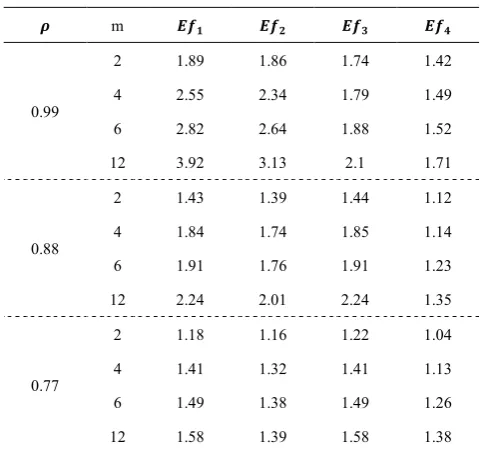
Using the real data set of PinusWallichiana taken from Langate block of district Baramulla from Kashmir valley data set, different sample where generated using SRS and RSS from a bivariate normal distribution using the above combinations of 𝛼𝛼 𝑎𝑎𝑛𝑛𝑎𝑎 𝛾𝛾 . From this distribution we generated 440 samples based on RSS with 10 cycles and another 440 samples using SRS. For each sample, the mean square errors are computed respectively. The above bivariate normal distribution was generated in R-Software using the function mvtnormfrom library(mvtnorm).Different values of
[image:4.595.311.553.523.749.2]ρ and m are used and the results are shown in Tables-2 and 3.
Table 2. Linear combination of Quartile deviation and Median
𝝆𝝆 m 𝑬𝑬𝒇𝒇𝟏𝟏 𝑬𝑬𝒇𝒇𝟐𝟐 𝑬𝑬𝒇𝒇𝟑𝟑 𝑬𝑬𝒇𝒇𝟒𝟒
0.99
2 1.89 1.86 1.74 1.42
4 2.55 2.34 1.79 1.49
6 2.82 2.64 1.88 1.52
12 3.92 3.13 2.1 1.71
0.88
2 1.43 1.39 1.44 1.12
4 1.84 1.74 1.85 1.14
6 1.91 1.76 1.91 1.23
12 2.24 2.01 2.24 1.35
0.77
2 1.18 1.16 1.22 1.04
4 1.41 1.32 1.41 1.13
6 1.49 1.38 1.49 1.26
Table 3. Linear combination of Quartile deviation and Coefficient of Skewness
𝝆𝝆 m 𝑬𝑬𝒇𝒇𝟏𝟏 𝑬𝑬𝒇𝒇𝟐𝟐 𝑬𝑬𝒇𝒇𝟑𝟑 𝑬𝑬𝒇𝒇𝟒𝟒
0.66
2 2.09 1.97 1.65 2.12
4 2.57 2.02 1.72 2.78
6 2.87 2.11 1.75 3.05
12 3.36 2.33 1.94 4.15
0.55
2 1.62 1.67 1.35 1.66
4 1.97 2.08 1.37 2.07
6 1.99 2.14 1.46 2.14
12 2.24 2.47 1.58 2.47
0.44
2 1.39 1.45 1.27 1.41
4 1.55 1.64 1.36 1.64
6 1.61 1.72 1.49 1.72
12 1.62 1.81 1.61 1.81
The efficiency of RSS with respect to corresponding estimators of SRS
𝐸𝐸𝑓𝑓𝑖𝑖 = 𝑀𝑀𝑀𝑀𝐸𝐸 ( 𝜇𝜇�SRS )𝑀𝑀𝑀𝑀𝐸𝐸 (𝜇𝜇�RSS )𝑖𝑖
𝑖𝑖 , where (𝑖𝑖 = 1,2,3,4)
7. Conclusions
From the results of Tables-2 and 3 it is concluded the modified ratio estimators under rank set sampling are more efficient than the classical ratio estimators given by Kadilar and Chingi[1] based on simple random sampling, also efficiency of RSS estimators decreases as the correlation coefficient decreases and efficiency is increasing as the set size m is increasing. The above results occurred because rank set samples are more regularly spaced than those obtained from SRS, therefore more representative of the population. Because of ranking the RSS procedure induces stratification at sample level which involves the gained precision in this scheme.
Acknowledgments
The first author wishes to record his gratitude and thanks to University Grants Commission, Govt of India, for providing the UGC National Fellowship for perusing the Doctorate programme in Statistics.
REFERENCES
[1] Kadilar,C. and Cingi,H.(2004).Ratio estimateors in simple random sampling, Applied Mathematics and Computation151,893-902.
[2] McIntyre, G. A. (1952) A Method of Unbiased Selective Sampling Using Ranked Set. Australian, J. Agricultural Research, 3, 385-390.
[3] Samawi, H. M. and Muttlak, H. A. (1996) Estimation of Ratio Using Rank Set Sampling, Biom. Journal,38, 753-764. [4] W.G.Cochran,(1977).Sampling Techniques, Third Edition,
Wiley Eastern Limited.
[5] Murthy,M.N.(1967).Sampling theory and methods, Statistical Publishing Society, Calcutta, India.
[6] Prasad,B.(1989) Some improved ratio type estimators of population mean and ratio infinite population sample surveys, Communications in Statistics: Theory and Methods18,379–392.
[7] Sen,A.R.(1993):Some early development sin ratio estimation, Biometric Journal 35(1),3-13.
[8] Singh,H.P. and Tailor,R.(2003).Use of known correlation co-efficient in estimating the finite population means, Statistics inTransition6(4), 555-560.
[9] Singh,H.P. and Tailor,R.(2005).Estimation of finite population mean with known co-efficient of variation of anauxiliary, STATISTICA,annoLXV,n.3,pp301-313 [10] Singh,H.P.,Tailor,R.,Tailor,R. and Kakran,M.S.(2004). An
Improved Estimator of population mean using Power transformation, Journal of the Indian Society of Agricultural Statistics 58(2),223-230.
[11] Kadilar,C. and Cingi,H.(2006).An Improvement in Estimating the Population mean by using the Correlation Co-efficient, Hacettepe Journal of Mathematics and Statistics Volume 35(1),103-109
[12] Koyuncu,N.and Kadilar,C.(2009).Efficient Estimators for the Population mean, Hacettepe Journal of Mathematics and Statistics, Volume 38(2),217-225.
[13] Yan,Z.andTian,B.(2010).RatioMethodtotheMeanEstimation UsingCo-efficientofSkewnessofAuxiliary
Variable,ICICA2010,PartII,CCIS106,pp.103–110.