Risk Management for Safety
Operation Utilizing Virtual Reality
Simulation Supported By Intelligent
HAZOP Analysis
September 2010
Nan Bin Mad Sahar
The Graduate School of
Natural Science and Technology
(Doctor Course)
OKAYAMA UNIVERSITY
A
bstract
Ensuring safe operability and minimizing risk is the key component to prevent negative impact in all industries dealing with toxic, reactive, flammable and explosive materials. HAZOP (Hazard and Operability), a preliminary and systematic approach for identifying hazards has been unquestionably successful in reducing incident of hazards by mitigating the consequence of major accident in the industrial process facilities. However, laborious work, time and cost are the shortcoming in performing and maintaining HAZOP analysis. Many research works on HAZOP automation are available, yet the traditional approach is still widely used by plant operators. The traditional method only covers parts and aspects of a specific plant type rather than generalizing to fit many plant types. In HAZOP analysis of chemical process industries (CPI), process analysis can be divided into two groups - defined or routine process, which roughly occupies 60-80% and predefined or non routine process, which occupies 20-60% of HAZOP analysis. Thus leading towards the significance of having safety information as update and accessible as possible.
In recent years, computer hardware capable of developing and running virtual reality model has become more affordable for middle and small scale CPI. Consequently, virtual reality has been proposed as a technological breakthrough that holds the power to facilitate analysis. The ability to visualize complex and dynamic systems involving personnel, equipment and layouts during any real operation is a potential advantage of such an approach. With virtual reality supporting HAZOP, analysis which often solely relied on expert imaginative thinking in simulating hazard conditions, will aid understanding, memory retention and create a more interactive analysis experience.
‘paper-based’ view.
We also present Virtual HAZOP Training system, a risk-managing virtual training concept supported by intelligent HAZOP proposed to eliminate analysis redundancies and bring static ‘paper-based’ analysis to more dynamic and interactive virtual analysis simulation. However, the efficiency of VR simulator depends on the scenario accuracy to the real world that can be simulated. We introduce the system’s artificial intelligent engine responsible for retrieving the most accurate and highest possibility ‘to-happen’ scenario case. A fuzzy – CBR method enables the engine to classify and use real past scenarios combined with suitable parameters in creating a defined scenario. This method resolves issues in balancing between computational complexity and knowledge elicitation
Reactor section in a vacuum gas oil hydrodesulphurization (VGO HDS) process is used as the case study to illustrate the performance of the proposed system. The wide usages of HDS unit in the petroleum refining industry play important roles in chemical plant incidents happening worldwide. HAZOP analysis management system in average manages to reduce more than half the time required in performing HAZOP analysis compares to traditional method. With the proposed system, operator is able to optimally use safety information in HMS to prevent common and repetitive mistakes. Virtual process and accident simulator available in virtual HAZOP training system help to improve safety operator estimate overall impact towards equipment, operator and environment during process 20-35% better.
A
bbreviations
AI Artificial Intelligence AHA Automatic Hazard Analyzer
ANSI American National Standards Institute CCPS Center for Chemical Process Safety CIA Chemical Industries Association
CHAZOP Control or (Computer) Hazard and Operability analysis COMHAZOP Computer program as an aid for HAZOP studies
ETA Event Tree Analysis
FMEA Failure Modes Effects Analysis FRR Facility Risk Review
FTA Fault Tree Analysis HAZAN hazard analysis
HAZOP hazard and operability study
HAZROP Hazard, Reliability, and Operability Analysis HDG HAZOP-Digraph Model
HRA Human Reliability Analysis HSE Health and Safety Executive ICI Imperial Chemical Industries IPL Independent Protection Layers ISA International Standards Association MHA Major Hazard Analysis
OSHA Occupational Safety and Health Administration PHA Process Hazard Analysis
P&IDs Piping & Instrumentation Diagrams CBR Case-Based Reasoning
DBMS Database Management Systems HMS HAZOP Analysis Management System VR Virtual Reality
G
lossary
Accident: An unplanned event or sequence of events that results in undesirable consequence. An incident with specific safety consequence or impacts.
Availability: The ability of an item to be in a state to perform a required function under conditions at a given time interval, assuming that the required external resources are provided.
Bureaucracy: the combined organizational structure, procedures, protocols, and set of regulations in place to manage activity, usually in large organizations.
Consequence: The direct, undesirable result of an accident sequence usually involving a fire, explosion, or release of toxic material.
Consequence Analysis: The analysis of the effects of incident outcome cases independent of frequency or probability.
Event: An occurrence related to equipment performance or human action, or an occurrence external to the system that causes system upset.
Event Sequence: A specific, unplanned series of events composed of an initiating event and intermediate events that may lead to an incident.
Failure Mode: A symptom, condition, or fashion in which hardware fails. A failure mode might be identified as loss of function, premature function, or a simple physical characteristic.
Fault: The state of an item characterized by inability to perform a required function, excluding the inability during preventive maintenance or other planned action. FMECA: A variation of FMEA that includes a quantitative estimate of the significance of the consequence of a failure mode.
Function: The normal or characteristic actions of an item.
Initiating Event: The first event in an event sequence and can result in an accident unless engineered protection systems or human actions intervene to prevent or mitigate the accident.
Item: Any part, component, device, subsystem, functional unit, equipment or system that can be individually considered.
Operating Time: The time interval during which an item is in an operating state. Reliability: The probability of an item to perform a required function, under given conditions, for a given time interval.
accident or a group of accidents.
Risk Assessment: The process by which the results of a risk analysis are used to make decisions, either through relative ranking of risk reduction strategies or through comparison with risk targets.
Risk Management: The systematic application of management policies, procedures, and practices to the tasks of analysis, assessing, and controlling risk in order to protect employees, the general public, the environment, and company assets.
Risk Measures: Ways of combining and expressing information on likelihood with the magnitude of loss or injury.
Safety System: Equipment and/or procedures designed to limit or terminate an accident sequence, thus mitigating the accident and its consequences.
T
able of Contents
Chapter 1
General Introduction
1
1.1
General Overview of Research Problem
1
1.2 Research
Objectives
6
1.3 Research
Methodologies
7
1.4 Research
Significance
9
1.5 Justification for the research studies
11
1.6
Organization of the Dissertation
12
Chapter 2
14
Preliminaries and Basic Concepts in Risk Management
14
2.1 Introduction
14
2.2
Safety in Chemical Industry
14
2.2.1
Safety
Culture
14
2.2.2 Hazard in Chemical Industries
16
2.2.2.1 Electrical hazards
16
2.2.2.2 Health and occupational hygiene hazards
17
2.2.2.3 Chemical reaction hazards
18
2.2.2.4 Explosion and fire hazards
19
2.2.2.5 Operational and control hazards
19
2.2.2.6 Hardware hazards
20
2.2.3 Risk Assessment and Hazard Identification
20
2.2.3.1
Risk
Assessment
21
2.2.3.2
Hazard
Identification
22
2.2.3.3 Reliability and failure analysis
22
2.2.3.4 Fault Tree Analysis (FTA)
22
2.2.3.5 Failure Mode and Effect Analysis (FMEA)
23
2.2.3.6 Hazard and operability analysis (HAZOP)
23
2.3
Review of Risk Management Systems
24
2.4 Summary
25
Theoretical Framework
27
3.1 Introduction
27
3.2 HAZOP
28
3.2.1 Hazard and Operability Study
30
3.2.2
HAZOP Responsibilities31
3.2.2.1
Process Hazard Analysis (PHA) Team Leader31
3.2.2.2
Engineering Experts32
3.2.3 Technical Approach to HAZOP
32
3.2.4
Consequences and Safeguards34
3.2.5
Extending HAZOP Identification Scope35
3.2.5.1 Considering qualification
36
3.2.5.2 The human factor
37
3.2.5.3 Specific HAZOP modification
38
3.2.6 Automated HAZOP: Expert System
39
3.2.7 HAZOP supported by dynamic simulation
42
3.3 Intelligent HAZOP
43
3.4 Fuzzy - Case Base Reasoning (Fuzzy-CBR)
45
3.4.1 Case Base reasoning
46
3.4.2 Fuzzy rule-base system
48
3.4.3 Fuzzy-CBR
50
3.4.3.1 Fuzzy-CBR representation
50
3.4.3.2 Fuzzy Knowledge acquisition
51
3.4.3.3 Membership function
53
3.4.3.4 Fuzzy inference and indexing
54
3.4.4 Case Base representation
60
3.5 Application
Example
66
3.5.1
Retrieve67
3.5.2 Reused Case
71
3.5.3 Revised Case
71
3.5.4 Retained Case
71
3.6
Virtual reality Training
72
3.6.1
Training
73
3.6.2
Computer
Graphics
73
3.6.2.1 Computer graphics history
74
3.6.2.2 Computer graphics theory
75
3.6.2.4 Design Engineering
76
3.6.2.5 Computer art
76
3.6.2.6 Presentation graphics
76
3.6.2.7 Entertainment
76
3.6.3 Simulation and Peripherals Technology
77
3.6.4 Virtual reality application in Training
77
3.6.4.1 Aircraft and vehicle training
78
3.6.4.2 Medical training
79
3.6.4.3 Military training
80
3.6.4.4 Industries
81
3.6.5 Benefits
and
Applications
82
3.6.7 Limitations of VRT
83
3.7 Research
Model
Development
84
3.7.1 HAZOP Analysis Management System Model
85
3.7.2 Virtual HAZOP Training Model
86
3.7.3 Data Resources – database
87
3.8 Ontology
90
3.9 Summary
92
Chapter 4
Development of Intelligent Risk Management System
94
4.1 Introduction
94
4.2
HAZOP Analysis Management System
94
4.2.1 System Structure and Work Flow
94
4.2.1.1
Authentication
Module
95
4.2.1.2
Predefined
Path
Analysis
Module
97
4.2.1.3
Predefined
Process Analysis Module
98
4.2.1.4
New
Analysis
Module
100
4.2.2 System Result Interface
102
4.2.2.1
Schematic
Diagram
Module
104
4.2.2.2 Visual Model Support Module
105
4.3
Virtual HAZOP Training
106
4.3.1 Structure and work flow
107
4.3.2
Interface
Module
108
4.3.3 VR Processor Engine
110
4.3.4 Scenario Generator Engine
110
4.3.5 Resource Database Management Engine
111
Chapter 5
Application to Industrial Safety Management – A
Hydrodesulphurization Case Study
114
5.1 Introduction
114
5.2 Hydrodesulphurization
114
5.2.1
History
115
5.2.2 The Process Chemistry
115
5.2.3
Process
Description
116
5.3
Reactor Part of HDS Plant Model
119
5.3.1
Model
Layout
119
5.3.2 Development of the 3-D Model
122
5.3.2.1
Reactors
122
5.3.2.2
Heat
Exchanger
123
5.3.2.3
Pumps
123
5.3.2.4
Pipes
123
5.3.2.5
Fire
Heater
127
5.4
Discussion of Results
127
5.4 Summary
133
Chapter 6
136
Conclusions and Future Work
136
6.1
Conclusions and Future Works
136
References
137
Appendices
141
Appendix A: Near Miss and Accident Case collected
from
PEC-SAFER
Databases
142
T
able of Figures
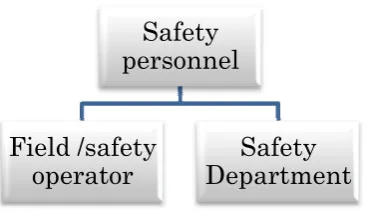
Fig 1.1 Safety personnel classifications.
2
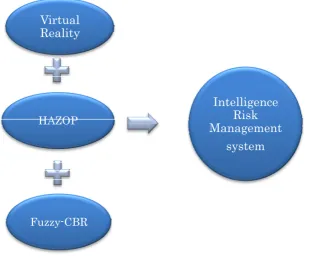
Fig. 1.2 Dynamic risk management system
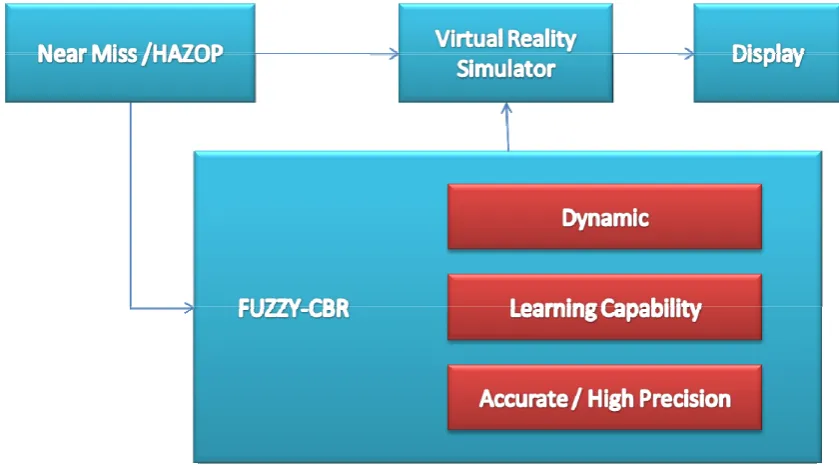
8
Fig. 1.3 Relationship between methodologies
9
Fig. 3.1 Trend of related-HAZOP publications 29
Fig. 3.2 HAZOP research lines proportion 29
Fig. 3.3 HAZOP study procedure 31
Fig. 3.4: R4 cycle in case base reasoning
48
Fig. 3.5 CBR cycle
49
Fig. 3.6 Fuzzy rule-based systems.
49
Fig. 3.7 Fuzzy set of Probability Factor
52
Fig. 3.8 Fuzzy set of Severity of Harm Factor
52
Fig. 3.9 Fuzzy set of Frequency Factor
52
Fig. 3.10 Fuzzy set of Risk Factor
53
Fig. 3.11 Triangular curve
54
Fig. 3.12 Membership set linguistic value of severity of harm factor(S),
probability factor(P), frequency factor(F) and output risk (R)
55
Fig. 3.13 Fuzzy inference for two input one output system.
56
Fig. 3.14 Relationship between input member set and output
57
Fig. 3.15 IF-Then rules setting windows in Matlab
63
Fig. 3.16 Surface show relationships between severity, probability and
risk.
64
Fig 3.17 Rule view simulate risk factor in Matlab
64
Fig 3.18 Rule view simulate risk factor in Matlab
65
Fig 3.19 Rule view simulate risk factor in Matlab
65
Fig. 3.20 Analysis types and its characteristic
70
Fig. 3.21 The first interactive graphics system in 1963
74
Fig. 3.22: Screenshot from Motorola virtual reality model
78
Fig. 3.23: Virtual prototyping of medical robotic interfaces
80
Fig. 3.24: Virtual reality training for military applications
81
Fig. 3.25: Pre-shift truck inspection
81
in 3D studio max.
Fig. 3.28: Visual Model of HDS Reactor part.
86
Fig. 3.29: Visual HAZOP training interface
86
Fig. 3.30: Relationship between tables in VGO_HDS.accdb
89
Fig. 3.31: List field of Main HAZOP table and list field of Case base
90
Fig. 3.32: List field of others tables
90
Fig. 4.1: Workflow diagram of HAZOP analysis management System
95
Fig. 4.2: HAZOP Analysis Management system Authentication
interface.
96
Fig. 4.3: Selecting analysis type of HAZOP Analysis Management
system.
97
Fig. 4.4: Predefined path analysis of HAZOP Analysis Management
system.
98
Fig. 4.5: Predefined process analysis of HAZOP Analysis Management
system.
99
Fig. 4.6: Predefined process analysis of HAZOP Analysis Management
system path confirmation page.
100
Fig. 4.7: New analysis entry page of HAZOP Analysis Management
system.
102
Fig. 4.8: Result comparison of analysis similarity of new case in
HAZOP Analysis Management system.
103
Fig. 4.9: Result with risk assessments and virtual model of HAZOP
Analysis Management system.
104
Fig. 4.10: Virtual model of HAZOP Analysis Management system.
105
Fig. 4.11: HMS deploy on IPAD from Apple incorporated.
106
Fig 4.12: Case matching using fuzzy-CBR between user input and case
base.
107
Fig 4.13: Virtual HAZOP training system workflow.
108
Fig. 4.14: Virtual HAZOP training system interface during properties
setting.
109
Fig.4.15: Virtual HAZOP training system interface during simulation. 110
Fig. 4.16 Relationship between scenario, keyword and cases.
111
Fig. 5.1 Schematic diagram of a typical Hydrodesulphurization (HDS)
unit in a petroleum refinery with reactor section highlighted.
117
Fig. 5.2: VGO hydrodesulphurization fresh feed of reactor section
119
Fig. 5.3: Perspective view
120
Fig. 5.4: Front view
120
Fig. 5.6: Top view
121
Fig. 5.7 Wire frame view
122
Fig. 5.8 HDS reactor model
122
Fig. 5.9 HDS Heat exchanger model
123
Fig. 5.10 HDS Pump model
123
Fig. 5.11 HDS corner pipe model
124
Fig. 5.12 HDS T junction pipe model
124
Fig. 5.13 HDS Heat small pipe model
125
Fig. 5.14 HDS Heat large pipe with joiner model
125
Fig. 5.15 HDS pipe inner model
126
Fig. 5.16 HDS pipe with valve model
126
Fig 5.17 HDS Fired heater model
127
Fig. 5.18: Relation between membership function. Right: risk
(R)x(F)(P),left :Risk(R)x(S)(F)
132
Fig. 5.19 Perform computations using fuzzy by simulation with
Matlab.
132
Fig. 5.20 Construction of the consequent membership function from
four active rules for a system with tree Inputs and two outputs.
L
ist of Tables
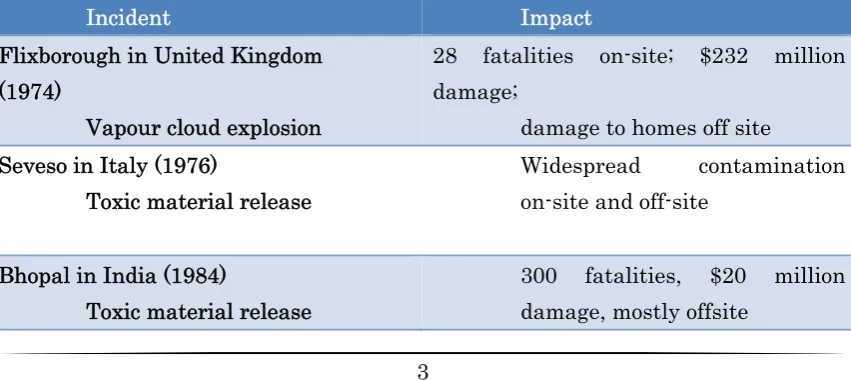
Table 1.1: Selected major incidents
3
Table 3.1 list of guideword in HAZOP study
33
Table 3.2 HAZOP analysis information
44
Table 3.3 Real operation cases with HAZOP parameters
44
Table 3.4 Improved HAZOP analysis information
45
Table 3.5: Gradation of the probability factor in association with the
undesirable
event
61
Table 3.6 Gradation of the severity of harm factor in association with the
undesirable
event
61
Table 3.7 Gradation of the frequency (or the exposure) factor in association
with
the
undesirable
event
62
Table 3.8 Estimation of linguistics risk factor to urgency level of required
action.
62
Nan Bin Mad Sahar© Chapter 1: General Introduction
1
G
eneral Introduction
1.1
General Overview of Research Problem
To compete in the ever – expanding global market as well as to meet increasingly tighter safety and environmental constraints, process industries are being compelled to ensure safer, operable and reliable plants and process that result in safer high-quality product in shorter time and lesser cost. Therefore, different approaches are needed that address all these requirements throughout the plant process from the eyes of safety personnel.
Nan Bin Mad Sahar© Chapter 1: General Introduction
2
[image:17.595.222.409.245.354.2]operations and as a result, they receive off site training such as offered by Occupational Health & Safety Advisory Services (OHSA) institute. The advantage of such training is that documentation - procedures manual are well organized. Invariably, this prevents knowledge and skill acquisition as every safety procedural step has been detailed thereby undermining the capability of the operator in responding to emergency risk operations. Consequently, acquiring operation skills in risk management is far from the field operator.
Fig 1.1 Safety personnel classifications.
Risk as defined by OHSAS is the product of the probability of a hazard resulting in an adverse event and the severity of the event. Most human activities involve specific risks. The risk profiles of industries change with time as certain hazards are overcome, new ones appear. The main hazards of the process industries arise from the escape of process materials, which may be inherently dangerous or become dangerous being present at high pressures and high or low temperatures. A review of worldwide chemical or chemical related incidents that have had major impacts on surrounding communities is summarized in table 1.1. This suggests the need for improved approaches to the handling of hazardous materials [1].
As chemical industries become increasingly complicated and automated, the gap between safety operators and processes becomes wider. Safety operators lose the ability to analysis real processes as field operator manipulate plants through control panels, which include switches, alarms, recorders, monitors, and many other instruments. It is difficult for them to understand all the knowledge about relevant processes and emergency situations. Accidents in chemical processes arise mostly from operator error [2].
To reduce these errors in operating procedures, effective analysis methods must be developed. In the past the objective of safety operator analysis was only to prevent direct damage and to reduce the loss of lives and property from accidents but at present, it includes the wider meaning of developing human resources and
Safety
personnel
Field /safety
Nan Bin Mad Sahar© Chapter 1: General Introduction
3
increasing the productivity, safety and efficiency of industries. The importance of safety operator education is emphasized now more than ever.
Process Hazard Analysis (PHA) has always been considered an important factor in staying competitive in a global economy. Safety operator need to remain up to date with the latest methods and technology. Most people would agree that safety training is important, but there is an obvious cost in developing or purchasing safety training. Companies also lose productive operator time while they sit through the training; not to mention travel costs if the training is not offered locally [3].
Safety Training should involve an introduction to basic hazards and plant procedures in which the flammability, toxicity and the corrosive properties of chemicals are discussed. Also the use of personal protective equipment, fire alarm systems and work safety processes should be incorporated. The safety operator should be assigned to a particular plant to work alongside an experienced operator, in order to receive practical instructions in all aspects of plant operations, including safety and emergency processes. These safety training methods in combination with available process hazard analysis can be used to help the safety operator to understand specialized aspects of process hazards such as emergency safety and permit-to-work systems.
[image:18.595.86.512.587.777.2]Three-dimensional simulation systems allow users to navigate in any direction within a computer-generated environment, decide what actions to take and immediately see the impact of those actions [4]. These virtual reality systems allow safety operator to walk around the plant, see all the equipment that constitutes the process, have the possibility of starting, running and shutting down equipment and responding to error conditions without causing any damage to the equipment or harm to themselves.
Table 1.1: Selected major incidents
Incident Impact
Flixborough in United Kingdom (1974)
Vapour cloud explosion
28 fatalities on-site; $232 million damage;
damage to homes off site Seveso in Italy (1976)
Toxic material release
Widespread contamination on-site and off-site
Bhopal in India (1984)
Toxic material release
Nan Bin Mad Sahar© Chapter 1: General Introduction
4 Mexico City LPG (1984)
LPG Explosion
2500 fatalities many others injured off-site
Chernobyl in Ukraine (1986) Fire and radiation release
31 fatalities; 300 square miles evacuated;
widespread contamination Sandoz warehouse Switzerland
(1986)
Toxic material release
Major impact on ecology of Rhine River
Shell Norco refinery in United States (1988)
Vapour cloud explosion
7 fatalities on-site; neighbouring town evacuated; damage exceeded $50 million;
widespread damage to homes off-site
The human and economic costs of accidents worldwide can be shocking. In 2004 industrial workplace accidents killed one person every two hours and injured one person every five seconds. The cost of accidents at work and occupational diseases ranged for most countries from 2.6 to 3.8% of Gross National Product [5]. Up to 85% of accidents can be traced back to human & organizational factors causes:
Unclear management structure, unavailability of information, Lack of coordination,
Ineffective training,
Procedure difficult to use,
Inadequate investigation for the causes of most recurring problems, Deviations from safety procedures are among the main causes.
Unfortunately, safety operators are the one who will be blamed for this. Safety operators’ occupation description is direct or indirectly related to the above causes.
Nan Bin Mad Sahar© Chapter 1: General Introduction
5
training module. Virtual reality can offer the potential to immerse personnel into an interactive and well controlled virtual world containing simulated hazards. This may operate as an enhancement to existing process hazard analysis (PHA) method especially HAZOP. While HAZOP undeniably has successfully managed to mitigate major accident, HAZOP analysis done by human teams has the following shortcomings: time consuming, laborious, expensive and inconsistent. To solve these problems, various model and/or rule-based HAZOP expert systems have been developed during the last one decade [6]. These systems, however, can only address “routine” or process-generic HAZOP analysis. In the chemical process industries (CPI), “routine” HAZOP analysis roughly occupies 60-80% while “non-routine” or process-specific HAZOP analysis occupies 20-40%. Due to the lack of learning capability of the current HAZOP experts systems, the knowledge of non-routine analysis could not be formulated and reused for similar chemical processes, and the “non-routine” HAZOP analysis still needs to be addressed by human experts. The major problem with HAZOP expert system proposed in [1] is design to fit general plant instead of plant type specific. This leaves incompleteness of HAZOP analysis. A normal practice of CPI is to record all near miss cases or accident cases for future reference. These cases sometime can be traced back from five to even ten years ago. In this dissertation, we propose a system that can manipulate and take advantages of this information in completing HAZOP analysis. Because of these cases are past histories they are more reliable compare to expert knowledge. We used risk factor as an indexing mechanism for setting cases priority in order to assist safety operator in deciding responses upon emergency.
From an interview with safety operators, we found several issues arise from the operator view point that never been discussed in past research in the safety domain. These issues are: Inadequate safety training, management bureaucracy, Miss looks and access limit.
Nan Bin Mad Sahar© Chapter 1: General Introduction
6
With regards to problem of management bureaucracy, in standard plant, process hazard analysis normally kept by the safety department or human resource department depending on production scale. Due to safety analysis documentation nature, the possibility that this documentation be revised or referred often is low. The troublesome procedure faced by the operator in terms of form filling, permission request for using or modifying leading obsolete analysis constitutes a bottleneck. The possibility of the revision of the documentation is only during a safety audit which is dependent on the plant management itself which is every quarter year to one year.
Prior to HAZOP analysis, preparation including brainstorming, site visit and information gathering are conduct. During the analysis itself, HAZOP team will use P and ID and their expert creative imagination to simulate the possible sequence and consequent. This action often results in overlooking mistakes where the location of real physical equipment is influencing the environment. The phenomenon is referred to as Miss looks in industrial operations. An example is, heat from heat exchanger may leak to a nearby container belonging to a totally different process line or overlapping pipes and equipments. This can only be noticed by being on the site while doing the analysis.
Consequently, the primary issues addressed by this research are to propose mechanisms and develop implementation of system to assist safety operator in managing safety information as well as use the information effectively during critical time.
1.2 Research
Objectives
Nan Bin Mad Sahar© Chapter 1: General Introduction
7
development of emergency scenarios for application in the chemical process industry during hazard and operability analysis (HAZOP). It is believed that the use of such systems will increase safety awareness and knowledge of safety procedures and therefore hopefully lead to reducing the plant accident rate.
The specific objectives can be classified in the following way:
To facilitate risk estimation for safety recommendation.
To integrate intelligent system into HAZOP to give learning capability to traditional HAZOP.
To improve the HAZOP analysis quality continuously during practice.
To take the advantages of other safety information such as near miss and accident cases to assist safety analysis.
To investigate the general suitability and potential of virtual reality technology for safety audit application in the field of chemical engineering
To develop a range of virtual chemical plants environments in which to train safety operators for a range of different scenarios
To identify components and characteristics of the HAZOP processes to be simulated in the virtual world for adequate realism and training acceptance
To develop a complete but easy to use system of HAZOP analysis for a range of chemical plant scenarios.
1.3
Research Methodologies
Nan Bin Mad Sahar© Chapter 1: General Introduction
8
[image:23.595.108.424.411.677.2]analysis is covered by using proposed Fuzzy-CBR method - a hybrid of fuzzy logic and case base reasoning technique used in this research for indexing and retrieving similar cases for a future analysis. In safety domain, risk factor is very important in making decision. As we are in the safety domain and not soft-computing domain, the proposed approach enables us to apply fuzzy and case base reasoning for separate knowledge representation. A proportional risk assessment is suggested to be indexer for the case base, where case with higher risk value is priorities for action. While HAZOP analysis information, near miss, accident case and past scenario are knowledge case base representation. Virtual reality is responsible for bringing safe analysis experience to safety operator without endanger or giving negative impact on overall plant operability. The integration of these three methods as shown in Figure 1.2 are applied into the proposed HAZOP analysis management system, and virtual HAZOP analysis system produces an intelligence risk management tools for safety personnel. HAZOP analysis management system is used to manage and manipulate safety information while virtual HAZOP analysis assists safety operator to perform HAZOP analysis with virtual reality support.
Fig. 1.2 Intelligent Risk Management System
Figure 1.3 shows the relationship between proposed methodologies. Information
Virtual
Reality
HAZOP
Fuzzy-CBR
Intelligence
Risk
Management
Nan Bin Mad Sahar© Chapter 1: General Introduction
9
[image:24.595.87.507.341.575.2]from HAZOP and previous safety cases such as near miss cases are managed and manipulated by fuzzy-CBR. Similar case within case base is compared to HAZOP case. If suitable, the case from case base will be used to improve HAZOP case description. Fuzzy-CBR is dynamic while the rules of decision making is not static and thus can be adjusted according to operator need. For example, to retrieve and reuse case from case base, similarity index must be between 0.8 and 1.0, which mean almost the same. However, case base with a small number of cases can be benefited by widening the similarity index from 0.5 to 1.0, which will include more results. Accurate and high precession is achieved by indexing and matching only the most similar cases. This retrieved cases are associated with keyword, which used by virtual reality scenario as parameters. This scenario will be used to help safety operator visualizes HAZOP scenario.
Fig. 1.3 Relationship between methodologies
1.4 Research Significance
his research work contributes to the HAZOP analysis in chemical process industry
T
Nan Bin Mad Sahar© Chapter 1: General Introduction
10
HAZOP done by human teams. Given the enormous amounts of time, efforts and money involved in performing HAZOP, there exists considerable incentive to develop intelligent systems for assisting the process hazards analysis of chemical process plants. An intelligent system can reduce the time, efforts and expense involved.
Learning to predict and prevent chemical process hazards is an essential part of
he unique contributions of this research work are as summarized
below.
This work combines virtual reality simulation with
uzzy-CBR method - a hybrid of fuzzy logic and case
the safety operator education. However, taking advantages of available safety information was not a simple task.
While others similar research focusing
on safety training for field operator, this research is focusing on assisting
new-to-experience safety personnel to be able to handle emergency situations
effectively and at the same time able to profitably minimize the negative
impact on life in case of unavoidable accident incidence. The light weight and
portability of developed system expected to mould safety operator mind set to
a new level. Compare to field operator, safety operator unable to fully master
every aspect of the plant. Without real situation emergency training of every
part of the plant, it is difficult for safety operator to make important decision
regarding safety and develop safety procedures based only on previous PHA.
Developed risk management system in this research is hoped to assist safety
operators to be able to see beyond their imagination.
T
HAZOP for providing virtual model support in
assisting HAZOP analysis. The integrated system
now helps HAZOP team to see different perspectives
that were impossible with the pipe and instrument
diagrams (PID). Hitherto, there has not been a
similar work combining virtual reality simulation
with HAZOP analysis in this manner.
F
Nan Bin Mad Sahar© Chapter 1: General Introduction
11
HAZOP analysis method. In this new integrated
system, safety information is stored in single case
base where accident data from past long years can
be easily reused. The proposed information
management system serves as a supplement for
continuously improving quality of HAZOP analysis
during practice.
The virtual analysis environment proposed in this
is worth noting that consistence and completeness are critical in HAZOP analysis
1.5
Justification for the research studies
Risk management undeniably is a crucial part in any industrial system
thesis interfaces with various safety information
modules. This newly designed user interface system
provides support for retrieval of information on pipe
and instrument diagram from database. The new
system is different from common virtual reality
simulation where users interact with and immerse
into the system during practice.
It
because neglect of any potential hazard may even result in disasters. Investigation results of past industrial accidents, e.g. the tragic BP Texas city plant accident occurred in March 2005, have proven that poor quality of PHA is a major root cause of accidents occurred in the CPI.
Nan Bin Mad Sahar© Chapter 1: General Introduction
12
of risk is difficult to be agreed by everyone in the team? This risk level will determine what action ought to be taken. Deciding the risk level would consume time even for a single process. Hitherto, there is no method to model risk that suits every safety operator decision. Risk matrix only addresses the direct byproduct of risk component which will not address safety operator rules. Therefore, a concept of fuzziness is required to govern the rules in risk estimation. Hitherto, virtual aid such as virtual reality or virtual model has never been used to facilitate HAZOP analysis. Virtual aid is established to be a profound medium in current process safety training for operators. Low cost per performance of this technology enables everyone to enjoy the virtual aid benefit. When these two concepts are combined, it is expected to increase HAZOP expert system efficiency. Fuzzy-cbr proposed in this thesis with virtual aid; provide tools to assist HAZOP study with reliable reasoning for analysis result.
1.6
Organization of the Dissertation
hapter one is the general introduction which consists of the research problem
C
Nan Bin Mad Sahar© Chapter 1: General Introduction
13
Chapter II
PRELIMINARIES AND BASIC CONCEPTS
Nan Bin Mad Sahar© Chapter 2: Preliminaries and Basic Concepts in Risk Management
14
P
reliminaries and Basic
Concepts in Risk Management
2.1 Introduction
This chapter discusses available literature relating to hazards and safety in the chemical industries. It also provides a short description of a number of incidents in order to show the consequences of such events. Furthermore, it considers some of the main hazards in the chemical industries and discusses the process safety issues while indicating methods to avoid and anticipate catastrophic events for chemical plants. The definitions of risk and safety management stated in this chapter outline the differences. In chemical process industries, safety management systems (SMS) are more preferred in terms of overall purpose. Risk management system proposed in this thesis has never been discussed in any literature of safety concern. However, similar systems employing risk assessments to ensure safety are available with different process hazard analysis (PHA).
2.2 Safety in Chemical Industry
2.2.1 Safety
Culture
The increasing size and complexity of industrial processes creates increased scope for major disasters, leading to greatly increased public concern about industrial safety. The last century has seen series of such disasters worldwide.
Nan Bin Mad Sahar© Chapter 2: Preliminaries and Basic Concepts in Risk Management
15
Process safety has advanced over the last thirty years. In the 1970s the introduction of a number of checklists, such as the development of HAZOP studies and the Dow’s Fire and Explosions Index constituted a major breakthrough in the history of industrial safety. Dow’s Fire and Explosions Index is a checklist method of hazard identification, which provides a comparative ranking of the degree of hazard posed by particular design conditions and its third edition is published as a manual by the American Institute of Chemical Engineers [8] In the 1980s came an increase in the regulation of chemical plants which culminated in an overall socio technical and audit approach covering all aspects of design, operation and management of chemical plants [9].
The extent to which health and safety thinking is reflected in business activities and decision-making is an important determinant of effectiveness. The practical implications of safety policies must be thought through so as to avoid conflict between the demands of policy and other operational requirements. Management decisions were insufficient attention or weight given to health and safety leading to [9]
Unrealistic time scales for the implementation of plans which put pressure on people to reduce supervision;
Work scheduling and rosters which fail to take account of problems of fatigue;
Inadequate resources being allocated to training;
Organizational restructuring which places people in positions for which they have insufficient experience;
Jobs and controls systems which fail to recognize or allow for the fact that people are likely to make mistakes and might have difficulties communicating with one another.
Nan Bin Mad Sahar© Chapter 2: Preliminaries and Basic Concepts in Risk Management
16
The twelfth edition of Marsh and McLennan’s annual review analyzes the largest chemical industry losses, which refer to the cost of injuries and damage, since 1959 [11].Most of these losses occurred in oil refineries while the highest average losses occurred in natural gas processing plants. Mechanical failure of equipment was the most frequent of these causes. Most of these could have been avoided by proper inspection and maintenance. The next most frequent cause was stated to be operational errors, which could have been avoided by providing more effective training of operators.
Piping systems, which include hose, tubing, flanges, gauges, strainers and expansion joints were the most frequent origin of loss. The low frequency of losses originating at pumps and compressors was unexpected [8]
The public no longer regards processes industries as something remote from them, run by operators with an incomprehensive language of their own, but they consider them capable of giving rise to events which may directly affect ordinary people. Public opinion in the majority of countries is concerned about industrial accidents and their effects and will not tolerate fatalities on the scale that once existed.
2.2.2 Hazard in Chemical Industries
A hazard is a physical situation with a potential for human injury, damage to property, damage to the environment or some combination of these. Hazards do not only involve process plant and associated materials but also major structures, and materials, which release ionizing radiation [7]. The hazards, which are commonly identified in chemical industries, can be grouped in several different categories. These categories include electrical hazards, health and occupational hygiene hazards, chemical reactions hazards, explosion and fire hazards, operational and control hazards and hardware hazards.
2.2.2.1 Electrical hazards
Nan Bin Mad Sahar© Chapter 2: Preliminaries and Basic Concepts in Risk Management
17
Kingdom every year up to fifty people may be killed and up to a thousand are injured at work as a result of electrical accident [11].
2.2.2.2 Health and occupational hygiene hazards
Health and occupational hygiene is the science of anticipating, recognizing and controlling workplace conditions that may cause workers’ injury or illness. Major workplace risks can include chemical, biological, physical and ergonomic hazards. Harmful chemical compounds in the form of solids, liquids and gases exert toxic effects by inhalation, absorption or injection. Airborne chemical hazards exist as concentrations of mists, vapors, gases, fumes or solids. The degree of worker risk to any given substance depends on the nature and potency of the toxic effects and the magnitude and duration of exposure. Information on the risk to personnel from chemical hazards can be obtained from a material safety data sheet, which is a summary of the important health, safety and toxicological information on the chemical or mixture’s ingredients [12].
Biological hazards include bacteria, viruses and other living organism that can cause acute and chronic inflection by entering the human body. Occupations that deal with plants or animals or their products or with food processing products may expose workers to biological hazards. It is essential for an industry to provide proper ventilation, appropriate personal protective equipment such as gloves and respirators and adequate infectious waste disposal systems [12].
Physical hazards include excessive levels of electromagnetic radiation, noise, illumination and temperature. In occupations where there is exposure to radiation time distance and shielding are important tools in ensuring worker safety. Danger from radiation increases with the amount of time one is exposed to it. Hence, the shorter the time of exposure, the smaller the radiation danger will be. Distance, also is an available tool in controlling exposure to radiation and the radiation levels from some sources. It can be estimated by comparing the squares of distance between the worker and the source. Shielding involves the placing of protective materials between the source and the person to absorb partially or completely the amount of radiation [13].
Nan Bin Mad Sahar© Chapter 2: Preliminaries and Basic Concepts in Risk Management
18
The part that lighting plays in ensuring a safe and healthy place of work is increasingly recognized. The standard of luminance required depends on the visual efficiency necessary for the tasks involved and the decisions should be based on the recommendations of the code for lighting produced by Illuminating Engineering Society [12].
2.2.2.3 Chemical reaction hazards
A chemical reaction that goes out of control and runaways can create a serious incident with the risk of injury to people and damage to property and the environment. The reactivity of chemicals in process industries is a potential process hazard. The chemical reactivity of any substance should be considered in the following contexts [8].
Its reactivity with atmospheric oxygen
Its reactivity with elements and compounds with which it is required to react in the process
Its reactivity with water Its reactivity with itself
Its reactivity with other materials with which it may come in contact unintentionally in process
Its reactivity with materials of construction
Most hazards are caused by reactivity with atmospheric oxygen and the majority of problems arise from oxidative self-heating. In most continuous organic chemical reactors, which operate under pressure, air is automatically excluded. In some cases more stringent measures are taken not merely to prevent air entering the plant while it is running but also to remove it before the plant starts up and to remove oxygen from materials entering the process.
Nan Bin Mad Sahar© Chapter 2: Preliminaries and Basic Concepts in Risk Management
19
lead to thermal runaway, which begins when the heat produced by the reaction exceeds the heat removed. The rates of most reactions increase rapidly with temperature leading to the danger of their getting out of control, with large rises in temperature and pressure and loss of containment of the process material.
2.2.2.4 Explosion and fire hazards
The term explosion is used to describe incidents where there is a rapid release of energy, which causes a significant blast wave capable of causing damage. The gases in a chemical explosion, which is formed as a result of chemical reactions, expand rapidly due to a sudden increase in temperature, thereby increasing the pressure relative to the surrounding atmosphere. The damage which arises from an explosion may be caused either by the effect of a blast wave or by projected fragments or items of equipment. All chemical explosions are very fast; they give out heat, and make a loud noise. They fall into two classes:
Explosive deflagrations, which are caused by chemical reactions, which are passed through the deflagrating materials at well below sonic velocity. They develop an appreciable pressure producing a blast wave with the potential to damage and the burnt products move in the opposite direction from that of combustion wave.
Detonations are caused by very rapid chemical reactions which pass through the exploding materials at speeds of 1-10km/s. High pressures are developed and the burst products move in the same direction as the combustion wave.
Explosives, which normally detonate, are termed high explosives such as TNT (trinitrotoluene) and have high shattering power even when unconfined.
Fire is a process of combustion characterized by heat or smoke or flame or any combination of these.
2.2.2.5 Operational and control hazards
Nan Bin Mad Sahar© Chapter 2: Preliminaries and Basic Concepts in Risk Management
20
large pieces of the column up to 900 meters and the fire burned for 60 hours [14]. In order to understand the contribution of human behavior to the risk of accidents it is essential to examine the errors people make and what leads to such errors. The reduction of human error probability can lead to a reduction in the probability of accidents in chemical industries.
A useful classification framework identifies the human errors as slips-lapses, mistakes or violations. Slips or lapses typically occur through lack of attention or from stressful situations with the result that individuals fail to achieve what they intend to do. Slip or lapse human errors include forgetting to turn off power, becoming inattentive to important safety checks or forgetting important steps in work procedures, which may cause equipment damage [13].
Mistakes can result from incorrect decisions, poor communications and infrequently practiced operations. Typical mistakes include failure to appreciate the dangers of equipment and materials used, misunderstanding of operational procedures and emergency situations or failure to realize the implications of a process plant. Individual or team training is the most effective way to reduce these mistakes. Virtual reality training systems can help trainees to learn from their mistakes without causing any damage to equipment or themselves.
Violations are deliberate decisions to break agreed procedures. They can be associated with a steady drift into unacceptable attitudes, or can be deliberate acts by a workforce to adopt unsafe and unapproved practices. Some violation human errors include the deliberate use of unauthorized lifting equipment, the breaking of rules for an electrical unit or deviation from permitted work process. The study of the relationship between employees and the equipment with which they work in parallel with the physical environment in which man-machine system operates is extremely important for the safe and effective operation of process industries.
2.2.2.6 Hardware hazards
Nan Bin Mad Sahar© Chapter 2: Preliminaries and Basic Concepts in Risk Management
21
2.2.3 Risk Assessment and Hazard Identification
Risk is the likelihood of a specified undesired event occurring within a specified period or in specified circumstances. It may be either the frequency (the number of specified events occurring in unit time) or the probability (the probability of a specified event following a prior event), depending on the circumstances [8].
Cooper and Chapman [10] define risk as the exposure to the possibility of economic or financial loss or gain, physical damage or injury, or delay, as a consequence of the uncertainty associated with pursuing course of action.
A further definition of risk, which is used as the basis of many risk assessment techniques, is similar to the one quoted by Horton [13] and says that the term risk is used to cover the combination of an unfavorable result and the possibility of its occurrence. It is used as the recognition of future uncertainty and implies that a given set of circumstances has more than one possible outcome.
2.2.3.1 Risk Assessment
Improvement in safety performance has often meant seeking to reduce the number of potential accidents. The process of risk assessment attempts to minimize or eradicate the probability of an accident occurring. Risk assessment has been used informally throughout history, whenever there is a decision to be made, or an action taken there is always an associated risk. The outcome of the decision is in the future and is therefore uncertain, different actions might mean different outcomes while some outcomes might be more desirable than others.
The wide variety of industrial activities has created a wide variety of different definitions and hence a blur between terms such as risk assessment, risk analysis and risk estimation. Jones [8] gives one of the clearest definitions:
Risk assessment is the quantitative evaluation of the likelihood of undesired events and the likelihood of harm or damage being caused together with value judgments’ made concerning the significance of the results.
Risk analysis is an imprecise term that infers the quantified calculation of probabilities and risks without taking any judgments’ about their relevance. As such it is equivalent to risk estimation.
Nan Bin Mad Sahar© Chapter 2: Preliminaries and Basic Concepts in Risk Management
22
in deciding on methods of control. Knowledge of both areas is necessary to identify where to place the major effort in prevention and control, and in order to make decisions on the adequacy of control measures [12]. Assessing risks will demand a thorough knowledge of all the activities and working practices. The knowledge of the employees and safety representatives involved often proves valuable. Competent people should carry out risk assessments, and professional health and safety advice may be necessary in some cases [12].
Determining the relative importance of risks involves deciding on the severity of the hazard and the likelihood of occurrence. There is no universal formula for rating risk in relative importance but a number of techniques have been developed to assist in decision-making.
2.2.3.2 Hazard Identification
The identification of hazards is the vital element of risk analysis and its effectiveness requires a deep understanding of the process, which is clearly dependent on the knowledge, experience, engineering judgments and imagination of the team to whom the task is assigned. It can also be seen as a useful discipline in its own right. For example, identifying hazards at an early stage will often allow them to be eliminated by a modification of the design or system [13]. Hazard identification is the process of determining what hazards are associated with a given operation or design, as it is operating. In existing operations, hazard identification is performed periodically to determinate the implications of changes to process knowledge and to recognize changes to process, equipment and materials.
2.2.3.3 Reliability and failure analysis
Nan Bin Mad Sahar© Chapter 2: Preliminaries and Basic Concepts in Risk Management
23 2.2.3.4 Fault Tree Analysis (FTA)
Fault Tree Analysis is the technique that can be used to determine failure sequences and probabilities in complex systems. In a FTA a logic diagram or “fault tree” is developed to determine the causes of an undesired event. A fault tree may be constructed for virtually any undesired event that can occur within the system. Once an undesired event has been selected, it is shown at the top of the diagram and all the circumstances that lead to it are determined by reasoning backward from this event. These circumstances are then broken down into events that can produce them, and so on. The process is continued until all events that can ultimately lead to the undesired event are identified. Special symbols are used in FTA to represent events and their logical relationships. Circles, rectangles, diamonds and house-shaped Figs are the symbols which are used for events and indicate certain characteristics about them. Other symbols, called “logic gates” show the manner in which events at one level of fault tree combine to produce an event at the next higher level [8].
2.2.3.5 Failure Mode and Effect Analysis (FMEA)
Failure Mode and Effects Analysis is based on identifying the possible failure modes of each component of a system and predicting the consequences of the failure. In this procedure each item used in the system, which might include the people, equipment, materials, machine parts or environment, is listed on an FMEA. The analyst should consider the exact modes in which each item can fail. For example if a control valve fails to open it could result in too much pressure or the wrong ratios of flow [8]. The analysis is continued by determining the effects of each failure combination. Both the effects on other items within the system and those on overall system performance are considered and evaluations are then made concerning the seriousness of each failure or failure combination. Finally, the means of detecting each failure is determined and any additional remarks regarding the failures are recorded [6].
2.2.3.6 Hazard and operability analysis (HAZOP)
Nan Bin Mad Sahar© Chapter 2: Preliminaries and Basic Concepts in Risk Management
24
considered, but are most effective when carried out at a design stage where a wide range of possible actions still exist. The method uses guidewords such as “too much” and “too little”, which can be applied to the process parameters to generate “what if” questions. The guidewords that are used must be relevant to the stage of design and must be sufficiently comprehensive to be capable of identifying the hazards involved. While this method can be used without direct reference to engineering standards, it requires a broad documentation of the points studied to demonstrate the quality of the study. Experience has shown that this technique is most effective when carried out by a team of designers, operators, and other specialists as appropriate, at a series of study meetings [6].
2.3
Review of Risk Management Systems
Intensive search of risk management system in safety domain give almost no concrete result. While risk management in other domain such as financial, give many well established systems such as credits risk management system. Risk management and safety management are used in various ways and are often seen as identical. The IEC-standard [15] defines Risk management as the systematic application of management policies, procedures and practices to the tasks of analyzing, evaluating and controlling risk.
In several types of industry, the word “safety” is preferably often used.
Safety management may be defined as the aspect of the overall management function that determines and implements the safety policy. This will involve a whole range of activities, initiatives, programs, etc., focused on technical, human and organizational aspects and referring to all the individual activities within the organization, which tend to be formalized as Safety Management Systems (SMS).
In both these definitions, there are points of departure with regards to the policy of the company. That is in line with both quality and environmental standards. An example [16] is the environmental management system which is a part of the overall management system that includes organizational structure, planning activities, responsibilities, practices, procedures, processes and resources for developing, implementing, achieving, reviewing and maintaining the environmental policy.
137
References
[1] King R. and Hirst R. (1998). Safety in Process Industries, Arnold, London[2] Goh, S., Chang, B., Jeong, I., Kwon, H., and Moon, I., (1998), Safety Improvement by a Multimedia Operator Education System, Computers Chem. Eng., Vol.22, Suppl., pp.S531‐S536
a tool [3] Burton A., Hollands, R., Denby, B., Phillips R. and Weyman R., (2001), The use of virtual reality as
for teaching and testing hazard awareness in the construction industry, (awaiting publication)
[4] Goh, S., Chang, B., Jeong, I., Kwon, H., and Moon, I., (1998), Safety Improvement by a Multimedia
138 [27] B. Rasmussen, C. Whetton, Hazard identification based on plant functional modeling, Reliability Engineering and System Safety 55 (2) (1997) 77–84. ty [28] R. Kennedy, B. Kirwan, Development of a hazard and operability‐based method for identifying safe management vulnerabilities in high risk systems, Safety Science 30 (3) (1998) 249–274. [29] N.I. Pátkai, Data management tool for aiding the hazard and operability analysis process, in: IEEE , International Conference on Computational Cybernetics (ICCC), Budapest, Hungary, 20–22 August 2006. [30] P. Baybutt, Major hazard analysis: an improved method for process hazard analysis, Process Safety Progress 22 (1) (2003) 21–26. G. Grossm [31] ann, D. Fromm, HAZOP proof ammonia plant: a new way of defining a safeand reliable design, Plant/Operations Progress 10 (4) (1991) 223– 227.
[33] K. Suzuki, M. Ishida, I. Nojiri, Development of Operator Decision Support System using HAZOP results,
140
[79] Gary, J.H. and Handwerk, G.E. (1984). Petroleum Refining Technology and Economics (2nd Edition ed.). Marcel Dekker, Inc. ISBN 0‐8247‐7150‐8. [80] Nancy Yamaguchi, Trans Energy Associates, William and Flora Hewlett, Hydrodesulfurization Technologies and Costs Foundation Sulfur Workshop, Mexico City, May 29‐30, 2003 f [81] Nan Bin Mad Sahar, Syahril Ardi, Suzuki Kazuhiko, Munesawa Yoshiomi and Minowa Hirotsugu ,HAZOP Analysis Management System with Dynamic Visual Model Aid ,American Journal o Applied Sciences 2010 Volume 7 issue 7, : 943‐948, June 2010 [82] Nan Bin Mad Sahar, Suzuki Kazuhiko, and Minowa Hirotsugu , Utilizing Fuzzy‐CBR Methodology as an Artificial Intelligent Engine in Generating Scenario Case for Plant Virtual Reality Risk Simulation,European Journal of Scientific Research Volume 41 Issue 1, 57‐71, February, 2010 [83] NAN Bin Mad Sahar, SUZUKI Kazuhiko, MINOWA Hirotsugu, Virtual Grid Risk and Safety Identification System”, International Joint Seminar in Engineering IJSE 2008 proceeding, pp. 196‐199, 2008. f [84] Bin Mad Sahar NAN, Asral DATU RIZAL, Kazuhiko SUZUKI, Hirotsugu MINOWA ,Managing Risk Using Virtual Reality Simulation Supported by Automated HAZOP Analysis,” Asia Pacific Symposium on Safety,APSS 2007 proceeding pp. 35‐38, 2007. [85] Venkatasubramanian, V., Zhao, J., Viswanathan, S.,2000. Intelligent systems for HAZOP analysis of complex process plants, Computers & Chemical Engineering 24: 2291‐2302 [86] Wilson J.R., D’Cruz M., Cobb S. and Eastgate R., (1996), Virtual Reality for Industrial Applications: chool o Opportunities and Limitations, Nottingham University Press, Nottingham, United Kingdom.
[87] Carr, C., (1992), Is virtual reality virtual, Training and development at university of nottingham, s