Effect of Compositional Dependence on the Physical
Properties of Sn-Se-Sb Chalcogenide Glasses
Lalit Kumar Abhilashi
1, Pankaj Sharma
2,*, Rahul Vaish
3, Parikshit Sharma
41Department of Electronics, Sai Nath University, Ranchi, India
2Department of Physics and Materials Science, Jaypee University of Information Technology, Waknaghat, Solan, India 3School of Engineering, Indian Institute of Technology, Mandi, India
4Department of Physics, Abhilashi University, Mandi, India
*Corresponding Author: [email protected]
Copyright © 2015 Horizon Research Publishing All rights reserved.
Abstract
Sn13Se87-xSbx (x = 0, 3, 6, 9, 12) glassy systemis synthesized by melt quench technique. This glassy system has been studied for various physical parameters viz. coordination number, lone pair of electrons, number of constraints, bond energy, heat of atomization, glass transition temperature, cohesive energy, band gap and mean bond energy. From the physical analysis it is generalized that the average number of constraints, average heat of atomization, mean bond energy, glass transition temperature and cohesive energy are found to increase whereas numbers of lone pair of electrons calculated are found to decrease with the increase in the antimony content in the composition of the alloy. The increase in glass transition temperature has been explicated on the basis of accumulation of antimony atoms in selenium chain.
Keywords
Sn-Se-Sb, Glass, Mean Bond Energy,Cohesive Energy, Melt Quench
1. Introduction
In the present electronic era chalcogenide glasses have attracted the attention of various researchers due to their potential applications in active as well as passive solid state electronics and optical devices. Chalcogenide glassy system based expertise is utilized in various fields like thermal imaging, switching memory, integrated fiber optics, photo detectors, photoreceptors, photovoltaic cells, ultra high density phase change storage and memory, optical fibers, photoresist [1-9]. Modern chalcogenide glasses are extensively used in rewritable optical disks and phase change memory devices. Since they are fragile glass formers, therefore by applying heat they can be switched between an amorphous and a crystalline state. This transformation helps these glassy systems for the storage of information by changing their optical and electrical properties [10]. Many chalcogenide glasses exhibit several non linear optical
which varies from floppy mode to the rigid mode.
The present paper deals with the compositional study of Sn13Se87-xSbx (x = 0, 3, 6, 9, 12) glassy system for various physical parameters. The physical parameters viz. coordination number, number of constraints, number of lone pair electrons, bond energies of the different bonds formed in the system, heat of atomization, cohesive energy, mean bond energy, glass transition temperature are theoretically studied for the Sn-Se-Sb glassy system.
2. Experimental
Glassy alloys of Sn13Se87-xSbx (x = 0, 3, 6, 9, 12) system were prepared by melt quench technique. The different compositional materials (99.999% purity) were weighed according to their atomic percentages and sealed in evacuated (at ~ 10 –4 Pa) quartz ampoules. The sealed ampoules were then kept inside a furnace where the temperature was increased up to 800oC at a heating rate of 3-4oC/min. The ampoules were then frequently rocked for 8 h at the highest temperature to make the melt homogeneous. The quenching was done in the ice cold water. Thin films of glassy alloys were prepared on glass substrates by vacuum evaporation technique at the room temperature and with the base pressure of 10-4Pa. The glassy substrates were firstly cleaned by soap solution at room temperature using ultrasonic cleaner then with double distilled water, a dip in acetone followed by ethyl alcohol, dried in an oven at approximately 110˚C. The bulk as well as thin films of the samples prepared were characterized by X-ray diffraction technique and found to be amorphous in nature as no prominent peak was observed in the spectra.
3. Results and Discussions
3.1. Calculation of coordination number (m) and number of constraints in glassy network
The coordination number of glasses varies with their varying compositions, so it is of immense importance to calculate the average coordination number <m>. The average coordination number in Sn13Se87-xSbx (x = 0, 3, 6, 9, 12) glassy system has been calculated by using the standard relation:
100
Sb Se
Sn
N
N
N
m
=
α
+
b
+
γ
(1)where α, β and γ are the atomic % of Sn, Se and Sb respectively and NSb, NSe and NSb are their respective coordination numbers. Average coordination number <m>is an important contrivance for the ternary system Sn13Se87-xSbx (x = 0, 3, 6, 9, 12) to test the validity of topological concepts [17, 18] because of its large glass forming domain. The calculated coordination numbers <m> lie in the range 2.26 ≤ m ≤ 2.38 and are given in Table 1. The calculated values of
the coordination number in Sn13Se87-xSbx (x = 0, 3, 6, 9, 12) glassy system increases with increase in Sb content. This fact attributes to the fact that the alloys are compactly packed. Table 1. Describes the values of the average coordination number < m>, number of constraints arising from bond stretching (Na), number of
constraints arising from bond bending (Nb), average number of constraints
(Nc) and effective coordination number <meff> for Sn13Se87-xSbx (x = 0, 3, 6,
9, 12) glassy system.
Composition m Na Nb Nc <meff>
Sn13Se87 2.26 1.130 1.52 2.650 2.26
Sn13Se84Sb3 2.29 1.145 1.58 2.725 2.29
Sn13Se81Sb6 2.32 1.160 1.64 2.800 2.32
Sn13Se78Sb9 2.35 1.175 1.70 2.875 2.35
Sn13Se75Sb12 2.38 1.190 1.76 2.950 2.38
The covalently bonded glassy networks confine mechanically with the interatomic valence forces like bond stretching (Na) and bond bending (Nb). These mechanical constraints (Nc) are linked with atomic bonding and effective coordination number <meff>. The number of constraints per atom arising from bond bending can be calculated by Nb= 2m − 3 and from bond stretching by Na= m/2 for the atomic species having coordination number (m). For various compositions of the glassy system Sn13Se87-xSbx (x = 0, 3, 6, 9, 12)by knowing the average number of constraints i.e. Nc= Na+ Nband the average coordination number (m), the effective coordination number <meff> can be calculated by using the relation:
(
3
)
5
2
+
>=
<
m
effN
c (2)The computed values of Na, Nb, Nc and <meff> for the Sn13Se87-xSbx (x = 0, 3, 6, 9, 12) glassy system are listed in Table 1. According to Thorpe [18], the system should contain floppy and rigid regions in the range of the glass forming compositions. In Sn13Se87-xSbx (x = 0, 3, 6, 9, 12) glassy system compositions the average coordination number varies from 2.26 to 2.38.
3.2. Role of Lone Pair Electrons in the Glass Forming Ability
The prologue of average coordination number projected by Phillips [17] leads to the calculation of the number of lone pairs of chalcogenide glassy systems. The number of lone pair electrons is equal to the difference of all the valence electrons of the system and the shared electrons given by the relation:
system. It shows that the bond deformation decreases with increase in Sb content and thus decreasing the flexibility of the system. This is simulated by the interaction between the Sb ion and the lone pair electrons of a bridging Se atom. The interaction thus decreases the role played by the lone-pair electrons in the glass formation. Zhenhua [19] introduced a simple criterion for computing the power of a chalcogenide system to retain its vitreous state. This criterion includes the study of number of lone pair electrons necessary for obtaining the system in its vitreous state. Thus for a binary system the number of lone-pair electrons must be larger than 2.6 and for ternary system it must be larger than 1. In our case the values of lone pair electrons lie in the range from 3.48 to 3.24. This explains that the system can be obtained in glassy state.
Table 2. describes the number of lone pair electrons, bond energies of different bonds possible in Sn13Se87-xSbx (x = 0, 3, 6, 9, 12) glassy alloys and
their cohesive energies.
Composition m V L = V-m Bonds
Bond Energy
(eV/ Bond) Sn13Se87 2.26 5.74 3.48 Sn-Sn 1.4834
Sn13Se84Sb3 2.29 5.71 3.42 Se-Se 1.9085
Sn13Se81Sb6 2.32 5.68 3.36 Sb-Sb 1.3099
Sn13Se78Sb9 2.35 5.65 3.30 Sn-Se 2.1340
Sn13Se75Sb12 2.38 5.62 3.24 Se-Sb 1.9065
Sn-Sb 1.4050
Figure 1. shows the variation of lone pair of electrons (L) with average coordination number < m> for the Sn13Se87-xSbx (x = 0, 3, 6, 9, 12) glassy
system.
3.3. Bond Energies of Homo and Heteronuclear Bonds Heteronuclear bonds are formed in preference to homonuclear bonds according to the study by Zachariasen [20]. The different types of bonds possible in the present system are Sn-Sn, Se-Se, Sb-Sb, Se-Sn, Se-Sb and Sn-Sb. These bonds are formed in the sequence of their decreasing
bond energy. This is equivalent to the assumptionof the maximum possible amount of chemical ordering. This leads to an important conclusion that the bonds between like atoms will only occur if there is an excess of a certain type of atom. The possible bond distribution at various compositions is expressed using chemically ordered network (CONM) model given by Ovshinsky et al [21].
According to CONM model atoms combine more favorably with atoms of different kinds than with those of same kind. Thus the possibility of formation of heteropolar bonds is more as compared to homopolar bonds. Moreover bonds are formed in the sequence of decreasing bond energy until all available valences of the atoms are saturated. The bond energies EA-B for heteronuclear bonds have been calculated by using the relation [22]:
(
)
2B A 5
. 0 B B A A B
A
(
E
E
)
30
E
−=
−×
−+
χ
−
χ
(4)where EA-A and EB-Bare the bond energies of the homonuclear bonds and
χ
Aandχ
B are the electro negativities of the atoms involved. The values of the electro negativities of Se, Sn and Sb are 2.55 and 1.96 and 2.05 respectively. The calculated values for different bonds are given in Table 2.3.4. Average heat of atomization
The lone-pair forms the top of the valence band and the anti-bonding band forms the bottom conduction band [23] in chalcogenide glasses containing a high concentration of group VI element. Metal atoms can form a dative bond with group VI atoms, lone pair with empty orbital, without any cost of energy, due to the presence of high-energy lone pair on the latter. Dative bonds correspond to empty anti bonding levels which give localized acceptors states in the gap [24]. The optical band gap is closely related to the chemical bond energy.
According to Pauling [25] at standard temperature and pressure of a binary semiconductor formed from atoms A and B the heat of atomization HS (A − B) is the sum of the heat of formation ΔH and the average of the heat of atomization HSA and HSB that corresponds to the average non polar bond energy of the two atoms and is given by the relation:
(
)
(
B)
S A S
S
A
B
H
2
1
H
H
H
−
=
∆
+
+
(5)The first term in the above equation is directly proportional to the square of the difference between the electronegativities χA and χB of the two atoms
(
)
2B A
H
∝
χ
−
χ
∆
(6)In order to extend this approach to ternary and higher order semiconducting compounds, the average heat of atomization
H
S(in kcal per gram-atom) is defined for a compound AαBβCγ and is considered a direct measure of theγ
+
b
+
α
γ
+
b
+
α
=
AS SB CS SH
H
H
H
(7)Apparently the
H
S values do not contain the heat of formation (ΔH) as part of cohesive energy even though it is a useful parameter for correlating the physical properties of semiconducting compounds. In case of chalcogenide glasses the heat of formation contributes very little towards the average heat of atomization because the electronegativities of the constituent elements i.e. Se, Sn and Sb are very similar and in most of the cases of chalcogenide glasses the heat of formation is unknown. In the few materials for which heat of formation is known it accounts only 10% for the heat of atomization and is therefore neglected. Hence for binary chalcogenide glasses HS(A − B) is given by:(
)
(
B)
S A S
S
A
B
2
1
H
H
H
−
=
+
(8) [image:4.595.58.298.487.591.2]whereas for ternary and higher order compounds,
H
Sis given by equation (7). The values of heat of atomization for Se, Sn and Sb elements are 226.0 kJ/mol, 302.0 kJ/mol and 262.04 kJ/mol, respectively. The calculated average heat of atomizationH
Sand average single bond energy (H
S/m) are given in Table 3, where m is the average coordination number. It is evident from the Table 3 that the heat of atomization increases with the increase of Sb content while the average single bond energy (H
S/m) which is a measure of cohesive energy decreases with the increase of Sb content. This decrease in the average single bond energy with the increase of Sb content may be responsible for the decrease of optical band gap.Table 3. describes the values of average heat of atomization , average single bond energy , mean bond energy and glass transition temperature for Sn13Se87-xSbx (x = 0, 3, 6, 9, 12) glassy alloys.
Composition
H
S(eV/bond)
m
H
S/
(eV/bond)
<E>
(eV/bond) Tg (K)
Sn13Se87 2.447 1.083 2.13 385.61
Sn13Se84Sb3 2.459 1.074 2.17 395.90
Sn13Se81Sb6 2.470 1.065 2.21 407.31
Sn13Se78Sb9 2.481 1.056 2.25 419.78
Sn13Se75Sb12 2.492 1.047 2.29 433.28
3.5. Mean Bond Energy and Glass Transition Temperature
The properties of chalcogenide glasses are in close relation with overall mean bond energy <E>. The mean bond energy of the system is calculated by using the relation:
rm
C
E
E
E
>=
+
<
(9) where Ec is the overall contribution towards bond energy arising from strong heteronuclear bonds and Erm is the contribution arising from weaker bonds that remain after the number of strong bonds will become maximum i.e. average bond energy per atom of the 'remaining matrix'. ForSnxSeySbz system (where x+y+z = 1), and in the selenium rich region,
Sb Se Se
Sn
c
xE
zE
E
=
4
−+
3
− (10)and
[
]
Se Se
rm
y
m
x
z
E
E
<
>
−−
−
=
2
4
3
(11)The calculated values of the mean bond energy are given in Table 3. This is clear from mean bond energy data that when Sb content increases, the mean bond energy of the system increases.
The glass transition temperature Tg for the chalcogenide glasses is theoretically predicted as a first approximation by covalent bond approach of Tichy and Ticha [26, 27]. Tichy and Ticha examined 186 chalcogenide glasses with Tg ranging from 320K to 760 K, and obtained a good correlation between Tg and <E> in the form
[
0
.
9
]
311
−
=
E
T
g (12)which satisfies the Arrhenius relation for viscosity.
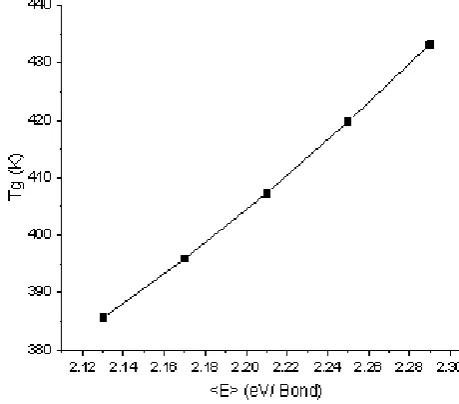
Figure 2 shows the variation of glass transition temperature with mean bond energy. The glass transition temperature increases with the increase in mean bond energy. The glass transition temperature for the various compositions of the Sn13Se87-xSbx (x = 0, 3, 6, 9, 12) glassy system has been calculated using equation (12) and is listed in Table 3. The glass transition temperature of the system under consideration shows an increase with the increase of the Sb content. This increase in the value of the glass transition temperature with increasing Sb content in glass forming alloys may be due to the accumulation of three dimensional structural units SbSe3/2 and SnSe4/2 in them and due to the decrease of the content of chain like formation of excess Se.
Figure 2. shows the variation of glass transition temperature (Tg) with
mean bond energy < E > in the Sn13Se87-xSbx (x = 0, 3, 6, 9, 12) glassy
system.
[image:4.595.313.543.494.696.2]For binary system theoretically band gap (Eg) can be calculated by the relation given by Shimakawa [28]:
𝐸𝐸𝑔𝑔(𝐴𝐴𝐴𝐴)= 𝑉𝑉𝐸𝐸𝑔𝑔(𝐴𝐴)+ (1 − 𝑉𝑉)𝐸𝐸𝑔𝑔(𝐴𝐴) (13)
where V is the volume fraction of element A and (1-V) is the volume fraction of element B. Eg(A) and Eg(B) are energy gaps of elements A and B respectively. The same relation can be applied for ternary systems. It is inferred that with the addition of Sb in Sn-Se alloy the band gap considerably increases. This can be associated with increase in average heat of atomization [29] as well as decrease in electronegativity [30]. There is direct relationship between the Hs and Eg given by Aigrain and Balkanski [31] which leads to the important conclusion that the band gap increases with the increase in Sn content. Cohesive energy is the stabilization energy of an infinitely large cluster of material per atom. It gives a measure of the average bond strength. Chemical Bond Approach method [20] has been used to find the cohesive energy of the system under study. According to this method, bonds are formed in the order of their decreasing bond energies. So the cohesive energy is calculated by summing the bond energies over all bonds expected in the present system. The values of the bond energy for the different compositions of the Sn13Se87-xSbx (x = 0, 3, 6, 9, 12) system are shown in Table 2. The values of cohesive energy show an increasing trend with the increase of Sb content. This increase in the value of cohesive energy can be assigned to the formation of more and more heteronuclear bonds of Sn with Se with the increase in Sb content. These Sn-Se bonds have the highest value of bond energy for the present glassy alloy.
Cohesive energy of samples has been calculated by chemical bond approach [20].
C. E. = ∑ �CtDt
100� (14)
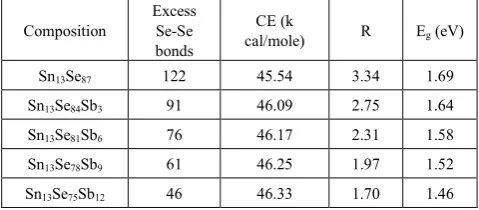
where Ct represent the number of expected chemical bonds and Dt is the energy of each bond respectively. The calculated values of cohesive energies of different glassy samples along with excess Se-Se bonds are given in the Table 4. It increases with the addition of Sb content, which means average stabilization energy also increases. Increase in CE thus causes a gap between bonding and anti-bonding orbital.
Deviation of stoichiometry (R) is defined as the ratio of covalent bonding possibilities of chalcogen atoms. It is calculated by the relation:
𝑅𝑅 =𝑋𝑋𝑁𝑁𝑌𝑌𝑁𝑁𝑆𝑆𝑆𝑆
𝑆𝑆𝑆𝑆+ 𝑍𝑍𝑁𝑁𝑆𝑆𝑆𝑆
[image:5.595.312.552.101.206.2]where X, Y, Z are the atomic fractions of Sn, Se and Sb respectively. This approach leads to an important conclusion that for R>1, system is chalcogen rich and for R<1, system is chalcogen poor and for R=1, is threshold value where heteropolar bonds exists. From Table 4 it is clear that R>1 for all the samples under consideration and hence system under investigation is chalcogen-rich region.
Table 4. describes the values of cohesive energies, excess Se-Se bonds, parameter R and band gap for Sn13Se87-xSbx (x = 0, 3, 6, 9, 12) glassy alloys.
Composition Excess Se-Se bonds
CE (k
cal/mole) R Eg (eV)
Sn13Se87 122 45.54 3.34 1.69
Sn13Se84Sb3 91 46.09 2.75 1.64
Sn13Se81Sb6 76 46.17 2.31 1.58
Sn13Se78Sb9 61 46.25 1.97 1.52
Sn13Se75Sb12 46 46.33 1.70 1.46
4. Conclusions
It is evident from the theoretical investigation that the change in composition of Sn13Se87-xSbx (x = 0, 3, 6, 9, 12) glassy system changes almost all the physical parameters. The present work on Sn13Se87-xSbx (x = 0, 3, 6, 9, 12) glassy system shows that the average coordination number, number of constraints, average heat of atomization, mean bond energy, cohesive energy and glass transition temperature increases with the increase of Sb content while the number of lone pair of electrons, band gap and average single bond energy (
H
S/m)decreases. The increase in glass transition temperature (Tg) and cohesive energy with increasing Sb content is explained on the basis of chemically ordered network model by which heteronuclear bonds are preferred to homonuclear ones.REFERENCES
[1] Fritzsche, J. Phys. & Chem. Solids 68, 878 (2007). [2] P. Pattanayak, S. Asokan, Europhys. Lett. 75, 778 (2006). [3] H. F. Hamann, M. O. Boyle, Y. C. Martin, M. Rooks, H. K.
Wickramasinghe, Nature Mater. 5, 383 (2006).
[4] Balitska, O. Shpotyuk, H. Altenberg, J. Non-Cryst. Solids 352 4809 (2006).
[5] A. Ganjoo, H. Jain C. Yu, R. Song, J. V. Ryan, J. Irudayaraj, Y. J. Ding, C.G. Pantano, J. Non-Cryst. Solids 352, 584 (2006).
[6] M. Bayindir, O. Shapira, D. S. Hinczewski, J. Viens, A. F. Abouraddy, J. D. Joannopoulos, Y. Fink, Nature Mater. 4, 820 (2005).
[7] S. A. Mcdonald, G. Konstantatos, S. Zhang, P. W. Cyr, E. J. D. Klem, L. levinal, W. H. Sargent, Nature Mater. 4, 138 (2005). [8] G. Boudebs, S. Cherukulappaurath, M. Guignrd, J. Troles, F.
Smektala, F. Sanchez, Optics Commun. 230, 331 (2004). [9] M. Popescu, in “Non-Crystalline Chalcogenides” Kluwer
Academic, Boston (2001).
[11] K. Tanaka, K. Shimakawa, Phys. Status Solidi. B 246, 1744 (2009)
[12] P. S. R. Alerigi, H. Dalaver, Anjum, Y. Zhang, X. Yang, A. Benslimane, K. Tien, M. N. Hedhili, A. Mohammad, S. O. Boon, J. Appl. Phys. 113, 044116 (2013).
[13] N. Mehta, M. Zulfequar, A. Kumar, J. Optoelectron. Adv. Mater 6, 441 (2004).
[14] D. V. Harea, I. A. Vasilev, E. P. Colomeico, M. S. Lovu, J. Optoelectron. Adv. Mater. 5, 1115 (2003).
[15] P. Kumar, R. Thangaraj, J. Non-Cryst. Solids 352, 2288 (2006).
[16] P. Sharma, S.C. Katyal, Thin Solid Films 517 (2009) 3813. [17] J. C. Phillips, J. Non-Cryst. Solids 34, 153 (1979). [18] M. F. Thorpe, J. Non-Cryst. Solids 57, 355 (1983). [19] L. Zhenhua, J. Non-Cryst. Solids 127, 298 (1991). [20] W. H. Zachariasen, J. Am. Chem. Soc. 54, 3841 (1932). [21] J. Bicerno, S. R. Ovshinsky, J. Non-Cryst. Solids 74, 75
(1985).
[22] P. Sharma, S. C. Katyal, J. Non-Cryst. Solids 354 (2008) 3836.
[23] M. Kastner, Phys. Rev. Lett. 28, 355 (1972).
[24] S. R. Ovshinsky, Selected papers, “Disordered Materials: Science and Technology”, D. Adler (Ed.) Amorphous Institute Press, USA 83 (1982).
[25] L. Pauling, “The Nature of Chemical Bond”, Cornell University Press, New York (1963).
[26] L. Tichy, H. Ticha, J. Non-Cryst. Solids 189, 141 (1995). [27] L. Tichy, H. Ticha, Mater. Lett. 21, 313 (1994).
[28] K. Shimakawa, J. Non-Cryst.Solid. 43 229 (1981).
[29] A.H. Ammar, A.M. Farid, S.S. Fouad Physica B 307, 64 (2001).
[30] V. Pandey, S. K. Tripathi, A. Kumar, J. Optoelectron. Adv. Mater. 8 (2), 796 (2006).