
NURUL HUDA BINTI AHMAD ZAHARI
A thesis submitted in
fulfillment of the requirement for the award of the Master of Information Technology
Faculty of Information Technology and Multimedia Universiti Tun Hussein Onn Malaysia
v
ABSTRACT
The Malaysian Government has created smart national identity card named MyKad for every citizen aged 12 and above since September, 2001. In the following year, the National Registration Department of Malaysia (JPN) has embedded the latest application of MyKad, which is known as Public Key Infrastructure (PKI). It allows secure electronic transactions over the Internet. The electronic transactions include online submission of tax returns, secure email and e-commerce. In parallel with the emergence of e-commerce payment system, a new MyKad Payment Model (MPM) is proposed in order to introduce to the public another function of MyKad that is not only for identification purposes, but also in e-commerce transactions. However, to make this payment model accepted by the public, the focus should be made on two issues;
trust/security issue and performance issue. A system with security technique named Arbitrary Random Security Algorithm (ARSA) and a one-to-one multithreading model need to be developed in order to accelerate the authentication response time of MPM. ARSA will automatically change its security algorithm based on times and attacks. If there is no attack or intrusion detected, MPM will wait for the scheduled switching within 30 minutes. However, if attack or intrusion is detected in less than 30 minutes, ARSA will automatically change the security algorithm to a new one. The
ABSTRAK
Kerajaan Malaysia telah memperkenalkan kad pengenalan diri pintar untuk semua warganegaranya yang berumur 12 tahun dan ke atas sejak September 2001. Pada tahun berikutnya pula, Jabatan Pendaftaran Negara Malaysia (JPN) telah
melancarkan aplikasi terbaharu MyKad yang dikenali sebagai Infrastruktur Kekunci Awam (PKI). Aplikasi terbaharu ini membolehkan pengguna melakukan transaksi elektronik dengan menggunakan kemudahan Internet. Transaksi yang dimaksudkan adalah seperti penghantaran borang cukai pendapatan dalam talian, emel yang selamat dan e-dagang. Seiring dengan perkembangan e-dagang kini, Model
Pembayaran MyKad (MPM) yang baharu dicadangkan untuk diperkenalkan kepada masyarakat umum bahawa MyKad bukan sekadar digunakan untuk tujuan
pengenalan diri tetapi juga untuk transaksi e-dagang. Walau bagaimanapun, untuk membolehkan model ini diterima pakai oleh rakyat Malaysia, terdapat dua isu yang perlu difokuskan iaitu isu kebolehpercayaan/keselamatan dan isu prestasi. Oleh itu, satu sistem yang menggunakan teknik keselamatan yang dinamakan sebagai
vii
CONTENTS
TITLE i
DECLARATION ii
DEDICATION iii
ACKNOWLEDGEMENT iv
ABSTRACT v
CONTENTS vii
LIST OF TABLES xi
LIST OF FIGURES xii
LIST OF SYMBOLS AND ABBREVIATIONS xiv
LIST OF APPENDICES xvi
CHAPTER 1 INTRODUCTION 1
1.1 Background of Study 1
1.2 Problem Statement 4
1.3 Research Question 6
1.4 Research Objectives 6
1.5 Research Hypothesis 7
2.2 Smart Card 10
2.3 MyKad 11
2.3.1 MyKad PKI 13
2.3.2 MyKad PKI in e-Commerce Application 15
2.4 Overview of Electronic Payment 16
2.5 Security Features of Payment Model 19 2.5.1 Encryption/Decryption Process 20
2.5.2 Hashing Process 25
2.6 Payment Model with Multithreading Technique 28
2.6.1 User Level Thread 28
2.6.2 Kernel Level Thread 30
2.7 Summary 32
CHAPTER 3 RESEARCH METHODOLOGY 34
3.1 Introduction 34
3.2 MyKad Payment Model (MPM) 35
3.3 Architecture of MPM 39
3.3.1 Arbitrary Random Switching Technique
(ARSA) 41
3.3.2 Thread Handler 44
3.4 Summary 46
CHAPTER 4 SYSTEM DESIGN 47
4.1 Introduction 47
4.2 Module of the System 48
4.2.1 Server Software Module 48
4.2.2 Client Software Module 48
4.2.3 Security Module 49
ix
4.4 MPM Unified Modeling Language (UML)
Diagram - Use Case Diagram 57
4.5 MPM Unified Modeling Language (UML)
Diagram -Class Diagram 58
4.6 Multithreading Performance Test 59
4.6.1 Testing Process 59
4.7 Summary 64
CHAPTER 5 RESULT AND DISCUSSION 66
5.1 Introduction 66
5.2 Testing Result 66
5.2.1 Expected Time and Multithread Simulation
Result 67
5.2.2 Simulation Results of the Transaction Time
between Single Thread and Multithread 71 5.2.3 Simulation Results of the Login Time between
Single Thread and Multithread 72
5.2.4 Simulation Results of the Payment Time
between Single Thread and Multithread 74 5.2.5 MPM and Credit Card Authorisation System 76
Comparison
5.3 Summary 77
CHAPTER 6 CONCLUSION AND FUTURE WORK 79
6.1 Introduction 79
6.2 Summary of Contributions 79
6.2.1 Arbitrary Random Security Algorithm 80
6.2.2 Multithreading 81
6.3 Future Work 82
6.4 General Discussion 82
xi
LIST OF TABLES
2.1 Summary of smart card history 11
2.2 Summary of reviewed payment models 17
2.3 Comparison of electronic payment model characteristics 18 2.4 The differences between Symmetric and Asymmetric. 22 2.5 The advantages and disadvantages of Kernel-Level Threads 30
2.6 Basic Thread Operation 31
4.1 Symmetric Encryption Scheme 49
4.2 Description of System Functionalities 56
5.1 Transaction response time per thread 68
5.2 Comparison results between expected time transaction and testing
time results 69
5.3 Comparison of the transaction time between single and multithread 71 5.4 Comparison of the Login transaction time between single thread and
multi thread 72
5.5 Comparison of the payment transaction time between single thread
and multi thread 74
5.6 Comparison time of multithread technique in MPM and Credit Card
LIST OF FIGURES
1.1 Allocated Space for Various Applications with MyKad Chip 3
2.1 Certificate Format 14
2.2 Example of Digital Certificate 14
2.3 Encryption/Decryption Process 22
2.4 Example of Hashing Process 27
2.5 Basic Thread States and Operations 32
3.1 Basic Proposed Payment Model of MyKad 36
3.2 MPM Model Details 37
3.3 MPM Architecture 40
3.4 ARSA Flow 42
3.5 ARSA Library 43
3.6 ARSA Process 44
3.7 MPM Thread Processing 45
4.1 Success Security Phase I 51
4.2 Failure Security Phase I
51
4.3 Success Security Phase II 52
4.4 Failure Security Phase II 52
4.5 Success Security Phase III 53
4.6 Failure Security Phase III 53
4.7 MPM Functional Specification 55
4.8 MPM Use Case Diagram 57
4.9 Class Diagram 59
4.10 Protocol menu in HP LoadRunner 60
4.11 MPM working directory 61
4.12 System Recording 61
4.13 Process of testing 62
xiii
4.15 LoadRunner Testing Report 63
4.16 LoadRunner Testing Process 64
5.1 Graphical comparison between expected time transaction and testing
time results. 70
5.2 Graphical results of Transaction time between Single Thread and
Multithread 71
5.3 Simulation result of Transaction time between Single Thread
and Multithread 72
5.4 Graphical results of Login time between Single Thread and
Multithread 73
5.5 Simulation results of Login time between Single Thread and
Multithread 73
5.6 Graphical results of Payment between Single Thread and Multithread 74 5.7 Simulation l results of Payment between Single Thread and
Multithread 75
5.8 Comparison time of multithread technique in MPM and Credit Card
LIST OF SYMBOLS AND ABBREVIATIONS
AES - Advanced Encryption Standard ATM - Automated Teller Machine CA - Certification Authority
CAPICOM - Microsoft security algorithm pack DES - Data Encryption Standard
3DES - Triple Data Encryption Standard
EEPROM - Electrically Erasable and Programmable Read Only Memory GSM - Global System for Mobile
iVEST - Virtual Environment for Secure Transaction
i - Starting of Thread
JPJ - Road Transportation Department JPN- National Registration Department LRT - Light Rail Transit
LHDN - The Inland Revenue Malaysia
MAMPU- Malaysia Administrative Modernization and Management Planning Unit
MD - Message Digest
MEPS - Malaysian Electronic Payment System MIMOS - Malaysian Institute of Microelectric Systems
n - Number of concurrent threads NIC - National Identity Card
NIST - National Institute Standard Technology NITC - National Information Technology Council SIM - Subscriber Identity Module
PDRM - Traffic Police Officer of Royal Malaysian Police PIN - Personal Identification Number
xv
RC - Rivest Cipher
RSA - Rivest Shamir Adleman SHA - Secure Hash Algorithm
T - Thread response time
LIST OF APPENDICES
A Software Tester Form 90
B Thread Management 92
C ARSA 93
D ARSA Library 94
CHAPTER 1
INTRODUCTION
1.1 Background of Study
A lot of changes had occurred in the development of smart card since it started to be
patented in early 1970’s. It started with a magnetic stripe card to the latest version,
contactless smart card. Until now, smart cards have been used to store small amount
of money, as a debit card to pay telephone bills, photocopy, pay transportation to
tickets and many more. After the launch of the smart-based Subscriber Identity
Module (SIM) card in the Europe in 1990’s, the use of this card has finally made
sense to the public. This smart-based SIM card is used in Global System for Mobile
(GSM) for mobile phones in the European countries (Henry, 2007). Smart card is
widely used as an identification card in several countries such as Germany, South
Korea and Malaysia. A lot of information can be encoded in the chip card such as
health status, driving license, insurance and other important details about oneself.
The Malaysian Government has used smart card as identification card for
Malaysian and permanent residents aged 12 and above since its official launching on
the 5th September 2001. It incorporates an ATMEL 64K Electrically Erasable and
Programmable Read Only Memory (EEPROM) microchip. This chip contains
several items of data including biometrics. The Malaysian Government
Multipurpose Card or also known as MyKad is a multipurpose card that enables its
user to access public and private services. It is regarded as the world’s first smart
applications but the uptake of public applications has been minimal. The council
also reported that roughly RM900 million has been invested in MyKad project,
including RM600 million for the purchase of 22 million smartcards. In order to
ensure that MyKad application achieves its full potential, various agencies such as
Malaysia Administrative Modernisation and Management Planning Unit (MAMPU),
National Registration Department (JPN), Pos Malaysia Berhad and NITC itself are
required to cooperate. After spending such an amount on developing the project, the
use of MyKad is not limited to identification purpose only, but it is also developed to
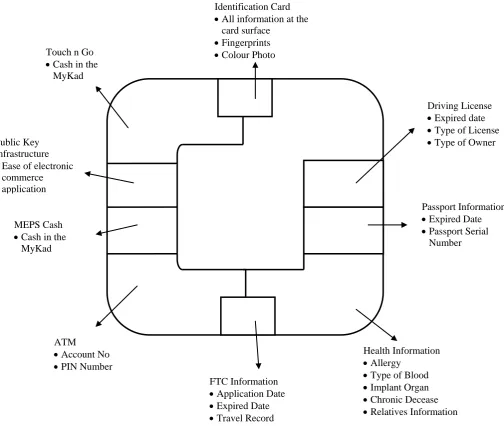
perform different access to Government agencies. Figure 1.1 presents the
information contained in the chip of MyKad.
Based on the figure, there are about eight more applications that can be
carried out by using MyKad. The applications include driving license information,
passport information, health information, frequency traveller card, Automated Teller
Machine (ATM) application, Malaysian Electronic Payment System (MEPS) cash
(MEPSCASH), Touch ‘n Go and the latest one, Public Key Infrastructure (PKI). For
the driving license application, MyKad replaces the paper-based laminated cards and
functions as a regular driving license. The users for this application are the Road
Transportation Department (JPJ) enforcement officers and the Police Traffic Officers
of the Royal Malaysian Police (PDRM). The passport application in MyKad
supplements Malaysians to facilitate efficient exit and re-entry from Malaysian
Immigration check points. Health information in MyKad stores basic and critical
medical information. Another application in MyKad, MEPSCASH facilitates
payment of small purchases and enhances the efficiency and quality of public and
payment services. For transportation, MyKad can be used for the payment at the toll
gates, parking fees, bus and Light Rail Transit (LRT) fares. For banking application,
MyKad provides easy and convenient transaction that acts like an ATM card. The
functions include cash withdrawal, balance inquiry, and fund transfer. Finally, the
latest application implemented, PKI provides confidentiality, integrity,
non-repudiation and authentication.
Out of eight applications mentioned earlier, by far, the application that is
3
secure electronic commerce and transactions using digital certificate over the
networks such as the Internet. The authenticity and integrity of the data are protected
and inaccessible to anyone, except from the relevant Government agencies and the
[image:16.595.60.565.194.620.2]owner of MyKad (Clarke, 2005).
Figure 1.1: Allocated Space for Various Applications in MyKad chip (JPN, 2007)
Currently, MyKad’s PKI application allows secure electronic transactions
over the Internet. The transactions include online submission of tax returns, secure
email and electronic commerce. Based on JPN’s website, there are three agencies
Identification Card
• All information at the card surface
• Fingerprints
• Colour Photo
Driving License
• Expired date
• Type of License
• Type of Owner
Passport Information
• Expired Date
• Passport Serial Number
Health Information
• Allergy
• Type of Blood
• Implant Organ
• Chronic Decease
• Relatives Information FTC Information
• Application Date
• Expired Date
• Travel Record ATM
• Account No
• PIN Number MEPS Cash
• Cash in the MyKad Public Key Infrastructure
• Ease of electronic commerce application
Touch n Go
Institute of Microelectronic Systems (MIMOS). As presented by Wan Ibrahim
(2005), the use of MyKad’s PKI needs to be a mandatory application in five years to
ensure the implementation of MyKad can achieve its Return on Investment (ROI).
However, only National Identity Card (NIC) application is loaded into MyKad by
default while other applications are loaded voluntarily (Loo et al., 2009). The
Government faces difficulties in convincing all MyKad users to acknowledge
MyKad’s full potential and capabilities. Therefore, this research aims to close the
gap and to propose that the MyKad’s PKI to be embedded in e-commerce
application.
1.2 Problem Statement
Nowadays, the Internet helps and facilitates online business to be more flexible.
With the pressure from the fluctuated economic growth, Malaysians are turning more
towards the online business. This kind of business is beneficial to both merchants
and consumers as the company needs low cost to build its business while the
customers can easily deal with the company. There are, however, a number of
problems with the current online business model. According to a survey by Rahman
and Masrom (2010), these online business systems do not provide legal binding
proof of the business transaction. Normally, consumers are asked to bank the
required amount of money for the item they want to buy. However, there is no legal
evidence that the money transferred to the merchant’s account is a payment for that
particular item. Hence, there is no way for the customers to prove that they have
made the payment in accordance to any electronic order form prior to the transaction.
In addition, since the transferred money is in the merchant’s account, it is not
guaranteed that the merchant will ship the product to the consumer. Based on these
situations, the customers are likely not to make the purchase as they do not will to
5
Therefore, this research proposes a new payment model that is suitable and
acceptable in Malaysia. In order to overcome the issues mentioned earlier, MyKad
will be used as the medium of payment since the PKI in MyKad is recognised by the
authority as legally bonded. Besides, this research introduces to the public another
use of MyKad that is not only for identification purpose but also in e-commerce
transactions. Hence, the new payment model will introduce to the Malaysians the
secure usability of PKI application in MyKad that can be used as an alternative
payment method. In order to make this payment model acceptable by the public, the
proposed model needs to overcome these issues:
(a) Trust and Security issues
Trust has been found to have an influence on a customer’s willingness to purchase
online (Gefen et al., 2006). For example, an entity can be said to trust a second entity
when the first entity makes the assumption that the second entity will perform
exactly as the first entity expects. In this proposed research, the use of PKI will gain
the trust from the public because if anything happens during the transaction, the
evidence generated from the PKI is admissible in the court of law since it is
recognised as legally bonded. With the PKI, the public will find that their transaction
and money are secure even if something happens during the transaction.
Other than the trust issue, security has always been considered as an essential
and critical area of research (Rahman and Masrom, 2010). It is crucial for a payment
model to have its own security framework. This research intends to propose the
security of payment model for financial transaction using MyKad.
(b) Performance issue
In this issue, it emphasises on real-time performance especially regarding
authentication response time because it can affect the users’ behaviour whether they
want to use the system or not due to its performance. For example, in a credit card
system during peak hours, credit card transaction takes longer time for authorisation
process. The performance of the system is affected whenever the authorisation
implementation. Based on the comparison between single and multithread using the
proposed system, the performance of the multithread system has increased almost
two-fold than the single thread system. It proves that multithreading can give better
response time to the users and also allows users to execute the tasks simultaneously
while running the process.
1.3 Research Questions
From the earlier discussion, research questions have been formulated as follows:
(i) What are the elements involved in MyKad payment model?
(ii) What security frameworks can MyKad payment model implement to
secure customers during transaction?
(iii) Does the new payment model with security and multithreading
technique perform better than the credit card?
1.4 Research Objectives
Based on the research background and other related issues, the objectives of this
research are as follows:
(i) To identify all the elements of the payment model related to MyKad
based on the study of payment model.
(ii) To design a payment model with security and multithreading
technique as proposed in the research.
(iii) To evaluate the model based on response time of the transaction with
7
1.5 Research Hypothesis
In order to determine whether the new payment model named MyKad Payment
Model (MPM) performs as good as the credit card system, the following null
hypothesis was tested.
Null Hypothesis 1. There is no difference between MyKad Payment Model (MPM)
and credit card authorisation system response time.
1.6 Thesis Outline
(i) Chapter 1 presents a brief explanation about the background, research problem statements, research questions, research objectives and research
hypothesis.
(ii) Chapter 2 discusses an overview of smart card, MyKad and their
applications. Related payment models are compared in this chapter in order
to identify the players involved in a transaction for a basic model. Besides
that, this chapter discusses a general idea on security and multithreading
parts.
(iii) Chapter 3 starts with the introduction of the basic payment model and followed by the details of the proposed model. The chapter continues by
describing how the model has been formulated and designed. It also discusses
the two techniques proposed, which are ARSA and multithreading.
(iv) Chapter 4 describes the details of MPM model along with its module, techniques proposed, architecture design of the proposed model and its
prototype with detailed explanation on the system architecture. In the last
section in the chapter, the performance testing of the MPM is conducted by
using HP Load Runner.
(v) Chapter 5 summarizes the analyses and findings of the MPM. The findings discussed in this section are the multithreading result. The response time
between the proposed technique, multithread and single thread are compared
CHAPTER 2
ELECTRONIC PAYMENT MODEL – DATA SECURITY AND PERFORMANCE
2.1 Introduction
MyKad contains multiple applications for users’ convenience, with the latest one is Public Key Infrastructure or PKI in short. As it is PKI-ready, MyKad is capable to store digital certificate that can be used to digitally sign and encrypt Internet
transactions. Based on its security features, MyKad gives more secure and protected e-commerce transactions where it can be used as a medium of payment in purchasing everyday items. In order to develop a new security payment model for MyKad named MyKad Payment Model (MPM), four types of payment model are discussed in this chapter, which are:
(i) Electronic Credit Card (ii) Electronic Cash (iii) Electronic Check (iv) Smart Card Payment
As mentioned in Chapter 1, the issues on security and performance will be focused. In security issue, several algorithms will be discussed in this chapter in order to find the suitable algorithm to be put in the model. The algorithms include the encryption/decryption and hashing process. The performance of MPM is
2.2 Smart Card
Smart card is an intelligent card with a built-in chip capable of storing information in its memory (Awad, 2007). The card contains a programmable chip, a combination of RAM and ROM storages and an operating system. Turban and McElroy (1998) identified two main categories of smart cards. The first category of smart card is a memory card that contains only non-volatile memory storage components, and perhaps some specific security logic. For example, the users can spend this type of smart card on pay phone, retail, vending machines and other related transactions. The second category is a microprocessor or intelligent card that contains volatile memory and microprocessor components. Most of the intelligent cards offer read and write applications, and new information can be added and processed (Turban and McElroy, 1998; and Maher, 2004).
Since smart cards have been around for about 20 years, the demand for public key smart cards in the last four years has been increasing (Raihi, 2001). The demand includes the Government sector, banks and insurance institutions. The popularity of Internet recently also contributes to the increas of e-commerce applications and this will affect the growth of smart cards application in the Internet (Guthery and
11
Table 2.1: Summary of smart card history (Cardwerk, 2009)
Year Inventor Description
1968 Jurgen Dethloff &
Helmutt Grupp
An automated chip card, patent approved in 1982 and first used with France pay phones.
1970 Dr. Kunitaka Arimura Filed the first and only patented the smart card
concept.
1974 Roland Moreno Filed the original patent for the IC card, later dubbed
the “smart card”.
1977 Bull CP8, SGS
Thomson, and Schlumberger
Three commercial manufacturers began developing the IC card.
1979 Motorola Developed the first secure single chip microcontroller
for use in French banking.
1982 French
Telecommunication Company
Field testing of serial memory phone cards took place in France, the world’s first major IC card test.
1984 Bank Field trials of ATM bank cards with successfully
conducted chips.
1986 Bull CP8 Distributed smart cards to its clients such as Bank of
Virginia, Maryland National Bank, First National Palm Beach Bank and Mall Bank.
1987 U.S. Department of
Agriculture’s nationwide Peanut Marketing Card.
First large-scale smart card application implemented in the United States.
1991 Wyoming Special
Supplemental Nutrition Program for Women, Infants, and Children (WIC).
First Electronic Benefits Transfer (EBT) smart card project launched.
1993 Telecarte (for public
phones)
Field test of multifunction smart card applications in Rennes, France, enabled in a Smart Bank Card.
1994 Europay, MasterCard,
and Visa (EMV)
Published joint specifications for global microchip-based bank cards (smart cards).
Germany began issuance of 80 million serial memory chip cards as citizen health cards.
1995 Mobile Phones
Companies
Mobile phone subscribers worldwide began initiating and billing calls with smart cards.
The first of 40,000 multifunctional, multi-technology MARC cards with chips were issued to U.S. Marines in Hawaii.
1996 Atlanta Olympics
MasterCard and Visa
Over 1.5 million VISACash stored value cards were issued at the Atlanta Olympics.
MasterCard and Visa began sponsorship of
2.3 MyKad
MyKad is a multipurpose card that will enable Malaysians to access public and private services since the data stored in it include personal identification, driving license number, passport information, medical data and financial information. Some of the services provided for MyKad holder are highway tolls, parking fees and public transportation such as bus fares and LRT fares. According to Knight (2001), MyKad is regarded as the world’s first National Identification Smart Card. MyKad supports eight types of applications such as identity card including fingerprint and photo, driving license, passport, e-cash, ATM card integration, Touch ‘n Go, as well as MyKad PKI application.
This study is on one of the applications of Mykad, which is the Public Key Infrastructure (PKI) supported by the 64 Kb version of MyKad. It has been
implemented since February, 2003. With it, PKI allows easy securing of private data over public, thus allowing secure electronic transactions over the Internet, which include online submission of tax returns, Internet banking and secure email. However, at this moment these functions are still not widely used by Malaysian because they are not widely promoted and this causes the Malaysian to be unaware of this application. MyKad’s PKI will be explained further in next section.
General Services Administration
United States Navy Microsoft
smart card system and card management solution at the Smart Card Technology Center in Washington, D.C.
Announced its new Windows smart card operating system.
2001 Social Security IDCard,
Spain.
Full scale introduction in progress. Card gave access to medical benefit.
2001 Malaysian
Government
Compulsory national ID scheme included different applications and was rolled out for 18 million users.
13
2.3.1 MyKad’s PKI
The driving force behind the security of MyKad is Virtual Environment for Secure Transactions (iVEST), while the PKI is developed by a subsidiary of MiMOS Bhd of the same name (Swinburne, 2009). MyKad has an embedded PKI that supports security mechanisms such asencryption, message authentication and digital signatures (Phan, 2003). The PKI in MyKad performs encryption and digital signatures by making use the public-key techniques. Such techniques make use a pair of keys, namely a private key, which is kept secret, and a public key that is “widely broadcasted to the public”. The twokeys are generated such that when one key is usedto transform some information into an unintelligible form (encryption), the only way to reverse the process is by using the other key (via decryption).
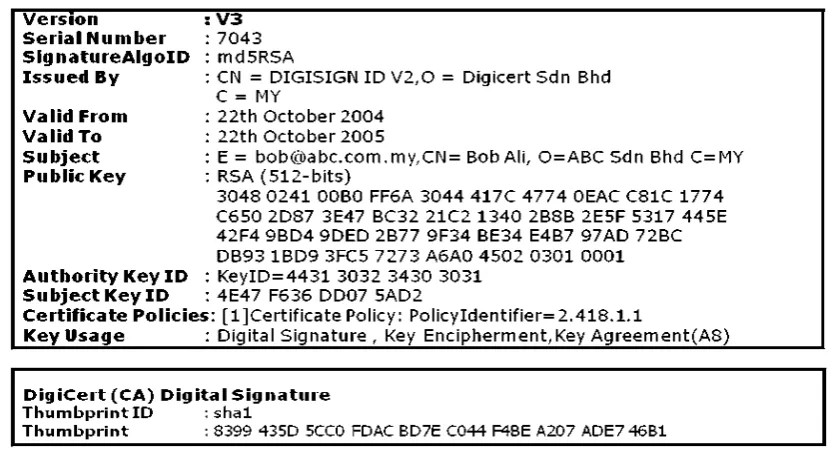
The MyKad PKI uses X.509 Version 3 (v3) certificates (Mykad Guidelines, 2005). The structure of the X.509 v3 certificate is illustrated in Figure 2.1. The certificates contains the owner’s public key, some forms of the principal’s identity, algorithms used in the certificates, digitally signed and issued by Certification Authority (CA), and has a finite validity period (Norbik, 2006). In particular, Figure 2.2 shows how the certificate may be extended with optional extension fields. These certificates are digitally signed using the private key of the issuing CA. A part of the PKI implementation focuses on MyKad physical requirements as set by the National Registration Department. All registered MyKads with the identities of every
individual shall fit for the registration and usage of the digital certificates. The characters of the basic requirements, but not limited to MyKad, are as follows:
(i) Card Operating System
(ii) Support international standard, ISO 7816 Part 3 and 4. (iii) Cryptographic Module
(iv) Higher security features and accelerators. (v) Secure protection of private keys
(vi) Digital signature support
Figure 2.1 Certificate Format (Norbik, 2006)
Figure 2.2 Example of Digital Certificate (Norbik, 2006)
The implementation of PKI capabilities into MyKad along with the usage of Digital Certificates shall provide a few key benefits (MyKad Guideline, 2005). There shall be two sets of digital certificates in MyKad. Each certificate shall have its own functions to be performed in accordance to Digital Signature Act 1997 and Digital Signature Regulations 1998. The first set of digital certificate is used for digital signature and the cardholder uses the private key to carry out the function
issuer name validity period subject name
subject public key info issuer unique identifier {extensions}
[image:27.595.109.525.360.587.2]15
while the second set of digital certificate is used in authentication and encryption function (Mykad Guidelines, 2005).
MyKad’s PKI architecture contains security measure that involves certificate registration. The process of certification creation involves a lot of encryption and decryption of sensitive data (SANS Institute, 2001). The encryption and decryption of the data are done by applying any strong security algorithms so that the data cannot be decrypted easily by third party. Every encryption and decryption process will have an assigned public key and private key in which they are only known to the authorised party.
The security features such as public key and digital signatures included in MyKad’s PKI enable more secure and protected e-commerce transactions.
Malaysians whom have converted their old national identity card to MyKad can use it as a medium to purchase everyday items, to pre-pay for any services requested and to do online transactions with any of the e-commerce merchants using the MyKad’s PKI e-commerce application. Currently, there is still lack of e-commerce
applications that are compatible with MyKad’s PKI. Therefore, in the next section further discussion on how MyKad’s PKI can be enhanced to support the e-commerce application with minimal fuss, the risk and other major considerations that need to be considered for the development of MyKad e-commerce applications.
2.3.2 MyKad’s PKI in e-Commerce Application
reader to its customer since 2007 to perform transactions. The bank reported that almost one million of its customers are using it (Bielski, 1999). It shows a good response since it was launched. Hence, the user has the control on the validity of identification by using the card reader. Due to that, the use of smart card reader is seen as a reason that widens the acceptance of smart card (Chege, 2002).
2.4 Overview on Electronic Payment
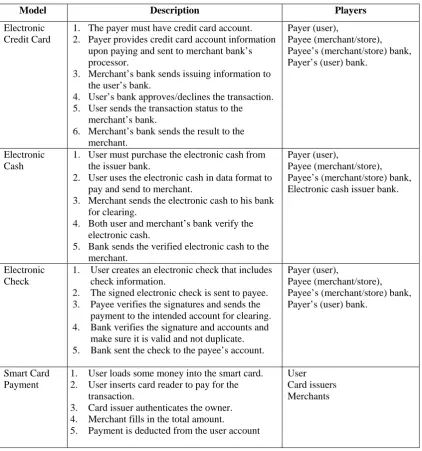
There are several electronic payment systems and models proposed that depend on their application or transaction requirements. Generally, there are four major categories of electronic payment system, which are online credit card payment, electronic cash, electronic checks and small payment (Wayner, 1997). However, Meng (2003) classified the electronic payment model into three payment models, which are similar to the models proposed by Wayner (1997) except the small
17
Table 2.2: Summary of reviewed payment models
Model Description Players
Electronic Credit Card
1. The payer must have credit card account. 2. Payer provides credit card account information
upon paying and sent to merchant bank’s processor.
3. Merchant’s bank sends issuing information to the user’s bank.
4. User’s bank approves/declines the transaction. 5. User sends the transaction status to the
merchant’s bank.
6. Merchant’s bank sends the result to the merchant.
Payer (user),
Payee (merchant/store), Payee’s (merchant/store) bank, Payer’s (user) bank.
Electronic Cash
1. User must purchase the electronic cash from the issuer bank.
2. User uses the electronic cash in data format to pay and send to merchant.
3. Merchant sends the electronic cash to his bank for clearing.
4. Both user and merchant’s bank verify the electronic cash.
5. Bank sends the verified electronic cash to the merchant.
Payer (user),
Payee (merchant/store), Payee’s (merchant/store) bank, Electronic cash issuer bank.
Electronic Check
1. User creates an electronic check that includes check information.
2. The signed electronic check is sent to payee. 3. Payee verifies the signatures and sends the
payment to the intended account for clearing. 4. Bank verifies the signature and accounts and
make sure it is valid and not duplicate. 5. Bank sent the check to the payee’s account.
Payer (user),
Payee (merchant/store), Payee’s (merchant/store) bank, Payer’s (user) bank.
Smart Card Payment
1. User loads some money into the smart card. 2. User inserts card reader to pay for the
transaction.
3. Card issuer authenticates the owner. 4. Merchant fills in the total amount.
5. Payment is deducted from the user account
Authority Security number + PIN
PIN Digital Signatures
+ Digital Certificates
PIN / Digital Signatures + Digital Certificates Actual Pay
Time
Later Before Later Pay Before
User Legitimate
Credit card user
Anyone Bank Account
Holder
Smart Card Account / Bank Account
Transaction Risk
Most risks are borne by bank
Risk of electronic cash to be stolen, lost or misused
User responsible most of the risk, however the payment can be stopped by user
Risk of smart card to be stolen, lost or misused.
Micro Payment No Yes No Yes
Large Payment Yes No Yes Yes
Transfer Limitation
Depends on limit of the card
Depends on the prepaid
No limit Depends on how
much money is saved
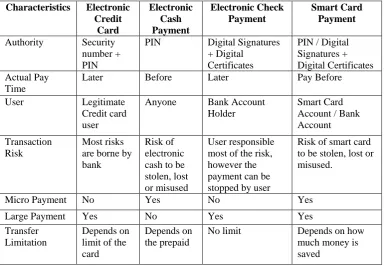
Based on both tables, the users of the electronic credit card payment need to provide three security numbers at the back of the card and PIN number for
authorisation. Electronic cash payment only uses PIN number for authentication. Electronic check payment provides strong authentication, which is digital signatures and digital certificates. For time settlement, electronic credit card and electronic check payment are paid after the statements are sent to the users while the electronic cash is paid before the payment is made because the users need to buy the electronic cash before spending it.
[image:31.595.114.501.102.368.2]19
can freely enter any amount of money without limits if they use the electronic check while the other two models depend on their card or prepaid limit.
Because smart card also provides an access to valuable assets or secret information such as electronic cash and banking information, they must be secured against any threats. Some smart cards show the account number of the owner and some others are required to enter a PIN number that must match the card. However, currently most of the cards use encrypted form to store information in the smart cards. That is why Turban et al. (2008) classified smart cards hacking as “class 3” attack because the cost for attacking exceeds the benefit.
Therefore, to ensure the implementation of MyKad Payment Model (MPM) succeeds, the model should be secured and offers good performance in term of time such as quick and less authentication time for authorisation. In order to achieve these criteria, the MPM should be developed with the tightest security as it holds critical information of the users and the capability to provide shorter waiting time for authentication. Next section discusses further on security.
2.5 Security Features of Payment Model
Computer security technology is constantly improved from time to time, as new technologies are being introduced almost every day. However, for all the new technologies that are being introduced to the computer world, the obsolete
pack, or CAPICOM. CAPICOM is a security technology from Microsoft that is used as part of this research project. It enables to do digitally signed data with a smart card or software key, verifies digitally signed data, graphically displays certificate
information, and encrypts and decrypts data using public keys and certificates (Lambert, 2001).
Basically, CAPICOM is a library that contains various types of Hashing and Encryption/Decryption algorithms. For encryption process, five different types of algorithms are used such as Data Encryption Standard (DES), 3Data Encryption Standard (3DES), Advanced Encryption Standard (AES), Rivest Cipher 2 (RC2) and Rivest Cipher 4 (RC4), while in hashing Message Digest 2 (MD2), Message Digest 4 (MD4), Message Digest 5 (MD5) and Secure Hash Algorithm 1 (SHA-1) are used.
2.5.1 Encryption/Decryption Process
Encryption is a process of transforming a plaintext to a ciphertext. In a normal context, encryption can be referred to as a football playing strategy. For example, a coach will refer a playing strategy to simple codes such as 4-4-2 strategy or 4-3-3 strategy, and the players will automatically know that this strategy is devised from the details of four defence player, 4 midfielders player and 2 strikers being for the former. Besides, in this strategy, the coach already includes all playing methods such as ball wasting, passing mode, tackling mode and others that the players are already aware of. It is important so that when the coach wants to change the strategy, he only mentions the simple code to avoid any leak of information to the opponent.
21
from the disguised message. Encryption and decryption processes need to be
employed in MPM due to the amount of sensitive data that MPM holds. MPM holds and transmits a lot of sensitive information that can be stolen such as customer information and account information. These data need to be masked before the transaction can take place so that, even though it is stolen during the transaction, the thief will not be able to use the stolen data because it is encrypted. So, in order to be able to encrypt and decrypt all the data, an algorithm will be used. This algorithm can be referred as a medium and process of encryption and decryption. Therefore, MPM introduces ARSA as its main security feature.
Figure 2.3: Encryption and Decryption Processes
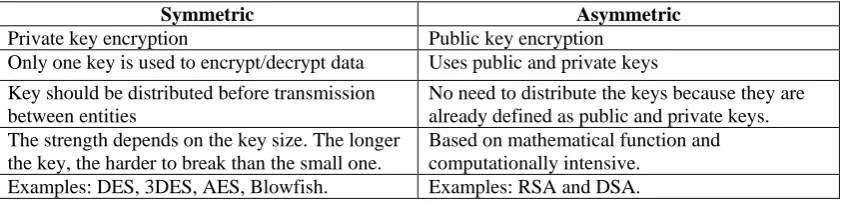
There are two types of encryption process. They are Symmetric and Asymmetric Encryptions. The differences between Symmetric and Asymmetric Encryptions are shown in Table 2.4.
Table 2.4: The differences between Symmetric and Asymmetric Encryptions
Symmetric Asymmetric
Private key encryption Public key encryption
Only one key is used to encrypt/decrypt data Uses public and private keys Key should be distributed before transmission
between entities
No need to distribute the keys because they are already defined as public and private keys. The strength depends on the key size. The longer
the key, the harder to break than the small one.
Based on mathematical function and computationally intensive.
Examples: DES, 3DES, AES, Blowfish. Examples: RSA and DSA.
As mentioned earlier in previous section, CAPICOM mainly uses DES, 3DES, AES, RC2 and RC4 for encryption process. However, some of the algorithms used in CAPICOM have their own weaknesses and they are not suitable to be
implemented in MPM security module.
[image:35.595.115.536.429.531.2]23
proposed. However, the entrenchment of DES within the communities such as banking will make it difficult to switch to a different encryption algorithm even if NIST does not recertify DES (Scheneir, 1994).
3DES is the improvement from weakness of the DES. This algorithm was proposed as a replacement for DES due to the advances in key searching (Nadeem & Javed, 2005). It is a 64 bits block size but with 192 bits key size, which is three times higher than DES. It is applied three times from DES encryption algorithm to increase the encryption level and the average safe time (Elminaam et al., 2008). However, because it applies three times, 3DES is known as slower than other block cipher method (Stallings, 2005) but it is more secure if used properly.
AES became the U.S Government standard in 2002 and has been approved for use with classified information. AES was proposed because clearly a
replacement for DES was needed at that time (NIST, 1997). AES encryption is fast and flexible and can be implemented on various platforms especially in small devices (Naik & Wei, 2001). In addition, AES has been carefully tested for many security applications (Stallings, 2005; Daemen & Rijmen, 2001). The known attacks against AES to date have involved timing, where the keys are guessed by analysing how long particular steps require. Some cryptographers worry that there might be attacks on the algorithm itself, but none have publicly emerged to date. Moreover, in terms of power consumption and throughput, AES has an advantage over 3DES, DES and RC2 (Elminaam et al., 2008).
RC2 and RC4 were invented by Ronald Rivest for RSA Data Security, Inc. RC2 is known to have two weaknesses that are vulnerable to differential attacks related to key attack (Elbaz & Bar-El, 2000). A study also showed that RC2 still has low performance among of these algorithms. On the other hand, the disadvantage of RC4 is the weak key-mixing phase. Obviously, 1 over 256 of the keys belongs to a class of weak keys and they are detectable. Based on the algorithms above, only two algorithms are selected in ARSA library, which are 3DES and AES. The other three algorithms will be replaced with the latest algorithms, which are RC6, Blowfish and Rivest Shamir Adleman (RSA).
well-As a replacement for the DES algorithm, Blowfish is applied. Blowfish takes a variable length key, ranging from 32 bits to 448 bits and it consumes a lot of time to break. The Blowfish is designed to resist all known attacks on block cipher and it is known for its security and availability in common encryption products (Elbaz & Bar-El, 2000). In performance simulation done by Elminaam et al. (2008), it was also concluded that Blowfish has a better performance than other common
encryption algorithms used, followed by RC6.
As stated earlier, one of the basic requirements in MyKad is the minimum of RSA 1024 bits processor. For that, RSA scheme is implemented in ARSA library. RSA algorithm is based on the factoring of very large prime numbers and demand as the easiest public key algorithm that works for encryption. The advantage of RSA comes from the fact that, while it is easy to multiply two huge prime numbers together to obtain the product, it is computationally difficult to do the reverse. RSA is still the most widely used encryption algorithm. However, while other standards such as DES are faster to decrypt, RSA remains as an industry-favourite for
encrypting data with many believing its 2048 bit key encryption is virtually unbreakable. This is because factoring is such a slow process, and because of this combination of the slowness of factoring and an asymmetric encryption process, that make RSA so powerful and revolutionary compared to previous systems of
encryption. Below is the general algorithm encryption step:
(i) Plain text is ready to be converted (plain text here is any information that needs to be transmitted).
(ii) Plain text is converted by the algorithm to mask its original information.
General algorithm key is used here. (iii) The masked data is transmitted.
![Crystal Structures of (\u3cem\u3eZ\u3c/em\u3e)-5-[2-(benzo[\u3cem\u3eb\u3c/em\u3e]thiophen-2-yl)-1-(3,5-dimethoxyphenyl)ethenyl]-1\u3cem\u3eH\u3c/em\u3e-tetrazole and (\u3cem\u3eZ\u3c/em\u3e)-5-[2-(benzo[\u3cem\u3eb\u3c/em\u3e]thiophen-3-yl)-1-(3,4,5-trim](data:image/gif;base64,R0lGODlhAQABAIAAAP///wAAACH5BAEAAAAALAAAAAABAAEAAAICRAEAOw==)