International Journal of Automotive Technology, Vol. 12, No. 2, pp. 225-232 (2011) DO1 10.1007/s12239-011~27-7
Copyright 0 2011 KSAE 1229-91381201 11057-09
OFF-SET CRACK PROPAGATION ANALYSIS
UNDER MIXED MODE LOADINGS
A. E.
ISM AIL^)',
A.
K.
ARBFN),
S. ABDULLAH~)
and
M.
J.
GHAZALF)
"Department of Engineering Mechanics, Universiti Tun Hussein 01111 Malaysia, Batu Pahat 86400, Malaysia
''Department of Mechanical & Materials Engineering, Universiti Kebangsaan Malaysia, Bangi 43600, Malaysia
(Received 9 December 2009; Revised I July 2010)
ABSTRACT-An assessment was carried out herein to study the eccentricity of cracks subjected to mixed-mode loadings. Several loading locations relative to a central line were selected to induce mixed-mode loadings, which were comvuted us in^ a fmte element method. An adaptive meshing technique was adopted during the simulation of'crackpropagation to ensure the singularity of stress at the tip of the crack. The stress intensity failure criterion was nsed and progammed, and the node splitting technique was nsed when the stress intensity factor reached the fracture toughness of the material to simulate crack propagations. It was found that large variations m the stress intensity factor were observed when off-set cracks were used, and that
K,,
decreased when loading distance inmeased, hut increased when the off-set crack distance was increased. Both crack eccentricity and loading distance played important roles in producing mixed-mode loading, compared to the influence of central cracks. Correction factors were introduced to m o w the calculation of stress intensity factors under mixed-mode loadings. Sunulations of nack propagation were also conducted to study the effects of crack eccentricities and loading distances. It was found that the crack length, the loading distance relative to the central crack and the m c k eccentricity dominated calculations of the integrity of cracked structures.KEY WORDS : Mixed-mode loading, Crack eccentxicity, Stress intensity factor, Crack propagation
The complexity of modem engineaing designs demands reliable structural integrity, even in the presence of man-made defects such as holes or cross-sectional changes (Jun et al., 2008; Baek et al, 2008). These defects
are
capable of inducing for a concentration of stress that may lead to crack initiations and potentially fail catastrophically. According to the present design practice guidelines available in (Mumlami, 1987), the calculation of s e s s intensity factors for any cracked strucbx~ is based on the symmetrical loading of a crack, which is. . . .
asu--nfct iceL
however, cracks are normally situated off-axis from tbe central line.
Tne problem of crack eccentricity may not be directly treated by the standard crack configuration, as there are more than two combinations of loadings. For example, a beam subjected to four point bendng moments is subjected to mixed-mode
K,
and K, stress intensity factors. There are several well establishedmethods used to produce mixed-mode loadings, and these methodsare
summarized in (Mendelsohn et al., 2001). These include the Iosipescu arrangement (losipescu, 19671, the Brazilian compressive disk test (Shetty et al., 1986), a rotated and rnodh5ed compact tension method*Corresponding author e-mail: [email protected]
OFF-SET CRACK PROPAGATION ANALYSIS UNDER MIXED MODE LOADWGS 23 1
0.40
5.
CONCLUSIONS
@
In
this work, numerical simulations were conducted to'
0.30 - m . o examine the behavior of cracked structures, in particular,g
csiW=o.~ loaded beams with mixed-mode loadings. Three important5
aspects were considered: crack lengths, crack eccenhicitiese
0209
.-
and loading distances from the midline. Several conclusions 2z
can be drawn:.-
% 0.10 (1) The developed mathematical model was successfully
used to determine stress intensity factors (K, and K,,)
and simulate static crack propagation
in
high-strength0.00 steel beams under mixed-mode loadings.
0.~0 0.10 0.50 0~60 0.m 0.80 (2) Computational analysis was carried out for variable off-set c-ack gmwtb r r k , deItn(n>,V'
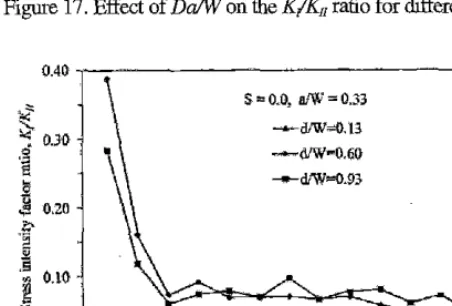
[image:7.605.32.255.88.244.2] [image:7.605.32.258.283.436.2]crach and loading distances. Crack eccentricity played an Figure 17. Effect of Da/W on the Kfi,, ratio for different d/W
0.30 0.40 0.50 O.W 070 0.80 sack #oWm ratio. ddiuid/IP
impoaant role in reducing the K, value, and therefore,
correction factors were introduced to compensate for variations in the stress intensity factor.
(3) The loading distance relative to the central crack was
found to reduce K,. However, no relationship in the decrease as a function of a/W was noted.
(4) The results of the simulations confirmed the existence of the
K,[
stress intensity factor when the cracks were offset from the midline and the loading distance was increased. The crack propagation simulation revealed that a dominant K,, factor around the crack tip producesan inclined crack at an angle with respect to the vertical line.
REFERENCES
.Figure 18. Effect of Da/Won the K,lK,,~ati~ for d i f f e r e n t s ~
Adffin,
A. K.,Huzni,
S., Mohamed,N.
A.N.
and Nor,M.
J.M. (20041. The imulementatiou of inter-element model for
less than 4 mm, the ratio of
WK,,
is not affected by the incrementation of crack lengch. In the case of longer crack lengths, K, is effectively governed by AzW values between0.3 and 0.4. Beyond this range, the pattem of the c w e s is
similar
to those corresponding to a 4mm
crack length To study the influence of crack eccentricity, another graph was p l o u das
shown in Figure 18. Similar curve patterns were---
.
.e ~ ~ a a d o f f - set cracks can be seen.
At the beginning of crack propagation, a high ratio of Kd K, for central cracks was noted. This ratio is smaller than
that of off-set cracks, even when cracks are loaded at the same position. Off-set cracks had higher shear forces that were found to be accumulated around the crack tip, due to an imbalance between cracks that created more shear stresses. Mode I failure was more pronounced for central cracks than mode
II
failure. m i s is supported by induced higher KJK,, ratios. One of the reasons for this result is thatthe loading distance is far from the midline, creating large amounts of bending stress compared to the amounts of shear stress present. Bending stress creates an opening crack or mode I failnre.
-k growth simuiation. Key Engrg Mat., 262,687-592.
Baek, S. H., Cho, S. S. and Joo, W. S. (2008). Fatigue Me prediction based on the raidow cycle counhg method for the end beam of a freight car bogie. Int. J. Automotive Technology 9,1,95-101.
Banks-Sills, L., Arcan,
M.
and Bortman, Y (1984). A mixed mode fracture specimen for modeII
dominant deformation. Engrg. Frac Mech., 20,145-202.L h i - L g u y s ~ , R .
A. (2005). Fracturebehavior under mixed-mode loading of ceramic plasma- sprayed thermal barrier coatings at ambient and elevated temperatures. Engrg. Frac. Mech., 72,2144-2158.
Glodez, S . and Kramberger, J. M. (2002). A computational model for determination of service life of gears. Int. J. Fatigue, 24,1013-1020.
Gross,
B.,
Buzzard, R. J. and Brown, W. F. (1986). Elastic analysis of a modeII
fatigue crack test specimen. Int J.Fracture, 31, 151-158.
He,
M. Y.
and Hutchinson, J. W (2000). Asymmetric four-point crack specimen.
J.
Appl. Mech., 67,207-209.Iosipescu,
N.
(1967). New accurate procedure for singleshear testing of materials. J. Mat. Sci., 2 , 537403.
Jeu, W.
K.,
Lin,H. C.
and Hua,K.
(1997). Calculation of Stress232 A. E. ISMAIL, A. K. ARIFFIN, S. ABDULLAH and M. 1. GHAZALI
Taplin D m Editor. Frachlre. Oxford; Pergamon Press. 123-156.
Jun, C., Jin-quan,
X.
and Mutoh Y. (2006). A general mixed- mode brittle fracture criterion for cracked materials. EngrgFrac Mech., 73,1249-1263.
Jun, K . J., Park, T. W , Lee, S. H., Jung, S. P. and Yoon, 1. W. (2008). Prediction of fatigue life and estimation of its reliability on the parts of an air suspension system. Int.
J.
Automotive Technology 9,6,741-747.
Mendelsohn, D. A., Gross, T. S., Young, L. J., Chen, E and Goulet, R. U. (2001). Geometry and load fmhue effects in the four-point-bend mixed mode fracture specimen.
Engrg. Fra. Mech., 68,587604.
Murakami,
Y
(1987). Stress Intensiry Factors Handbook. Pergamon Press. New YorkPhongthanapanich, S. and Dechaumphai,
I!
(2004). Adaptive Delaunay triangulation with object otiented programming for nack propagation analysis. Finite Elements Anal. Des.,40,17531771.
Shahani, A. R. and Tabatahaei, S. A. (2008). Computation of mixed mode stress intensity factors in a four-point bend specimen. Appl. Math. Mode, 32,1281-1288. Shetty, D. K., Rosemield, A. R. andDuckworth, W. H. (1986).
Mixed mode fiacture of ceramics in diametral compression.
J. Am Ceramic Society, 69,437490,
Sutthisak, P. and Pramote,
P
(2004). Adaptive Delaunay kiangulation with object-oriented programming for crack propagation analysis. Finite Elements AnaL Des., 40,1753-1771.
Yongming, L. and Sankaran,