Systematic Design of Chemical Reactors with
Multiple Stages via Multi-Objective Optimization
Approach
Mohd Nazri Mohd Fuad,a and Mohd Azlan Hussainb
aChemical and Petroleum Engineering, Faculty of Engineering, Technology and Built
Environment, UCSI University (North Wing), 56000, Kuala Lumpur, Malaysia
bChemical Engineering Department, Faculty of Engineering, University of Malaya,
50603, Kuala Lumpur, Malaysia
Abstract
The purpose of this study is to extend the approach that was introduced by Hillestad (2010) to handle chemical reactor design problem with multiple stages. Specifically, multi-objective optimization method will be used to generate Pareto optimal solutions that characterize the non-inferior solutions set for the problem. Following the identification of path-dependent design variables, several (possibly conflicting) design objectives will be selected and solutions of the corresponding problem will be generated from multi-objective optimization algorithm. This approach is investigated for two industrially important reactor systems: ethylene oxide and phthalic anhydride synthesis. By using reference-point based multi-objective evolutionary algorithm (R-NSGA-II), Pareto-optimal solutions are successfully generated within the region of user-specified reference points, thus facilitating in the selection of final optimal designs. Apart from the extensive selection of optimal candidate reactor designs, this approach also enables further insights to be obtained regarding the optimal arrangement of the path-dependent design variables along the reactor length.
Keywords: systematic staging; chemical reactor design; multi-objective optimization; R-NSGA-II; ethylene oxide; phthalic anhydride.
1.Introduction
There are many trade-offs that must be considered carefully when designing a chemical reactor. Among these trade-offs are balancing the reactor size with reactant conversion, balancing reactant conversion with selectivity, or balancing heat transfer area with hot spot temperature. Suitable reactor design parameters must be selected so that these trade-offs can be balanced in an appropriate way. The multi-objective nature of this problem can be handled systematically if multi-objective optimization algorithm is adopted. In this approach, these trade-offs will become the objective functions to be optimized simultaneously while the algorithm will be used to generate non-inferior solutions along the Pareto-optimal front of these objective functions. The application of this approach for reactor design problem has been investigated for several important industrial reactor systems in the past. Some of these examples are styrene reactor system (Yee et al., 2003), steam reformer (Rajesh et al., 2000), and ethylene reactor (Tarafder et al., 2005).
The purpose of this study is to apply multi-objective optimization approach to derive optimal reactor design that employs systematic staging along the reactor path. Two industrial reactor systems are adopted to illustrate this method, i.e. ethylene oxide and phthalic anhydride synthesis. The corresponding reactors resemble a multi-tubular fixed-bed reactor with constant coolant/wall temperature. It will be shown that systematic staging concept that is coupled with multi-objective optimization algorithm will enable derivation of novel reactor design that can improve further the performance of the process in various aspects.
2.Mathematical modelling and optimization formulation
2.1. Plug-flow model
All the reactors in this study are treated as a plug-flow system to simplify the mathematical representation for optimization purpose. As the optimization step that is adopted in this work is a time-consuming process, the choice of this simpler representation will be justified front the point of view of minimizing the complexity of mathematical model solution. If required, the results can be further validated by simulating the reactor system with more complicated mathematical model later. However, the effort is being made also to validate the approach by comparing the obtained solutions with industrial reactor design that is simulated by the same mathematical model that is used for optimization. The following mathematical models are adopted to represent the corresponding reactor systems in this study:
Ethylene oxide synthesis reactor (Peschel et al., 2011):
ௗ
ௗ௭ ൌ ܮ௧ܣߙߩσ ߥǡݎ ேೃ
ୀଵ (1)
ௗ் ௗ௭ൌ ܮ௧ܣ
ିఈఘ್σಿೃೕసభೕ൫ିுೕ൯ିరሺ்ି்ሻ
σಿసభ
(2)
ௗ
ௗ௭ൌ െܮ௧ͳͷͲ
ఓ௨బሺଵିఌሻమ ௗమఌయ ͳǤͷ
ఘ௨బమሺଵିఌሻ ௗఌయ ൨ ͳͲ
ିହ (3)
with initial conditions z = 0 ĺ ni = ni0, T = T0, and P = P0.
ݑ௦ௗௗ௭ೌ ܮ௧൬ఘ್ெఘ൰ ݎൌ Ͳ (4)
ݑ௦ߩܥௗ்ௗ௭െ ܮ௧ቂሺെȟܪሻߩݎସௗ
ሺܶ െ ܶ௪ሻቃ ൌ Ͳ (5)
with initial conditions z = 0 ĺ Pa = Pa0 and T = T0.
The kinetics expressions for the corresponding reactions are taken from the respective literatures: ethylene oxide synthesis (Al-Saleh et al., 1988) and phthalic anhydride synthesis (Anastasov, 2003).
2.2. Path-dependent design variables
A path is a line along the reactor where the reactions take place (Hillestad, 2010). Along this path, additional design variables can be introduced that act as the forcing function to modify the characteristics of the reaction process taking place. The path-dependent design variables for the respective reactor systems are summarized in Table 1. The corresponding variables are parameterized by piecewise constant profiles. This method divides the reactor path into several stages, Nz where the length and design variable for
[image:3.541.95.443.286.336.2]each stage is optimized.
Table 1. Path-dependent design variables for the respective reactor systems
Reactor system Path-dependent variables Number of stages
Ethylene oxide synthesis Catalyst dilution 2
Phthalic anhydride synthesis Catalyst types – low productive catalyst (Catalyst I) versus high productive catalysts (Catalyst II and Catalyst III)
3
2.3. Objective functions
The multiple objective criteria that are selected for each reactor designs are summarized in Table 2. These criteria are selected based on the profitability, safety, and cost minimization aspect of the reactor design. It can be seen that these criteria are conflicting with each other, thus requiring necessary trade-off in the final reactor design.
Table 2. Design objectives for the respective reactor systems
Reactor system Design objectives Target
Ethylene oxide synthesis Ethylene oxide productivity Heat transfer area Active catalyst mass
Maximize Minimize Minimize Phthalic anhydride synthesis Phthalic anhydride composition
Mass of high productive catalysts Total reactor volume
Maximize Minimize Minimize
2.4. Multi-objective optimization formulation
The multi-objective optimization problem for the reactor designs can be represented generally by the following mathematical statement:
ݐ݅݉݅ݖ݁൫݂ଵሺݔሻǡ ݂ଶሺݔሻǡ ǥ ǡ ݂ሺݔሻ൯ objective functions vector (6) s.t.
݃ሺݔሻ Ͳ i = 1, 2, …, ni inequality constraints (7)
݄ሺݔሻ ൌ Ͳ i = 1, 2, …, ni equality constraints (8)
[image:3.541.94.436.423.487.2]where n is the number of objective functions to be optimized simultaneously, x is the vector of m decision variables (continuous and/or discontinuous) with lower (xl) and
upper (xu) bounds, ni and ne are the number of inequality (g) and equality (h) constraints,
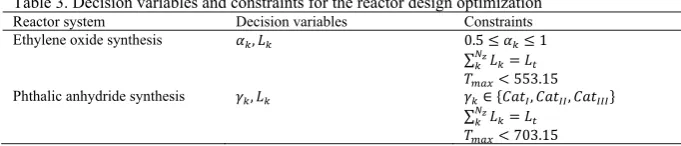
respectively. The lists of decision variables and constraints for the respective reactor systems are presented in Table 3.
[image:4.541.93.434.231.304.2]Apart from the path-dependent design variables, the following reactor design parameters (i.e. tube length, tube diameter, and number of tubes) are also included as additional decision variables for the optimization. Tube diameters and number of tubes are specified by discrete variables so as to follow precisely the allowable range of variation for the corresponding reactor design parameters. The inequality constraint for the minimum exit pressure is also specified to ensure that allowable pressure drop is maintained throughout the reactor length.
Table 3. Decision variables and constraints for the reactor design optimization Reactor system Decision variables Constraints Ethylene oxide synthesis ߙǡ ܮ ͲǤͷ ߙ ͳ
σ ܮே ൌ ܮ௧
ܶ௫൏ ͷͷ͵Ǥͳͷ
Phthalic anhydride synthesis ߛǡ ܮ ߛא ሼܥܽݐூǡ ܥܽݐூூǡ ܥܽݐூூூሽ σ ܮே ൌ ܮ௧
ܶ௫൏ Ͳ͵Ǥͳͷ
2.5. Solution by using R-NSGA-II
As opposed to single-objective optimization that only gives single optimal solution, solutions of multi-objective optimization problems give rise to Pareto-optimal solutions that characterize the non-inferior solutions set for these problems. These solutions have the property such that when one moves from one solution to another in the corresponding set, one objective function improves while the other worsens. In this work, reference- point based multi-objective evolutionary algorithm method (R-NSGA-II) (Deb et al., 2006), a modification of the well-known and popular multi-objective genetic algorithm method (i.e. NSGA-II) is adopted to solve the corresponding reactor design problems. The modification of the original NSGA-II algorithm allows the generation of Pareto-optimal solutions near the region of user-specified reference points, thus facilitating the selection of final optimal solutions. More information regarding the algorithm implementations can be found from their original literatures (Deb et al., 2002; Deb et al., 2006).
3.Results and discussion
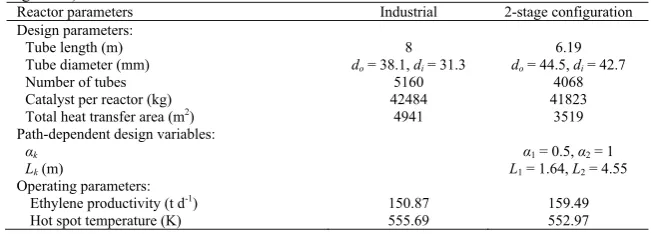
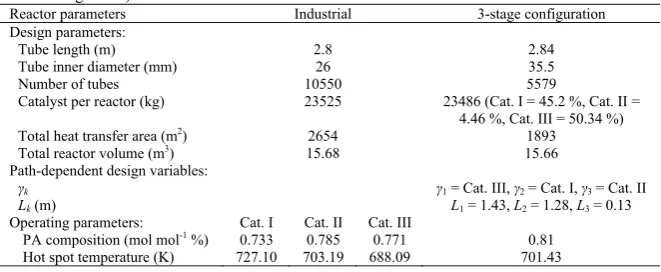
design variables along the reactor length. For ethylene oxide reactor design case, the analysis of the selected Pareto solution clearly indicates that the location of catalyst dilution zone should be near the reactor inlet (see Table 4). The benefits of this configuration are that total heat transfer area can be reduced without increasing the hot spot temperature beyond acceptable limit while at the same time the productivity of ethylene oxide can be further increased. For phthalic anhydride reactor design case, the examination of the selected Pareto solution clearly indicates that the optimum staging of catalyst types can improve further the phthalic anhydride (PA) exit composition if compared with the industrial reactor designs where only one type of catalyst is employed throughout the reactor (see Table 5).
Fig. 1. Pareto optimal solutions for multi-objective optimization of ethylene oxide and phthalic anhydride reactor designs. Pareto solutions (circles), reference points (triangles), and industrial
reactors (squares)
Table 4. Comparison of selected Pareto solution with industrial reactor (ethylene oxide reactor design case)
Reactor parameters Industrial 2-stage configuration Design parameters:
Tube length (m) 8 6.19
Tube diameter (mm) do = 38.1, di = 31.3 do = 44.5, di = 42.7
Number of tubes 5160 4068
Catalyst per reactor (kg) 42484 41823
Total heat transfer area (m2) 4941 3519
Path-dependent design variables:
Įk Į1 = 0.5, Į2 = 1
Lk (m) L1 = 1.64, L2 = 4.55
Operating parameters:
Ethylene productivity (t d-1) 150.87 159.49
Hot spot temperature (K) 555.69 552.97
4.Conclusion
Systematic staging of chemical reactor design via multi-objective optimization approach has been investigated in this study. By demonstrating the application on two industrially important reactor systems (i.e. ethylene oxide and phthalic anhydride synthesis), it can be shown that optimal reactor designs can be obtained that utilized optimally the path-dependent design variables along the reactor length. These results show promising improvement to the reactor design and operation. Moreover, the analysis of the multi-objective optimization results also offers valuable insights into the optimal arrangement of the selected path-dependent design variables that can improve further the
140 150
160 170
3000 4000 5000
3.5 4 4.5 5
x 104
EtO prod. (t day-1)
A (m2)
W
ca
t
(k
g
)
0.7
0.8 0.9
0 10 20 30
0 1 2 3
x 104
PA compo. (mol/mol %)
V (m3)
W
ca
t
(k
g
[image:5.541.106.432.366.483.2]performance of the reaction system. This multi-objective optimization approach is applicable to design other industrial fixed-bed reactors operated under non-isothermal condition.
Table 5. Comparison of selected Pareto solution with industrial reactor (phthalic anhydride reactor design case)
Reactor parameters Industrial 3-stage configuration Design parameters:
Tube length (m) 2.8 2.84
Tube inner diameter (mm) 26 35.5
Number of tubes 10550 5579
Catalyst per reactor (kg) 23525 23486 (Cat. I = 45.2 %, Cat. II = 4.46 %, Cat. III = 50.34 %)
Total heat transfer area (m2) 2654 1893
Total reactor volume (m3) 15.68 15.66
Path-dependent design variables:
Ȗk Ȗ1 = Cat. III, Ȗ2 = Cat. I, Ȗ3 = Cat. II
Lk (m) L1 = 1.43, L2 = 1.28, L3 = 0.13
Operating parameters: Cat. I Cat. II Cat. III
PA composition (mol mol-1 %) 0.733 0.785 0.771 0.81 Hot spot temperature (K) 727.10 703.19 688.09 701.43
References
M. A. Al-Saleh, M. S. Al-Ahmadi and M. A. Shalabi, 1988, Kinetic study of ethylene oxidation in a Berty reactor, Chemical Engineering Journal, 37, 35-41.
A. I. Anastasov, 2003, An investigation of the kinetic parameters of the o-xylene oxidation process carried out in a fixed bed of high-productive vanadia-titania catalyst, Chemical Engineering Science, 58, 89-98.
K. Deb, A. Pratap, S. Agarwal and T. Meyarivan, 2002, A Fast and Elitist Multiobjective Genetic Algorithm: NSGA-II, IEEE Transactions on Evolutionary Computation, 6, 182-197. K. Deb, J. Sundar, U. B. Rao N. and S. Chaudhuri, 2006, Reference Point Based Multi-Objective
Optimization Using Evolutionary Algorithms, International Journal of Computational Intelligence Research, 2, 3, 273-286.
M. Hillestad, 2010, Systematic staging in chemical reactor design, Chemical Engineering Science, 65, 3301-3312.
G. A. Orozco, J. R. Gomez, O. F. Sanchez, I. D. Gil and A. Duran, 2010, Effect of kinetic models on hot spot temperature prediction for phthalic anhydride production in a multitubular packed bed reactor, The Canadian Journal of Chemical Engineering, 88, 224-231.
A. Peschel, F. Karst, H. Freund and K. Sundmacher, 2011, Analysis and optimal design of an ethylene oxide reactor, Chemical Engineering Science, 66, 6453-6469.
J. K. Rajesh, S. K. Gupta, G. P. Rangaiah and A. K. Ray, 2000, Multiobjective optimization of steam reformer performance using genetic algorithm, Industrial and Engineering Chemistry Research, 39, 706-717.
A. Tarafder, B. C. S. Lee, A. K. Ray and G. P. Rangaiah, 2005, Multiobjective optimization of an industrial ethylene reactor using a nondominated sorting genetic algorithm, Industrial and Engineering Chemistry Research, 44, 124-141.