R E V I E W
Open Access
Disease vectors in the era of next
generation sequencing
David C. Rinker
1, R. Jason Pitts
1and Laurence J. Zwiebel
1,2*Abstract
Almost 20 % of all infectious human diseases are vector borne and, together, are responsible for over one million deaths per annum. Over the past decade, the decreasing costs of massively parallel sequencing technologies have facilitated the agnostic interrogation of insect vector genomes, giving medical entomologists access to an ever-expanding volume of high-quality genomic and transcriptomic data. In this review, we highlight how genomics resources have provided new insights into the physiology, behavior, and evolution of human disease vectors within the context of the global health landscape.
Background
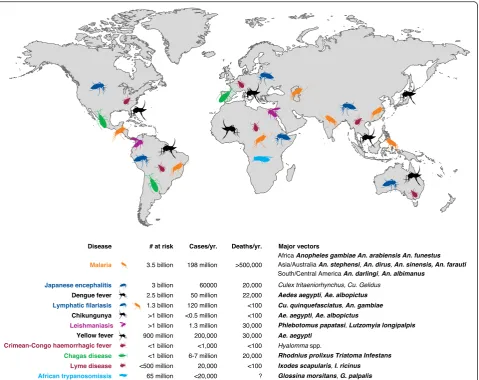
The significance of arthropod vectors in disease trans-mission came into focus in the late 19th century when researchers such as Charles Alphonse Laveran, Giovanni Grassi, and Ronald Ross convincingly described the role of Anopheles mosquitoes in the human malaria cycle. Until that time, it had been largely unappreciated that human diseases could be spread via intermediate organ-isms (vectors) that could themselves be infected with an agent of human disease. Even 'malaria', the name of the quintessential vector borne disease, is derived from a Latinate word meaning 'bad air' and is reflective of the mystery surrounding the disease’s etiology that persisted for centuries. Subsequent to that initial insight, scores of other arthropod species have been implicated as vectors for many human diseases, and current World Health Organization estimates suggest that 17 % of all infectious human diseases are vector borne (Fig. 1). The broad field of medical entomology emerged on the heels of those
* Correspondence:[email protected] 1
Department of Biological Sciences, Vanderbilt University, Nashville, Tennessee, USA
2Department of Pharmacology, Vanderbilt Brain Institute, Program in
Developmental Biology, and Institutes of Chemical Biology and Global Health, Vanderbilt University Medical Center, Nashville, Tennessee, USA
early discoveries as scientists sought to examine the biol-ogy of insect vectors comprehensively in an effort to re-duce their health impact.
Historically, vector control strategies have drawn on biological knowledge about vector species to both curtail their population sizes and limit human contact. Elimin-ation of vector breeding sites was the earliest mechan-ism of population reduction and this strategy was soon followed by the widespread application of a range of chemical insecticides [1]. Reduction of host–vector con-tact has also been implemented as a more recent control strategy that uses combinations of chemical (insect repellants) and physical (full-coverage clothing, bed nets, window screens and so on) barriers [2].
More recently, vector control initiatives have also been influenced by the use of increasingly sophisticated computer-modeling approaches, as well as by a rapidly expanding wealth of genetic information and gene-editing technologies. Genetic markers, revealed through molecu-lar karyotyping, polymerase chain reaction (PCR)-based assays and now next generation sequencing (NGS), have led to more detailed systematic and epidemiologic knowledge. Such data, when coupled to advances in computational modeling and more powerful genome-editing technologies, can lead to more accurate estimations of disease risk [3], as well as to the strategic modification of vector genomes to reduce either their competence or their population size [4, 5].
The newest insights into improved vector surveillance and control are increasingly being driven by NGS technolo-gies, which have themselves fostered the rapid accumula-tion and sharing of genomic resources for 'non-model organisms' such as disease vectors. Indeed, the ever-decreasing cost of NGS has altered the nature and scale of potential scientific queries. It is now very feasible for indi-vidual researchers to obtain not just whole-genome se-quences for taxa of interest but also genomic information specific to individuals within those taxa. Similarly, compre-hensive transcriptional data can be reliably acquired at the level of individual tissue and cell types, while de novo
assemblies of transcriptome data can provide a wealth of genetic and phylogenomic information even in the absence of an assembled genome sequence.
In this review, we provide an overview of some of the recent applications of NGS strategies to disease vectors and illustrate how these approaches can inform our un-derstanding of their evolutionary histories, biology, and phenotypes. Studies that have examined a diverse array of vector taxa are discussed. The majority of published research remains focused on mosquitoes (Diptera: Culic-idae), which by themselves account for the transmission of the majority of the most prevalent vector-borne dis-eases worldwide (Fig. 1). Nonetheless, NGS technologies have been applied to questions relating to other import-ant vectors, such as triatomine bugs and ticks. More specifically, the studies highlighted here both draw on and impact the abstract concept of vectorial capacity, a quantitative estimation of the degree to which a vector poses a risk to human health. In that light, NGS
approaches have been used to examine factors related to vector population sizes (such as reproductive biology and insecticide resistance), the ability of a species to re-sist infection (vector competence), and the frequency of human–vector contact (host-seeking). We present exam-ples from the published literature covering each of these topics. We conclude by offering some examples of trans-lational research that bring together information gar-nered from NGS data with ideas for novel vector control strategies. These examples are potential harbingers of the impact that 'big data' will have on the biology of dis-ease transmission.
Genomics resources for understanding disease vectors
Traditional methods in medical entomology and mo-lecular biology have been the mainstays of vector biol-ogy, but new information is needed in the fight against human disease. Genomics technologies offer access to
[image:2.595.60.540.87.467.2]the deeper secrets of organismal biology that are locked in the genetic code, and thus afford tremendous oppor-tunities to increase our understanding of disease vectors. From the basic genomic sequence to nucleotide poly-morphisms to profiles of RNA expression, sequencing technologies can be leveraged to probe a wide array of questions about the organization, function, and evolu-tionary histories of vector genomes. The knowledge gained by having access to entire gene families can in-form new vector control strategies in ways that trad-itional gene-by-gene studies could never hope to. The complete sequencing of the genome of the major African malaria mosquito Anopheles gambiae was a milestone effort that ushered in an exciting era in vector biology. More than a decade later, the expansion of both gen-omic and transcriptgen-omic sequencing capabilities has continued to allow the collection of genomics data from a broad spectrum of vector species.
Vector genomes
The systematics of arthropods allows for broad distinc-tions between vector and non-vector species, as well as for inferring those species’ population sizes, ranges, and evolutionary histories. The advent of molecular tools (such as karyotyping, restriction fragment length poly-morphism (RFLP) and PCR) has steadily increased the resolving power of species and subspecies identifications down to the molecular level. Of all vector taxa, mosqui-toes are the most widely dispersed, with competent vec-tor species present in virtually every geographic cline. Consequently, mosquitoes were early targets for whole genome sequence (WGS) efforts; the 2002 publication of the genome forAn. gambiae represented a milestone in vector genomics. This paved the way for comprehensive studies of gene function and evolution that have drawn on the complete complement of genes [6]. Early in 2015, the genomes of an additional 16 Anophelesspecies were published [7, 8], an accomplishment that immeasurably benefited from the speed and depth of coverage afforded by NGS. The analysis of the full suite of Anopheles ge-nomes, the species makeup of which spans the taxo-nomic breadth of the entire subfamily, revealed the genomic composition of Anopheles mosquitoes to be evolving rapidly. These genomes share tendencies to-ward X-chromosomal rearrangements distinct from any patterns of gene reshuffling observed in the genomes of the Dengue/Yellow/Zika virus vector mosquito, Aedes aegypti, or Drosophila melanogaster [8]. Fontaine et al. [9] took advantage of the chromosomal context afforded by the new genomic information to resolve the fine evo-lutionary relationships that exist within theAn. gambiae
species complex, in which morphological and evolution-ary similarity has been difficult to disentangle using con-ventional methods. By supplementing the new genomic
information with additional NGS information derived from individual mosquitoes, a fine-scale evolutionary picture has emerged. This analysis reveals that the two major malaria vector species within the complex (An. gambiaes.l. andAn. arabiensis) were the first to diverge from other minor- or non-vector members of their spe-cies complex [9].
Following the release of theAn. gambiae genome, the genome sequences of Ae. aegypti and the West Nile mosquito,Culex quinquefasciatus, were published [10, 11]. As was the case for other genome sequencing efforts at that time, the sequencing of these two genomes relied on conventional (Sanger) sequencing technologies and, con-sequently, were expensive efforts that were time- and labor-intensive. Following the advent of and the steady improvements in NGS technologies, WGS has become an increasingly common undertaking, such that the number of available vector genomes has grown significantly over the past decade. In the past year, the annotated genome sequences of multiple vector and non-vector Anopheline mosquitoes have been made available, resulting in a flurry of ancillary studies [8, 12]. Furthermore, the genome of the Asian tiger mosquito, Aedes albopictus, has also re-cently been completed, offering the potential for timely in-sights into the genome of this highly invasive Dengue-and Chikungunya-competent vector [13]. Perhaps most telling of the time and effort required to sequence a single insect species’genome, the genome papers for both An. stephensi and Ae. albopictus genomes each list just over 30 authors, a number that stands in stark contrast to the 123 authors of the inauguralAn. gambiaegenome report.
Beyond Culicidae, a handful of vector genomes have been assembled and can be accessed at publically avail-able databases, including the National Center for
Bio-technology Information (NCBI) and the National
Institute of Allergy and Infectious Diseases (NIAID)-supported VectorBase (vectorbase.org). These databases offer an incredible assortment of tools that enable rapid homology searches, sequence downloads, and gene ex-pression analyses. Genomes for the vectors of leishman-iasis, trypanosomleishman-iasis, typhus and Lyme disease have been completed, with numerous others in progress. We expect the number of assembled vector genomes to in-crease rapidly in the next few years as per-genome costs continue to decrease and more studies of neglected trop-ical diseases are made easier by the relative simplicity of NGS technologies.
RNA-sequencing and transcriptome assemblies
for the vast majority of encoded genes in a vector species [14]. Importantly, because RNA-seq largely captures only fully spliced transcripts, an informative de novo transcrip-tome assembly of RNA sequences can be generated af-fordably and analyzed efficiently, even in the absence of an assembled genome. Already, de novo assemblies of RNA-seq-derived insect transcriptomes have provided invaluable sequence information amenable to powerful molecular evolutionary analyses and quantitative gene expression profiles in the absence of genome resources (reviewed in [15]). For vector insects, the recently com-pleted housefly (Musca domesticaL.) [16] and tsetse fly (Glossina morsitans) [17] genome projects both used transcriptome assemblies as a means of enriching the quality of their respective genome assemblies, at least insofar as transcribed regions are concerned. Addition-ally, in mosquitoes, de novo transcriptome assemblies were successfully applied toAn. funestuswell in advance of the availability of a genome sequence [18].
In Culicinae, the transcriptome assembly of the non-bloodfeeding genus Toxorhynchites has revealed exten-sive evidence for its phylogenetic relationship relative to the two fully sequenced major Culicinae vectors, Ae. aegypti and Culex pipiens [19]. In ticks, only the Lyme disease vector, Ixodes scapularis [20], has an assembled genome, but robust transcriptomic approaches have been used for the study of other important vector species, such asIxodes ricinus[21, 22],Amblyomma americanum
[23], Dermacentor variabilis [24, 25], and Hyalomma marginatum rufipes[26] (reviewed in [27]). Comparative studies of vector transcriptomes can be expected to pro-vide important insights into the shared features of com-mon biological processes, as well as the identification of species-specific transcripts that may ultimately be targeted for the design and development of novel control strategies. Notable advantages of de novo transcriptome assembly are its rapid turnaround time and relatively low acquisi-tion cost. For example, at present, the only genome as-sembly for a vector of Chagas disease is that of the kissing bug, Rhodnius prolixus, a species that has already been eradicated in some Chagas-endemic regions of Central America. Nonetheless,Triatominae vectors other thanR. prolixusare emerging as potentially new Chagas vectors, and a composite strategy toward de novo transcriptome assembly has proved effective in capturing some of the transcribed genomic elements ofTriatome brasiliensis, an emergent Chagas vector in Brazil [28].
Improved understanding of vector biology
The increasing availability of NGS- and WGS-derived metadata represents a watershed opportunity to trans-form research efforts that touch upon many, if not all, salient aspects of vector biology. One can envision a landscape in which publically available datasets are
continuously augmented by a wide range of sources encompassing small-scale, single-species independent re-search, moderate-scale multi-species surveys, and large-scale network-level initiatives. In turn, these new data-sets may be shared, supplemented and integrated with one another, facilitating the efficient follow-up of previ-ous studies and fostering previprevi-ously unforeseen efforts for synthetic studies (Fig. 2). As a result, data sharing of NGS information holds the potential to spur the devel-opment of novel approaches to reduce both vector com-petence and vectorial capacity across a wide spectrum of disease vector insects.
Reproduction and vector populations
NGS and WGS datasets have informed studies involving the reproductive biology and developmental trajectories of disease vectors, highlighting potential vector popula-tion control strategies. A particularly salient example is the recent identification and characterization ofNixas a male-determining factor inAe. aegypti, which was facili-tated by sequencing and comparing male and female ge-nomes to identify male-specific genomic regions. An RNA-seq-based filter applied to these regions then highlighted theNixgene, a distant homolog ofD. melano-gaster tranformer-2, which is known to play an important role in that species’sex determination. Subsequent knock-out and ectopic expression studies confirmed the role of
spermatogenesis-disrupting compounds proximate to or directly onto host species as a means of reducing tick populations.
The ability of a vector population to endure seasonal climatic shifts is an attribute that directly impacts the ability of vectors to transmit diseases over broad ranges. One of the most important mechanisms for overwinter-ing in mosquitoes is a shift toward developmental dor-mancy, called diapause, which allows the organism to maintain a breeding population during periods when temperatures and host availability are unfavorable. The development stage of diapause varies among species, and the molecular basis of the shift toward diapause is imperfectly characterized (reviewed in [32]). Neverthe-less, photoperiodic diapause is an important predictor of how readily invasive species can spread. For example, egg diapause is prominent in temperate populations of
Ae. albopictus [33]. The mechanisms of photoperiodic diapause in Ae. albopictus have been successfully ex-plored by sequencing the whole transcriptome of devel-oping oocytes and assembling genes de novo [34, 35].
The results of this transcriptome-based analysis ultim-ately pointed to preparatory signatures of photoperiodic diapause that are unique to Ae. albopictus, suggesting that a plausible, reproductive adaptation has facilitated the global proliferation of this vector. Importantly, this work was achieved prior to the release of the Ae. albo-pictusgenome assembly.
Beyond basic genomics and transcription studies, population-level variation within and between vector species can also be characterized by applying the power of NGS. InC. pipiens, RNA-seq proved to be an expedi-ent tool for highlighting genetic componexpedi-ents involved in local adaptation by measuring the divergence rates of genes between the morphologically identical wild (C. pipiens) and domesticated (Culex molestus) forms [36]. Similar approaches in An. gambiae s.l. and Ae. aegypti
have also proved fruitful [37, 38]. In an elegant applica-tion of sequencing technology to vector biology, Quillery et al. [39] utilized a genome-reduction strategy and pyro-sequencing to generate short-read libraries from two populations of I. ricinus. A large number of single
[image:5.595.58.538.88.403.2]nucleotide polymorphisms (SNPs) were identified, a subset of which were sampled for variation revealing de-viations from Hardy-Weinberg equilibrium among six field-collected populations. Restriction-site associated DNA marker (RAD) sequencing is another genome-reduction strategy that can provide efficient population genomic data for non-model species. RAD sequencing ofAe. aegyptispecimens from around the world suggests that a single subspeciation event occurred within the do-mesticated form in Africa; the mosquitoes then dis-persed globally along commercial trade routes [40]. Both studies validate the likelihood that these methodologies will be useful for assessing population genetic structures in non-model vector species, with or without genome assemblies. Finally, it is important to note that the Well-come Trust (via its Sanger Institute) has established the
Anopheles gambiae1000 genomes (Ag1000G) consortium (https://www.malariagen.net/projects/vector/ag1000g) to provide a global repository for WGS data collected from wild-caught mosquitoes across Africa, thereby providing a catalog of genetic variation across natural vector popula-tions. Given its scope and the otherwise nearly impossible access to such datasets, Ag1000G is almost certain to become an increasingly important resource for the ana-lysis of vector competence and vectorial capacity inAn. gambiae.
The genomics of host-seeking behavior
The concept of vectorial capacity considers the totality of vector–host–parasite interactions, including the pro-clivity of a vector species to feed preferentially on a given host, the vector population size, susceptibility to infection, and survival rates [41]. The host-preference parameter, specifically the degree of anthropophagy (hu-man biting), will dramatically impact the rate at which host-specific pathogens spread. Conversely, vectors that blood feed more opportunistically will transmit any host-specific pathogens less efficiently.
Long- and medium-range host-seeking behaviors, which are loosely defined as occurring outside a radius of a few meters around hosts, are directly attributable to host-associated olfactory and other chemosensory cues and dramatically impact the vectorial capacity of insects. Accordingly, the molecular underpinning of chemosen-sation has been a major area of focus for both basic study and vector control. Because components of the chemosensory signal transduction machinery are gener-ally highly localized within specific appendages, such as the antennae, maxillary palps, and labellum, tissue-specific transcriptome profiles have become essential for measuring transcript abundances that would otherwise be diluted and potentially undetectable in whole-body preparations of RNA. In contrast to the relative paucity of studies on gustatory appendages, chemoreceptor
abundance quantitation by RNA-seq has been carried out comprehensively in many of the major olfactory ap-pendages of An. gambiae [42], C. quinquefasciatus[43], Ae. aegypti[38],An. quadriannulatus[37],Cimex lectu-larius[44], andT. brasiliensis[28].
An initial RNA-seq study of An. gambiae antennae showed that levels of chemoreceptors were lower overall in males than in females. This observation is largely accounted for by the antennal sexual dimorphism that exists between blood-feeding females and the non-blood-feeding males, but the RNA expression data also revealed the surprising finding that the variety and rela-tive abundances of the chemoreceptors were otherwise remarkably conserved between the sexes [42]. Also in
An. gambiae, an RNA-seq time-course study revealed the relationship between chemoreceptor transcriptional differences and reproductive biology. Rinker et al. [45] observed that individual odorant receptor (OR) tran-script profiles in female antennae changed only slightly on the taking of a blood meal but, when viewed collect-ively, the cumulative effects of these small changes showed that there was an overall shift in olfactory re-sponsiveness in advance of ovipositing. Similarly, subtle distinctions in OR transcriptome profiles were reported in two studies that compared mosquito species that were phenotypically divergent in terms of their host prefer-ences. The first comparison between An. gambiae and its less-anthropophilic sibling speciesAn. quadriannula-tus pointed to an overall enrichment of transcripts for multiple ORs inAn. gambiaethat are predicted to act in concert to enhance responsiveness to human-associated odors [37]. In the second study, differences in the anten-nal transcriptome profiles of two subspecies of Ae. aegypti that differ in their preferences for feeding on humans were examined. The results pointed to notable differences in both the abundance and functional re-sponse of a single OR, suggesting that it might be linked to the anthropophily exhibited by one subspecies [19, 38]. Whether or not the different degrees of anthro-pophily inAe. aegypti can be attributed to only a single chemoreceptor rather than to a suite of chemoreceptor genes or other genes remains an open question.
chemoreceptive plasticity could further modulate periph-eral olfactory signals in response to physiologic and biotic cues. Such a mechanism could also be an expedient for niche adaptation that is integral to speciation. Importantly, because alterations in the transcriptome profile typically occur without any change within the organism’s under-lying chemosensory gene repertoire, quantitative RNA-seq-based studies of chemosensory tissues represent an essential tool for the examination of subtle, yet profoundly important, olfactory-related phenotypic differences.
Genomics of immunity
Vector arthropods and the diseases that they transmit are the evolutionary byproducts of complex host–parasite, genotype-by-genotype interactions. Successful vector-borne parasites are finely tuned to negotiate the physiol-ogies and immune responses of not just one but two hosts, and comprise one corner of a complex 'co-evolutionary triangle'. In the case of malaria, the genomes of the Plas-modium pathogen, the Anopheles vectors, and human hosts all bear testament to this three-way tug-of-war [46, 47]. Given that the degree of vector competence within Anophelinae can be highly heterogeneous, even among closely related sister subspecies, the genomic factors impacting the degree of competency are likely a myriad. In this light, it is credible that whole-genome approaches represent a unique opportunity to acquire new insight into this multifaceted interaction.
For most vector species, only a minority of individuals are infective at any given time. This is partially due to heterogeneity in vector immune responses, although the evolutionary origins of such heterogeneity are not always clear. InAn. gambiae, adult susceptibility toPlasmodium
infection may have complex origins in larval adaptations to challenges stemming from microbial diversity among breeding sites [48]. Although loci associated with defense against Plasmodium appear to be under strong selective pressures [49] andPlasmodiumeffectively suppresses spe-cific aspects of the mosquito’s defense mechanisms [50], divergences in the selective signatures of other anti-parasitic genes suggest thatPlasmodiumwas not the prin-cipal evolutionary driver [51, 52]. Recently, a fascinating co-evolutionary link between reproduction and immunity was found in Anopheles mosquitoes using new genomic data [53]. This comparative genomic study found that a male-derived steroid hormone and its female-derived interacting protein appeared to have evolved in concert, and that, upon mating, the male hormone induced an in-crease in lipid transporters that are known to inhibit the anti-Plasmodium immune response in females. Beyond such specifics, recent RNA-seq studies in An. gambiae
have indicated that much of the known transcriptional re-sponse to parasite infection stems from unannotated gen-omic regions, leading to speculation that the mosquito
may be employing non-coding RNAs as part of its basic response mechanism [54, 55].
Furthermore, WGS/NGS-based approaches have in-creased the awareness of the role played by the native microbiome of vector insects in the modulation of the immune response. Most notably, Wolbachiainfection of several mosquito species has been implicated in the dra-matic reduction of vector competence for Plasmodium
pathogens and for a number of arboviruses (including those responsible for Dengue, Yellow, Chikungunya, West Nile, and Zika fevers) [56–59]. InAn. gambiae, the mosquito's tolerance for harboring midgut bacteria can
aid in abating the immune response to Plasmodium
[60], although some bacteria have been shown to confer resistance by directly interfering with the development of the parasite [61]. In Ae. aegypti, a three-way inter-action was observed among microbiome composition, mosquito immune response, and Dengue virus infection [62], echoing tripartite interaction similar to that re-ported for trypanosome infection in G. morsitans [63]. In R. prolixus, high-throughput pyrosequencing allowed an accurate time-course quantitation of gut microbiota, revealing that the presence of Trypanosoma rangeli
pathogens directly affects microbiome composition, probably by interacting with and affecting the respon-siveness of the bug’s immune system [64]. Given the complex immunomodulatory role that gut microbiota appear to play in vector competency, WGS/NGS-based approaches offer tremendous potential for future work to further elucidate these multi-organism interactions.
The blacklegged tick, I. scapularis, transmits numer-ous human pathogens, including the causative agent of Lyme disease in North America,Borrelia burgdorferi. Al-though understudied, immunity genes are likely to con-tribute to gut microbe homeostasis in ticks, and thus influence the competence of these vectors for human pathogens. A recent review identified a set of 234 immunity-related genes in the I. scapularis genome using bioinformatics searches with queries derived from the genome annotation and published literature [65]. While observational in scope, studies such as these lay an important foundation for future work on comparative phylogenomics and the effects of immune responses on pathogen survival. A recent deep-sequencing-based study has characterized the transcriptome of I. ricinus
areas of study, and in identifying new targets that can be harnessed in the development of novel control strategies.
The future of vector genomics and vector control Translational studies that bridge the gap between gen-omic data and real-world applications are both present and forthcoming. Several recent innovations demon-strate how genomic data can foster the design of new vector-management tools. In one example, a chemical compound was identified that activates the highly con-served insect odorant receptor co-receptor (Orco) and, thus, has the potential to interfere with the host-seeking behaviors of insect vectors by hyper-stimulating olfac-tory sensory neurons [66]. In a second example, a small molecule inhibitor of a human inward rectifier potas-sium channel (Kir) was found to block the activity of a mosquito Kir; this molecule might provide the structural basis for novel insecticide design [67]. Finally, in a more publicized example, genetically modified male mosqui-toes are being actively deployed to promising effect in suppressing natural vector populations [68]. Because the development of these control strategies has been directly facilitated by the ready availability of genomic resources, it is reasonable to posit that increasing genomic re-sources will also further inform future control strategies. This effort will continue to identify new targets [69] for chemical control or will facilitate the genetic engineering of incompetent vectors through the selective alteration of genes that are implicated in vector competency (for examples, see [70–73]).
Moreover, NGS technologies will be increasingly har-nessed for population-level monitoring of nascent and emerging vectors. As has already been witnessed in the spread of insecticide resistance or in the elimination of
R. prolixus from Central America (reviewed in [74]), new genetic variants will invariably emerge to perpetuate the risk to human health. Effective monitoring of vector populations using NGS strategies should allow for more rapid identification of emerging trends and for the devel-opment of better predictive models to forecast these trends within vector populations [75]. As sequencing technologies and data-analysis approaches continue to become faster and more accessible, assays of pooled samples of individuals [76–78] will facilitate the compre-hensive monitoring and mapping of vector species. The resulting datasets will incidentally contain valuable gen-etic information relating to infection rates and poten-tially (via sampling of blood meals) host preferences. Importantly, these data retain their value indefinitely as they can be analyzed retroactively. For example, novel functional variants can be identified to help trace the or-igins of emergent insecticide resistance. Finally, such multidimensional datasets, which could conceivably be collected and sequenced with relative ease and economy
over large spatiotemporal ranges, could then better in-form models of disease transmission and risk that may be lacking in contextual sophistication [75]. Initiatives aimed at curbing vector populations through habitat ma-nipulation or the application of insecticides have met with some success, but these strategies also provide se-lective pressure that can result in genomic adaptations that severely impair future control efforts. This is most dramatically illustrated by the global rise of insecticide-resistant insects [79]. The knockdown resistance mech-anism, which results from mutations in the molecular targets of ubiquitously over-applied pyrethroid insecti-cides, has arisen independently in most arthropods and is thus readily detectable using conventional PCR-based strategies [80]. However, insects can also become resist-ant to insecticides through other cryptic metabolic mechanisms that break down the insecticidal agents and render them inert, especially those involving members of the cytochrome p450 family of monooxygenase enzymes [81]. The mechanistic changes leading to this mode of resistance are less understood and believed to be much more species specific [82–84], making nascent resistance difficult to detect across diverse populations (for ex-ample [85]). NGS can provide routes toward agnostic implication of how metabolic pathways have evolved to confer insecticide resistance. For example, a recent RNA-seq study in insecticide-resistant Ae. aegypti has uncovered numerous genomic changes (including poly-morphism, copy number variation, and gene amplifica-tion events) in certain detoxificaamplifica-tion enzymes that could then serve as informative markers for monitoring emer-ging resistance through simple PCR-based assays [86].
Conclusions
be accomplished by first examining the standards that groups such as the Immunogenomic Next Generation Se-quencing Data Consortium (http://igdawg.org/ngs.html) have put forward. In this way, the true power of large re-positories of NGS data can be fully utilized so that the data are both particularly and cumulatively informative, becoming a gift that keeps on giving.
We have attempted to highlight the growing impact of NGS on vector biology. Nonetheless, it is clear that too few studies have utilized sequencing-based approaches despite their rapidly expanding accessibility. It will prob-ably be some time before the field of medical entomol-ogy embraces the comprehensiveness and agnosticism offered by NGS assays. Until that happens, the potential benefits of data integration among studies will remain unrealized, and the myriad potential of this 21st century research strategy will remain mired within the experi-mental paradigms of the 20thcentury.
Abbreviations
Ag1000G:Anopheles gambiae1000 genomes consortium; Kir: human inward rectifier potassium channel; NCBI: National Center for Biotechnology Information; NGS: next generation sequencing; OR: odorant receptor; PCR: polymerase chain reaction; RAD: restriction-site associated DNA marker; RNA-seq: massively parallel sequencing of RNA molecules; SNP: single nucleotide polymorphism; WGS: whole genome sequence.
Competing interests
The authors declare that they have no competing interests.
Authors’contributions
DCR, RJP, and LJZ discussed the format and drafted the manuscript and contributed to all subsequent revisions. All authors read and approved the final manuscript.
Acknowledgements
We thank the editors and reviewer for their critical readings.
Funding
The authors were supported by grants from the Innovation and Discovery in Engineering and Science (IDEAS) program of Vanderbilt University and from the National Institutes of Health (NIAID, AI056402) to LJZ. DCR was supported by the NIDCD through an NRSA (F31 DC012991).
References
1. Walker K, Lynch M. Contributions ofAnopheleslarval control to malaria suppression in tropical Africa: review of achievements and potential. Med Vet Entomol. 2007;21:2–21.
2. Achee NL, Bangs MJ, Farlow R, Killeen GF, Lindsay S, Logan JG, et al. Spatial repellents: from discovery and development to evidence-based validation. Malar J. 2012;11:164.
3. Chiyaka C, Tatem AJ, Cohen JM, Gething PW, Johnston G, Gosling R, et al. Infectious disease. The stability of malaria elimination. Science. 2013;339:909–10.
4. Nguyen TH, Nguyen HL, Nguyen TY, Vu SN, Tran ND, Le TN, et al. Field evaluation of the establishment potential of wmelpopWolbachiain Australia and Vietnam for dengue control. Parasit Vectors. 2015;8:563. 5. Winskill P, Carvalho DO, Capurro ML, Alphey L, Donnelly CA, McKemey AR.
Dispersal of engineered male Aedes aegypti mosquitoes. PLoS Negl Trop Dis. 2015;9:e0004156.
6. Holt RA, Subramanian GM, Halpern A, Sutton GG, Charlab R, Nusskern DR, et al. The genome sequence of the malaria mosquitoAnopheles gambiae. Science. 2002;298:129–49.
7. Marinotti O, Cerqueira GC, de Almeida LG, Ferro MI, Loreto EL, Zaha A, et al. The genome ofAnopheles darlingi, the main neotropical malaria vector. Nucleic Acids Res. 2013;41:7387–400.
8. Neafsey DE, Waterhouse RM, Abai MR, Aganezov SS, Alekseyev MA, Allen JE, et al. Mosquito genomics. Highly evolvable malaria vectors: the genomes of 16Anophelesmosquitoes. Science. 2015;347:1258522.
9. Fontaine MC, Pease JB, Steele A, Waterhouse RM, Neafsey DE, Sharakhov IV, et al. Mosquito genomics. Extensive introgression in a malaria vector species complex revealed by phylogenomics. Science. 2015;347:1258524. 10. Arensburger P, Megy K, Waterhouse RM, Abrudan J, Amedeo P, Antelo B,
et al. Sequencing ofCulex quinquefasciatusestablishes a platform for mosquito comparative genomics. Science. 2010;330:86–8.
11. Nene V, Wortman JR, Lawson D, Haas B, Kodira C, Tu ZJ, et al. Genome sequence ofAedes aegypti, a major arbovirus vector. Science. 2007;316:1718–23.
12. Jiang X, Peery A, Hall AB, Sharma A, Chen XG, Waterhouse RM, et al. Genome analysis of a major urban malaria vector mosquito,Anopheles stephensi. Genome Biol. 2014;15:459.
13. Chen XG, Jiang X, Gu J, Xu M, Wu Y, Deng Y, et al. Genome sequence of the Asian Tiger mosquito,Aedes albopictus, reveals insights into its biology, genetics, and evolution. Proc Natl Acad Sci U S A. 2015;112:E5907–15. 14. Martin JA, Wang Z. Next-generation transcriptome assembly. Nat Rev Genet.
2011;12:671–82.
15. Oppenheim SJ, Baker RH, Simon S, DeSalle R. We can't all be supermodels: the value of comparative transcriptomics to the study of non-model insects. Insect Mol Biol. 2015;24:139–54.
16. Scott JG, Warren WC, Beukeboom LW, Bopp D, Clark AG, Giers SD, et al. Genome of the house fly,Musca domesticaL., a global vector of diseases with adaptations to a septic environment. Genome Biol. 2014;15:466. 17. International Glossina Genome Initiative. Genome sequence of the
tsetse fly (Glossina morsitans): vector of African trypanosomiasis. Science. 2014;344:380–6.
18. Crawford JE, Guelbeogo WM, Sanou A, Traore A, Vernick KD, Sagnon N, et al. De novo transcriptome sequencing inAnopheles funestususing Illumina RNA-seq technology. PLoS One. 2010;5:e14202.
19. Zhou X, Rinker DC, Pitts RJ, Rokas A, Zwiebel LJ. Divergent and conserved elements comprise the chemoreceptive repertoire of the nonblood-feeding mosquitoToxorhynchites amboinensis. Genome Biol Evol. 2014;6:2883–96. 20. Lewis LA, Radulovic ZM, Kim TK, Porter LM, Mulenga A. Identification of
24 hIxodes scapularisimmunogenic tick saliva proteins. Ticks Tick Borne Dis. 2015;6:424–34.
21. Kotsyfakis M, Kopacek P, Franta Z, Pedra JH, Ribeiro JM. Deep sequencing analysis of theIxodes ricinushaemocytome. PLoS Negl Trop Dis. 2015;9:e0003754.
22. Schwarz A, von Reumont BM, Erhart J, Chagas AC, Ribeiro JM, Kotsyfakis M. De novoIxodes ricinussalivary gland transcriptome analysis using two next-generation sequencing methodologies. FASEB J. 2013;27:4745–56. 23. Gibson AK, Smith Z, Fuqua C, Clay K, Colbourne JK. Why so many unknown
genes? Partitioning orphans from a representative transcriptome of the lone star tick Amblyomma americanum. BMC Genomics. 2013;14:135.
24. Bissinger BW, Donohue KV, Khalil SM, Grozinger CM, Sonenshine DE, Zhu J, et al. Synganglion transcriptome and developmental global gene expression in adult females of the American dog tick,Dermacentor variabilis
(Acari: Ixodidae). Insect Mol Biol. 2011;20:465–91.
25. Sonenshine DE, Bissinger BW, Egekwu N, Donohue KV, Khalil SM, Roe RM. First transcriptome of the testis-vas deferens-male accessory gland and proteome of the spermatophore fromDermacentor variabilis(Acari: Ixodidae). PLoS One. 2011;6:e24711.
26. Francischetti IM, Anderson JM, Manoukis N, Pham VM, Ribeiro JM. An insight into the sialotranscriptome and proteome of the coarse bontlegged tick,Hyalomma marginatum rufipes. J Proteomics. 2011;74:2892–908. 27. Chmelar J, Kotal J, Karim S, Kopacek P, Francischetti IM, Pedra JH, Kotsyfakis M.
Sialomes and mialomes: a systems-biology view of tick tissues and tick–host interactions. Trends Parasitol. 2016;32:242–54.
28. Marchant A, Mougel F, Almeida C, Jacquin-Joly E, Costa J, Harry M. De novo transcriptome assembly for a non-model species, the blood-sucking bugTriatoma brasiliensis, a vector of Chagas disease. Genetica. 2015;143:225–39.
30. Shaw WR, Attardo GM, Aksoy S, Catteruccia F. A comparative analysis of reproductive biology of insect vectors of human disease. Curr Opin Insect Sci. 2015;10:142–8.
31. Benoit JB, Attardo GM, Michalkova V, Krause TB, Bohova J, Zhang Q, et al. A novel highly divergent protein family identified from a viviparous insect by RNA-seq analysis: a potential target for tsetse fly-specific abortifacients. PLoS Genet. 2014;10:e1003874.
32. Denlinger DL, Armbruster PA. Mosquito diapause. Annu Rev Entomol. 2014;59:73–93.
33. Hanson SM, Craig Jr GB. Cold acclimation, diapause, and geographic origin affect cold hardiness in eggs ofAedes albopictus(Diptera: Culicidae). J Med Entomol. 1994;31:192–201.
34. Poelchau MF, Reynolds JA, Elsik CG, Denlinger DL, Armbruster PA. RNA-Seq reveals early distinctions and late convergence of gene expression between diapause and quiescence in the Asian tiger mosquito,Aedes albopictus. J Exp Biol. 2013;216:4082–90.
35. Poelchau MF, Reynolds JA, Denlinger DL, Elsik CG, Armbruster PA. A de novo transcriptome of the Asian tiger mosquito,Aedes albopictus, to identify candidate transcripts for diapause preparation. BMC Genomics. 2011;12:619.
36. Price DC, Fonseca DM. Genetic divergence between populations of feral and domestic forms of a mosquito disease vector assessed by transcriptomics. Peer J. 2015;3:e807.
37. Rinker DC, Zhou X, Pitts RJ, Rokas A, Zwiebel LJ. Antennal transcriptome profiles of anopheline mosquitoes reveal human host olfactory specialization inAnopheles gambiae. BMC Genomics. 2013;14:749. 38. McBride CS, Baier F, Omondi AB, Spitzer SA, Lutomiah J, Sang R, et al.
Evolution of mosquito preference for humans linked to an odorant receptor. Nature. 2014;515:222–7.
39. Quillery E, Quenez O, Peterlongo P, Plantard O. Development of genomic resources for the tickIxodes ricinus: isolation and characterization of single nucleotide polymorphisms. Mol Ecol Resour. 2014;14:393–400.
40. Brown JE, Evans BR, Zheng W, Obas V, Barrera-Martinez L, Egizi A, et al. Human impacts have shaped historical and recent evolution inAedes aegypti, the dengue and yellow fever mosquito. Evolution. 2014;68:514–25. 41. Massad E, Coutinho FA. Vectorial capacity, basic reproduction number, force
of infection and all that: formal notation to complete and adjust their classical concepts and equations. Mem Inst Oswaldo Cruz. 2012;107:564–7. 42. Pitts RJ, Rinker DC, Jones PL, Rokas A, Zwiebel LJ. Transcriptome profiling of
chemosensory appendages in the malaria vectorAnopheles gambiaereveals tissue- and sex-specific signatures of odor coding. BMC Genomics. 2011;12:271.
43. Leal WS, Choo YM, Xu P, da Silva CS, Ueira-Vieira C. Differential expression of olfactory genes in the southern house mosquito and insights into unique odorant receptor gene isoforms. Proc Natl Acad Sci U S A. 2013;110:18704–9.
44. Hansen IA, Rodriguez SD, Drake LL, Price DP, Blakely BN, Hammond JI, et al. The odorant receptor co-receptor from the bed bug,Cimex lectularius L. PLoS One. 2014;9:e113692.
45. Rinker DC, Pitts RJ, Zhou X, Suh E, Rokas A, Zwiebel LJ. Blood meal-induced changes to antennal transcriptome profiles reveal shifts in odor sensitivities inAnopheles gambiae. Proc Natl Acad Sci U S A. 2013;110:8260–5. 46. Cohuet A, Harris C, Robert V, Fontenille D. Evolutionary forces onAnopheles:
what makes a malaria vector? Trends Parasitol. 2010;26:130–6. 47. Kwiatkowski DP. How malaria has affected the human genome and
what human genetics can teach us about malaria. Am J Hum Genet. 2005;77:171–92.
48. Mitri C, Vernick KD.Anopheles gambiaepathogen susceptibility: the intersection of genetics, immunity and ecology. Curr Opin Microbiol. 2012;15:285–91.
49. Rottschaefer SM, Riehle MM, Coulibaly B, Sacko M, Niare O, Morlais I, et al. Exceptional diversity, maintenance of polymorphism, and recent directional selection on the APL1 malaria resistance genes ofAnopheles gambiae. PLoS Biol. 2011;9:e1000600.
50. Ramphul UN, Garver LS, Molina-Cruz A, Canepa GE, Barillas-Mury C.
Plasmodium falciparumevades mosquito immunity by disrupting JNK-mediated apoptosis of invaded midgut cells. Proc Natl Acad Sci U S A. 2015;112:1273–80.
51. White BJ, Lawniczak MK, Cheng C, Coulibaly MB, Wilson MD, Sagnon N, et al. Adaptive divergence between incipient species ofAnopheles gambiae
increases resistance toPlasmodium. Proc Natl Acad Sci U S A. 2011;108:244–9.
52. Crawford JE, Bischoff E, Garnier T, Gneme A, Eiglmeier K, Holm I, et al. Evidence for population-specific positive selection on immune genes of
Anopheles gambiae. G3 (Bethesda). 2012;2:1505–19.
53. Mitchell SN, Kakani EG, South A, Howell PI, Waterhouse RM, Catteruccia F. Mosquito biology. Evolution of sexual traits influencing vectorial capacity in anopheline mosquitoes. Science. 2015;347:985–8.
54. Padron A, Molina-Cruz A, Quinones M, Ribeiro JM, Ramphul U, Rodrigues J, et al. In depth annotation of theAnopheles gambiaemosquito midgut transcriptome. BMC Genomics. 2014;15:636.
55. Biryukova I, Ye T, Levashina E. Transcriptome-wide analysis of microRNA expression in the malaria mosquitoAnopheles gambiae. BMC Genomics. 2014;15:557.
56. Raquin V, Valiente Moro C, Saucereau Y, Tran FH, Potier P, Mavingui P. NativeWolbachiafromAedes albopictusblocks Chikungunya Virus infection in cellulo. PLoS One. 2015;10:e0125066.
57. Bian G, Xu Y, Lu P, Xie Y, Xi Z. The endosymbiotic bacteriumWolbachia
induces resistance to dengue virus inAedes aegypti. PLoS Pathog. 2010;6:e1000833.
58. Moreira LA, Iturbe-Ormaetxe I, Jeffery JA, Lu G, Pyke AT, Hedges LM, et al. A
Wolbachiasymbiont inAedes aegyptilimits infection with dengue, Chikungunya, andPlasmodium. Cell. 2009;139:1268–78.
59. van den Hurk AF, Hall-Mendelin S, Pyke AT, Frentiu FD, McElroy K, Day A, et al. Impact ofWolbachiaon infection with chikungunya and yellow fever viruses in the mosquito vectorAedes aegypti. PLoS Negl Trop Dis. 2012;6:e1892.
60. Kumar S, Molina-Cruz A, Gupta L, Rodrigues J, Barillas-Mury C. A peroxidase/ dual oxidase system modulates midgut epithelial immunity inAnopheles gambiae. Science. 2010;327:1644–8.
61. Cirimotich CM, Dong Y, Clayton AM, Sandiford SL, Souza-Neto JA, Mulenga M, et al. Natural microbe-mediated refractoriness toPlasmodiuminfection in
Anopheles gambiae. Science. 2011;332:855–8.
62. Ramirez JL, Souza-Neto J, Torres Cosme R, Rovira J, Ortiz A, Pascale JM, Dimopoulos G. Reciprocal tripartite interactions between theAedes aegypti
midgut microbiota, innate immune system and dengue virus influences vector competence. PLoS Negl Trop Dis. 2012;6:e1561.
63. Wang J, Wu Y, Yang G, Aksoy S. Interactions between mutualist
Wigglesworthiaand tsetse peptidoglycan recognition protein (PGRP-LB) influence trypanosome transmission. Proc Natl Acad Sci U S A. 2009;106:12133–8.
64. Vieira CS, Mattos DP, Waniek PJ, Santangelo JM, Figueiredo MB, Gumiel M, et al.Rhodnius prolixusinteraction withTrypanosoma rangeli: modulation of the immune system and microbiota population. Parasit Vectors. 2015;8:135. 65. Smith AA, Pal U. Immunity-related genes inIxodes scapularis—perspectives
from genome information. Front Cell Infect Microbiol. 2014;4:116. 66. Jones PL, Pask GM, Rinker DC, Zwiebel LJ. Functional agonism of insect
odorant receptor ion channels. Proc Natl Acad Sci U S A. 2011;108:8821–5. 67. Raphemot R, Rouhier MF, Hopkins CR, Gogliotti RD, Lovell KM, Hine RM,
et al. Eliciting renal failure in mosquitoes with a small-molecule inhibitor of inward-rectifying potassium channels. PLoS One. 2013;8:e64905. 68. Carvalho DO, McKemey AR, Garziera L, Lacroix R, Donnelly CA, Alphey L,
et al. Suppression of a field population ofAedes aegyptiin Brazil by sustained release of transgenic male mosquitoes. PLoS Negl Trop Dis. 2015;9:e0003864.
69. Benton R, Vannice KS, Gomez-Diaz C, Vosshall LB. Variant ionotropic glutamate receptors as chemosensory receptors inDrosophila. Cell. 2009;136:149–62.
70. Telleria EL, Sant'Anna MR, Ortigao-Farias JR, Pitaluga AN, Dillon VM, Bates PA, et al. Caspar-like gene depletion reducesLeishmaniainfection in sand fly hostLutzomyia longipalpis. J Biol Chem. 2012;287:12985–93.
71. Garver LS, Dong Y, Dimopoulos G. Caspar controls resistance toPlasmodium falciparumin diverse anopheline species. PLoS Pathog. 2009;5:e1000335. 72. Gupta L, Molina-Cruz A, Kumar S, Rodrigues J, Dixit R, Zamora RE, Barillas-Mury
C. The STAT pathway mediates late-phase immunity againstPlasmodiumin the mosquitoAnopheles gambiae. Cell Host Microbe. 2009;5:498–507. 73. Hurwitz I, Hillesland H, Fieck A, Das P, Durvasula R. The paratransgenic sand fly:
a platform for control ofLeishmaniatransmission. Parasit Vectors. 2011;4:82. 74. Hashimoto K, Schofield CJ. Elimination ofRhodnius prolixusin Central
America. Parasit Vectors. 2012;5:45.
76. Gautier M, Foucaud J, Gharbi K, Cezard T, Galan M, Loiseau A, et al. Estimation of population allele frequencies from next-generation sequencing data: pool-versus individual-based genotyping. Mol Ecol. 2013;22:3766–79.
77. Fumagalli M, Vieira FG, Korneliussen TS, Linderoth T, Huerta-Sanchez E, Albrechtsen A, Nielsen R. Quantifying population genetic differentiation from next-generation sequencing data. Genetics. 2013;195:979–92. 78. Fumagalli M, Vieira FG, Linderoth T, Nielsen R. ngsTools: methods for
population genetics analyses from next-generation sequencing data. Bioinformatics. 2014;30:1486–7.
79. Ffrench-Constant RH. The molecular genetics of insecticide resistance. Genetics. 2013;194:807–15.
80. Hemingway J. The role of vector control in stopping the transmission of malaria: threats and opportunities. Philos Trans R Soc Lond B Biol Sci. 2014;369:20130431.
81. David JP, Ismail HM, Chandor-Proust A, Paine MJ. Role of cytochrome P450s in insecticide resistance: impact on the control of mosquito-borne diseases and use of insecticides on Earth. Philos Trans R Soc Lond B Biol Sci. 2013;368:20120429.
82. Bonizzoni M, Afrane Y, Dunn WA, Atieli FK, Zhou G, Zhong D, et al. Comparative transcriptome analyses of deltamethrin-resistant and -susceptibleAnopheles gambiaemosquitoes from Kenya by RNA-Seq. PLoS One. 2012;7:e44607.
83. David JP, Coissac E, Melodelima C, Poupardin R, Riaz MA, Chandor-Proust A, Reynaud S. Transcriptome response to pollutants and insecticides in the dengue vectorAedes aegyptiusing next-generation sequencing technology. BMC Genomics. 2010;11:216.
84. David JP, Faucon F, Chandor-Proust A, Poupardin R, Riaz MA, Bonin A, et al. Comparative analysis of response to selection with three insecticides in the dengue mosquitoAedes aegyptiusing mRNA sequencing. BMC Genomics. 2014;15:174.
85. Knox TB, Juma EO, Ochomo EO, Pates Jamet H, Ndungo L, et al. An online tool for mapping insecticide resistance in majorAnophelesvectors of human malaria parasites and review of resistance status for the Afrotropical region. Parasit Vectors. 2014;7:76.