5
IV
April 2017
Technology (IJRASET)
Design and Analysis of a Camshaft by using 3D
Printing Technology
A. Sathishkumar1, J. Kanagaraju2,P. Gopi3,G. P. Sathishkumar4, K. Tamilmani5 1
Assistant professor, 2, 3, 4, 5 UG Scholar, Department of Mechatronics Engineering Mahendra College of Engineering, Salem, Tamilnadu. (India)
Abstract: Normally the cam shaft found over the piston cylinder and its rotate about that axis across connected to the timing chain. It can be functioned of opening and closing of inlet and outlet valve of the engine. In our project considered the camshaft manufacturing under the 3D printing technology. The associated parts are push rods, rocker arms, valve spring, and tappets. In this work, Camshaft is designed for single cylinder engine and its 3D-model of the Camshaft is created using modeling software CATIA V5. The model created in CAD file is converted into STL file. After completing the work production complete into two different material used like PLA (Poly Lactic Acid) &ABS (Acrylonitrile Butadiene Styrene). After taking the result of two material analysis one by one. Finally, the test will be taken to check the material strength.
Keywords: ANSYS software; PLASTO 2000; ABS & PLA materials; Julius plus; 3D printing.
I. INTRODUCTION
In our project, the camshaft produced under the 3D printing technology. In the version of PLASTO 2000 whereas using Rapid Prototyping method. Rapid Prototyping is a process which is used to create a prototyping of a newly created design in order to carry out further advancement or changes in the design. Rapid Prototyping is a material addition process which makes use of additive manufacturing technology in which the component is produced by adding the material layer by layer in the form of a powder with the advancement in a additive manufacturing technology, the process used to produce only prototypes can be used in mass production for producing the components directly. Camshaft, which is produced by conventional and other unconventional machining processes, requires a series of processes to obtain the final product which requires a lot of power, space, cost and time. In this, it is proposed to produce the camshaft by an additive manufacturing process using Rapid prototypes.
II. DEFINITION
RP is an additive manufacturing process in which a three-dimensional product or component is produced from a three-dimensional design using computer aided design (CAD) software in a very short period of time. The components are produced by metal deposition or plastic process. One or more materials can also be added layer by layer in a plane. The 3D models are created by various CAD software’s and the 3D model is then fed into the Rapid Prototyping machine. It is fed in. STL format so that the RP m/c reads it
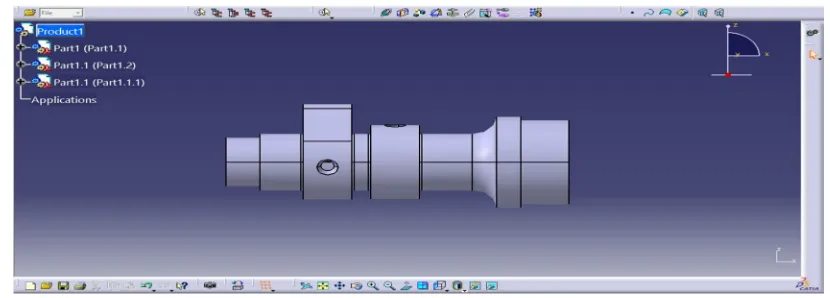
A. Modelling of Cam Shaft by 3D Model
[image:2.612.102.517.554.703.2]Technology (IJRASET)
[image:3.612.145.416.89.213.2]B. Special Features of 3D Printing Machine (Plasto 2000)
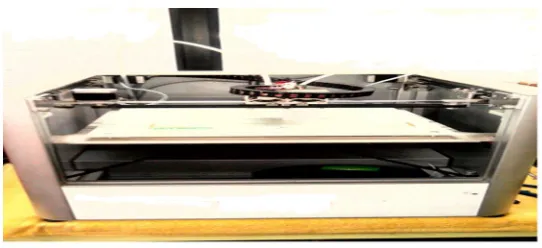
Fig. 2. 3D printing machine
1) Version of machine PLASTO 2000
2) It prints in plastics (ABS, PLA)
3) Dual Extruders- prints simultaneously in 2 color or with a color and soluble support material
4) Can prints many part in one g
5) Can prints Multi color parts
6) Wide choice of material colors
7) Low running cost
8) Compact and Easy to use
9) Large Build size
10) Rugged design (Made in Europe)
C. Special Features of 3D Printing Machine (Julius Plus)
Fig. 3. 3D printing machine
1) Large Build Volume: A large build volume of 25L*20W*27H cubic centimeter enables rapid prototyping and model making.
2) 100 Micron Layer Resolutions: Create professional quality, the high-resolution prototypes, and complex models.
3) Auto Bed Level: Adaptive fully automatic bed leveling system so that you don’t have to do it yourself to get a perfect print
4) Heated Bed: Heated bed to maintain a constant temperature gradient so that the print doesn’t warp
5) E3D Nozzle : Full metal nozzle. Easy to maintain, easy to use
6) Multiple Connectivity Options: Julia V2 comes build to be a standalone printer. Just plug and play directly from SD card, USB or Bluetooth
Technology (IJRASET)
[image:4.612.208.415.94.176.2]D. Raw Material Used for PLA & ABS Component
Fig. 4. PLA and ABS Raw material
When the raw material is the filament in wire shape. It can be the input of 3D printing machine and it’s made layer by layer formation of easy steps to be providing product formation.
[image:4.612.172.451.249.332.2]E. PLA Product in 3D Print ING Technology
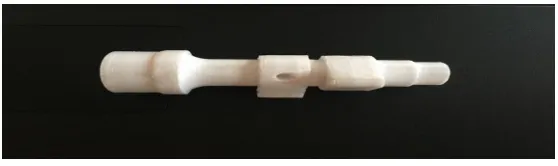
Fig. 5.PLA 3D printing final product
[image:4.612.42.506.494.715.2]After finishing the job of PLA which is the fine structure of camshaft obtained from scrap removing over the structure on the object
Fig. 6. ABS 3D printing final product
After finishing the job of ABS which is the fine structure of camshaft obtained from scrap removing over the structure on the object
F. Mesh Analysis using Ansys Software
Fig. 7.Mesh analysis test function
[image:4.612.122.489.614.703.2]Technology (IJRASET)
[image:5.612.134.488.92.222.2]1) Structural Analysis using PlA:
Fig. 9.ANSYS software model analysis of PLA Material
PLA can be processed by extrusions such as 3D printing, injection moulding, film and sheet casting, and spinning, providing access to a wide range of materials. PLA is used as a feedstock material in desktop fused filament fabrication-based 3D printers (e.g. RepRap). PLA is printed solids that can be encased in plaster-like moulding materials, and then burned out in a furnace, so that the resulting void can be filled with molten metal. This is known as "lost-PLA casting", a type of investment casting. PLA can also be used as a decomposable packaging material, either cast, injection-molded, or spun. The cups and bags have been made from this material. In the form of a film, it’s shrinking upon heating, allowing it to be used in shrink tunnels. It is useful for the producing loose-fill packaging, compost bags, food packaging and disposable tableware. In the form of a fibers and nonwoven fabrics, PLA also has many potential uses, for example as upholstery, disposable garments, awnings, feminine hygiene products, and diapers.
[image:5.612.99.499.381.524.2]2) Structural Analysis using ABS:
Fig. 10.ANSYS software model analysis of ABS Plastic Material
[image:5.612.128.497.570.705.2]Technology (IJRASET)
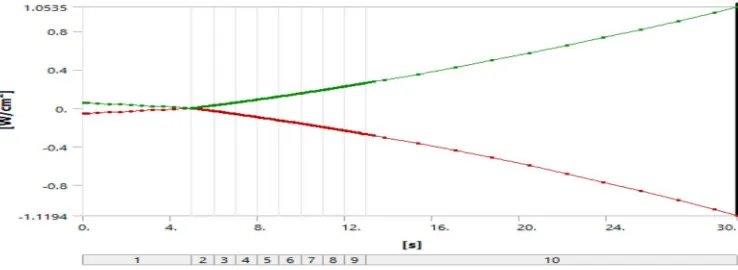
Fig. 12.ANSYS Model of flux rating
TABLE I FINAL ANALYSIS RESULT OF HEAT FLUX RATING
Temperature c & Material
Young’s modulus dyne cm-2
Poison’s ratio
Bulk modulus dyne cm-2
Shear modulus dyne cm-2
Steel 2.e+012 0.3 1.6667e+012 7.6923e+011
ABS 3500 0.35 38889 12963
PLA 21900 0.36 26071 8051.5
[image:6.612.158.471.437.693.2]Modal analysis is done to determine the natural frequencies under applied loads and was drawn and noted frequencies displacements for 3 material by Model (H4) > Transient Thermal (H5) > Solution (H6) > Total Heat Flux
Technology (IJRASET)
TABLE 2MATERIAL PROPERTIES OF PLA AND ABS
1) Advantages: By the implementing above-mentioned solutions we will be able to gain the following advantages over the
conventional machining process
a) Increased productivity
b) Less time
c) Less space
d) No wastage of the materials
III. CONCLUSIONS
Thus, the Rapid Prototyping metal addition 3-D printing process of method can be adapted for mass production of complex parts. The advancement in SLS technology enables the increase in production rate. The advancements made in the setup consist of increasing the number of platforms and the number of laser points to be directed onto the material. This allows multiple cams to be produced at a time by the help of a powerful laser. Thus, this helps in mass production of the component.
REFERENCES
[1] International journal of automotive tech, ISSN: 2051-7831, vol.29, issue. I 1103
[2] Pulak. M. Pandey, Rapid prototyping technologies, applications and part deposition planning, iitd.ac.in, 2010. [3] A.schneider, J.gardan, N.gargan- Characterisation of an optimized model manufactured by rapid prototyping.
[4] Nam YS, Yoon JJ, Park TG. A novel fabrication method of macroporous biodegradable polymer scaffolds using gas foaming salt as a porogen additive. J Biomed Mater Res 2000
[5] Kong CY, Soar RC. Fabrication of metal–matrix composites and adaptive composites using ultrasonic consolidation process. [6] Chung H, Das S. Functionally graded Nylon-11/silica nanocomposites produced by selective laser sintering. Mater Sci Eng A 2008 [7] Gibson I, Savalani MM, Tarik A, Liu Y. The use of multiple materials in Rapid Prototyping. In: Proc. VRAP, Portugal; 2007 [8] Bellehumeur, C.T.; Bisaria, M.; and Vlachopoulos, J. (1997). “An experimental study and model assessment of polymer sintering.” [9] Sun, Q.; Bellehumeur, C.; and Gu, P. (2002). “Investigation of bond formation in FDM process.” Solid Freeform Fabrication Symp.
[10] “Analysis and fabrication of FDM prototypees with locally controlled properties.” PhD dissertation. Calgary, Alberta: Dept. of Mechanical and Manufacturing. (2002).
[11] Hornsby, P.R. and Maxwell, A.S. (1992). “Mechanism of sintering between polypropylene beads”.
S.NO Material properties ABS PLA
1. Density P (Mg/cm3) 1.25 1.01- 1.21
2. Young’s modulus E (GPa) 3.5 1.1-2.9
3. Elongation at break (%) 6 3-75
4. Melting temperature Tm (c) 160 88-128
5. Tensile strength σy (MPa) 36-55 25-50
6. Thermal expansion(um/m*k) - 83-95
7. Strength to weight ratio(kNm/kg) 40 31-80
8. Yield stress σy (Mpa) - 18.5-51