Technology (IJRASET)
Automatic Intravenous Fluid Level Indication
System for Hospitals
Priyadharshini.R1, Mithuna.S2, Vasanth Kumar.U3, Kalpana Devi.S4, Dr. SuthanthiraVanitha.N5. 1, 2, 3
B.E(Final year), 4 Associate professor, 5 Professor& Head (EEE) Knowledge Institute of Technology, Tamilnadu, India.
Abstract: During recent years due to the technological advancements many sophisticated techniques has been evolved for assuring fast recovery of the patients in hospitals. For good patient care in hospitals, assessment and management of patient’s fluid and electrolyte need is the most fundamental thing required. All most in all hospital, an assist/nurse is responsible for monitoring the IV fluid level continuously. But unfortunately during most of the time, the observer may forget to change the saline bottle at correct time due to their busy schedule. This may leads to several problems to the patients such as backflow of blood, blood loss etc. To overcome this critical situation, a low cost RF based automatic alerting and indicating device is proposed where IR sensor is used as a level sensor. It is based on the principle that the IR sensor output voltage level changes when intravenous fluid level is below certain limit. A comparator is used to continuously compare the IR output with predefined threshold. When the transceiver output is negative then the Arduino controller identifies the fluid level is too low and it alerts the observer by buzzer and LCD at the control room indicates the room number of the patient for quick recovery.
Keywords: Intravenous fluid, RF Transceiver, IR sensor, Arduino Controller, Buzzer, LCD
I. INTRODUCTION
Generally, as the population growth increases, the need for health care also increases. Hence it is a mandatory thing for everyone in this world to take care of their health properly. In this scenario, maintaining patient’s safety is the top most priority to be given in all hospitals. Now days, many automatic health monitoring devices are developed to ensure patients safety and to reduce the stress of the doctors. The invention of such devices introduces a drastic change in medical field for monitoring the parameters like heart beat rate, detection of heart attack symptoms and much more automatically with interdisciplinary nature. Even though many advanced automatic devices are used, ensuring the safety of the patients during IV period is still a challenging issue. Intravenous (within vein) therapy is the infusion of liquid substances directly into the vein. Therapies administered intravenously are often called specialty pharmaceuticals or drips. Even though monitoring the IV fluid level of patient is a small thing for a nurse but it will affect the patient health severely during illness if the assist does not monitor it regularly. This may leads to blood loss or backflow of blood to IV tube from their vein. This results in the reduction of hemoglobin level of patients and it may also make the person anemic. The task of assessing and managing the patients with sufficient skill needs to be a fundamental thing for a good patient care.
Hence to assure the safety of the patient during IV period there is a need to develop an efficient health monitoring system. This can be achieved with the proposed idea of RF based IV fluid level indicating system where IR sensor, RF transmitter, receiver and buzzer are used to provide intimation to control room either to change the intravenous set or to switch it off. This will reduces the stress in continual monitoring by the doctor or nurse at an affordable cost.
II. LITERATURE SURVEY
R.Vasuki and et al., proposes “A portable monitoring device of measuring drips rate by using an intravenous (IV) set”. In this method the IV set is attached to the drips chamber. The flow sensor is used to detect each drops of IV set. For each drop, the beam of light is broken at each time and that is transmitted and received by IR sensor. This provides a change in sensor output and comparator gives a pulse output for each drop. The drip rate is indicated using the LCD with which the observer can identify the volume of fluid in IV set. If the device is not sensed for 45 seconds it will give an alarm.
Technology (IJRASET)
comparator and phototransistor. The 8051 microcontroller is used to count the pulse in unit time. This will resemble the flow rate. Through GSM technology the information about the flow rate is send to the observer’s mobile. The cost of this device is high.
R.Aravind and et al., Proposed a paper, “Design of family health monitoring system using wireless communication”. This is an
ARM based embedded system through which the data of the patient is transmitted and received via zigbee or RF transmitter and
receiver. Then the information is stored as database and send to GSM. The database consists of all the details about the patient health conditions such as temperature, blood pressure and heartbeat by using visual basics. This makes the residential people to check their health by themselves but computer should need an IE. But It is not suitable for illiterate people for whom it is very difficult to operate and understand.
V.Ramya and et al., proposes an “Embedded patient monitoring system”. In this system the status of the patient is monitored continuously by using an embedded system. Here the PIC microcontroller and sensor are used to sense temperature and drip status. This status is given to the PC. If the temperature is greater than the set value it will send an alert to mobile phone and produces an alarm until the doctor response to that message.
III. PROPOSED METHOD
Generally, Intravenous therapy is a medical procedure in which the liquid substances (medications) are directly entered into the vein through an IV tube and needle is inserted into the patients’ vein. A sealed device called drip chamber controls the entire process so that the substance slowly pass into the vein, and it also blocks the air to enter into the blood stream. An IV drip is usually used for long term treatments. But it can also be used for short term treatment to rehydrate patients or to give them medicines to revitalize them. It is an very efficient process for quickly supplying the prescribed medicines into the entire body. The fig.1 shows the patient receiving IV drip.
Fig-1: A patient receiving IV drip.
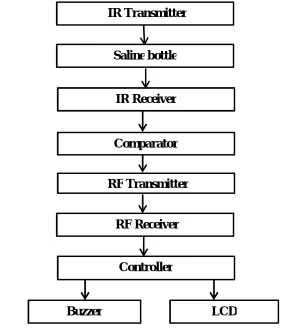
The intravenous therapy is not only used to correct electrolyte imbalances but it can also be used to deliver medicines. Patients those who cannot consume enough nutrients or who cannot eat at all due to an illness, surgery or accident, can be feeded with enough nutrition through their vein using IV therapy. These sterile solutions (sodium and dextrose) containing necessary nutrients to support the human life which is injected into the patient’s body through a tube attached to the needle. Due to lack of caring, many problems will arise such as blood loss, backflow of blood through an IV tube. To overcome this situation an effective idea is proposed to develop an effective health monitoring system which alerts the doctor or nurse when the fluid level of saline bottle is beyond the threshold limit. It comprises of IR sensor, RF transmitter, Receiver, buzzer, etc. Basically IR transmitter transmits an IR ray which is received by the IR receiver and the measured output is in terms of voltage. Fig.2 shows the block diagram of Automatic drips level Indicating system. Initially IR sensors (IR Transmitter – IR Receiver ) are placed at the bottom on either sides of saline bottle. The IR transmitter continuously transmits the rays through the saline liquid and the IR receiver starts to receive it and the corresponding output voltage is measured as 4.5V. When the process is going on, slowly the saline liquid enters into the patient’s body through their vein. This is done with the help of intravenous (IV) set. Hence the level of nutritious liquid in the saline bottle is getting decreased gradually. When the medication liquid in the drips bottle goes beyond IR sensor covering area, the IR receiver receives more rays than in previous condition whose output voltage is measured as 5V.
Technology (IJRASET)
Fig 2: Block Diagram of Proposed System
Then the output from the IR sensor is fed to the comparator which normally compares this output voltage with reference voltage. The generated error signal is given as an input to the RF transmitter. If the difference between the two voltages is zero or positive then the output is HIGH otherwise the input to RF receiver is LOW and by using inverter the comparator output to the RF Transmitter has been changed.
IR Voltage
Comparat or Output
Controller
LCD Buffer
4.5 1 0 Low Low
[image:4.612.174.472.84.413.2]5 0 1 High High
Table 1: Comparator circuit output to RF receiver.
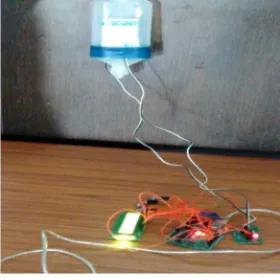
The input to the RF receiver may be either logic 0 or logic 1 and is given to the Arduino controller which performs the corresponding operations. If the received data is HIGH there will be an indication using buzzer else no indication takes place. The prototype model of the proposed system is shown in fig.3.
In this system, it is proposed to keep the RF transmitter at each room in hospital. But RF receiver is placed at a centralized location. Receiver receives the data from all transmitters at different frequency ranges. The frequency range of each transmitter is allocated separately.
IIR Transmitter
Saline
bottle
IR
Receiver
Comparator
I
RF
Transmitter
IRF Receiver
Controller
[image:4.612.165.446.499.591.2]Technology (IJRASET)
Fig 3: Prototype model of proposed system. Fig 4: Prototype model with LCD and buzzer indications.
IV. EXPERIMENTAL ANALYSIS
The simplest experiment was done to verify the performance of the proposed device. Let us consider three rooms in hospital. Initially IR sensors are fixed at the bottom of saline bottles in all three rooms. IR rays from the transmitter travels through the liquid in saline bottle and it reaches the receiver on the other side. If the liquid is present in the travelling path then output voltage is measured as 4.5V from IR sensor. This voltage is set as threshold level of comparator. Now when the dripping system is ON, the saline level gets gradually decreases and when it goes beyond the threshold level the mode of propagation of IR rays changes, hence the IR receiver receives more rays and output voltage is now measured as 5V. This voltage is given as input to comparator and it produces error signal which is inverted by using inverter circuit and fed to the RF transmitter. The above procedure was done in all the three rooms (control room). Here the receiver is fixed at a centralized place which receives all data and it feeds those to controller. Then according to the instruction written in the controller, it performs the sequence of operation, with display device LCD and buzzer. LCD displays the room number of the patient needed to change the saline bottle. The buzzer is used to produce alarm until observer change the saline bottle. The fig.4 shows the LCD which displays room number of patient.
In conventional methodology, IR sensor is used as flow rate sensor which is used to give intimation to change the intravenous set at the last moment. This may leads to serious health problems and also to late recovery. Here the name IR sensor is recommended to use as a level sensor for providing the intimation to the assist to change the intravenous set. This is implemented with a simple Arduino controller, IR sensor, RF transceiver to give the proper information at mean time and it is also be practically feasible and affordable.
V. CONCLUSION
Technology development is an ultimate aim in all sectors. Especially, more new technologies are emerging in medical field for the betterment of people and to serve the society. The proposed arduino based indicating device acts as an assist to nurse and doctors in monitoring the patients. This also reduces the stress of repeated checking about the status of IV set. It also has an appreciable advantage such as small size, affordable cost, and high accuracy, easy handling and completely automated. Certainly, this device reveals a good change in medical field especially in patient monitoring system with less initial investment if implemented in real time work.
REFENENCES
[1] R.Vasuki, C.Dennis, HemPriya Changer, “An portable monitoring device of measuring drips rate by using an Intravenous (IV) set”, International Journal of Biotechnology Trends and Technology Vol. 1, Issue 3, No.4 2011.
[2] C.C.Gavimath, Krishnamurthy Bhat, C.C.Chayalakshmi, R.S.Hooli, B.E.Ravishankera “Design and Development of versatile saline flow rate measuring system and GSM based remote monitoring device”, International Journal Of Pharmaceutical Applications ISSN 0976-2639.
[3] R.Aravind, Syed Mustak Ahmed “Design of family health monitoring system using wireless communication”, International Journal of Advanced Research in Computer and Communication Engineering Vol. 2, Issue 9, September 2013
[4] V.Ramya, B.Palaniappan, Anuradha Kumari “Embedded patient monitoring system” International Journal of Embedded Systems and Applications (IJESA) Vol.1, No.2, December 2011
[5] D.Janani, J.Prathibanandhi, P.Meenakshi Vidya, K.S.Sujatha “Wireless Saline Bottle Level Indicator for Hospitals”, Compo soft an International Journal of Advanced computer Technology.
[image:5.612.40.180.77.216.2] [image:5.612.345.500.78.204.2]Technology (IJRASET)
Part 1, 2929-2937.[7] Cyber-Physical Medical and Medication Systems by Albert M. K. Cheng, 2008.
[8] Zhou Xiao, Li Jiaming, Pu Junjia, Yang Zhi, “The Design and implement of Mobile Remote Medical Ward System.” 2010.
[9] Nivedita Daimiwal, DipaliRamdasi, RevathiShriram, AsmitaWakankar, “Wireless Transfusion Supervision and Analysis Using Embedded System”.
BIOGRAPHIES
PRIYADHARSHINI.R is pursuing Bachelor of Engineering in the discipline of Electrical and Electronics Engineering at Knowledge Institute of Technology, Salem, under Anna University, Chennai, India. She has presented number of technical papers in symposium. She is acting as a student member of various clubs and forums like Robotics and Intelligence Machines (RIM) club, Green club, i-can Club, Instrumentation and Control Engineers (ICE) club. She received YOUNG SCIENTIST AWARD for her biomedical project during the year 2014. She also published an International Journal and presented a paper at National Conference. Presently she is doing minor research works on various fields like Biomedical Instrumentation, Robotics etc.
MITHUNA.S is pursuing Bachelor of Engineering in the discipline of Electrical and Electronics Engineering at Knowledge Institute of Technology, Salem, under Anna University, Chennai, India. She has presented number of technical papers in symposium. She is acting student member of various clubs and forums like Robotics and Intelligence Machines (RIM) Club, Green club, i-can Club, Instrumentation and Control Engineers (ICE) club. She was selected for Grand finale of the ROBO ZEST’14 competition in IIT (Bombay) which was conducted by Robospecies Technology Pvt.Ltd during the year 2014. She won prizes for project contest. Presently she is doing minor research works on various fields like Power Electronics, Biomedical Instrumentation and Robotics etc. She got more awards and prizes for her extracurricular activities.
VASANTHKUMAR.U is pursuing Bachelor of Engineering in the discipline of Electrical and Electronics Engineering at Knowledge Institute of Technology, Salem, under Anna University, Chennai, India. He has won first prize with cash award of Rs.30,000 at National Level for the project titled as “Advanced Line Following Robot using Bar Addressing Techniques” in e-yantra ideas competition 2015 conducted by IIT – Bombay. He is the member of various technical clubs like Robotics and Intelligence Club, Instrumentation and Control Engineers Club of Knowledge Institute of Technology. He has presented number of technical papers at National level. Presently he is doing minor research works on various fields like Biomedical, Robotics etc.
S.KALPANADEVI is currently working as an Associate Professor in the Department of Electrical and Electronics Engineering at Knowledge Institute of Technology, Salem. She received his UG degree in the discipline of Electrical and Electronics Engineering from Kongu Engineering college under Bharathiyar University, Coimbatore and got PG degree in Process Control and Instrumentation discipline from Annamalai University, Chidambaram. She has published and presented number of technical papers in National and International Journals and Conferences.She is a life member of ISTE. She has guided number of projects for students. She has organized many guest lectures in various fields. Her research interests lie in the field of Control System, Medical Instrumentation and Embedded System.