Technology (IJRASET)
©IJRASET 2015: All Rights are Reserved
217
Automatic Tablet Filler Using PLC
Prashant kumar1, H M Mallaradhya2
1
M.Tech final Year student, S.J.C. Institute of Technology, Chickballapur
2Assistant Professor, Dept. of Mechanical Engineering, S.J.C. Institute of Technology, Chickballapur
Abstract— The project entitled “Automatic tablet filler using PLC” is an automating tablet filling processes in pharmaceutical companies. It differs from present tablet filling machines used in the industries in various aspects such as sensors, valves, conveyor belt, motor and PLC logic being used currently throughout the industries. This project focuses on automatically filling the tablets into the selected bottles using PLC ladder logic. It requires no human intervention during the tablet filling process once bottle is loaded manually at starting point on the conveyor. It is highly efficient and reliable system of tablet filling which will reduce the overall cost at great extent. It is user friendly and non-hazardous for workers who will be working in the vicinity of installed system.
Keywords— Programmable Logic Controller (PLC)
I. INTRODUCTION
As we know that PLC is widely used in the industries for controlling and automating the repetitive tasks and processes. Automation technology has revolutionized the industries and its way of handling the production systems. There are numerous number of filling machines used for various materials like powder filling, water filling but this project has been develop for filling tablets into bottles and hence called automatic tablet filler. Conventional way of tablet filling process is time consuming and inefficient if observed. This project has implemented PLC ladder logic to control the tablet filling machines in more efficient way. It uses different sensors, valves, motor and conveyor belt for hardware integration.[1] The project consists of three main parts which has been designed and integrated to complete the system at reasonable cost. The three basic elementary parts of the system are conveyor system , Filling station and feeding section called hopper.[2] This project is a good example where almost all elements of automation has been integrated to develop the system. This project is complete integration of electrical, mechanical, control system and computer system. In brief this system of tablet filling is boon for medicine industries where a lot of attention and precautions are to be taken to complete the filling task. Same thing has been achieved by this project in more easier and efficient way. This project automatically carries the bottle at filling station where desired numbers of tablet will be filled from hopper and process will be repeated for selected number of iterations. This is simple application of PLC in tablet filling process which will reduce the cost of production at great extent in coming future.[3]
II. EXPERIMENTALDETAILS
A. Ladder Logic Implementation
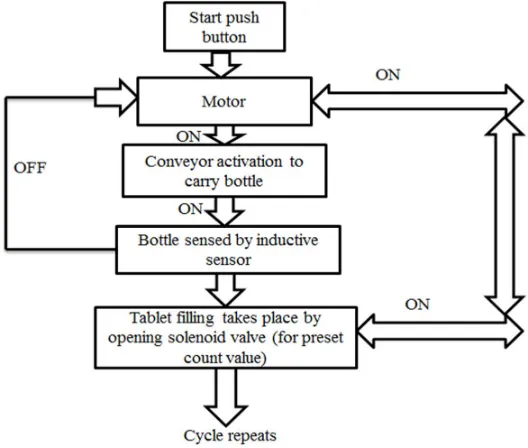
Flow chart 1: Ladder logic diagram for sequences of operations
B. Working Methodology Of System
[image:3.612.174.438.406.630.2]When start pushbutton is pressed motor will start running which will drive the conveyor belt with bottles up to tablet filling station. When it reaches filling station inductive sensor detect the presence of bottle and a signal is passed which will stop the motor. Then solenoid valve open the nozzle of hopper to fill the tablet into the bottle for preselected value of counts. After filling process motor again start to carry next bottle at filling station and this cycle repeats during entire tablet filling process.[5]
Fig. 1: Functional blocks of system
Technology (IJRASET)
A. The Prototype
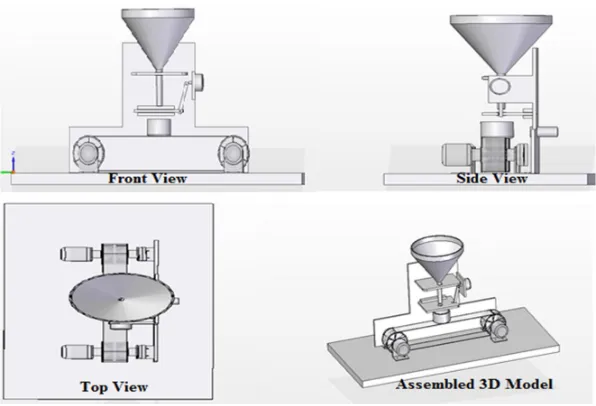
(a). Left side view (b). Right side view
[image:4.612.149.460.78.452.2](c). Front view (d). Top view
Fig. 2: Model from different viewing angles
[image:4.612.157.455.488.691.2]B. Tablet Filler Connection with PLC
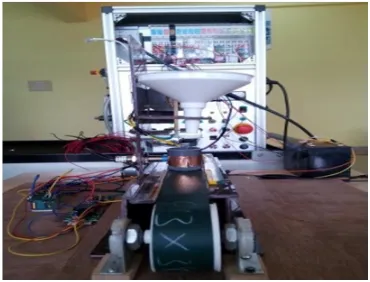
Fig. 4: Tablet filler interfacing to indralogic-10 PLC
This stage of connection is very important in aspect that system is going to be operated for desired sequences of operations. Before making this connection it has been being ensured that all inputs and outputs connection to the PLC is correct.[6] After making the connection two major objectives first one detecting presence of bottle using sensor and finally filling operation has been done successfully. During this final stage of connection sensors output can’t be given as a input to the PLC directly because it runs on 24V DC power supply. Therefore a signal conditioning circuit is used which will modify the outputs in such a way that it can be given to PLC. To ensure the safety of PLC the inputs are connected through the relay driver circuit.[7] It means inputs are connected to common terminal of PLC which prevents it from damage.
C. Bottle Sensing Mechanism
It is achieved using the inductive sensor. Bottle used in project is of plastic material but inductive sensor detect metallic object only. To overcome this problem a thin film of copper sheet is wrapped around the bottle to ensure that it gets detected by the inductive sensor.[8] To make the project cost effective it has been done otherwise capacitive sensor is best available option for detecting the plastic material. When bottle reaches filling station that in front of inductive sensor, current starts to flow through the copper sheet wrapped around the bottle as a result of which a new magnetic field is generated in the vicinity of inductive sensor which opposes the original magnetic field of the coil of inductive sensor. At this point a net magnetic field is generated which changes the inductance of the coil. Now this inductance is being measured to detect presence of different metallic material. In this project copper sheet is being detected which allow the bottle to stop at filling station.
D. Tablet Filling Operation
This operation fills the tablets from hopper into bottle. Bottle arrival at filling station activates the solenoid or electromagnet which opens the filling nozzle and tablets starts falling into bottle. Through beam sensor below the nozzle detects tablets falling into bottle and for each interrupted beam it sends signal to counter where pulses are counted for preselected value once desired value of tablets are matched (say count=5) then supply to solenoid it cut off as a result of which hopper opening gets closed and tablets stop falling into bottle. This operation is controlled by PLC ladder logic and desired delay in opening and closing of solenoid has been set for proper functioning.[9] After filling process get completed motor is switched on to carry the bottle away from filling station to ensure that next bottle is being loaded. Motor also starts and stop after selected delay duration for facilitating smooth movement of conveyor.
IV. CONCLUSIONANDFUTURESCOPEOFWORK
A. Conclusion
Technology (IJRASET)
simple, compact and reliable tablet filling system is developed using PLC.
B. Future Scope of Work
The performances of the system can be enhanced if some of the electrical and mechanical components are upgraded. Modification done in the hardware parts design and features can increase the efficiency of the system.[10] This is all about eliminating the drawbacks and demerits present in the current system. Some of the major recommendations that can be taken into considerations in this project are:
In this project only one sensor is used to detect the presence of bottle at filling station. System performance can be enhanced if one more sensor is used at loading station. By doing this whenever bottle will be loaded it will be sense by the sensor and automatically motor will start and carry the bottle to filling station.
Buzzer alarm can be used for alert in case of system failure.
REFERENCES
[1] K. Ogata, “Modern Control Engineering”, PHI Publication, 5th
Edition, 2009.
[2] Hong-bo Liu, Li-zhong wang, Zhen-yu Hou and Guang-de wang “Research on System of Liquid Automatic Filling” IEEE 2011.
[3] Mallaradhya H M and K R Prakash, “ Automatic liquid filling to bottles of different height using programmable logic controller”, AECE-IRAJ International Conference, 14th July 2013, Tirupati, India, ISBN: 978-81-927147-9-0.
[4] Shaukat.N, “PLC based automatic liquid filling process”, Multi Topic Conference 2002, IEEE publications.
[5] Gary Dunning, ”Introduction to Programmable Logic Controller”, Thomson Learning, 2nd
Edition, 2002.
[6] Rexroth IndraLogic L20 System Description, Operating and Programming Guide R911312329, 1st Edition.
[7] Rexroth Bosch, Understanding the IEC61131-3 programming languages, Drive and Control News letter, (2009). U.A. Bakshi and M.V. Bakshi, “DC Machines and Synchronous Machines ”, Technical publication Pune, 1st Edition,2008.
[8] Hugh Jack, “Automating Manufacturing System with PLCs”, version -5, may 4, 2007. [9] W. Bolton, “Electronic control system in mechanical and electronic engineering”, Pearson, 5th Edition, 2011.
Mr. Prashant kumar, currently pursuing M.Tech (final year) in Industrial Automation and Robotics from Sri Jagadguru Chandrashekaranatha Swamiji Institute of Technology, Chickballapur. He completed his B.E (EEE) from Global Academy of Technology, Bangalore. His area of interest is in control system, power system and robotics.