A Modified Eigenvector Method for Blind Deconvolution of
MIMO Systems Using the Matrix Pseudo-Inversion
Lemma*
Mitsuru Kawamoto1, Kiyotaka Kohno2, Yujiro Inouye3, Koichi Kurumatani1
1Information Technology Research Institute, National Institute of Advanced Science and Technology, Tsukuba, Japan 2Department of Electronic Control Engineering, Yonago National College of Technology, Yonago-city, Japan
3Department of Electronic and Control Systems Engineering, Shimane University, Matsue, Japan
E-mail:{m.kawamoto, k.kurumatani}@aist.go.jp, kohno@yonago-k.ac.jp, inouye@riko.shimane-u.ac.jp Received August 26,2010; revised December 2, 2010; accepted December 8,2010
Abstract
Recently we have developed an eigenvector method (EVM) which can achieve the blind deconvolution (BD) for MIMO systems. One of attractive features of the proposed algorithm is that the BD can be achieved by calculating the eigenvectors of a matrix relevant to it. However, the performance accuracy of the EVM de-pends highly on computational results of the eigenvectors. In this paper, by modifying the EVM, we propose an algorithm which can achieve the BD without calculating the eigenvectors. Then the pseudo-inverse which is needed to carry out the BD is calculated by our proposed matrix pseudo-inversion lemma. Moreover, using a combination of the conventional EVM and the modified EVM, we will show its performances comparing with each EVM. Simulation results will be presented for showing the effectiveness of the proposed methods.
Keywords:Blind Signal Processing, Blind Deconvolution, Eigenvector Methods, Super-Exponential Mthods, MIMO Systems, Matrix Pseudo-Inversion Lemma
1. Introduction
In this paper, we deal with a blind deconvolution (BD) problem for a multiple-input and multiple-output (MIMO) infinite-impulse response (IIR) channels. A large number of methods for solving the BD problem have been pro-posed until now (see [1], and reference therein). In order to solve the BD problem, this paper focuses on the eigenvec-tor method (EVM).
The first proposal of the EVM was done by Jelonnek et al.
[2]. They have proposed the EVM for solving blind equa-lization (BE) problems of single-input single-output (SISO) channels and single-input multiple-output (SIMO) channels. The most attractive feature of the EVM is that its algorithm can be derived from a closed-form solution using reference signals. Then, a generalized eigenvector problem can be formulated and the eigenvector calculation is carried out in order to solve the BE problem. Owing to the property, dif-ferently from the algorithms derived from steepest descent methods, the EVM does not need many iterations to achieve the BE, but works so as to solve the BE problem
with one iteration.
Recently, we extended the EVM to the case of MI-MO-IIR channels [3,4]. Then we proved that the proposed EVM can work so as to recover all source signals from their mixtures with one iteration. However, in the EVM, its performance accuracy depends highly on computational results of the eigenvectors.
In this paper, we modify the EVM and then an algo-rithm for solving the BD is proposed, in which the pro-posed algorithm can be carried out without calculating the eigenvectors. Namely, the proposed algorithm can achieve the BD with as less computational complexity as possible, compared with the conventional EVMs. More-over, a combination of the conventional EVM and the modified EVM is proposed. The combined EVM has su- ch properties that the BD can be achieved with as less computational complexity as possible and with good acc- uracy compared with each EVM.
The present paper uses the following notation: Let Z
de-note the set of all integers. Let C denote the set of all com-plex numbers. Let Cn denote the set of all n-column vectors
with complex components. Let Cm×n denote the set of all
m n matrices with complex components. The
scripts T, *, and H denote, respectively, the transpose, the complex conjugate, and the complex conjugate transpose
(Hermitian) of a matrix. The symbol† denotes a pseudo-
inverse of a matrix. The symbols block-diag
and diag
denote respectively a block diagonal and a diagonalmatrices with the block diagonal and the diagonal elements
. The symbol cum{x1, x2, x3, x4} denotes the fourth-order cumulant of xi's. Let i = 1, n stand for I1, 2,, .n
2. Problem Formulation and Assumptions
We consider a MIMO system with n inputs and m
out-puts as described by
( ) –
( ) k ( ) ( ), ,
k
y t
H s t k n t t Z (1)where s(t) is an n-column vector of input (or source)
signals, y(t) is an m-column vector of system outputs,
n(t) is an m-column vector of Gaussian noises, and
{H(k)} is an m×n impulse response matrix sequence.
The transfer function of the system is defined by H(z)
= ( )
–
k k
k H z
, z ∈ C.To recover the source signals, we process the output
signals by an n×m deconvolver (or equalizer) W(z)
de-scribed by
( ) –
( ) k ( )
k
v t
W y t k
( ) ( )
– –
k k
k G s t k k W n t k
, (2)where {G(k)} is the impulse response matrix sequence of
G(z) : = W(z)H(z), which is defined by G(z) =
kk k)
z
(G
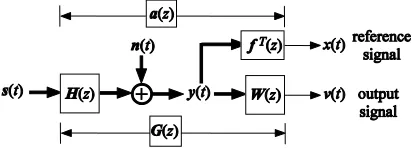
, z ∈ C. The cascade connection of the [image:2.595.69.275.599.673.2]unknown system and the deconvolver is illustrated in
Figure 1.
Here, we put the following assumptions on the system, the source signals, the deconvolver, and the noises.
A1) The transfer function H(z) is stable and has full
column rank on the unit circle |z| = 1, where the
assump-tion A1) implies that the unknown system has less inputs
than outputs, i.e., n ≤ m, and there exists a left stable inverse of the unknown system. Please do not revise any of the current designations.
Figure 1. The composite system of the unknown system H(z) and the deconvolver W(z), and the reference system f(z) with m inputs and single output x(t). It is the case of single reference.
A2) The input sequence {s(t)} is a complex,
ze-ro-mean and non-Gaussian random vector process with element processes {si(t)}, i = 1,n being mutually inde-pendent. Each element process {si(t)} is an i.i.d. process
with a variance 2 0
i
s
and a nonzero fourth-order
cumulant i0 defined as
* *
cum , , , 0.
i s t s t s t s ti i i i
(3)
A3) The deconvolver W(z) s an FIR system, that is,
W(z) =
2 1) (
L L
k W kzk , where the length L := L2 L1 + 1
is taken to be sufficiently large so that the truncation effect can be ignored.
A4) The noise sequence {n(t)} is a zero-mean,
Gaus-sian vector stationary process whose component processes {nj(t)}, j = 1,m have nonzero variances 2 0
i
n
,
j = 1,m.
A5) The two vector sequences {n(t)} and {s(t)} are
mutually statistically independent.
Under A3), the impulse response {G(k)} of the cascade
system is given by
,
: 2
1
) ( ) ( )
(
L
L
τ k
k W H
G k ∈ Z (4)
In a vector form, (4) can be written as
i i
g Hw , i1,n (5)
where giis the column vector consisting of the i-th
output impulse response of the cascade system defined
by : 1 2
T
T T T
i i i in
g g ,g , ,g , gij is expressed as
: 1 0 1 T 1
ij ij ij ij
g ,g ,g ,g , , j , n (6)
where gij(k) is the (i, j)-th element of matrix G(k), and i
w is the mL-column vector consisting of the tap
coeffi-cients (corresponding to the i-th output) of the
decon-volver defined by w~ :=i [w wTi1, Ti2, , winT T] ∈ CmL, wijis defined by
1 1
2: 1 T L 1
ij ij ij ij
w w L ,w L , ,w L C , j ,m,(7)
where wij(k) is the (i,j)-th element of matrix W(k),
andH is the n×m block matrix whose (i,j)-th block
ele-ment Hij is the matrix (of L columns and possibly infinite number of rows) with the (l,r)-th element [Hij]lr defined by[Hij]lr := hji(l r), l = 0, 1, 2, , r = L1,L2, where
hij(k) is the (i,j)-th element of the matrix H(k).
In the MIMO deconvolution problem, we want to ad-just w~i's (i= 1,n) so that
g1, , gn
H w
1, ,wn
δ1, ,δnP, (8)n-block column vector defined by 1 2
T
T T T
i i i in
δ δ ,δ , , δ ,i
= 1,n, δij:δˆifor i = j, otherwise.
,0,0,0,
T Here,
i
ˆ is the column vector (of infinite elements) whose r-th
elementˆi() is given by ˆi
di
r k i
, where
t is the Kronecker delta function, di is a complex
number standing for a scale change and a phase shift, and
ki is an integer standing for a time shift.
3. The Conventional Eigenvector Algorithms
Jelonnek et al. [2] have shown in the single-input case
that from the following problem, that is, Maximize
* *
cum , , ,
i
v x i i
D v t v t x t x t
under 2 2 ,
i
i s
v
(9) a closed-form solution expressed as a generalized eigen-vector problem can be led by the Lagrangian method, wherev2iands2idenote the variances of the output vi(t) and a source signalsi(t), respectively, iis one of integers
1, 2 , n
such that the set { 1, 2, , n} is a permutation of the set
1, 2, , n
, vi(t) is the i-th ele-ment of v(t) in (2), and the reference signal x(t) is givenby fT
z y t using an appropriate filter f(z) (seeFig-ure 1). The filter f(z) is called a reference system. Let
a(z) :=
1
, 2 , ,
T T
n
H z f z a z a z a z , then
x(t) = fT
z H z s t a z s tT
.The element ai(z) ofthe filter a(z) is defined as ( )
ki k i
a z
a k z and thereference system f(z) is an $m$-column vector whose
elements are fj(z) =
2 1 ( )L L
k fj k zk , j = 1,m, where dif-ferently from the wij(k), the parameter fj(k) is any fixed value.
In our case, Dv xi and 2 i
v
can be expressed in terms of
the vector w~i as, respectively, i
H i x vi
D w~ B~w~ and
i H i vi w Rw~
~ ~
2
whereB~is the m×m block matrix whose
(i,j)-th block element Bij is the matrix with the (l,r)-th element calculated by cum
y tL rj 1 1 ,y tL li*
1 1 ,
x t x t*
,
(l,r = 1,L) and
* T
R E y t y t is the covariance matrix of m-block column vector~y(t)defined by
: 1
2
T
T T T mL
m
y t y t , y t ,..., y t C (10) where
: ,j
1
1 1 , ,
2
,T L
j j j
y t y t L y t L y t L C
j=1,m. It follows from (10) thaty t( )is expressed as ~y(t)
= Dc(z)y(t), where Dc(z) is an mL×m converter
(consist-ing of m identical delay chains each of which has L delay
elements when L1 = 1) defined by Dc(z) :=
block-diag
d zc
, , d zc
with m diagonal blockelements all being the same L-column vector dc(z)
de-fined by dc(z) = zL1, ,zL2T.
Therefore, by the
simi-lar way to as in [2], the maximization of |Dvix| under
2 2
i
i s
v
leads to the following generalized
eigenvec-tor problem;
. ~ ~ ~ ~
i i
i Rw
w
B (11)
Moreover, Jelonnek et al. have shown in [2] that the
eigenvector corresponding to the maximum magnitude
eigenvalue ofR~†B~ becomes the solution of the blind
equalization problem, which is referred to as an
eigen-vector algorithm (EVA). It has been also shown in [3] that the BD for MIMO-IIR systems can be achieved with the eigenvectors ofR~†B~, using only one reference
sig-nal. Note that since Jelonnek et al. have dealt with
SI-SO-IIR systems or SIMO-IIR systems, the constructions of B, w ,i and Rin (11) are different from those pro-posed in [2].
Castella et al. [5] have shown that from (9), a BD can
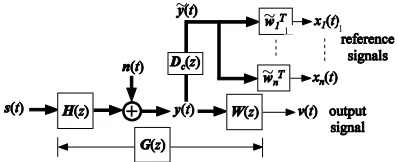
be iteratively achieved by using xi(t) =w~i~y(t)(i = 1,n) as
reference signals (see Figure 2), where the number of
reference signals corresponds to the number of source signals and w~ is a vector obtained byi R~†B~i divided
byiin the previous iteration, where Bi represents
Bin (11) calculated by xi(t) = w~i~y(t). Namely, they considered the following equation;
. ~ ~ ~ ~
i i i
iw w
B
R† (12)
Then a deflation method was used to recover all source signals. However, the EVM proposed by Castella
et al. requires the calculation of the eigenvectors of the matrixR~†B~ito achieve the BD.
4. The Proposed Algorithm
Figure 2. The composite system of the unknown system H(z) and the deconvolver W(z), and the reference system with m inputs and n outputs, where Dc(z) is an mL×m converter.
It is the case of multiple reference system.
, ~ ~ 1 ~
i i
i R d
w †
i = 1,n, (13)
where on the details of di B w , i i see (30) in Appendix.
Differently from the EVM in [5], (13) means that wi is
modified iteratively by the value of the right-hand side of (13) without calculating the eigenvectors of R~†B~iwhere
i
w in both xi(t) and diis the value of the left-hand side
of (13) in the previous iteration. Moreover, the EVMs in [2,6] must select the appropriate parameter for the
refer-ence system f(z), but our proposed algorithm does not
need such a troublesome process. The scalariis fixed to
be 1, but w~ obtained by (13) should be normalized at i
each iteration, that is
i H i
i i
w R w
w w
~ ~ ~
~ :
~ , i = 1,n. (14)
It can be seen that the iterative algorithm (13) is noth-ing but an iterative procedure of the super-exponential method (SEM) [7-9] (see Appendix), where the first pro-posal of the SEM was done by Shalvi and Weinstein [9]. Therefore, our proposed algorithm for achieving the BD is that the vectorwiis modified by using the value Rdi
~ ~† in
(13), and then the modified vector, that is, wi in the
left-hand side of (13) is normalized by (14).
Here, the calculation ofR~†is implemented by using the following algorithm based on the matrix pseudo-inversion lemma proposed in [10]. The reason is that in the case that the pseudo-inverse is calculated using data block, the convergence speed is increased and the computational complexity is reduced, compared with the conventional pseudo-inverse algorithms, for example, the built-in func-tion “pinv” in MATLAB [11]. Therefore, in order to pro-vide a recursive formula based on block data for time-updating of pseudo-inverse, the block index “k” is defined, and then R~ and R~† are described asR~(k)and
P(k), respectively, where the k-th block of data is defined
as
t = kl + i, i = 1,l – 1, k ∈ Z (15)
the parameters l and t denote the block length and the
original discrete (or sample) time, respectively. The
ma-trix R k
is obtained by(k), (k) )
1 (k ~ ) 1 ( (k)
~ *
k
k R Y YT
R (16)
where
Y(k) =y
k 1
l , y
k 1
l1
, , y
k 1
l l 1
∈ CmL×l (17)
andkis a positive number close to, but greater than zero, which accounts for some exponential weighting factor or forgetting factor [12]. Moreover, the following parame-ters are defined;
*
,k
Y k Y k (18)
1 1 1 ,
Y k = R k - P k - Y k (19)
2( ) ( 1) ( 1) .
Y k I R k P k Y k (20)
Then the pseudo-inverse P(k) can be explicitly
ex-pressed, as follows:
B
P k P k†
† 1
1 2 1 2
k k k k k k H
B D
P Y ,Y P Y ,Y †
kB
P
(21) whereP kB
† and 1
D
P k are respectively defined by
1 1 1
†
k
k 1 k 1 k k k 1 k
1
H A B
P P Y P Y P P :
† †
2H k 2 k
Y Y , (22)
and
1
2
1
1
1 1
1 2 1
Δ k k Δ k
k :
k Δ k k k Δ k D
P P
I E E E
(23)
with
2
1Δ k : I E k E k , (24) where
†1 k 1 k k 1 k
H B
E B P B , (25)
†2 k 2 k k 2 k
H B
E B P B ,
We treat P(k) as R~†,and wiis iteratively modified
using (13) and (14), whereiin (13) is assumed to be
fixed to 1 and di :B w i i in (13) is estimated by using
Y(k).
Thus, the proposed iterative algorithm for solving the BD problem is summarized, as follows:
1) Choose appropriate initial values ofwi
0 ,P(0),
R 0 , d 0 ,i
i=1,n and set k = 1.2) EstimateR k
1
,d k 1 ,i
by their moving aver-ages, and P k
1
by (21).3) Calculate thew k ,i
fromP k- 1 w k ,
i and then(k) ~
i
w is normalized by H
k k 1
ki i
w R w .
4) Put k = k + 1 and stock thewiobtained in (13). If k = k' (where k' denotes an appropriate iteration number), stop the iterations, otherwise go to 2).
5. Simulation Results
To demonstrate the proposed algorithm, we considered a
MIMO system H(z) with two inputs (n = 2) and three
outputs (m = 3), and assumed that the system H(z) is FIR and the length of channel is three, that is H(k)'s in (1)
were set to be
H(z) =
2
0 ) (
k
k
k z
H
=
2 2
2 2
2 2
1 . 0 2 . 0 1 . 0 4 . 0 1 . 0 6 . 0
1 . 0 25 . 0 1 2 . 0 1 . 0 5 . 0
15 . 0 25 . 0 65 . 0 1 . 0 15 . 0 1
z z z
z
z z z
z
z z z
z
The source signals s1(t) and s2(t) were a sub-Gaussian signal which takes one of two values, –1 and 1 with equal probability 1/2. The parameters L1 and L2 in W(z) were set to be 0 and 9, respectively. As a measure of
performances, we used the multichannel intersymbol
interference (MISI) [8], which was the average of 50
Monte Carlo runs. In each Monte Carlo run, using 300
data samples, wiis modified by (13) and (14), and the
total number of modification times is 10. About the
block length l, the following two cases were considered:
l = 1 and l = 2. For obtaining the pseudo-inverse of the
correlation matrix, the initial values ofR d ,i and P were
estimated using 30 data samples. The value ofkwas
chosen as
l
k 1 k
[image:5.595.325.525.65.229.2] for each k.
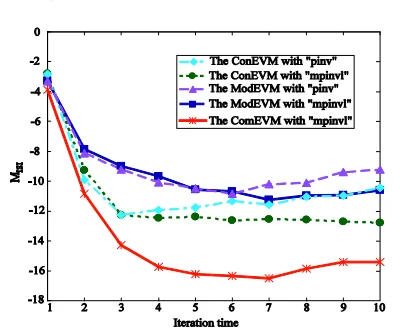
Figure 3 shows the results obtained by the
convention-al EVM (ConEVM), the modified EVM (ModEVM), and
their combined EVM (ComEVM) in the case of l = 1. As
a ConEVM, we selected the EVM proposed by Castella et
al.. Then, the pseudo-inverse ofR in (12) was calculated
by the built-in function “pinv” in MATLAB and our pro-posed matrix pseudo-inversion lemma, denoted by “mpinvl”. In the ComEVM, the ConEVM was carried out at the first modification and from the second modification the ModEVM was carried out, where the
pseu-do-inverseRin (12) was calculated by “mpinvl”. From
the figure, the ConEVM with mpinvl provides a better performance compared with the other EVMs, except for the ComEVM. However, the average of the execution time of the ConEVM with mpinvl is longer than the one
of the ModEVM with mpinvl (see Table 1).
Figure 3. The performances of the proposed algorithm and the conventional methods (l = 1).
On the other hand, the ComEVM with mpinvl is carried out with a little bit longer execution time than the Mod-EVM with mpinvl but the performance of the ComMod-EVM with mpinvl is better than the other EVMs. From these results, we recommend to use the ComEVM with mpinvl to achieve the BD in the case of l = 1.
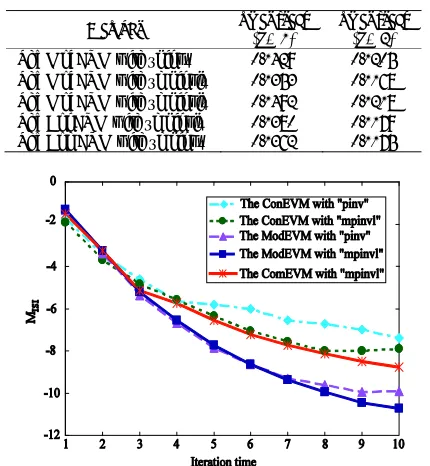
Figure 4 shows the results obtained by the EVMs in
the case of l = 2. From Figure 4, one can see that the
ModEVMs with mpinvl provides better performances than the other EVMs. Therefore we recommend to use the ModEVM with mpinvl to achieve the BD in the case of l = 2.
Table 1 shows the average of the execution times for
the proposed method and the conventional EVM, using a personal computer (Windows machine) with 3.33 GHz
processor and 3 GB main memories. From the Table 1,
one can see that the execution time of the ModEVM with mpinvl is the fastest compared with other EVMs. The reasons are that the ModEVM is carried out without
cal-culating the eigenvectors of R~†B~i in (12) and the
mpinvl has a property written in [13].
6. Conclusions
In this paper, by modifying the EVM, we have proposed an algorithm which can achieve the BD without calcu-lating eigenvectors. Moreover, a combination of the modified EVM and the conventional EVM has been proposed. It can be seen that the combined EVM pro-vides a better performance than the other EVMs in the
case of l = 1, and the ModEVA with mpinvl provides a
better performance than the other EVMs in the case of l
Table 1. Comparison of the averages of the execution times.
Methods times (l = [1)sec] times (l = [2)sec]
The ModEVM with “pinv” 0.1429 0.1205 The ModEVM with “mpinvl” 0.1353 0.1168 The ModEVM with “mpinvl” 0.1492 0.1218 The ConEVM with “mpinvl” 0.1380 0.1179 The ComEVM with “mpinv” 0.1362 0.1175
Figure 4. The performances of the proposed algorithm and the conventional methods (l = 2).
7. Acknowledgements
This work was supported by the Grant-in-Aids for the Scientific Research by the Ministry of Education, Cul-ture, Sports, Science and Technology of Japan, No.21500 088 and No.22500079.
8. References
[1] Special Issue on Blind System Identification and Esti- Mation, Proceedings of the IEEE, Vol. 86, No. 10, 1998, pp. 1907-2089.
[2] B. Jelonnek and K. D. Kammeyer, “A Closed-form Solution to Blind Equalization,” Signal Processing, Vol. 36, No. 3, 1994, pp. 251-259. doi:10.1016/0165-1684 (94)90026-4
[3] M. Kawamoto, K. Kohno, Y. Inouye and K. Kurumatani, “A Modified Eigenvector Method for Blind Deconvo- lution of MIMO Systems Using the Matrix Pseudo- Inversion Lemma,” International Symposium on Circuits and Systems 2010, Paris, 30 May-2 June 2010, pp. 2514- 2517.
[4] M. Kawamoto, K. Kohno and Y. Inouye, “Eigenvector
Algorithms for Blind Deconvolution of MIMO-IIR Sy- stems,” International Symposium on Circuits and Systems
2007, New Orleans, 25-28 May 2007, pp. 3490-3493.doi: 10.1109/ISCAS.2007.378378
[5] B. Jelonnek, D. Boss and K. D. Kammeyer, “Generalized Eigenvector Algorithm for Blind Equalization,” Signal Processing, Vol. 61, No. 3, 1997, pp. 237-264.doi:10.1016/ S0165-1684(97)00108-4
[6] M. Kawamoto, Y. Inouye and K. Kohno, “Recently De- veloped Approaches for Solving Blind Deconvolution of MIMO-IIR Systems: Super-Exponential and Eigenvector Methods,” International Symposium on Circuits and Sy- stems 2008, Seattle, 18-21 May 2008, pp. 121-124. [7] M. Castella, et al., “Quadratic Higher-Order Criteria for
Iterative Blind Separation of a MIMO Convolutive Mix- ture of Sources,” IEEE Transactions. Signal Processing, Vol. 55, No. 1, 2007, pp. 218-232. doi:10.1109/TSP.20 06.882113
[8] Y. Inouye and K. Tanebe, “Super-Exponential Algorithms for Multichannel Blind Deconvolution,” IEEE Transaction on Signal Processing, Vol. 48, No. 3, 2000. pp. 881-888. doi: 10.1109/78.824685
[9] K. Kohno, Y. Inouye and M. Kawamoto, “Super Ex- ponential Methods Incorporated with Higher-Order Correlations for Deflationary Blind Equalization of MIMO Linear Systems,”5th International Conference on Independent Component Analysis and Blind Signal Se- paration, Granada, 22-24 September 2004, pp. 685-
693.
[10] O. Shalvi and E. Weinstein, “Super-Exponential Methods for Blind Deconvolution,” The IEEE Transactions on Information Theory, Vol. 39, No. 2, 1993, pp. 504-519. doi: 10.1109/18.212280
[11] K. Kohno, Y. Inouye and M. Kawamoto, “A Matrix Pseudo-Inversion Lemma for Positive Semidefinite He- rmitian Matrices and Its Application to Adaptive Blind Deconvolution of MIMO Systems,” IEEE Transactions Circuits and Systems-I, Vol. 55, No. 1, 2008, pp. 424- 435. doi:10.1109/TCSI.2007.913613
[12] S. Haykin, “Adaptive Filter Theory,” 3rd Edition, PrenticeHall, New Jersey, 1995.
Appendix
The relationship between (13) and the SEM
The matricesR~andB~ican be expressed as
H
Σ
H
R~ ~H~~, B~i H~HΛ~iH~ (28)
whereΣ~is a block-diagonal matrix which is denoted as
1
Σ: block -diag Σ, , Σn,
2 2Σ: diag , si, si, ,i
=1,n, Λ~iis a block-diagonal matrix which is represented asΛ~i:= block-diag
Λi1, , Λin
,
2 2
Λij: diag ,gij( 1) j,gij(0) j, , (29)
j = 1,n. Then, from (5) and (28), d~i B~iw~ican be ex-pressed as
. ~ ~ ~ ~ ~ ~
i i H i i
i Bw H Λg
d (30)
It can be seen from (29) that the elements ofΛ~ig~iare
2
,
ij ij j
g k g k k = –∞,∞. Here,we define the
fol-lowing equation:
2
2 .
j
j
ij ij ij
s
f k g k g k
(31)
This can be used for the SEM with respect to gij(k),
using the 4th order cumulant. [7] Substituting (31) into (30), we obtain the following equation:
, ~ ~ ~ ~
i H
i H Σf
d (32) where
1 2 1 0 1
T T
T T T
i i i in ij ij ij
f f , f , , f , f , f , f , .
Moreover, substituting (28) and (32) into (13), then (13) can be expressed as
†Σ
H H
i i
w H ΣH H f , (33)
whereiis assumed to be 1. (33) is the first step of the
SEM with respect tow~ [8]i .In the SEM, the second step,