
Technology (IJRASET)
A Review of complexity method for wireless
Channel Estimation using a BEM
Prikshit Aggarwal#1, Pushparaj Pal*2 #
M. Tech. Scholor , SRM IET ,ECE Dept., Kurukshetra University, India *Asst. Prof. SRM IET ECE Dept. Krukshetra University, India
Abstract: Our channel estimation method differs in its ability to estimate fast time-varying wireless channel since pilot tones are inserted into each OFDM block, and in its explicit relation with space-frequency code design which can benefit the channel estimation in return. Then the simple LS algorithm can be used to solve the estimation problem, provided that the noise term in the quasi-linear form is Gaussian. The matrix representation of the signal model of MIMO-OFDM systems, which clearly describes the relation of signals in frequency domain and time domain and expressing operations like adding CP and removing CP as matrix product. In this paper, the ML algorithm can be directly utilized to estimate the target location since the probability density function of the observation data is known with our assumption. We proposed a low complexity algorithm for equalization, which uses the estimated BEM coefficients directly without creating the channel matrix and equalization method require O (K log K) in operations and O (K) in memory.
Keywords: BEM, OFDM, CP, MIMO, ML, LS, Channel Estimation.
I. INTRODUCTION
In LTE-A, average spectrum efficiency and the cell-edge user throughput are given a higher priority than the peak spectrum efficiency and Voice over IP (VoIP) capacity. In LTE-A, the DL peak spectrum efficiency is targeted up to 30 bps/Hz while for UL peak spectrum efficiency should be up to 15 bps/Hz for a system employing 8 × 8 or less antenna configurations for DL and 4 × 4 or less antenna configurations for UL [1].The first generation comprises the analog frequency division multiple access (FDMA) systems such as the NMT and AMPS (Advanced Mobile Phone Services) [2]. The second generation consists of the first digital mobile communication systems such as the time division multiple access (TDMA) based GSM (Global System for Mobile Communication), D-AMPS (Digital AMPS), PDC and code division multiple access (CDMA) based systems such as IS-95. The third generation [3] started operations on 1st October 2002 in Japan.
II. ABOUT OFDM
A. OFDM Basics
To reduce the equipment cost and to require less number of RF radios at the transceiver ends, Discrete Fourier Transform (DFT) is used as an efficient computational tool.
B. OFDM Block Diagram
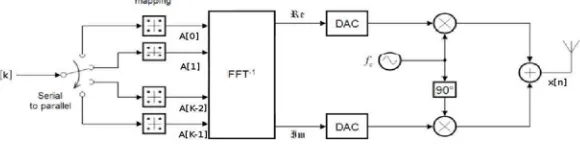
The key steps carried out in an OFDM communication system are shown in Figure. QAM modulator is used to convert the
incoming data into complex valued symbols . This sequence contains the samples of the
multicarrier signal and each QAM symbol X[i] is transmitted over different carrier frequency, given as
. After modulating over carrier frequency, CP is added to each OFDM symbol. At receiver side the incoming parallel data is passed through parallel to serial converter and then these digital samples are converted into analog
Technology (IJRASET)
Figure 1: Transmitter Structure of OFDM
III. LITERATURE
In [1], the pilot arrangement for OFDM system has been investigated. The comb type pilot channel estimation is implemented for the channel interpolation. IDFT (Inverse Discrete Fourier Transform) and zero padding are used to convert frequency domain to time domain. DFT (Discrete Fourier Transform) is used to convert time to frequency domain. For low Doppler frequencies, the decision feedback estimations performance is slightly worse than the low-pass interpolation channel estimation. In [2], a low rank Wiener filter based channel estimator is proposed to reduce the complexity. This optimal estimator avoids large-scale inverse matrix operation, so MMSE estimator complexity is reduced. Moreover this estimator transmits two training blocks instead of one training block of data. This estimator also pre-calculates the singular value decomposition (SVD) of the channel correlation matrix [2]. In [3], a sample spaced approach has been develop for an OFDM system with transmit antenna diversity. This paper analyzes the MSE performance and the leakage effect for sample spaced taps and non sample spaced taps. In [4], the decision-directed MMSE and adaptive channel prediction schemes are proposed for channel estimation. This paper proposes the MMSE predictor which calculates the predicted channel coefficient vector from the current and past received vector. This predictor memory allows exploiting the temporal channel correlations. There the input signal is directly linked to output symbol samples.
IV. PROPOSED WORK
A. Problem Definition
During the past few years, there has been an explosion in wireless technology. This growth has opened a new dimension to future wireless communications whose ultimate goal is to provide universal personal and multimedia communication without regard to mobility or location with high data rates. To achieve such an objective, the next generation personal communication [5] networks will need to be support a wide range of services which will include high quality voice, data, facsimile, still pictures and streaming video.
B. Objectives
1) Study and implementation of OFDM system.
2) Proposed our system to compare bit error rate of different modulation schemes, channels and channel equalization.
[image:3.612.162.452.596.668.2]Technology (IJRASET)
Fig.3 demonstrates a typical OFDM receiver with the ideal channel. The time domain receive signal is first demodulated from
the carrier frequency fc, the cyclic-prefix is removed, and then the signal is changed to a digital equivalent for further signal
processing.
[image:4.612.100.515.355.468.2]Figure 3: Typical example of an OFDM receiver.
Figure shows a block diagram of a baseband OFDM modem which is based on PHY (physical layer) of IEEE standard 802.11a [7].Before describing the mathematical model, we define the symbols and notations used in this paper. Capital and lower-case letters denote signals in frequency domain and in time domain respectively. Arrow bar indicates a vector and boldface letter without an arrow bar represents a matrix. It is packed into a table as follows. As shown in Figure 5, the input serial binary data will be processed by a data scrambler first and then channel coding is applied to the input data to improve the BER (bit error rate) performance of the system.
Figure 4: Block diagram of a baseband OFDM transceiver
V. CONCLUSION
In this paper, first part addresses the problem of channel estimation of MIMO-OFDM systems. It starts from the matrix representation of the signal model of MIMO-OFDM systems, which clearly describes the relation of signals in frequency domain and time domain and expressing operations like adding CP and removing CP as matrix product. Our channel estimation method differs in its ability to estimate fast time-varying wireless channel since pilot tones are inserted into each OFDM block, and in its explicit relation with space-frequency code design which can benefit the channel estimation in return. Here, we address problems of wireless channel estimation and equalization, for transmission using OFDM setup through rapidly varying wireless channels, and proposed an efficient low complexity method for wireless channel estimation using a Basis Expansion Model for the wireless channel taps.
REFERENCES
[1] Coleri,S; Ergen,M; Puri,A; Bahai,A. “Channel estimation techniques based on pilot arrangement in OFDM systems”, IEEE Transactions on Broadcasting, vol. 48, Issue 3, pp. 223229, Sept. 2002.
Technology (IJRASET)
IEEE Transactions on Broadcasting, vol. 52, no. 2, June 2006.
[4] Dieter Schafhuber and Gerald Matz, “MMSE and Adaptive prediction of time-varying channels for OFDM systems”, IEEE Transactions on Wireless Communications, vol. 4, no 2, March 2005.
[5] Carlos Ribeiro and Atilio Gameiro, “An OFDM symbol design for reduced complexity MMSE channel estimation”, Journal of Communications, vol. 3, no. 4, Sept. 2008.
[6] Gunther Auer and Eleftherious Karipidis; “Pilot aided channel estimation for OFDM: a separated approach for smoothing and interpolation”, IEEE International Conference on Communications, vol. 4, pp 2173-2178, Aug. 2005.
[7] Ove Edfors, Magnus Sandell, Jan-Jaap van de Beek,Sarah Kate Wilson,Per Ola Borjesson, “An application of the singular value decomposition to OFDM channel estimation”, IEEE Transactions on Communications, vol. 4, no 3, March 1998.
[8]G. J. Foschini and M. J. Gans, “On limits of wireless communications in a fading evvironments when using multiple antennas,” Wireless Pers. Commun., vol. 6, no. 3, pp. 311-335, Mar. 1998.
[9] E. Telatar, “Capacity of multi-antenna Gaussian channels,” Euro. Trans. Comun., vol. 10, no. 6, pp. 585-595, Nov.-Dec. 1999.
![Figure shows a block diagram of a baseband OFDM modem which is based on PHY (physical layer) of IEEE standard 802.11a [7].Before describing the mathematical model, we define the symbols and notations used in this paper](https://thumb-us.123doks.com/thumbv2/123dok_us/8586508.862578/4.612.100.515.355.468/figure-diagram-baseband-physical-standard-describing-mathematical-notations.webp)
