Copyright © 2000, American Society for Microbiology. All Rights Reserved.
Identification of the Major Spanish Clones of
Penicillin-Resistant Pneumococci via the Internet Using Multilocus
Sequence Typing
JIAJI ZHOU, MARK C. ENRIGHT,ANDBRIAN G. SPRATT*
Wellcome Trust Centre for the Epidemiology of Infectious Disease, Department of Zoology, University of Oxford, Oxford OX1 3FY, United Kingdom
Received 21 July 1999/Returned for modification 13 November 1999/Accepted 27 November 1999
Multilocus sequence typing was used to characterize isolates of the major Spanish clones of penicillin-resistant and multiple-antibiotic-penicillin-resistantStreptococcus pneumoniae. Isolates of the multidrug-resistant Span-ish serotype 23F clone and serotype variants of this clone either had identical allelic profiles or their allelic profiles differed from this typical allelic profile at only one of the seven housekeeping loci. Similarly, isolates of the Spanish serotype 6B and 14 clones and the penicillin-resistant serotype 9V clone (and serotype variants of this clone) each had the same allelic profiles or profiles that differed at a single locus. Multilocus sequence typing therefore allows resistant pneumococci to be assigned to the Spanish clones if they have the typical allelic profile of the clone or if their profiles differ from that profile at a single locus. A few resistant isolates that had allelic profiles typical of that of a Spanish clone or whose profiles differed from that of the typical profile at only a single locus possessed penicillin-binding proteinpbp1a,pbp2b, orpbp2xgenes that differed from those that are characteristic of the clone. In most cases these isolates could be assigned as variant members of the clone. Since almost all serotype 9V isolates have very similar genotypes, independently emerging penicillin-resistant clones of this serotype will inevitably appear to be similar by molecular typing procedures. Analysis of thepbpgenes, in addition to multilocus sequence typing (or any other molecular typing procedure), is therefore required to assign isolates unambiguously to the penicillin-resistant Spanish serotype 9V clone.
Spain was among the first countries to report a high inci-dence of antibiotic-resistant Streptococcus pneumoniae (3). Penicillin-resistant and multidrug-resistant isolates were first detected in the late 1970s, and their prevalence increased rap-idly during the 1980s to reach a peak in 1989 of about 44% of invasive isolates with penicillin resistance (15). Since 1989, the incidence of penicillin-resistant pneumococci (MICs,ⱖ0.1g of penicillin/ml) has remained fairly constant, with penicillin resistance occurring in about 40% of all isolates (16).
Multidrug-resistant clones of serotypes 23F and 6B and a penicillin-resistant clone of serotype 9V have been common in Spain since the 1980s (10, 12, 35), and more recently, a mul-tidrug-resistant serotype 14 clone has been identified (5). Ac-cording to the newly recommended nomenclature, the latter clones are now designated Spain23F-1, Spain6B-2, France9V-3
(as this clone may have emerged within France), and Spain14-5.
The first three clones have been detected in many countries and on different continents and can be considered globally distributed (2, 19, 20, 25, 26, 28, 29, 31, 34).
Studies from other countries that have a high incidence of penicillin-resistant pneumococci have identified additional dis-tinctive clones which have presumably emerged within these countries (17, 28, 30). In addition to the increasing number of penicillin-resistant clones that are being recognized, variants of the major clones that differ in serotype are commonly ob-served. For example, serotype 19F variants of the Spain23F-1
clone (4) and serotype 14 variants of the France9V-3 clone (2)
are now widely disseminated (7–9, 19).
Penicillin-resistant isolates are assigned to the same clone if they have identical or very similar overall genotypes and iden-tical altered forms of the penicillin-binding protein pbp1a,
pbp2b, andpbp2xgenes (10). Allelic variants of thesepbpgenes are usually assigned by gene fingerprinting (4), but a number of different methods have been used to compare the overall re-latedness of resistant pneumococci (19, 26, 29, 31, 36). As increasing numbers of penicillin-resistant clones are defined and as the genotypes of clones diversify and their serotypes change, the assignment of isolates to these clones becomes more difficult and a method is required that can unambigu-ously assign resistant isolates to known clones or new clones without the need for laboratories to exchange reference strains.
Multilocus sequence typing (MLST) is a procedure that ful-fils these criteria as it produces unambiguous data that can be transmitted electronically via the Internet (24, 32). By this procedure the nucleotide sequences of⬃450-bp internal frag-ments of seven housekeeping genes are determined for each isolate. The different sequences at each locus are assigned as distinct alleles, and for each isolate, the alleles at the seven loci define the allelic profile or sequence type. MLST can resolve billions of pneumococcal genotypes, and the probability that two isolates will have the same allelic profile by chance is extremely low (11). The method is highly portable, as any laboratory can compare the sequences at the seven loci in their isolates with those in a central database on the World Wide Web (http://mlst.zoo.ox.ac.uk) and can obtain the allelic profile of each isolate. The relationship of these isolates to the known penicillin-resistant clones can then be established by compar-ing these allelic profiles with those in the central database, * Corresponding author. Mailing address: Wellcome Trust Centre
for the Epidemiology of Infectious Disease, Department of Zoology, University of Oxford, South Parks Rd., Oxford OX1 3FY, United Kingdom. Phone: 44 1865 281301. Fax: 44 1865 281891. E-mail: brian [email protected].
977
on May 15, 2020 by guest
http://jcm.asm.org/
which contains the allelic profiles of the known penicillin-resistant clones (11, 28, 32).
We demonstrate that most isolates of each of the major Spanish clones have the same allelic profile or have a profile that differs from this typical allelic profile at a single locus, allowing resistant pneumococci to be assigned unambiguously to these clones via the Internet.
MATERIALS AND METHODS
Pneumococcal isolates.The pneumococci included in this study were multiple-antibiotic-resistant pneumococci from Spain (5), penicillin-resistant pneumo-cocci from Taiwan (28), and multiple-antibiotic-resistant serotype 6B isolates assigned to the Spain6B-2 clone by Hermans et al. (19). In addition, we studied
a collection of 429 isolates from patients who recently had cases of invasive disease, including 274 isolates from eight countries described by Enright and Spratt (11) and 106 isolates from Spain (12). These isolates have the prefix M. We also searched the MLST database, which includes the allelic profiles of over 700 pneumococci.
MICs were determined according to the guidelines of the British Society for Antimicrobial Chemotherapy (1) by using the E-test (AB Biodisk, Solna, Swe-den). Serotypes were kindly determined by David Griffiths, using the Quellung reaction, with sera obtained from the Statens Seruminstitut, Copenhagen, Den-mark.
Genetic relatedness of isolates.The nucleotide sequences of⬃450-bp internal regions from thearoE,ddl,gdh,gki,recP,spi, andxptgenes were amplified by PCR with the primers described previously (11). Both strands of the gene frag-ments were directly sequenced by using the primers that were used for the PCR and an ABI 377 Prism automated sequencer with BigDye terminators (Perkin-Elmer Applied Biosystems, Foster City, Calif.). For each isolate, the allelic profiles were obtained from the sequences at the seven loci, and the allelic profiles were compared with those in our pneumococcal MLST database by using the software at the pneumococcal MLST website (http://mlst.zoo.ox.ac.uk). The relatedness among isolates was visualized as a dendrogram, constructed from the matrix of pairwise differences between the allelic profiles by using the un-weighted pair group method with arithmetic averages (UPGMA).
Analysis ofpbpgenes.Thepbp1a,pbp2b, andpbp2xgenes were amplified from chromosomal DNA by PCR with the primers and conditions described previ-ously (5). Thepbpgene fragments were gel purified with a Qiagen QIAEX II Agarose gel extraction kit (Qiagen Ltd., Crawley, United Kingdom), and 50 ng of the purified fragments was used in a second 50-l PCR mixture (25 cycles) that contained 0.5g of each primer (as described above), deoxynucleoside triphos-phates (100M), rhodamine (R110)-labeled dUTP (1M), PCR buffer (Qia-gen), and 2.5 U of QiagenTaqDNA polymerase. The fluorescently labeledpbp
gene fragments were ethanol precipitated, resuspended in 40l of distilled water, digested for 1 h withAluI (5 U; total reaction volume, 50l), ethanol precipitated, and resuspended in 30l of distilled water. One microliter of the digested fragments was mixed with 2.3l of loading buffer containing TAMRA-labeled GeneScan-500 internal molecular size markers (Perkin-Elmer Applied Biosystems), and the fragments were fractionated on a 4% denaturing polyacryl-amide gel with an ABI Prism 377 DNA sequencer with virtual filter set C. The DNA fragment patterns were compared by using Genescan Analysis software (PE Applied Biosystems).
The fingerprints obtained byAluI digestion of thepbpgenes of from isolates assigned by MLST to the major resistant Spanish clones were compared to the fingerprints obtained byAluI digestion ofpbpgenes from previously character-ized reference isolates of each clone (5). Those with identicalAluI digestion fingerprints were assigned the same allele numbers as those reported previously (5). Isolates that hadpbpfingerprints which differed from those typical of the clone were assigned new allele numbers. As these variantpbpfingerprints were not compared with theAluI digestion fingerprints of each of the many alleles identified previously (5), the variant alleles were assigned roman (rather than arabic) numerals.
RESULTS
Analysis of isolates of the Spain23F-1 clone.Previously
char-acterized isolates of the Spain23F-1 clone (5), including
sero-type 19A and 19F variants of this clone (6, 7), were analyzed by MLST. All 16 of these isolates had identical allelic profiles (profile 4-4-2-4-4-1-1) except for one isolate (isolate C85) whose profile differed from this profile (Table 1). Additional isolates with the same allelic profiles and isolates whose pro-files differed from this typical profile at a single locus were identified among a collection of 74 penicillin-resistant isolates from hospitals in Taiwan (28). Among these Taiwanese iso-lates, 16 had the typical allelic profile (11 were of serotype 23F
and 5 were of serotype 19F), and a further 5 isolates (all of serotype 23F) had identical profiles (profile 4-4-2-4-6-1-1) which differed from the typical allelic profile only at thespi
locus. All 21 of the Taiwanese isolates had the samepbp1a,
pbp2b, andpbp2xgene fingerprints as the Spain23F-1 clone and
the characteristic antibiotic resistance profile of the Spain23F-1
clone (28).
Five isolates with the typical allelic profile and four single-locus variants were found among a collection of 429 isolates (those with an M prefix) from patients with serious invasive disease (11, 12). One isolate with the typical allelic profile was serotype 19F, but the other eight isolates were serotype 23F; all were penicillin resistant and had the characteristic antibiotic resistance profile of the Spain23F-1 clone. Thepbp1a, pbp2b,
and pbp2x gene fingerprints of two isolates with the typical allelic profile (isolates M41 and M329) and one of the single-locus variants (isolate M170) were examined, and all were typical of those of the Spain23F-1 clone.
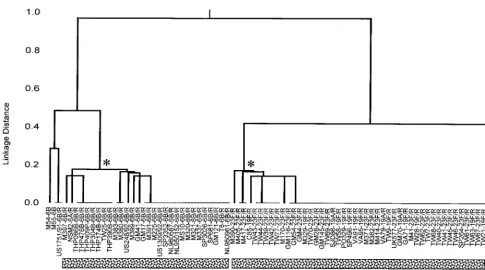
The relationships among all isolates in the MLST database that differed at less than or equal to three of the seven alleles from the typical allelic profile of the Spain23F-1 clone are
shown in Fig. 1. The allelic profiles of none of the isolates in the MLST database differed from the typical allelic profile at two of seven loci. The profiles of four isolates differed at three of seven loci. The serotype of isolate M18 and the MIC of penicillin for M18 is not known since it has not survived; the other three isolates were not serotype 23F (or serotype 19A or 19F) and were penicillin susceptible. The isolates of the Spain23F-1 clone were therefore well resolved from all other
isolates in the MLST database.
Analysis of isolates of the Spain6B-2 clone.The allelic
pro-files of three previously characterized isolates of the Spain6B-2
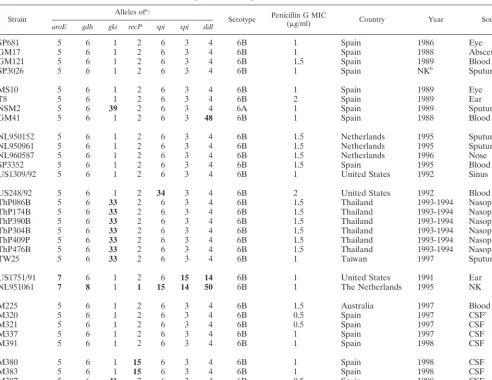
clone were identical (profile 5-6-1-2-6-3-4) (Table 2). These isolates have been shown to be indistinguishable by multilocus enzyme electrophoresis (MLEE) (16 loci were examined) and bypbp1a,pbp2b, andpbp2xgene fingerprinting (5). One fur-ther isolate (isolate SP3026) that has been assigned to the Spain6B-2 clone also had the allelic profile mentioned above.
Three multidrug-resistant serogroup 6 isolates that have been shown (5) to be closely related in overall genotype to the Spain6B-2 clone but which differed in that they have variant
forms of thepbp2bgene (isolates T8, NSM2, and MS10) were also examined. MS10 and T8 (both of which were of serotype 6B) had the typical allelic profile of the Spain6B-2 clone,
whereas NSM2 (serotype 6A) differed only atgki(profile 5-6-39-2-6-3-4). These isolates were considered minor variants of the Spain6B-2 clone. A further isolate (isolate GM41, serotype
6B) was also closely related to the other isolates of the Spain6B-2 clone as determined by MLEE but possessed
differ-ent forms of the pbp1a, pbp2b, and pbp2x genes. The allelic profile of this isolate (profile 5-6-1-2-6-3-48) differed from the typical allelic profile of the Spain6B-2 clone only atddl.
We also examined 14 multidrug-resistant serotype 6B iso-lates assigned previously by Hermans et al. (19) to the Spain6B-2 clone on the basis of restriction fragment end
label-ing (Table 2). One of these isolates (isolate NL-951061) was clearly not related to the Spain6B-2 clone, as its allelic profile
differed at six of seven loci from the typical allelic profile of the Spain6B-2 clone and it possessed pbp1a, pbp2b, and pbp2x
genes that differed from those of the Spain6B-2 clone (19).
Another of these isolates (isolate US1751/91) was also not closely related to the Spain6B-2 clone, as its profile differed
from the typical allelic profile at three of seven loci and it had
pbp2b and pbp2x genes that differed from those of the
Spain6B-2 clone (19). Five of the other 12 isolates had the
typical allelic profile (profile 5-6-1-2-6-3-4), one isolate from
on May 15, 2020 by guest
http://jcm.asm.org/
the United States differed from the Spain6B-2 clone only atspi
(profile 5-6-1-2-35-3-4), and the other six isolates, all of which were from Thailand, were identical single-locus variants that differed from the Spain6B-2 clone atgki(profile
5-6-33-2-6-3-4). One isolate among the 74 penicillin-resistant pneumococci from Taiwan (isolate TW25) was identical to the single locus variants from Thailand, as determined by MLST, and had the characteristic pbp gene fingerprints and antibiotic resistance profile of the Spain6B-2 clone (28). All of the 12 isolates from
the study of Hermans et al. (19) that were assigned to the Spain6B-2 clone and the isolate from Taiwan had the
charac-teristic pbp1a and pbp2x genes of the Spain6B-2 clone,
al-though, as found previously (19), 6 of the former strains had variantpbp2bgenes (data not shown).
Among our collection of 429 invasive isolates, 5 isolates had the typical allelic profile of the Spain6Bclone (profile
5-6-1-2-6-3-4) and 4 isolates were single-locus variants (Table 2). All were multiple-antibiotic-resistant serotype 6B isolates from Spain except for which strain M225, was from Australia.
Figure 1 shows the relationships among the isolates in the MLST database whose allelic profiles differ from the typical allelic profile of the Spain6B-2 clone at less than or equal to
three of the seven loci. The profiles of none of the isolates in the MLST database differed from the typical allelic profile at two of seven loci, but the profiles of three isolates (isolates
M54, M55, and US1751/91) differed at three of seven loci. All three isolates were of serotype 6B, but only one was penicillin resistant. The last isolate (isolate US1751/91) was discussed above, and the difference in its allelic profile and itspbp1aand
pbp2xgenes from those for the Spain6B-2 clone strongly
sug-gests it is not a member of the Spain6B-2 clone. Except for
strain GM41, which appeared to be a member of the Spain6B-2
clone but which had different pbpgenes, the isolates of the Spain6B-2 clone were well resolved from all other isolates in
the MLST database.
Analysis of isolates of the France9V-3 clone. A reference
isolate (isolate SP665) of the France9V-3 clone (4) had allelic
profile 7-11-10-1-6-8-1 (Table 3). A second reference strain from France (strain TL7/1993 [22]) had the identical allelic profile. Fourteen isolates with this allelic profile were found among the collection of 429 invasive isolates (those with an M prefix). All of these isolates were resistant to penicillin. Nine were serotype 9V and had the samepbp1a,pbp2b, andpbp2x
gene fingerprints as the reference isolates of the France9V-3
clone. Two further penicillin-resistant serotype 9V isolates from Poland in the MLST database (isolates 181 and 337) also had the same allelic profile andpbpgene fingerprints as the France9V-3 clone.
The other five invasive isolates with the allelic profile 7-11-10-1-6-8-1 and six further isolates from Uruguay with this pro-TABLE 1. Properties of the Spain23F-1 clone
Strain Alleles of
a:
Serotype Penicillin G MIC(g/ml) Country Year Source Alleles of:
aroE gdh gki recP spi xpt ddl pbp1a pbp2b pbp2x
SP264 4 4 2 4 4 1 1 23F 2 Spain 1984 Blood 1 1 1
GM4 4 4 2 4 4 1 1 23F 2 Spain 1988 Eye 1 1 1
GM28 4 4 2 4 4 1 1 23F 2 Spain 1988 Eye 1 1 1
GM54 4 4 2 4 4 1 1 23F 1 Spain 1988 Eye 1 1 1
GM116 4 4 2 4 4 1 1 23F 2 Spain 1989 Eye 1 1 1
GM145 4 4 2 4 4 1 1 23F 1 Spain 1989 Lung 1 1 1
GM70 4 4 2 4 4 1 1 19A 2 Spain 1990 Blood 1 1 1
VA79 4 4 2 4 4 1 1 19A 2 Spain 1994 Eye 1 1 1
SJD86 4 4 2 4 4 1 1 19A 1 Spain 1994 Blood 1 1 1
GA71 4 4 2 4 4 1 1 19F 2 Spain 1990 Nose 1 1 1
SP496 4 4 2 4 4 1 1 19F 1 Spain 1985 Lung 1 1 1
VA91 4 4 2 4 4 1 1 19F 2 Spain 1994 Nose 1 1 1
VA95 4 4 2 4 4 1 1 19F 1 Spain 1994 Sputum 1 1 1
UK577 4 4 2 4 4 1 1 23F 1 United Kingdom 1987 Not known 1 1 1
PO329 4 4 2 4 4 1 1 19F 2 Poland 1994 Sputum 1 1 1
C85 4 4 2 4 8 1 1 19F 1 Spain 1994 Lung 1 1 1
TW41b 4 4 2 4 4 1 1 23F 1 Taiwan 1997 Blood 1 1 1
TW28c 4 4 2 4 4 1 1 19F 1 Taiwan 1997 Sputum 1 1 1
TW42d 4 4 2 4 6 1 1 23F 1 Taiwan 1997 Sputum 1 1 1
M41 4 4 2 4 4 1 1 23F 1 United Kingdom 1997 Sputum 1 1 1
M329 4 4 2 4 4 1 1 19F 1 Spain 1997 CSFe 1 1 1
M371 4 4 2 4 4 1 1 23F 1 Spain 1998 CSF NDf ND ND
M382 4 4 2 4 4 1 1 23F 2 Spain 1998 CSF ND ND ND
M414 4 4 2 4 4 1 1 23F 2 Spain 1998 CSF ND ND ND
M170 4 4 2 4 5 1 1 23F 2 Denmark 1996 Blood 1 1 1
M390 8 4 2 4 4 1 1 23F 1 Spain 1998 CSF ND ND ND
M405 4 4 2 4 4 1 47 23F 2 Spain 1998 CSF ND ND ND
M417 4 4 2 4 4 1 47 23F 1 Spain 1998 CSF ND ND ND
aAlleles that differ from those found in the typical allelic profile of the Spain23F-1 clone are in boldface type.
bTen additional serotype 23F isolates from Taiwan had this allelic profile and the typicalpbpfingerprints of the Spain23F-1 clone. cFour additional serotype 19F isolates from Taiwan had this allelic profile and the typicalpbpfingerprints of the Spain23F-1 clone. dFour additional serotype 23F isolates from Taiwan had this allelic profile and the typicalpbpfingerprints of the Spain23F-1 clone. eCSF, cerebrospinal fluid.
fND, not determined.
on May 15, 2020 by guest
http://jcm.asm.org/
[image:3.612.54.550.84.401.2]file were serotype 14 and had thepbp2xand pbp2bgene fin-gerprints characteristic of this clone but had a slightly different
pbp1a gene fingerprint (Table 3). These serotype 14 isolates have been shown to be variants of the France9V-3 clone (2)
that have arisen by a recombinational exchange which replaces the capsular biosynthetic region and part of the downstream
pbp1agene with the corresponding region from a serotype 14 donor strain (8).
The allelic profiles of one penicillin-resistant isolate from Taiwan (strain TW50) and one from Uruguay (strain U1) differed from the typical allelic profile of the France9V-3 clone
at a single locus, and there were an additional 9 penicillin-resistant single-locus variants among the 429 invasive isolates. All of the penicillin-resistant serotype 9V single-locus variants producedpbp1afingerprints identical to that of the France9V-3
clone, whereas (except for strain M295) the resistant serotype 14 single-locus variants had the variantpbp1afingerprint char-acteristic of the serotype 14 variants of this clone (8). The
pbp1a,pbp2b, andpbp2xfingerprints of resistant serotype 14 isolate M295 were each different from those of the France9V-3
clone.
There were four penicillin-susceptible single-locus variants of the France9V-3 clone among the collection of invasive
iso-lates. One of these was serotype 9V, and the others were serotype 19F; all had the same allelic profile (profile 7-11-10-1-6-8-14). The profiles of a further seven invasive isolates (five serotype 9V isolates and two serotype 19F isolates differed from the profile of the France9V-3 clone at two loci. All of
these were penicillin susceptible (Table 3).
One striking feature of the isolates whose allelic profiles differed from the allelic profile of the France9V-3 clone at one
or two loci was that, except for strain M295, those that had allele 14 at theddllocus were penicillin susceptible, whereas those with allele 1 were invariably penicillin resistant. A pos-sible explanation for this finding is given below.
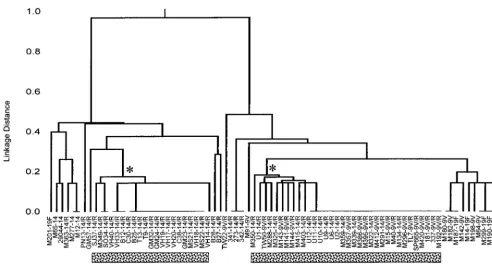
Figure 2 shows the relatedness of all isolates in the MLST database whose allelic profiles differ from the typical allelic profile of the France9V-3 clone at less than or equal to three of
the seven loci.
Analysis of isolates of the Spain14-5 clone.Eighteen
previ-ously characterized isolates of the Spain14-5 clone were
ana-lyzed. All of these isolates have been shown to be closely related in terms of their overall genotypes and to have identical
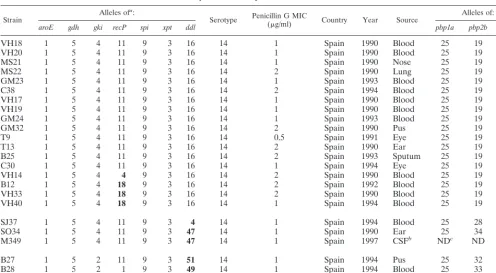
pbp1a,pbp2b, and pbp2xgene fingerprints (5). Fourteen had the same allelic profile (profile 1-5-4-11-9-3-16), three were identical single-locus variants (profile 1-5-4-18-9-3-16), and one was a different single-locus variant (profile 1-5-4-4-9-3-16) (Table 4).
The allelic profiles of two additional multidrug-resistant se-rotype 14 isolates that had been shown to be closely related to the Spain14-5 clone by MLEE also differed from the typical
allelic profile at only a single locus. However, these isolates had
pbp2b genes (strain SJ37) or pbp2b and pbp2x genes (strain SO34) that differed from those of the Spain14-5 clone. No
pneumococci that had the typical allelic profile of the Spain14-5
clone were found among the collection of 429 invasive isolates, but one invasive isolate from Spain (isolate M349) was a single-locus variant that had the same allelic profile as SO34. This isolate was resistant to penicillin and had the typical antibiotic resistance profile of the Spain14-5 clone. These isolates were
tentatively assigned as variant members of the Spain14-5 clone.
[image:4.612.61.546.71.340.2]Figure 2 shows the relatedness of all isolates in the MLST
FIG. 1. Relationships among isolates of the Spain23F-1 and Spain6B-2 clones and isolates with similar allelic profiles. A dendrogram was constructed by the UPGMA
method to show the relatedness of all isolates that had allelic profiles which differed from the typical allelic profiles of the Spain23F-1 clone (profile 4-4-2-4-4-1-1) and
the Spain6B-2 clone (profile 5-6-1-2-6-3-4) at less than or equal to three of the seven loci. The name of each isolate is followed (separated by a hyphen) by the serotype,
and penicillin-resistant isolates are identified by the suffix /R. Isolates below each horizontal line have identical allelic profiles. The asterisks show the nodes that define the isolates of the Spain23F-1 and Spain6B-2 clones. For each clone, the profiles of all of these isolates were either identical to that of the Spain23F-1 or Spain6B-2 clones
or their profiles differed from the typical profiles of the Spain23F-1 and Spain6B-2 clones at a single locus.
on May 15, 2020 by guest
http://jcm.asm.org/
database whose allelic profiles differ from the allelic profile of the Spain14-5 clone at less than or equal to three of the seven
loci. The allelic profile of one resistant isolate (isolate GM57) that hadpbp1a,pbp2b, and pbp2xgenes which differed from those of the Spain14-5 clone and which has been shown to be
only distantly related to this clone by MLEE (5) differed at two of seven loci as determined by MLST. This isolate also differed from the Spain14-5 clone in that it was susceptible to
tetracy-cline and was not considered a member of the clone. The profiles of two further well-characterized resistant isolates (iso-lates B27 and B28) differed at two of seven and three of seven loci, respectively, and they also had differentpbp2bandpbp2x
genes (5) and were not considered members of the Spain14-5
clone. Besides the isolates described above, the profiles of none of the penicillin-susceptible or -resistant isolates in the MLST database differed at two of seven loci. The profiles of seven isolates (six serotype 14 and one serotype 19F) differed at three of seven loci (Fig. 2). Three of these serotype 14 isolates were resistant to penicillin (MICs, ⱖ1 g/ml), and although their pbp genes were not examined, they are very unlikely to be members of the Spain14-5 clone.
DISCUSSION
The identification of the major clones, minor clones, and unique isolates among a collection of penicillin-resistant S. pneumoniaeisolates that have been recovered within a com-munity over a short time period is usually relatively straight-forward. Many molecular typing procedures can successfully identify the clusters of closely related isolates that indicate the predominant penicillin-resistant clones in such populations (10, 21, 35). However, determination of whether these clones are novel or correspond to penicillin-resistant clones that have been described previously is more problematic. The difficulty arises from the fact that several of the major penicillin-resis-tant clones probably arose in the 1970s, and as they have spread their genotypes have diversified and their serotypes have changed so that they are no longer uniquely defined by any of the molecular typing procedures that are commonly used.
[image:5.612.58.551.83.463.2]A second problem arises because penicillin resistance has emerged predominantly in a small number of serotypes, typi-cally those that are commonly carried by children (serotypes TABLE 2. Properties of the Spain6B-2 clone and related isolates
Strain Alleles of
a:
Serotype Penicillin G MIC(g/ml) Country Year Source
aroE gdh gki recP spi xpi ddl
SP681 5 6 1 2 6 3 4 6B 1 Spain 1986 Eye
GM17 5 6 1 2 6 3 4 6B 1 Spain 1988 Abscess
GM121 5 6 1 2 6 3 4 6B 1.5 Spain 1989 Blood
SP3026 5 6 1 2 6 3 4 6B 1 Spain NKb Sputum
MS10 5 6 1 2 6 3 4 6B 1 Spain 1989 Eye
T8 5 6 1 2 6 3 4 6B 2 Spain 1989 Ear
NSM2 5 6 39 2 6 3 4 6A 1 Spain 1989 Sputum
GM41 5 6 1 2 6 3 48 6B 1 Spain 1988 Blood
NL950152 5 6 1 2 6 3 4 6B 1.5 Netherlands 1995 Sputum
NL950961 5 6 1 2 6 3 4 6B 1.5 Netherlands 1995 Sputum
NL960587 5 6 1 2 6 3 4 6B 1.5 Netherlands 1996 Nose
SP3352 5 6 1 2 6 3 4 6B 1.5 Spain 1995 Blood
US1309/92 5 6 1 2 6 3 4 6B 1 United States 1992 Sinus
US248/92 5 6 1 2 34 3 4 6B 2 United States 1992 Blood
ThP086B 5 6 33 2 6 3 4 6B 1.5 Thailand 1993-1994 Nasopharynx
ThP174B 5 6 33 2 6 3 4 6B 1.5 Thailand 1993-1994 Nasopharynx
ThP390B 5 6 33 2 6 3 4 6B 1.5 Thailand 1993-1994 Nasopharynx
ThP304B 5 6 33 2 6 3 4 6B 1.5 Thailand 1993-1994 Nasopharynx
ThP409P 5 6 33 2 6 3 4 6B 1.5 Thailand 1993-1994 Nasopharynx
ThP476B 5 6 33 2 6 3 4 6B 1.5 Thailand 1993-1994 Nasopharynx
TW25 5 6 33 2 6 3 4 6B 1 Taiwan 1997 Sputum
US1751/91 7 6 1 2 6 15 14 6B 1 United States 1991 Ear
NL951061 7 8 1 1 15 14 50 6B 1 The Netherlands 1995 NK
M225 5 6 1 2 6 3 4 6B 1.5 Australia 1997 Blood
M320 5 6 1 2 6 3 4 6B 0.5 Spain 1997 CSFc
M321 5 6 1 2 6 3 4 6B 0.5 Spain 1997 CSF
M337 5 6 1 2 6 3 4 6B 1 Spain 1997 CSF
M391 5 6 1 2 6 3 4 6B 1 Spain 1998 CSF
M380 5 6 1 15 6 3 4 6B 1 Spain 1998 CSF
M383 5 6 1 15 6 3 4 6B 1 Spain 1998 CSF
M397 5 6 41 2 6 3 4 6B 0.5 Spain 1998 CSF
M399 5 6 1 2 6 3 54 6B 2 Spain 1998 CSF
aAlleles that differ from those in the typical allelic profile of the Spain6B-2 clone are in boldface type. bNK, not known.
cCSF, cerebrospinal fluid.
on May 15, 2020 by guest
http://jcm.asm.org/
6B, 9V, 14, 19F, 23F [27]), and although isolates of the same serotype are often only distantly related in terms of overall genotype (11), most isolates of a few serotypes (e.g., serotypes 9V and 7F) appear to have very similar genotypes (11, 18, 23, 33). The genotypes of two penicillin-resistant clones of one of the latter serotypes that emerge independently will therefore almost inevitably appear to be closely related. The similarity of genotypes therefore does not always imply that two penicillin-resistant isolates are descended from the same ancestral resis-tant isolate.
MLST provides a new way of defining the genotype of a penicillin-resistant isolate as a string of integers, the alleles at each of the seven housekeeping loci. Comparison of allelic profiles is less ambiguous than comparison of patterns of DNA
fragments on agarose gels, but as with all molecular typing procedures, there can be some ambiguity in assigning penicil-lin-resistant isolates as members of a clone, as variants of the clone, or as genetically similar isolates that have emerged in-dependently. This problem can largely be circumvented by analyzing thepbp1a, pbp2b, andpbp2x genes, as well as the overall genotype, as it is extremely unlikely that independently arising penicillin-resistant clones will have acquired indistin-guishable mosaicpbpgenes.
[image:6.612.56.548.83.512.2]A major advantage of MLST is that the allelic profiles of pneumococcal isolates, including reference isolates of all of the known penicillin-resistant and multidrug-resistant clones, to-gether with epidemiological data, can be stored in a single central database which can be interrogated remotely via the TABLE 3. Properties of the France9V-3 clone and related lineages
Strain Alleles of
a:
Serotype Penicillin G MIC(g/ml) Country Year Source Alleles of b:
aroE gdh gki recP spi xpt ddl pbp1a pbp2b pbp2x
SP665 7 11 10 1 6 8 1 9V 2 Spain 1988 Ear 1 1 1
M15 7 11 10 1 6 8 1 9V 1 United Kingdom 1997 Blood 1 1 1
M40 7 11 10 1 6 8 1 9V 2 United Kingdom 1997 Sputum 1 1 1
M192 7 11 10 1 6 8 1 9V 1 United Kingdom 1996 CSFc 1 1 1
M296 7 11 10 1 6 8 1 9V 1 Canada 1996 CSF 1 1 1
M357 7 11 10 1 6 8 1 9V 2 Spain 1997 CSF 1 1 1
181 7 11 10 1 6 8 1 9V 1 Poland 1994 Throat 1 1 1
337 7 11 10 1 6 8 1 9V 0.5 Poland 1994 Sputum 1 1 1
M386 7 11 10 1 6 8 1 9V 1 Spain 1998 CSF ND ND ND
M395 7 11 10 1 6 8 1 9V 1 Spain 1998 CSF ND ND ND
M412 7 11 10 1 6 8 1 9V 1 Spain 1998 CSF ND ND ND
M420 7 11 10 1 6 8 1 9V 1 United Kingdom 1999 CSF ND ND ND
M134 7 11 10 1 6 8 1 14 2 Denmark 1997 Blood 1⬘ 1 1
M291 7 11 10 1 6 8 1 14 2 Uruguay 1996 Blood 1⬘ 1 1
M322 7 11 10 1 6 8 1 14 1 Spain 1997 CSF 1⬘ 1 1
M339 7 11 10 1 6 8 1 14 0.5 Spain 1997 CSF 1⬘ 1 1
M359 7 11 10 1 6 8 1 14 1 Spain 1997 CSF 1⬘ 1 1
U2d 7 11 10 1 6 8 1 14 2 Uruguay 1994 Blood 1⬘ 1 1
M144 7 11 10 1 1 8 1 9V 1.5 Denmark 1997 Blood 1 1 1
M141 7 11 10 1 20 8 1 9V 1.5 Denmark 1996 Blood 1 1 1
M143 7 11 10 1 21 8 1 9V 2 Denmark 1997 Blood 1 1 1
TW50 7 11 10 1 6 1 1 9V 1.5 Taiwan 1997 Pus 1 1 1
M288 7 11 10 1 6 34 1 14 1.5 Uruguay 1996 CSF 1⬘ 1 1
M325 7 11 10 1 4 8 1 14 0.5 Spain 1997 CSF 1⬘ 1 vii
M350 1 11 10 1 6 8 1 14 2 Spain 1997 CSF 1⬘ 1 1
M403 7 5 10 1 6 8 1 14 2 Spain 1998 CSF ND ND ND
M415 7 34 10 1 6 8 1 14 1 Spain 1998 CSF ND ND ND
U1 7 11 10 1 6 42 1 14 2 Uruguay 1993 CSF 1⬘ 1 1
M64 7 11 10 1 6 8 14 9V 0.012 United Kingdom 1994 CSF S S S
M295 7 11 10 1 6 8 14 14 0.5 Canada 1995 CSF vi viii ix
M189 7 11 10 1 6 8 14 19F 0.012 United Kingdom 1996 CSF S S S
M190 7 11 10 1 6 8 14 19F 0.012 United Kingdom 1996 CSF S S S
M299 7 11 10 1 6 8 14 19F 0.032 Canada 1995 Blood S S S
M78 7 11 10 5 6 8 14 9V 0.012 United Kingdom 1996 Blood S S S
M142 7 11 10 1 1 8 14 9V 0.023 Denmark 1997 Blood S S S
M180 7 11 10 1 10 8 14 9V 0.012 United Kingdom 1995 CSF S S S
M182 7 11 10 1 10 8 14 9V 0.006 United Kingdom 1995 CSF S S S
M187 7 11 10 1 10 8 14 19F 0.008 United Kingdom 1996 CSF S S S
M198 7 11 10 12 6 8 14 9V 0.016 United Kingdom 1995 CSF S S S
M14 7 11 10 6 6 8 14 19F 0.012 United Kingdom NKe Blood S S S
aAlleles that differ from those found in the typical allelic profile of the France9V-3 clone are in boldface type.
bAlleles in arabic numerals correspond to those in reference 5 allele 1⬘is the variant ofpbp1aallele 1 found in the serotype 14 isolates of the France9V-3 clone; alleles
in lowercase roman numerals differ from those characteristic of the France9V-3 clone, but they were not compared with those in reference 5. S, penicillin-susceptible
isolates; ND, not determined. cCSF, cerebrospinal fluid.
dFive other penicillin-resistant serotype 14 isolates from Uruguay had the same allelic profile. eNK, not known.
on May 15, 2020 by guest
http://jcm.asm.org/
Internet (32). MLST can be used to identify the major clones among large collections of resistant pneumococci from a geo-graphic region (28), but for many laboratories this may not be practical, and in this case MLST can be applied to a single example of each clone identified by other methods (e.g., pulsed-field gel electrophoresis). By using software available on the pneumococcal MLST website (http://mlst.zoo.ox.ac.uk), the sequences at the seven loci can be used to identify whether each of the identified penicillin-resistant clones is already known or whether the sequences define new clones. The allelic profiles of the isolates and the associated epidemiological data can be deposited in the pneumococcal database on the MLST website to provide a tool for global epidemiology and surveil-lance.
This paper addresses the variation in allelic profiles that is found among the Spanish clones of penicillin-resistant pneu-mococci (which are probably among the oldest and which are certainly the most widely disseminated of such clones), as this determines the ease with which they can be identified unam-biguously by MLST.
Previously characterized isolates of each penicillin-resistant clone had the same allelic profile (the typical profile) or their profiles differed from this profile at only a single locus. For example, all isolates with the typical allelic profile of the Spain23F-1 clone and all single-locus variants expressed
high-level resistance to penicillin and had the antibiotic resistance profile and the typicalpbpgene fingerprints of this clone. The allelic profiles of none of the isolates in the database differed from the typical allelic profile of the Spain23F-1 clone at two
loci, and all the isolates whose profiles differed at three loci were penicillin susceptible. The absence from the MLST da-tabase of penicillin-susceptible isolates that are closely related in genotype to the Spain23F-1 clone suggests that the parental
serotype 23F isolate from which the Spain23F-1 clone emerged
may have had a rare genotype. The rarity of closely related genotypes allows an unambiguous identification of this clone by MLST, and a multidrug-resistant pneumococcus that has the typical allelic profile of the Spain23F-1 clone or whose
profile differs from this profile at a single locus can confidently be assigned as a member of the Spain23F-1 clone.
Isolates of the Spain6B-2 clone that had the characteristic
pbp gene fingerprints of this clone also had identical allelic profiles or profiles that differed from this profile at a single locus. However, in contrast to the Spain23F-1 clone, which had
uniformpbpgene fingerprints, there was some variation among isolates of the Spain6B-2 clone in terms of theirpbp2b
finger-prints. Furthermore, one isolate (isolate GM41) whose allelic profile differed from the typical allelic profile of the Spain6B-2
clone at only a single locus hadpbp1a,pbp2b, andpbp2xgenes that were distinct from those found in this clone. This isolate was also very closely related to the Spain6B-2 clone by MLEE
(5) and, on the basis of the criterion of genetic relatedness, would be assigned to the Spain6B-2 clone, although the
differ-ences in all threepbpgenes suggest that it is not a member of the clone. This is probably an example of the independent emergence of penicillin resistance in a serotype 6B isolate that had a genotype similar to that of the Spain6B-2 clone.
Some of the penicillin-resistant serotype 6B isolates that we examined by MLST had been identified as members of the Spain6B-2 clone by using restriction fragment end labeling (19).
Although most of these isolates were confirmed to be members of the Spain6B-2 clone by MLST, two isolates were clearly not
members of this clone. These isolates differed from the Spain6B-2 clone at three of seven and six of seven loci,
[image:7.612.58.551.68.332.2]respec-tively, as determined by MLST and had completely different alleles at the pbp1a, pbp2b, and pbp2x genes (19). The six
FIG. 2. Relationships among isolates of the France9V-3 and Spain14-5 clones and isolates with similar allelic profiles. The dendrogram includes all isolates with
allelic profiles that differ from the typical allelic profiles of the France9V-3 clone (profile 7-11-10-1-6-8-1) and Spain6B-2 clone (profile 5-6-1-2-6-3-4) at less than or equal
to three of the seven loci. The isolate designations are as described in the legend to Fig. 1. The asterisks show the nodes that define the isolates of the France9V-3 and
Spain6B-2 clones. For each clone, all of these isolates were either identical to that of the France9V-3 or Spain6B-2 clones or differed from the typical profiles of the
France9V-3 and Spain6B-2 clones at a single locus.
on May 15, 2020 by guest
http://jcm.asm.org/
resistant serotype 6B isolates from Thailand were identical by MLST and were single-locus variants of the Spain6B-2 clone.
These isolates were previously correctly identified by Hermans et al. (19) as members of the Spain6B-2 clone, but by restriction
fragment end labeling, they were scattered across the part of the dendrogram which included the members of this clone. MLST was therefore able to identify in Thailand a distinctive variant of the Spain6B-2 clone which was not apparent by a
method that depends on computer-assisted comparisons of DNA fragment sizes on gels. The identification of one multi-drug-resistant serotype 6B isolate from Taiwan with the same allelic profile as the isolates from Thailand suggests that this distinctive variant of the Spain6B-2 clone has spread within
Southeast Asia and also demonstrates the power of MLST to identify unambiguously a single isolate whose allelic profile matches a particular allelic profile within a database of any size.
The definition of the France9V-3 clone is likely to be slightly
problematic by any typing procedure since the genotypes of all serotype 9V isolates (penicillin susceptible or penicillin resis-tant) appear to be closely related (11, 18), and this was the only Spanish resistant clone where there were penicillin-susceptible isolates which had allelic profiles that differed from those of the resistant clones at a single locus. Furthermore, three sero-types were represented and there was a poor congruence be-tween serotype and genotype among the cluster of isolates that are most similar to the France9V-3 clone (Fig. 2), suggesting
that changes of serotype may been more common among these isolates than among those of most other pneumococcal lin-eages (11). Examination of thepbpgene fingerprints is there-fore essential for distinguishing isolates of the France9V-3
clone from genotypically similar penicillin-resistant isolates (e.g., isolate M295) that have emerged independently.
With one exception, all of the allelic variants of the France9V-3 clone that possessed allele 14 at theddllocus were
penicillin susceptible, whereas those with allele 1 were penicil-lin resistant. Theddllocus is known to be 783 bp downstream ofpbp2b, and recombinational exchanges that replace the nor-malpbp2bgene of penicillin-susceptible isolates with that from related streptococcal species or from another penicillin-resis-tant pneumococcus often extend into or throughddl(13). A likely scenario is that a penicillin-susceptible serotype 9V clone (allelic profile 7-11-10-1-6-8-14) was the progenitor of the France9V-3 clone (allelic profile 7-11-10-1-6-8-1) and that,
dur-ing the emergence of penicillin resistance, the recombinational exchange that introduced the mosaic pbp2b gene (probably from an isolate of the Spain23F-1 clone [4]) extended intoddl
to result in a change from allele 14 to allele 1. The one excep-tional isolate, which possessed ddl allele 14 but which was penicillin resistant, almost certainly emerged independently, as it possessedpbp1a,pbp2b, andpbp2xgenes that differed from those of the France9V-3 clone.
Penicillin-resistant isolates that have the allelic profile 7-11-10-1-6-8-1 are clearly assigned as members of the France9V-3
clone. Penicillin-resistant isolates that differ from the typical allelic profile at a single locus are also likely to be members of the clone (although caution is required if they have a different
ddlallele), especially if they are susceptible to chloramphenicol and tetracycline and resistant to trimethoprim-sulfamethox-azole. Comparison of thepbpgene fingerprints to those of a reference isolate of the France9V-3 clone is required for a
[image:8.612.55.551.82.355.2]definitive assignment to the clone. TABLE 4. Properties of the Spain14-5 clone and related isolates
Strain Alleles of
a:
Serotype Penicillin G MIC(g/ml) Country Year Source Alleles of:
aroE gdh gki recP spi xpt ddl pbp1a pbp2b pbp2x
VH18 1 5 4 11 9 3 16 14 1 Spain 1990 Blood 25 19 46
VH20 1 5 4 11 9 3 16 14 1 Spain 1990 Blood 25 19 46
MS21 1 5 4 11 9 3 16 14 1 Spain 1990 Nose 25 19 46
MS22 1 5 4 11 9 3 16 14 2 Spain 1990 Lung 25 19 46
GM23 1 5 4 11 9 3 16 14 1 Spain 1993 Blood 25 19 46
C38 1 5 4 11 9 3 16 14 2 Spain 1994 Blood 25 19 46
VH17 1 5 4 11 9 3 16 14 1 Spain 1990 Blood 25 19 46
VH19 1 5 4 11 9 3 16 14 1 Spain 1990 Blood 25 19 46
GM24 1 5 4 11 9 3 16 14 1 Spain 1993 Blood 25 19 46
GM32 1 5 4 11 9 3 16 14 2 Spain 1990 Pus 25 19 46
T9 1 5 4 11 9 3 16 14 0.5 Spain 1991 Eye 25 19 46
T13 1 5 4 11 9 3 16 14 2 Spain 1990 Ear 25 19 46
B25 1 5 4 11 9 3 16 14 2 Spain 1993 Sputum 25 19 46
C30 1 5 4 11 9 3 16 14 1 Spain 1994 Eye 25 19 46
VH14 1 5 4 4 9 3 16 14 2 Spain 1990 Blood 25 19 46
B12 1 5 4 18 9 3 16 14 2 Spain 1992 Blood 25 19 46
VH33 1 5 4 18 9 3 16 14 2 Spain 1990 Blood 25 19 46
VH40 1 5 4 18 9 3 16 14 1 Spain 1994 Blood 25 19 46
SJ37 1 5 4 11 9 3 4 14 1 Spain 1994 Blood 25 28 46
SO34 1 5 4 11 9 3 47 14 1 Spain 1990 Ear 25 34 51
M349 1 5 4 11 9 3 47 14 1 Spain 1997 CSFb NDc ND ND
B27 1 5 2 11 9 3 51 14 1 Spain 1994 Pus 25 32 45
B28 1 5 2 1 9 3 49 14 1 Spain 1994 Blood 25 33 50
GM57 1 5 4 11 9 43 52 14 0.5 Spain 1988 Blood 28 21 1
aAlleles that differ from those in the typical allelic profile of the Spain14-5 clone are in boldface type. bCSF, cerebrospinal fluid.
cND, not determined.
on May 15, 2020 by guest
http://jcm.asm.org/
All previously characterized isolates of the Spain14-5 clone
that had the characteristicpbpgene fingerprints of this clone were identical by MLST or differed from the typical allelic profile at a single locus. Penicillin-resistant isolates can there-fore be assigned as members of the Spain14-5 clone if they have
the typical allelic profile of this clone or have a profile that differs from the typical profile at a single locus.
It is interesting that the allelic profiles of the penicillin-resistant and multidrug-penicillin-resistant Spanish clones are not uni-form and that the profiles of about 25% of the members of the Spanish clones differ from those of typical isolates of the Span-ish clones at one of the seven housekeeping genes. The com-mon ancestors of these clones must have emerged very recently on an evolutionary time scale and have certainly emerged since the introduction of penicillin in the 1940s, and it might be expected that the profiles of members of these very young clones would be identical at these neutral loci. The relatively rapid rate of clonal diversification in the resistant clones, which will make it increasingly difficult to define them unambiguously by MLST or any other molecular typing procedure, has been shown to be due to high rates of recombinational exchanges in the naturally transformable pneumococcus (14).
In conclusion, penicillin-resistant and multidrug-resistant isolates can be assigned to the major penicillin-resistant and multidrug-resistant Spanish clones by MLST if they have the typical allelic profile of the clone or if their profiles differ from the typical profile at a single locus. However, definitive assign-ment to a clone by MLST (or any other typing procedure) may require an analysis of theirpbp1a,pbp2b, andpbp2xgenes.
ACKNOWLEDGMENTS
This work was supported by the Wellcome Trust. B.G.S. is a Well-come Trust Principal Research Fellow.
We thank Tracey Coffey for allowing the use of unpublished data, David Griffiths and the Oxford Vaccine Group for serotyping, and Marcel Sluijter for providing pneumococcal isolates.
REFERENCES
1.Anonymous.1991. A guide to sensitivity testing. Report of the Working Party on Antibiotic Sensitivity Testing of the British Society for Antimicrobial Chemotherapy. J. Antimicrob. Chemother.27(Suppl. D):1–50.
2.Camou, T., M. Hortal, and A. Tomasz.1998. The apparent importation of penicillin-resistant capsular type 14 Spanish/French clone ofStreptococcus pneumoniaeinto Uruguay in the early 1990’s. Microb. Drug Resist.4:219– 224.
3.Casal, J.1982. Antimicrobial susceptibility of Streptococcus pneumoniae: serotype distribution of penicillin-resistant strains in Spain. Antimicrob. Agents Chemother.22:222–225.
4.Coffey, T. J., C. G. Dowson, M. Daniels, J. Zhou, C. Martin, B. G. Spratt, and J. M. Musser.1991. Horizontal transfer of multiple penicillin-binding pro-tein genes, and capsular biosynthetic genes, in natural populations of Strep-tococcus pneumoniae. Mol. Microbiol.5:2255–2260.
5.Coffey, T. J., S. Berro´n, M. Daniels, M. E. Garcia-Leoni, E. Cercenado, E. Bouza, A. Fenoll, and B. G. Spratt.1996. Multiply antibiotic-resistant Strep-tococcus pneumoniaerecovered from Spanish hospitals (1988–1994): novel major clones of serotypes 14, 19F and 15F. Microbiology142:2747–2757. 6.Coffey, T. J., M. C. Enright, M. Daniels, P. Wilkinson, S. Berro´n, A. Fenoll,
and B. G. Spratt.1998. Serotype 19A variants of the Spanish serotype 23F multiresistant clone ofStreptococcus pneumoniae. Microb. Drug Resist.4:51– 55.
7.Coffey, T. J., M. C. Enright, M. Daniels, J. K. Morona, R. Morona, W. Hryniewicz, J. C. Paton, and B. G. Spratt.1998. Recombinational exchanges at the capsular polysaccharide biosynthetic locus lead to frequent serotype changes among natural isolates ofStreptococcus pneumoniae. Mol. Micro-biol.27:73–83.
8.Coffey, T. J., M. Daniels, M. C. Enright, and B. G. Spratt.1999. Serotype 14 variants of the Spanish penicillin-resistant serotype 9V clone ofStreptococcus pneumoniaearose by large recombinational replacements of thecpsA-pbp1a
region. Microbiology145:2023–2031.
9.Corso, A., E. P. Severina, V. F. Petruk, Y. R. Mauriz, and A. Tomasz.1998.
Molecular characterization of penicillin-resistantStreptococcus pneumoniae
isolates causing respiratory disease in the United States. Microb. Drug Re-sist.4:325–337.
10.Crook, D. W. M., and B. G. Spratt.1998. Multidrug resistance in Strepto-coccus pneumoniae. Br. Med. Bull.54:593–608.
11.Enright, M. C., and B. G. Spratt.1998. A multilocus sequence typing scheme forStreptococcus pneumoniae: identification of clones associated with serious invasive disease. Microbiology144:3049–3060.
12.Enright, M. C., A. Fenoll, D. Griffiths, and B. G. Spratt.1999. The three major Spanish clones of penicillin-resistantStreptococcus pneumoniaeare the most common clones recovered from recent cases of meningitis in Spain. J. Clin. Microbiol.37:3210–3216.
13.Enright, M. C., and B. G. Spratt.1999. Extensive variation in theddlgene of penicillin-resistantStreptococcus pneumoniaeresults from a hitchhiking ef-fect driven by the penicillin-binding protein 2b gene. Mol. Biol. Evol.16:
1687–1695.
14.Feil, E. J., J. Maynard Smith, M. C. Enright, and B. G. Spratt.Estimating recombinational parameters inStreptococcus pneumoniaefrom multilocus sequence typing data. Genetics, in press.
15. Fenoll, A., C. Martı´n Bourgon, R. Mun˜oz, D. Vicioso, and J. Casal.1991. Serotype distribution and antimicrobial resistance ofStreptococcus pneu-moniaeisolates causing systemic infections in Spain, 1979–1989. Rev. Infect. Dis.13:56–60.
16. Fenoll, A., I. Jado, D. Vicioso, A. Pe´rez, and J. Casal.1998. Evolution of
Streptococcus pneumoniaeserotypes and antibiotic resistance in Spain: up-date (1990–1996). J. Clin. Microbiol.36:3447–3454.
17. Figueiredo, A. M., R. Austrian, P. Urbaskova, L. A. Teixeira, and A. Tomasz.
1995. Novel penicillin-resistant clones ofStreptococcus pneumoniaein the Czech Republic and in Slovakia. Microb. Drug Resist.1:71–78.
18. Gasc, A. M., P. Giammarinaro, B. Ton-Hoang, P. Geslin, M. van der Giezen, and M. Sicard. 1997. Structural organization of theStreptococcus pneu-moniaechromosome and relatedness of penicillin-sensitive and -resistant strains in type 9V. Microb. Drug Resist.3:65–72.
19. Hermans, P. W., M. Sluijter, S. Dejsirilert, N. Lemmens, K. Elzenaar, A. van Veen, W. H. Goessens, and R. de Groot.1997. Molecular epidemiology of drug-resistant pneumococci: toward an international approach. Microb. Drug Resist.3:243–251.
20. Klugman, K. P., T. J. Coffey, A. Smith, A. Wasas, M. Myers, and B. G. Spratt.1994. Cluster of an erythromycin-resistant variant of the Spanish multiply resistant 23F clone ofStreptococcus pneumoniaein South Africa. Eur. J. Clin. Microbiol.13:171–174.
21. Klugman, K. P.1996. Epidemiology, control, and treatment of multiresistant pneumococci. Drugs52:S2–S6.
22. Lefevre, J. C., M. A. Bertrand, and G. Faucon.1995. Molecular analysis by pulsed-field gel electrophoresis of penicillin-resistantStreptococcus pneu-moniaefrom Toulouse, France. Eur. J. Clin. Microbiol. Infect. Dis.14:491– 497.
23. Louie, M., L. Louie, G. Papia, J. Talbot, M. Lovgren, and A. E. Simor.1999. Molecular analysis of the genetic variation among penicillin-susceptible and penicillin-resistantStreptococcus pneumoniaeserotypes in Canada. J. Infect. Dis.179:892–900.
24. Maiden, M. C. J., J. A. Bygraves, E. Feil, G. Morelli, J. E. Russell, R. Urwin, Q. Zhang, J. Zhou, K. Zurth, D. A. Caugant, I. M. Feavers, M. Achtman, and B. G. Spratt.1998. Multilocus sequence typing: a portable approach to the identification of clones within populations of pathogenic microorganisms. Proc. Natl. Acad. Sci. USA95:3140–3145.
25. McGee, L., K. P. Klugman, D. Friedland, and H. J. Lee.1997. Spread of the Spanish multi-resistant serotype 23F clone ofStreptococcus pneumoniaeto Seoul, Korea. Microb. Drug Resist.3:253–257.
26. Mun˜oz, R., T. J. Coffey, M. Daniels, C. G. Dowson, G. Laible, J. Casal, R. Hakenbeck, M. Jacobs, J. M. Musser, B. G. Spratt, and A. Tomasz.1991. Intercontinental spread of a multiresistant clone of serotype 23F Streptococ-cus pneumoniae. J. Infect. Dis.164:302–306.
27. Scott, J. A. G., A. J. Hall, R. Dagan, J. M. S. Dixon, S. J. Eykyn, A. Fenoll, M. Hortal, L. P. Jette, J. H. Jorgensen, F. Lamothe, C. Latorre, J. T. MacFarlane, D. M. Shlaes, L. E. Smart, and A. Tauney.1996. Serogroup-specific epidemiology ofStreptococcus pneumoniae—associations with age, sex, and geography in 7,000 episodes of invasive disease. Clin. Infect. Dis.
22:973–981.
28. Shi, Z.-Y., M. C. Enright, P. Wilkinson, D. Griffiths, and B. G. Spratt.1998. Identification of three major clones of multiply antibiotic-resistant Strepto-coccus pneumoniaein Taiwanese hospitals using multilocus sequence typing. J. Clin. Microbiol.36:3514–3519.
29. Sibold, C., J. Wang, J. Henrichsen, and R. Hakenbeck.1992. Genetic rela-tionships of penicillin-susceptible and -resistantStreptococcus pneumoniae
strains isolated on different continents. Infect. Immun.60:4119–4126. 30. Smith, A. M., and K. P. Klugman.1997. Three predominant clones identified
within penicillin-resistant South African isolates of Streptococcus pneu-moniae. Microb. Drug Resist.3:385–389.
31. Soares, S., K. G. Kristinsson, J. M. Musser, and A. Tomasz.1993. Evidence for the introduction of a multiresistant clone of serotype 6BStreptococcus
on May 15, 2020 by guest
http://jcm.asm.org/
pneumoniaefrom Spain to Iceland in the late 1980’s. J. Infect. Dis.168:158–163. 32.Spratt, B. G.1999. Multilocus sequence typing: molecular typing of bacterial pathogens in an era of rapid DNA sequencing and the Internet. Curr. Opin. Microbiol.2:312–316.
33.Takala, A. K., J. Vuopio-Varkila, E. Tarkka, M. Leinonen, and J. M. Musser.
1996. Subtyping of common pediatric pneumococcal serotypes from invasive disease and pharyngeal carriage in Finland. J. Infect. Dis.173:128–135. 34. Tarasi, A., Y. Chong, K. Lee, and A. Tomasz.1997. Spread of the serotype
23F multidrug-resistantStreptococcus pneumoniaeclone to South Korea. Microb. Drug Resist.3:105–109.
35. Tomasz, A.1997. Antibiotic resistance inStreptococcus pneumoniae. Clin. Infect. Dis.24:S85–S88.
36. Versalovic, J., V. Kapur, E. O. Mason, U. Shah, T. Koeuth, J. R. Lupski, and J. M. Musser.1993. Penicillin-resistantStreptococcus pneumoniaestrains recovered in Houston: identification and molecular characterization of mul-tiple clones. J. Infect. Dis.167:850–856.